ClinQueryAgent: A Conversational Agent for Population Health Management
Pith reviewed 2026-05-21 01:27 UTC · model grok-4.3
The pith
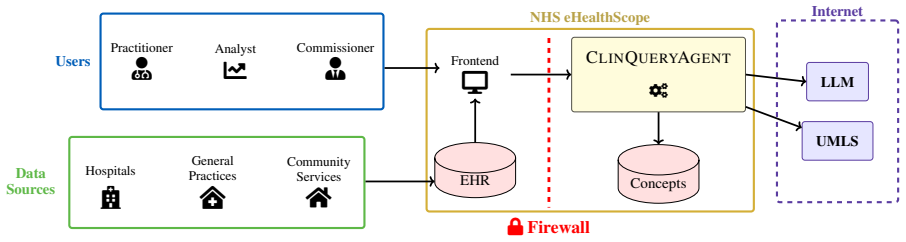
ClinQueryAgent translates natural language health questions into database queries while keeping all patient data inside a secure local environment.
A machine-rendered reading of the paper's core claim, the machinery that carries it, and where it could break.
Core claim
The paper presents ClinQueryAgent as a multi-agent system that accepts natural language questions on population health, breaks them into steps, and produces executable database queries. A novel separation keeps all patient data local while allowing cloud models to handle general reasoning and language tasks. Information retrieval is handed to a sub-agent to reduce drift in extended dialogues. Deployment inside a live NHS platform and evaluation on real tasks demonstrate that non-programmers can generate useful population-level insights directly from patient records.
What carries the argument
The multi-agent architecture with local data handling and a dedicated sub-agent for information retrieval that keeps cloud model calls separate from patient records.
If this is right
- Staff without programming skills can produce population health reports and analyses from patient records.
- The system supports autonomous completion of a range of health informatics tasks inside an existing platform.
- Real deployment across 148,000 patients shows the approach scales to multiple practices.
- Actionable information can be extracted from health records through chat without moving data outside the secure environment.
Where Pith is reading between the lines
- The same local-plus-cloud split could be applied to other domains that need powerful models on sensitive records, such as finance or legal case management.
- Smaller healthcare organizations might adopt advanced query capabilities without building large local AI infrastructure.
- Adding more external knowledge sources through the sub-agent could further improve accuracy on complex population questions.
Load-bearing premise
Delegating information retrieval to a sub-agent will effectively prevent inaccuracies that arise from context loss during longer conversations.
What would settle it
A controlled test that measures query error rates on conversations of increasing length with and without the sub-agent delegation; a sharp rise in errors beyond a few turns despite the sub-agent would undermine the claim.
Figures


read the original abstract
In this paper we introduce ClinQueryAgent, a system for translating natural language population health questions into executable database queries using agents with access to both local and external knowledge bases. Our novel architecture enables the use of powerful cloud-based language models whilst ensuring that no patient data leaves the secure environment. To combat inaccuracies over the course of longer dialogues due to context rot, information retrieval is delegated to a sub-agent. We deploy the system via a chat window embedded within an existing population health management platform where it has been used by 128 staff from 15 healthcare practices covering a total of 148,319 patients in the UK's National Health Service (NHS). We evaluate the system's capacity to autonomously handle a range of health informatics tasks on a constructed dataset and via a beta-testing phase. Our results show that both analysts and clinicians are able to easily generate actionable information from patient health records using natural language requests requiring no programming expertise to verify. We make a public demo of the system available at: https://demo-899965260288.europe-west1.run.app/
Editorial analysis
A structured set of objections, weighed in public.
Referee Report
Summary. The paper introduces ClinQueryAgent, a conversational agent for translating natural language population health questions into executable database queries. It proposes a novel architecture combining local and external knowledge bases to enable cloud-based LLMs while claiming that no patient data leaves the secure environment. Information retrieval is delegated to a sub-agent to address context rot in longer dialogues. The system is deployed in an NHS population health platform and has been used by 128 staff across 15 practices covering 148,319 patients. Evaluation is described on a constructed dataset and via beta-testing, with claims that analysts and clinicians can easily generate actionable information without programming expertise. A public demo link is provided.
Significance. If the security isolation and query accuracy claims are substantiated, the work could meaningfully advance accessible health data querying for non-technical users in clinical settings, with potential benefits for population health management. The reported real-world NHS deployment with substantial patient coverage is a practical strength that, if paired with rigorous metrics, would strengthen the contribution.
major comments (3)
- [Abstract and system architecture] Abstract and architecture description: the headline claim that the novel architecture ensures 'no patient data leaves the secure environment' is load-bearing but unsupported by concrete specifications of prompt templates, tool schemas, message boundaries, or data-flow isolation between local records and cloud LLM calls. Without these details it remains possible that retrieval results containing identifiers or record excerpts are serialized into external prompts.
- [Evaluation] Evaluation section: the abstract states successful autonomous handling on a constructed dataset and beta-testing with real users, yet provides no quantitative metrics (accuracy, error rates, success rates, or comparison baselines). This leaves the central claims about accuracy and ease of use without detailed supporting evidence.
- [System description] System description: the assumption that delegating information retrieval to a sub-agent effectively combats inaccuracies due to context rot over longer dialogues is presented as a design choice but lacks empirical validation, such as dialogue-length ablation results or error-rate comparisons with and without the sub-agent.
minor comments (2)
- [Evaluation] The constructed dataset used for autonomous evaluation should be described in more detail (size, query types, ground-truth construction) to allow reproducibility.
- [System architecture] Consider adding a diagram of the agent and sub-agent architecture to improve clarity of the data-flow and security boundaries.
Simulated Author's Rebuttal
We thank the referee for their constructive and detailed feedback, which highlights important areas for clarification and strengthening. We address each major comment below and describe the revisions we will incorporate to improve the manuscript while preserving its core contributions and real-world deployment evidence.
read point-by-point responses
-
Referee: [Abstract and system architecture] Abstract and architecture description: the headline claim that the novel architecture ensures 'no patient data leaves the secure environment' is load-bearing but unsupported by concrete specifications of prompt templates, tool schemas, message boundaries, or data-flow isolation between local records and cloud LLM calls. Without these details it remains possible that retrieval results containing identifiers or record excerpts are serialized into external prompts.
Authors: We agree that the security claim is central and would benefit from explicit technical details to rule out potential leakage paths. In the revised manuscript we will add a new subsection (under System Architecture) that specifies the prompt templates, tool schemas for local versus external knowledge bases, message boundary rules, and the precise data-flow isolation. This will include an updated architecture diagram and concrete examples demonstrating that patient identifiers and raw record excerpts remain confined to the local secure environment, with only de-identified query formulations or aggregated outputs passed to the cloud LLM. revision: yes
-
Referee: [Evaluation] Evaluation section: the abstract states successful autonomous handling on a constructed dataset and beta-testing with real users, yet provides no quantitative metrics (accuracy, error rates, success rates, or comparison baselines). This leaves the central claims about accuracy and ease of use without detailed supporting evidence.
Authors: We acknowledge that the evaluation section would be strengthened by explicit quantitative metrics. The constructed dataset was designed to test autonomous query generation across a range of health informatics tasks, and the beta-testing captured real usage by 128 staff. In the revised manuscript we will expand the Evaluation section to report accuracy rates, error categories and frequencies, task success rates, and any available baseline comparisons from the dataset experiments, together with summary statistics from the beta-testing phase. revision: yes
-
Referee: [System description] System description: the assumption that delegating information retrieval to a sub-agent effectively combats inaccuracies due to context rot over longer dialogues is presented as a design choice but lacks empirical validation, such as dialogue-length ablation results or error-rate comparisons with and without the sub-agent.
Authors: The sub-agent design was motivated by observed context degradation in early internal testing of longer dialogues. We agree that dedicated empirical validation would make the rationale more robust. In the revision we will add a short discussion (in System Description or a new Limitations subsection) that explains the design rationale with illustrative examples drawn from the beta-testing logs and, where feasible, reports comparative error observations between dialogues of varying lengths. Full controlled ablation experiments would require additional dedicated studies beyond the current deployment scope. revision: partial
Circularity Check
No circularity: system description paper with no derivations, fits, or self-referential predictions
full rationale
This is a system description and deployment report for ClinQueryAgent. The paper introduces an architecture for translating natural language queries into database queries using agents with local and external knowledge bases, claims secure isolation of patient data from cloud LLMs, and delegates retrieval to a sub-agent to mitigate context rot. These are presented as architectural choices and supported by usage statistics from 128 staff across 15 practices covering 148,319 patients, plus evaluation on a constructed dataset and beta-testing. No equations, fitted parameters, predictions, or uniqueness theorems appear. No self-citation chains, ansatz smuggling, or renaming of known results reduce any claim to its own inputs by construction. The derivation chain is absent; the work is self-contained as an engineering report against external benchmarks of real-world usage.
Axiom & Free-Parameter Ledger
axioms (1)
- domain assumption Large language models can translate natural language health questions into correct executable database queries when given access to local and external knowledge bases.
invented entities (2)
-
ClinQueryAgent
no independent evidence
-
Sub-agent for information retrieval
no independent evidence
Lean theorems connected to this paper
-
IndisputableMonolith/Foundation/RealityFromDistinction.leanreality_from_one_distinction unclear?
unclearRelation between the paper passage and the cited Recognition theorem.
Our novel architecture enables the use of powerful cloud-based language models whilst ensuring that no patient data leaves the secure environment. ... information retrieval is delegated to a sub-agent.
-
IndisputableMonolith/Cost/FunctionalEquation.leanwashburn_uniqueness_aczel unclear?
unclearRelation between the paper passage and the cited Recognition theorem.
To combat inaccuracies over the course of longer dialogues due to context rot, information retrieval is delegated to a sub-agent.
What do these tags mean?
- matches
- The paper's claim is directly supported by a theorem in the formal canon.
- supports
- The theorem supports part of the paper's argument, but the paper may add assumptions or extra steps.
- extends
- The paper goes beyond the formal theorem; the theorem is a base layer rather than the whole result.
- uses
- The paper appears to rely on the theorem as machinery.
- contradicts
- The paper's claim conflicts with a theorem or certificate in the canon.
- unclear
- Pith found a possible connection, but the passage is too broad, indirect, or ambiguous to say the theorem truly supports the claim.
Reference graph
Works this paper leans on
-
[1]
Miotto, Riccardo and Li, Li and Kidd, Brian A. and Dudley, Joel T. , month = may, year =. Deep. Scientific Reports , publisher =. doi:10.1038/srep26094 , abstract =
-
[2]
Journal of the American Medical Informatics Association: JAMIA , author =
Data from clinical notes: a perspective on the tension between structure and flexible documentation , volume =. Journal of the American Medical Informatics Association: JAMIA , author =. 2011 , keywords =. doi:10.1136/jamia.2010.007237 , abstract =
-
[3]
Annual review of biomedical data science , author =
Advances in. Annual review of biomedical data science , author =. 2018 , pages =. doi:10.1146/annurev-biodatasci-080917-013315 , abstract =
-
[4]
and Tzavella, Loukia , month = jan, year =
Chambers, Christopher D. and Tzavella, Loukia , month = jan, year =. The past, present and future of. Nature Human Behaviour , publisher =. doi:10.1038/s41562-021-01193-7 , abstract =
-
[5]
and Kraljevic, Zeljko and Shek, Anthony and Teo, James and Dobson, Richard J
Bean, Daniel M. and Kraljevic, Zeljko and Shek, Anthony and Teo, James and Dobson, Richard J. B. , month = may, year =. Hospital-wide natural language processing summarising the health data of 1 million patients , volume =. PLOS Digital Health , publisher =. doi:10.1371/journal.pdig.0000218 , abstract =
-
[6]
Coiera, Enrico , month = may, year =. Recent. BMJ , publisher =. doi:10.1136/bmj.310.6991.1381 , abstract =
-
[7]
Gold, Sigfried and Lehmann, Harold P. and Schilling, Lisa M. and Lutters, Wayne G. , month = dec, year =. Value sets and the problem of redundancy in value set repositories , volume =. PLOS ONE , publisher =. doi:10.1371/journal.pone.0312289 , abstract =
-
[8]
Caralt, Mireia Hernandez and Ng, Clarence Boon Liang and Rei, Marek , editor =. Continuous. Proceedings of the 23rd. 2024 , pages =. doi:10.18653/v1/2024.bionlp-1.19 , abstract =
-
[9]
Hierarchical Retrieval with Out-Of-Vocabulary Queries: A Case Study on SNOMED CT
Dilworth, Jonathon and Yang, Hui and Chen, Jiaoyan and Gao, Yongsheng , month = nov, year =. Hierarchical. doi:10.48550/arXiv.2511.16698 , abstract =
work page internal anchor Pith review Pith/arXiv arXiv doi:10.48550/arxiv.2511.16698
-
[10]
Journal of the American Medical Informatics Association , author =. 2023 , pages =. doi:10.1093/jamia/ocad149 , abstract =
-
[11]
M3: Conversational LLMs Simplify Secure Clinical Data Access, Understanding, and Analysis
Attrach, Rafi Al and Moreira, Pedro and Fani, Rajna and Umeton, Renato and Fiske, Amelia and Celi, Leo Anthony , month = nov, year =. Conversational. doi:10.48550/arXiv.2507.01053 , abstract =
work page internal anchor Pith review Pith/arXiv arXiv doi:10.48550/arxiv.2507.01053
-
[12]
Hanna, Michael , year =. How to. doi:10.1007/978-3-030-02955-5 , abstract =
-
[13]
Journal of the American Geriatrics Society , author =
Automatable end-of-life screening for older adults in the emergency department using electronic health records , volume =. Journal of the American Geriatrics Society , author =. 2023 , note =. doi:10.1111/jgs.18262 , abstract =
-
[14]
Journal of General Internal Medicine , author =
Electronic. Journal of General Internal Medicine , author =. 2019 , pages =. doi:10.1007/s11606-019-05219-9 , abstract =
-
[15]
Advances in Neural Information Processing Systems , author =
A. Advances in Neural Information Processing Systems , author =. 2024 , pages =. doi:10.52202/079017-1400 , language =
-
[16]
Journal of Medical Systems , author =
Data base design for natural language medical data , volume =. Journal of Medical Systems , author =. 1982 , keywords =. doi:10.1007/BF00994122 , abstract =
- [17]
-
[18]
Dissecting racial bias in an algorithm used to manage the health of populations , volume =. Science , author =. 2019 , keywords =. doi:10.1126/science.aax2342 , abstract =
-
[19]
The meaning and use of the area under a receiver operating characteristic (. Radiology , author =. 1982 , keywords =. doi:10.1148/radiology.143.1.7063747 , abstract =
-
[21]
Journal of Pain and Symptom Management , author =
Systematic. Journal of Pain and Symptom Management , author =. 2012 , keywords =. doi:10.1016/j.jpainsymman.2011.04.012 , abstract =
-
[22]
BMJ supportive & palliative care , author =
Science of forecasting: new methods to predict death , issn =. BMJ supportive & palliative care , author =. 2025 , keywords =. doi:10.1136/spcare-2025-005746 , language =
-
[23]
Greenwood, Major , year =. A
-
[24]
A. Reports on. 1927 , note =. doi:10.1001/jama.1927.02680330059037 , abstract =
-
[25]
The Journal of Ambulatory Care Management , author =
New. The Journal of Ambulatory Care Management , author =. 2007 , pages =
work page 2007
- [26]
-
[27]
Kaplan, E. L. and Meier, Paul , month = jun, year =. Nonparametric. Journal of the American Statistical Association , publisher =. doi:10.1080/01621459.1958.10501452 , abstract =
-
[28]
Kaplan, E. L. and Meier, Paul , year =. Nonparametric. Journal of the American Statistical Association , publisher =. doi:10.2307/2281868 , abstract =
-
[29]
anthropics/claude-code , url =
Anthropic , month = feb, year =. anthropics/claude-code , url =
-
[30]
Team, Kimi and Bai, Tongtong and Bai, Yifan and Bao, Yiping and Cai, S. H. and Cao, Yuan and Charles, Y. and Che, H. S. and Chen, Cheng and Chen, Guanduo and Chen, Huarong and Chen, Jia and Chen, Jiahao and Chen, Jianlong and Chen, Jun and Chen, Kefan and Chen, Liang and Chen, Ruijue and Chen, Xinhao and Chen, Yanru and Chen, Yanxu and Chen, Yicun and Che...
work page internal anchor Pith review Pith/arXiv arXiv doi:10.48550/arxiv.2602.02276
-
[31]
Understanding algorithmic fairness for clinical prediction in terms of subgroup net benefit and health equity , issn =. Epidemiology , author =. doi:10.1097/EDE.0000000000001949 , abstract =
-
[32]
Journal of Pain & Palliative Care Pharmacotherapy , publisher =
Funding the. Journal of Pain & Palliative Care Pharmacotherapy , publisher =. 2011 , note =. doi:10.3109/15360288.2011.621020 , abstract =
-
[33]
Palliative Medicine , author =
Identification of patients with potential palliative care needs:. Palliative Medicine , author =. 2020 , pages =. doi:10.1177/0269216320929552 , abstract =
-
[34]
How many people will need palliative care in 2040?. BMC medicine , author =. 2017 , keywords =. doi:10.1186/s12916-017-0860-2 , abstract =
-
[35]
Noutahi, Emmanuel and Beaini, Dominique and Horwood, Julien and Giguère, Sébastien and Tossou, Prudencio , month = apr, year =. Towards. doi:10.48550/arXiv.1905.11577 , abstract =
-
[36]
and Sun, Jimeng , month = aug, year =
Choi, Edward and Bahadori, Mohammad Taha and Song, Le and Stewart, Walter F. and Sun, Jimeng , month = aug, year =. Proceedings of the 23rd. doi:10.1145/3097983.3098126 , abstract =
-
[37]
Diagnostic. JAMA Network Open , author =. 2025 , pages =. doi:10.1001/jamanetworkopen.2025.50454 , abstract =
-
[38]
doi:10.48550/arXiv.2511.17559 , abstract =
Lee, Gyubok and Chay, Woosog and Choi, Edward , month = dec, year =. doi:10.48550/arXiv.2511.17559 , abstract =
-
[39]
and Kendall, Marilyn and Boyd, Kirsty and Sheikh, Aziz , month = apr, year =
Murray, Scott A. and Kendall, Marilyn and Boyd, Kirsty and Sheikh, Aziz , month = apr, year =. Illness trajectories and palliative care , volume =. BMJ , publisher =. doi:10.1136/bmj.330.7498.1007 , abstract =
-
[40]
Pavlovic, Maja , month = sep, year =. Understanding. doi:10.48550/arXiv.2501.19047 , abstract =
-
[41]
Veličković, Petar and Cucurull, Guillem and Casanova, Arantxa and Romero, Adriana and Liò, Pietro and Bengio, Yoshua , month = feb, year =. Graph. doi:10.48550/arXiv.1710.10903 , abstract =
work page internal anchor Pith review Pith/arXiv arXiv doi:10.48550/arxiv.1710.10903
-
[42]
Knowledge and Information Systems , author =
Provably accurate and scalable linear classifiers in hyperbolic spaces , volume =. Knowledge and Information Systems , author =. 2023 , keywords =. doi:10.1007/s10115-022-01820-3 , abstract =
-
[43]
The geometry of graphs and some of its algorithmic applications , volume =. Combinatorica , author =. 1995 , keywords =. doi:10.1007/BF01200757 , abstract =
-
[44]
Maguire, Rebecca and Maguire, Phil and Keane, Mark T. , year =. Making sense of surprise:. Journal of Experimental Psychology: Learning, Memory, and Cognition , publisher =. doi:10.1037/a0021609 , abstract =
-
[45]
Journal of Forecasting , author =
How probable is probable?. Journal of Forecasting , author =. 1982 , note =. doi:10.1002/for.3980010305 , abstract =
-
[46]
Vogel, Hannah and Appelbaum, Sebastian and Haller, Heidemarie and Ostermann, Thomas , year =. The. German. doi:10.3233/SHTI220798 , pages =
-
[47]
End of life care for adults: service delivery , shorttitle =. 2019 , note =
work page 2019
-
[48]
Experiences of dying, death and bereavement in motor neurone disease:
Whitehead, Bridget and O’Brien, Mary R and Jack, Barbara A and Mitchell, Douglas , month = jun, year =. Experiences of dying, death and bereavement in motor neurone disease:. Palliative Medicine , publisher =. doi:10.1177/0269216311410900 , abstract =
-
[49]
Learning Continuous Hierarchies in the Lorentz Model of Hyperbolic Geometry
Nickel, Maximilian and Kiela, Douwe , month = jul, year =. Learning. doi:10.48550/arXiv.1806.03417 , abstract =
work page internal anchor Pith review Pith/arXiv arXiv doi:10.48550/arxiv.1806.03417
-
[50]
Identifying patients who could benefit from palliative care by making use of the general practice information system: the. Family Practice , author =. 2020 , pages =. doi:10.1093/fampra/cmaa049 , abstract =
-
[51]
Prediction of appropriate timing of palliative care for older adults with non-malignant life-threatening disease: a systematic review , volume =. Age and Ageing , author =. 2005 , pages =. doi:10.1093/ageing/afi054 , abstract =
-
[52]
Clopper, C. J. and Pearson, E. S. , year =. The. Biometrika , publisher =. doi:10.2307/2331986 , number =
-
[53]
Hastie, Trevor and Tibshirani, Robert and Friedman, Jerome , year =. The. doi:10.1007/978-0-387-84858-7 , urldate =
-
[54]
Developing clinical prediction models: a step-by-step guide , volume =
Efthimiou, Orestis and Seo, Michael and Chalkou, Konstantina and Debray, Thomas and Egger, Matthias and Salanti, Georgia , month = sep, year =. Developing clinical prediction models: a step-by-step guide , volume =. BMJ , publisher =. doi:10.1136/bmj-2023-078276 , abstract =
-
[55]
Development and. Medical Care , author =. 2022 , pages =. doi:10.1097/MLR.0000000000001699 , abstract =
-
[56]
Improving. NEJM Catalyst , author =. doi:10.1056/CAT.24.0392 , language =
-
[57]
How accurate is the ‘. BMC Medicine , author =. 2017 , keywords =. doi:10.1186/s12916-017-0907-4 , abstract =
- [58]
-
[59]
Epidemiology , url =
-
[60]
Occupational Medicine , author =
The. Occupational Medicine , author =. 2008 , pages =. doi:10.1093/occmed/kqm162 , number =
-
[61]
and McDowell, Ian and Mitnitski, Arnold , month = aug, year =
Rockwood, Kenneth and Song, Xiaowei and MacKnight, Chris and Bergman, Howard and Hogan, David B. and McDowell, Ian and Mitnitski, Arnold , month = aug, year =. A global clinical measure of fitness and frailty in elderly people , volume =. CMAJ , publisher =. doi:10.1503/cmaj.050051 , abstract =
-
[62]
Assessing the. Epidemiology , author =. 2010 , pages =. doi:10.1097/EDE.0b013e3181c30fb2 , abstract =
-
[63]
Association. JAMA , author =. 2016 , pages =. doi:10.1001/jama.2016.16840 , abstract =
-
[64]
International Journal for Quality in Health Care , author =
Developing evidence-based clinical indicators: a state of the art methods primer , volume =. International Journal for Quality in Health Care , author =. 2003 , pages =. doi:10.1093/intqhc/mzg084 , abstract =
-
[65]
Morrison, R. Sean and Meier, Diane E. , month = jun, year =. Palliative. New England Journal of Medicine , publisher =. doi:10.1056/NEJMcp035232 , abstract =
-
[66]
Collins, Gary S. and Moons, Karel G. M. and Dhiman, Paula and Riley, Richard D. and Beam, Andrew L. and Calster, Ben Van and Ghassemi, Marzyeh and Liu, Xiaoxuan and Reitsma, Johannes B. and Smeden, Maarten van and Boulesteix, Anne-Laure and Camaradou, Jennifer Catherine and Celi, Leo Anthony and Denaxas, Spiros and Denniston, Alastair K. and Glocker, Ben ...
-
[67]
Hepatology (Baltimore, Md.) , author =
A. Hepatology (Baltimore, Md.) , author =. 2021 , keywords =. doi:10.1002/hep.32086 , abstract =
-
[68]
and Boyd, Kirsty and Sheikh, Aziz , month = mar, year =
Murray, Scott A. and Boyd, Kirsty and Sheikh, Aziz , month = mar, year =. Palliative care in chronic illness , volume =. BMJ , publisher =. doi:10.1136/bmj.330.7492.611 , abstract =
-
[69]
Primary care must be prioritised to achieve universal palliative care , volume =
Mitchell, Sarah and Fuller, Claire and Doyle, Amanda and Ziegler, Lucy , month = oct, year =. Primary care must be prioritised to achieve universal palliative care , volume =. British Journal of General Practice , publisher =. doi:10.3399/BJGP.2025.0344 , abstract =
-
[71]
International Journal of Epidemiology , author =
Interrupted time series regression for the evaluation of public health interventions: a tutorial , issn =. International Journal of Epidemiology , author =. 2016 , pages =. doi:10.1093/ije/dyw098 , abstract =
-
[72]
Axiomatic Attribution for Deep Networks
Sundararajan, Mukund and Taly, Ankur and Yan, Qiqi , month = jun, year =. Axiomatic. doi:10.48550/arXiv.1703.01365 , abstract =
work page internal anchor Pith review Pith/arXiv arXiv doi:10.48550/arxiv.1703.01365
-
[73]
doi:10.1177/0272989X06295361 , language =
Decision. doi:10.1177/0272989X06295361 , language =
-
[74]
Duke, Jon and Knoll, Chris and Shah, Nigam , year =
-
[75]
Journal of Biomedical Informatics , author =
Clinical code set engineering for reusing. Journal of Biomedical Informatics , author =. 2017 , keywords =. doi:10.1016/j.jbi.2017.04.010 , abstract =
-
[76]
Identifying clinical features in primary care electronic health record studies: methods for codelist development , volume =. BMJ Open , author =. 2017 , pages =. doi:10.1136/bmjopen-2017-019637 , abstract =
-
[77]
Term sets:. PLoS ONE , author =. 2019 , pages =. doi:10.1371/journal.pone.0212291 , abstract =
-
[78]
Hosseini-Asl, Ehsan and McCann, Bryan and Wu, Chien-Sheng and Yavuz, Semih and Socher, Richard , year =. A. Advances in
-
[79]
Journal of Machine Learning Research , author =
A. Journal of Machine Learning Research , author =. 2003 , pages =
work page 2003
-
[80]
Advances in Neural Information Processing Systems , author =. 2022 , pages =
work page 2022
-
[81]
Health and Technology , author =
Google. Health and Technology , author =. 2017 , pages =. doi:10.1007/s12553-017-0179-1 , abstract =
-
[82]
Journal of Biomedical Informatics , author =. 2024 , pages =. doi:10.1016/j.jbi.2024.104649 , abstract =
discussion (0)
Sign in with ORCID, Apple, or X to comment. Anyone can read and Pith papers without signing in.