Quasinormal modes of Proca and Maxwell fields in d-dimensional Schwarzschild-AdS black holes
Pith reviewed 2026-05-20 09:09 UTC · model grok-4.3
pith:XW6AXQU3 Add to your LaTeX paper
What is a Pith Number?\usepackage{pith}
\pithnumber{XW6AXQU3}
Prints a linked pith:XW6AXQU3 badge after your title and writes the identifier into PDF metadata. Compiles on arXiv with no extra files. Learn more
The pith
Maxwell perturbations in large d-dimensional Schwarzschild-AdS black holes have purely imaginary low-frequency modes.
A machine-rendered reading of the paper's core claim, the machinery that carries it, and where it could break.
Core claim
Proca and Maxwell fields in d-dimensional Schwarzschild-AdS black holes are investigated through their linear perturbations and quasinormal modes with Dirichlet boundary conditions at infinity. The Proca equations reduce to one decoupled and two coupled radial wave-like equations, from which Maxwell equations emerge in the zero-mass limit. Numerical computations show that scalar-type Maxwell perturbations in large d≥5 Schwarzschild-AdS black holes exhibit purely imaginary low-frequency modes, analogous to vector-type gravitational perturbations, corresponding to the hydrodynamic regime in the dual CFT.
What carries the argument
The radial wave-like equations derived from Proca and Maxwell field perturbations, solved numerically for quasinormal modes in asymptotically AdS spacetimes.
Load-bearing premise
The Dirichlet boundary conditions at infinity are the correct choice for selecting quasinormal modes that correspond to the hydrodynamic regime in the dual conformal field theory.
What would settle it
Computing the low-frequency scalar-type Maxwell quasinormal modes in a five-dimensional Schwarzschild-AdS black hole with a method that allows for complex frequencies and finding a nonzero real component would contradict the reported purely imaginary nature.
Figures



read the original abstract
Proca and Maxwell fields in $d$-dimensional Schwarzschild black holes with anti-de Sitter (AdS) asymptotics are investigated through their linear perturbations and associated quasinormal modes (QNMs) with Dirichlet boundary conditions at infinity. The Proca field equations reduce to one decoupled and two coupled radial wave-like equations. We demonstrate how the Maxwell equations emerge from the zero-mass limit of the Proca system. Several analytical properties of the corresponding QNM spectrum are examined. To compute the QNM frequencies, we employ two complementary numerical methods particularly suited to asymptotically AdS spacetimes. Using these techniques, we determine the QNMs modes of Proca field perturbations in $4$, $5$, $6$, and $7$-dimensional Schwarzschild-AdS backgrounds. As a new result, we find numerically that scalar-type Maxwell perturbations in large $d\geq 5$ Schwarzschild-AdS black holes exhibit purely imaginary low-frequency modes, analogous to those found in vector-type gravitational perturbations. The presence of such modes is especially relevant within the AdS/CFT correspondence, as they correspond to the linearized hydrodynamic regime in the dual conformal field theory. We also analyze the influence of the Proca mass on the QNM spectrum, also emphasizing how Maxwell modes are recovered in the massless limit. The dependence of the spectrum on the black hole radius is explored. In addition, analytic expressions for the QNM frequencies of vector-type and monopole Proca perturbations, as well as Maxwell modes, are derived for small $d$-dimensional Schwarzschild-AdS black holes by matching asymptotic expansions using an intermediate region. These analytic results show good agreement with the numerical findings, confirming, in particular, the existence of purely imaginary low-frequency scalar-type Maxwell modes in large $d\geq 5$ Schwarzschild-AdS spacetimes.
Editorial analysis
A structured set of objections, weighed in public.
Referee Report
Summary. The manuscript investigates quasinormal modes of Proca and Maxwell fields in d-dimensional Schwarzschild-AdS black holes with Dirichlet boundary conditions at infinity. The Proca equations reduce to one decoupled and two coupled radial wave equations, recovering Maxwell in the m→0 limit. Two complementary numerical methods suited to AdS spacetimes compute the QNM spectrum for d=4,5,6,7; a central new result is that scalar-type Maxwell perturbations in large d≥5 black holes exhibit purely imaginary low-frequency modes, analogous to vector gravitational perturbations and relevant for the linearized hydrodynamic regime in the dual CFT. Analytic asymptotic matching yields closed-form expressions for vector-type and monopole Proca modes (and Maxwell) in the small-black-hole limit, with good numerical agreement. Dependence on Proca mass and black-hole radius is also examined.
Significance. If the central numerical result holds, the work strengthens the catalog of QNM spectra in higher-dimensional AdS black holes and supplies a concrete bulk realization of hydrodynamic modes via the AdS/CFT dictionary. The combination of two independent numerical techniques with analytic asymptotic matching for small black holes, together with explicit cross-checks and recovery of the Maxwell limit, constitutes a clear methodological strength that supports the reported agreement and the identification of the imaginary modes.
major comments (1)
- [§4] §4 (numerical results for Maxwell perturbations, d=5,6,7 low-frequency branch): the claim that the scalar-type modes are purely imaginary rests on the output of the two AdS-adapted methods. To confirm that Re(ω) vanishes exactly rather than remaining below numerical tolerance, the manuscript should supply a quantitative convergence study or error estimate for the real part in the low-frequency regime (e.g., scaling of Re(ω) with radial grid resolution, truncation order, or compactification parameter). Without this, a small systematic bias cannot be ruled out and would undermine the hydrodynamic interpretation.
minor comments (2)
- [Abstract] The abstract states 'large d≥5' while the computations are performed at fixed d=5,6,7; a brief clarifying sentence on whether the imaginary-mode behavior is observed to strengthen with increasing d would improve readability.
- [§2] Notation for the two radial equations after Proca reduction (decoupled vs. coupled sectors) is introduced without an explicit equation label; adding an equation number would aid cross-reference in later sections.
Simulated Author's Rebuttal
We thank the referee for the careful reading of our manuscript and the constructive comments. We address the single major comment below and have incorporated revisions to strengthen the numerical evidence as requested.
read point-by-point responses
-
Referee: §4 (numerical results for Maxwell perturbations, d=5,6,7 low-frequency branch): the claim that the scalar-type modes are purely imaginary rests on the output of the two AdS-adapted methods. To confirm that Re(ω) vanishes exactly rather than remaining below numerical tolerance, the manuscript should supply a quantitative convergence study or error estimate for the real part in the low-frequency regime (e.g., scaling of Re(ω) with radial grid resolution, truncation order, or compactification parameter). Without this, a small systematic bias cannot be ruled out and would undermine the hydrodynamic interpretation.
Authors: We agree that an explicit quantitative convergence study for the real part strengthens the claim of exact vanishing. Although the two independent numerical methods already agree to high precision and the analytic asymptotic matching in the small-black-hole limit independently predicts purely imaginary frequencies, we have added a new convergence analysis in the revised §4. This includes tables and plots showing the scaling of Re(ω) with radial grid resolution (pseudospectral method) and truncation order (continued-fraction method) for representative large-d cases. Re(ω) decreases below 10^{-12} with increasing resolution, consistent with numerical zero within machine precision and supporting the hydrodynamic interpretation. revision: yes
Circularity Check
No significant circularity: independent numerical solution and asymptotic matching.
full rationale
The paper reduces the Proca system to explicit radial equations, takes the m→0 limit to recover Maxwell, and computes QNMs via two direct numerical methods plus independent asymptotic matching for small black holes. Frequencies are not obtained by fitting parameters to a subset of the same data and then relabeling the output as a prediction. No self-definitional loops, load-bearing self-citations, or smuggled ansatzes appear in the derivation chain. The purely imaginary low-frequency claim follows from the numerical output under stated boundary conditions rather than from any redefinition of inputs.
Axiom & Free-Parameter Ledger
free parameters (2)
- Proca mass
- Black hole radius
axioms (2)
- domain assumption Linearized perturbation theory on a fixed Schwarzschild-AdS background
- domain assumption Dirichlet boundary conditions at spatial infinity
Lean theorems connected to this paper
-
IndisputableMonolith/Foundation/AlexanderDuality.leanalexander_duality_circle_linking unclear?
unclearRelation between the paper passage and the cited Recognition theorem.
We find numerically that scalar-type Maxwell perturbations in large d≥5 Schwarzschild-AdS black holes exhibit purely imaginary low-frequency modes, analogous to those found in vector-type gravitational perturbations.
What do these tags mean?
- matches
- The paper's claim is directly supported by a theorem in the formal canon.
- supports
- The theorem supports part of the paper's argument, but the paper may add assumptions or extra steps.
- extends
- The paper goes beyond the formal theorem; the theorem is a base layer rather than the whole result.
- uses
- The paper appears to rely on the theorem as machinery.
- contradicts
- The paper's claim conflicts with a theorem or certificate in the canon.
- unclear
- Pith found a possible connection, but the passage is too broad, indirect, or ambiguous to say the theorem truly supports the claim.
Reference graph
Works this paper leans on
-
[1]
One starts from a point near the horizon, with radiusr i =r h(1 +ϵ),ϵ≪1, where it is imposed the boundary condition at the horizon, Eq
The shooting method (a) Scalar-typeℓ= 0monopole Proca field and vector- type Proca field: Decoupled Schr¨ odinger-like equation The numerical integration method to obtain the QNMs for the Proca field ind-dimensions can be based on inte- grating the Schr¨ odinger-like equation using the shooting method [6, 18, 19, 21, 45]. One starts from a point near the ...
-
[2]
scalar-type
The Horowitz-Hubeny method One can also apply the Horowitz–Hubeny numerical method to the Proca equations ind-dimensions. This method is well suited for determining QNMs in asymp- totically AdS spacetimes and has become one of the standard approaches for studying perturbations in such backgrounds. Although the method has been clearly de- scribed in severa...
-
[3]
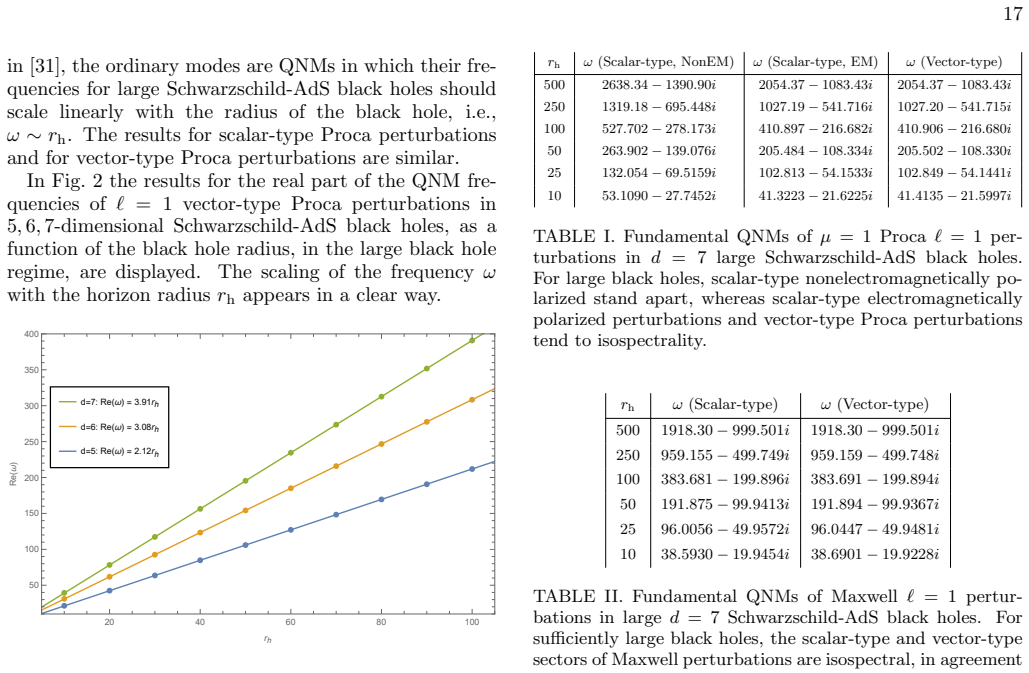
Large black holes (a) Ordinary modes of large black holes We now analyze the dependence of the QNMs on large black hole horizon radius for ordinary modes. As shown 17 in [31], the ordinary modes are QNMs in which their fre- quencies for large Schwarzschild-AdS black holes should scale linearly with the radius of the black hole, i.e., ω∼r h. The results fo...
1918
-
[4]
As we decrease the horizon radius from the large black hole case, the QNMs start to deviate from the linear scal- ing as one approachesr h ≃1
Intermediate black holes We now analyze the case of intermediate black holes. As we decrease the horizon radius from the large black hole case, the QNMs start to deviate from the linear scal- ing as one approachesr h ≃1. This is shown in Fig. 5, where it can be seen that the real part of the frequencies approaches a minimum forr h <1, meaning that there a...
-
[5]
As one approaches ther h →0 limit, the QNM frequen- cies approach those of pure AdS spacetime, see Fig
Small black holes We now analyze the case of small black holes. As one approaches ther h →0 limit, the QNM frequen- cies approach those of pure AdS spacetime, see Fig. 5, studied in [54]. Scalar-type Proca modes with nonelec- tromagnetic and electromagnetic polarizations approach the scalar-typej=ℓ+ 1 and the scalar-typej=ℓ−1 modes of pure AdS, respective...
-
[6]
Scalar-type Proca perturbations: Monopole case Near region To deal with the near region we define the unitless radial coordinatezby z≡z(r) = 1− rh r d−3 ,(66) meaningz= 0 at the horizon andz= 1 at spatial in- finity. From Eq. (7) together with Eq. (15), theℓ= 0 Schr¨ odinger-like equation in the near region is then z(1−z) d2unear 1 dz2 + 1−z 2 + 1 d−3 dun...
-
[7]
Vector-type Proca perturbations Near region In the near region, the background is essentially Schwarzschild, and one can use the approximation r−rh l ≪ 1 ωl to rewrite Eq. (11) as z(1−z) d2unear 3 dz2 + 1−z 2 + 1 d−3 dunear 3 dz + + 1 (d−3) 2 ω2r2 h z(1−z) − (ℓ+ 1)(ℓ+d−4) +µ 2r2 h 1−z − (d−4)(d−6)z 4(1−z) − (d−4)(d−3) 2 unear 3 = 0,(77) withz≡z(r) = 1−( r...
-
[8]
Scalar-type Maxwell perturbations Near region We now perform the matching asymptotic expansions for the Maxwell field in a Schwarzschild-AdS black hole background, a procedure that, to our knowledge, has not yet been carried out explicitly indspacetime dimensions. While similar techniques have been extensively applied to scalar and gravitational fields, t...
-
[9]
In particu- lar, the real part ofδfor the vector-type eletromagnetic perturbations is given by Eq
Vector-type Maxwell perturbations Regarding the vector-type Maxwell perturbations, the QNM frequenciesω=ω AdS +iδfollow from the vector- type Proca perturbations by settingµ= 0. In particu- lar, the real part ofδfor the vector-type eletromagnetic perturbations is given by Eq. (86) withµ= 0, and so γ= 1 + 1 2 p (d−3) 2, yielding Reδ=− 2Γ [k+ℓ+d−2] Γ 2 h 1 ...
2025
-
[10]
V we introduced our own numerical method based on the shooting method, and mentioned that we have also used, as way of comparing the results, the Horowitz-Hubeny method [31]
Preamble In Sec. V we introduced our own numerical method based on the shooting method, and mentioned that we have also used, as way of comparing the results, the Horowitz-Hubeny method [31]. We now present the Horowitz-Hubeny method. This method is widely used to compute QNMs in asymptotically AdS spacetimes, using the fact that the eigenvalue problem in...
-
[11]
Horowitz-Hubeny numerical integration method for the Proca field: Decoupled and coupled Schr¨ odinger-like equations a. Scalar-typeℓ= 0monopole Proca field and vector-type Proca field: Decoupled Schr¨ odinger-like equation The Horowitz-Hubeny method in the Proca field case can be applied to the monopole case of the scalar-type Proca field described byu 1 ...
-
[12]
So under Dirichlet boundary condition, the method for de- coupled Proca equations given above can in principle be applied
Horowitz-Hubeny numerical integration method for the Maxwell field: Decoupled equations The Maxwell field also yields decoupled equations. So under Dirichlet boundary condition, the method for de- coupled Proca equations given above can in principle be applied. The Horowitz-Hubeny numerical integration method can be applied to the scalar-type Maxwell fiel...
-
[13]
Stability of a Schwarzschild singularity
T. Regge and J. A. Wheeler, “Stability of a Schwarzschild singularity”, Phys. Rev.108, 1063 (1957)
1957
-
[14]
Effective potential for even-parity Regge- Wheeler gravitational perturbation equations
F. J. Zerilli, “Effective potential for even-parity Regge- Wheeler gravitational perturbation equations”, Phys. Rev. Lett.24, 737 (1970)
1970
-
[15]
Stability of the Schwarzschild Met- ric
C. V. Vishveshwara, “Stability of the Schwarzschild Met- ric”, Phys. Rev. D1, 2870 (1970)
1970
-
[16]
Electro- magnetic field of a particle moving in a spherically sym- metric black hole background
R. Ruffini, J. Tiomno, and C. V. Vishveshwara, “Electro- magnetic field of a particle moving in a spherically sym- metric black hole background”, Lett. Nuovo Cimento3, 211 (1972)
1972
-
[17]
Rotating black holes: Separable wave equations for gravitational and electromagnetic pertur- bationse
S. A. Teukolsky, “Rotating black holes: Separable wave equations for gravitational and electromagnetic pertur- bationse”, Phys. Rev. Lett.20, 1114 (1972)
1972
-
[18]
The quasinormal modes of the Schwarzschild black hole
S. Chandrasekhar and S. Detweiler, “The quasinormal modes of the Schwarzschild black hole”, Proc. R. Soc. A 344, 441 (1975)
1975
-
[19]
Chandrasekhar,The Mathematical Theory of Black Holes(Oxford University Press, New York, 1983)
S. Chandrasekhar,The Mathematical Theory of Black Holes(Oxford University Press, New York, 1983)
1983
-
[20]
Behavior of massive vector particles in a Schwarzschild field
D. V. Gal’tsov, G. V. Pomerantseva, and G. A. Chizhov, “Behavior of massive vector particles in a Schwarzschild field”, Sov. Phys. J.27, 697 (1984)
1984
-
[21]
Massive scalar quasinor- mal modes of Schwarzschild and Kerr black holes
L. E. Simone and C. M. Will, “Massive scalar quasinor- mal modes of Schwarzschild and Kerr black holes”, Clas- sical Quantum Gravity9, 963 (1992)
1992
-
[22]
Quasi-Normal Modes of Stars and Black Holes
K, D. Kokkotas and B. G. Schmidt, “Quasinormal modes of stars and black holes”, Living Rev. Rel 2 (1999) 2; arXiv:gr-qc/9909058 [gr-qc]
work page internal anchor Pith review Pith/arXiv arXiv 1999
-
[23]
L. C. B. Crispino, A. Higuchi, and G. E. A. Mat- sas, “Quantization of the electromagnetic field outside static black holes and its application to low-energy phe- nomena”, Phys. Rev. D63, 124008 (2001); arXiv:gr- qc/0011070
-
[24]
The Timescale for Loss of Massive Vector Hair by a Black Hole and its Consequences for Proton Decay
A. Pawl, “The timescale for loss of massive vector hair by a black hole and its consequences for proton decay”, Phys. Rev. D70, 124005 (2004); arXiv:hep-th/0411175
work page internal anchor Pith review Pith/arXiv arXiv 2004
-
[25]
Decay of massive scalar field in a Schwarzschild background
R. A. Konoplya and A. V. Zhidenko, “Decay of massive scalar field in a Schwarzschild background”, Phys. Lett. B609, 377 (2005); arXiv:gr-qc/0411059
work page internal anchor Pith review Pith/arXiv arXiv 2005
-
[26]
Massive scalar field quasi-normal modes of higher dimensional black holes
A. V. Zhidenko, “Massive scalar field quasinormal modes of higher dimensional black holes”, Phys. Rev. D74, 064017 (2006); arXiv:gr-qc/0607133
work page internal anchor Pith review Pith/arXiv arXiv 2006
-
[27]
The black hole bomb and superradiant instabilities
V. Cardoso, O. J. C. Dias, J. P. S. Lemos, S. Yoshida, “The black hole bomb and superradiant instabilities”, Phys. Rev. D70, 044039 (2004); arXiv:hep-th/0404096
work page internal anchor Pith review Pith/arXiv arXiv 2004
-
[28]
R. A. Konoplya, “Massive vector field perturbations in the Schwarzschild background: Stability and quasinor- mal spectrum” Phys. Rev. D73, 024009 (2006); arXiv:gr- qc/0509026
-
[29]
Electromagnetic quasinormal modes of D-dimensional black holes
A. L´ opez-Ortega, “Electromagnetic quasinormal modes ofd-dimensional black holes”, Gen. Relativ. Gravit.38, 1747 (2006); arXiv:gr-qc/0605034
work page internal anchor Pith review Pith/arXiv arXiv 2006
-
[30]
Linear perturbations of black holes: stability, quasi-normal modes and tails
A. Zhidenko,Linear Perturbations of Black Holes: Stabil- ity, Quasinormal Modes and Tails, (PhD thesis, IFUSP, Universidade de S˜ ao Paulo, 2009); arXiv:0903.3555 [gr- qc]
work page internal anchor Pith review Pith/arXiv arXiv 2009
-
[31]
Massive vector fields on the Schwarzschild spacetime: quasinormal modes and bound states
J. G. Rosa and S. R. Dolan, “Massive vector fields on the Schwarzschild spacetime: Quasinormal modes and bound states”, Phys. Rev. D85, 044043 (2012); arXiv:1110.4494 [hep-th]. 30
work page internal anchor Pith review Pith/arXiv arXiv 2012
-
[32]
Hawking radiation for a Proca field in D-dimensions
C. Herdeiro, M. O. P. Sampaio, and M. Wang, “Hawking radiation for a Proca field ind-dimensions”, Phys. Rev. D85, 024005 (2012); arXiv:1110.2485 [gr-qc]
work page internal anchor Pith review Pith/arXiv arXiv 2012
-
[33]
Advanced Methods in Black-Hole Perturbation Theory
P. Pani, “Advanced methods in black-hole perturba- tion theory”, Int. J. Mod. Phys. A28, 1340018 (2013); arXiv:1305.6759 [gr-qc]
work page internal anchor Pith review Pith/arXiv arXiv 2013
-
[34]
Instability of the Proca field on Kerr spacetime
S. R. Dolan, “Instability of the Proca field on Kerr space- time”, Phys. Rev. D98, 104006 (2018); arXiv:1806.01604 [gr-qc]
work page internal anchor Pith review Pith/arXiv arXiv 2018
-
[35]
Quasinormal modes of mas- sive vector fields on the Kerr spacetime
J. Percival and S. R. Dolan, “Quasinormal modes of mas- sive vector fields on the Kerr spacetime”, Phys. Rev. D 102, 104055 (2020); arXiv:2008.10621 [gr-qc]
-
[36]
Schwarzschild quasinormal modes of non-minimally coupled vector fields
S. Garcia-Saenz, A. Held, and J. Zhang, “Schwarzschild quasinormal modes of non-minimally coupled vector fields”, J. High Energy Phys. JHEP 05 (2022) 139; arXiv:2202.07131 [gr-qc]
-
[37]
Superradiant instability of a charged regular black hole
S. R. Dolan, M. A. A. de Paula, L. C. S. Leite, and L. C. B. Crispino, “Superradiant instability of a charged regular black hole”, Phys. Rev. D109, 124037 (2024); arXiv:2401.14967 [gr-qc]
-
[38]
Stability of black holes in de Sitter space
F. Mellor and I. Moss, “Stability of black holes in de Sitter space”, Phys. Rev. D41, 403 (1990)
1990
-
[39]
Quasinormal modes of the near extremal Schwarzschild-de Sitter black hole
V. Cardoso and J. P. S. Lemos, “Quasinormal modes of the near extremal Schwarzschild-de Sitter black hole”, Phys. Rev. D67, 084020 (2003); arXiv.gr-qc/0301078
work page internal anchor Pith review Pith/arXiv arXiv 2003
-
[40]
Quasinormal modes of Schwarzschild-de Sitter black holes
A. Zhidenko, “Quasinormal modes of Schwarzschild-de Sitter black holes”, Classical Quantum Gravity21, 273 (2004); arXiv:gr-qc/0307012
-
[41]
R. A. Konoplya and A. Zhidenko, “Nonoscillatory gravitational quasinormal modes and telling tails for Schwarzschild-de Sitter black holes”, Phys. Rev. D106, 124004 (2022); arXiv:2209.12058 [gr-qc]
-
[42]
Two regimes of asymptotic fall-off of a massive scalar
R. A. Konoplya, “Two regimes of asymptotic fall-off of a massive scalar”, field in the Schwarzschild-de Sit- ter spacetime”, Phys. Rev. D109, 104018 (2024); arXiv:2401.17106 [gr-qc]
-
[43]
Quasinormal modes of AdS black holes and the approach to thermal equi- librium
G. T. Horowitz and V. E. Hubeny, “Quasinormal modes of AdS black holes and the approach to thermal equi- librium”, Phys. Rev. D62, 024027 (2000); arXiv:hep- th/9909056
-
[44]
Scalar, electromagnetic and Weyl perturbations of BTZ black holes: Quasinor- mal modes
V. Cardoso and J. P. S. Lemos, “Scalar, electromagnetic and Weyl perturbations of BTZ black holes: Quasinor- mal modes”, Phys. Rev. D63, 124015 (2001); arXiv:gr- qc/0101052 [gr-qc]
-
[45]
V. Cardoso and J. P. S. Lemos, “Quasinormal modes of Schwarzschild anti-de Sitter black holes: Electromag- netic and gravitational perturbations”, Phys. Rev. D64, 084017 (2001); arXiv:gr-qc/0105103
work page internal anchor Pith review Pith/arXiv arXiv 2001
-
[46]
V. Cardoso and J. P. S. Lemos, “Quasinormal modes of toroidal, cylindrical and planar black holes in anti- de Sitter spacetimes: Scalar, electromagnetic, and gravi- tational perturbations”, Classical Quantum Gravity18, 5257 (2001); arXiv:gr-qc/0107098
work page internal anchor Pith review Pith/arXiv arXiv 2001
-
[47]
E. Berti and K. D. Kokkotas. “Quasinormal modes of Reissner-Nordstr¨ om-anti-de Sitter black holes: Scalar, electromagnetic, and gravitational perturbations”, Phys. Rev. D67, 064020 (2003); arXiv:gr-qc/0301052
work page internal anchor Pith review Pith/arXiv arXiv 2003
-
[48]
V. Cardoso, J. P. S. Lemos, and R. A. Konoplya, “Quasi- normal frequencies of Schwarzschild black holes in anti-de Sitter spacetimes: A complete study on the asymptotic behavior”, Phys. Rev. D68, 044024 (2003); arXiv:gr- qc/0305037
-
[49]
H. Kodama and A. Ishibashi, “A master equation for gravitational perturbations of maximally symmetric black holes in higher dimensions”, Prog. Theor. Phys. 110, 701 (2003); arXiv:hep-th/0305147
work page internal anchor Pith review Pith/arXiv arXiv 2003
-
[50]
Stability of Higher-Dimensional Schwarzschild Black Holes
H. Kodama and A. Ishibashi, “Stability of higher- dimensional Schwarzschild black holes”, Prog. Theor. Phys.110, 901 (2003); arXiv:hep-th/0305185
work page internal anchor Pith review Pith/arXiv arXiv 2003
-
[51]
H. Kodama and A. Ishibashi, “Master equations for per- turbations of generalised static black holes with charge in higher dimensions”, Prog. Theor. Phys.111, 24 (2004); arXiv:hep-th/0308128
work page internal anchor Pith review Pith/arXiv arXiv 2004
-
[52]
Dynamics in Non-Globally-Hyperbolic Static Spacetimes III: Anti-de Sitter Spacetime
A. Ishibashi and R. M. Wald, “Dynamics in non-globally- hyperbolic static spacetimes : III. Anti-de Sitter space- time”, Classical Quantum Gravity21, 2981 (2004); arXiv:hep-th/0402184
work page internal anchor Pith review Pith/arXiv arXiv 2004
-
[53]
A. S. Miranda and V. T. Zanchin, “Quasinormal modes of plane-symmetric anti-de Sitter black holes: A complete analysis of the gravitational perturbations”, Phys. Rev. D73, 064034 (2006); arXiv:gr-qc/0510066
work page internal anchor Pith review Pith/arXiv arXiv 2006
-
[54]
Classical instability of Kerr-AdS black holes and the issue of fi- nal state
V. Cardoso, O. J. C. Dias, and S. Yoshida, “Classical instability of Kerr-AdS black holes and the issue of fi- nal state”, Phys. Rev. D74, 044008 (2006); arXiv:hep- th/0607162
-
[55]
Expanding plasmas and quasinormal modes of anti-de Sitter black holes
J. J. Friess, S. S. Gubser, G. Michalogiorgakis, and S. S. Pufu, “Expanding plasmas and quasinormal modes of anti-de Sitter black holes”, J. High Energy Phys. JHEP 04, (2007) 080; arXiv:hep-th/0611005
work page internal anchor Pith review Pith/arXiv arXiv 2007
-
[56]
Low frequency quasi-normal modes of AdS black holes
G. Siopsis, “Low frequency quasinormal modes of AdS black holes”, J. High Energy Phys. JHEP 05 (2007) 042; arXiv:hep-th/0702079
work page internal anchor Pith review Pith/arXiv arXiv 2007
-
[57]
Stability of higher dimensional Reissner-Nordstrom-anti-de Sitter black holes
R. A. Konoplya and A. Zhidenko, “Stability of higher dimensional Reissner-Nordstr¨ om-anti-de Sitter black holes”, Phys. Rev. D78, 104017 (2008); arXiv:0809.2048 [hep-th]
work page internal anchor Pith review Pith/arXiv arXiv 2008
-
[58]
Breit-Wigner resonances and the quasinormal modes of anti-de Sitter black holes
E. Berti, V. Cardoso, and P. Pani, “Breit-Wigner reso- nances and the quasinormal modes of anti-de Sitter black holes”, Phys. Rev. D79, 101501 (2009); arXiv:0903.5311 [gr-qc]
work page internal anchor Pith review Pith/arXiv arXiv 2009
-
[59]
Superradiant instabilities in a $D$-dimensional small Reissner-Nordstr\"om-Anti-de Sitter black hole
M. Wang and C. Herdeiro, “Superradiant instabili- ties in ad-dimensional small Reissner-Nordstr¨ om-anti- de Sitter black hole”, Phys. Rev. D89, 084062 (2014); arXiv:1403.5160 [gr-qc]
work page internal anchor Pith review Pith/arXiv arXiv 2014
-
[60]
M. Wang, C. Herdeiro, and M. O. Sampaio, “Maxwell perturbations on asymptotically anti-de Sitter space- times: Generic boundary conditions and a new branch of quasinormal modes”, Phys. Rev. D92, 124006 (2015); arXiv:1510.04713 [gr-qc]
work page internal anchor Pith review Pith/arXiv arXiv 2015
-
[61]
Massive vector field perturba- tions on extremal and near-extremal static black holes
K. Ueda and A. Ishibashi, “Massive vector field perturba- tions on extremal and near-extremal static black holes”, Phys. Rev. D97, 124050 (2018); arXiv:1805.02479 [gr- qc]
-
[62]
Quasinormal modes of Proca fields in a Schwarzschild-AdS spacetime
T. V. Fernandes, D. Hilditch, J. P. S. Lemos, and V. Cardoso, “Quasinormal modes of Proca fields in a Schwarzschild-AdS spacetime”, Phys. Rev. D105, 044017 (2022); arXiv:2112.03282 [gr-qc]
-
[63]
Normal modes of Proca fields in AdS spacetime
T. V. Fernandes, D. Hilditch, J. P. S. Lemos, and V. Car- doso, “Normal modes of Proca fields in AdS spacetime”, Gen. Relativ. Gravit.55, 5 (2023); arXiv:2301.10248 [gr- qc]
-
[64]
K. Lin, “Quasinormal modes and echo effect of cylindrical anti-de Sitter black hole spacetime with a thin shell”, Phys. Rev. D107, 124002 (2023); arXiv:2306.01269 [gr- qc]
-
[65]
Quasinormal mode spectrum of the AdS black hole with the Robin boundary condition
S. Kinoshita, T. Kozuka, K. Murata, and K. Sugawara, “Quasinormal mode spectrum of the AdS black hole with the Robin boundary condition”, Classical Quantum 31 Gravity41, 055010 (2024); arXiv:2305.17942 [gr-qc]
-
[66]
Normal modes of Proca fields in AdS d spacetime
D. Lopes, T. V. Fernandes, and J. P. S. Lemos, “Normal modes of Proca fields in AdS d spacetime”, Phys. Rev. D 109, 064041 (2024); arXiv:2401.13030 [gr-qc]
-
[67]
Quasinormal modes of a Proca field in Schwarzschild- AdS5 spacetime via the isomonodromy method
J. Barrag´ an Amado, T. V. Fernandes, and D. C. Lopes “Quasinormal modes of a Proca field in Schwarzschild- AdS5 spacetime via the isomonodromy method”, J. High Energy Phys. JHEP 09 (2025) 108; arXiv:2504.00080 [gr- qc]
-
[68]
A profusion of black holes from two to ten dimensions
J. P. S. Lemos, “A profusion of black holes from two to ten dimensions”, inProceedings of the XVIIth Brazilian Meeting of Particle Physics abd Fields, editor A. J. Silva (University of S˜ ao Paulo Press, 1997), p. 40; arXiv:hep- th/9701121
-
[69]
The bizarre anti-de Sitter spacetime
L. M. Soko lowski, “The bizarre anti-de Sitter spacetime”, Int. Jour. Geom. Meth. Mod. Phys.13, 1630016 (2016); arXiv:1611.01118 [gr-qc]
work page internal anchor Pith review Pith/arXiv arXiv 2016
-
[70]
G. Bertone and D. Hooper, “A history of dark matter”, Rev. Mod. Phys.90, 45002 (2018); arXiv:1605.04909 [astro-ph.CO]
work page internal anchor Pith review Pith/arXiv arXiv 2018
-
[71]
Abramowitz and I
M. Abramowitz and I. A. Stegun,Handbook of Mathe- matical Functions with Formulas, Graphs, and Mathe- matical Tables(Dover, New York, 1965)
1965
discussion (0)
Sign in with ORCID, Apple, or X to comment. Anyone can read and Pith papers without signing in.