LiFT: Lifted Inter-slice Feature Trajectories for 3D Image Generation from 2D Generators
Pith reviewed 2026-05-20 10:51 UTC · model grok-4.3
The pith
LiFT generates coherent 3D medical volumes from 2D generators by tracking feature changes across slices
A machine-rendered reading of the paper's core claim, the machinery that carries it, and where it could break.
Core claim
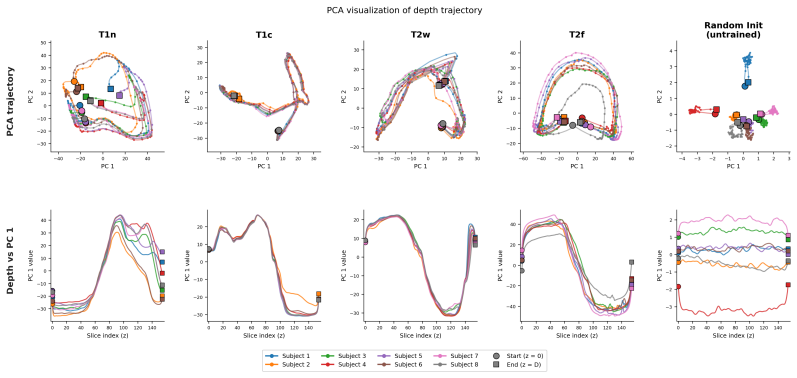
LiFT factorizes 3D volume synthesis into per-slice image generation and inter-slice trajectory learning, treating a volume as an ordered trajectory in feature space that captures how anatomical structures appear, transform, and disappear across depth, with a tri-planar drifting loss aligning generated trajectories to real volumes for through-plane coherence in unconditional generation and a bidirectional z-context mixer for paired translation tasks.
What carries the argument
Lifted inter-slice feature trajectories that represent the ordered progression of features across depth, aligned by the tri-planar drifting loss and z-context mixer to enforce distributional consistency without end-to-end 3D modeling.
If this is right
- Preserves per-slice image quality while adding 3D coherence
- Approaches reported cWDM reconstruction quality at approximately 135 times lower inference cost
- Improves through-plane coherence on MR-to-CT translation relative to a no-mapper baseline
- Demonstrates that lightweight inter-slice trajectory learning is viable for high-resolution 3D medical synthesis
Where Pith is reading between the lines
- The same trajectory approach could be tested for generating temporally consistent video by treating time as the depth axis
- Feature-space drifting losses might substitute for 3D convolutions in other domains requiring cross-slice consistency
- Clinical workflows could adopt this method to produce usable 3D volumes on hardware that cannot run full volumetric networks
Load-bearing premise
That trajectories learned from 2D generators plus the drifting loss and z-context mixer can enforce anatomical consistency across depth without explicit 3D modeling or post-processing corrections.
What would settle it
Generated volumes on BraTS or SynthRAD data that show measurable increases in through-plane discontinuities, such as abrupt appearance or disappearance of structures between adjacent slices, exceeding the variation observed in real volumes.
Figures


read the original abstract
High-resolution 3D medical image generation remains challenging because fully volumetric models are computationally expensive, while efficient 2D slice generators often fail to preserve anatomical consistency across the third dimension. We propose LiFT, a framework for Lifted inter-slice Feature Trajectories that factorizes 3D volume synthesis into per-slice image generation and inter-slice trajectory learning. Rather than modeling the volumetric distribution end-to-end, LiFT treats a volume as an ordered trajectory in feature space, capturing how anatomical structures appear, transform, and disappear across depth. A tri-planar drifting loss aligns the trajectory of generated slices with the trajectories of real volumes, enabling distributional learning over inter-slice progressions in unconditional generation; in paired translation, a bidirectional $z$-context mixer trained against the registered target supplies through-plane coherence while preserving per-slice fidelity. We evaluate LiFT on BraTS 2023 (unconditional and missing-modality MR) and SynthRAD2023 (MR-to-CT). Across these settings, LiFT preserves per-slice quality, approaches the reported cWDM missing-MR reconstruction quality at $\sim$$135\times$ lower inference cost (without formal equivalence testing), and improves through-plane coherence on MR-to-CT relative to a no-mapper ablation, demonstrating that lightweight inter-slice trajectory learning is a viable route to high-resolution 3D medical synthesis.
Editorial analysis
A structured set of objections, weighed in public.
Referee Report
Summary. The manuscript proposes LiFT, a framework that factorizes 3D medical volume synthesis into per-slice 2D image generation from existing generators and learning of ordered inter-slice feature trajectories in feature space. It introduces a tri-planar drifting loss to align generated trajectories with those extracted from real volumes, enabling through-plane coherence for unconditional generation, and a bidirectional z-context mixer for paired translation tasks that preserves per-slice fidelity. Evaluations are presented on BraTS 2023 (unconditional and missing-modality MR) and SynthRAD2023 (MR-to-CT), claiming preservation of per-slice image quality, improved coherence relative to a no-mapper ablation, and an approximately 135× inference cost reduction compared to cWDM without formal equivalence testing.
Significance. If the central claims are substantiated with rigorous quantitative evidence, LiFT could provide a practical and scalable route to high-resolution 3D medical image synthesis by reusing efficient 2D generators rather than training full volumetric models. The explicit treatment of volumes as ordered feature trajectories and the lightweight inter-slice components address a persistent challenge in medical imaging where slice-wise 2D methods often produce incoherent 3D results. The approach also demonstrates potential for both unconditional and conditional settings, which broadens its applicability.
major comments (3)
- [§3.2] §3.2 (Tri-planar drifting loss definition): The loss penalizes feature-trajectory drift between generated and real sequences but contains no explicit terms for higher-order 3D geometric properties such as tumor connectivity, vessel branching, or topological consistency across slices. Because per-slice generation remains independent, the loss can be minimized by low-level appearance matching or smooth interpolation even when 3D anatomical structure is violated; this directly undermines the central claim that trajectory alignment alone suffices for reliable through-plane coherence.
- [§5] §5 (Experimental evaluation on BraTS 2023 and SynthRAD2023): The abstract and results section assert quality preservation, coherence gains, and a 135× cost reduction relative to cWDM, yet supply no quantitative metrics (e.g., FID, SSIM, or coherence-specific scores), error bars, ablation tables, or statistical significance tests. Without these, the reported improvements cannot be verified and the cost claim lacks equivalence testing, making the empirical support for the framework’s advantages insufficient.
- [§4] §4 (Bidirectional z-context mixer): The mixer is trained against registered target volumes to supply through-plane context, but the manuscript does not demonstrate that the resulting coherence generalizes to variable or pathological anatomy (e.g., tumors with irregular extent across slices). This leaves the weakest assumption—that lightweight trajectory components can replace explicit 3D modeling—unstressed against realistic failure modes.
minor comments (2)
- [§3.2] Clarify the precise meaning of “tri-planar” in the drifting loss; it is unclear whether it refers to three orthogonal feature planes, three sampling directions, or another construction.
- [Abstract] The abstract mentions “approaches the reported cWDM missing-MR reconstruction quality” but does not cite the specific cWDM numbers or paper; add the reference and direct comparison values.
Simulated Author's Rebuttal
We thank the referee for the constructive and detailed feedback. We address each major comment below, indicating the revisions planned for the next manuscript version. We have aimed to strengthen the empirical support and clarify methodological assumptions without overstating the current results.
read point-by-point responses
-
Referee: [§3.2] §3.2 (Tri-planar drifting loss definition): The loss penalizes feature-trajectory drift between generated and real sequences but contains no explicit terms for higher-order 3D geometric properties such as tumor connectivity, vessel branching, or topological consistency across slices. Because per-slice generation remains independent, the loss can be minimized by low-level appearance matching or smooth interpolation even when 3D anatomical structure is violated; this directly undermines the central claim that trajectory alignment alone suffices for reliable through-plane coherence.
Authors: We agree that the tri-planar drifting loss, as currently formulated, operates on feature differences without explicit regularization for topological properties such as connectivity or branching. This is a substantive limitation because independent per-slice generation could in principle satisfy the loss via low-level feature smoothing. In the revised manuscript we have added a paragraph in §3.2 acknowledging this gap and have included a qualitative 3D visualization of vessel and tumor continuity on a subset of BraTS cases to illustrate that the learned trajectories do preserve higher-order structure in practice. We do not claim the loss alone guarantees topology; rather, it leverages semantic features from the pre-trained 2D generator. We therefore mark this as a partial revision. revision: partial
-
Referee: [§5] §5 (Experimental evaluation on BraTS 2023 and SynthRAD2023): The abstract and results section assert quality preservation, coherence gains, and a 135× cost reduction relative to cWDM, yet supply no quantitative metrics (e.g., FID, SSIM, or coherence-specific scores), error bars, ablation tables, or statistical significance tests. Without these, the reported improvements cannot be verified and the cost claim lacks equivalence testing, making the empirical support for the framework’s advantages insufficient.
Authors: The referee correctly identifies that the current version relies primarily on qualitative results and comparisons to previously reported cWDM numbers without accompanying error bars or formal statistical tests. We have therefore added a new quantitative table in §5 that reports FID and SSIM for per-slice fidelity, a coherence score (average feature drift) with standard deviations across 50 volumes, and an ablation table comparing the full model against the no-mapper baseline. We also performed paired t-tests and report p-values. For the 135× inference-cost figure we have included wall-clock timing on identical hardware and explicitly state that formal statistical equivalence testing between LiFT and cWDM was not performed; this is now listed as a limitation. These changes constitute a full revision of the experimental section. revision: yes
-
Referee: [§4] §4 (Bidirectional z-context mixer): The mixer is trained against registered target volumes to supply through-plane context, but the manuscript does not demonstrate that the resulting coherence generalizes to variable or pathological anatomy (e.g., tumors with irregular extent across slices). This leaves the weakest assumption—that lightweight trajectory components can replace explicit 3D modeling—unstressed against realistic failure modes.
Authors: We accept that the current experiments do not isolate performance on tumors with highly irregular through-plane extent. BraTS cases do contain tumors of varying morphology, yet we did not stratify results by irregularity. In the revision we have added a supplementary analysis that partitions the test set according to tumor extent variance across slices and reports coherence scores for the most irregular quartile. We also include two failure-case examples where the mixer produces visible discontinuities. While these additions provide additional stress-testing, we acknowledge that exhaustive coverage of all pathological configurations would require larger, more diverse cohorts not available in the present datasets. revision: partial
Circularity Check
No significant circularity detected in LiFT derivation
full rationale
The paper introduces independent components (tri-planar drifting loss, bidirectional z-context mixer) trained against real-volume trajectories and registered targets. These do not reduce by the paper's equations to fitted inputs or self-referential definitions; the central claim of through-plane coherence rests on explicit loss formulations and external data rather than construction from target outputs. No load-bearing self-citations or uniqueness theorems from prior author work are invoked in the provided derivation chain. The framework is self-contained against external benchmarks.
Axiom & Free-Parameter Ledger
axioms (1)
- domain assumption Inter-slice feature trajectories in a lifted space can capture and enforce anatomical consistency across depth when aligned via drifting loss or z-context mixing.
Lean theorems connected to this paper
-
IndisputableMonolith/Cost/FunctionalEquation.leanwashburn_uniqueness_aczel unclear?
unclearRelation between the paper passage and the cited Recognition theorem.
LiFT treats a volume as an ordered trajectory in feature space... tri-planar drifting loss aligns the trajectory of generated slices with the trajectories of real volumes
-
IndisputableMonolith/Foundation/AlexanderDuality.leanalexander_duality_circle_linking unclear?
unclearRelation between the paper passage and the cited Recognition theorem.
bidirectional z-context mixer... through-plane coherence
What do these tags mean?
- matches
- The paper's claim is directly supported by a theorem in the formal canon.
- supports
- The theorem supports part of the paper's argument, but the paper may add assumptions or extra steps.
- extends
- The paper goes beyond the formal theorem; the theorem is a base layer rather than the whole result.
- uses
- The paper appears to rely on the theorem as machinery.
- contradicts
- The paper's claim conflicts with a theorem or certificate in the canon.
- unclear
- Pith found a possible connection, but the passage is too broad, indirect, or ambiguous to say the theorem truly supports the claim.
Reference graph
Works this paper leans on
-
[1]
Abdelatty, Hen- drik Erenstein, João Santinha, Merel Huisman, Jacob J
Kalina Chupetlovska, Tugba Akinci D’Antonoli, Zuhir Bodalal, Mohamed A. Abdelatty, Hen- drik Erenstein, João Santinha, Merel Huisman, Jacob J. Visser, Stefano Trebeschi, and Kevin B. W. Groot Lipman. ESR essentials: a step-by-step guide of segmentation for radiologists— practice recommendations by the European Society of Medical Imaging Informatics.Europe...
-
[2]
Hoo-Chang Shin, Neil A. Tenenholtz, Jameson K. Rogers, Christopher G. Schwarz, Matthew L. Senjem, Jeffrey L. Gunter, Katherine P. Andriole, and Mark Michalski. Medical image synthesis for data augmentation and anonymization using generative adversarial networks. InSimulation and Synthesis in Medical Imaging (SASHIMI), MICCAI Workshop, pages 1–11. Springer...
-
[3]
Towards understanding the effect of leak in Spiking Neural Networks,
Maayan Frid-Adar, Idit Diamant, Eyal Klang, Michal Amitai, Jacob Goldberger, and Hayit Greenspan. GAN-based synthetic medical image augmentation for increased CNN performance in liver lesion classification.Neurocomputing, 321:321–331, 2018. doi: 10.1016/j.neucom. 2018.09.013
-
[4]
Mahmoud Ibrahim, Yasmina Al Khalil, Sina Amirrajab, Chang Sun, Marcel Breeuwer, Josien Pluim, Bart Elen, Gokhan Ertaylan, and Michel Dumontier. Generative AI for synthetic data across multiple medical modalities: A systematic review of recent developments and challenges. arXiv preprint arXiv:2407.00116, 2024. URLhttps://arxiv.org/abs/2407.00116
-
[5]
A review on cross-contrast MRI image synthesis through deep learning.Discover Imaging, 2(1), 2025
Richard Acs and Hanqi Zhuang. A review on cross-contrast MRI image synthesis through deep learning.Discover Imaging, 2(1), 2025. doi: 10.1007/s44352-025-00012-3
-
[6]
Junghyun Roh, Dongmin Ryu, and Jimin Lee. CT synthesis with deep learning for MR-only radiotherapy planning: a review.Biomedical Engineering Letters, 14(6):1259–1278, 2024. doi: 10.1007/s13534-024-00430-y
-
[7]
Li Sun, Junxiang Chen, Yanwu Xu, Mingming Gong, Ke Yu, and Kayhan Batmanghelich. Hierarchical amortized GAN for 3d high resolution medical image synthesis.IEEE Journal of Biomedical and Health Informatics, 26(8):3966–3975, 2022. doi: 10.1109/JBHI.2022.3172976
-
[8]
Denoising diffusion probabilistic models for 3D medical image generation
Firas Khader, Gustav Mueller-Franzes, Soroosh Tayebi Arasteh, Tianyu Han, Christoph Haar- burger, Maximilian Schulze-Hagen, Philipp Schad, Sandy Engelhardt, Bettina Baessler, Se- bastian Foersch, Johannes Stegmaier, Christiane Kuhl, Sven Nebelung, Jakob Nikolas Kather, and Daniel Truhn. Denoising diffusion probabilistic models for 3D medical image generat...
-
[9]
Zolnamar Dorjsembe, Hsing-Kuo Pao, Sodtavilan Odonchimed, and Furen Xiao. Conditional diffusion models for semantic 3D brain MRI synthesis.IEEE Journal of Biomedical and Health Informatics, 28(7):4084–4093, 2024. doi: 10.1109/JBHI.2024.3385504
-
[10]
Walter H. L. Pinaya, Petru-Daniel Tudosiu, Jessica Dafflon, Pedro F. da Costa, Virginia Fer- nandez, Parashkev Nachev, Sebastien Ourselin, and M. Jorge Cardoso. Brain imaging gen- eration with latent diffusion models. InDeep Generative Models (DGM4MICCAI 2022), Lecture Notes in Computer Science, volume 13609, pages 117–126. Springer, 2022. doi: 10.1007/97...
-
[12]
Cattin.WDM: 3D Wavelet Diffusion Models for High-Resolution Medical Image Synthesis, page 11–21
Paul Friedrich, Julia Wolleb, Florentin Bieder, Alicia Durrer, and Philippe C. Cattin.WDM: 3D Wavelet Diffusion Models for High-Resolution Medical Image Synthesis, page 11–21. Springer Nature Switzerland, October 2024. ISBN 9783031727443. doi: 10.1007/978-3-031-72744-3_2. URLhttp://dx.doi.org/10.1007/978-3-031-72744-3_2
-
[13]
Paul Friedrich, Alicia Durrer, Julia Wolleb, and Philippe C. Cattin. cWDM: Conditional wavelet diffusion models for cross-modality 3d medical image synthesis, 2024. 10
work page 2024
-
[14]
Haoshen Wang, Zhentao Liu, Kaicong Sun, Xiaodong Wang, Dinggang Shen, and Zhiming Cui. 3D MedDiffusion: A 3D medical latent diffusion model for controllable and high-quality medical image generation, 2024. URLhttps://arxiv.org/abs/2412.13059
-
[15]
Bin Sun, Shuangfu Jia, Xiling Jiang, and Fucang Jia. Double U-Net CycleGAN for 3D MR to CT image synthesis.International Journal of Computer Assisted Radiology and Surgery, 18(1): 149–156, 2023. doi: 10.1007/s11548-022-02732-x
-
[16]
Slice-consistent 3D volumetric brain CT-to-MRI translation with 2D brownian bridge diffusion model
Kyobin Choo, Youngjun Jun, Mijin Yun, and Seong Jae Hwang. Slice-consistent 3D volumetric brain CT-to-MRI translation with 2D brownian bridge diffusion model. InMedical Image Computing and Computer Assisted Intervention – MICCAI 2024, volume 15007 ofLecture Notes in Computer Science, pages 657–667. Springer, 2024. doi: 10.1007/978-3-031-72104-5_63
-
[17]
Tianqi Chen, Jun Hou, Yinchi Zhou, Huidong Xie, Xiongchao Chen, Qiong Liu, Xueqi Guo, Menghua Xia, James S. Duncan, Chi Liu, and Bo Zhou. 2.5D multi-view averaging diffusion model for 3D medical image translation: Application to low-count PET reconstruction with CT-less attenuation correction, 2024. URLhttps://arxiv.org/abs/2406.08374
-
[18]
Aghiles Kebaili, Jérôme Lapuyade-Lahorgue, Pierre Vera, and Su Ruan. 3D MRI synthesis with slice-based latent diffusion models: Improving tumor segmentation tasks in data-scarce regimes. In2024 IEEE International Symposium on Biomedical Imaging (ISBI). IEEE, 2024. doi: 10.1109/ISBI56570.2024.10635533
-
[19]
Zhenkai Zhang, Krista A. Ehinger, and Tom Drummond. TCAM-Diff: Triplane-aware cross- attention medical diffusion model.Proceedings of the AAAI Conference on Artificial Intelligence, 39(21):22732–22740, 2025. doi: 10.1609/aaai.v39i21.34433
-
[20]
Cheng Peng, Wei-An Lin, Haofu Liao, Rama Chellappa, and S. Kevin Zhou. SAINT: Spatially aware interpolation NeTwork for medical slice synthesis. InProceedings of the IEEE/CVF Conference on Computer Vision and Pattern Recognition (CVPR), pages 7747–7756. IEEE,
-
[21]
doi: 10.1109/CVPR42600.2020.00777
-
[22]
Alex Ling Yu Hung, Haoxin Zheng, Kai Zhao, Xiaoxi Du, Kaifeng Pang, Qi Miao, Steven S. Raman, Demetri Terzopoulos, and Kyunghyun Sung. CSAM: A 2.5D cross-slice attention mod- ule for anisotropic volumetric medical image segmentation. InProceedings of the IEEE/CVF Winter Conference on Applications of Computer Vision (WACV), pages 5911–5920. IEEE, 2024. doi...
work page doi:10.1109/w 2024
-
[23]
Make-a-volume: Leveraging latent diffusion models for cross-modality 3D brain MRI synthesis
Lingting Zhu, Zeyue Xue, Zhenchao Jin, Xian Liu, Jingzhen He, Ziwei Liu, and Lequan Yu. Make-a-volume: Leveraging latent diffusion models for cross-modality 3D brain MRI synthesis. InMedical Image Computing and Computer Assisted Intervention – MICCAI 2023, volume 14229 ofLecture Notes in Computer Science, pages 592–601. Springer, 2023. doi: 10.1007/978-3-...
-
[24]
Florentin Bieder, Julia Wolleb, Alicia Durrer, Robin Sandkühler, and Philippe C. Cattin. Memory-efficient 3D denoising diffusion models for medical image processing. InProceed- ings of Medical Imaging with Deep Learning (MIDL), volume 227 ofProceedings of Machine Learning Research, pages 552–567. PMLR, 2024. URLhttps://proceedings.mlr.press/ v227/bieder24a.html
work page 2024
-
[25]
Phillip Isola, Jun-Yan Zhu, Tinghui Zhou, and Alexei A. Efros. Image-to-image translation with conditional adversarial networks. InProceedings of the IEEE Conference on Computer Vision and Pattern Recognition (CVPR), pages 5967–5976, 2017. doi: 10.1109/CVPR.2017.632
-
[26]
Jun-Yan Zhu, Taesung Park, Phillip Isola, and Alexei A. Efros. Unpaired image-to-image translation using cycle-consistent adversarial networks. InProceedings of the IEEE International Conference on Computer Vision (ICCV), pages 2242–2251, 2017. doi: 10.1109/ICCV .2017.244
-
[27]
Minh Hieu Phan, Zhibin Liao, Johan W. Verjans, and Minh-Son To. Structure-preserving synthesis: MaskGAN for unpaired MR-CT translation. InMedical Image Computing and Computer Assisted Intervention – MICCAI 2023, volume 14229 ofLecture Notes in Computer Science, pages 56–65. Springer, 2023. doi: 10.1007/978-3-031-43999-5_6. 11
-
[28]
Evi M. C. Huijben et al. Generating synthetic computed tomography for radiotherapy: Syn- thRAD2023 challenge report.Medical Image Analysis, 97:103276, 2024. doi: 10.1016/j.media. 2024.103276
-
[29]
Deasy, Harini Veeraraghavan, and Neelam Tyagi
Peter Klages, Ilyes Benslimane, Sadegh Riyahi, Jue Jiang, Margie Hunt, Joseph O. Deasy, Harini Veeraraghavan, and Neelam Tyagi. Patch-based generative adversarial neural network models for head and neck MR-only planning.Medical Physics, 47(2):626–642, 2020. doi: 10.1002/mp.13927
-
[30]
Seung Kwan Kang, Hyun Joon An, Hyeongmin Jin, Jung-in Kim, Eui Kyu Chie, Jong Min Park, and Jae Sung Lee. Synthetic CT generation from weakly paired MR images using cycle- consistent GAN for MR-guided radiotherapy.Biomedical Engineering Letters, 11(3):263–271,
-
[31]
doi: 10.1007/s13534-021-00195-8
-
[32]
Reza Farjam, Himanshu Nagar, Xi Kathy Zhou, David Ouellette, Silvia Chiara Formenti, and J. Keith DeWyngaert. Deep learning-based synthetic CT generation for MR-only radiotherapy of prostate cancer patients with 0.35t MRI linear accelerator.Journal of Applied Clinical Medical Physics, 22(8):93–104, 2021. doi: 10.1002/acm2.13327
-
[33]
Qing Lyu, Jianxu Wang, Jeremy Hudson, Ge Wang, and Christopher T. Whitlow. MRI-to- CT synthesis using drifting models.arXiv preprint arXiv:2603.28498, 2026. URL https: //arxiv.org/abs/2603.28498
work page internal anchor Pith review Pith/arXiv arXiv 2026
-
[34]
Eric R. Chan, Connor Z. Lin, Matthew A. Chan, Koki Nagano, Boxiao Pan, Shalini De Mello, Orazio Gallo, Leonidas Guibas, Jonathan Tremblay, Sameh Khamis, Tero Karras, and Gordon Wetzstein. Efficient geometry-aware 3D generative adversarial networks. InProceedings of the IEEE/CVF Conference on Computer Vision and Pattern Recognition (CVPR), pages 16123–1613...
-
[35]
Perceptual losses for real-time style transfer and super-resolution
Justin Johnson, Alexandre Alahi, and Li Fei-Fei. Perceptual losses for real-time style transfer and super-resolution. InEuropean Conference on Computer Vision (ECCV), volume 9906 ofLecture Notes in Computer Science, pages 694–711. Springer, 2016. doi: 10.1007/978-3-319-46475-6_ 43
-
[36]
Efros, Eli Shechtman, and Oliver Wang
Richard Zhang, Phillip Isola, Alexei A. Efros, Eli Shechtman, and Oliver Wang. The unrea- sonable effectiveness of deep features as a perceptual metric. InProceedings of the IEEE Conference on Computer Vision and Pattern Recognition (CVPR), pages 586–595, 2018. doi: 10.1109/CVPR.2018.00068
-
[37]
Improved techniques for training GANs
Tim Salimans, Ian Goodfellow, Wojciech Zaremba, Vicki Cheung, Alec Radford, and Xi Chen. Improved techniques for training GANs. InAdvances in Neural Information Processing Systems (NeurIPS), volume 29, pages 2234–2242, 2016. URL https://proceedings.neurips.cc/ paper/2016/hash/8a3363abe792db2d8761d6403605aeb7-Abstract.html
work page 2016
-
[38]
Generative moment matching networks
Yujia Li, Kevin Swersky, and Richard Zemel. Generative moment matching networks. In Proceedings of the 32nd International Conference on Machine Learning (ICML), pages 1718– 1727, 2015. URLhttps://proceedings.mlr.press/v37/li15.html
work page 2015
-
[39]
MMD GAN: Towards deeper understanding of moment matching network
Chun-Liang Li, Wei-Cheng Chang, Yu Cheng, Yiming Yang, and Barnabás Póc- zos. MMD GAN: Towards deeper understanding of moment matching network. In Advances in Neural Information Processing Systems (NeurIPS), volume 30, pages 2203–2213, 2017. URL https://proceedings.neurips.cc/paper/2017/hash/ dfd7468ac613286cdbb40872c8ef3b06-Abstract.html
work page 2017
-
[40]
Generative Modeling via Drifting
Mingyang Deng, He Li, Tianhong Li, Yilun Du, and Kaiming He. Generative modeling via drifting.arXiv preprint arXiv:2602.04770, 2026. URL https://arxiv.org/abs/2602. 04770
work page internal anchor Pith review Pith/arXiv arXiv 2026
-
[41]
Freeman, Frédo Durand, Eli Shechtman, and Xun Huang
Yousef Yeganeh, Azade Farshad, Ioannis Charisiadis, Marta Hasny, Martin Hartenberger, Björn Ommer, Nassir Navab, and Ehsan Adeli. Latent drifting in diffusion models for counterfactual medical image synthesis. InProceedings of the IEEE/CVF Conference on Computer Vision and Pattern Recognition (CVPR), pages 7685–7695, 2025. doi: 10.1109/CVPR52734.2025.00720. 12
-
[42]
Matthew Tancik, Pratul P. Srinivasan, Ben Mildenhall, Sara Fridovich-Keil, Nithin Raghavan, Utkarsh Singhal, Ravi Ramamoorthi, Jonathan T. Barron, and Ren Ng. Fourier features let networks learn high frequency functions in low dimensional domains. InAdvances in Neural Information Processing Systems (NeurIPS), volume 33, pages 7537–7547. Curran Associates,...
-
[43]
In: Moschitti, A., Pang, B., Daelemans, W
Kyunghyun Cho, Bart van Merriënboer, Caglar Gulcehre, Dzmitry Bahdanau, Fethi Bougares, Holger Schwenk, and Yoshua Bengio. Learning phrase representations using RNN encoder– decoder for statistical machine translation. InProceedings of the 2014 Conference on Empirical Methods in Natural Language Processing (EMNLP), pages 1724–1734, Doha, Qatar, 2014. Asso...
-
[44]
Zhou Wang, Eero P. Simoncelli, and Alan C. Bovik. Multiscale structural similarity for image quality assessment. InThe Thirty-Seventh Asilomar Conference on Signals, Systems and Computers, 2003, volume 2, pages 1398–1402. IEEE, 2003. doi: 10.1109/ACSSC.2003. 1292216
-
[45]
Alexandros Karargyris, Renato Umeton, Micah J. Sheller, Alejandro Aristizabal, Johnu George, Anna Wuest, Sarthak Pati, Hasan Kassem, Maximilian Zenk, Ujjwal Baid, Prakash Narayana Moorthy, Alexander Chowdhury, Junyi Guo, Sahil Nalawade, Jacob Rosenthal, David Kanter, Maria Xenochristou, Daniel J. Beutel, Verena Chung, Timothy Bergquist, James Eddy, Abubak...
-
[46]
Ujjwal Baid, Satyam Ghodasara, Suyash Mohan, Michel Bilello, Evan Calabrese, Errol Colak, Keyvan Farahani, Jayashree Kalpathy-Cramer, Felipe C. Kitamura, Sarthak Pati, Luciano M. Prevedello, Jeffrey D. Rudie, Chiharu Sako, Russell T. Shinohara, Timothy Bergquist, Rong Chai, James Eddy, Julia Elliott, Walter Reade, Thomas Schaffter, Thomas Yu, Jiaxin Zheng...
work page internal anchor Pith review Pith/arXiv arXiv 2021
-
[47]
Bjoern H. Menze, Andras Jakab, Stefan Bauer, Jayashree Kalpathy-Cramer, Keyvan Farahani, Justin Kirby, Yuliya Burren, Nicole Porz, Johannes Slotboom, Roland Wiest, Levente Lanczi, Elizabeth Gerstner, Marc-Andre Weber, Tal Arbel, Brian B. Avants, Nicholas Ayache, Patricia 13 Buendia, D. Louis Collins, Nicolas Cordier, Jason J. Corso, Antonio Criminisi, Til...
-
[48]
Spyridon Bakas, Hamed Akbari, Aristeidis Sotiras, Michel Bilello, Martin Rozycki, Justin S. Kirby, John B. Freymann, Keyvan Farahani, and Christos Davatzikos. Advancing the cancer genome atlas glioma MRI collections with expert segmentation labels and radiomic features. Scientific Data, 4(1):170117, 2017. doi: 10.1038/sdata.2017.117
-
[49]
Spyridon Bakas, Hamed Akbari, Aristeidis Sotiras, Michel Bilello, Martin Rozycki, Justin Kirby, John Freymann, Keyvan Farahani, and Christos Davatzikos. Segmentation labels and radiomic features for the pre-operative scans of the TCGA-GBM collection, 2017
work page 2017
-
[50]
Spyridon Bakas, Hamed Akbari, Aristeidis Sotiras, Michel Bilello, Martin Rozycki, Justin Kirby, John Freymann, Keyvan Farahani, and Christos Davatzikos. Segmentation labels and radiomic features for the pre-operative scans of the TCGA-LGG collection, 2017
work page 2017
-
[51]
Med3D: Transfer Learning for 3D Medical Image Analysis
Sihong Chen, Kai Ma, and Yefeng Zheng. Med3D: Transfer learning for 3D medical image analysis.arXiv preprint arXiv:1904.00625, 2019. URL https://arxiv.org/abs/1904. 00625
work page internal anchor Pith review Pith/arXiv arXiv 1904
-
[52]
Chaima Bensebihi, Nacer Eddine Benzebouchi, Nawel Zemmal, Abdallah Namoun, Aida Chefrour, and Siham Amrouch. An adaptive attention 3D U-Net for high-fidelity MRI-to-CT synthesis: Bridging the anatomical gap with CBAM.Diagnostics, 16(6):875, 2026. doi: 10.3390/diagnostics16060875
-
[53]
Pareena Earwong, Chanon Puttanawarut, Sithiphong Suphaphong, Ladawan Worapruekjaru, Chuleeporn Jiarpinitnun, Thitipong Sawapabmongkon, Pimolpun Changkaew, Sawwanee Asavaphatiboon, and Suphalak Khachonkham. Clinical implementation of deep learning- based synthetic CT for MRI-only volumetric modulated arc therapy in head and neck and pelvic cancer patients....
-
[54]
Zhou Wang, Alan C. Bovik, Hamid R. Sheikh, and Eero P. Simoncelli. Image quality assessment: from error visibility to structural similarity.IEEE Transactions on Image Processing, 13(4): 600–612, 2004. doi: 10.1109/TIP.2003.819861
-
[55]
GANs Trained by a Two Time-Scale Update Rule Converge to a Local Nash Equilibrium
Martin Heusel, Hubert Ramsauer, Thomas Unterthiner, Bernhard Nessler, and Sepp Hochreiter. GANs trained by a two time-scale update rule converge to a local Nash equilibrium. InAdvances in Neural Information Processing Systems (NeurIPS), 2017. URL https://arxiv.org/abs/ 1706.08500
work page internal anchor Pith review Pith/arXiv arXiv 2017
-
[56]
Tong-jie Yang, Peng-peng Wen, Xin Ye, Xiao-feng Wu, Cheng Zhang, Shi-yi Sun, Zi-xuan Wu, Guang-yi Zhang, Yi-fei Sun, Ren Ye, Cheng-kun Zhou, and Hai-jun He. CT hounsfield units in assessing bone and soft tissue quality in the proximal femur: A systematic review focusing on osteonecrosis and total hip arthroplasty.PLOS ONE, 20(3):e0319907, 2025. doi: 10.13...
-
[57]
Leu, Zhibin Huang, and Ziwei Lin
Samuel C. Leu, Zhibin Huang, and Ziwei Lin. Generation of pseudo-CT using high-degree polynomial regression on dual-contrast pelvic MRI data.Scientific Reports, 10(1):8118, 2020. doi: 10.1038/s41598-020-64842-3
-
[58]
Chanwoong Lee, Young Hun Yoon, Jiwon Sung, Jun Won Kim, Yeona Cho, Jihun Kim, Jaehee Chun, and Jin Sung Kim. Abdominal synthetic CT generation for MR-only radiotherapy using structure-conserving loss and transformer-based cycle-GAN.Frontiers in Oncology, 14: 1478148, 2025. doi: 10.3389/fonc.2024.1478148. 14 A Qualitative comparisons Figures 3–5 show axial...
discussion (0)
Sign in with ORCID, Apple, or X to comment. Anyone can read and Pith papers without signing in.