FusionCell: Cross-Attentive Fusion of Layout Geometry and Netlist Topology for Standard-Cell Performance Prediction
Pith reviewed 2026-05-21 08:18 UTC · model grok-4.3
The pith
By fusing routed layout geometry and netlist topology through cross-attention, a model predicts standard-cell delay and power with 0.92 percent average error.
A machine-rendered reading of the paper's core claim, the machinery that carries it, and where it could break.
Core claim
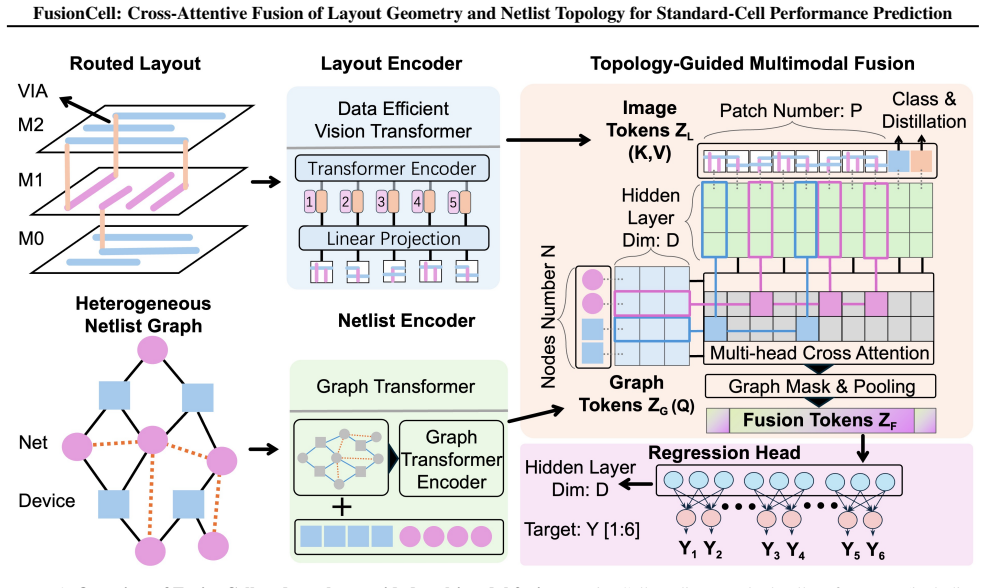
FusionCell treats routed layout geometry and netlist topology as dual modalities that are fused explicitly inside one model. A DeiT encoder processes the three-layer routed layout while a graph transformer models the heterogeneous device and net graph. These representations are integrated by a topology-guided mechanism in which the netlist acts as a structural map that actively queries the most relevant physical regions in the layout for joint geometric and topological reasoning. The resulting predictor targets six metrics—signal rise and fall delay, transition times, and power—on a 7 nm dataset of over 19,500 cells from 149 types generated automatically from the ASAP7 PDK.
What carries the argument
Topology-guided cross-attention fusion in which netlist nodes serve as queries that selectively attend to spatial regions inside the encoded layout representation.
If this is right
- Library development teams can evaluate thousands of cell variants in minutes rather than days of simulation time.
- Design-space exploration gains reliable ranking of cell options, improving choices for timing and power closure.
- The same fused representation can serve as a fast surrogate inside larger place-and-route or optimization loops.
- Characterization throughput increases by orders of magnitude, allowing more exhaustive library coverage within fixed compute budgets.
Where Pith is reading between the lines
- If the cross-modal fusion proves robust, similar topology-guided attention could be applied to predict full-chip timing or power from floorplan and netlist data.
- The approach opens a route to closed-loop layout optimization where performance feedback is obtained in seconds instead of hours.
- Industrial adoption would require direct comparison against measured silicon data from multiple foundry nodes to confirm transfer beyond the training PDK.
Load-bearing premise
The automatically generated 19.5k cells from the ASAP7 PDK already contain enough variety of layout-dependent coupling and parasitics for the learned fusion to generalize to unseen cells and real design flows.
What would settle it
Evaluating the trained model on standard cells drawn from a different process design kit or from silicon measurements and observing average MAPE well above 1 percent on the same six metrics would show that the learned fusion does not generalize as claimed.
Figures



read the original abstract
Standard cells form the building blocks of digital circuits, so their delay and power critically influence chip-level performance; yet characterization still relies on slow simulation sweeps, and many fast predictors ignore layout geometry, missing coupling and layout-dependent effects. The challenge is to jointly represent layout geometry and netlist topology so models capture fine-grained spatial details together with structural connectivity for accurate performance prediction. We introduce FusionCell, a dual-modality predictor that treats routed layout geometry and netlist topology as inputs and fuses them explicitly in a unified model. A DeiT encoder processes three-layer routed layouts, while a graph transformer models heterogeneous device/net graphs. The modalities are integrated through a topology-guided mechanism, where the netlist acts as a structural "map" to actively query relevant physical regions in the layout for joint geometric and topological reasoning. We build a 7nm dataset based on the ASAP7 PDK with over 19.5k cells spanning 149 types using automatic tools, targeting six metrics: signal rise/fall delay, transition, and power. Experimental results demonstrate that FusionCell reduces regression error, with an average MAPE of 0.92 percent, and improves Spearman/Kendall ranking over baselines, while accelerating the characterization process by orders of magnitude compared to circuit simulation.
Editorial analysis
A structured set of objections, weighed in public.
Referee Report
Summary. The paper introduces FusionCell, a dual-modality architecture that fuses routed layout geometry (via DeiT encoder on three-layer layouts) with netlist topology (via graph transformer on heterogeneous device/net graphs) through a topology-guided cross-attentive mechanism. The model is trained to regress six performance metrics (rise/fall delay, transition time, power) on a dataset of 19.5k automatically generated standard cells spanning 149 types from the ASAP7 7nm PDK. It claims an average MAPE of 0.92%, improved Spearman/Kendall ranking correlations over baselines, and orders-of-magnitude speedup relative to full circuit simulation.
Significance. If the central performance claims hold under proper validation, the work could meaningfully accelerate standard-cell library characterization in VLSI flows by replacing slow simulation sweeps with fast, layout-aware predictions. The explicit cross-attentive fusion addresses a recognized gap where pure netlist or pure geometry models miss coupling and layout-dependent parasitics. The scale of the generated dataset (19.5k cells) provides a useful training resource, and the reproducible use of open PDK tools is a positive attribute.
major comments (2)
- [§4 and Table 2] §4 (Experimental Setup) and Table 2: the reported average MAPE of 0.92% and ranking improvements are presented without specifying baseline implementations, train/test split strategy, statistical significance tests, or error bars; this information is load-bearing for the claim that the fusion mechanism itself drives the gains rather than dataset artifacts or implementation differences.
- [§3.2 and §5] §3.2 (Dataset) and §5 (Discussion): the generalizability claim rests on the untested assumption that automatically generated ASAP7 cells contain representative layout-dependent coupling, parasitics, and routing patterns; no ablation or hold-out experiments on foundry-specific DRCs, multi-patterning, or irregular placements are shown, which directly affects whether the cross-attentive fusion captures the intended physics beyond the synthetic distribution.
minor comments (2)
- [§3.3] The description of the topology-guided query mechanism in §3.3 would benefit from a diagram or pseudocode to clarify how netlist nodes actively attend to layout regions.
- [§2] Missing references to prior work on layout-aware timing models (e.g., recent graph-neural or vision-transformer approaches in EDA) in the related-work section.
Simulated Author's Rebuttal
We thank the referee for the constructive and detailed feedback on our manuscript. The comments highlight important aspects of experimental rigor and generalizability that we address point by point below. We indicate where revisions will be incorporated to strengthen the paper.
read point-by-point responses
-
Referee: [§4 and Table 2] §4 (Experimental Setup) and Table 2: the reported average MAPE of 0.92% and ranking improvements are presented without specifying baseline implementations, train/test split strategy, statistical significance tests, or error bars; this information is load-bearing for the claim that the fusion mechanism itself drives the gains rather than dataset artifacts or implementation differences.
Authors: We agree that these details are essential to substantiate our performance claims. In the revised manuscript, we will expand §4 to provide: complete descriptions of all baseline implementations (including architectures, hyperparameters, and training protocols); the exact train/test split strategy (including ratio, stratification by cell type, and any cross-validation procedure); results from statistical significance tests (e.g., paired t-tests or Wilcoxon signed-rank tests with p-values); and error bars (standard deviation across runs) in Table 2 and associated figures. These additions will be supported by updated supplementary material to demonstrate that gains arise from the topology-guided cross-attention rather than implementation or data artifacts. revision: yes
-
Referee: [§3.2 and §5] §3.2 (Dataset) and §5 (Discussion): the generalizability claim rests on the untested assumption that automatically generated ASAP7 cells contain representative layout-dependent coupling, parasitics, and routing patterns; no ablation or hold-out experiments on foundry-specific DRCs, multi-patterning, or irregular placements are shown, which directly affects whether the cross-attentive fusion captures the intended physics beyond the synthetic distribution.
Authors: We acknowledge this as a valid limitation of the current evaluation. Our dataset leverages the open ASAP7 PDK and automated generation for reproducibility, yet it cannot fully replicate proprietary foundry variations. In the revised §5 we will add an explicit limitations paragraph discussing this assumption and outlining future validation paths. We will also incorporate a new ablation in the experiments that holds out cell subsets with simulated routing irregularities and varied placement densities to probe the fusion mechanism's sensitivity to layout patterns. Experiments involving actual foundry DRCs or multi-patterning rules remain outside the present scope due to access constraints, but the proposed additions will better bound the claims. revision: partial
Circularity Check
No significant circularity; supervised regressor trained on external simulation labels
full rationale
The paper introduces a neural architecture (DeiT for layouts + graph transformer for netlists + topology-guided cross-attention) and trains it end-to-end as a supervised regressor on 19.5k simulation-generated labels for delay/power metrics. No equations or claims reduce a prediction to a fitted parameter by construction, no self-citation chain justifies a uniqueness result, and no ansatz is smuggled in. The reported MAPE and ranking gains are empirical outcomes on held-out cells from the same generated distribution; the derivation chain remains self-contained against the external simulation oracle.
Axiom & Free-Parameter Ledger
free parameters (1)
- DeiT and graph transformer training hyperparameters
Lean theorems connected to this paper
-
IndisputableMonolith/Cost/FunctionalEquation.leanwashburn_uniqueness_aczel unclear?
unclearRelation between the paper passage and the cited Recognition theorem.
A DeiT encoder processes three-layer routed layouts, while a graph transformer models heterogeneous device/net graphs. The modalities are integrated through a topology-guided mechanism, where the netlist acts as a structural 'map' to actively query relevant physical regions in the layout
-
IndisputableMonolith/Foundation/DimensionForcing.leanalexander_duality_circle_linking unclear?
unclearRelation between the paper passage and the cited Recognition theorem.
We build a 7nm dataset based on the ASAP7 PDK with over 19.5k cells spanning 149 types using automatic tools, targeting six metrics: signal rise/fall delay, transition, and power.
What do these tags mean?
- matches
- The paper's claim is directly supported by a theorem in the formal canon.
- supports
- The theorem supports part of the paper's argument, but the paper may add assumptions or extra steps.
- extends
- The paper goes beyond the formal theorem; the theorem is a base layer rather than the whole result.
- uses
- The paper appears to rely on the theorem as machinery.
- contradicts
- The paper's claim conflicts with a theorem or certificate in the canon.
- unclear
- Pith found a possible connection, but the passage is too broad, indirect, or ambiguous to say the theorem truly supports the claim.
Reference graph
Works this paper leans on
-
[1]
ISBN 979-8-4007-0635-6. doi: 10.1145/3658617.3703638. URL https://dl.acm. org/doi/10.1145/3658617.3703638. Cheng, X., Ye, Y ., He, G., Song, Q., and Cao, P. Hetero- geneous graph attention network based statistical timing library characterization with parasitic RC reduction. In 2024 29th Asia and South Pacific Design Automation Conference (ASP-DAC), pp. 1...
-
[2]
doi: 10.1109/ASP-DAC58780.2024
ISBN 979-8-3503-9354-5. doi: 10.1109/ASP-DAC58780.2024. 10473881. URL https://ieeexplore.ieee. org/document/10473881/. Clark, L. T., Vashishtha, V ., Shifren, L., Gujja, A., Sinha, S., Cline, B., Ramamurthy, C., and Yeric, G. Asap7: A 7-nm finfet predictive process design kit. Microelectronics Journal, 53:105–115,
-
[3]
doi: https://doi.org/10.1016/j.mejo.2016.04
ISSN 1879-2391. doi: https://doi.org/10.1016/j.mejo.2016.04
-
[4]
Dong, Z., Cao, W., Zhang, M., Tao, D., Chen, Y ., and Zhang, X
URL https://www.sciencedirect.com/ science/article/pii/S002626921630026X. Dong, Z., Cao, W., Zhang, M., Tao, D., Chen, Y ., and Zhang, X. CktGNN: Circuit graph neural network for electronic design automation. URL http://arxiv.org/abs/ 2308.16406. Dosovitskiy, A., Beyer, L., Kolesnikov, A., Weissenborn, D., Zhai, X., Unterthiner, T., Dehghani, M., Minderer...
-
[5]
URL https: //arxiv.org/abs/2010.11929. Guo, K. and Lin, Y . Multi-row standard cell layout synthesis with enhanced scalability. In2025 International Sympo- sium of Electronics Design Automation (ISEDA), pp. 317– 323,
work page internal anchor Pith review Pith/arXiv arXiv 2010
-
[6]
He, K., Zhang, X., Ren, S., and Sun, J
doi: 10.1109/ISEDA65950.2025.11101126. He, K., Zhang, X., Ren, S., and Sun, J. Deep residual learning for image recognition,
-
[7]
Deep Residual Learning for Image Recognition
URL https:// arxiv.org/abs/1512.03385. Kang, S.-M. and Leblebici, Y .CMOS Digital Integrated Circuits: Analysis and Design. McGraw-Hill, New York, NY , USA, 3rd edition,
work page internal anchor Pith review Pith/arXiv arXiv
-
[8]
doi: 10.1109/TCSI.2021.3069664
ISSN 1549-8328, 1558-0806. doi: 10.1109/TCSI.2021.3069664. URL https:// ieeexplore.ieee.org/document/9394564/. Klemme, F., Chauhan, Y ., Henkel, J., and Amrouch, H. Cell library characterization using machine learning for design technology co-optimization. InProceedings of the 39th International Conference on Computer-Aided Design, pp. 1–9. ACM,
-
[9]
ISBN 978-1-4503-8026-3. doi: 10.1145/3400302.3415713. URL https://dl. acm.org/doi/10.1145/3400302.3415713. Liu, L., Li, Y ., Lu, B., Shang, L., and Yang, F. GTN-cell: Efficient standard cell characterization using graph trans- former network. In2025 Design, Automation & Test in Europe Conference (DATE), pp. 1–7. IEEE,
-
[10]
ISBN 978-3-9826741-0-0. doi: 10.23919/DATE64628. 2025.10992976. URL https://ieeexplore. ieee.org/document/10992976/. Luo, Z., Zhou, L., Zhang, Z., Zhou, J., Li, Z., You, H., Yao, F., and Zhao, Z. Protocelllayout: Prototype-guided graph learning for accurate and generalizable standard cell layout ppa estimation. InProceedings of the 44th International Conf...
-
[11]
doi: 10.1109/ICCAD66269.2025. 11240788. Ma, T., Fan, G., Deng, Z., Sun, X., Low, K., and Shao, L. Fast cell library characterization for design technology co-optimization based on graph neural networks,
-
[12]
Mallik, A., Zuber, P., Liu, T.-T., Chava, B., Ballal, B., Del Bario, P
URLhttp://arxiv.org/abs/2312.12784. Mallik, A., Zuber, P., Liu, T.-T., Chava, B., Ballal, B., Del Bario, P. R., Baert, R., Croes, K., Ryckaert, J., Badaroglu, M., Mercha, A., and Verkest, D. TEASE: a systematic analysis framework for early evaluation of FinFET-based advanced technology nodes. InProceed- ings of the 50th Annual Design Automation Conference...
-
[13]
Multiple chip planning for chip- interposer codesign,
ISBN 978-1-4503-2071-9. doi: 10.1145/2463209.2488764. URL https://dl.acm. org/doi/10.1145/2463209.2488764. Pei, Z., Zhen, H.-L., Yuan, M., Huang, Y ., and Yu, B. Bet- terV: Controlled verilog generation with discriminative guidance. 10 FusionCell: Cross-Attentive Fusion of Layout Geometry and Netlist Topology for Standard-Cell Performance Prediction Shehz...
-
[14]
Shi, Z., Ma, C., Zheng, Z., Zhou, L., Pan, H., Jiang, W., Yang, F., Yang, X., Chu, Z., and Xu, Q
URLhttp://arxiv.org/abs/2407.09777. Shi, Z., Ma, C., Zheng, Z., Zhou, L., Pan, H., Jiang, W., Yang, F., Yang, X., Chu, Z., and Xu, Q. Deep- Cell: Self-supervised multiview fusion for circuit repre- sentation learning. URL http://arxiv.org/abs/ 2502.06816. Touvron, H., Cord, M., Douze, M., Massa, F., Sablayrolles, A., and J ´egou, H. Training data-efficien...
-
[15]
Training data-efficient image transformers & distillation through attention
URL https://arxiv.org/abs/2012.12877. Vaswani, A., Shazeer, N., Parmar, N., Uszkoreit, J., Jones, L., Gomez, A. N., Kaiser, L., and Polosukhin, I. Attention is all you need,
-
[16]
URL https://arxiv.org/ abs/1706.03762. Wang, M., Wen, Y ., Sun, B., Mu, J., Li, J., Wang, X., Ye, J., Yu, B., and Li, H. Bridging layout and RTL: Knowledge distillation based timing prediction. Weste, N. H. E. and Harris, D. M.CMOS VLSI De- sign: A Circuits and Systems Perspective. Addison- Wesley, Boston, MA, USA, 4th edition,
work page internal anchor Pith review Pith/arXiv arXiv
-
[17]
DeepLayout: Learning neural representations of circuit placement layout
Zhao, Y ., Chai, Z., Jiang, X., Xu, Q., Wang, R., and Lin, Y . DeepLayout: Learning neural representations of circuit placement layout. Zhu, K., Chen, H., Turner, W. J., Kokai, G. F., Wei, P.-H., Pan, D. Z., and Ren, H. TAG: Learning circuit spatial embedding from layouts. URL http://arxiv.org/ abs/2209.03465. 11
discussion (0)
Sign in with ORCID, Apple, or X to comment. Anyone can read and Pith papers without signing in.