The third wheel: ringdown and lensing of triple systems
Pith reviewed 2026-05-21 01:52 UTC · model grok-4.3
The pith
Numerical relativity simulations of black hole head-on collisions near a companion show Doppler and gravitational redshifts in the ringdown along with lensing amplification.
A machine-rendered reading of the paper's core claim, the machinery that carries it, and where it could break.
Core claim
In fully nonlinear numerical relativity simulations of head-on black hole collisions in the presence of a companion black hole, the ringdown phase displays Doppler and gravitational redshift, gravitational lensing amplifies the emitted waves with occasional appearance of a second image and hints of resonant mode excitation, and lensed gravitational radiation does not lead to collapse into black holes even in extreme setups.
What carries the argument
Fully nonlinear numerical relativity simulations of head-on black hole collisions with a third companion black hole that track the dynamics, wave generation, and propagation effects including redshift and lensing.
If this is right
- Ringdown signals from black hole mergers carry detectable imprints of nearby massive companions through combined Doppler and gravitational redshift.
- Gravitational lensing by a companion black hole amplifies the amplitude of gravitational waves from the merger event.
- Certain geometries produce a second distinct image of the merger in the observed waveform.
- The companion can excite resonant modes in the ringdown of the merged black hole.
- Lensed gravitational waves in triple systems do not trigger formation of new black holes even at high intensities.
Where Pith is reading between the lines
- These redshift and lensing signatures could alter how signals from mergers in dense stellar environments are interpreted by current detectors.
- Future gravitational wave catalogs might use anomalous ringdown features to flag the presence of undetected companions.
- Similar effects warrant investigation in other strong-field multi-body configurations such as hierarchical triples or galactic-center dynamics.
Load-bearing premise
The numerical relativity simulations accurately capture the fully nonlinear dynamics and gravitational wave propagation without dominant numerical artifacts or resolution-dependent biases.
What would settle it
Higher-resolution simulations or independent codes applied to the same initial data that fail to reproduce the reported redshifts, lensing amplification, or second images would falsify the central claims.
Figures






read the original abstract
Triple systems have progressively been recognized as ubiquitous in our universe and provide a good testing ground for wave generation and propagation in nontrivial environments. We study the dynamics of triple systems in a fully nonlinear setting. In particular, we analyze numerical relativity simulations of head-on collisions of black holes in the presence of a companion. We show evidence for Doppler and gravitational redshift in the ringdown, and clear signs of amplification by lensing. In certain cases, we also show the appearance of a second image, with hints of resonant mode excitation. Our results pave the way for the understanding of mergers in the vicinity of massive companions. Even in extreme setups we do not find collapse to black holes from lensed gravitational radiation.
Editorial analysis
A structured set of objections, weighed in public.
Referee Report
Summary. The manuscript presents numerical relativity simulations of head-on black-hole collisions in the presence of a third companion. It reports evidence for Doppler and gravitational redshifts in the ringdown waveforms, clear lensing amplification, the appearance of a second image in some cases, hints of resonant mode excitation, and the absence of collapse to black holes from lensed gravitational radiation even in extreme configurations. The work is positioned as a step toward understanding mergers near massive companions.
Significance. If the numerical results hold, the study provides direct, fully nonlinear evidence for wave-propagation effects (redshift, lensing, and possible resonance) in triple systems that are inaccessible to perturbative or linearized treatments. The use of head-on collisions with a companion offers a controlled yet nontrivial testbed for gravitational-wave lensing and propagation in strong-field, multi-body spacetimes, with potential relevance to LISA-band signals influenced by nearby supermassive black holes. The direct integration of Einstein's equations without fitted parameters or self-referential derivations is a methodological strength.
major comments (2)
- [Results / Numerical methods] The central claims of redshift, lensing amplification, second-image formation, and resonant excitation all rest on the fidelity of the extracted waveforms. The abstract and results presentation supply no quantitative error bars, resolution studies, or convergence tests (e.g., agreement of ringdown frequencies and amplitudes to within a few percent between successive resolutions, or stability of amplification factors under changes in extraction radius or gauge). Without such validation, it is impossible to assess whether the reported subtle effects exceed truncation error, numerical dispersion, or gauge artifacts.
- [Discussion / Extreme setups] The claim that 'even in extreme setups we do not find collapse to black holes from lensed gravitational radiation' is load-bearing for the overall narrative yet is stated without supporting diagnostics such as apparent-horizon searches, curvature invariants, or energy-density thresholds that would demonstrate the absence of collapse is physical rather than a resolution-limited outcome.
minor comments (2)
- [Abstract] The abstract states that 'evidence was found' but does not specify the quantitative measures (frequency shifts, amplitude ratios, or image separation) used to identify the reported effects; adding these metrics would improve clarity.
- [Methods] Initial-data details (masses, separations, boost parameters) and the precise gauge and extraction procedures should be summarized with references to standard NR codes or papers to allow reproducibility.
Simulated Author's Rebuttal
We thank the referee for their careful reading and constructive comments, which have helped us improve the clarity and rigor of our presentation. We address the major comments point by point below.
read point-by-point responses
-
Referee: The central claims of redshift, lensing amplification, second-image formation, and resonant excitation all rest on the fidelity of the extracted waveforms. The abstract and results presentation supply no quantitative error bars, resolution studies, or convergence tests (e.g., agreement of ringdown frequencies and amplitudes to within a few percent between successive resolutions, or stability of amplification factors under changes in extraction radius or gauge). Without such validation, it is impossible to assess whether the reported subtle effects exceed truncation error, numerical dispersion, or gauge artifacts.
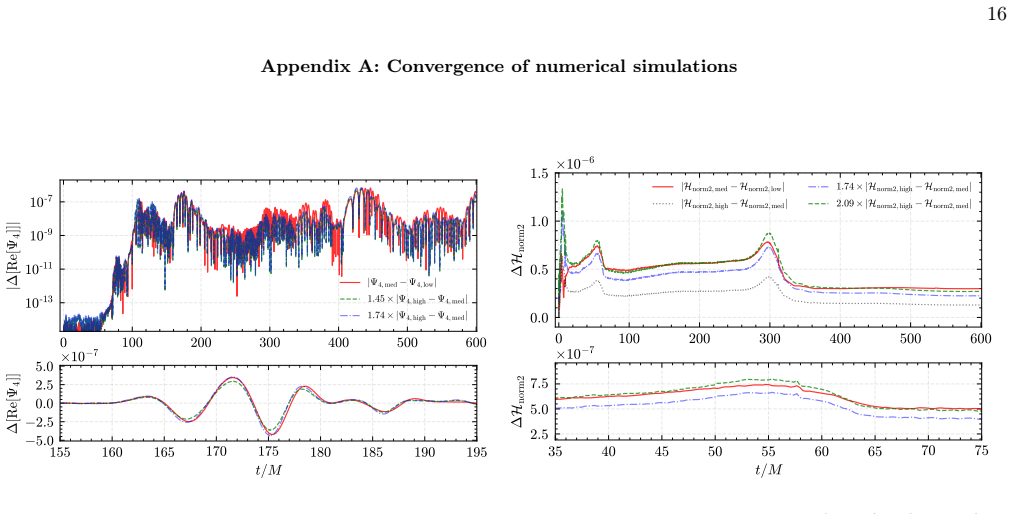
Authors: We acknowledge that the initial manuscript did not include explicit quantitative convergence tests or error estimates in the main text or abstract. The simulations were performed using multiple resolutions, and the reported redshift, lensing amplification, and second-image features remain consistent across these runs, with ringdown frequencies agreeing to within a few percent of the expected values for head-on mergers. We have revised the manuscript to add a dedicated subsection on numerical methods and validation, including tables comparing key waveform quantities (frequencies, amplitudes, and amplification factors) between successive resolutions and different extraction radii. Error estimates derived from these comparisons have been incorporated into the relevant figures and discussion. revision: yes
-
Referee: The claim that 'even in extreme setups we do not find collapse to black holes from lensed gravitational radiation' is load-bearing for the overall narrative yet is stated without supporting diagnostics such as apparent-horizon searches, curvature invariants, or energy-density thresholds that would demonstrate the absence of collapse is physical rather than a resolution-limited outcome.
Authors: We agree that additional diagnostics strengthen this claim. In the simulations, apparent-horizon finders were used throughout the evolution, and no new horizons formed from the lensed radiation in the extreme configurations. We monitored the maximum value of the curvature invariant and energy density in the relevant regions and observed no indications of collapse. We have revised the manuscript to include these diagnostics explicitly, with a brief description of the horizon search results and time evolution of the curvature invariant for the extreme cases. A more exhaustive resolution study of the most extreme setups is computationally demanding and is noted as a direction for future work. revision: partial
Circularity Check
No significant circularity: results from direct NR integration of Einstein equations
full rationale
The paper reports outcomes from numerical relativity simulations of head-on black-hole collisions with a companion. Claims of Doppler/gravitational redshift in ringdown, lensing amplification, second images, and absence of collapse are extracted from the simulated waveforms. No derivation chain reduces a prediction or first-principles result to its own inputs by construction; there are no fitted parameters renamed as predictions, self-definitional steps, or load-bearing self-citations that collapse the central results to tautology. The work is self-contained against external benchmarks (numerical solution of the field equations) and receives the default low score for honest non-findings.
Axiom & Free-Parameter Ledger
Lean theorems connected to this paper
-
IndisputableMonolith/Foundation/AlexanderDuality.leanalexander_duality_circle_linking unclear?
unclearRelation between the paper passage and the cited Recognition theorem.
We employ the Einstein Toolkit... BSSN formulation... fourth-order finite differences... extraction of the Newman-Penrose scalar Ψ4... ringdown waves... Doppler and gravitational redshift... amplification by lensing... second image
What do these tags mean?
- matches
- The paper's claim is directly supported by a theorem in the formal canon.
- supports
- The theorem supports part of the paper's argument, but the paper may add assumptions or extra steps.
- extends
- The paper goes beyond the formal theorem; the theorem is a base layer rather than the whole result.
- uses
- The paper appears to rely on the theorem as machinery.
- contradicts
- The paper's claim conflicts with a theorem or certificate in the canon.
- unclear
- Pith found a possible connection, but the passage is too broad, indirect, or ambiguous to say the theorem truly supports the claim.
Reference graph
Works this paper leans on
-
[1]
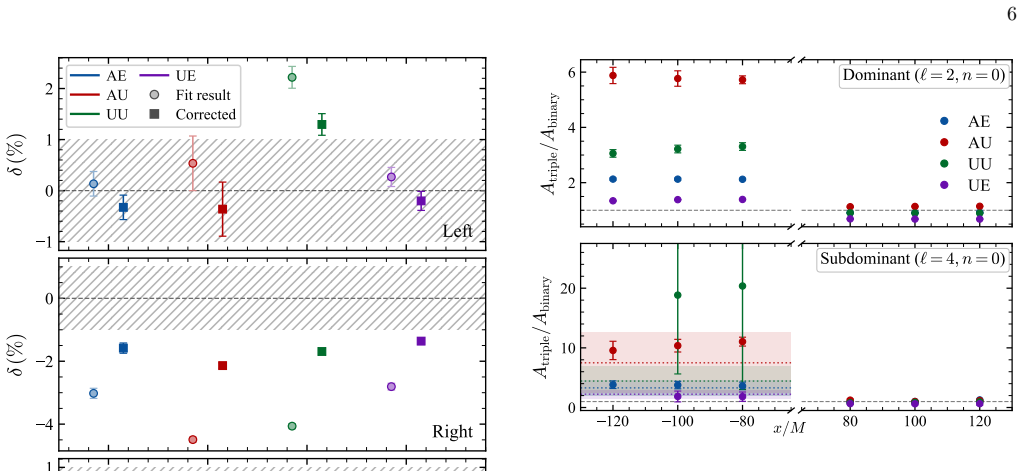
Doppler and gravitational shifts We expect the QNM frequencies observed to be grav- itationally and Doppler shifted. In order to test if this is an observable effect in our simulations, we ex- tract the frequency and damping time of the two dom- inant QNMs, at different observing points, for the four tripletconfigurationsofTableI.Weaveragetheextracted fre...
-
[2]
Amplification from lensing Next, we compare the extracted QNM amplitudes of the first ringdown stage with those from the reference binaries – ID AB and UB. These configurations are iden- tical to initial data AE and AU (for ID AB), and UU and UE (for ID UB), except that there is no BH companion, m1 = 0. Thus, one expects that the direct ringdown at extrac...
-
[3]
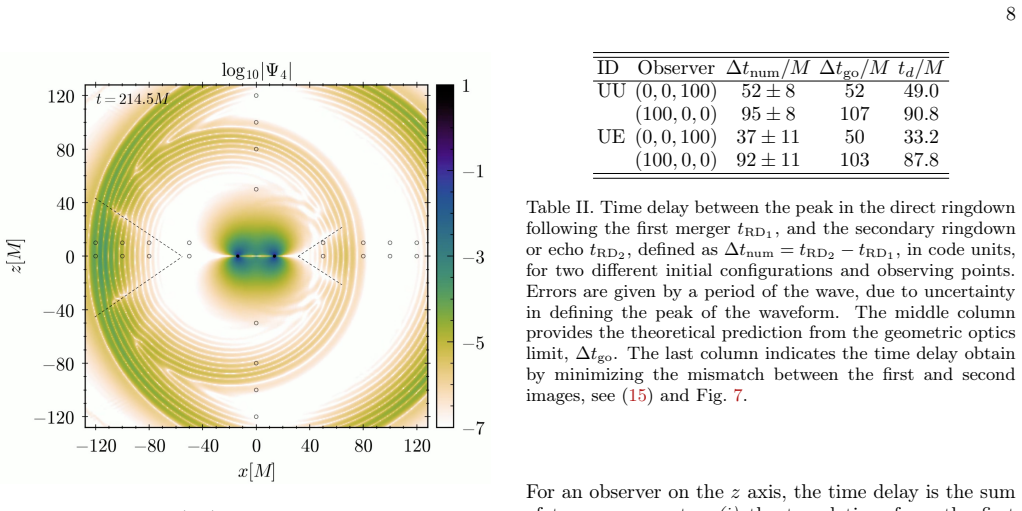
Interference fringes Interference is one of the defining properties of wave mechanics. When the first ringdown scatters off the lens, we expect to see an interference pattern, resulting from different paths taken aroundm1. This picture is clearly present in ID UU and UE. In Fig. 6 we show a snapshot of the curvature scalar Ψ4 for ID UU where interference ...
-
[4]
Other modes We have also investigated the presence of nonlinear modes in the signal. By considering a hybrid model, where we fix the signal to contain theℓ= 2,4fun- damental modes, and one additional free frequency, we find some evidence of a quadratic QNM with frequency ω∼2ω 2,0. More accurate simulations and parameter estimation techniques will be neces...
-
[5]
Time delay between images Theobserveddelaytimebetweenmaindirectpulseand second image can be compared against a simple predic- tion in the geometric optics. Take a gravitational wave as aparticleonanullgeodesic, withquasinormalmodescor- responding to trapped particles in the light ring [62, 110]. ID Observer∆t num/M∆t go/M t d/M UU(0,0,100) 52±85249.0 (100...
-
[6]
The smaller amplitude of this signal hinders an analysis of the amplification akin to Sec
Properties of the lensed ringdown WeexaminefurtherthesecondaryimageinFig.7. The smaller amplitude of this signal hinders an analysis of the amplification akin to Sec. IIIB2. Thus we instead em- ploy a simpler analysis based entirely on the geometric optics limit. Notice that the ringdown is quite monochro- matic — in the frequency domain, all frequencies ...
-
[7]
Black holes: gravita- tional engines of discovery
New modes in secondary images We can now examine the second ringdown in more de- tail. As evidenced by Fig. 7, this second image is not an exact copy of the first image – we expect this to be man- ifest in its mode content. Theoretically, we expect two things: (i)thefirstimageshouldhavemodesthatarered- shifted, when extracting in the positivex-axis, where...
work page 2020
-
[8]
Black hole hair: twenty--five years after
Jacob D. Bekenstein, “Black hole hair: 25 - years after,” in2nd International Sakharov Conference on Physics (1996) pp. 216–219, arXiv:gr-qc/9605059
work page internal anchor Pith review Pith/arXiv arXiv 1996
-
[9]
Has the black hole equilibrium problem been solved?
B. Carter, “Has the black hole equilibrium problem been solved?” in8th Marcel Grossmann Meeting on Recent Developments in Theoretical and Experimental General Relativity, Gravitation and Relativistic Field Theories (MG 8)(1997) pp. 136–155, arXiv:gr-qc/9712038
work page internal anchor Pith review Pith/arXiv arXiv 1997
-
[10]
Stationary Black Holes: Uniqueness and Beyond
Piotr T. Chrusciel, Joao Lopes Costa, and Markus Heusler, “Stationary Black Holes: Uniqueness and Be- yond,” Living Rev. Rel.15, 7 (2012), arXiv:1205.6112 [gr-qc]
work page internal anchor Pith review Pith/arXiv arXiv 2012
-
[11]
Uniqueness of the Kerr black hole,
D. C. Robinson, “Uniqueness of the Kerr black hole,” Phys. Rev. Lett.34, 905–906 (1975)
work page 1975
-
[12]
Testing the nature of dark compact objects: a status report
Vitor Cardoso and Paolo Pani, “Testing the nature of dark compact objects: a status report,” Living Rev. Rel. 22, 4 (2019), arXiv:1904.05363 [gr-qc]
work page internal anchor Pith review Pith/arXiv arXiv 2019
-
[13]
The Physics of Black Holes and Their Environments: Consequences for Gravitational Wave Science,
Vitor Cardoso, Shauvik Biswas, and Subhodeep Sarkar, “The Physics of Black Holes and Their Environments: Consequences for Gravitational Wave Science,” (2025) arXiv:2511.14841 [gr-qc]
-
[14]
Black holes in bi- nary systems. Observational appearance,
N. I. Shakura and R. A. Sunyaev, “Black holes in bi- nary systems. Observational appearance,” Astron. As- trophys.24, 337–355 (1973)
work page 1973
-
[15]
B. P. Abbottet al.(LIGO Scientific, Virgo), “Binary Black Hole Population Properties Inferred from the First and Second Observing Runs of Advanced LIGO and Advanced Virgo,” Astrophys. J. Lett.882, L24 (2019), arXiv:1811.12940 [astro-ph.HE]
-
[16]
Post-Newtonian Theory for Gravitational Waves
Luc Blanchet, “Post-Newtonian Theory for Gravi- tational Waves,” Living Rev. Rel.17, 2 (2014), arXiv:1310.1528 [gr-qc]
work page internal anchor Pith review Pith/arXiv arXiv 2014
-
[17]
Zvi Bern, Clifford Cheung, Radu Roiban, Chia-Hsien Shen, MikhailP.Solon, andMaoZeng,“ScatteringAm- plitudes and the Conservative Hamiltonian for Binary Systems at Third Post-Minkowskian Order,” Phys. Rev. Lett.122, 201603 (2019), arXiv:1901.04424 [hep-th]
work page internal anchor Pith review Pith/arXiv arXiv 2019
-
[18]
Inspiral, merger and ring-down of equal-mass black-hole binaries
Alessandra Buonanno, Gregory B. Cook, and Frans Pretorius, “Inspiral, merger and ring-down of equal- mass black-hole binaries,” Phys. Rev. D75, 124018 (2007), arXiv:gr-qc/0610122
work page internal anchor Pith review Pith/arXiv arXiv 2007
-
[19]
Inspiral, merger and ringdown of unequal mass black hole binaries: a multipolar analysis
Emanuele Berti, Vitor Cardoso, Jose A. Gonzalez, Ul- rich Sperhake, Mark Hannam, Sascha Husa, and Bernd Bruegmann, “Inspiral, merger and ringdown of unequal mass black hole binaries: A Multipolar analysis,” Phys. Rev. D76, 064034 (2007), arXiv:gr-qc/0703053
work page internal anchor Pith review Pith/arXiv arXiv 2007
-
[20]
Scheel et al.,The SXS collaboration’s third catalog of binary black hole simulations,Class
Mark A. Scheelet al., “The SXS collaboration’s third catalog of binary black hole simulations,” Class. Quant. 12 Grav.42, 195017 (2025), arXiv:2505.13378 [gr-qc]
-
[21]
Black hole spectroscopy: from theory to experiment
Emanuele Bertiet al., “Black hole spectroscopy: from theory to experiment,” (2025), arXiv:2505.23895 [gr- qc]
work page internal anchor Pith review Pith/arXiv arXiv 2025
-
[22]
Rapid and Bright Stellar-mass Binary Black Hole Mergers in Active Galactic Nuclei
Imre Bartos, Bence Kocsis, Zolt Haiman, and Szabolcs Márka, “Rapid and Bright Stellar-mass Binary Black Hole Mergers in Active Galactic Nuclei,” Astrophys. J. 835, 165 (2017), arXiv:1602.03831 [astro-ph.HE]
work page internal anchor Pith review Pith/arXiv arXiv 2017
-
[23]
Assisted Inspirals of Stellar Mass Black Holes Embedded in AGN Disks: Solving the "Final AU Problem"
Nicholas C. Stone, Brian D. Metzger, and Zoltán Haiman, “Assisted inspirals of stellar mass black holes embedded in AGN discs: solving the ‘final au prob- lem’,” Mon.Not.Roy.Astron.Soc.464,946–954(2017), arXiv:1602.04226 [astro-ph.GA]
work page internal anchor Pith review Pith/arXiv arXiv 2017
-
[24]
Peng Peng, Alessia Franchini, Matteo Bonetti, Alberto Sesana, and Xian Chen, “The Fate of EMRI-IMRI Pairs in Active Galactic Nucleus Accretion Disks: Hy- drodynamical and Three-body Simulations,” Astrophys. J.989, 122 (2025), arXiv:2411.16070 [astro-ph.HE]
-
[25]
Observing GW190521-like binary black holes and their environment with LISA,
Laura Sbernaet al., “Observing GW190521-like binary black holes and their environment with LISA,” Phys. Rev. D106, 064056 (2022), arXiv:2205.08550 [gr-qc]
-
[26]
The Evolution of Inclined Binary Black Holes in the Disks of Active Galactic Nuclei,
Alexander J. Dittmann, Adam M. Dempsey, and Hui Li, “The Evolution of Inclined Binary Black Holes in the Disks of Active Galactic Nuclei,” Astrophys. J.964, 61 (2024), arXiv:2310.03832 [astro-ph.HE]
-
[27]
Indication for a Com- pact Object Next to a LIGO–Virgo Binary Black Hole Merger,
Shu-Cheng Yang, Wen-Biao Han, Hiromichi Tagawa, Song Li, Ye Jiang, Ping Shen, Qianyun Yun, Chen Zhang, and Xing-Yu Zhong, “Indication for a Com- pact Object Next to a LIGO–Virgo Binary Black Hole Merger,” Astrophys. J. Lett.988, L41 (2025), arXiv:2401.01743 [astro-ph.HE]
-
[28]
A. G. Abacet al.(LIGO Scientific, Virgo, KAGRA), “GW241011 and GW241110: Exploring Binary Forma- tion and Fundamental Physics with Asymmetric, High- spin Black Hole Coalescences,” Astrophys. J. Lett.993, L21 (2025), arXiv:2510.26931 [astro-ph.HE]
-
[29]
Detection of GW200105 with a targeted eccentric search
Khun Sang Phukon, Patricia Schmidt, Gonzalo Mor- ras, andGeraintPratten,“DetectionofGW200105with a targeted eccentric search,” (2025), arXiv:2512.10803 [gr-qc]
work page internal anchor Pith review Pith/arXiv arXiv 2025
-
[30]
GW231123: a product of successive mergers from∼10stellar-mass black holes,
Yin-Jie Li, Shan-Peng Tang, Ling-Qin Xue, and Yi-Zhong Fan, “GW231123: a product of successive mergers from∼10stellar-mass black holes,” (2025), arXiv:2507.17551 [astro-ph.HE]
-
[31]
In-plane Black-hole Spin Measure- ments Suggest Most Gravitational-wave Mergers Form in Triples,
Jakob Stegmann, Fabio Antonini, Aleksandra Olejak, Sylvia Biscoveanu, Vivien Raymond, Stefano Rinaldi, and Beth Flanagan, “In-plane Black-hole Spin Measure- ments Suggest Most Gravitational-wave Mergers Form in Triples,” (2025), arXiv:2512.15873 [astro-ph.HE]
-
[32]
A New Type of Extreme-mass-ratio Inspirals Produced by Tidal Capture of Binary Black Holes
Xian Chen and Wen-Biao Han, “A New Type of Extreme-mass-ratio Inspirals Produced by Tidal Cap- ture of Binary Black Holes,” Communications Physics 1, 53 (2018), arXiv:1801.05780 [astro-ph.HE]
work page internal anchor Pith review Pith/arXiv arXiv 2018
-
[33]
Testing general relativity using binary extreme-mass-ratio inspirals
Wen-Biao Han and Xian Chen, “Testing general relativity using binary extreme-mass-ratio inspirals,” Mon. Not. Roy. Astron. Soc.485, L29–L33 (2019), arXiv:1801.07060 [gr-qc]
work page internal anchor Pith review Pith/arXiv arXiv 2019
-
[34]
Relativistic model of binary extreme-mass- ratio inspiral systems and their gravitational radiation,
Yucheng Yin, Josh Mathews, Alvin J. K. Chua, and Xian Chen, “Relativistic model of binary extreme-mass- ratio inspiral systems and their gravitational radiation,” Phys. Rev. D111, 103007 (2025), arXiv:2410.09796 [gr- qc]
-
[35]
Distinguishability of binary extreme-mass-ratio inspirals in low frequency band,
Ye Jiang, Wen-Biao Han, Xing-Yu Zhong, Ping Shen, Zi-Ren Luo, and Yue-Liang Wu, “Distinguishability of binary extreme-mass-ratio inspirals in low frequency band,” Eur. Phys. J. C84, 478 (2024)
work page 2024
-
[36]
Eccentric Black Hole Mergers in Dense Star Clusters: The Role of Binary-Binary Encounters
Michael Zevin, Johan Samsing, Carl Rodriguez, Carl- Johan Haster, and Enrico Ramirez-Ruiz, “Eccentric Black Hole Mergers in Dense Star Clusters: The Role of Binary–Binary Encounters,” Astrophys. J.871, 91 (2019), arXiv:1810.00901 [astro-ph.HE]
work page internal anchor Pith review Pith/arXiv arXiv 2019
-
[37]
Formation and Evolution of Compact Object Bi- naries in AGN Disks,
Hiromichi Tagawa, Zoltan Haiman, and Bence Koc- sis, “Formation and Evolution of Compact Object Bi- naries in AGN Disks,” Astrophys. J.898, 25 (2020), arXiv:1912.08218 [astro-ph.GA]
-
[38]
Black Hole Mergers from Hierarchical Triples in Dense Star Clusters,
Miguel A. S. Martinezet al., “Black Hole Mergers from Hierarchical Triples in Dense Star Clusters,” Astrophys. J.903, 67 (2020), arXiv:2009.08468 [astro-ph.GA]
-
[39]
Black Hole Mergers in Galactic Nuclei Induced by the Eccentric Kozai-Lidov Effect
Bao-Minh Hoang, Smadar Naoz, Bence Kocsis, Fred- eric A. Rasio, and Fani Dosopoulou, “Black Hole Mergers in Galactic Nuclei Induced by the Eccentric Kozai–Lidov Effect,” Astrophys. J.856, 140 (2018), arXiv:1706.09896 [astro-ph.HE]
work page internal anchor Pith review Pith/arXiv arXiv 2018
-
[40]
Migration Traps in Disks Around Supermassive Black Holes
Jillian M. Bellovary, Mordecai-Mark Mac Low, Barry McKernan, and K. E. Saavik Ford, “Migration Traps in Disks Around Supermassive Black Holes,” Astrophys. J. Lett.819, L17 (2016), arXiv:1511.00005 [astro-ph.GA]
work page internal anchor Pith review Pith/arXiv arXiv 2016
-
[41]
Black hole mergers and blue stragglers from hierarchical triples formed in globular clusters
Fabio Antonini, Sourav Chatterjee, Carl L. Ro- driguez, Meagan Morscher, Bharath Pattabiraman, Vicky Kalogera, and Frederic A. Rasio, “Black hole mergers and blue stragglers from hierarchical triples formed in globular clusters,” Astrophys. J.816, 65 (2016), arXiv:1509.05080 [astro-ph.GA]
work page internal anchor Pith review Pith/arXiv arXiv 2016
-
[42]
Spin wave optics for gravita- tional waves lensed by a Kerr black hole,
Kei-ichiro Kubota, Shun Arai, Hayato Motohashi, and Shinji Mukohyama, “Spin wave optics for gravita- tional waves lensed by a Kerr black hole,” (2024), arXiv:2408.03289 [gr-qc]
-
[43]
Martin Pijnenburg, Giulia Cusin, Cyril Pitrou, and Jean-Philippe Uzan, “Wave optics lensing of gravita- tional waves: Theory and phenomenology of triple sys- tems in the LISA band,” Phys. Rev. D110, 044054 (2024), arXiv:2404.07186 [gr-qc]
-
[44]
Lensing and wave optics in the strong field of a black hole,
Juno C. L. Chan, Conor Dyson, Matilde Garcia, Jaime Redondo-Yuste, and Luka Vujeva, “Lensing and wave optics in the strong field of a black hole,” (2025), arXiv:2502.14073 [gr-qc]
-
[45]
Repeated grav- itational lensing of gravitational waves in hierarchical black hole triples,
Daniel J. D’Orazio and Abraham Loeb, “Repeated grav- itational lensing of gravitational waves in hierarchical black hole triples,” Phys. Rev. D101, 083031 (2020), arXiv:1910.02966 [astro-ph.HE]
-
[46]
Marius A. Oancea, Richard Stiskalek, and Miguel Zu- malacárregui, “Frequency- and polarization-dependent lensing of gravitational waves in strong gravita- tional fields,” Phys. Rev. D109, 124045 (2024), arXiv:2209.06459 [gr-qc]
-
[47]
Marius A. Oancea, Richard Stiskalek, and Miguel Zu- malacárregui, “Probing general relativistic spin–orbit coupling with gravitational waves from hierarchical triple systems,” Mon. Not. Roy. Astron. Soc.535, L1– L6 (2024), arXiv:2307.01903 [gr-qc]
-
[48]
Helena Ubach, “Self-lensing of moving gravitational- wave sources can break the microlensing crossing timescale degeneracy,” (2025), arXiv:2512.08898 [astro- ph.HE]
-
[49]
Strong-field gravitational-wave lensing in the Kerr background,
M. V. S. Saketh, Rajes Ghosh, and Anuj Mishra, “Strong-field gravitational-wave lensing in the Kerr background,” Phys. Rev. D113, 084056 (2026), arXiv:2511.23110 [gr-qc]. 13
-
[50]
On the Doppler effect for light from orbiting sources in Kerr-type metrics
S. Cisneros, G. Goedecke, C. Beetle, and M. Engel- hardt, “On the Doppler effect for light from orbiting sources in Kerr-type metrics,” Mon. Not. Roy. Astron. Soc.448, 2733–2736 (2015), arXiv:1203.2502 [gr-qc]
work page internal anchor Pith review Pith/arXiv arXiv 2015
-
[51]
The effect of matter structure on the gravitational waveform
Camille Bonvin, Chiara Caprini, Riccardo Sturani, and Nicola Tamanini, “Effect of matter structure on the gravitational waveform,” Phys. Rev. D95, 044029 (2017), arXiv:1609.08093 [astro-ph.CO]
work page internal anchor Pith review Pith/arXiv arXiv 2017
-
[52]
Kohei Inayoshi, Nicola Tamanini, Chiara Caprini, and Zoltán Haiman, “Probing stellar binary black hole for- mation in galactic nuclei via the imprint of their cen- ter of mass acceleration on their gravitational wave sig- nal,” Phys. Rev. D96, 063014 (2017), arXiv:1702.06529 [astro-ph.HE]
work page internal anchor Pith review Pith/arXiv arXiv 2017
-
[53]
Detecting hierarchical stellar systems with LISA
Travis Robson, Neil J. Cornish, Nicola Tamanini, and Silvia Toonen, “Detecting hierarchical stellar sys- tems with LISA,” Phys. Rev. D98, 064012 (2018), arXiv:1806.00500 [gr-qc]
work page internal anchor Pith review Pith/arXiv arXiv 2018
-
[54]
Peculiar accel- eration of stellar-origin black hole binaries: Measure- ment and biases with LISA,
Nicola Tamanini, Antoine Klein, Camille Bonvin, En- rico Barausse, and Chiara Caprini, “Peculiar accel- eration of stellar-origin black hole binaries: Measure- ment and biases with LISA,” Phys. Rev. D101, 063002 (2020), arXiv:1907.02018 [astro-ph.IM]
-
[55]
Detecting triple systems with gravitational wave observations
Yohai Meiron, Bence Kocsis, and Abraham Loeb, “De- tecting triple systems with gravitational wave observa- tions,” Astrophys. J.834, 200 (2017), arXiv:1604.02148 [astro-ph.HE]
work page internal anchor Pith review Pith/arXiv arXiv 2017
-
[56]
Binary radial velocity measurements with space- based gravitational-wave detectors,
Kaze W. K. Wong, Vishal Baibhav, and Emanuele Berti, “Binary radial velocity measurements with space- based gravitational-wave detectors,” Mon. Not. Roy. Astron. Soc.488, 5665–5670 (2019), arXiv:1902.01402 [astro-ph.HE]
-
[57]
A Direct Probe of Mass Density Near Inspiraling Binary Black Holes
Lisa Randall and Zhong-Zhi Xianyu, “A Direct Probe of Mass Density Near Inspiraling Binary Black Holes,” Astrophys. J.878, 75 (2019), arXiv:1805.05335 [gr-qc]
work page internal anchor Pith review Pith/arXiv arXiv 2019
-
[58]
Calculating the gravitational waves emitted from high- speed sources,
Han Yan, Xian Chen, and Alejandro Torres-Orjuela, “Calculating the gravitational waves emitted from high- speed sources,” Phys. Rev. D107, 103044 (2023), arXiv:2305.04969 [gr-qc]
-
[59]
Lorenz Zwick, János Takátsy, Pankaj Saini, Kai Hen- driks, Johan Samsing, Christopher Tiede, Connar Rowan, and Alessandro A. Trani, “Environmental effects in stellar mass gravitational wave sources I: Expected fraction of signals with significant dephas- ing in the dynamical and AGN channels,” (2025), arXiv:2503.24084 [astro-ph.HE]
-
[60]
János Takátsy, Lorenz Zwick, Kai Hendriks, Pankaj Saini, Gaia Fabj, and Johan Samsing, “The construc- tion and use of dephasing prescriptions for environmen- tal effects in gravitational wave astronomy,” (2025), arXiv:2505.09513 [astro-ph.HE]
-
[61]
Detecting the Beaming Effect of Gravitational Waves,
Alejandro Torres-Orjuela, Xian Chen, Zhoujian Cao, Pau Amaro-Seoane, and Peng Peng, “Detecting the Beaming Effect of Gravitational Waves,” Phys. Rev. D 100, 063012 (2019), arXiv:1806.09857 [astro-ph.HE]
-
[62]
Phase shift of gravitational waves induced by aberration,
Alejandro Torres-Orjuela, Xian Chen, and Pau Amaro- Seoane, “Phase shift of gravitational waves induced by aberration,” Phys. Rev. D101, 083028 (2020), arXiv:2001.00721 [astro-ph.HE]
-
[63]
Alejandro Torres-Orjuela, Pau Amaro Seoane, Zeyuan Xuan, Alvin J. K. Chua, María J. B. Rosell, and Xian Chen, “Exciting Modes due to the Aberration of Gravitational Waves: Measurability for Extreme-Mass- Ratio Inspirals,” Phys. Rev. Lett.127, 041102 (2021), arXiv:2010.15842 [gr-qc]
-
[64]
Aberration of gravitational waveforms by pecu- liar velocity,
Camille Bonvin, Giulia Cusin, Cyril Pitrou, Simone Mastrogiovanni, Giuseppe Congedo, and Jonathan Gair, “Aberration of gravitational waveforms by pecu- liar velocity,” Mon. Not. Roy. Astron. Soc.525, 476–488 (2023), arXiv:2211.14183 [gr-qc]
-
[65]
Giulia Cusin, Cyril Pitrou, Camille Bonvin, Aurélien Barrau, and Killian Martineau, “Boosting gravitational waves: a review of kinematic effects on amplitude, po- larization, frequency and energy density,” Class. Quant. Grav.41, 225006 (2024), arXiv:2405.01297 [gr-qc]
-
[66]
Gravitational tuning forks and hierarchical triple systems,
Vitor Cardoso, Francisco Duque, and Gaurav Khanna, “Gravitational tuning forks and hierarchical triple systems,” Phys. Rev. D103, L081501 (2021), arXiv:2101.01186 [gr-qc]
-
[67]
Resonances in binary extreme mass ratio inspirals,
João S. Santos, Vitor Cardoso, Alexandru Lupsasca, José Natário, and Maarten van de Meent, “Resonances in binary extreme mass ratio inspirals,” Phys. Rev. D 113, 064025 (2026), arXiv:2601.02468 [gr-qc]
-
[68]
Strong-gravity precession resonances for binary systems orbiting a Schwarzschild black hole,
Marta Cocco, Gianluca Grignani, Troels Harmark, Marta Orselli, and Daniele Pica, “Strong-gravity precession resonances for binary systems orbiting a Schwarzschild black hole,” Phys. Rev. D112, 044010 (2025), arXiv:2505.15901 [gr-qc]
-
[69]
Quasinormal modes of black holes and black branes
Emanuele Berti, Vitor Cardoso, and Andrei O. Starinets, “Quasinormal modes of black holes and black branes,” Class. Quant. Grav.26, 163001 (2009), arXiv:0905.2975 [gr-qc]
work page internal anchor Pith review Pith/arXiv arXiv 2009
-
[70]
Black Hole Spectroscopy in Environments: Detectabil- ity Prospects,
Thomas F. M. Spieksma, Vitor Cardoso, Gregorio Carullo, Matteo Della Rocca, and Francisco Duque, “Black Hole Spectroscopy in Environments: Detectabil- ity Prospects,” Phys. Rev. Lett.134, 081402 (2025), arXiv:2409.05950 [gr-qc]
-
[71]
Geodesic struc- ture and quasinormal modes of a tidally per- turbed spacetime,
Vitor Cardoso and Arianna Foschi, “Geodesic struc- ture and quasinormal modes of a tidally per- turbed spacetime,” Phys. Rev. D104, 024004 (2021), arXiv:2106.06551 [gr-qc]
-
[72]
Takuya Katagiri and Vitor Cardoso, “The relativis- tic restricted three-body problem: geometry and mo- tion around tidally perturbed black holes,” (2026), arXiv:2601.14979 [gr-qc]
work page internal anchor Pith review Pith/arXiv arXiv 2026
-
[73]
Tidal perturbations of an extreme mass ra- tio inspiral around a Kerr black hole,
Marta Cocco, Gianluca Grignani, Troels Harmark, Marta Orselli, David Pereñiguez, and Maarten van de Meent, “Tidal perturbations of an extreme mass ra- tio inspiral around a Kerr black hole,” (2026), arXiv:2601.00954 [gr-qc]
-
[74]
João S. Santos, Vitor Cardoso, José Natário, and Maarten van de Meent, “Gravitational Waves from Bi- nary Extreme Mass Ratio Inspirals: Doppler Shift and Beaming, Resonant Excitation, Helicity Oscillations, and Self-Lensing,” Phys. Rev. Lett.135, 211402 (2025), arXiv:2506.14868 [gr-qc]
-
[75]
Emergent Turbulence in Nonlinear Gravity,
Sizheng Ma, Luis Lehner, Huan Yang, Lawrence E. Kidder, Harald P. Pfeiffer, and Mark A. Scheel, “Emergent Turbulence in Nonlinear Gravity,” (2025), arXiv:2508.13294 [gr-qc]
-
[76]
Nonlinear Dynamics in General Relativity,
Vitor Cardoso, Jaime Redondo-Yuste, Ulrich Sperhake, and Furkan Tuncer, “Nonlinear Dynamics in General Relativity,” (2026), arXiv:2603.04501 [gr-qc]
-
[77]
Self-force framework for transition- to-plunge waveforms,
Lorenzo Küchler, Geoffrey Compère, Leanne Durkan, and Adam Pound, “Self-force framework for transition- to-plunge waveforms,” SciPost Phys.17, 056 (2024), arXiv:2405.00170 [gr-qc]
-
[78]
Close encounters of three black holes
Manuela Campanelli, Carlos O. Lousto, and Yosef Zlo- 14 chower, “Close encounters of three black holes,” Phys. Rev. D77, 101501 (2008), arXiv:0710.0879 [gr-qc]
work page internal anchor Pith review Pith/arXiv arXiv 2008
-
[79]
Foundations of multiple black hole evolutions
Carlos O. Lousto and Yosef Zlochower, “Foundations of multipleblackholeevolutions,” Phys.Rev.D77,024034 (2008), arXiv:0711.1165 [gr-qc]
work page internal anchor Pith review Pith/arXiv arXiv 2008
-
[80]
Extreme gravitational interactions in the prob- lem of three black holes in general relativity,
Mario Imbrogno, Claudio Meringolo, and Sergio Ser- vidio, “Extreme gravitational interactions in the prob- lem of three black holes in general relativity,” Class. Quant. Grav.40, 075008 (2023), arXiv:2108.01392 [gr- qc]
discussion (0)
Sign in with ORCID, Apple, or X to comment. Anyone can read and Pith papers without signing in.