Recognition: 2 theorem links
· Lean TheoremThe relativistic restricted three-body problem: geometry and motion around tidally perturbed black holes
Pith reviewed 2026-05-16 12:14 UTC · model grok-4.3
The pith
Increasing tidal strength around a rotating black hole drives bound geodesics through four stages ending in no stable orbits.
A machine-rendered reading of the paper's core claim, the machinery that carries it, and where it could break.
Core claim
In the relativistic restricted three-body problem around a tidally deformed black hole, bound geodesics transition with rising tidal amplitude through weak chaos within bound motion, plunging trajectories, unbinding of remaining paths, and complete loss of bound orbits, accompanied by estimates for the critical tidal strengths at each stage.
What carries the argument
The tidally perturbed Kerr metric and the associated timelike geodesics, analyzed within an adiabatically evolving binary setup to model local structural changes in the restricted three-body problem.
Load-bearing premise
The description assumes test particles that do not back-react on the spacetime metric and that the binary evolves adiabatically with slow changes in parameters relative to orbital times.
What would settle it
Detection of bound orbits persisting at tidal amplitudes above the estimated critical value for complete depletion, perhaps through timing of orbits in a binary black hole system or signals from accreting matter.
Figures


read the original abstract
We investigate the geometry of a tidally deformed, rotating black hole and timelike geodesics in its vicinity. Our framework provides a local picture of the structural evolution of a relativistic restricted three-body problem around a deformed black hole in an adiabatically evolving binary, motivated by various astrophysical settings including disk dynamics and extreme mass-ratio inspirals. As the tidal-field strength is increased, initially regular, bound geodesics undergo four stages: (i) weak chaos emerges within the bound motion; (ii) a subset of trajectories plunges into the black hole; (iii) a fraction of the remaining trajectories becomes unbound; and (iv) no bound trajectories persist. We provide semi-analytic estimates for the critical tidal amplitudes associated with each transition. Our estimates, within the idealized test-particle description, indicate that, within the frequency band of ground-based gravitational-wave detectors, the matter flow around black holes may already be depleted, whereas LISA and (B-)DECIGO could probe the earlier stages. Our results suggest that an object orbiting a tidally deformed massive black hole may remain near resonances in a long term, indicating an accumulated, non-negligible impact on the gravitational-wave phase. Another finding is that tidal perturbations can modulate nonlinear couplings among epicyclic oscillations of geodesics, and could therefore, in principle, affect resonant excitation mechanism potentially relevant to quasi-periodic oscillations in X-ray light curves from accreting black holes.
Editorial analysis
A structured set of objections, weighed in public.
Referee Report
Summary. The manuscript examines the geometry of tidally deformed rotating black holes and the motion of timelike geodesics in their vicinity within the relativistic restricted three-body problem. It identifies four stages of evolution for initially regular bound geodesics as the tidal field strength increases: (i) emergence of weak chaos, (ii) plunging into the black hole, (iii) becoming unbound, and (iv) complete depletion of bound trajectories. Semi-analytic estimates for the critical tidal amplitudes at each transition are provided, with discussions on implications for gravitational-wave observations in different detector bands and for quasi-periodic oscillations in accreting black holes.
Significance. If the results hold within the stated approximations, the work offers a local picture of structural evolution in binaries involving black holes, potentially relevant to extreme mass-ratio inspirals and disk dynamics. The provision of semi-analytic estimates for critical amplitudes is a notable strength, allowing for concrete predictions about when bound motion persists or depletes. This could inform interpretations of gravitational-wave signals and X-ray light curves from black hole systems.
major comments (1)
- [Abstract] Abstract: the four-stage sequence and semi-analytic critical amplitudes are derived entirely within the test-particle limit on a static (or adiabatically frozen) tidally deformed background. No quantitative threshold (e.g., mass-ratio or inspiral-time-scale bound) is supplied at which the no-backreaction and slow-evolution assumptions fail, which is load-bearing for the applicability claims to LIGO and LISA bands.
minor comments (1)
- [Abstract] Abstract: the abstract mentions 'semi-analytic estimates' but does not specify the method or validation approach used to derive the critical amplitudes.
Simulated Author's Rebuttal
We thank the referee for the careful reading and constructive feedback. The major comment highlights an important point about the regime of validity of our test-particle analysis. We address it below and have revised the manuscript to strengthen the discussion of applicability without extending the scope beyond the geodesic problem.
read point-by-point responses
-
Referee: [Abstract] Abstract: the four-stage sequence and semi-analytic critical amplitudes are derived entirely within the test-particle limit on a static (or adiabatically frozen) tidally deformed background. No quantitative threshold (e.g., mass-ratio or inspiral-time-scale bound) is supplied at which the no-backreaction and slow-evolution assumptions fail, which is load-bearing for the applicability claims to LIGO and LISA bands.
Authors: We agree that explicit quantitative thresholds would better support the applicability statements. Our framework is deliberately limited to timelike geodesics on a fixed, adiabatically deformed background in order to isolate the geometric and dynamical effects of tidal deformation. Determining precise mass-ratio or timescale bounds at which backreaction or non-adiabatic evolution invalidates the approximation would require a self-consistent radiation-reaction calculation, which lies outside the present scope. We have added a dedicated paragraph in the Discussion section that supplies order-of-magnitude estimates drawn from the EMRI literature: the adiabatic approximation remains valid for mass ratios q ≲ 10^{-4} over timescales of many orbital periods, while backreaction on the background is negligible for the local geodesic dynamics considered here. We have also revised the abstract and introduction to qualify the detector-band statements as applying within the test-particle, adiabatic limit, thereby clarifying that the LIGO-band depletion claim is indicative rather than quantitative for comparable-mass systems. revision: partial
Circularity Check
No circularity: semi-analytic critical amplitudes derived from geodesic integration on fixed deformed metric
full rationale
The four-stage sequence and critical tidal amplitudes are obtained by direct numerical integration of timelike geodesics in an explicitly constructed tidally perturbed metric (test-particle limit, adiabatically frozen background). No step reduces a claimed prediction to a fitted parameter taken from the same data set, nor does any load-bearing premise collapse to a self-citation whose content is itself unverified. The test-particle and slow-evolution assumptions are stated as modeling choices, not derived from the paper's own equations. The derivation chain therefore remains self-contained against external benchmarks.
Axiom & Free-Parameter Ledger
axioms (3)
- standard math Timelike geodesics govern test-particle motion in the deformed spacetime
- domain assumption Test-particle limit with no back-reaction
- domain assumption Adiabatic evolution of the binary
Lean theorems connected to this paper
-
IndisputableMonolith/Foundation/AlexanderDuality.leanalexander_duality_circle_linking unclear?
unclearRelation between the paper passage and the cited Recognition theorem.
As the tidal-field strength is increased, initially regular, bound geodesics undergo four stages: (i) weak chaos... (iv) no bound trajectories persist. We provide semi-analytic estimates for the critical tidal amplitudes
-
IndisputableMonolith/Cost/FunctionalEquation.leanwashburn_uniqueness_aczel unclear?
unclearRelation between the paper passage and the cited Recognition theorem.
Effective potential V = (1−r+/r)(1+L̂²/r²) − ε(1+3cos2φ)...
What do these tags mean?
- matches
- The paper's claim is directly supported by a theorem in the formal canon.
- supports
- The theorem supports part of the paper's argument, but the paper may add assumptions or extra steps.
- extends
- The paper goes beyond the formal theorem; the theorem is a base layer rather than the whole result.
- uses
- The paper appears to rely on the theorem as machinery.
- contradicts
- The paper's claim conflicts with a theorem or certificate in the canon.
- unclear
- Pith found a possible connection, but the passage is too broad, indirect, or ambiguous to say the theorem truly supports the claim.
Reference graph
Works this paper leans on
-
[1]
Astrophysical implications 10 A
Effective potential 7 2.ϵ − c : from bound phase to chaotic phase 8 3.ϵ + c : from chaotic phase to collapsing phase 9 4.ϵ 0 c: from collapsing phase to depleted phase 10 V. Astrophysical implications 10 A. Structural evolution of accretion disks 10 B. EMRIs in a tidal environment 11 C. Imprints on GW observations 11 VI. Summary 12 Acknowledgments 13 A. T...
-
[2]
Background null tetrad 13
-
[3]
Reconstruction of a tidally deformed metric 15
Stationary tidal perturbations 14 B. Reconstruction of a tidally deformed metric 15
-
[4]
Metric reconstruction 15 C. Tidally deformed Schwarzschild metric 17 References 18 I. INTRODUCTION Gravitational-wave (GW) astronomy paved a new way to look at the Universe, and provides a unique and exquisite probe of black holes (BHs) in the strong-field regime of General Relativity (GR) [1–6]. The com- ing decades will witness higher sensitivity detect...
work page internal anchor Pith review Pith/arXiv arXiv 2026
-
[5]
Effective potential The metric of a tidally deformed Schwarzschild BH is provided in Appendix C. Following the manner of Ref. [16], we obtain the equation of motion foru r: −(u r)2 + ˆE2 −V= 0,(18) 8 where V= 1− r+ r 1 + ˆL2 r2 ! −ϵ(1 + 3 cos 2φ) 1− r+ r (19) × " 2r(r−r +) + ˆL2 r2 4r2 −2r +r−r 2 + # . This recovers Eq. (23) of Cardoso and Foschi [16] by ...
-
[6]
× 10-5 L 0/r+ ϵc - E=0.96 E=0.97 E=0.98 E=0.99 2.0 2.5 3.0 3.5
-
[7]
× 10-5 L 0/r+ ϵc + 2.0 2.5 3.0 3.5
-
[8]
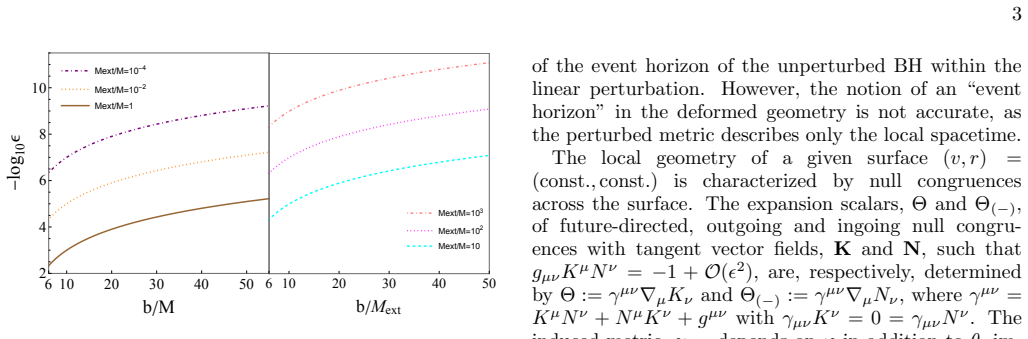
× 10-5 L 0/r+ ϵc0 FIG. 6:Left:ϵ − c given in Eq. (29) for various sets of ( ˆE, ˆL0). The curves correspond to ˆE= 0.96 (blue dashed), ˆE= 0.97 (purple dot-dashed), ˆE= 0.98 (orange dotted), ˆE= 0.99 (red solid), respectively.Middle:ϵ + c given in Eq. (33) for the same set of ( ˆE, ˆL0) as in the left panel.Right:ϵ 0 c given in Eq. (35). Note that, given...
work page 2020
-
[9]
Background null tetrad We analyze tidal perturbations within the Newman- Penrose formalism [109, 110]. First, let us introduce two real null vectors,{l,n}, and two complex null vectors, {m, m}, where mis the complex conjugate ofm, subject to [109] lµlµ =n µnµ =m µmµ = mµmµ = 0, lµnµ =−1, m µmµ = 1,(A1) lµmµ =l µmµ =n µmµ =n µmµ = 0. The set of these vecto...
-
[10]
Tidal moments We introduce the notion of gravitoelectric tidal mo- ments, which encode information of an external gravi- tational source approximately. In a binary system with large separation, the characteristic length scale of the ex- ternal universe,R, is much larger thanM, i.e.,M≪ R. In the region ofr≪ R, tidal deformations are de- scribed within full...
-
[11]
Stationary tidal perturbations Tidal perturbations are governed by the Teukolsky equations [115, 116]. The solution withs= +2 is de- composed as ψ0 = X ℓm αℓmR+2 ℓm(r)Y +2 ℓm .(A12) Note that, since our interest is in a slowly-varying tidal perturbation, the spin-weighted spheroidal harmonics re- duce toY +2 ℓm . Following the manner of Ref. [106], we ob-...
-
[12]
Hertz potential Reconstruction of a tidally deformed metric consists of two parts: (i) deriving a potential – referred to as a Hertz potential – from the Weyl scalar and (ii) acting a certain differential operator on the potential, thereby ob- taining a metric perturbation that shares physically same information with the Weyl scalar used in the reconstruc...
-
[13]
Metric reconstruction Before introducing the operator generating a metric perturbation from Ψ, we adopt the ingoing-radiation gauge on the metric perturbationh µν [103, 104] lµhµν = 0, g µνhµν = 0.(B4) The Geroch, Held, and Penrose (GHP) operator,S µν, al- lows us to generate a metric perturbation from the Hertz potential (B3) via [119] hµν = 4Re S † µνΨ ...
-
[14]
B. P. Abbottet al.(LIGO Scientific, Virgo), Phys. Rev. Lett.116, 221101 (2016), [Erratum: Phys.Rev.Lett. 121, 129902 (2018)], arXiv:1602.03841 [gr-qc]
work page internal anchor Pith review Pith/arXiv arXiv 2016
-
[15]
Testing the nature of dark compact objects: a status report
V. Cardoso and P. Pani, Living Rev. Rel.22, 4 (2019), arXiv:1904.05363 [gr-qc]
work page internal anchor Pith review Pith/arXiv arXiv 2019
-
[16]
Tests of General Relativity with GWTC-3
R. Abbottet al.(LIGO Scientific, VIRGO, KAGRA), Phys. Rev. D112, 084080 (2025), arXiv:2112.06861 [gr- qc]
work page internal anchor Pith review Pith/arXiv arXiv 2025
-
[17]
A. G. Abacet al.(LIGO Scientific, Virgo, KAGRA), Phys. Rev. Lett.135, 111403 (2025), arXiv:2509.08054 [gr-qc]
work page internal anchor Pith review Pith/arXiv arXiv 2025
-
[18]
Black hole spectroscopy: from theory to experiment
E. Bertiet al., (2025), arXiv:2505.23895 [gr-qc]
work page internal anchor Pith review Pith/arXiv arXiv 2025
-
[19]
V. Cardoso, S. Biswas, and S. Sarkar (2025) arXiv:2511.14841 [gr-qc]
-
[21]
Branchesiet al., JCAP07, 068 (2023), arXiv:2303.15923 [gr-qc]
M. Branchesiet al., JCAP07, 068 (2023), arXiv:2303.15923 [gr-qc]
- [22]
-
[23]
S.-C. Yang, W.-B. Han, H. Tagawa, S. Li, Y. Jiang, P. Shen, Q. Yun, C. Zhang, and X.-Y. Zhong, Astro- phys. J. Lett.988, L41 (2025), arXiv:2401.01743 [astro- ph.HE]
- [24]
- [25]
- [26]
- [27]
-
[28]
O. Straubet al.(GRAVITY), Astron. Astrophys.672, A63 (2023), [Erratum: Astron.Astrophys. 677, C2 (2023)], arXiv:2303.04067 [astro-ph.GA]
-
[29]
V. Cardoso and A. Foschi, Phys. Rev. D104, 024004 (2021), arXiv:2106.06551 [gr-qc]
-
[30]
F. Camilloni, G. Grignani, T. Harmark, R. Oliveri, M. Orselli, and D. Pica, Phys. Rev. D107, 084011 (2023), arXiv:2301.04879 [gr-qc]
-
[31]
Tidal deformation of a slowly rotating black hole
E. Poisson, Phys. Rev. D91, 044004 (2015), arXiv:1411.4711 [gr-qc]
work page internal anchor Pith review Pith/arXiv arXiv 2015
-
[32]
Tidal deformation of a slowly rotating material body. External metric
P. Landry and E. Poisson, Phys. Rev. D91, 104018 (2015), arXiv:1503.07366 [gr-qc]
work page internal anchor Pith review Pith/arXiv arXiv 2015
-
[33]
P. Pani, L. Gualtieri, A. Maselli, and V. Ferrari, Phys. Rev. D92, 024010 (2015), arXiv:1503.07365 [gr-qc]
work page internal anchor Pith review Pith/arXiv arXiv 2015
-
[34]
D. C. Robinson, Phys. Rev. Lett.34, 905 (1975)
work page 1975
- [35]
-
[36]
S. W. Hawking, Commun. Math. Phys.25, 152 (1972)
work page 1972
- [37]
-
[38]
Has the black hole equilibrium problem been solved?
B. Carter, in8th Marcel Grossmann Meeting on Recent Developments in Theoretical and Experimental General Relativity, Gravitation and Relativistic Field Theories (MG 8)(1997) pp. 136–155, arXiv:gr-qc/9712038
work page internal anchor Pith review Pith/arXiv arXiv 1997
-
[39]
P. T. Chrusciel, J. Lopes Costa, and M. Heusler, Living Rev. Rel.15, 7 (2012), arXiv:1205.6112 [gr-qc]
work page internal anchor Pith review Pith/arXiv arXiv 2012
-
[40]
Testing the black hole "no-hair" hypothesis
V. Cardoso and L. Gualtieri, Class. Quant. Grav.33, 174001 (2016), arXiv:1607.03133 [gr-qc]
work page internal anchor Pith review Pith/arXiv arXiv 2016
- [41]
-
[42]
Nonrotating black hole in a post-Newtonian tidal environment
S. Taylor and E. Poisson, Phys. Rev. D78, 084016 (2008), arXiv:0806.3052 [gr-qc]
work page internal anchor Pith review Pith/arXiv arXiv 2008
-
[43]
Tidal heating and torquing of a Kerr black hole to next-to-leading order in the tidal coupling
K. Chatziioannou, E. Poisson, and N. Yunes, Phys. Rev. D87, 044022 (2013), arXiv:1211.1686 [gr-qc]
work page internal anchor Pith review Pith/arXiv arXiv 2013
-
[44]
Katagiri,https://github.com/TakuyaKatagiri/ Tidally_Deformed_metric(2026)
T. Katagiri,https://github.com/TakuyaKatagiri/ Tidally_Deformed_metric(2026)
work page 2026
-
[45]
T. Katagiri and V. Cardoso,https:// the-center-of-gravity.com/data-and-routines/ (2026)
work page 2026
-
[46]
W. M. Kinnersley,Type D gravitational fields, Ph.D. thesis, Caltech (1968)
work page 1968
-
[47]
Geometry and dynamics of a tidally deformed black hole
E. Poisson and I. Vlasov, Phys. Rev. D81, 024029 (2010), arXiv:0910.4311 [gr-qc]
work page internal anchor Pith review Pith/arXiv arXiv 2010
-
[48]
Relativistic theory of tidal Love numbers
T. Binnington and E. Poisson, Phys. Rev. D80, 084018 (2009), arXiv:0906.1366 [gr-qc]
work page internal anchor Pith review Pith/arXiv arXiv 2009
- [49]
-
[50]
P. Charalambous, S. Dubovsky, and M. M. Ivanov, JHEP05, 038 (2021), arXiv:2102.08917 [hep-th]
-
[51]
E. Poisson, Phys. Rev. D104, 104062 (2021), 19 arXiv:2108.07328 [gr-qc]
-
[52]
S. E. Gralla, Class. Quant. Grav.35, 085002 (2018), arXiv:1710.11096 [gr-qc]
work page internal anchor Pith review Pith/arXiv arXiv 2018
-
[53]
E. Poisson, Phys. Rev. D103, 064023 (2021), arXiv:2012.10184 [gr-qc]
-
[54]
T. Katagiri, K. Yagi, and V. Cardoso, Phys. Rev. D 111, 084080 (2025), arXiv:2409.18034 [gr-qc]
-
[55]
T. Katagiri, V. Cardoso, T. Ikeda, and K. Yagi, Phys. Rev. D111, 084081 (2025), arXiv:2410.02531 [gr-qc]
-
[56]
J. M. Bardeen, W. H. Press, and S. A. Teukolsky, As- trophys. J.178, 347 (1972)
work page 1972
-
[57]
Contopoulos,Order and chaos in dynamical astron- omy(2002)
G. Contopoulos,Order and chaos in dynamical astron- omy(2002)
work page 2002
-
[58]
J. R. Gair, C. Li, and I. Mandel, Phys. Rev. D77, 024035 (2008), arXiv:0708.0628 [gr-qc]
work page internal anchor Pith review Pith/arXiv arXiv 2008
-
[59]
The non-integrability of the Zipoy-Voorhees metric
G. Lukes-Gerakopoulos, Phys. Rev. D86, 044013 (2012), arXiv:1206.0660 [gr-qc]
work page internal anchor Pith review Pith/arXiv arXiv 2012
-
[60]
K. Destounis and P. G. S. Fernandes, (2025), arXiv:2508.20191 [gr-qc]
-
[61]
The Astrophysics of Resonant Orbits in the Kerr Metric
J. Brink, M. Geyer, and T. Hinderer, Phys. Rev. D91, 083001 (2015), arXiv:1501.07728 [gr-qc]
work page internal anchor Pith review Pith/arXiv arXiv 2015
-
[62]
Celestial mechanics in Kerr spacetime
W. Schmidt, Class. Quant. Grav.19, 2743 (2002), arXiv:gr-qc/0202090
work page internal anchor Pith review Pith/arXiv arXiv 2002
-
[63]
Spacetime Encodings II - Pictures of Integrability
J. Brink, Phys. Rev. D78, 102002 (2008), arXiv:0807.1179 [gr-qc]
work page internal anchor Pith review Pith/arXiv arXiv 2008
-
[64]
V. I. Arnold,Mathematical Methods of Classical Me- chanics, Graduate Texts in Mathematics (Springer, 1989)
work page 1989
-
[65]
Laskar, Celestial Mechanics and Dynamical Astron- omy56, 191 (1993)
J. Laskar, Celestial Mechanics and Dynamical Astron- omy56, 191 (1993)
work page 1993
-
[66]
Poincar´ e, Rendiconti del Circolo Matematico di Palermo (1884-1940)33, 375 (1912)
H. Poincar´ e, Rendiconti del Circolo Matematico di Palermo (1884-1940)33, 375 (1912)
work page 1940
-
[67]
G. D. Birkhoff, Transactions of the American Mathe- matical Society14, 14 (1913)
work page 1913
-
[68]
An observable signature of a background deviating from Kerr
G. Lukes-Gerakopoulos, T. A. Apostolatos, and G. Contopoulos, Phys. Rev. D81, 124005 (2010), arXiv:1003.3120 [gr-qc]
work page internal anchor Pith review Pith/arXiv arXiv 2010
-
[69]
T. A. Apostolatos, G. Lukes-Gerakopoulos, and G. Contopoulos, Phys. Rev. Lett.103, 111101 (2009), arXiv:0906.0093 [gr-qc]
work page internal anchor Pith review Pith/arXiv arXiv 2009
-
[70]
Orbital resonances around Black holes
J. Brink, M. Geyer, and T. Hinderer, Phys. Rev. Lett. 114, 081102 (2015), arXiv:1304.0330 [gr-qc]
work page internal anchor Pith review Pith/arXiv arXiv 2015
-
[71]
A Periodic Table for Black Hole Orbits
J. Levin and G. Perez-Giz, Phys. Rev. D77, 103005 (2008), arXiv:0802.0459 [gr-qc]
work page internal anchor Pith review Pith/arXiv arXiv 2008
- [72]
- [73]
- [74]
-
[75]
R. V. Wagoner, Phys. Rept.311, 259 (1999), arXiv:astro-ph/9805028
work page internal anchor Pith review Pith/arXiv arXiv 1999
-
[76]
M. A. Abramowicz and W. Kluzniak, Astron. Astro- phys.374, L19 (2001), arXiv:astro-ph/0105077
work page internal anchor Pith review Pith/arXiv arXiv 2001
-
[77]
The physics of kHz QPOs---strong gravity's coupled anharmonic oscillators
W. Kluzniak and M. A. Abramowicz, (2001), arXiv:astro-ph/0105057
work page internal anchor Pith review Pith/arXiv arXiv 2001
-
[78]
M. A. Abramowicz and P. C. Fragile, Living Rev. Rel. 16, 1 (2013), arXiv:1104.5499 [astro-ph.HE]
work page internal anchor Pith review Pith/arXiv arXiv 2013
-
[79]
A. Ingram and S. Motta, New Astron. Rev.85, 101524 (2019), arXiv:2001.08758 [astro-ph.HE]
-
[80]
J. Horak, inWorkshop on Processes in the Vicinity of Black Holes and Neutron Stars(2004) arXiv:astro- ph/0408092
-
[81]
J. Hor´ ak, M. A. Abramowicz, W. Klu´ zniak, P. Rebusco, and G. T¨ or¨ ok, Astronomy and Astrophysics499, 535 (2009), arXiv:0901.3076 [astro-ph.CO]
work page internal anchor Pith review Pith/arXiv arXiv 2009
discussion (0)
Sign in with ORCID, Apple, or X to comment. Anyone can read and Pith papers without signing in.