Intent-First Aerial V2V for Tactical Coordination and Separation: Protocol and Performance Under Density and Disturbance
Pith reviewed 2026-05-21 05:12 UTC · model grok-4.3
The pith
An intent-first V2V stack supports tactical separation for unmanned aircraft in lower-to-moderate density regimes but shifts to guarded fallback as density, impairment, and complexity rise.
A machine-rendered reading of the paper's core claim, the machinery that carries it, and where it could break.
Core claim
The paper claims that the implemented controller-coupled, intent-first V2V tactical neighborhood exchange stack using sidelink-class C-V2X modules with authenticated freshness checks reduces stale-belief divergence, preserves observability through cooperative perception, rejects invalid tactical messages, suppresses false local inference, and structures shared-resource coordination, thereby providing a viable communication layer for tactical separation in lower-to-moderate regimes while transitioning toward guarded fallback as density, impairment, and complexity increase.
What carries the argument
The intent-first V2V tactical neighborhood exchange stack that combines refreshed state and intent beacons for local awareness and cooperative perception with event-triggered messages for yielding, sequencing, release, and contingency coordination.
If this is right
- V2V reduces stale-belief divergence among nearby aircraft.
- It preserves observability through cooperative perception.
- Invalid tactical messages are rejected and false local inferences are suppressed.
- Shared-resource coordination is structured through event-triggered exchanges for yielding, sequencing, and contingencies.
- The stack remains viable in lower-to-moderate regimes but shifts toward guarded fallback with rising density and disturbance.
Where Pith is reading between the lines
- This mechanism could extend to hybrid manned-unmanned coordination if adapted for compatibility with existing aviation protocols.
- Further tests in uncontrolled outdoor environments would better reveal where the transition to fallback occurs in practice.
- Integration with ground-based UTM services might allow hybrid local and central decision making for larger-scale operations.
Load-bearing premise
The results from the scenario-driven high-volume stress campaign supported by real-time field-anchored infrastructure generalize to real dense low-altitude aerial operations under disturbance.
What would settle it
Real-world flights at higher densities with actual disturbances that produce frequent stale beliefs, rejected messages, or heavy reliance on fallbacks would show the viability claim does not hold beyond moderate regimes.
Figures
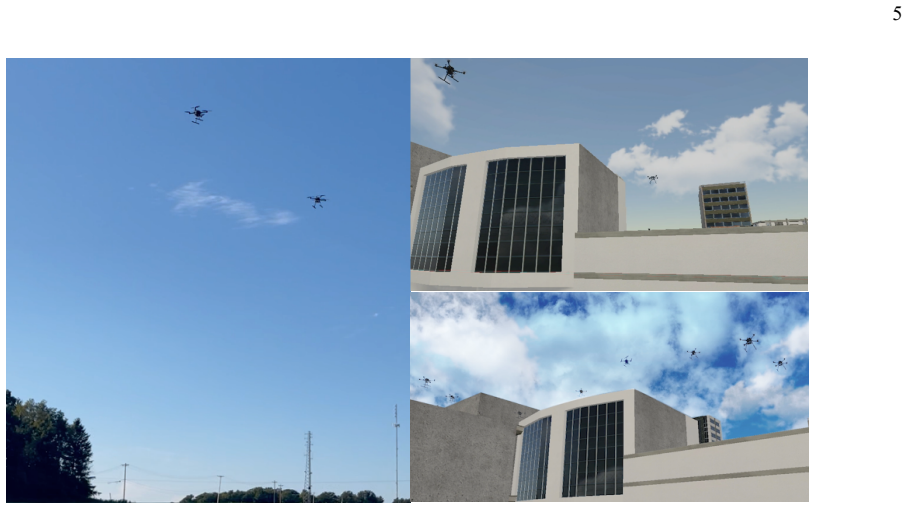
read the original abstract
Dense low-altitude aerial operations require more than pre-flight route coordination and last-resort collision avoidance. Once aircraft are airborne, disturbances can emerge on timescales shorter than strategic reauthorization can absorb, while collision avoidance is too late and disruptive to serve as routine traffic management. Although tactical separation is recognized as the intermediate layer, realizing it at scale requires a deployable neighborhood communication mechanism that provides fresh, trusted information for local coordination. This paper presents what is, to our knowledge, the first controller-coupled characterization of an all-airborne, sidelink-class, intent-first vehicle-to-vehicle (V2V) tactical neighborhood exchange stack for dense Unmanned Aircraft System Traffic Management (UTM) operations. Unlike awareness-only broadcast, the proposed exchange combines refreshed state and intent beacons for local awareness, cooperative perception, and degraded-mode assessment with event-triggered messages for yielding, sequencing, release, and contingency coordination. We implement and evaluate this model on an all-airborne V2V stack using sidelink-class C-V2X modules with authenticated freshness checks. Evaluation uses a scenario-driven, high-volume stress campaign supported by real-time, field-anchored infrastructure. Results show that V2V reduces stale-belief divergence, preserves observability through cooperative perception, rejects invalid tactical messages, suppresses false local inference, and structures shared-resource coordination. The implemented stack provides a viable communication layer for tactical separation in lower-to-moderate regimes, but transitions toward guarded fallback as density, impairment, and complexity increase. These findings position intent-first aerial V2V as a bounded enabler for scaling tactical coordination in disturbance-driven urban airspace.
Editorial analysis
A structured set of objections, weighed in public.
Referee Report
Summary. The manuscript presents the first controller-coupled characterization of an all-airborne, sidelink-class, intent-first V2V tactical neighborhood exchange stack for dense UTM operations. The protocol combines refreshed state and intent beacons for local awareness and cooperative perception with event-triggered messages for yielding, sequencing, release, and contingency coordination. It is implemented on sidelink-class C-V2X modules with authenticated freshness checks and evaluated via a scenario-driven high-volume stress campaign supported by real-time, field-anchored infrastructure. Results indicate that the stack reduces stale-belief divergence, preserves observability, rejects invalid tactical messages, suppresses false local inference, and structures shared-resource coordination, providing a viable communication layer for tactical separation in lower-to-moderate regimes while transitioning toward guarded fallback as density, impairment, and complexity increase.
Significance. If the reported performance holds under detailed scrutiny, the work offers a practical contribution to aerial robotics and UTM by supplying a deployable neighborhood communication mechanism that operates on timescales between strategic reauthorization and last-resort collision avoidance. Explicit credit is due for the real-hardware implementation on C-V2X modules, the inclusion of authenticated freshness checks, and the use of field-anchored infrastructure to support high-volume stress testing; these elements strengthen the empirical grounding relative to purely simulated studies.
major comments (2)
- [Evaluation] Evaluation section: the central viability claim for lower-to-moderate regimes rests on results from the scenario-driven stress campaign, yet the manuscript supplies no quantitative metrics, error bars, baseline comparisons, or detailed exclusion criteria for the tested densities and impairment levels. Without these data the magnitude of reductions in stale-belief divergence or gains in observability preservation cannot be assessed, weakening support for the headline finding.
- [Evaluation] Evaluation / stress-campaign description: no quantitative mapping is provided between the modeled disturbance parameters (density ramps, impairment levels) and empirical distributions drawn from real urban low-altitude flight data, nor is a sensitivity analysis reported for metrics such as stale-belief divergence or false-inference suppression under plausible deviations (e.g., correlated gusts or regulatory handoffs). This omission directly affects whether the observed transition to guarded fallback can be treated as a robust protocol property rather than a testbed artifact.
minor comments (2)
- [Abstract] Abstract: the phrase 'to our knowledge, the first' would benefit from a concise sentence contrasting the proposed stack with prior awareness-only broadcast or UTM communication approaches to clarify the precise novelty.
- [Throughout] Notation and terminology: ensure consistent definition of acronyms (C-V2X, UTM, V2V) on first use and verify that all performance metrics referenced in the results are defined before they appear in the evaluation narrative.
Simulated Author's Rebuttal
We thank the referee for the constructive feedback and for acknowledging the practical contributions of the real-hardware C-V2X implementation and field-anchored stress testing. We address the two major comments on the Evaluation section point by point below. We will revise the manuscript to incorporate additional quantitative details and analyses as described.
read point-by-point responses
-
Referee: [Evaluation] Evaluation section: the central viability claim for lower-to-moderate regimes rests on results from the scenario-driven stress campaign, yet the manuscript supplies no quantitative metrics, error bars, baseline comparisons, or detailed exclusion criteria for the tested densities and impairment levels. Without these data the magnitude of reductions in stale-belief divergence or gains in observability preservation cannot be assessed, weakening support for the headline finding.
Authors: We agree that the current manuscript presents results primarily through descriptive trends without explicit numerical metrics, error bars, or direct baseline comparisons. In the revised version we will expand the Evaluation section to report specific quantitative values, including measured reductions in stale-belief divergence (with means and standard deviations across runs), observability preservation percentages, and false-inference suppression rates. We will add comparisons against a baseline awareness-only C-V2X broadcast protocol and will explicitly state the exclusion criteria applied to the stress-campaign scenarios, such as the density range (e.g., 5–25 aircraft/km²) and impairment thresholds used. These additions will allow readers to assess the magnitude of the reported effects. revision: yes
-
Referee: [Evaluation] Evaluation / stress-campaign description: no quantitative mapping is provided between the modeled disturbance parameters (density ramps, impairment levels) and empirical distributions drawn from real urban low-altitude flight data, nor is a sensitivity analysis reported for metrics such as stale-belief divergence or false-inference suppression under plausible deviations (e.g., correlated gusts or regulatory handoffs). This omission directly affects whether the observed transition to guarded fallback can be treated as a robust protocol property rather than a testbed artifact.
Authors: We concur that explicit mapping to real-world distributions and sensitivity analysis would strengthen claims of robustness. The revised manuscript will include a dedicated subsection that quantitatively maps the modeled density ramps and impairment levels to available empirical statistics from public urban low-altitude flight datasets and UTM testbed records. We will also add sensitivity results for stale-belief divergence and false-inference suppression under perturbations such as correlated gusts and simulated regulatory handoffs. Where comprehensive real-world traces for every deviation are unavailable, we will clearly state this limitation and rely on the field-anchored infrastructure data already collected; the transition to guarded fallback will be presented with these caveats rather than as an unqualified protocol property. revision: partial
Circularity Check
No significant circularity in derivation chain
full rationale
The paper presents an implementation of an intent-first V2V protocol and reports empirical results from a scenario-driven stress campaign using field-anchored infrastructure. No mathematical derivations, equations, fitted parameters, or predictions appear in the provided text. Claims about performance (stale-belief reduction, observability preservation, etc.) are grounded directly in the described evaluation campaign rather than reducing to self-definitions, self-citations, or ansatzes. The work is self-contained as an engineering evaluation without load-bearing theoretical steps that could introduce circularity.
Axiom & Free-Parameter Ledger
Lean theorems connected to this paper
-
IndisputableMonolith/Foundation/AbsoluteFloorClosure.leanreality_from_one_distinction unclear?
unclearRelation between the paper passage and the cited Recognition theorem.
The protocol uses two channels. A periodic state and intent beacon maintains the local belief state... An event-triggered coordination channel is used only when aircraft need to negotiate... Freshness and trust rules determine whether received information may affect tactical control.
-
IndisputableMonolith/Cost/FunctionalEquation.leanwashburn_uniqueness_aczel unclear?
unclearRelation between the paper passage and the cited Recognition theorem.
Results show that V2V reduces stale-belief divergence, preserves observability through cooperative perception, rejects invalid tactical messages...
What do these tags mean?
- matches
- The paper's claim is directly supported by a theorem in the formal canon.
- supports
- The theorem supports part of the paper's argument, but the paper may add assumptions or extra steps.
- extends
- The paper goes beyond the formal theorem; the theorem is a base layer rather than the whole result.
- uses
- The paper appears to rely on the theorem as machinery.
- contradicts
- The paper's claim conflicts with a theorem or certificate in the canon.
- unclear
- Pith found a possible connection, but the passage is too broad, indirect, or ambiguous to say the theorem truly supports the claim.
Reference graph
Works this paper leans on
-
[1]
(a) Neighborhood PRR and (b) latency p95 across density and impairment class. PRR is measured as effective neighborhood reception under continuous multi-node broadcast. The 250 vehicles/km² slice is included as a diagnostic breakdown stress point. Deadline-miss behavior shows the transition more sharply. Deadline misses remain effectively zero under nomin...
work page 1960
-
[2]
Available: https://ntrs.nasa.gov/citations/20205002076
[Online]. Available: https://ntrs.nasa.gov/citations/20205002076
-
[3]
M. R. Jamali et al., "UAS traffic management communications: The legacy of ADS-B, new establishment of Remote ID, or leverage of ADS-B-like systems?," Drones, vol. 6, no. 3, Art. no. 57, 2022, doi: 10.3390/drones6030057
-
[4]
Reducing safe UAV separation distances with U2U communication and new Remote ID formats,
E. Vinogradov, F. Minucci, A. V. S. S. B. Kumar, S. Pollin, and E. Natalizio, "Reducing safe UAV separation distances with U2U communication and new Remote ID formats," 2022, arXiv:2209.13270
-
[5]
Remote ID for separation provision and multi-agent navigation,
E. Vinogradov, A. V. S. S. B. Kumar, F. Minucci, S. Pollin, and E. Natalizio, "Remote ID for separation provision and multi-agent navigation," 2023, arXiv:2309.00843
-
[6]
Markov decision process-based distributed conflict resolution for drone air traffic management,
H. Y. Ong and M. J. Kochenderfer, "Markov decision process-based distributed conflict resolution for drone air traffic management," J. Guid., Control, Dyn., vol. 40, no. 1, pp. 69–80, Jan. 2017, doi: 10.2514/1.G001822
-
[7]
S. Hoogendoorn, V. L. Knoop, H. Mahmassani, and S. Hoogendoorn-Lanser, "Game-theoretical approach to decentralized multi-drone conflict resolution and emergent traffic flow operations," 2023, arXiv:2308.01069
-
[8]
MADER: Trajectory planner in multiagent and dynamic environments,
J. Tordesillas and J. P. How, "MADER: Trajectory planner in multiagent and dynamic environments," IEEE Trans. Robot., vol. 38, no. 1, pp. 463–476, Feb. 2022, doi: 10.1109/TRO.2021.3080235
-
[9]
K. Kondo et al., "Robust MADER: Decentralized multiagent trajectory planner robust to communication delay in dynamic environments," IEEE Robot. Autom. Lett., vol. 8, no. 3, pp. 1687–1694, Mar. 2023, doi: 10.1109/LRA.2023.3236923
-
[10]
A. M. Khasawneh et al., "Latency analysis of drone-assisted C-V2X communications for basic safety and cooperative perception messages," Drones, vol. 8, no. 10, Art. no. 600, 2024, doi: 10.3390/drones8100600
-
[11]
D. Kavas-Torris, S. Y. Gelbal, M. R. Cantas, B. Aksun-Guvenc, and L. Guvenc, "V2X communication between connected and automated vehicles (CAVs) and unmanned aerial vehicles (UAVs)," Sensors, vol. 22, no. 22, Art. no. 8941, 2022, doi: 10.3390/s22228941
-
[12]
V2V UAS communications and use cases for advanced air mobility,
G. Gür et al., "V2V UAS communications and use cases for advanced air mobility," in Proc. IEEE Conf. Standards Commun. Netw. (CSCN), 2024, pp. 103–107
work page 2024
-
[13]
The philosophy of UAS-to-UAS communications,
K. Namuduri, J. S. Mandapaka, and M. F. Kidane, "The philosophy of UAS-to-UAS communications," in Proc. MOBILITY 2024: 14th Int. Conf. Mobile Services, Resour. Users, 2024, pp. 1–6
work page 2024
-
[14]
Digital traffic lights: UAS collision avoidance strategy for advanced air mobility,
Z. McCorkendale, L. McCorkendale, and K. Namuduri, "Digital traffic lights: UAS collision avoidance strategy for advanced air mobility," Drones, vol. 8, no. 10, Art. no. 590, 2024, doi: 10.3390/drones8100590
-
[15]
J. S. Mandapaka, B. Dalloul, S. Hawkins, K. Namuduri, S. Nicoll, and K. Gambold, "Collision avoidance strategies for cooperative unmanned aircraft systems using vehicle-to-vehicle communications," in Proc. IEEE 97th Veh. Technol. Conf. (VTC2023-Spring), Florence, Italy, Jun. 2023, pp. 1–7, doi: 10.1109/VTC2023-Spring57618.2023.10199913
work page doi:10.1109/vtc2023-spring57618.2023.10199913 2023
-
[16]
Collision avoidance strategies for advanced air mobility using UAS-to-UAS communications,
J. S. Mandapaka, L. McCorkendale, Z. McCorkendale, and K. Namuduri, "Collision avoidance strategies for advanced air mobility using UAS-to-UAS communications," Drone Syst. Appl., vol. 13, 2025, doi: 10.1139/dsa-2024-0044
-
[17]
Available: https://www.rtca.org/wp-content/uploads/2023/01/V2V-White-Paper-Final.pdf
[Online]. Available: https://www.rtca.org/wp-content/uploads/2023/01/V2V-White-Paper-Final.pdf
work page 2023
-
[18]
A. Aweiss et al., "Flight demonstration of unmanned aircraft system (UAS) traffic management (UTM) at technical capability level 3," in Proc. IEEE/AIAA 38th Digit. Avion. Syst. Conf. (DASC), San Diego, CA, USA, Sep. 2019, pp. 1–7, doi: 10.1109/DASC43569.2019.9081718
-
[19]
Vehicle to vehicle (V2V) communication for collision avoidance for multi-copters flying in UTM-TCL4,
A. Chakrabarty, C. A. Ippolito, J. Baculi, K. S. Krishnakumar, and S. Hening, "Vehicle to vehicle (V2V) communication for collision avoidance for multi-copters flying in UTM-TCL4," in Proc. AIAA Scitech Forum, San Diego, CA, USA, Jan. 2019, doi: 10.2514/6.2019-0690
-
[20]
Full-duplex aerial communication system for multiple UAVs with directional antennas,
T. Yu, K. Araki, and K. Sakaguchi, "Full-duplex aerial communication system for multiple UAVs with directional antennas," 2022, arXiv:2202.00176
-
[21]
Air-to-air channel characterization for UAV communications at 3.4 GHz,
A. Gürses, J. Kesler, and M. L. Sichitiu, "Air-to-air channel characterization for UAV communications at 3.4 GHz," 2026, arXiv:2604.01582
-
[22]
J. Beuster et al., "Enhancing situational awareness in ISAC networks via drone swarms: A real-world channel sounding data set," in Proc. 28th Int. Workshop Smart Antennas (WSA), 2025, pp. 170–173
work page 2025
-
[23]
T.-W. Hsu et al., "Vehicle-to-vehicle based autonomous flight coordination control system for safer operation of unmanned aerial 14 vehicles," Drones, vol. 7, no. 11, Art. no. 669, 2023, doi: 10.3390/drones7110669
-
[24]
V2X-ViT: Vehicle-to-everything cooperative perception with vision transformer,
R. Xu et al., "V2X-ViT: Vehicle-to-everything cooperative perception with vision transformer," in Proc. Eur. Conf. Comput. Vis. (ECCV), Tel Aviv, Israel, 2022, pp. 107–124
work page 2022
-
[25]
In: 2022 International Conference on Robotics and Automation (ICRA), pp
R. Xu et al., "OPV2V: An open benchmark dataset and fusion pipeline for perception with vehicle-to-vehicle communication," in Proc. IEEE Int. Conf. Robot. Autom. (ICRA), Philadelphia, PA, USA, 2022, pp. 2583–2589, doi: 10.1109/ICRA46639.2022.9812038
-
[26]
CoMamba: Real-time cooperative perception unlocked with state space models,
J. Zhao et al., "CoMamba: Real-time cooperative perception unlocked with state space models," 2024, arXiv:2409.10699
-
[27]
Y. Wang et al., "CoFormerNet: A transformer-based fusion approach for enhanced vehicle-infrastructure cooperative perception," Sensors, vol. 24, no. 13, Art. no. 4101, 2024, doi: 10.3390/s24134101
-
[28]
MCOP: Multi-UAV collaborative occupancy prediction,
Q. Wei et al., "MCOP: Multi-UAV collaborative occupancy prediction," 2025, arXiv:2510.12679
-
[29]
AGC-Drive: A large-scale dataset for real-world aerial-ground collaboration in driving scenarios,
L. Hou et al., "AGC-Drive: A large-scale dataset for real-world aerial-ground collaboration in driving scenarios," 2025, arXiv:2506.16371
-
[30]
AirV2X: Unified air-ground vehicle-to-everything collaboration,
X. Gao et al., "AirV2X: Unified air-ground vehicle-to-everything collaboration," 2025, arXiv:2506.19283
-
[31]
IEEE, "IEEE standard for wireless access in vehicular environments — Security services for applications and management messages," IEEE Std 1609.2-2022, Piscataway, NJ, USA,
work page 2022
-
[32]
Certificate management interfaces for end entities,
IEEE, "Certificate management interfaces for end entities," IEEE Std 1609.2.1-2022, Piscataway, NJ, USA,
work page 2022
-
[33]
Platoon control of connected multi-vehicle systems under V2X communications: Design and experiments,
Y. Li, W. Chen, S. Peeta, and Y. Wang, "Platoon control of connected multi-vehicle systems under V2X communications: Design and experiments," IEEE Trans. Intell. Transp. Syst., vol. 21, no. 5, pp. 1891–1902, May 2020, doi: 10.1109/TITS.2019.2905039
-
[34]
Multivehicle cooperative driving using cooperative perception: Design and experimental validation,
S.-W. Kim et al., "Multivehicle cooperative driving using cooperative perception: Design and experimental validation," IEEE Trans. Intell. Transp. Syst., vol. 16, no. 2, pp. 663–680, Apr. 2015, doi: 10.1109/TITS.2014.2352853
-
[35]
X. Chen, S. Leng, J. He, L. Zhou, and H. Liu, "The upper bounds of cellular vehicle-to-vehicle communication latency for platoon-based autonomous driving," IEEE Trans. Intell. Transp. Syst., vol. 24, no. 7, pp. 6874–6887, Jul. 2023, doi: 10.1109/TITS.2023.3284574. Mehrnaz Sabet is a Ph.D. candidate in the College of Computing and Information Science at Co...
discussion (0)
Sign in with ORCID, Apple, or X to comment. Anyone can read and Pith papers without signing in.