Topological Field Theories and the Algebraic Structures of the Two-Sphere
Pith reviewed 2026-05-21 02:07 UTC · model grok-4.3
The pith
Two presentations of two-sphere bordisms produce equivalent monoids whose prime endomorphisms simplify to multiplications by prime units.
A machine-rendered reading of the paper's core claim, the machinery that carries it, and where it could break.
Core claim
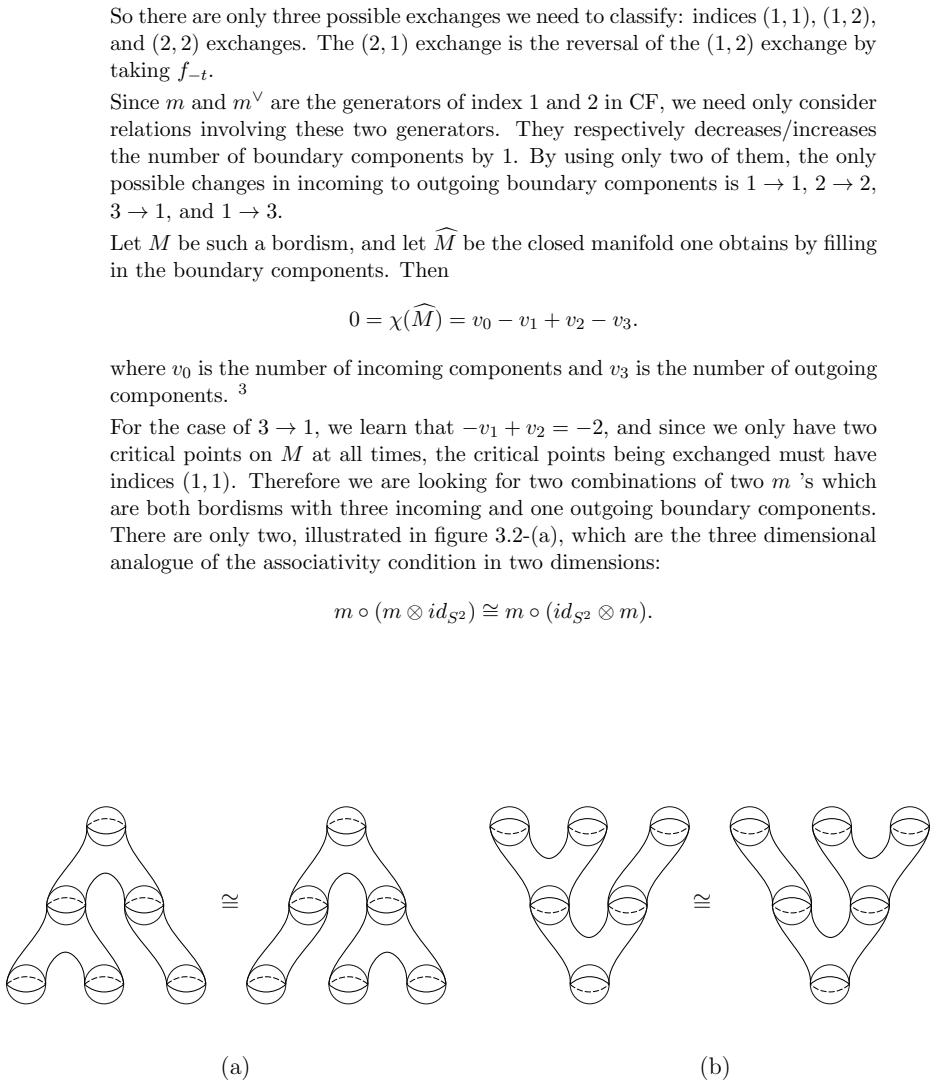
Two presentations for bordisms of S^2 in Cob(3) yield equivalent P-monoids and L-monoids after passing through topological field theories, with the prime structures labeled by closed oriented irreducible prime 3-manifolds satisfying countable relations including legs relations. Restricting to algebras, the legs relations force the prime endomorphisms to act by multiplication by prime units, rendering the additional prime structures remarkably simple. An infinity-operad is proposed that encodes these prime structures and contains the little 3-cube operad as a sub-operad.
What carries the argument
P-monoids and L-monoids, commutative Frobenius monoids equipped with endomorphisms or unit morphisms labeled by prime 3-manifolds and constrained by legs relations.
If this is right
- Prime endomorphisms reduce to multiplication by prime units once legs relations are imposed.
- P-monoids and L-monoids become interchangeable descriptions of the same algebraic object.
- An infinity-operad can be built that encodes the prime structures and contains the little 3-cube operad.
- Relations exist between these P/L-algebras and J-algebras that classify three-dimensional topological field theories.
Where Pith is reading between the lines
- The observed simplicity may permit direct computation of prime-labeled invariants on familiar Frobenius algebras.
- The proposed operad could organize algebraic models for field theories in dimensions above three.
- Explicit checks on low-genus surfaces or specific prime manifolds would test whether the equivalence holds in concrete examples.
Load-bearing premise
The two presentations for bordisms of S^2 in Cob(3) yield equivalent P-monoids and L-monoids after passing through topological field theories with the prime structures satisfying the stated countable relations including legs relations.
What would settle it
An explicit algebra equipped with a Frobenius structure and legs relations in which the endomorphism labeled by a concrete prime 3-manifold fails to coincide with multiplication by the corresponding prime unit.
Figures








read the original abstract
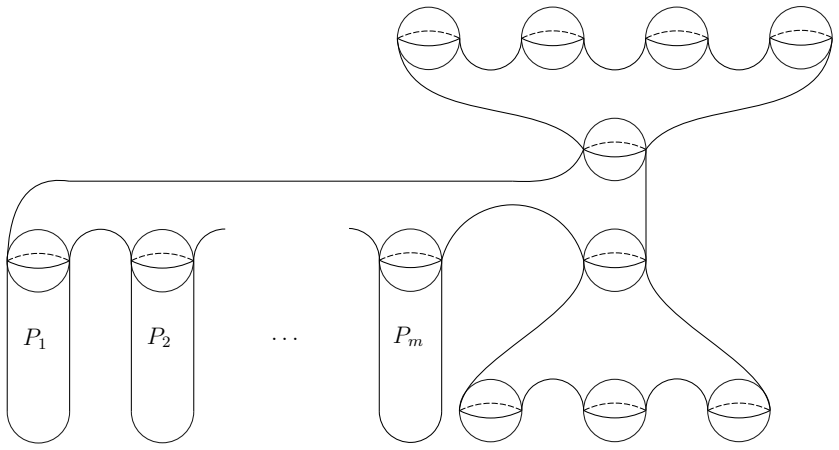
We give two presentations for bordisms of $S^2$ in the 3-dimensional oriented bordism category $\operatorname{Cob}(3) $, encoding the algebraic structures on $S^2$. After passing through topological field theories, we define two kinds of monoids which we call P-monoids and L-monoids. In addition to both being commutative Frobenius monoids, P-monoids are equipped with a class of endomorphisms while L-monoids are equipped with a class of unit morphisms, all of which are labelled by closed oriented irreducible prime 3-manifolds. They turn out to be equivalent. The new prime structures satisfy some countable relations with the commutative Frobenius structure, the most notable of which we call "legs relations." We then restrict to the setting of algebras and show that the legs relations place strong constraints on the new prime endomorphisms which forces them to act by multiplications by prime units, rendering the additional prime structures remarkably simple. We also propose an $\infty$-operad which encodes these prime structures and contains the $\infty$-little 3-cube operad as a sub-operad.% We briefly discuss the relations between P/L-algebras and J-algebras which classify 3-dimensional TFTs.
Editorial analysis
A structured set of objections, weighed in public.
Referee Report
Summary. The paper gives two presentations for bordisms of S² in the oriented 3-dimensional bordism category Cob(3). Passing through topological field theories, it defines equivalent P-monoids and L-monoids that are commutative Frobenius monoids equipped with additional endomorphisms or unit morphisms labeled by closed oriented irreducible prime 3-manifolds. These prime structures satisfy countable relations with the Frobenius structure, including the legs relations. Restricting to the algebra setting, the legs relations force the prime endomorphisms to act by multiplication by prime units. The paper also proposes an ∞-operad encoding the prime structures that contains the ∞-little 3-cube operad as a sub-operad.
Significance. If the equivalence and simplification results hold, the work supplies a concrete algebraic model for the structures on S² arising from 3-dimensional bordism and TFT data, with the reduction of prime endomorphisms to multiplication by prime units providing a notable simplification. The proposal of an ∞-operad extending the little 3-cubes operad is a potential strength for unifying these structures with existing operadic approaches to TFTs. The constructions are grounded in standard bordism presentations and category theory with no free parameters or ad-hoc axioms introduced.
minor comments (3)
- The abstract states that the two presentations yield equivalent P- and L-monoids after passage through TFTs, but the main text should include an explicit comparison or diagram showing how the legs relations are preserved under the equivalence map to make the central claim easier to verify.
- The proposed ∞-operad is mentioned only briefly; a dedicated section or subsection should define its operations and verify that the little 3-cube operad embeds as a sub-operad, including any necessary coherence data.
- Notation for the prime-labeled endomorphisms and unit morphisms could be introduced with a short table or list of examples early in the paper to aid readability when the legs relations are stated.
Simulated Author's Rebuttal
We thank the referee for their positive summary and significance assessment of our manuscript on topological field theories and the algebraic structures of the two-sphere. We appreciate the recommendation for minor revision. As no specific major comments were raised in the report, we have no points requiring detailed rebuttal or immediate revision based on major concerns. We will incorporate any minor editorial suggestions in the revised version.
Circularity Check
No significant circularity; derivation is self-contained
full rationale
The paper constructs two presentations of bordisms of S^2 in the oriented bordism category Cob(3), passes them through topological field theories to define P-monoids and L-monoids (both commutative Frobenius monoids equipped with prime-labeled structures), proves their equivalence, and then restricts to algebras to derive that the legs relations force prime endomorphisms to act by multiplication by prime units. These steps rest on standard definitions from bordism categories, TFTs, and category theory rather than any reduction of a claimed prediction to a fitted input, self-citation chain, or definitional equivalence. No load-bearing self-citation, ansatz smuggling, or renaming of known results is exhibited in the provided text; the central claims follow directly from the stated relations and external mathematical grounding.
Axiom & Free-Parameter Ledger
axioms (1)
- domain assumption Bordisms of S^2 in the 3-dimensional oriented bordism category Cob(3) encode algebraic structures on S^2 after passing through topological field theories.
invented entities (2)
-
P-monoid
no independent evidence
-
L-monoid
no independent evidence
Lean theorems connected to this paper
-
IndisputableMonolith/Foundation/AlexanderDuality.leanalexander_duality_circle_linking unclear?
unclearRelation between the paper passage and the cited Recognition theorem.
We give two presentations for bordisms of S² in the 3-dimensional oriented bordism category Cob(3), encoding the algebraic structures on S². ... legs relations ... prime endomorphisms which forces them to act by multiplications by prime units
What do these tags mean?
- matches
- The paper's claim is directly supported by a theorem in the formal canon.
- supports
- The theorem supports part of the paper's argument, but the paper may add assumptions or extra steps.
- extends
- The paper goes beyond the formal theorem; the theorem is a base layer rather than the whole result.
- uses
- The paper appears to rely on the theorem as machinery.
- contradicts
- The paper's claim conflicts with a theorem or certificate in the canon.
- unclear
- Pith found a possible connection, but the passage is too broad, indirect, or ambiguous to say the theorem truly supports the claim.
Reference graph
Works this paper leans on
- [1]
-
[2]
Differential geometrical methods in theoretical physics , pages=
The definition of conformal field theory , author=. Differential geometrical methods in theoretical physics , pages=. 1988 , publisher=
work page 1988
-
[3]
Journal of differential geometry , volume=
Supersymmetry and Morse theory , author=. Journal of differential geometry , volume=. 1982 , publisher=
work page 1982
-
[4]
Introductory lectures on topological quantum field theory , volume=
Carqueville, Nils and Runkel, Ingo , year=. Introductory lectures on topological quantum field theory , volume=. doi:10.4064/bc114-1 , journal=
-
[5]
Bulletin of the American Mathematical Society , author=
Remarks on Chern-Simons theory , volume=. Bulletin of the American Mathematical Society , author=. 2009 , month=jan, pages=. doi:10.1090/S0273-0979-09-01243-9 , abstractNote=
-
[6]
Proceedings of the International Congress of Mathematicians 2010 (ICM 2010) (In 4 Volumes) Vol
Topological field theory, higher categories, and their applications , author=. Proceedings of the International Congress of Mathematicians 2010 (ICM 2010) (In 4 Volumes) Vol. I: Plenary Lectures and Ceremonies Vols. II--IV: Invited Lectures , pages=. 2010 , organization=
work page 2010
-
[7]
A geometrical approach to two-dimensional conformal field theory , author=. Ph. D. Thesis , year=
-
[8]
Journal of Knot theory and its ramifications , volume=
Two-dimensional topological quantum field theories and Frobenius algebras , author=. Journal of Knot theory and its ramifications , volume=. 1996 , publisher=
work page 1996
-
[9]
Defining and classifying TQFTs via surgery , author=. Quantum Topology , volume=
-
[10]
Communications in number theory and physics , volume=
Electric-magnetic duality and the geometric Langlands program , author=. Communications in number theory and physics , volume=. 2007 , publisher=
work page 2007
-
[11]
A Celebration of the Mathematical Legacy of Raoul Bott, in: CRM Proc
Geometric Langlands from six dimensions , author=. A Celebration of the Mathematical Legacy of Raoul Bott, in: CRM Proc. Lecture Notes , volume=
-
[12]
Relative langlands duality , author=. arXiv preprint arXiv:2409.04677 , year=
-
[13]
Factorization homology as a fully extended topological field theory , author=. 2014 , school=
work page 2014
-
[14]
Topological Field Theories: Lecture Notes of the Working Seminar at The Hodge Institute , author =. 2016 , howpublished =
work page 2016
-
[15]
A note on the ( ,n) –category of cobordisms , volume=
Calaque, Damien and Scheimbauer, Claudia , year=. A note on the ( ,n) –category of cobordisms , volume=. Algebraic amp; Geometric Topology , publisher=. doi:10.2140/agt.2019.19.533 , number=
-
[16]
Diffeomorphism groups of reducible 3-manifolds , author=. Available at pi. math. cornell. edu/hatcher/Papers/DR3M. pdf , year=
-
[17]
The prime decomposition fibre sequence for moduli spaces of reducible 3-manifolds , author=. 2026 , eprint=
work page 2026
- [18]
-
[19]
Lurie, Jacob , month = dec, year =. Higher
-
[20]
Extended topological field theories and the cobordism hypothesis , author=. 2013 , school=
work page 2013
-
[21]
Categories for the working mathematician , language =
Mac Lane, Saunders , year =. Categories for the working mathematician , language =
- [22]
- [23]
-
[24]
Current Developments in Mathematics , author =
On the. Current Developments in Mathematics , author =. 2008 , pages =. doi:10.4310/CDM.2008.v2008.n1.a3 , language =
-
[25]
Journal of Mathematical Physics , author=
Higher-dimensional algebra and topological quantum field theory , volume=. Journal of Mathematical Physics , author=. 1995 , month=nov, pages=. doi:10.1063/1.531236 , abstractNote=
-
[26]
Publications Mathématiques de l'IHÉS , author =
La stratification naturelle des espaces de fonctions différentiables réelles et le théorème de la pseudo-isotopie , volume =. Publications Mathématiques de l'IHÉS , author =. 1970 , pages =. doi:10.1007/BF02684687 , language =
- [27]
- [28]
-
[29]
On. Journal of Algebra , author =. 1964 , pages =. doi:10.1016/0021-8693(64)90018-3 , language =
-
[30]
Extended 3-dimensional bordism as the theory of modular objects
Extended 3-dimensional bordism as the theory of modular objects , author=. arXiv preprint arXiv:1411.0945 , year=
work page internal anchor Pith review Pith/arXiv arXiv
-
[31]
Modular categories as representations of the 3-dimensional bordism 2-category
Modular categories as representations of the 3-dimensional bordism 2-category , author=. arXiv preprint arXiv:1509.06811 , year=
work page internal anchor Pith review Pith/arXiv arXiv
-
[32]
arXiv preprint arXiv:1610.02592 , year=
An introduction to geometric topology , author=. arXiv preprint arXiv:1610.02592 , year=
-
[33]
Contemporary Mathematics , volume=
Quasi-categories vs Segal spaces , author=. Contemporary Mathematics , volume=. 2007 , publisher=
work page 2007
-
[34]
Contemporary Mathematics , volume=
Operads, algebras, and modules , author=. Contemporary Mathematics , volume=. 1997 , publisher=
work page 1997
-
[35]
Formality of the little N-disks operad , ISBN=
Lambrechts, Pascal and Volić, Ismar , year=. Formality of the little N-disks operad , ISBN=
discussion (0)
Sign in with ORCID, Apple, or X to comment. Anyone can read and Pith papers without signing in.