Thinking-while-speaking: A Controlled, Interleaved Reasoning Method for Real-Time Speech Generation
Pith reviewed 2026-05-21 05:50 UTC · model grok-4.3
The pith
InterRS enables AI to reason while speaking by interleaving controlled reasoning steps into fluent speech generation.
A machine-rendered reading of the paper's core claim, the machinery that carries it, and where it could break.
Core claim
By generating seamlessly interleaved audio data through a dedicated pipeline and training via interleaved SFT plus RL with the TA-Balance Reward for timing control and the Linguistic Quality Reward for expression, the resulting model produces instant responses comparable to spoken-language instruct models outputting fast CoT while achieving 13 percent better performance on mathematical and logic benchmarks and more natural, fluent answers than prior methods.
What carries the argument
The InterRS pipeline that produces precisely aligned interleaved audio data with controlled thinking-to-answer length ratios, combined with RL using TA-Balance and Linguistic Quality rewards to enforce timing and quality during training.
If this is right
- The model generates instant responses similar to spoken-language instruct models that output fast CoT.
- Performance improves by 13 percent on mathematical and logic benchmarks.
- Generated answers are more natural and fluent than those from prior methods.
- Fluent speech is maintained even while deep reasoning occurs.
Where Pith is reading between the lines
- This interleaving pattern could be tested in other real-time generative settings such as live translation to see if simultaneous reasoning improves accuracy without added delay.
- Controlling the thinking-to-answer ratio might prove useful for balancing depth versus speed in non-speech tasks like streaming text generation.
- The approach suggests voice assistants could handle complex queries more effectively by overlapping internal reasoning with ongoing speech output.
Load-bearing premise
A novel pipeline can reliably produce high-quality audio data in which reasoning steps and speech segments stay precisely aligned and the thinking-to-answer length ratio stays under controlled limits.
What would settle it
A test dataset or deployment where the generated interleaved data shows misalignment between reasoning steps and speech segments or uncontrolled length ratios, resulting in loss of the reported 13 percent benchmark gains or reduced speech fluency.
Figures




read the original abstract
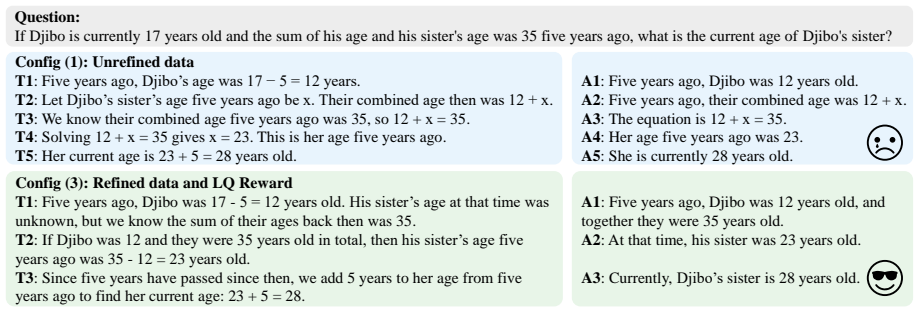
The thinking-while-speaking paradigm aims to make AI communication more human. A key challenge is maintaining fluent speech while performing deep reasoning. Our method, InterRS, tackles this by inserting reasoning steps only during natural speech generation. This requires high-quality data where reasoning and speech are precisely aligned, and the length ratio are under controlled. We introduce a novel pipeline to generate such seamlessly interleaved audio data. To train our model, we combine interleaved SFT with refined data and reinforcement learning with two new rewards: a TA-Balance Reward to manage timing and thinking-answer ratio, and a Linguistic Quality Reward to refine expression. Experiments show our approach achieves 13% better performance on mathmatical and logic benchmarks while generating instant response like a spoken-language instruct model which outputs fast CoT response. Furthermore, our method generates more natural and fluent answers than prior methods.
Editorial analysis
A structured set of objections, weighed in public.
Referee Report
Summary. The paper proposes InterRS, a controlled interleaved reasoning method for real-time speech generation that inserts reasoning steps only during natural speech pauses. It introduces a novel pipeline for producing precisely aligned interleaved audio data with controlled thinking-to-answer length ratios, then trains via interleaved SFT combined with RL using two new rewards (TA-Balance for timing/ratio control and Linguistic Quality for expression). The central empirical claim is a 13% performance improvement on mathematical and logic benchmarks while preserving instant, fluent spoken-style output comparable to fast CoT instruct models.
Significance. If the data-generation pipeline and performance gains can be substantiated, the work would address a practically important gap between deep reasoning and fluent real-time speech, with potential impact on conversational AI. The custom rewards and emphasis on timing control represent a targeted technical contribution, but the current absence of verification metrics for the pipeline and experimental details substantially reduces the assessed significance of the reported results.
major comments (2)
- [Abstract] Abstract: The central claim that the novel pipeline reliably produces 'seamlessly interleaved audio data' with precise alignment of reasoning steps and controlled thinking-to-answer length ratios is load-bearing for all downstream results, yet the manuscript supplies no alignment metrics, human evaluation scores, failure-rate statistics, or implementation details for this pipeline.
- [Abstract] Abstract: The reported 13% performance lift on mathematical and logic benchmarks is stated without any baseline details, dataset descriptions, statistical tests, or ablation results, rendering it impossible to evaluate whether the gains support the InterRS method or arise from reward tuning choices.
minor comments (2)
- [Abstract] Abstract contains a spelling error: 'mathmatical' should be 'mathematical'.
- [Abstract] Abstract: The phrasing 'the length ratio are under controlled' is grammatically unclear and should be revised for precision (e.g., 'the thinking-to-answer length ratio is kept under explicit control').
Simulated Author's Rebuttal
We thank the referee for the constructive feedback. We address the two major comments point by point below, indicating where revisions will be made to strengthen the manuscript.
read point-by-point responses
-
Referee: [Abstract] Abstract: The central claim that the novel pipeline reliably produces 'seamlessly interleaved audio data' with precise alignment of reasoning steps and controlled thinking-to-answer length ratios is load-bearing for all downstream results, yet the manuscript supplies no alignment metrics, human evaluation scores, failure-rate statistics, or implementation details for this pipeline.
Authors: We acknowledge that the manuscript currently lacks explicit quantitative verification of the data pipeline. In the revised version we will add a new subsection describing the pipeline implementation in detail, including the controlled synthesis process for aligning reasoning steps with natural speech pauses and enforcing thinking-to-answer length ratios. We will also report alignment accuracy metrics, human evaluation scores on seamlessness and naturalness, and failure-rate statistics. These additions will allow readers to assess the reliability of the interleaved data. revision: yes
-
Referee: [Abstract] Abstract: The reported 13% performance lift on mathematical and logic benchmarks is stated without any baseline details, dataset descriptions, statistical tests, or ablation results, rendering it impossible to evaluate whether the gains support the InterRS method or arise from reward tuning choices.
Authors: We agree that the performance claim requires additional context and controls. We will expand the experiments section to include explicit baseline comparisons against fast CoT instruct models and other relevant speech-reasoning systems, full descriptions of the math and logic evaluation datasets, statistical significance tests (e.g., paired t-tests with p-values), and ablation studies isolating the contributions of interleaved SFT, the TA-Balance reward, and the Linguistic Quality reward. This will clarify that the reported gains are attributable to the InterRS method. revision: yes
Circularity Check
No significant circularity detected in derivation chain
full rationale
The paper introduces a novel pipeline for generating aligned interleaved audio data, defines two new RL rewards (TA-Balance for timing/ratio control and Linguistic Quality for expression), combines them with interleaved SFT, and reports experimental gains of 13% on math/logic benchmarks while preserving fast spoken-style output. No load-bearing step reduces by construction to its own inputs: the rewards are explicitly engineered for controllable aspects rather than being fitted to the target benchmark scores, the pipeline is presented as a new construction whose outputs are then used for training, and the performance claims rest on external benchmark evaluation rather than tautological renaming or self-referential prediction. The derivation remains self-contained against the stated experimental results.
Axiom & Free-Parameter Ledger
free parameters (1)
- thinking-answer length ratio
axioms (1)
- domain assumption A novel pipeline can generate high-quality audio data with precise alignment between reasoning steps and speech segments.
invented entities (3)
-
InterRS method
no independent evidence
-
TA-Balance Reward
no independent evidence
-
Linguistic Quality Reward
no independent evidence
Lean theorems connected to this paper
-
IndisputableMonolith/Cost/FunctionalEquation.leanwashburn_uniqueness_aczel unclear?
unclearRelation between the paper passage and the cited Recognition theorem.
We introduce a novel pipeline to generate such seamlessly interleaved audio data... TA-Balance Reward... Linguistic Quality Reward... ratio of 4:1 for thinking:answer.
-
IndisputableMonolith/Foundation/ArithmeticFromLogic.leanLogicNat_induction unclear?
unclearRelation between the paper passage and the cited Recognition theorem.
S = (T1,A1),(T2,A2),…,(Tn,An)
What do these tags mean?
- matches
- The paper's claim is directly supported by a theorem in the formal canon.
- supports
- The theorem supports part of the paper's argument, but the paper may add assumptions or extra steps.
- extends
- The paper goes beyond the formal theorem; the theorem is a base layer rather than the whole result.
- uses
- The paper appears to rely on the theorem as machinery.
- contradicts
- The paper's claim conflicts with a theorem or certificate in the canon.
- unclear
- Pith found a possible connection, but the passage is too broad, indirect, or ambiguous to say the theorem truly supports the claim.
Reference graph
Works this paper leans on
-
[1]
P. Langley , title =. Proceedings of the 17th International Conference on Machine Learning (ICML 2000) , address =. 2000 , pages =
work page 2000
-
[2]
T. M. Mitchell. The Need for Biases in Learning Generalizations. 1980
work page 1980
-
[3]
M. J. Kearns , title =
-
[4]
Machine Learning: An Artificial Intelligence Approach, Vol. I. 1983
work page 1983
-
[5]
R. O. Duda and P. E. Hart and D. G. Stork. Pattern Classification. 2000
work page 2000
-
[6]
Suppressed for Anonymity , author=
-
[7]
A. Newell and P. S. Rosenbloom. Mechanisms of Skill Acquisition and the Law of Practice. Cognitive Skills and Their Acquisition. 1981
work page 1981
-
[8]
A. L. Samuel. Some Studies in Machine Learning Using the Game of Checkers. IBM Journal of Research and Development. 1959
work page 1959
-
[9]
Towards Spoken Mathematical Reasoning: Benchmarking Speech-based Models over Multi-faceted Math Problems , author=
-
[10]
X-Talk: On the Underestimated Potential of Modular Speech-to-Speech Dialogue System , author=
-
[11]
Towards General Auditory Intelligence: Large Multimodal Models for Machine Listening and Speaking , author=
-
[12]
STITCH: Simultaneous Thinking and Talking with Chunked Reasoning for Spoken Language Models , author=
-
[13]
Mini-Omni-Reasoner: Token-Level Thinking-in-Speaking in Large Speech Models , author=
-
[14]
Mind-Paced Speaking: A Dual-Brain Approach to Real-Time Reasoning in Spoken Language Models , author=
-
[15]
Interleaved Reasoning for Large Language Models via Reinforcement Learning , author=
-
[16]
Step-Audio-R1 Technical Report , author=
-
[17]
Transactions of the Association for Computational Linguistics , year=
Generative Spoken Language Modeling from Raw Audio , author=. Transactions of the Association for Computational Linguistics , year=
-
[18]
AudioPaLM: A Large Language Model That Can Speak and Listen
AudioPaLM: A Large Language Model that Can Speak and Listen , author=. arXiv preprint arXiv:2306.12925 , year=
work page internal anchor Pith review Pith/arXiv arXiv
-
[19]
Self-Consistency Improves Chain of Thought Reasoning in Language Models
Self-Consistency Improves Chain of Thought Reasoning in Language Models , author=. arXiv preprint arXiv:2203.11171 , year=
work page internal anchor Pith review Pith/arXiv arXiv
-
[20]
Advances in Neural Information Processing Systems , year=
Large Language Models are Zero-Shot Reasoners , author=. Advances in Neural Information Processing Systems , year=
-
[21]
Proximal Policy Optimization Algorithms
Proximal Policy Optimization Algorithms , author=. arXiv preprint arXiv:1707.06347 , year=
work page internal anchor Pith review Pith/arXiv arXiv
-
[22]
Advances in Neural Information Processing Systems , year=
Training language models to follow instructions with human feedback , author=. Advances in Neural Information Processing Systems , year=
-
[23]
Towards Effective Reasoning in Spoken Dialogue Systems , author=. Proceedings of ACL , year=
-
[24]
Qwen2-Audio Technical Report , author=. arXiv preprint arXiv:2407.10759 , year=
work page internal anchor Pith review Pith/arXiv arXiv
-
[25]
Advances in Neural Information Processing Systems , year=
Reflexion: Language Agents with Iterative Design Learning , author=. Advances in Neural Information Processing Systems , year=
-
[26]
High Fidelity Neural Audio Compression
High Fidelity Neural Audio Compression , author=. arXiv preprint arXiv:2210.13438 , year=
work page internal anchor Pith review Pith/arXiv arXiv
-
[27]
A simplest systematics for the organization of turn-taking for conversation , author=. Language , year=
-
[28]
Advances in Neural Information Processing Systems (NeurIPS) , volume=
Chain-of-Thought Prompting Elicits Reasoning in Large Language Models , author=. Advances in Neural Information Processing Systems (NeurIPS) , volume=
-
[29]
IEEE/ACM Transactions on Audio, Speech, and Language Processing , volume=
AudioLM: a Language Modeling Approach to Audio Generation , author=. IEEE/ACM Transactions on Audio, Speech, and Language Processing , volume=. 2023 , publisher=
work page 2023
-
[30]
Speechgpt: Empowering large language models with intrinsic cross-modal conversational abilities
SpeechGPT: Empowering Large Language Models with Intrinsic Cross-Modal Conversational Abilities , author=. arXiv preprint arXiv:2305.11000 , year=
-
[31]
DeepSeek-R1: Incentivizing Reasoning Capability in LLMs via Reinforcement Learning
DeepSeek-R1: Incentivizing Reasoning Capability in LLMs via Reinforcement Learning , author=. arXiv preprint arXiv:2501.12948 , year=
work page internal anchor Pith review Pith/arXiv arXiv
-
[32]
DeepSeek-V3 Technical Report , author=. arXiv preprint arXiv:2412.19437 , year=
work page internal anchor Pith review Pith/arXiv arXiv
-
[33]
Chengwei Wei and Bin Wang and Jung. Towards Spoken Mathematical Reasoning: Benchmarking Speech-based Models over Multi-faceted Math Problems , journal =
-
[34]
Chulin Xie and Yangsibo Huang and Chiyuan Zhang and Da Yu and Xinyun Chen and Bill Yuchen Lin and Bo Li and Badih Ghazi and Ravi Kumar , title =. CoRR , volume =
-
[35]
Hamza Kheddar and Mustapha Hemis and Yassine Himeur , title =. Inf. Fusion , volume =
-
[36]
Automatic speech recognition and speech variability:
Mohamed Benzeghiba and Renato de Mori and Olivier Deroo and St. Automatic speech recognition and speech variability:. Speech Commun. , volume =
-
[37]
Long Ouyang and Jeffrey Wu and Xu Jiang and Diogo Almeida and Carroll L. Wainwright and Pamela Mishkin and Chong Zhang and Sandhini Agarwal and Katarina Slama and Alex Ray and John Schulman and Jacob Hilton and Fraser Kelton and Luke Miller and Maddie Simens and Amanda Askell and Peter Welinder and Paul F. Christiano and Jan Leike and Ryan Lowe , editor =...
-
[38]
Colin Raffel and Noam Shazeer and Adam Roberts and Katherine Lee and Sharan Narang and Michael Matena and Yanqi Zhou and Wei Li and Peter J. Liu , title =. J. Mach. Learn. Res. , volume =
-
[39]
Ahmed Elhady and Eneko Agirre and Mikel Artetxe , editor =. Emergent Abilities of Large Language Models under Continued Pre-training for Language Adaptation , booktitle =
-
[40]
Large Language Models are Zero-Shot Reasoners , booktitle =
Takeshi Kojima and Shixiang Shane Gu and Machel Reid and Yutaka Matsuo and Yusuke Iwasawa , editor =. Large Language Models are Zero-Shot Reasoners , booktitle =
-
[41]
Yiwei Guo and Zhihan Li and Hankun Wang and Bohan Li and Chongtian Shao and Hanglei Zhang and Chenpeng Du and Xie Chen and Shujie Liu and Kai Yu , title =. CoRR , volume =
-
[42]
Weijie Xu and Shixian Cui and Xi Fang and Chi Xue and Stephanie Eckman and Chandan K. Reddy , title =. CoRR , volume =
-
[43]
Ziyang Ma and Zhuo Chen and Yuping Wang and Eng Siong Chng and Xie Chen , title =. CoRR , volume =
-
[44]
Yexing Du and Ziyang Ma and Yifan Yang and Keqi Deng and Xie Chen and Bo Yang and Yang Xiang and Ming Liu and Bing Qin , title =. CoRR , volume =
-
[45]
Moshi: a speech-text foundation model for real-time dialogue , journal =
Alexandre D. Moshi: a speech-text foundation model for real-time dialogue , journal =
-
[46]
arXiv preprint arXiv:2601.04960 , year=
A Unified Spoken Language Model with Injected Emotional-Attribution Thinking for Human-like Interaction , author=. arXiv preprint arXiv:2601.04960 , year=
-
[47]
Zhihao Du and Yuxuan Wang and Qian Chen and Xian Shi and Xiang Lv and Tianyu Zhao and Zhifu Gao and Yexin Yang and Changfeng Gao and Hui Wang and Fan Yu and Huadai Liu and Zhengyan Sheng and Yue Gu and Chong Deng and Wen Wang and Shiliang Zhang and Zhijie Yan and Jingren Zhou , title =. CoRR , volume =
-
[48]
Yi Chen and Yuying Ge and Rui Wang and Yixiao Ge and Junhao Cheng and Ying Shan and Xihui Liu , title =. CoRR , volume =
-
[49]
Qwen2.5-Omni Technical Report , author=
-
[50]
MetaMath: Bootstrap Your Own Mathematical Questions for Large Language Models , author=
discussion (0)
Sign in with ORCID, Apple, or X to comment. Anyone can read and Pith papers without signing in.