Powerful Radio Sources in the Southern Sky. IV. Observations of the G4Jy-3CRE Catalog with the Australian Square Kilometre Array Pathfinder
Pith reviewed 2026-05-22 05:33 UTC · model grok-4.3
The pith
New ASKAP radio maps classify 173 southern sources as jet-hosting, including 37 that appeared featureless before.
A machine-rendered reading of the paper's core claim, the machinery that carries it, and where it could break.
Core claim
The RACS surveys supply enough resolution and sensitivity to classify 173 G4Jy-3CRE sources with morphologies indicative of jets, 37 of which showed no jet activity on archival radio maps, while also supporting consistent FRI/FRII typing up to z = 1.35 and providing optical counterparts for six previously ambiguous sources.
What carries the argument
Morphological classification of multi-frequency continuum images to detect extended jet structures and assign FRI or FRII types based on the appearance of those structures.
Load-bearing premise
That the extended radio features visible at 600-1800 MHz are produced by jets and are not heavily distorted by projection effects or resolution limits.
What would settle it
A higher-resolution image or different-frequency observation of one of the 37 newly classified jet sources that shows no extended structure at all.
Figures


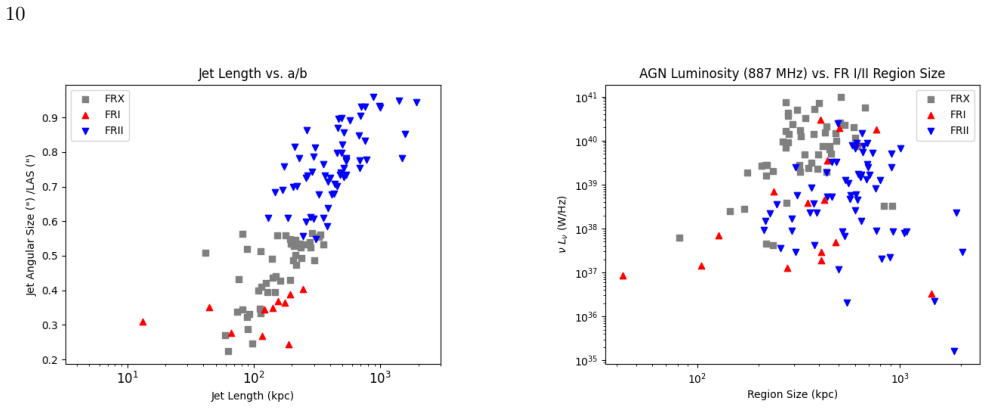
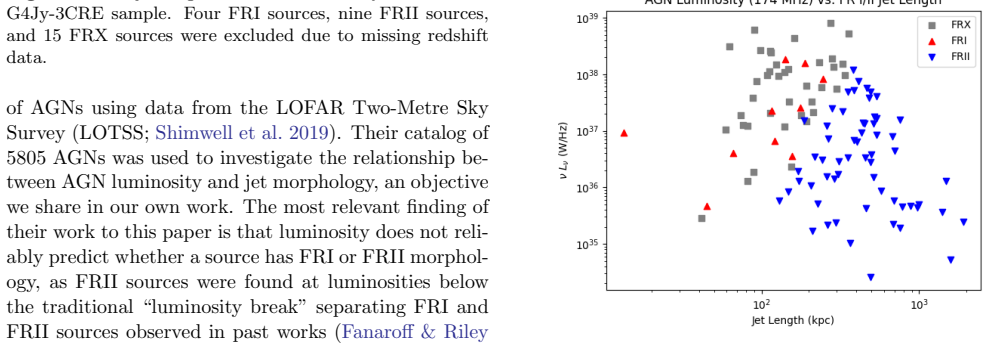


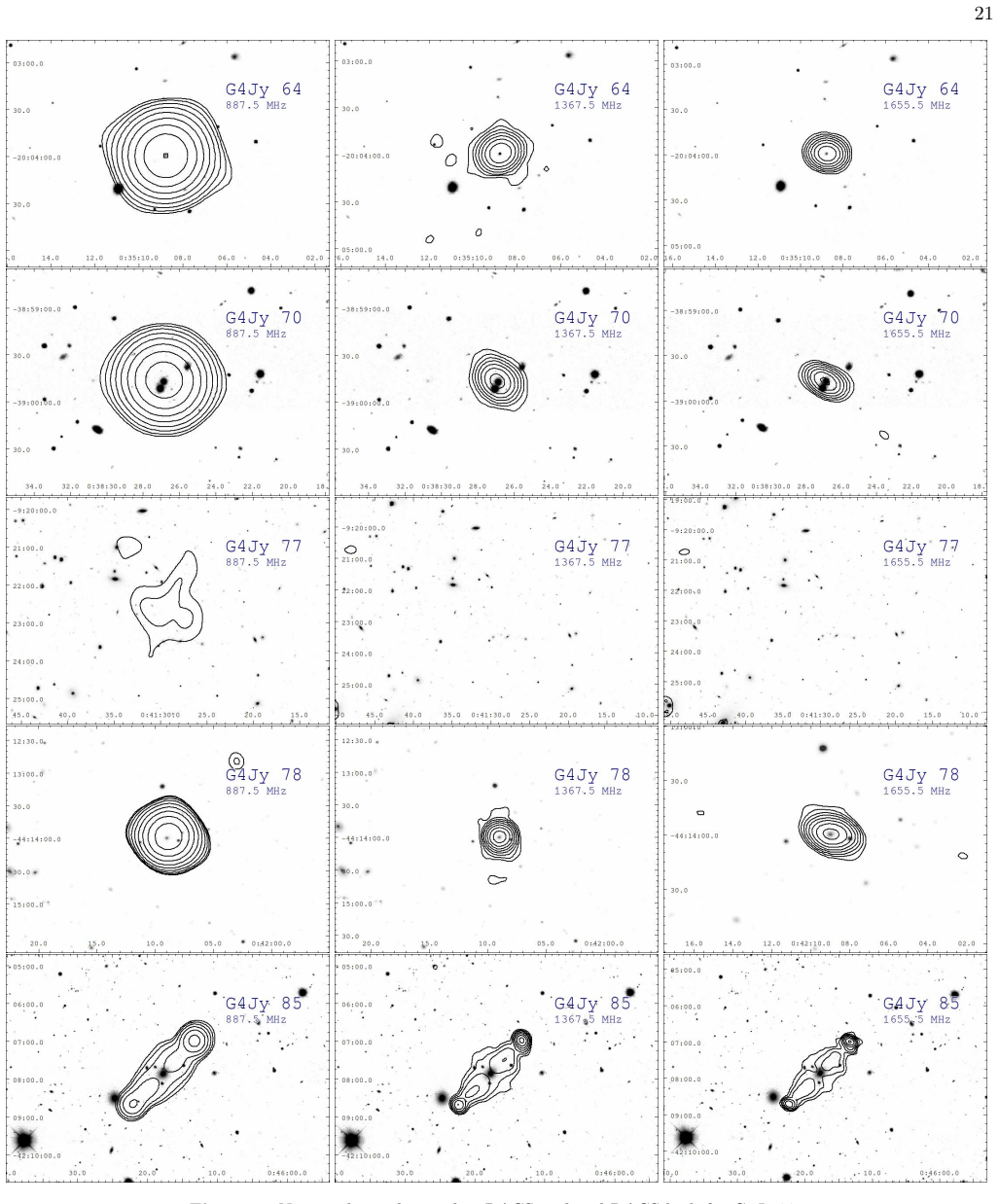


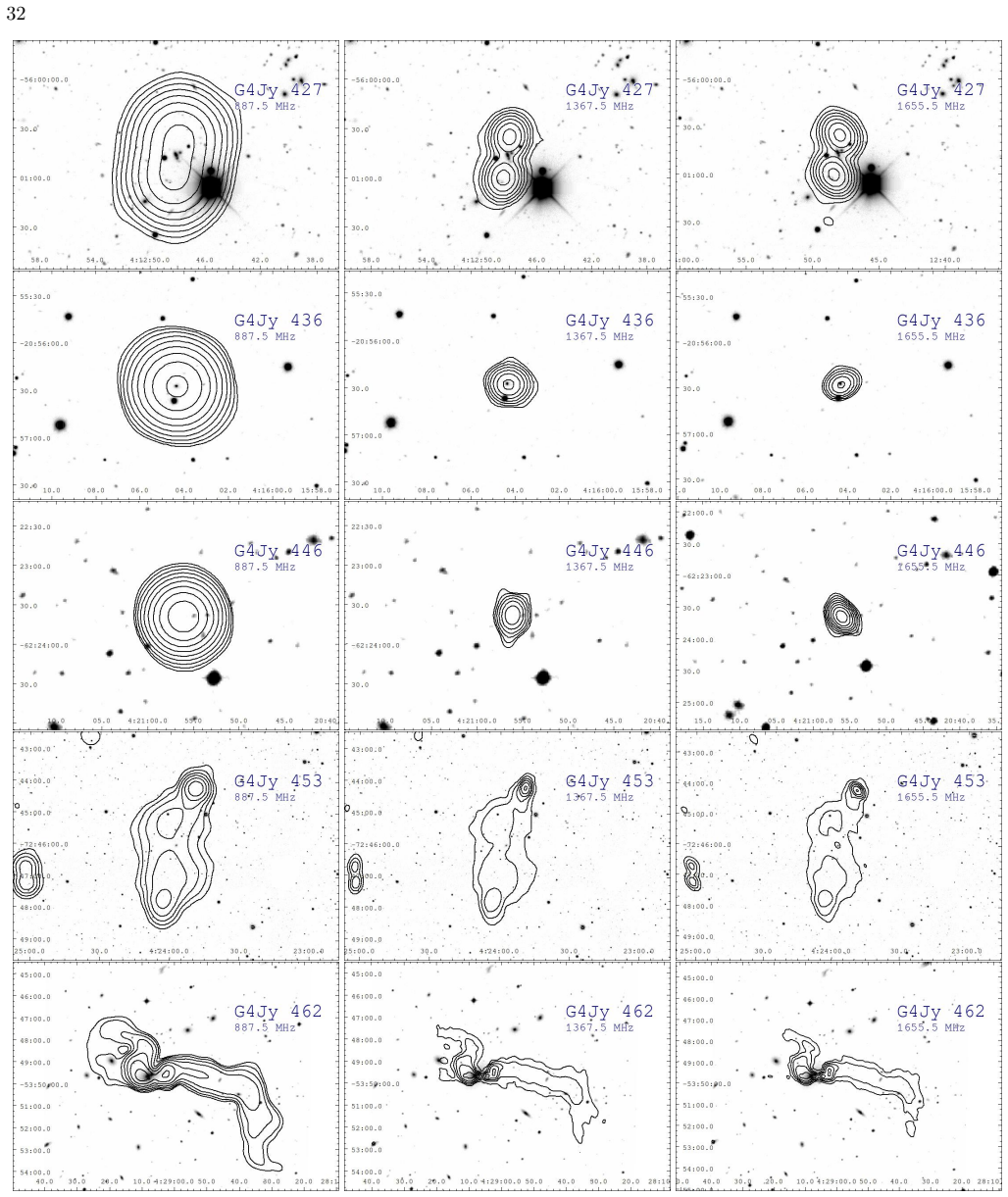








read the original abstract
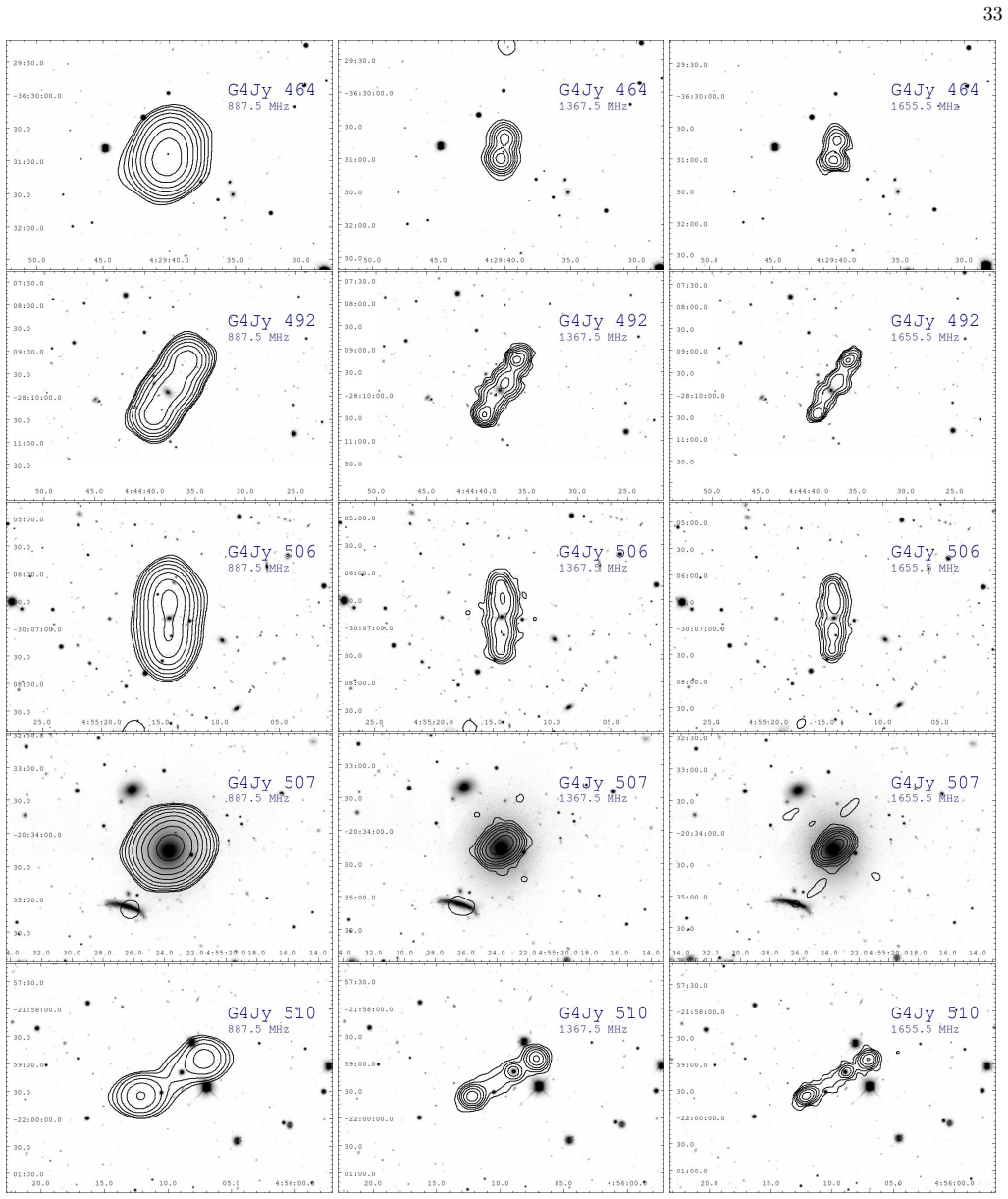
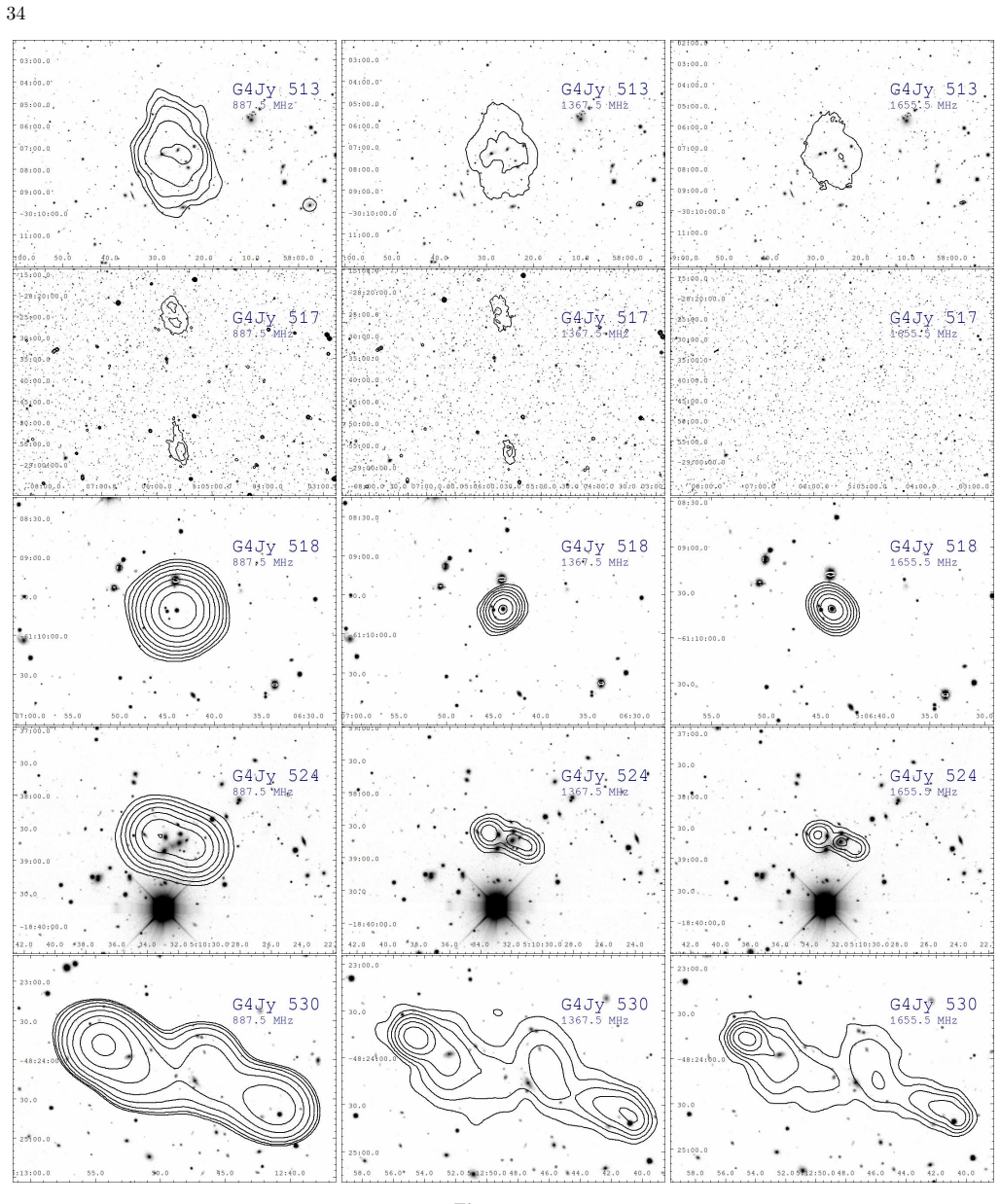
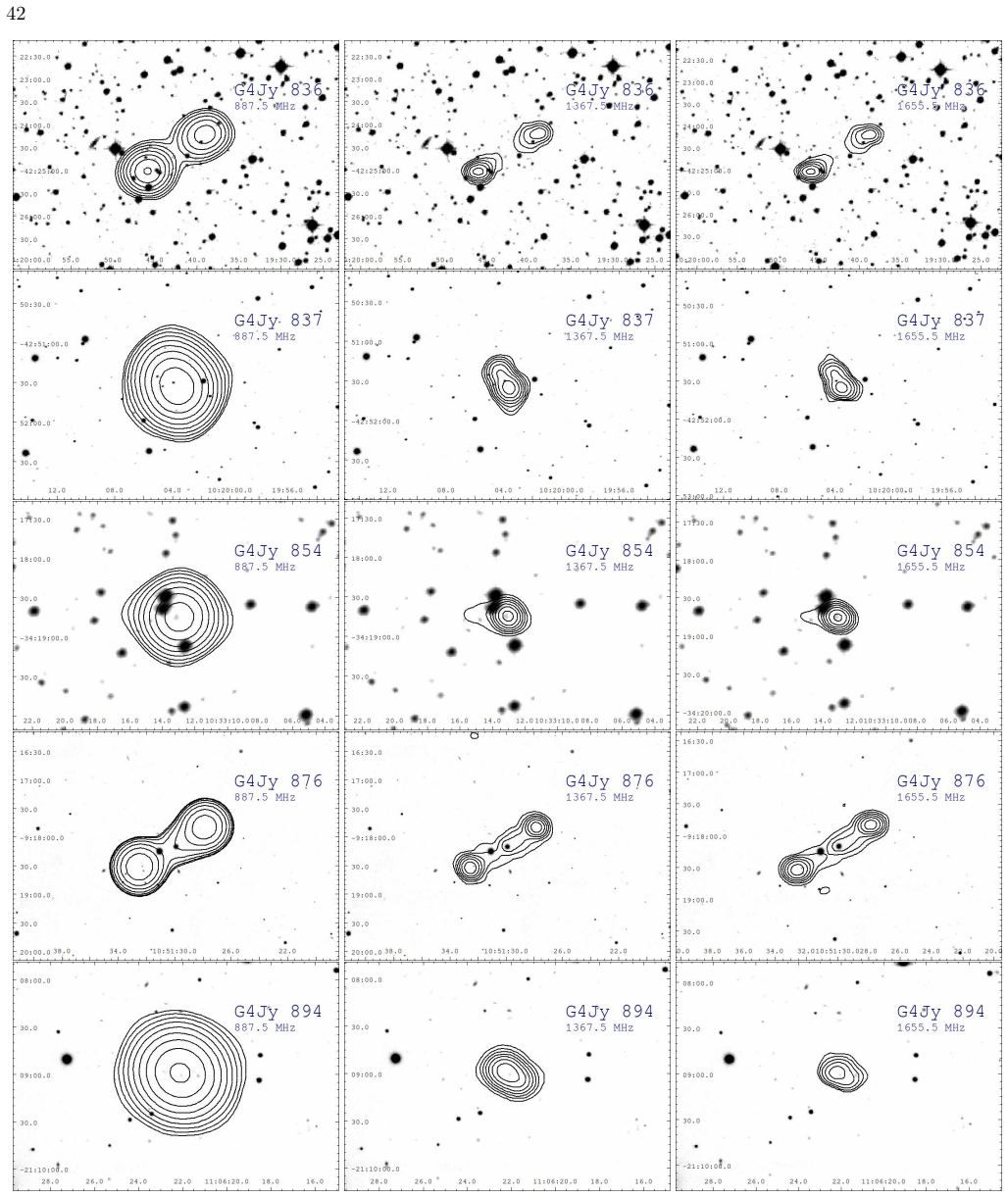
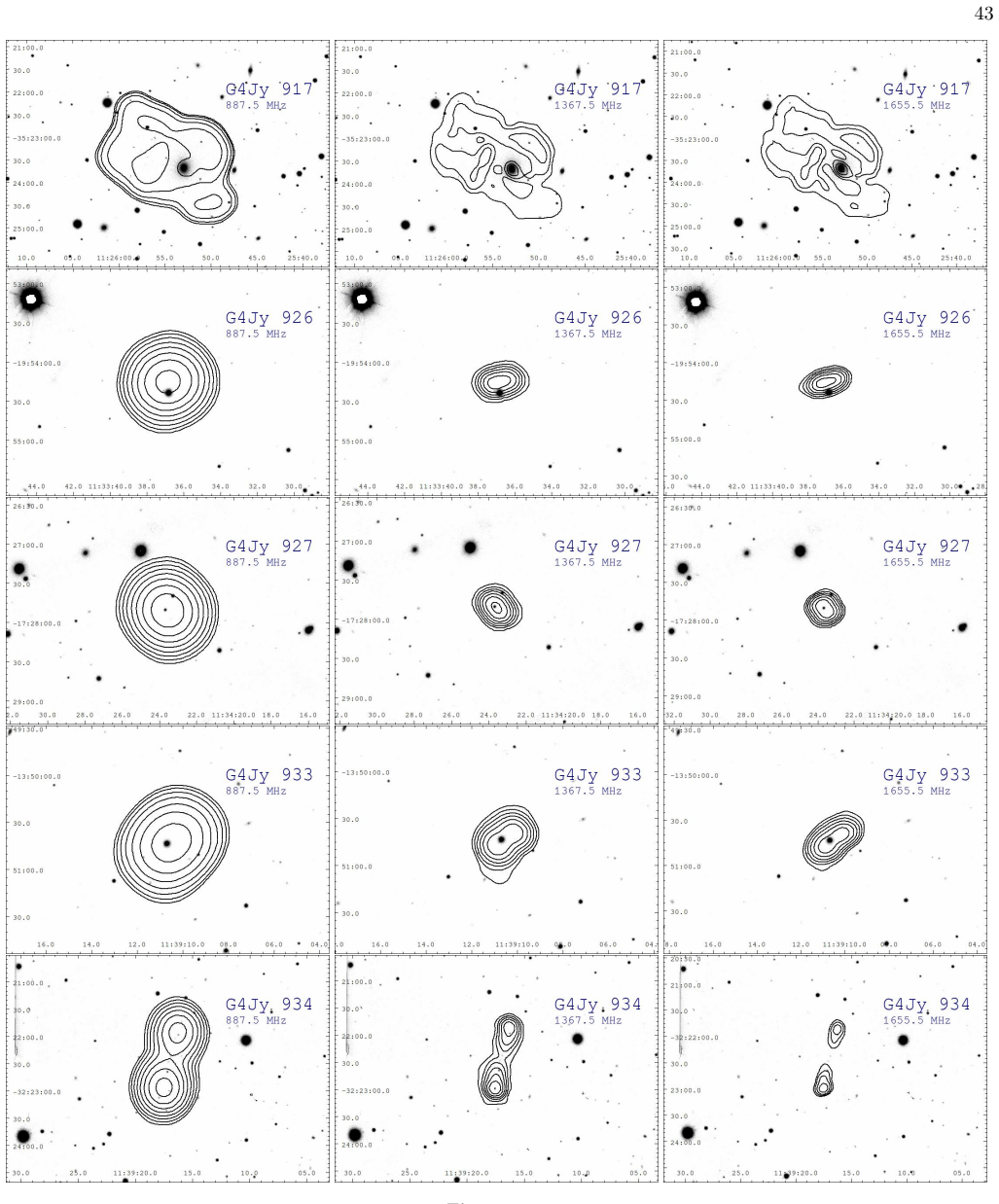
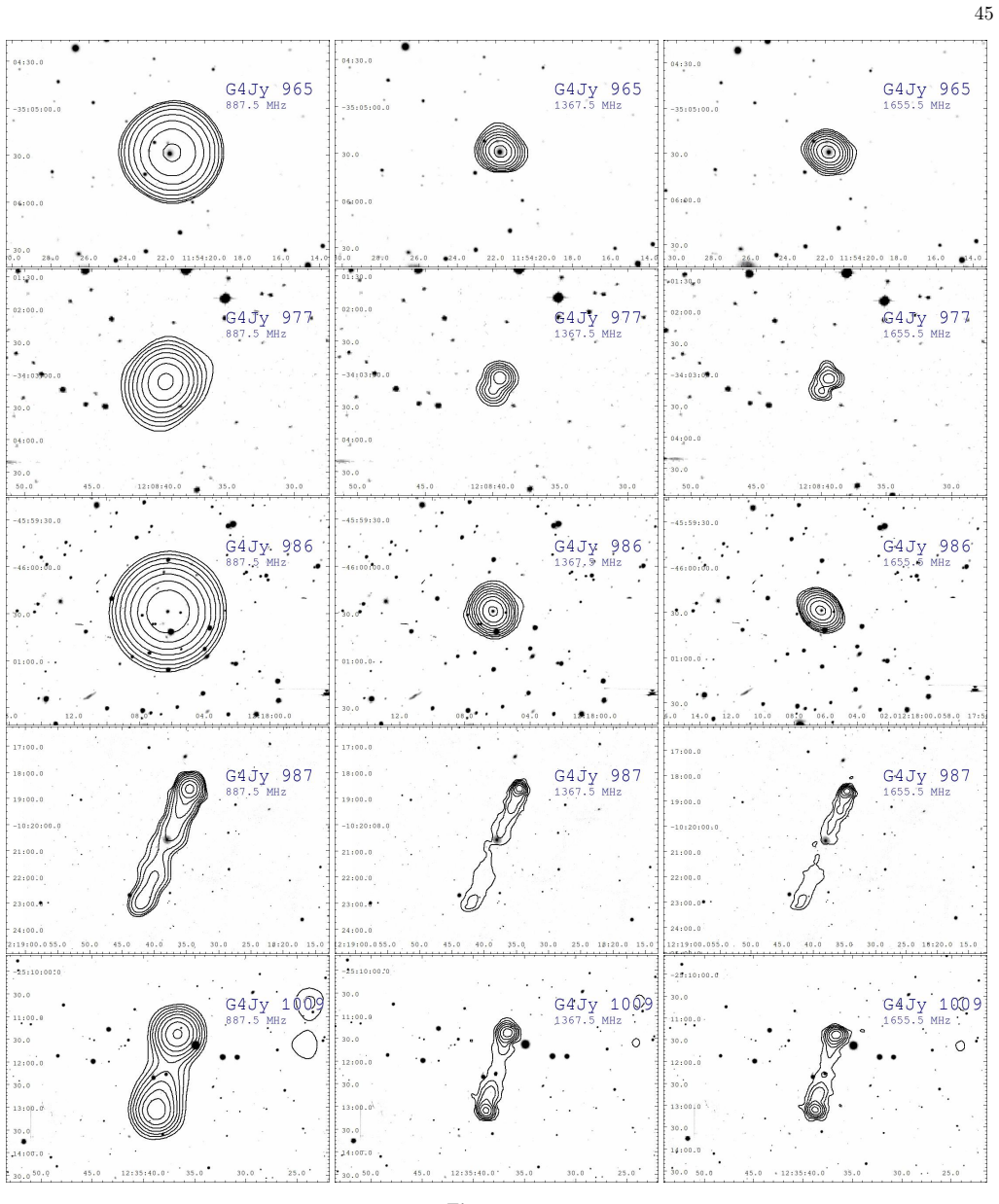
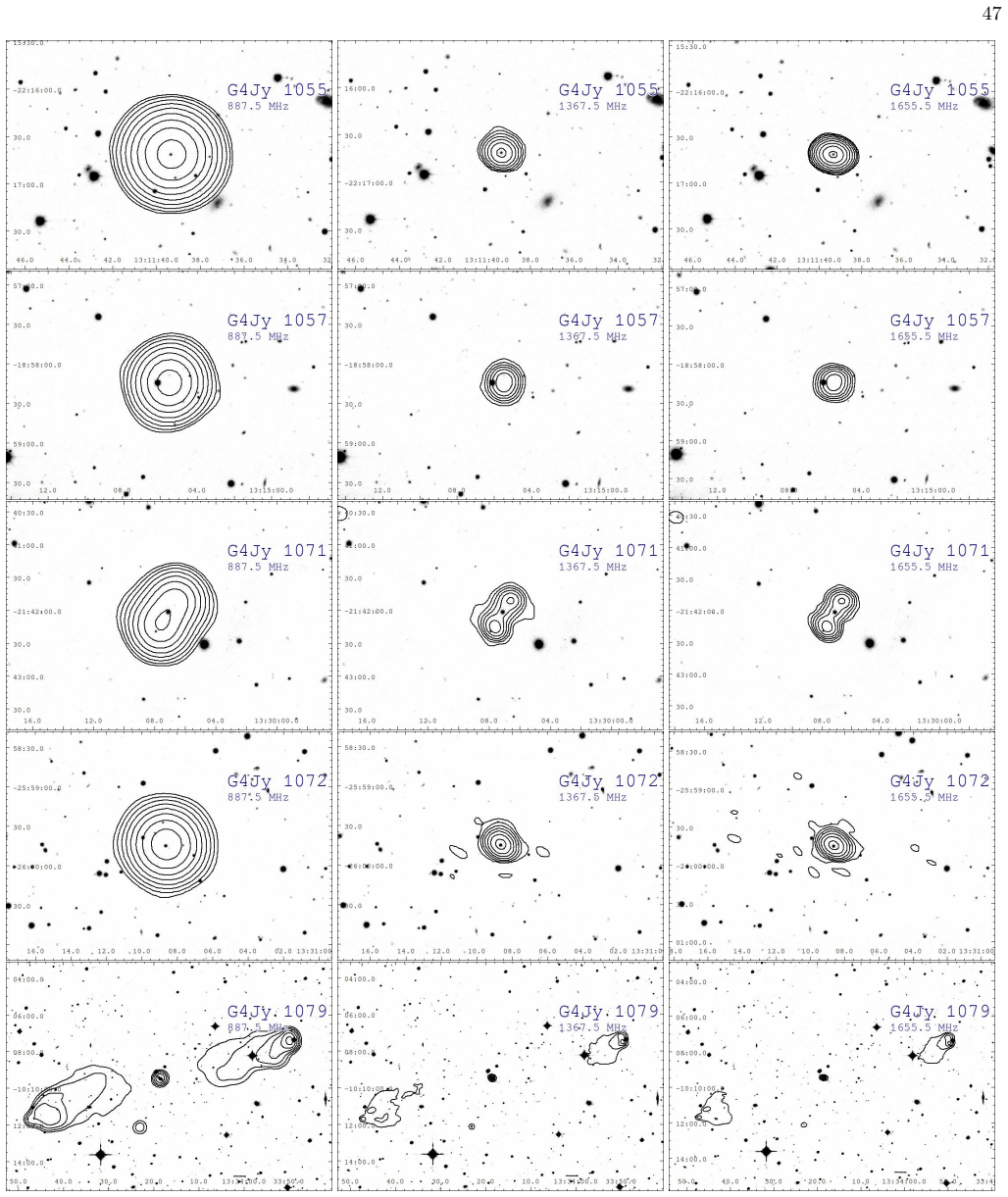
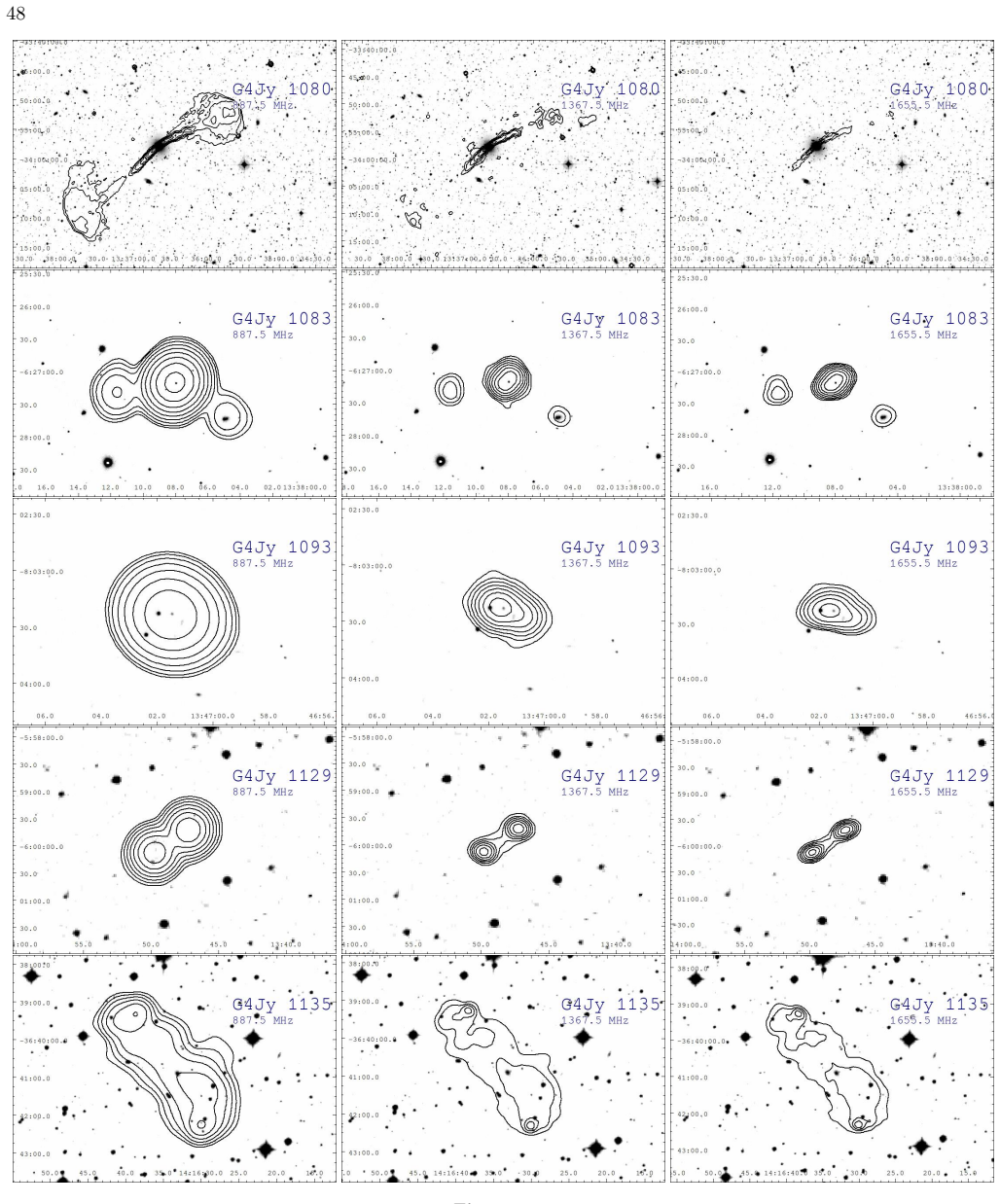
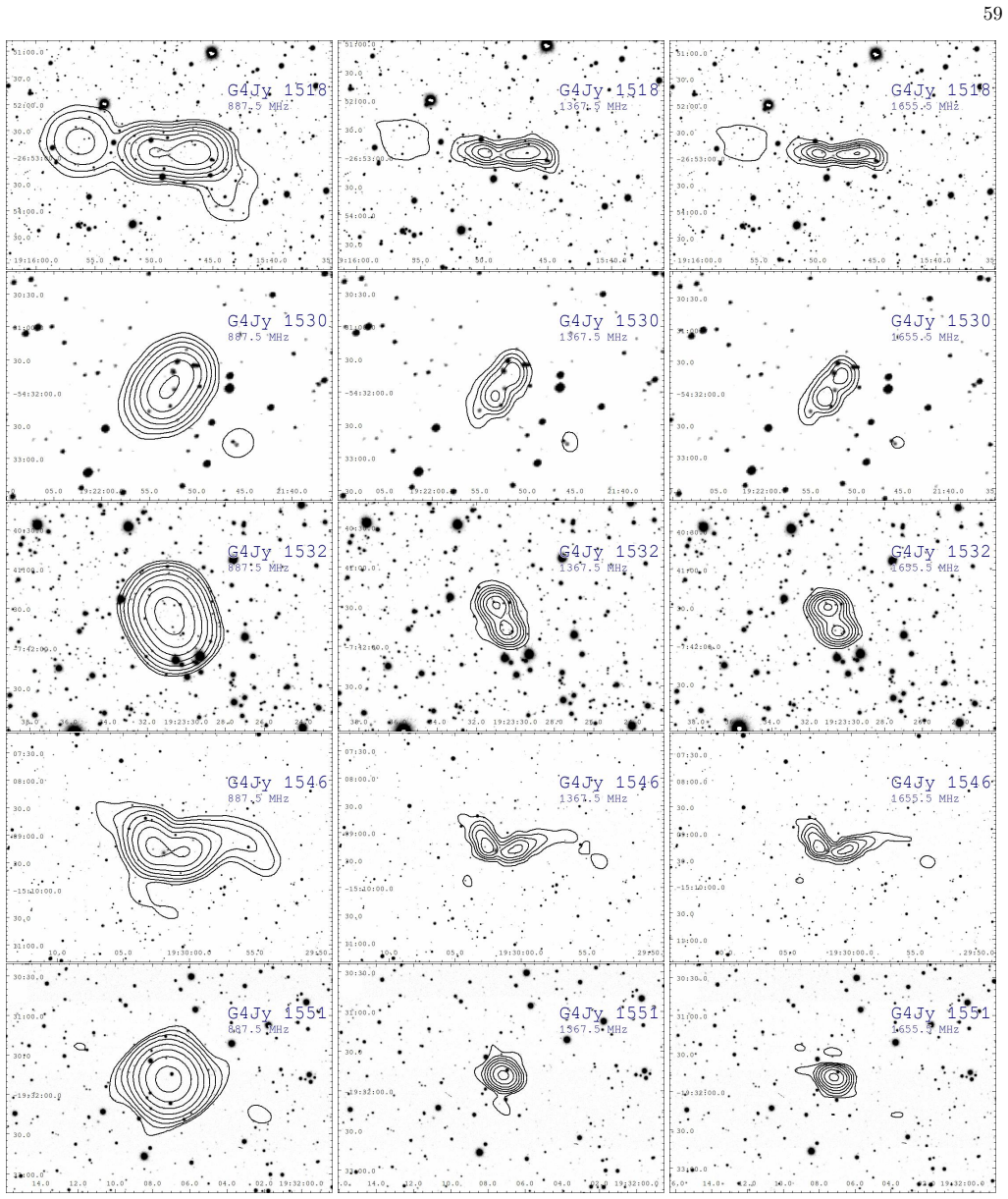
A recent 2023 paper by Massaro et al. introduced the G4Jy-3CRE, a new catalog of the brightest radio sources in the southern hemisphere that serve as a southern equivalent to the Third Cambridge Catalog Revised (3CR). The G4Jy-3CRE catalog selected 264 sources from the GLEAM-4Jy survey based on the same criteria used to select the sources in the 3CR. In this paper, we present new Australian Square Kilometre Array Pathfinder (ASKAP) continuuum imaging of the G4Jy-3CRE catalog. We use the three most recent data releases from the Rapid ASKAP Continuum Survey (RACS), covering the sky south of +30{\deg}decl.: RACS-low1, RACS-mid, and RACS-high. Together, these data releases cover a range of frequencies from 600 to 1800 MHz. The RACS surveys have improved spatial resolution and sensitivity over archival surveys at the same frequency, enabling us to classify 173 sources (66% of the sample) with morphologies indicative of the presence of jets, 37 of which did not show jet activity on archival radio maps. We were able to effectively classify FRI/FRII galaxies up to a redshift of z = 1.35. Moreover, we identified six optical counterparts for sources that were either previously unidentified or ambiguous.
Editorial analysis
A structured set of objections, weighed in public.
Referee Report
Summary. The paper presents new ASKAP continuum imaging from the RACS-low1, RACS-mid, and RACS-high surveys (600–1800 MHz) for the full G4Jy-3CRE sample of 264 bright southern radio sources. It reports that the improved resolution and sensitivity allow morphological classification of 173 sources (66% of the sample) as jet-bearing, including 37 sources whose jet activity was not visible in archival maps, FRI/FRII typing up to z = 1.35, and identification of six new or previously ambiguous optical counterparts.
Significance. If the classifications are reproducible, the work supplies a high-resolution radio dataset for a flux-limited southern sample that directly parallels the 3CR, enabling comparative studies of jet morphology, source evolution, and environment across hemispheres. The data release itself is a clear asset for the community.
major comments (3)
- [Results (morphological classification paragraph)] The manuscript states that 173 sources were classified on the basis of morphologies indicative of jets and that FRI/FRII types were assigned up to z = 1.35, yet no section supplies the quantitative decision criteria (e.g., minimum lobe angular extent, core-prominence threshold, or edge-brightening metric) used in the visual inspection. Without these, the 66 % classification rate and the 37 new jet detections cannot be independently verified or corrected for projection and resolution effects.
- [Results (new detections and optical counterparts)] The claim that the RACS images reveal jet/lobe features absent from archival maps rests entirely on unquantified visual comparison. No table or text reports inter-observer agreement, false-positive rates, or tests against simulated sources at the same surface-brightness and resolution limits, leaving the robustness of the 37 new detections and the six new optical IDs open to selection bias.
- [Discussion (redshift-dependent classification)] Although the paper asserts effective FRI/FRII classification to z = 1.35, there is no assessment of how beam smearing, surface-brightness dimming, or projection alter apparent morphology at the highest redshifts in the sample. This omission directly affects the load-bearing claim that the new data enable reliable typing across the full redshift range.
minor comments (2)
- [Figure captions] Figure captions should explicitly state the frequency of each RACS image and include a uniform angular-scale bar to facilitate direct comparison with archival maps.
- [Methods] A short methods subsection or appendix listing the exact visual-inspection protocol (even if qualitative) would improve reproducibility without lengthening the main text.
Simulated Author's Rebuttal
We are grateful to the referee for their constructive and detailed comments on our manuscript. We have carefully reviewed each major point and provide point-by-point responses below, indicating where revisions will be made to address the concerns raised.
read point-by-point responses
-
Referee: [Results (morphological classification paragraph)] The manuscript states that 173 sources were classified on the basis of morphologies indicative of jets and that FRI/FRII types were assigned up to z = 1.35, yet no section supplies the quantitative decision criteria (e.g., minimum lobe angular extent, core-prominence threshold, or edge-brightening metric) used in the visual inspection. Without these, the 66 % classification rate and the 37 new jet detections cannot be independently verified or corrected for projection and resolution effects.
Authors: We agree that the manuscript would be strengthened by an explicit description of the classification criteria. The classifications were performed via visual inspection by the author team using standard morphological indicators for jet-bearing radio sources (e.g., presence of extended lobes, jets, and core prominence). In the revised manuscript we will add a dedicated subsection in the Results section that outlines the specific features and approximate thresholds considered during inspection, such as minimum lobe angular extent and qualitative edge-brightening characteristics for FRII sources. This will improve reproducibility while acknowledging that some subjectivity is inherent to visual classification of complex sources. revision: yes
-
Referee: [Results (new detections and optical counterparts)] The claim that the RACS images reveal jet/lobe features absent from archival maps rests entirely on unquantified visual comparison. No table or text reports inter-observer agreement, false-positive rates, or tests against simulated sources at the same surface-brightness and resolution limits, leaving the robustness of the 37 new detections and the six new optical IDs open to selection bias.
Authors: We acknowledge that the 37 new jet detections and six new optical counterparts were identified through visual comparison of the higher-resolution and more sensitive RACS images against archival maps, without formal quantitative validation such as inter-observer agreement statistics or simulated source tests. In the revised manuscript we will expand the relevant Results section to describe the visual inspection process in more detail, including how consensus was reached among co-authors, and we will add a discussion of potential selection biases. However, we did not perform simulated source injections or calculate false-positive rates in the original analysis. revision: partial
-
Referee: [Discussion (redshift-dependent classification)] Although the paper asserts effective FRI/FRII classification to z = 1.35, there is no assessment of how beam smearing, surface-brightness dimming, or projection alter apparent morphology at the highest redshifts in the sample. This omission directly affects the load-bearing claim that the new data enable reliable typing across the full redshift range.
Authors: We accept this point. While the improved resolution of the RACS data enabled morphological classification up to z = 1.35, the manuscript does not include a dedicated assessment of beam smearing, surface-brightness dimming, or projection effects. In the revised version we will add a paragraph to the Discussion section that qualitatively evaluates these observational biases and their possible influence on classifications at the highest redshifts in the sample, referencing the redshift distribution of the classified sources. revision: yes
Circularity Check
No circularity: purely observational classification paper with independent results
full rationale
This is an observational data release paper presenting new ASKAP/RACS continuum imaging at 600-1800 MHz for the G4Jy-3CRE catalog. The central results—classification of 173 sources (66%) with jet morphologies, 37 newly detected jets, FRI/FRII typing to z=1.35, and six new optical IDs—are direct visual interpretations of improved-resolution images compared to archival maps. No equations, fitted parameters, predictions, or first-principles derivations are present. The single reference to the 2023 Massaro et al. paper defines the input catalog but does not support or justify the new morphological classifications, which rely on the current observations. The paper is self-contained as a straightforward observational report with no load-bearing self-citations or self-referential steps.
Axiom & Free-Parameter Ledger
axioms (1)
- domain assumption Standard radio galaxy morphological classification (FRI/FRII) based on jet appearance in continuum images is reliable at the resolution and sensitivity of RACS data.
Lean theorems connected to this paper
-
IndisputableMonolith/Foundation/DimensionForcing.leanreality_from_one_distinction unclear?
unclearRelation between the paper passage and the cited Recognition theorem.
classify 173 sources (66% of the sample) with morphologies indicative of the presence of jets... FRI/FRII galaxies up to a redshift of z=1.35
What do these tags mean?
- matches
- The paper's claim is directly supported by a theorem in the formal canon.
- supports
- The theorem supports part of the paper's argument, but the paper may add assumptions or extra steps.
- extends
- The paper goes beyond the formal theorem; the theorem is a base layer rather than the whole result.
- uses
- The paper appears to rely on the theorem as machinery.
- contradicts
- The paper's claim conflicts with a theorem or certificate in the canon.
- unclear
- Pith found a possible connection, but the passage is too broad, indirect, or ambiguous to say the theorem truly supports the claim.
Reference graph
Works this paper leans on
-
[1]
Macdonald, G. H. and Kenderdine, S. and Neville, Ann C. , title = ". Monthly Notices of the Royal Astronomical Society , volume =. 1968 , month =. doi:10.1093/mnras/138.3.259 , url =
-
[2]
, year = 1966, month = jan, volume =
The operation of the Cambridge one-mile telescope. , year = 1966, month = jan, volume =. doi:10.1093/mnras/134.1.87 , adsurl =
-
[3]
Tingay, S. J. and Goeke, R. and Bowman, J. D. and Emrich, D. and Ord, S. M. and Mitchell, D. A. and Morales, M. F. and Booler, T. and Crosse, B. and Wayth, R. B. and et al. , year=. The Murchison Widefield Array: The Square Kilometre Array Precursor at Low Radio Frequencies , volume=. doi:10.1017/pasa.2012.007 , journal=
-
[4]
Bennett, A. S. and Smith, F. G. , title = ". Monthly Notices of the Royal Astronomical Society , volume =. 1962 , month =. doi:10.1093/mnras/125.1.75 , url =
-
[5]
Mackay, Craig D. , title = ". Monthly Notices of the Royal Astronomical Society , volume =. 1971 , month =. doi:10.1093/mnras/154.2.209 , url =
-
[6]
McConnell, D. and Hale, C. L. and Lenc, E. and Banfield, J. K. and Heald, George and Hotan, A. W. and Leung, James K. and Moss, Vanessa A. and Murphy, Tara and O’Brien, Andrew and et al. , year=. The Rapid ASKAP Continuum Survey I: Design and first results , volume=. doi:10.1017/pasa.2020.41 , journal=
-
[7]
The Rapid ASKAP Continuum Survey Paper II: First Stokes I Source Catalogue Data Release. , keywords =. doi:10.1017/pasa.2021.47 , archivePrefix =. 2109.00956 , primaryClass =
-
[8]
The Rapid ASKAP Continuum Survey V: Cataloguing the sky at 1 367.5 MHz and the second data release of RACS-mid. , keywords =. doi:10.1017/pasa.2023.60 , archivePrefix =. 2311.12369 , primaryClass =
-
[9]
Wootten, Alwyn and Thompson, A. Richard , journal=. The Atacama Large Millimeter/Submillimeter Array , year=
-
[10]
Hotan, A. W. and Bunton, J. D. and Chippendale, A. P. and Whiting, M. and Tuthill, J. and Moss, V. A. and McConnell, D. and Amy, S. W. and Huynh, M. T. and Allison, J. R. and et al. , year=. Australian square kilometre array pathfinder: I. system description , volume=. doi:10.1017/pasa.2021.1 , journal=
-
[11]
Wayth, R. B. and Lenc, E. and Bell, M. E. and Callingham, J. R. and Dwarakanath, K. S. and Franzen, T. M. O. and For, B.-Q. and Gaensler, B. and Hancock, P. and Hindson, L. and et al. , year=. GLEAM: The GaLactic and Extragalactic All-Sky MWA Survey , volume=. doi:10.1017/pasa.2015.26 , journal=
-
[12]
VizieR Online Data Catalog: Powerful radio sources in the Southern Sky. I. (Massaro+, 2023)
work page 2023
-
[13]
A. M. Burgess and R. W. Hunstead , title =. The Astronomical Journal , abstract =. 2006 , month =. doi:10.1086/498677 , url =
-
[14]
, year = 1981, month = feb, volume =
The Molonglo Reference Catalogue of radio sources. , year = 1981, month = feb, volume =. doi:10.1093/mnras/194.3.693 , adsurl =
-
[15]
A 98 per cent spectroscopically complete sample of the most powerful equatorial radio sources at 408MHz. , keywords =. doi:10.1046/j.1365-8711.1999.02984.x , archivePrefix =. astro-ph/9903471 , primaryClass =
-
[16]
The Dark Energy Survey Data Release 1
The Dark Energy Survey: Data Release 1. , keywords =. doi:10.3847/1538-4365/aae9f0 , archivePrefix =. 1801.03181 , primaryClass =
work page internal anchor Pith review Pith/arXiv arXiv doi:10.3847/1538-4365/aae9f0
-
[17]
The Ninth Data Release of the Sloan Digital Sky Survey: First Spectroscopic Data from the SDSS-III Baryon Oscillation Spectroscopic Survey. , keywords =. doi:10.1088/0067-0049/203/2/21 , archivePrefix =. 1207.7137 , primaryClass =
work page internal anchor Pith review Pith/arXiv arXiv doi:10.1088/0067-0049/203/2/21
-
[18]
The Pan-STARRS1 Database and Data Products. , keywords =. doi:10.3847/1538-4365/abb82d , archivePrefix =. 1612.05243 , primaryClass =
-
[19]
Digitized Sky Survey , publisher =. doi:10.26131/IRSA441 , url =
-
[20]
Jansky Very Large Array Sky Survey (VLASS)
The Karl G. Jansky Very Large Array Sky Survey (VLASS). Science Case and Survey Design. , keywords =. doi:10.1088/1538-3873/ab63eb , archivePrefix =. 1907.01981 , primaryClass =
-
[21]
Astronomical Data Analysis Software and Systems XXVII , year = 2020, editor =
The CSIRO ASKAP Science Data Archive. Astronomical Data Analysis Software and Systems XXVII , year = 2020, editor =
work page 2020
-
[22]
Astronomical Data Analysis Software and Systems XXV , year = 2017, editor =
CASDA: The CSIRO ASKAP Science Data Archive. Astronomical Data Analysis Software and Systems XXV , year = 2017, editor =
work page 2017
-
[23]
Optical spectra of southern Molonglo radio sources - I. , keywords =. doi:10.1093/mnras/185.1.149 , adsurl =
-
[24]
A Swift X-Ray View of the SMS4 Sample-X-Ray Properties of 31 Quasars and Radio Galaxies. , keywords =. doi:10.3847/1538-4365/ac87a5 , archivePrefix =. 2208.04763 , primaryClass =
-
[25]
Magellan Spectroscopy of Low-Redshift Active Galactic Nuclei
Magellan Spectroscopy of Low-Redshift Active Galactic Nuclei. , keywords =. doi:10.1088/0067-0049/184/2/398 , archivePrefix =. 0909.0054 , primaryClass =
work page internal anchor Pith review Pith/arXiv arXiv doi:10.1088/0067-0049/184/2/398
-
[26]
The Parkes-MIT-NRAO (PMN) Survey. I. The 4850 MHz Surveys and Data Reduction. , keywords =. doi:10.1086/116545 , adsurl =
-
[27]
The Parkes-MIT-NRAO (PMN) Map Catalog of Radio Sources Covering -88 degrees < delta < -37 degrees at 4.85 GHz. , keywords =. doi:10.1086/191862 , adsurl =
-
[28]
A study of cores in a complete sample of radio sources. , keywords =. doi:10.1093/mnras/284.3.541 , adsurl =
-
[29]
Bright extragalactic radio sources at 2.7 GHz- III. The all-sky catalogue. , keywords =. doi:10.1093/mnras/216.2.173 , adsurl =
-
[30]
A Swift X-ray view of the SMS4 sample -- II: X-ray properties of 17 bright radio sources. arXiv e-prints , keywords =. doi:10.48550/arXiv.2407.06024 , archivePrefix =. 2407.06024 , primaryClass =
-
[31]
2009, MNRAS, 394, 2255, doi: 10.1111/j.1365-2966.2009.14499.x 24
The Australia Telescope 20 GHz Survey: the source catalogue. , keywords =. doi:10.1111/j.1365-2966.2009.15961.x , archivePrefix =. 0911.0002 , primaryClass =
-
[32]
doi:10.26093/cds/vizier.22420004 , adsurl =
VizieR Online Data Catalog: Two new catalogs of blazar candidates (D'Abrusco+, 2019). doi:10.26093/cds/vizier.22420004 , adsurl =
-
[33]
Two new catalogs of blazar candidates in the WISE infrared sky
Two New Catalogs of Blazar Candidates in the WISE Infrared Sky. , keywords =. doi:10.3847/1538-4365/ab16f4 , archivePrefix =. 1903.11124 , primaryClass =
work page internal anchor Pith review Pith/arXiv arXiv doi:10.3847/1538-4365/ab16f4 1903
-
[34]
A catalogue of quasars and active nuclei: 13th edition. , keywords =. doi:10.1051/0004-6361/201014188 , adsurl =
-
[35]
The UV-bright Quasar Survey (UVQS): DR1
The UV-bright Quasar Survey (UVQS): DR1. , keywords =. doi:10.3847/0004-6256/152/1/25 , archivePrefix =. 1602.06255 , primaryClass =
work page internal anchor Pith review Pith/arXiv arXiv doi:10.3847/0004-6256/152/1/25
-
[36]
Friends-of-friends galaxy group finder with membership refinement. Application to the local Universe
Friends-of-friends galaxy group finder with membership refinement. Application to the local Universe. , keywords =. doi:10.1051/0004-6361/201527755 , archivePrefix =. 1601.01117 , primaryClass =
work page internal anchor Pith review Pith/arXiv arXiv doi:10.1051/0004-6361/201527755
-
[37]
Radio galaxies of the local universe: all-sky catalog, luminosity functions, and clustering
Radio galaxies of the local universe. All-sky catalog, luminosity functions, and clustering. , keywords =. doi:10.1051/0004-6361/201219389 , archivePrefix =. 1206.0031 , primaryClass =
work page internal anchor Pith review Pith/arXiv arXiv doi:10.1051/0004-6361/201219389
-
[38]
The dynamical state of brightest cluster galaxies and the formation of clusters
The Dynamical State of Brightest Cluster Galaxies and The Formation of Clusters. , keywords =. doi:10.1088/0004-6256/137/6/4795 , archivePrefix =. 0903.2360 , primaryClass =
work page internal anchor Pith review Pith/arXiv arXiv doi:10.1088/0004-6256/137/6/4795
-
[39]
Optical properties of high-frequency radio sources from the Australia Telescope 20 GHz (AT20G) Survey. , keywords =. doi:10.1111/j.1365-2966.2011.19427.x , archivePrefix =. 1107.2454 , primaryClass =
-
[40]
Optical spectra of southern Molonglo radio sources- II. , keywords =. doi:10.1017/S1323358000017173 , adsurl =
-
[41]
Giant radio galaxies - II. Tracers of large-scale structure
Giant radio galaxies - II. Tracers of large-scale structure. , keywords =. doi:10.1093/mnras/stv273 , archivePrefix =. 1502.03954 , primaryClass =
work page internal anchor Pith review Pith/arXiv arXiv doi:10.1093/mnras/stv273
- [42]
-
[43]
2001, MNRAS, 322, 231, doi: 10.1046/j.1365-8711.2001.04022.x
The evolution and star formation of dwarf galaxies in the Fornax Cluster. , keywords =. doi:10.1046/j.1365-8711.2001.04646.x , archivePrefix =. astro-ph/0106376 , primaryClass =
-
[44]
Australian Journal of Physics Astrophysical Supplement , year = 1969, month = jan, volume =
Interferometric Observations of the Brightness Distribution of Southern Radio Sources. Australian Journal of Physics Astrophysical Supplement , year = 1969, month = jan, volume =
work page 1969
-
[45]
, year = 1993, month = aug, volume =
The radio structures of southern 2-Jy radio sources. , year = 1993, month = aug, volume =. doi:10.1093/mnras/263.4.1023 , adsurl =
-
[46]
Interaction of the radio source PKS 0427-53 with IC 2082 and the cluster medium. , keywords =. doi:10.1093/mnras/235.2.425 , adsurl =
-
[47]
A Uniformly Selected, Southern-sky 6dF, Optical AGN Catalog. , keywords =. doi:10.3847/1538-4365/ac4157 , archivePrefix =. 2111.13217 , primaryClass =
-
[48]
, year = 1972, month = jan, volume =
New redshifts of radio galaxies. , year = 1972, month = jan, volume =. doi:10.1093/mnras/158.3.277 , adsurl =
-
[49]
Emission lines and optical continuum in low-luminosity radio galaxies. , keywords =. doi:10.1111/j.1365-2966.2004.07195.x , archivePrefix =. astro-ph/0310256 , primaryClass =
-
[50]
CRATES: An All-Sky Survey of Flat-Spectrum Radio Sources
CRATES: An All-Sky Survey of Flat-Spectrum Radio Sources. , keywords =. doi:10.1086/513742 , archivePrefix =. astro-ph/0702346 , primaryClass =
work page internal anchor Pith review Pith/arXiv arXiv doi:10.1086/513742
-
[51]
Characterization of ICM Temperature Distributions of 62 Galaxy Clusters with XMM-Newton
Characterization of Intracluster Medium Temperature Distributions of 62 Galaxy Clusters with XMM-Newton. , keywords =. doi:10.1088/0004-637X/764/1/46 , archivePrefix =. 1212.2239 , primaryClass =
work page internal anchor Pith review Pith/arXiv arXiv doi:10.1088/0004-637x/764/1/46
-
[52]
The optical morphologies of the 2 Jy sample of radio galaxies: evidence for galaxy interactions. , keywords =. doi:10.1111/j.1365-2966.2010.17542.x , archivePrefix =. 1008.2683 , primaryClass =
-
[53]
The link between accretion mode and environment in radio-loud active galaxies
The link between accretion mode and environment in radio-loud active galaxies. , keywords =. doi:10.1093/mnras/stv1807 , archivePrefix =. 1508.01033 , primaryClass =
work page internal anchor Pith review Pith/arXiv arXiv doi:10.1093/mnras/stv1807
-
[54]
A Catalog of Rich Clusters of Galaxies. , keywords =. doi:10.1086/191333 , adsurl =
-
[55]
, year = 1958, month = may, volume =
The Distribution of Rich Clusters of Galaxies. , year = 1958, month = may, volume =. doi:10.1086/190036 , adsurl =
-
[57]
Parkes Radio Sources in the Direction of Southern Rich Clusters. , keywords =. doi:10.1086/116012 , adsurl =
-
[58]
Every BCG with a Strong Radio Agn has an X-Ray Cool Core: Is the Cool Core-Noncool Core Dichotomy Too Simple?. , keywords =. doi:10.1088/0004-637X/704/2/1586 , archivePrefix =. 0904.2006 , primaryClass =
work page internal anchor Pith review Pith/arXiv arXiv doi:10.1088/0004-637x/704/2/1586 2006
-
[59]
The Palermo Swift-BAT hard X-ray catalogue. III. Results after 54 months of sky survey. , keywords =. doi:10.1051/0004-6361/201015249 , archivePrefix =. 1009.0522 , primaryClass =
work page internal anchor Pith review Pith/arXiv arXiv doi:10.1051/0004-6361/201015249
-
[60]
The 105 month Swift-BAT all-sky hard X-ray survey
The 105-Month Swift-BAT All-sky Hard X-Ray Survey. , keywords =. doi:10.3847/1538-4365/aaa7fd , archivePrefix =. 1801.01882 , primaryClass =
work page internal anchor Pith review Pith/arXiv arXiv doi:10.3847/1538-4365/aaa7fd
-
[61]
Excitation and temperature of extended gas in active galaxies. I. Observations. , keywords =
-
[62]
2009, MNRAS, 394, 2255, doi: 10.1111/j.1365-2966.2009.14499.x 24
The 6dF Galaxy Survey: final redshift release (DR3) and southern large-scale structures. , keywords =. doi:10.1111/j.1365-2966.2009.15338.x , archivePrefix =. 0903.5451 , primaryClass =
-
[63]
Accurate classification of 75 counterparts of objects detected in the 54-month Palermo Swift/BAT hard X-ray catalogue. , keywords =. doi:10.1051/0004-6361/201322409 , archivePrefix =. 1311.1458 , primaryClass =
work page internal anchor Pith review Pith/arXiv arXiv doi:10.1051/0004-6361/201322409
-
[64]
Optical spectroscopy of 28 southern radio galaxies. , keywords =. doi:10.1093/mnras/202.3.703 , adsurl =
-
[65]
Extragalactic radio sources with hybrid morphology: implications for the Fanaroff-Riley dichotomy
Extragalactic radio sources with hybrid morphology: implications for the Fanaroff-Riley dichotomy. , keywords =. doi:10.48550/arXiv.astro-ph/0009441 , archivePrefix =. astro-ph/0009441 , primaryClass =
work page internal anchor Pith review Pith/arXiv arXiv doi:10.48550/arxiv.astro-ph/0009441
-
[66]
First ``Winged'' and X-Shaped Radio Source Candidates. II. New Redshifts. , keywords =. doi:10.1088/0067-0049/181/2/548 , archivePrefix =. 0811.3942 , primaryClass =
work page internal anchor Pith review Pith/arXiv arXiv doi:10.1088/0067-0049/181/2/548
-
[67]
The Radio Galaxy IC 4296 (PKS 1333-33). II. Spectroscopy, Surface Photometry, X-Ray Imaging, and Infrared Photometry. , keywords =. doi:10.1086/164576 , adsurl =
-
[68]
The Radio Galaxy IC 4296 (PKS 1333-33). III. Interpretation of the Radio, Optical, and X-Ray Data. , keywords =. doi:10.1086/165890 , adsurl =
-
[69]
Streaming motions of galaxy clusters within 12000kms ^ -1 - I. New spectroscopic data. , keywords =. doi:10.1046/j.1365-8711.2000.03251.x , adsurl =
-
[70]
Redshift-Distance Survey of Early-Type Galaxies: Spectroscopic Data
Redshift-Distance Survey of Early-Type Galaxies: Spectroscopic Data. , keywords =. doi:10.1086/378959 , archivePrefix =. astro-ph/0308357 , primaryClass =
work page internal anchor Pith review Pith/arXiv arXiv doi:10.1086/378959
-
[71]
Powerful AGN jets and unbalanced cooling in the hot atmosphere of IC 4296
Powerful AGN jets and unbalanced cooling in the hot atmosphere of IC 4296. , keywords =. doi:10.1093/mnras/stz1728 , archivePrefix =. 1903.03198 , primaryClass =
work page internal anchor Pith review Pith/arXiv arXiv doi:10.1093/mnras/stz1728 1903
-
[72]
Very Large Array Radio Study of a Sample of Nearby X-Ray and Optically Bright Early-type Galaxies. , keywords =. doi:10.3847/1538-4365/ac366c , archivePrefix =. 2111.02430 , primaryClass =
-
[73]
Threads, Ribbons, and Rings in the Radio Galaxy IC 4296. , keywords =. doi:10.3847/1538-4357/ac0880 , archivePrefix =. 2106.05340 , primaryClass =
- [74]
-
[75]
, year = 1993, month = aug, volume =
Optical spectroscopy of a complete sample of southern 2-Jy radio sources. , year = 1993, month = aug, volume =. doi:10.1093/mnras/263.4.999 , adsurl =
-
[76]
Optical Identifications of Southern Compact Radio Sources. , keywords =. doi:10.1086/115127 , adsurl =
-
[77]
The 70 Month Swift-BAT All-Sky Hard X-Ray Survey
The 70 Month Swift-BAT All-sky Hard X-Ray Survey. , keywords =. doi:10.1088/0067-0049/207/2/19 , archivePrefix =. 1212.3336 , primaryClass =
work page internal anchor Pith review Pith/arXiv arXiv doi:10.1088/0067-0049/207/2/19
-
[78]
Searching for new gamma-ray blazar candidates in the 3rd Palermo BAT Hard X-ray Catalog with WISE
Searching for New -Ray Blazar Candidates in the Third Palermo BAT Hard X-Ray Catalog with WISE. , keywords =. doi:10.1088/0067-0049/206/2/17 , archivePrefix =. 1308.0026 , primaryClass =
work page internal anchor Pith review Pith/arXiv arXiv doi:10.1088/0067-0049/206/2/17
-
[79]
Astropy: A Community Python Package for Astronomy
doi:10.1051/0004-6361/201322068 , Eid =. arXiv , Author =:1307.6212 , Journal =
work page internal anchor Pith review Pith/arXiv arXiv doi:10.1051/0004-6361/201322068
-
[80]
The Astropy Project: Building an inclusive, open-science project and status of the v2.0 core package
The Astropy Project: Building an Open-science Project and Status of the v2.0 Core Package. , keywords =. doi:10.3847/1538-3881/aabc4f , archivePrefix =. 1801.02634 , primaryClass =
work page internal anchor Pith review Pith/arXiv arXiv doi:10.3847/1538-3881/aabc4f
-
[81]
The Astropy Project: Sustaining and Growing a Community-oriented Open-source Project and the Latest Major Release (v5.0) of the Core Package. , keywords =. doi:10.3847/1538-4357/ac7c74 , archivePrefix =. 2206.14220 , primaryClass =
work page internal anchor Pith review Pith/arXiv arXiv doi:10.3847/1538-4357/ac7c74
discussion (0)
Sign in with ORCID, Apple, or X to comment. Anyone can read and Pith papers without signing in.