A formation scenario of black hole-envelope systems --viscous hydrodynamics simulation in general relativity--
Pith reviewed 2026-06-30 14:52 UTC · model grok-4.3
The pith
Black hole mass sets whether super-Eddington flows produce viscous outflows or convective envelopes.
A machine-rendered reading of the paper's core claim, the machinery that carries it, and where it could break.
Core claim
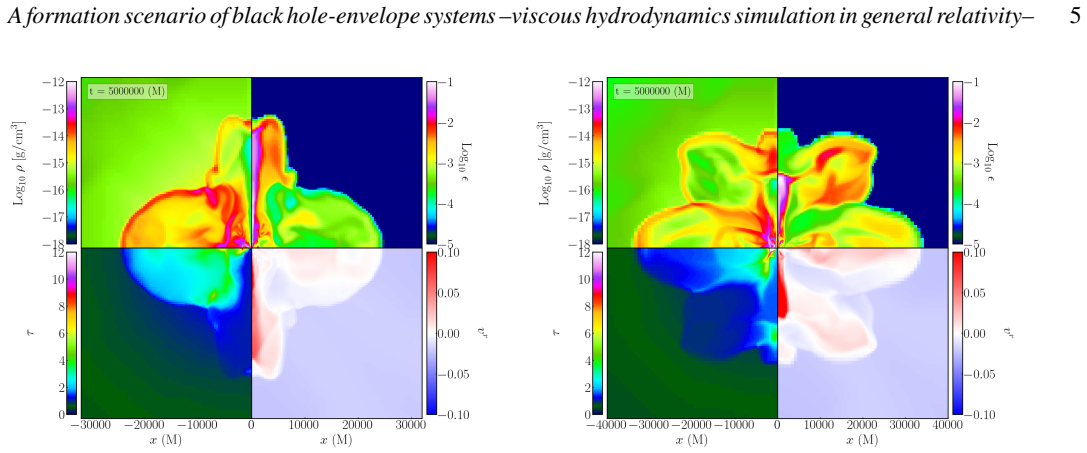
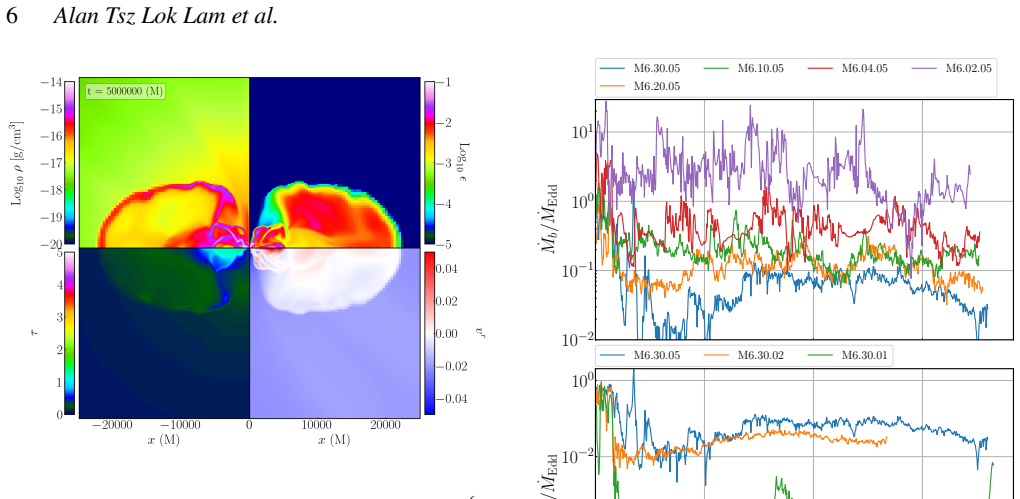
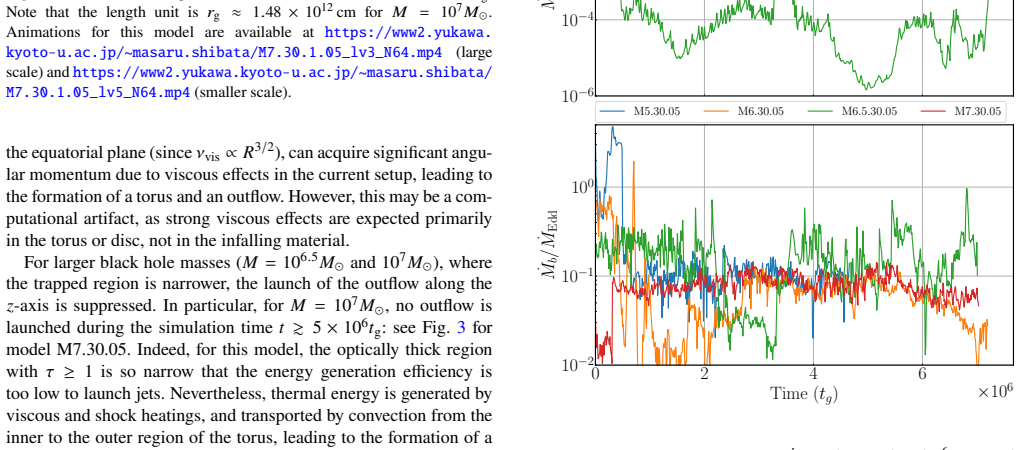
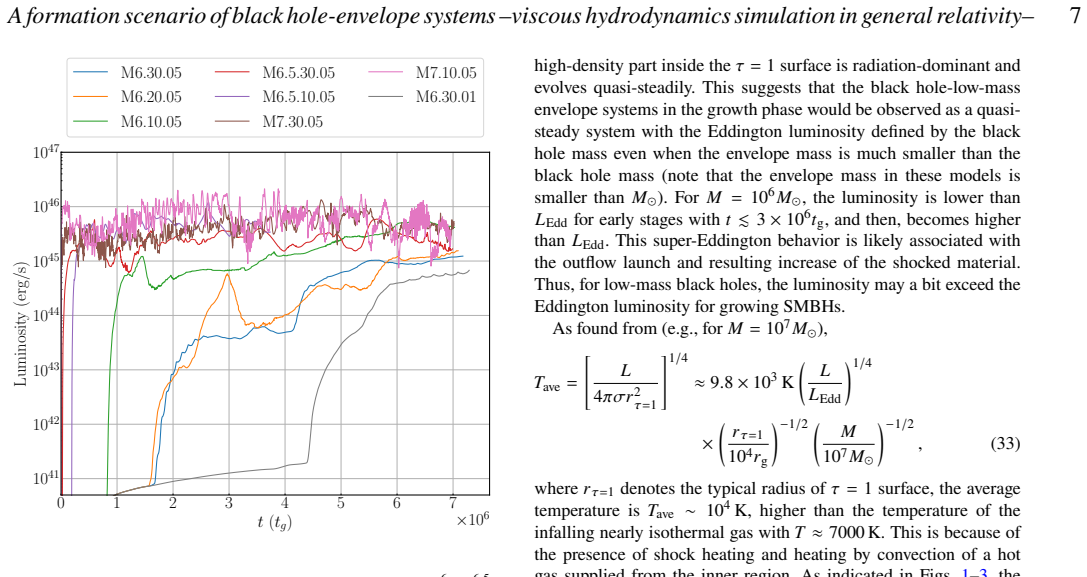
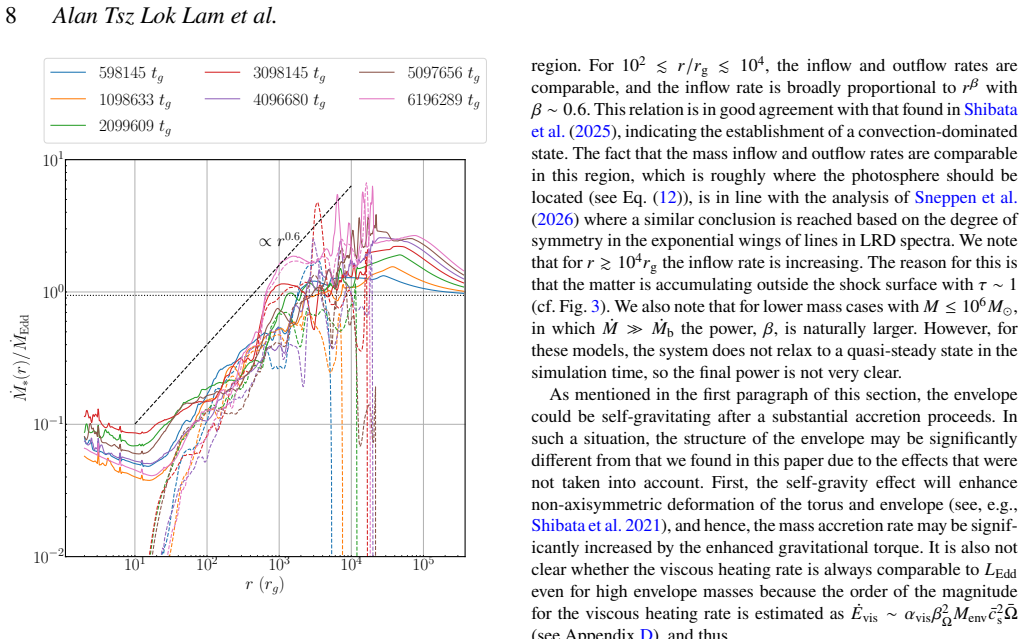
For black holes with M ≲ 10^6 M_⊙ a photon-trapped region forms in the inner region and a significant viscous outflow driven near the polar region overcomes the ram pressure of the mass inflow, leading to an inflow-outflow structure; for M ≳ 3×10^6 M_⊙ the outflow is not launched and a convective envelope around the black hole gradually develops; irrespective of black-hole mass the mass accretion rate onto the black hole is of order 10 percent of the Eddington accretion rate for reasonable viscous coefficients.
What carries the argument
Viscous hydrodynamics simulation in general relativity applied to quasi-spherical Bondi-type initial flows, tracking photon trapping, viscous heating, and the competition between outflow and ram pressure.
If this is right
- For black holes below 10^6 solar masses the envelope mass grows until total viscous heating exceeds the system Eddington luminosity, provided the high supply rate lasts at least 10^8 years scaled by mass.
- The black hole accretion rate stays roughly 10 percent Eddington across the full mass range studied for reasonable viscous coefficients.
- The transition between outflow-dominated and envelope-dominated regimes occurs between 10^6 and 3 times 10^6 solar masses.
- Envelope growth outpaces black hole growth for the lower-mass cases, altering the final system mass ratio.
Where Pith is reading between the lines
- If real distant flows carry more angular momentum than the assumed Bondi setup, the mass threshold for the outflow-to-envelope transition could shift.
- The reported 10 percent Eddington accretion could be compared directly with X-ray or radio observations of candidate black hole-envelope systems at different masses.
- Long-term evolution beyond the simulated timescales might reveal whether the envelope eventually becomes optically thick enough to alter the observed luminosity.
Load-bearing premise
The distant gas supply is modeled as a fixed-rate quasi-spherical Bondi inflow in which radial motion dominates angular momentum and the gas temperature stays below 10,000 K.
What would settle it
Observations of black hole systems near 10^6 solar masses that show neither polar outflows nor convective envelopes, or that exhibit accretion rates far from 10 percent Eddington, would contradict the reported mass-dependent transition.
Figures
read the original abstract
By performing a viscous hydrodynamics simulation in general relativity for super-Eddington accretion flows onto massive black holes of mass $M=10^5$--$10^7M_\odot$, we discuss a formation scenario for black hole-envelope systems. We consider the mass accretion rate of $a^3/G \approx 1.5 \times 10^{25} (a/10\,\mathrm{km\,s^{-1}})^3$\,g/s, comparable to the Eddington mass accretion rate of a $10^7M_\odot$ black hole, assuming that the gas temperature of the infalling matter is $\lesssim 10^4$\,K. Here, $a$ and $G$ denote the sound speed and gravitational constant. For the accretion flow, we set up a quasi-spherical Bondi-type flow in which radial inflow dominates over angular momentum in the distant region. It is found that (i) for low-mass black holes with $M \lesssim 10^6M_\odot$, a photon-trapped region forms in the inner region, and a significant viscous outflow driven near the polar region overcomes the ram pressure of the mass inflow, leading to an inflow-outflow structure; (ii) for massive black holes of $M \gtrsim 3 \times 10^6M_\odot$, the outflow is not launched, and a convective envelope around the black hole gradually develops; and (iii) irrespective of the black-hole mass, the mass accretion rate onto the black hole is of order 10\% of the Eddington accretion rate for reasonable values of the viscous coefficient. As the mass accretion rate onto the black holes is much lower than the mass growth rate of the envelope for low-mass black holes with $M\lesssim 10^6M_\odot$, the envelope mass is likely to increase until the total viscous heating rate exceeds the Eddington luminosity of the system, if the mass accretion rate is preserved to be high for $\gtrsim 10^8 (M/10^7M_\odot)$\,yrs.
Editorial analysis
A structured set of objections, weighed in public.
Referee Report
Summary. The manuscript reports results from viscous hydrodynamics simulations in general relativity of super-Eddington accretion onto black holes with masses 10^5–10^7 M_⊙. Adopting a quasi-spherical Bondi-type initial condition with radial inflow dominating angular momentum at large radii, fixed supply rate a³/G ≈ 1.5×10²⁵ (a/10 km s⁻¹)³ g s⁻¹, and T ≲ 10⁴ K, it finds that (i) for M ≲ 10⁶ M_⊙ a photon-trapped inner region develops with significant polar viscous outflow overcoming ram pressure to produce an inflow-outflow structure; (ii) for M ≳ 3×10⁶ M_⊙ no outflow is launched and a convective envelope forms; and (iii) the black-hole accretion rate is ~10% of Eddington in both regimes for reasonable viscous coefficients. The paper discusses implications for envelope growth when the supply persists.
Significance. If the results hold under the stated assumptions and numerical setup, the work supplies a concrete mass-dependent hydrodynamical pathway for forming black hole-envelope systems, with the ~10% Eddington accretion fraction emerging as a robust outcome across the explored mass range. This could inform models of super-Eddington phases in AGN or other accreting systems.
major comments (2)
- [Abstract / Initial conditions] Abstract / Initial conditions: The reported mass-dependent transition between polar outflow (low M) and convective envelope (high M) is obtained exclusively under the quasi-spherical Bondi-type outer boundary condition in which radial inflow dominates angular momentum. The manuscript does not test or discuss the effect of even modest specific angular momentum at large radii, which would lead to circularization and a qualitatively different disk geometry; because the threshold itself arises from the competition between ram pressure, viscous heating, and photon trapping in this radial setup, the transition's survival is not demonstrated.
- [Numerical methods] Numerical methods: The available text provides no information on the GR hydrodynamics code, grid resolution, convergence tests, or the numerical treatment of photon trapping and the viscous term. These details are required to evaluate the robustness of the photon-trapped region, the outflow launch, and the claimed 10% accretion fraction.
minor comments (1)
- The viscous coefficient is characterized only as 'reasonable' without reporting the range of values explored or quantifying its influence on the reported accretion fraction.
Simulated Author's Rebuttal
We thank the referee for the constructive comments. We respond to each major point below.
read point-by-point responses
-
Referee: [Abstract / Initial conditions] Abstract / Initial conditions: The reported mass-dependent transition between polar outflow (low M) and convective envelope (high M) is obtained exclusively under the quasi-spherical Bondi-type outer boundary condition in which radial inflow dominates angular momentum. The manuscript does not test or discuss the effect of even modest specific angular momentum at large radii, which would lead to circularization and a qualitatively different disk geometry; because the threshold itself arises from the competition between ram pressure, viscous heating, and photon trapping in this radial setup, the transition's survival is not demonstrated.
Authors: We agree that the reported transition is obtained under the specific quasi-spherical Bondi-type initial condition with radial inflow dominating angular momentum at large radii. This setup is chosen to isolate the competition between ram pressure, viscous heating, and photon trapping for the low-angular-momentum supply scenario under consideration. We acknowledge that even modest specific angular momentum could induce circularization and produce a different geometry, so the survival of the mass threshold under those conditions is not demonstrated. In the revised manuscript we will add an explicit limitations paragraph in the discussion section stating that the results apply to this class of initial conditions and recommending future simulations that include non-negligible angular momentum. revision: partial
-
Referee: [Numerical methods] Numerical methods: The available text provides no information on the GR hydrodynamics code, grid resolution, convergence tests, or the numerical treatment of photon trapping and the viscous term. These details are required to evaluate the robustness of the photon-trapped region, the outflow launch, and the claimed 10% accretion fraction.
Authors: We apologize for the omission. The revised manuscript will include a new subsection in the methods section that specifies the general-relativistic hydrodynamics code, the grid resolution and domain, the convergence tests that were performed, and the numerical implementation of photon trapping together with the viscous stress tensor. These additions will allow readers to assess the robustness of the reported structures and accretion fraction. revision: yes
Circularity Check
No significant circularity; results from direct numerical integration
full rationale
The paper reports outcomes of viscous GR hydrodynamics simulations performed with explicitly stated initial conditions (quasi-spherical Bondi-type flow, fixed supply rate a³/G, T ≲ 10⁴ K) and a free viscous coefficient described only as 'reasonable.' No quantity is obtained by fitting a parameter to a data subset and then relabeling a related output as a prediction; no equation reduces algebraically to its own input by construction; and no load-bearing premise rests on a self-citation chain. The mass-dependent transition and ~10% Eddington accretion rate emerge from the time-dependent integration rather than from any renaming or self-referential definition.
Axiom & Free-Parameter Ledger
free parameters (2)
- viscous coefficient
- mass accretion rate normalization
axioms (2)
- domain assumption Quasi-spherical Bondi-type flow in which radial inflow dominates over angular momentum at large radii
- domain assumption Gas temperature of infalling matter ≲ 10^4 K
Forward citations
Cited by 1 Pith paper
-
Little Red Dots as Intermediate Mass, Super-Eddington Engines: Insights from Type IIn Supernovae and The 1837-1856 Great Eruption of $\eta$ Carinae
LRDs are reinterpreted as intermediate-mass super-Eddington systems with wind-driven pseudo-photospheres that explain their spectra and imply engine masses below 10^5 solar masses rather than overmassive black holes.
Reference graph
Works this paper leans on
-
[1]
A direct black hole mass measurement in a Little Red Dot at the Epoch of Reionization
AbramowiczM.A.,IgumenshchevI.V.,QuataertE.,NarayanR.,2002,ApJ, 565, 1101 Balbus S. A., Hawley J. F., 1998, Rev. Mod. Phys., 70, 1 Begelman M. C., Volonteri M., Rees M. J., 2006, Mon. Not. Roy. Astron. Soc., 370, 289 Begelman M. C., Rossi E. M., Armitage P. J., 2008, Mon. Not. Roy. Astron. Soc., 387, 1649 Blandford R. D., Payne D. G., 1982, MNRAS, 199, 883...
work page internal anchor Pith review Pith/arXiv arXiv doi:10.1017/9781009253161 2002
-
[2]
In each iteration, we cycle through thedomainusingfouralternategridpointordersfor𝑖, 𝑗=1,
For all interior grid points,weassignlargeinitialvalues(e.g.,10 99)to𝜏 𝑖, 𝑗,whichwillbe updated in subsequent iterations. In each iteration, we cycle through thedomainusingfouralternategridpointordersfor𝑖, 𝑗=1, . . . , 𝑁: (i)𝑖=1to𝑁and𝑗=1to𝑁; (ii)𝑖=1to𝑁and𝑗=𝑁to1; (iii) 𝑖=𝑁to1and𝑗=𝑁to1; (iv)𝑖=𝑁to1and𝑗=1to𝑁, to update 𝜏𝑖, 𝑗 as 𝜏new 𝑖, 𝑗 = min(𝜏1,...
1979
discussion (0)
Sign in with ORCID, Apple, or X to comment. Anyone can read and Pith papers without signing in.