Solar Axions from Nuclear Transitions
Pith reviewed 2026-06-30 15:49 UTC · model grok-4.3
The pith
Solar axion fluxes from 57Fe transitions exceed those from 83Kr by nearly three orders of magnitude despite similar couplings, producing stronger limits on axion parameters.
A machine-rendered reading of the paper's core claim, the machinery that carries it, and where it could break.
Core claim
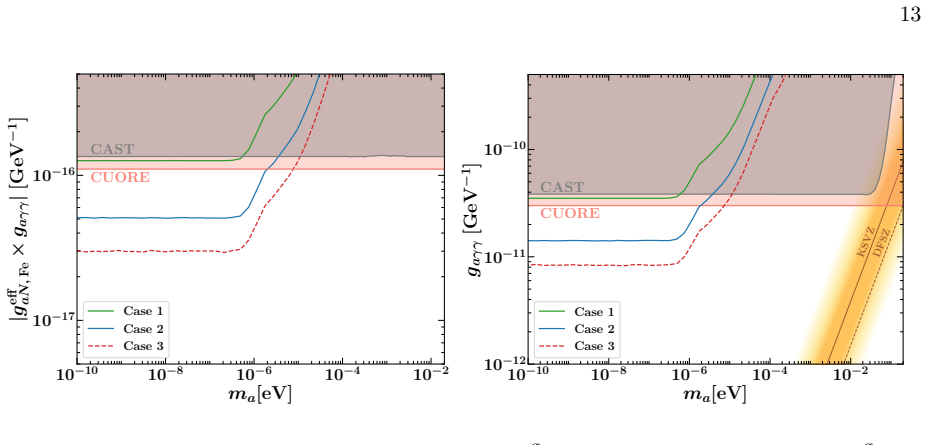
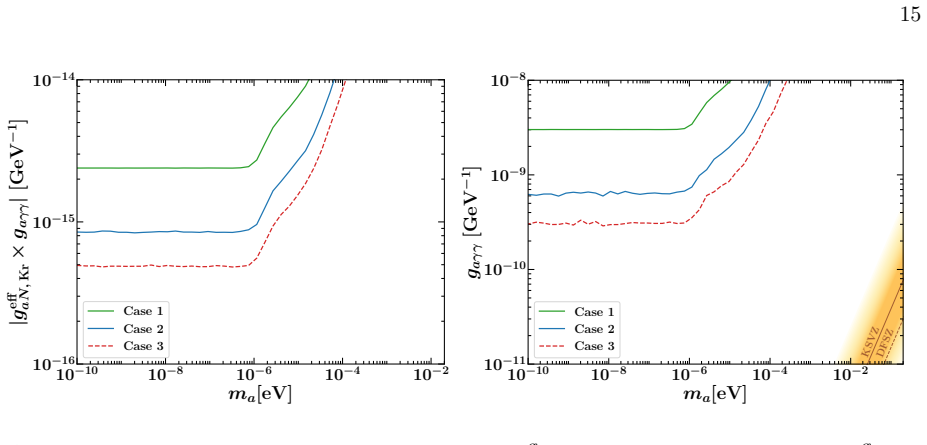
Although the effective axion-nucleon couplings for 83Kr and 57Fe differ only slightly, their fluxes differ by nearly three orders of magnitude. Consequently, the limit on |g_aN^eff × g_aγγ| and only g_aγγ vs. m_a provide more than an order-of-magnitude stronger constraint for Fe than for Kr.
What carries the argument
Ratio of solar axion fluxes from the M1 nuclear transitions of 57Fe and 83Kr, evaluated with XSM quiet-Sun X-ray observations.
If this is right
- Limits derived from the iron transition are more than ten times stronger than those from krypton for the same data set.
- The product of axion-nucleon and axion-photon couplings receives tighter bounds when the higher-flux channel is analyzed.
- Quiet-Sun X-ray monitors can serve as axion detectors for nuclear-transition channels without dedicated hardware.
- Future solar X-ray data sets can be re-analyzed with the same flux-ratio method to improve the bounds.
Where Pith is reading between the lines
- Transitions in other abundant solar nuclei with large M1 matrix elements could be checked for even higher production rates.
- Simultaneous analysis of multiple nuclear lines in the same data set could test whether any excess scales with the predicted flux ratios.
- The same XSM data could be re-examined at slightly different energies to search for the axion mass dependence of the conversion probability.
Load-bearing premise
The soft X-ray counts recorded by XSM can be interpreted as direct upper limits on axion-induced photons from the cited nuclear transitions, with no dominant contribution from other solar processes or instrumental backgrounds.
What would settle it
A calculation showing that ordinary solar coronal or instrumental X-ray emission fully accounts for the observed counts in the 9–15 keV band would remove the basis for the reported axion limits.
Figures

read the original abstract
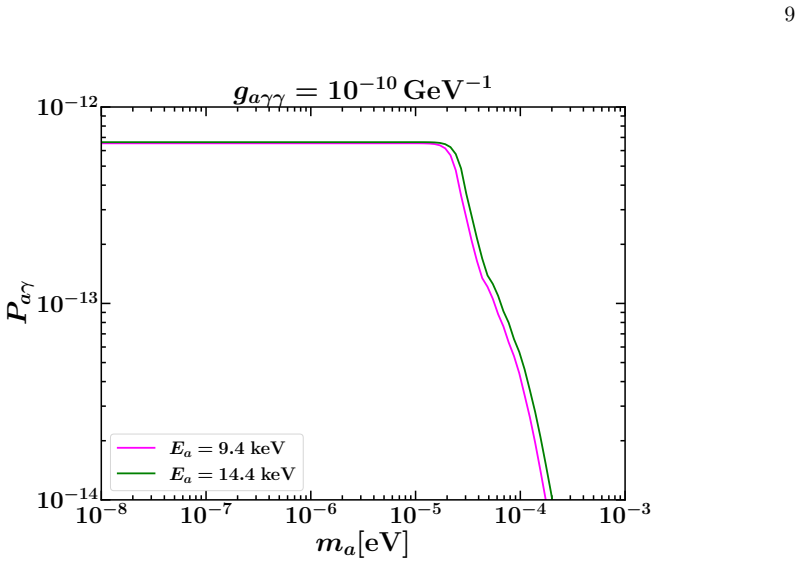
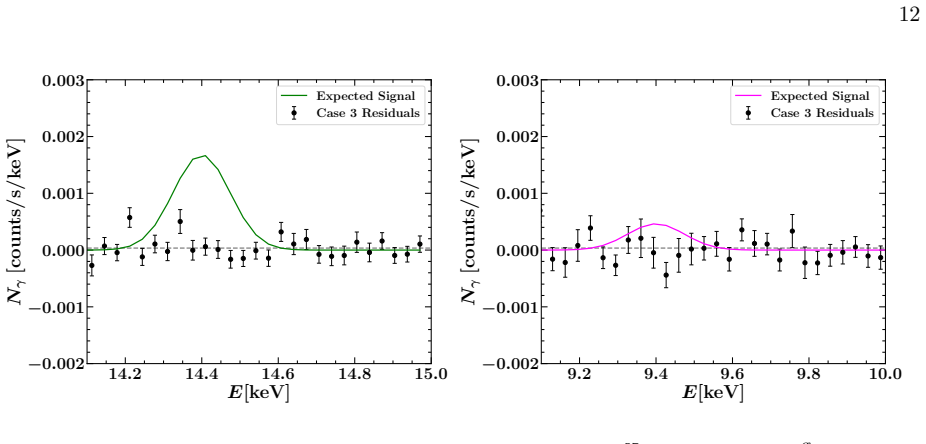
We investigate the possibility of detecting 14.4 keV and 9.4 keV solar axions and axion-like particles that could be produced in the M1 nuclear transitions of $^{57}$Fe and $^{83}$Kr, respectively. To do so, we used data from soft X-ray observations of the quiet Sun collected by the Solar X-ray Monitor (XSM) on board India's Chandrayaan-2 lunar mission. We observe that although the effective axion-nucleon couplings for $^{83}$Kr and $^{57}$Fe differ only slightly, their fluxes differ by nearly three orders of magnitude. Consequently, the limit on $|g_{aN}^{\rm eff} \times g_{a\gamma\gamma}|$ and only $g_{a\gamma\gamma}$ vs. $m_a$ provide more than an order-of-magnitude stronger constraint for Fe than for Kr.
Editorial analysis
A structured set of objections, weighed in public.
Referee Report
Summary. The paper investigates the production of 14.4 keV and 9.4 keV solar axions via M1 nuclear transitions in 57Fe and 83Kr, respectively, and uses soft X-ray data from the XSM instrument on Chandrayaan-2 to derive upper limits on the axion fluxes. It reports that the effective axion-nucleon couplings for the two isotopes are similar, yet the fluxes differ by nearly three orders of magnitude, yielding more than an order-of-magnitude stronger constraints on |g_aN^eff × g_aγγ| and on g_aγγ versus m_a for 57Fe than for 83Kr.
Significance. If the XSM quiet-Sun count rates can be robustly interpreted as direct upper bounds on the specific axion fluxes (with negligible contamination from other solar X-ray processes), the result would supply new, isotope-specific limits that exploit differences in solar abundances and transition energies. The work would thereby illustrate how nuclear-physics inputs and solar composition can produce large variations in sensitivity even when couplings are comparable.
major comments (2)
- [Abstract] Abstract (final paragraph) and § on data analysis: the conversion of XSM count rates at 9.4 keV and 14.4 keV into axion-flux upper limits is asserted without any displayed derivation, error budget, energy-resolution modeling, or explicit data-selection criteria. This step is load-bearing for the claimed flux ratio of ~1000 and the resulting order-of-magnitude difference in limits.
- [Abstract] Abstract (final paragraph) and discussion of XSM observations: the claim that the observed soft X-ray signal can be treated as an upper limit on axion-induced photons requires explicit demonstration that thermal bremsstrahlung, other elemental lines, coronal activity, and instrumental backgrounds do not dominate at the quoted energies. No such supporting analysis or reference is indicated.
Simulated Author's Rebuttal
We thank the referee for the careful reading of the manuscript and the constructive comments. We address the two major comments point by point below.
read point-by-point responses
-
Referee: [Abstract] Abstract (final paragraph) and § on data analysis: the conversion of XSM count rates at 9.4 keV and 14.4 keV into axion-flux upper limits is asserted without any displayed derivation, error budget, energy-resolution modeling, or explicit data-selection criteria. This step is load-bearing for the claimed flux ratio of ~1000 and the resulting order-of-magnitude difference in limits.
Authors: We agree that the conversion step requires explicit documentation. The revised manuscript will include a new subsection (or appendix) that derives the axion-flux upper limits from the XSM count rates, incorporating the instrument energy resolution, the full error budget, and the precise data-selection criteria applied at 9.4 keV and 14.4 keV. This addition will directly support the reported flux ratio and the resulting constraints. revision: yes
-
Referee: [Abstract] Abstract (final paragraph) and discussion of XSM observations: the claim that the observed soft X-ray signal can be treated as an upper limit on axion-induced photons requires explicit demonstration that thermal bremsstrahlung, other elemental lines, coronal activity, and instrumental backgrounds do not dominate at the quoted energies. No such supporting analysis or reference is indicated.
Authors: The manuscript currently adopts the quiet-Sun XSM count rates as conservative upper bounds on any axion-induced contribution at the nuclear-transition energies. We acknowledge that a more detailed justification is needed. In the revision we will add references to published quiet-Sun X-ray spectral studies and include a short discussion (or supporting figure) showing that, within the XSM energy resolution at 9.4 keV and 14.4 keV, the dominant backgrounds do not preclude the use of the total observed rate as an upper limit on an additional axion signal. revision: yes
Circularity Check
No significant circularity; derivation relies on external XSM data and independent nuclear inputs
full rationale
The paper calculates axion fluxes from M1 transitions in 57Fe and 83Kr using standard nuclear matrix elements and solar abundances, then converts XSM quiet-Sun count rates into upper limits on |g_aN^eff × g_aγγ| and g_aγγ(m_a). No equation defines a flux or coupling in terms of a fitted parameter taken from the same XSM dataset; the reported order-of-magnitude difference between isotopes follows directly from the nuclear physics inputs and the energy-dependent detector response. The central claim does not reduce to a self-citation chain or to renaming a known result. The interpretation of XSM data as axion-flux bounds is an external assumption, not a definitional loop internal to the derivation.
Axiom & Free-Parameter Ledger
axioms (2)
- domain assumption M1 nuclear transitions in 57Fe and 83Kr produce axions at 14.4 keV and 9.4 keV respectively with effective couplings that differ only slightly
- domain assumption XSM soft X-ray counts from the quiet Sun can be converted into upper limits on axion fluxes
Reference graph
Works this paper leans on
-
[1]
R. D. Peccei and H. R. Quinn, CP Conservation in the Presence of Instantons, Phys. Rev. Lett.38, 1440 (1977)
1977
-
[2]
Wilczek, Problem of StrongPandTInvariance in the Presence of Instantons, Phys
F. Wilczek, Problem of StrongPandTInvariance in the Presence of Instantons, Phys. Rev. Lett.40, 279 (1978)
1978
-
[3]
Weinberg, A New Light Boson?, Phys
S. Weinberg, A New Light Boson?, Phys. Rev. Lett.40, 223 (1978)
1978
-
[4]
Dine and W
M. Dine and W. Fischler, The Not So Harmless Axion, Phys. Lett. B120, 137 (1983)
1983
-
[5]
L. F. Abbott and P. Sikivie, A Cosmological Bound on the Invisible Axion, Phys. Lett. B120, 133 (1983)
1983
-
[6]
Preskill, M
J. Preskill, M. B. Wise, and F. Wilczek, Cosmology of the Invisible Axion, Phys. Lett. B120, 127 (1983)
1983
-
[7]
R. L. Davis, Cosmic Axions from Cosmic Strings, Phys. Lett. B180, 225 (1986)
1986
- [8]
-
[9]
D. J. E. Marsh, Axion Cosmology, Phys. Rept.643, 1 (2016), arXiv:1510.07633 [astro-ph.CO]
work page internal anchor Pith review Pith/arXiv arXiv 2016
- [10]
-
[11]
M. Baryakhtaret al., Dark Matter In Extreme Astrophysical Environments, in2022 Snowmass Summer Study(2022) arXiv:2203.07984 [hep-ph]
-
[12]
The landscape of QCD axion models
L. Di Luzio, M. Giannotti, E. Nardi, and L. Visinelli, The landscape of QCD axion models, Phys. Rept. 870, 1 (2020), arXiv:2003.01100 [hep-ph]
work page internal anchor Pith review Pith/arXiv arXiv 2020
-
[13]
The Low-Energy Frontier of Particle Physics
J. Jaeckel and A. Ringwald, The Low-Energy Frontier of Particle Physics, Ann. Rev. Nucl. Part. Sci. 60, 405 (2010), arXiv:1002.0329 [hep-ph]
work page internal anchor Pith review Pith/arXiv arXiv 2010
-
[14]
Stellar Recipes for Axion Hunters
M. Giannotti, I. G. Irastorza, J. Redondo, A. Ringwald, and K. Saikawa, Stellar Recipes for Axion Hunters, JCAP10, 010, arXiv:1708.02111 [hep-ph]
work page internal anchor Pith review Pith/arXiv arXiv
-
[15]
Agrawalet al., Feebly-interacting particles: FIPs 2020 workshop report, Eur
P. Agrawalet al., Feebly-interacting particles: FIPs 2020 workshop report, Eur. Phys. J. C81, 1015 (2021), arXiv:2102.12143 [hep-ph]
-
[16]
L. Di Luzio, M. Fedele, M. Giannotti, F. Mescia, and E. Nardi, Stellar evolution confronts axion models, JCAP02(02), 035, arXiv:2109.10368 [hep-ph]
-
[17]
Giannotti, Exciting times, Nature Phys.13, 530 (2017)
M. Giannotti, Exciting times, Nature Phys.13, 530 (2017)
2017
-
[18]
M. Giannotti, Aspects of Axions and ALPs Phenomenology, in10th Symposium on Large TPCs for Low-Energy Rare Event Detection(2022) arXiv:2205.06831 [hep-ph]. 18
-
[19]
I. G. Irastorza and J. Redondo, New experimental approaches in the search for axion-like particles, Prog. Part. Nucl. Phys.102, 89 (2018), arXiv:1801.08127 [hep-ph]
work page internal anchor Pith review Pith/arXiv arXiv 2018
-
[20]
Round Table on Axions and Axion-like Particles
P. Di Vecchia, M. Giannotti, M. Lattanzi, and A. Lindner, Round Table on Axions and Axion-like Particles, PoSConfinement2018, 034 (2019), arXiv:1902.06567 [hep-ph]
work page internal anchor Pith review Pith/arXiv arXiv 2019
-
[21]
Sikivie, Invisible Axion Search Methods, Rev
P. Sikivie, Invisible Axion Search Methods, Rev. Mod. Phys.93, 015004 (2021), arXiv:2003.02206 [hep-ph]
-
[22]
Arzaet al., (2026), arXiv:2603.03433 [hep-ph]
A. Arzaet al., The cosmic wispers white paper: The physics case for weakly interacting slim particles (2026), arXiv:2603.03433 [hep-ph]
-
[23]
O’Hare, cajohare/axionlimits: Axionlimits,https://cajohare.github.io/AxionLimits/(2020)
C. O’Hare, cajohare/axionlimits: Axionlimits,https://cajohare.github.io/AxionLimits/(2020)
2020
-
[24]
G. G. Raffelt, ASTROPHYSICAL AXION BOUNDS DIMINISHED BY SCREENING EFFECTS, Phys. Rev. D33, 897 (1986)
1986
-
[25]
G. G. Raffelt, Plasmon Decay Into Low Mass Bosons in Stars, Phys. Rev. D37, 1356 (1988)
1988
- [26]
- [27]
-
[28]
E. Guarini, P. Carenza, J. Galan, M. Giannotti, and A. Mirizzi, Production of axionlike parti- cles from photon conversions in large-scale solar magnetic fields, Phys. Rev. D102, 123024 (2020), arXiv:2010.06601 [hep-ph]
-
[29]
Solar axion flux from the axion-electron coupling
J. Redondo, Solar axion flux from the axion-electron coupling, JCAP12, 008, arXiv:1310.0823 [hep-ph]
work page internal anchor Pith review Pith/arXiv arXiv
- [30]
-
[31]
New CAST Limit on the Axion-Photon Interaction
V. Anastassopouloset al.(CAST), New CAST Limit on the Axion-Photon Interaction, Nature Phys. 13, 584 (2017), arXiv:1705.02290 [hep-ex]
work page internal anchor Pith review Pith/arXiv arXiv 2017
-
[32]
Revisiting the bound on axion-photon coupling from Globular Clusters
A. Ayala, I. Dom´ ınguez, M. Giannotti, A. Mirizzi, and O. Straniero, Revisiting the bound on axion- photon coupling from Globular Clusters, Phys. Rev. Lett.113, 191302 (2014), arXiv:1406.6053 [astro- ph.SR]
work page internal anchor Pith review Pith/arXiv arXiv 2014
-
[33]
Straniero, A
O. Straniero, A. Ayala, M. Giannotti, A. Mirizzi, and I. Dominguez, Axion-Photon Coupling: Astro- physical Constraints, in11th Patras Workshop on Axions, WIMPs and WISPs(2015) pp. 77–81
2015
- [34]
-
[35]
T. W. Donnelly, S. J. Freedman, R. S. Lytel, R. D. Peccei, and M. Schwartz, Do Axions Exist?, Phys. Rev. D18, 1607 (1978)
1978
-
[36]
R. Massarczyk, P. H. Chu, and S. R. Elliott, Axion emission from nuclear magnetic dipole transitions, Phys. Rev. D105, 015031 (2022), arXiv:2112.08285 [hep-ph]
-
[37]
A. V. Derbin, A. I. Egorov, I. A. Mitropolsky, and V. N. Muratova, Search for solar axions emitted in an M1 transition in Li-7 nuclei, JETP Lett.81, 365 (2005). 19
2005
-
[38]
Belliet al., Li-7 solar axions: Preliminary results and feasibility studies, Nucl
P. Belliet al., Li-7 solar axions: Preliminary results and feasibility studies, Nucl. Phys. A806, 388 (2008)
2008
-
[39]
Belliniet al.(Borexino), Search for solar axions emitted in the M1-transition of Li-7* with Borexino CTF, Eur
G. Belliniet al.(Borexino), Search for solar axions emitted in the M1-transition of Li-7* with Borexino CTF, Eur. Phys. J. C54, 61 (2008)
2008
-
[40]
S. Andriamonjeet al.(CAST), Search for solar axion emission from 7LiandD(p, γ) 3Henuclear decays with the CASTγ-ray calorimeter, JCAP03, 032, arXiv:0904.2103 [hep-ex]
work page internal anchor Pith review Pith/arXiv arXiv
-
[41]
A proposal to search for a monochromatic component of solar axions using $^{57}$Fe
S. Moriyama, A Proposal to search for a monochromatic component of solar axions using Fe-57, Phys. Rev. Lett.75, 3222 (1995), arXiv:hep-ph/9504318
work page internal anchor Pith review Pith/arXiv arXiv 1995
-
[42]
Search for Solar Axions Using Fe-57
M. Krcmar, Z. Krecak, M. Stipcevic, A. Ljubicic, and D. A. Bradley, Search for invisible axions using Fe-57, Phys. Lett. B442, 38 (1998), arXiv:nucl-ex/9801005
work page internal anchor Pith review Pith/arXiv arXiv 1998
-
[43]
Search for 14.4 keV solar axions emitted in the M1-transition of 57Fe nuclei with CAST
S. Andriamonjeet al.(CAST), Search for 14.4-keV solar axions emitted in the M1-transition of Fe-57 nuclei with CAST, JCAP12, 002, arXiv:0906.4488 [hep-ex]
work page internal anchor Pith review Pith/arXiv arXiv
-
[44]
Search for 14.4 keV solar axions from M1 transition of Fe-57 with CUORE crystals
F. Alessandriaet al.(CUORE), Search for 14.4 keV solar axions from M1 transition of Fe-57 with CUORE crystals, JCAP05, 007, arXiv:1209.2800 [hep-ex]
work page internal anchor Pith review Pith/arXiv arXiv
-
[45]
A Search For Solar Hadronic Axions Using Kr-83
K. Jakovcic, Z. Krecak, M. Krcmar, and A. Ljubicic, A Search for solar hadronic axions using 83Kr, Radiat. Phys. Chem.71, 793 (2004), arXiv:nucl-ex/0402016
work page internal anchor Pith review Pith/arXiv arXiv 2004
-
[46]
Y. M. Gavrilyuket al., First result of the experimental search for the 9.4 keV solar axion reactions with 83Kr in the copper proportional counter, Phys. Part. Nucl.46, 152 (2015), arXiv:1405.1271 [nucl-ex]
work page internal anchor Pith review Pith/arXiv arXiv 2015
-
[47]
L. Di Luzioet al., Probing the axion–nucleon coupling with the next generation of axion helioscopes, Eur. Phys. J. C82, 120 (2022), arXiv:2111.06407 [hep-ph]
- [48]
-
[49]
Raffelt and L
G. Raffelt and L. Stodolsky, New Particles From Nuclear Reactions in the Sun, Phys. Lett. B119, 323 (1982)
1982
-
[50]
Search for Solar Axions Produced in $p(d,\rm{^3He})A$ Reaction with Borexino Detector
G. Belliniet al.(Borexino), Search for Solar Axions Produced inp(d, 3He)A Reaction with Borexino Detector, Phys. Rev. D85, 092003 (2012), arXiv:1203.6258 [hep-ex]
work page internal anchor Pith review Pith/arXiv arXiv 2012
-
[51]
G. Lucente, N. Nath, F. Capozzi, M. Giannotti, and A. Mirizzi, Probing high-energy solar axion flux with a large scintillation neutrino detector, Phys. Rev. D106, 123007 (2022), arXiv:2209.11780 [hep- ph]
-
[52]
M. Asplund, A. M. Amarsi, and N. Grevesse, The chemical make-up of the Sun: A 2020 vision, Astron. Astrophys.653, A141 (2021), arXiv:2105.01661 [astro-ph.SR]
work page internal anchor Pith review Pith/arXiv arXiv 2020
- [53]
- [54]
- [55]
-
[56]
Ruz et al.,NuSTAR as an Axion Helioscope,Phys
J. Ruzet al., NuSTAR as an Axion Helioscope, Phys. Rev. Lett.135, 141001 (2025), arXiv:2407.03828 [astro-ph.CO]
-
[57]
F. T. Avignone, C. Baktash, W. C. Barker, F. P. Calaprice, R. W. Dunford, W. C. Haxton, D. Kahana, R. T. Kouzes, H. S. Miley, and D. M. Moltz, Search for Axions From the 1115-kev Transition of 65Cu, Phys. Rev. D37, 618 (1988)
1988
-
[58]
Y. Herrera and A. Serenelli, Standard solar models B23 / SF-III (v1.2), 10.5281/zenodo.10822316 (2023)
-
[59]
Raffelt and L
G. Raffelt and L. Stodolsky, Mixing of the Photon with Low Mass Particles, Phys. Rev. D37, 1237 (1988)
1988
- [60]
-
[61]
R. P. Dufresne, G. Del Zanna, P. R. Young, K. P. Dere, E. Deliporanidou, W. T. Barnes, and E. Landi, CHIANTI—An Atomic Database for Emission Lines—Paper. XVIII. Version 11, Advanced Ionization Equilibrium Models: Density and Charge Transfer Effects, Astrophys. J.974, 71 (2024), arXiv:2403.16922 [astro-ph.SR]
-
[62]
G. Del Zanna, K. P. Dere, P. R. Young, and E. Landi, CHIANTI—An Atomic Database for Emis- sion Lines. XVI. Version 10, Further Extensions, Astrophys. J.909, 38 (2021), arXiv:2011.05211 [physics.atom-ph]
-
[63]
Chiantipy,https://github.com/chianti-atomic/ChiantiPy/(2022)
2022
-
[64]
Berger, J
M. Berger, J. Hubbell, S. Seltzer, J. Chang, J. Coursey, R. Sukumar, D. Zucker, and K. Olsen, Xcom: Photon cross sections database,https://www.nist.gov/pml/ xcom-photon-cross-sections-database
-
[65]
M. Shanmugam, S. V. Vadawale, A. R. Patel, H. K. Adalaja, N. P. S. Mithun, T. Ladiya, S. K. Goyal, N. K. Tiwari, N. Singh, S. Kumar, D. K. Painkra, Y. B. Acharya, A. Bhardwaj, A. K. Hait, A. Patinge, A. Kapoor, H. N. S. Kumar, N. Satya, G. Saxena, and K. Arvind, Solar X-ray Monitor onboard Chandrayaan-2 Orbiter, Current Science118, 45 (2020), arXiv:1910.0...
- [66]
-
[67]
MultiNest: an efficient and robust Bayesian inference tool for cosmology and particle physics
F. Feroz, M. P. Hobson, and M. Bridges, MultiNest: an efficient and robust Bayesian inference tool for cosmology and particle physics, Mon. Not. Roy. Astron. Soc.398, 1601 (2009), arXiv:0809.3437 [astro-ph]
work page internal anchor Pith review Pith/arXiv arXiv 2009
discussion (0)
Sign in with ORCID, Apple, or X to comment. Anyone can read and Pith papers without signing in.