Coarse-to-Fine Domain Incremental Learning with Attentive Distillation for Mining Footprint Segmentation in Multispectral Imagery
Pith reviewed 2026-06-30 13:22 UTC · model grok-4.3
The pith
Coarse mining labels improve fine boundary segmentation through selective attentive distillation in a teacher-student setup.
A machine-rendered reading of the paper's core claim, the machinery that carries it, and where it could break.
Core claim
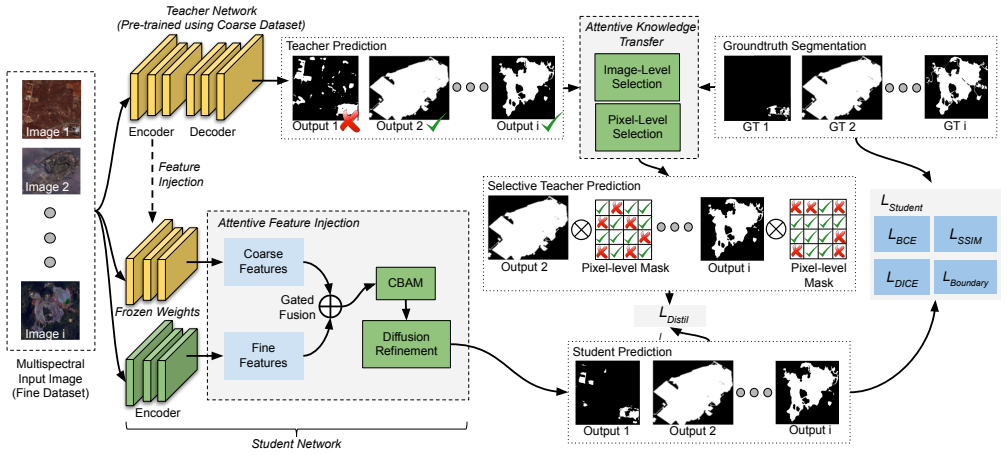
MineC2FNet is a coarse-to-fine domain incremental learning framework that adopts a teacher-student architecture with attentive distillation at both the feature and prediction levels to selectively transfer generalized knowledge from the coarse domain while enabling boundary refinement using limited fine-grained data.
What carries the argument
Attentive distillation at feature and prediction levels within a teacher-student architecture that filters for generalized knowledge transferable across domain shift.
If this is right
- Coarse data becomes usable for fine-grained segmentation without requiring full domain alignment techniques.
- Boundary accuracy improves on limited fine annotations by distilling from abundant coarse sources.
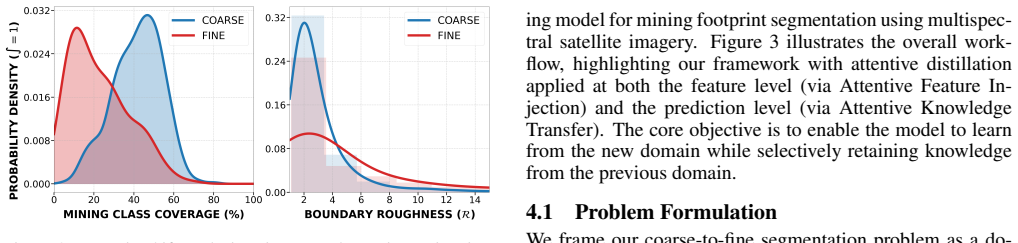
- The approach handles significant domain shift between coarse and fine mining footprint imagery.
- A new dataset of 219 expert-annotated images enables reproducible evaluation across geographies and commodities.
Where Pith is reading between the lines
- The same selective distillation pattern could extend to other remote-sensing segmentation tasks where coarse labels exist at scale but fine boundaries matter for impact assessment.
- Annotation budgets for environmental monitoring might shift toward collecting fewer precise labels once coarse data transfer is reliable.
- Validation on additional sensor types or mining commodities would test whether the attentive filter generalizes beyond the reported multispectral cases.
Load-bearing premise
The attentive mechanism can reliably isolate and transfer only domain-general knowledge without passing or amplifying domain-specific artifacts from the coarse data.
What would settle it
Performance on the fine domain falls below a model trained solely on the fine data when the coarse teacher is added, indicating negative transfer occurred.
Figures


read the original abstract
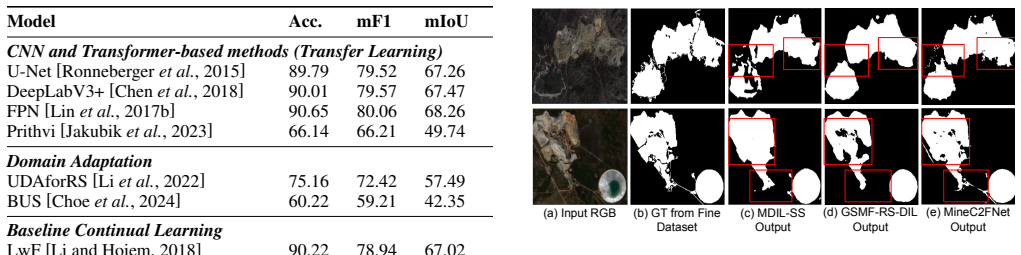
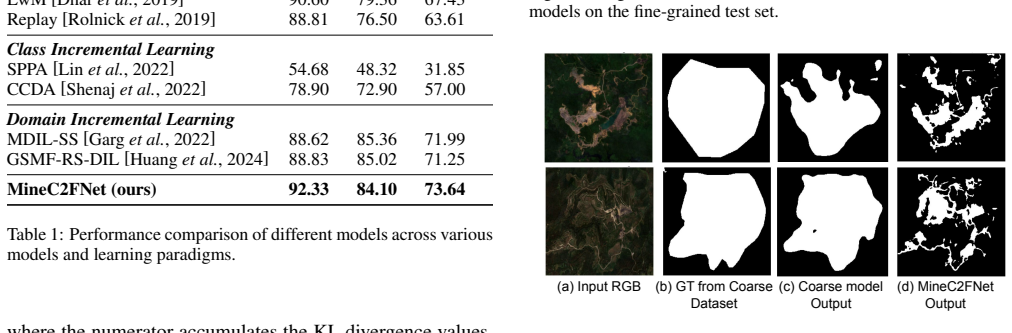
Automatically mapping and segmenting global mining footprints using remote sensing and deep learning is critical for monitoring the socio-environmental risks and impacts of mining, yet its progress is hindered by the scarcity of fine-grained annotated data. Although large-scale datasets with coarse boundaries are widely available, leveraging them to improve fine-grained segmentation is challenging due to significant domain shift. To address this, we propose MineC2FNet, a coarse-to-fine domain incremental learning framework that exploits abundant coarse data to enhance fine-grained mining footprint segmentation. MineC2FNet adopts a teacher-student architecture with attentive distillation at both the feature and prediction levels, selectively transferring generalized knowledge from the coarse domain while enabling boundary refinement using limited fine-grained data (fine domain). We further introduce an expertly validated dataset of 219 images with precise boundary annotations across diverse geographies and commodities. Extensive experiments against state-of-the-art approaches, including domain adaptation and domain incremental learning methods, demonstrate that MineC2FNet achieves superior performance while effectively handling domain shift. The dataset and code are publicly available at https://github.com/risqiutama/MineC2FNet.
Editorial analysis
A structured set of objections, weighed in public.
Referee Report
Summary. The paper proposes MineC2FNet, a teacher-student coarse-to-fine domain incremental learning framework for mining footprint segmentation in multispectral imagery. It employs attentive distillation at feature and prediction levels to transfer generalized knowledge from abundant coarse-boundary data to refine segmentation using limited fine-grained annotations, despite domain shift. The work also introduces a new expertly validated dataset of 219 images across geographies and commodities, with public code and data release, and reports superior performance versus domain adaptation and incremental learning baselines.
Significance. If the attentive distillation mechanism is validated as selectively transferring useful knowledge without negative transfer, the approach would be a useful contribution to remote sensing segmentation tasks where coarse labels are plentiful but fine labels are scarce. The public dataset and code are clear strengths that enable reproducibility and further work in environmental monitoring applications.
major comments (2)
- [Experiments section] Experiments section (and associated ablation tables): the central claim that attentive distillation selectively transfers generalized knowledge without amplifying domain-specific artifacts requires an isolating control that disables the attention weighting mechanism while retaining the teacher-student structure and coarse data access. No such ablation is described; reported gains versus domain-adaptation baselines could therefore be attributable to data volume or training schedule rather than the attentive component.
- [Method and Experiments sections] Method and Experiments sections: no quantitative measure of domain shift (e.g., MMD, Wasserstein distance, or feature distribution statistics between coarse and fine domains) is reported. This is load-bearing for the claim that the framework 'effectively handles domain shift,' as it leaves the operating regime of the selectivity assumption uncharacterized.
minor comments (2)
- [Abstract and §1] Abstract and §1: the statement of 'superior performance' would be strengthened by explicit reference to the primary quantitative metrics (e.g., mIoU, F1) and the magnitude of improvement over the strongest baseline.
- [Dataset description] Dataset description: the 219-image dataset is a valuable contribution, but the train/validation/test split ratios, geographic/commodity stratification, and annotation protocol details should be expanded for reproducibility.
Simulated Author's Rebuttal
We thank the referee for the constructive comments, which help strengthen the validation of our attentive distillation approach. We address each point below.
read point-by-point responses
-
Referee: [Experiments section] Experiments section (and associated ablation tables): the central claim that attentive distillation selectively transfers generalized knowledge without amplifying domain-specific artifacts requires an isolating control that disables the attention weighting mechanism while retaining the teacher-student structure and coarse data access. No such ablation is described; reported gains versus domain-adaptation baselines could therefore be attributable to data volume or training schedule rather than the attentive component.
Authors: We agree that an isolating ablation is required to substantiate the selectivity claim. In the revised manuscript we will add a control experiment that retains the full teacher-student structure and coarse-data access but replaces attentive distillation with uniform (non-attentive) feature and prediction distillation. The resulting performance delta will isolate the contribution of the attention weighting. revision: yes
-
Referee: [Method and Experiments sections] Method and Experiments sections: no quantitative measure of domain shift (e.g., MMD, Wasserstein distance, or feature distribution statistics between coarse and fine domains) is reported. This is load-bearing for the claim that the framework 'effectively handles domain shift,' as it leaves the operating regime of the selectivity assumption uncharacterized.
Authors: We acknowledge the value of explicitly quantifying domain shift. We will compute and report Maximum Mean Discrepancy (MMD) and Wasserstein distances between the coarse- and fine-domain feature distributions (extracted from the teacher and student encoders) and include these statistics together with the existing performance tables in the revised Experiments section. revision: yes
Circularity Check
No significant circularity in derivation chain
full rationale
The paper introduces MineC2FNet as a teacher-student framework with attentive distillation for domain incremental learning, supported by empirical comparisons to external baselines and a new dataset. No self-definitional equations, fitted parameters renamed as predictions, or load-bearing self-citations that reduce claims to inputs appear in the provided abstract or described architecture. The central performance claims rest on external evaluation rather than construction from the method's own outputs.
Axiom & Free-Parameter Ledger
free parameters (1)
- distillation attention weights and loss balancing hyperparameters
axioms (1)
- domain assumption Coarse and fine domains share transferable generalized features that attentive mechanisms can isolate without introducing boundary errors.
Reference graph
Works this paper leans on
-
[1]
Simcs: Sim- ulation for domain incremental online continual segmen- tation.Proceedings of the AAAI Conference on Artificial Intelligence, 38(10):10795–10803, Mar
[Alfarraet al., 2024 ] Motasem Alfarra, Zhipeng Cai, Adel Bibi, Bernard Ghanem, and Matthias M¨uller. Simcs: Sim- ulation for domain incremental online continual segmen- tation.Proceedings of the AAAI Conference on Artificial Intelligence, 38(10):10795–10803, Mar
2024
-
[2]
Owen, Christopher N
[Anget al., 2023 ] Michelle Li Ern Ang, John R. Owen, Christopher N. Gibbins, ´El´eonore L `ebre, Deanna Kemp, Muhamad Risqi U. Saputra, Jo-Anne Everingham, and Alex M. Lechner. Systematic review of gis and remote sensing applications for assessing the socioeconomic im- pacts of mining.The Journal of Environment & Develop- ment, 32(3):243–273,
2023
-
[3]
Beck, Niklaus E
[Becket al., 2018 ] Hylke E. Beck, Niklaus E. Zimmermann, Tim R. McVicar, Noemi Vergopolan, Alexis Berg, and Eric F. Wood. Present and future k ¨oppen-geiger climate classification maps at 1-km resolution.Scientific Data, 5(1):180214, Oct
2018
-
[4]
[Caiet al., 2023 ] Zhiwen Cai, Haodong Wei, Qiong Hu, Wei Zhou, Xinyu Zhang, Wenjie Jin, Ling Wang, Shuxia Yu, Zhen Wang, Baodong Xu, et al. Learning spectral-spatial representations from vhr images for fine-scale crop type mapping: A case study of rice-crayfish field extraction in south china.ISPRS Journal of Photogrammetry and Re- mote Sensing, 199:28–39,
2023
-
[5]
Encoder-decoder with atrous separable convolution for se- mantic image segmentation,
[Chenet al., 2018 ] Liang-Chieh Chen, Yukun Zhu, George Papandreou, Florian Schroff, and Hartwig Adam. Encoder-decoder with atrous separable convolution for se- mantic image segmentation,
2018
-
[6]
Coarse-to-fine semantic segmentation of satel- lite images.ISPRS Journal of Photogrammetry and Re- mote Sensing, 217:1–17,
[Chenet al., 2024 ] Hao Chen, Wen Yang, Li Liu, and Gui- Song Xia. Coarse-to-fine semantic segmentation of satel- lite images.ISPRS Journal of Photogrammetry and Re- mote Sensing, 217:1–17,
2024
-
[7]
Open-set domain adaptation for semantic segmentation
[Choeet al., 2024 ] Seun-An Choe, Ah-Hyung Shin, Keon- Hee Park, Jinwoo Choi, and Gyeong-Moon Park. Open-set domain adaptation for semantic segmentation. InProceed- ings of the IEEE/CVF Conference on Computer Vision and Pattern Recognition, pages 23943–23953,
2024
-
[8]
Urban scene seman- tic segmentation with low-cost coarse annotation
[Daset al., 2023 ] Anurag Das, Yongqin Xian, Yang He, Zeynep Akata, and Bernt Schiele. Urban scene seman- tic segmentation with low-cost coarse annotation. In2023 IEEE/CVF Winter Conference on Applications of Com- puter Vision (WACV), pages 5967–5976,
2023
-
[9]
Learning without memorizing
[Dharet al., 2019 ] Prithviraj Dhar, Rajat Vikram Singh, Kuan-Chuan Peng, Ziyan Wu, and Rama Chellappa. Learning without memorizing. InProceedings of the IEEE/CVF conference on computer vision and pattern recognition, pages 5138–5146,
2019
-
[10]
Multi-domain incremental learning for semantic segmentation
[Garget al., 2022 ] Prachi Garg, Rohit Saluja, Vineeth N Bal- asubramanian, Chetan Arora, Anbumani Subramanian, and CV Jawahar. Multi-domain incremental learning for semantic segmentation. InProceedings of the IEEE/CVF Winter Conference on Applications of Computer Vision, pages 761–771,
2022
-
[11]
Domain-incremental learning for remote sensing semantic segmentation with multifeature constraints in graph space.IEEE Transactions on Geoscience and Re- mote Sensing, 62:1–15,
[Huanget al., 2024 ] Wubiao Huang, Mingtao Ding, and Fei Deng. Domain-incremental learning for remote sensing semantic segmentation with multifeature constraints in graph space.IEEE Transactions on Geoscience and Re- mote Sensing, 62:1–15,
2024
-
[12]
[Jakubiket al., 2023 ] Johannes Jakubik, Sujit Roy, C. E. Phillips, Paolo Fraccaro, Denys Godwin, Bianca Zadrozny, Daniela Szwarcman, Carlos Gomes, Gabby Nyirjesy, Blair Edwards, Daiki Kimura, Naomi Simumba, Linsong Chu, S. Karthik Mukkavilli, Devyani Lambhate, Kamal Das, Ranjini Bangalore, Dario Oliveira, Michal Muszynski, Kumar Ankur, Muthukumaran Ramas...
2023
-
[13]
[Kemp and Owen, 2025] Deanna Kemp and John R. Owen. Global mining and the production of inequality: a case for continued inquiry.World Development Perspectives, 39:100708,
2025
-
[14]
Spatial assessment of open cut coal mining progressive rehabilitation to support the monitor- ing of rehabilitation liabilities.Resources Policy, 50:234– 243, December
[Lechneret al., 2016 ] Alex Mark Lechner, Owen Kassulke, and Corinne Unger. Spatial assessment of open cut coal mining progressive rehabilitation to support the monitor- ing of rehabilitation liabilities.Resources Policy, 50:234– 243, December
2016
-
[15]
[Lechneret al., 2017 ] Alex M
Publisher Copyright: © 2016 El- sevier Ltd Copyright: Copyright 2017 Elsevier B.V ., All rights reserved. [Lechneret al., 2017 ] Alex M. Lechner, Neil McIntyre, Katherine Witt, Christopher M. Raymond, Sven Arnold, Margaretha Scott, and Will Rifkin. Challenges of inte- grated modelling in mining regions to address social, en- vironmental and economic impac...
2016
-
[16]
Historical socio-environmental assessment of resource develop- ment footprints using remote sensing.Remote Sensing Applications: Society and Environment, 15:100236,
[Lechneret al., 2019 ] Alex M Lechner, John Owen, Michelle Li Ern Ang, Mansour Edraki, Nor Ak- lima Che Awang, and Deanna Kemp. Historical socio-environmental assessment of resource develop- ment footprints using remote sensing.Remote Sensing Applications: Society and Environment, 15:100236,
2019
-
[17]
Learning without forgetting.IEEE Transactions on Pat- tern Analysis and Machine Intelligence, 40(12):2935– 2947,
[Li and Hoiem, 2018] Zhizhong Li and Derek Hoiem. Learning without forgetting.IEEE Transactions on Pat- tern Analysis and Machine Intelligence, 40(12):2935– 2947,
2018
-
[18]
Unsupervised domain adapta- tion for remote sensing semantic segmentation with trans- former.Remote Sensing, 14(19),
[Liet al., 2022 ] Weitao Li, Hui Gao, Yi Su, and Bif- fon Manyura Momanyi. Unsupervised domain adapta- tion for remote sensing semantic segmentation with trans- former.Remote Sensing, 14(19),
2022
-
[19]
Feature pyramid networks for object detection
[Linet al., 2017b ] Tsung-Yi Lin, Piotr Doll ´ar, Ross Gir- shick, Kaiming He, Bharath Hariharan, and Serge Be- longie. Feature pyramid networks for object detection. In 2017 IEEE Conference on Computer Vision and Pattern Recognition (CVPR), pages 936–944,
2017
-
[20]
Continual semantic segmentation via structure preserving and projected feature alignment
[Linet al., 2022 ] Zihan Lin, Zilei Wang, and Yixin Zhang. Continual semantic segmentation via structure preserving and projected feature alignment. In Shai Avidan, Gabriel Brostow, Moustapha Ciss´e, Giovanni Maria Farinella, and Tal Hassner, editors,Computer Vision – ECCV 2022, pages 345–361, Cham,
2022
-
[21]
[Loshchilov and Hutter, 2019] Ilya Loshchilov and Frank Hutter
Springer Nature Switzer- land. [Loshchilov and Hutter, 2019] Ilya Loshchilov and Frank Hutter. Decoupled weight decay regularization,
2019
-
[22]
Cross-entropy loss functions: Theoretical analy- sis and applications,
[Maoet al., 2023 ] Anqi Mao, Mehryar Mohri, and Yutao Zhong. Cross-entropy loss functions: Theoretical analy- sis and applications,
2023
-
[23]
da Silva, Michael Probst, Sid- nei L
[Mauset al., 2020 ] Victor Maus, Stefan Giljum, Jakob Gutschlhofer, Dieison M. da Silva, Michael Probst, Sid- nei L. B. Gass, Sebastian Luckeneder, Mirko Lieber, and Ian McCallum. A global-scale data set of mining areas. Scientific Data, 7(1):289, Sep
2020
-
[24]
Global-scale mining polygons (Version 2),
[Mauset al., 2022 ] Victor Maus, Dieison M da Silva, Jakob Gutschlhofer, Robson da Rosa, Stefan Giljum, Sidnei L B Gass, Sebastian Luckeneder, Mirko Lieber, and Ian Mc- Callum. Global-scale mining polygons (Version 2),
2022
-
[25]
Owen, Deanna Kemp, Alex M
[Owenet al., 2023 ] John R. Owen, Deanna Kemp, Alex M. Lechner, Jill Harris, Ruilian Zhang, and ´El´eonore L `ebre. Energy transition minerals and their intersection with land- connected peoples.Nature Sustainability, 6(2):203–211, Feb
2023
-
[26]
Open-pit mining area extraction using multispectral remote sensing images: A deep learning extraction method based on transformer.Applied Sciences, 14(14),
[Qiaoet al., 2024 ] Qinghua Qiao, Yanyue Li, and Huaquan Lv. Open-pit mining area extraction using multispectral remote sensing images: A deep learning extraction method based on transformer.Applied Sciences, 14(14),
2024
-
[27]
Lillicrap, and Greg Wayne
[Rolnicket al., 2019 ] David Rolnick, Arun Ahuja, Jonathan Schwarz, Timothy P. Lillicrap, and Greg Wayne. Experi- ence replay for continual learning,
2019
-
[28]
U-Net: Convolutional Networks for Biomedical Image Segmentation
[Ronnebergeret al., 2015 ] Olaf Ronneberger, Philipp Fis- cher, and Thomas Brox. U-net: Convolutional net- works for biomedical image segmentation.ArXiv, abs/1505.04597,
work page internal anchor Pith review Pith/arXiv arXiv 2015
-
[29]
Multi-modal deep learning approaches to semantic segmentation of mining footprints with multi- spectral satellite imagery.Remote Sensing of Environment, 318:114584,
[Saputraet al., 2025 ] Muhamad Risqi U Saputra, Ir- fan Dwiki Bhaswara, Bahrul Ilmi Nasution, Michelle Ang Li Ern, Nur Laily Romadhotul Husna, Tahjudil Witra, Vicky Feliren, John R Owen, Deanna Kemp, and Alex M Lechner. Multi-modal deep learning approaches to semantic segmentation of mining footprints with multi- spectral satellite imagery.Remote Sensing ...
2025
-
[30]
Continual coarse- to-fine domain adaptation in semantic segmentation.Im- age and Vision Computing, 121:104426,
[Shenajet al., 2022 ] Donald Shenaj, Francesco Barbato, Umberto Michieli, and Pietro Zanuttigh. Continual coarse- to-fine domain adaptation in semantic segmentation.Im- age and Vision Computing, 121:104426,
2022
-
[31]
Mining and biodiversity: key issues and research needs in conservation science.Proc Biol Sci, 285(1892), December
[Sonteret al., 2018 ] Laura J Sonter, Saleem H Ali, and James E M Watson. Mining and biodiversity: key issues and research needs in conservation science.Proc Biol Sci, 285(1892), December
2018
-
[32]
Sudre, Wenqi Li, Tom Ver- cauteren, Sebastien Ourselin, and M
[Sudreet al., 2017 ] Carole H. Sudre, Wenqi Li, Tom Ver- cauteren, Sebastien Ourselin, and M. Jorge Cardoso.Gen- eralised Dice Overlap as a Deep Learning Loss Func- tion for Highly Unbalanced Segmentations, page 240–248. Springer International Publishing,
2017
-
[33]
Gated-scnn: Gated shape cnns for semantic segmentation,
[Takikawaet al., 2019 ] Towaki Takikawa, David Acuna, Varun Jampani, and Sanja Fidler. Gated-scnn: Gated shape cnns for semantic segmentation,
2019
-
[34]
Land-cover classification with high-resolution remote sensing images using transferable deep models
[Tonget al., 2020 ] Xin-Yi Tong, Gui-Song Xia, Qikai Lu, Huanfeng Shen, Shengyang Li, Shucheng You, and Liang- pei Zhang. Land-cover classification with high-resolution remote sensing images using transferable deep models. Remote Sensing of Environment, 237:111322,
2020
-
[35]
Global-scale remote sensing of mine areas and analysis of factors explaining their extent
[Werneret al., 2020 ] Tim T Werner, Gavin M Mudd, Aafke M Schipper, Mark AJ Huijbregts, Lakshay Taneja, and Stephen A Northey. Global-scale remote sensing of mine areas and analysis of factors explaining their extent. Global Environmental Change, 60:102007,
2020
-
[36]
Semantic segmen- tation of water bodies in very high-resolution satellite and aerial images.Remote Sensing of Environment, 287:113452,
[Wielandet al., 2023 ] Marc Wieland, Sandro Martinis, Ralph Kiefl, and Veronika Gstaiger. Semantic segmen- tation of water bodies in very high-resolution satellite and aerial images.Remote Sensing of Environment, 287:113452,
2023
-
[37]
Cbam: Convolutional block attention module
[Wooet al., 2018 ] Sanghyun Woo, Jongchan Park, Joon- Young Lee, and In So Kweon. Cbam: Convolutional block attention module. InComputer Vision – ECCV 2018: 15th European Conference, Munich, Germany, September 8–14, 2018, Proceedings, Part VII, page 3–19, Berlin, Hei- delberg,
2018
-
[38]
[Zhaoet al., 2019 ] Shuai Zhao, Boxi Wu, Wenqing Chu, Yao Hu, and Deng Cai
Springer-Verlag. [Zhaoet al., 2019 ] Shuai Zhao, Boxi Wu, Wenqing Chu, Yao Hu, and Deng Cai. Correlation maximized structural sim- ilarity loss for semantic segmentation,
2019
-
[39]
Regionmatch: Pixel-region collaboration for semi- supervised semantic segmentation in remote sensing images
[Zhuet al., 2025 ] Xiaoqian Zhu, Xiangrong Zhang, Tianyang Zhang, Chaowei Fang, Xu Tang, and Licheng Jiao. Regionmatch: Pixel-region collaboration for semi- supervised semantic segmentation in remote sensing images. In James Kwok, editor,Proceedings of the Thirty-Fourth International Joint Conference on Artificial Intelligence, IJCAI-25, pages 2530–2538. ...
2025
-
[40]
Main Track. 7 Supplementary Material (a) Input RGB (b) GT from Fine Dataset (c) U-Net Output (d) DeepLabV3+ Output (e) FPN Output (f) LwF Output (g) LwM Output (h) MineC2FNet Output Figure 6: Segmentation results of MineC2FNet and several baseline models on the fine-grained test set. Mine ID Mine Name Country Commodity Climate Region Sensor 3 Alpamarca Pe...
-
[41]
Using the full, unfiltered set of 44,319 images yields the poorest performance, likely due to the noise introduced by the thousands of very low-resolution images
The results demonstrate the critical importance of curat- ing the coarse dataset. Using the full, unfiltered set of 44,319 images yields the poorest performance, likely due to the noise introduced by the thousands of very low-resolution images. Filtering the data to remove images smaller than 128x128 pixels (‘Coarse-128‘) provides a notable improve- ment....
2019
-
[42]
CL-based meth- ods. For the CNN and Transformer-based models, we trained FPN, DeepLabV3+, U-Net, and Prithvi (IBM-NASA geospa- tial foundation model) directly on our fine-grained dataset to establish a strong performance. For the CL-based meth- ods, since no prior work addresses our coarse-to-fine CL do- main adaptation task, we adapt LwF [Li and Hoiem, 2...
-
[43]
This significant improvement in accuracy comes with a mod- erate trade-off in computational efficiency
The table clearly shows that MineC2FNet achieves a substantial performance gain, improving the mIoU by 5.4 points over the baseline. This significant improvement in accuracy comes with a mod- erate trade-off in computational efficiency. Specifically, our model’s average inference time increased by 0.0161 seconds, resulting in a processing speed of 11.00 F...
2022
discussion (0)
Sign in with ORCID, Apple, or X to comment. Anyone can read and Pith papers without signing in.