Model dependence of XRISM black-hole spin constraints in Cyg X-1
Pith reviewed 2026-06-30 12:52 UTC · model grok-4.3
The pith
Black hole spin in Cyg X-1 depends on the X-ray reflection model
A machine-rendered reading of the paper's core claim, the machinery that carries it, and where it could break.
Core claim
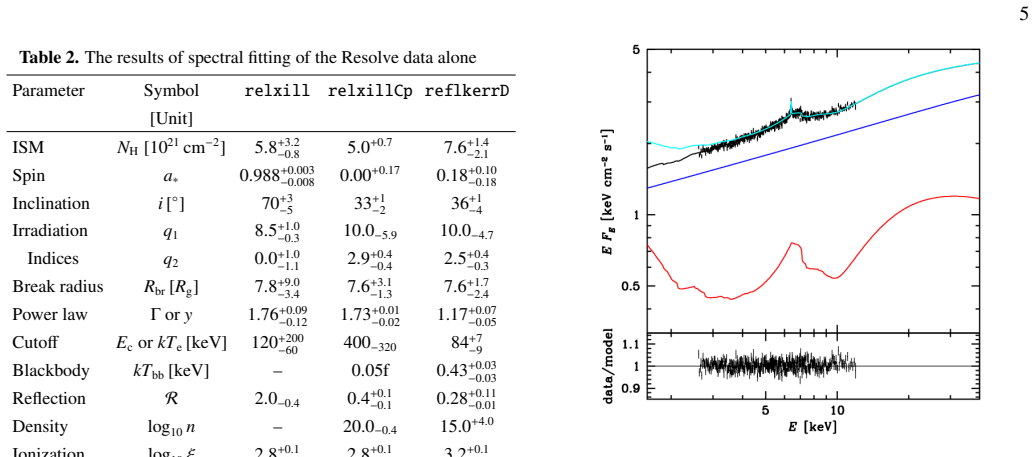
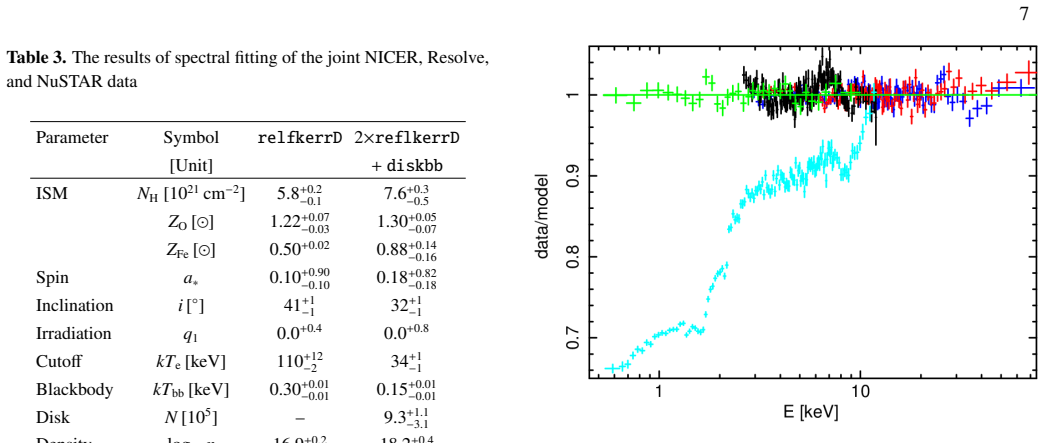
Fits of the Resolve data alone with the simplest available relativistic reflection model, relxill, yield a black hole spin parameter close to the maximum, a_* = 0.99. However, fitting with an improved, Comptonization-based model, relxillCp, yields a low a_*=0.0^{+0.17}. A similarly low range is obtained with another Comptonization-based model, reflkerrD. Then, fits to the combined data require two Comptonization models but are consistent with any spin value. We conclude that the spin value of Cyg X-1 is strongly model-dependent. However, low spin values are consistent with the constraints from gravitational waves. All of the models constrain the inner disk radius to be <10 gravitational radi
What carries the argument
Choice between the simplest relativistic reflection model relxill and Comptonization-based models relxillCp or reflkerrD when fitting the iron line and reflection spectrum
If this is right
- The derived spin changes from near-maximal to near-zero with model choice on the same data.
- Low spin values are allowed and align with gravitational wave constraints from black hole mergers.
- The inner accretion disk radius is constrained below 10 gravitational radii in every model.
- An outflowing disk corona is indicated as the geometry of the X-ray source.
- The same geometry accounts for the observed X-ray polarization from the source.
Where Pith is reading between the lines
- Applying similar model comparisons to other X-ray binaries could test whether spin estimates are generally model-dependent.
- Reverberation lag measurements that independently confirm or refute the inner disk radius limit would test the robustness of the result.
- This model dependence suggests that published spin values for other sources may require re-analysis with multiple reflection models.
Load-bearing premise
Differences in fitted spin arise purely from the choice of reflection model rather than from unaccounted systematic effects in data calibration, background subtraction, or unmodeled spectral components.
What would settle it
An independent spin measurement for the black hole in Cyg X-1, such as from gravitational waves in a future merger, that lies outside the range permitted by the Comptonization models.
Figures

read the original abstract
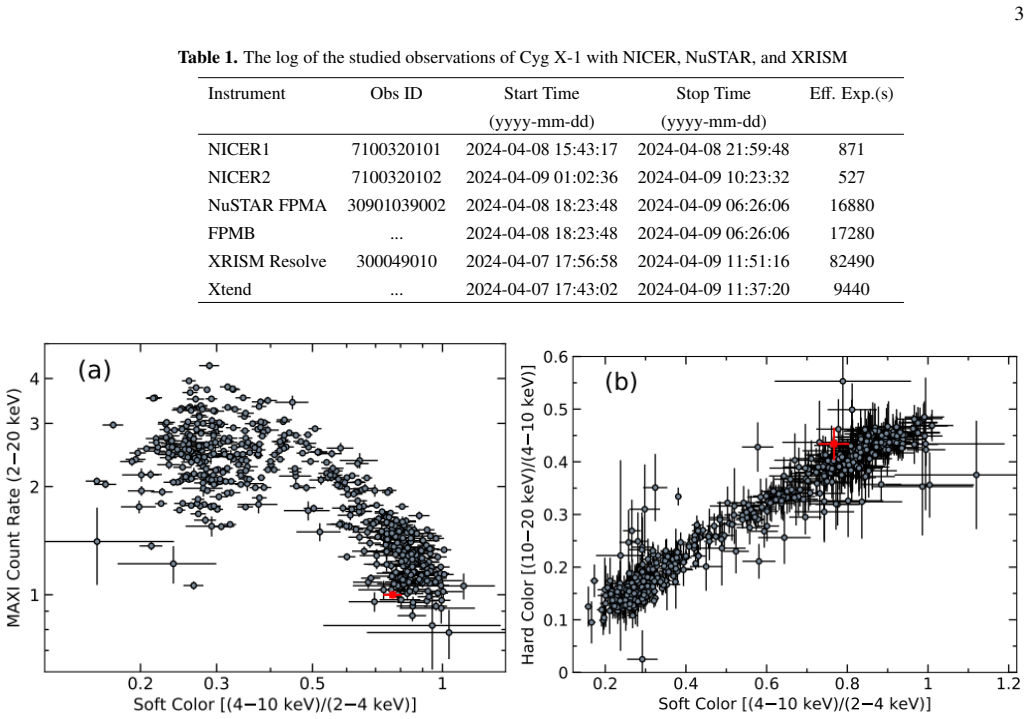
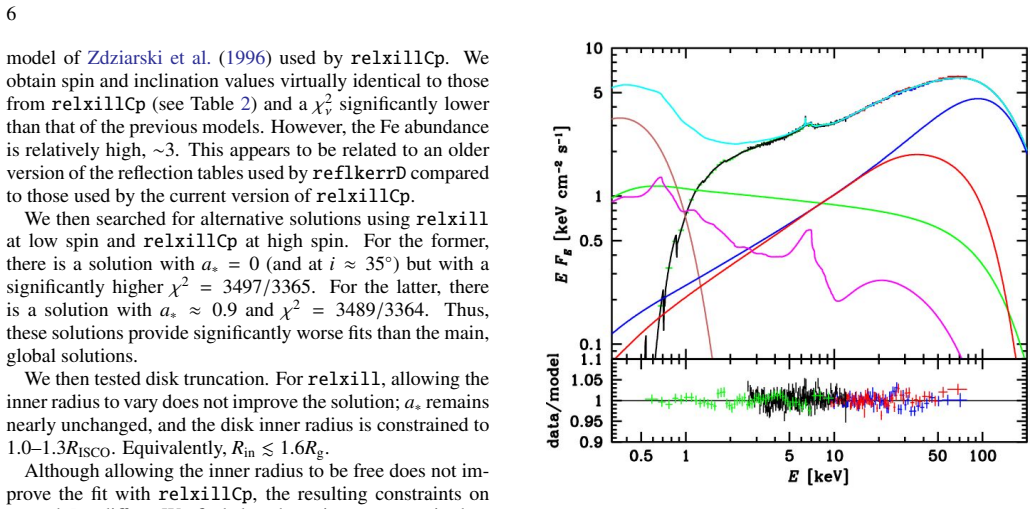
We study the persistent black hole X-ray binary Cyg X-1, recently observed by XRISM Resolve and simultaneously by NICER and NuSTAR in its hard spectral state. We confirm the result of Draghis et al. that fits of the Resolve data alone with the simplest available relativistic reflection model, relxill, yield a black hole spin parameter close to the maximum, $a_* = 0.99$. However, fitting with an improved, Comptonization-based model, relxillCp, yields a low $a_*=0.0^{+0.17}$. A similarly low range is obtained with another Comptonization-based model, reflkerrD. Then, fits to the combined data require two Comptonization models but are consistent with any spin value. We conclude that the spin value of Cyg X-1 is strongly model-dependent. However, low spin values are consistent with the constraints from gravitational waves. All of the models constrain the inner disk radius to be <10 gravitational radii, which is consistent with a recent finding of the weakness of thermal reverberation in Cyg X-1. The suggested source geometry is that of an outflowing disk corona, which was also proposed to explain the X-ray polarization observed from this source.
Editorial analysis
A structured set of objections, weighed in public.
Referee Report
Summary. The manuscript analyzes XRISM Resolve spectra of Cyg X-1 in the hard state, both alone and jointly with NICER/NuSTAR data, using three relativistic reflection models. It reports that the simplest model (relxill) returns a near-maximal spin a* = 0.99 while Comptonization-based models (relxillCp, reflkerrD) return a* = 0, with joint fits allowing any spin; the inner disk radius is constrained to <10 Rg in all cases. The authors conclude that the spin measurement is strongly model-dependent but that low-spin solutions are consistent with gravitational-wave constraints, favoring an outflowing corona geometry.
Significance. If the reported model dependence is robust, the result would caution against over-interpreting high spins obtained with the simplest reflection models and would strengthen the case for low spin in Cyg X-1, aligning X-ray reflection with gravitational-wave constraints. The consistent inner-radius limit across models also provides supporting evidence for the proposed corona geometry.
major comments (2)
- [Abstract] Abstract: the central claim of strong model dependence rests on the reported best-fit spins (a* = 0.99 vs a* = 0) differing between relxill and the Comptonization-based models, yet no fit statistics (reduced chi-squared, degrees of freedom, or null-hypothesis probabilities) are quoted, preventing assessment of whether the low-spin solutions are statistically preferred or merely allowed.
- [Results] The attribution of the spin discrepancy exclusively to the choice of reflection model assumes that data reduction, background subtraction, and calibration are identical across all fits; no quantitative test or table demonstrating that these systematics are held fixed is provided, leaving open the possibility that unmodeled components (e.g., the second Comptonization component required only in joint fits) contribute to the difference.
minor comments (1)
- A summary table listing best-fit parameters, uncertainties, and fit statistics for every model–dataset combination would make the model-dependence claim easier to evaluate.
Simulated Author's Rebuttal
We thank the referee for their careful reading and constructive comments on our manuscript. We address each major comment point by point below.
read point-by-point responses
-
Referee: [Abstract] Abstract: the central claim of strong model dependence rests on the reported best-fit spins (a* = 0.99 vs a* = 0) differing between relxill and the Comptonization-based models, yet no fit statistics (reduced chi-squared, degrees of freedom, or null-hypothesis probabilities) are quoted, preventing assessment of whether the low-spin solutions are statistically preferred or merely allowed.
Authors: We agree that explicit fit statistics in the abstract would aid assessment. The manuscript body and tables report reduced chi-squared values and degrees of freedom for all models; the Comptonization-based models yield statistically acceptable fits (reduced chi^2 comparable to or lower than relxill). We will revise the abstract to include a concise statement noting that all models provide acceptable fits to the Resolve data. revision: yes
-
Referee: [Results] The attribution of the spin discrepancy exclusively to the choice of reflection model assumes that data reduction, background subtraction, and calibration are identical across all fits; no quantitative test or table demonstrating that these systematics are held fixed is provided, leaving open the possibility that unmodeled components (e.g., the second Comptonization component required only in joint fits) contribute to the difference.
Authors: All fits in the manuscript (Resolve-only and joint) employ identical data reduction, background subtraction, and calibration for the XRISM, NICER, and NuSTAR datasets. The second Comptonization component appears only in joint fits to accommodate the wider bandpass; Resolve-only fits use a single component consistent with each reflection model. We will add an explicit statement in the data analysis section confirming that processing steps are held fixed across all model comparisons. revision: yes
Circularity Check
No circularity; results are direct outputs of independent model fits to data
full rationale
The paper reports spin constraints obtained by fitting named public reflection models (relxill, relxillCp, reflkerrD) to XRISM Resolve, NICER, and NuSTAR spectra. The differing a* values (0.99 vs. 0) and the joint-fit consistency with any spin are direct numerical outputs of those fits, not quantities defined in terms of themselves or reduced by construction from the paper's own equations. No self-citations are invoked to justify uniqueness or load-bearing premises, no ansatzes are smuggled via prior work, and no fitted parameters are relabeled as predictions. The derivation chain is therefore self-contained against external data and standard models.
Axiom & Free-Parameter Ledger
free parameters (2)
- black hole spin a_*
- inner disk radius R_in
axioms (1)
- domain assumption The relativistic reflection models relxill, relxillCp, and reflkerrD provide adequate descriptions of the hard-state spectrum of Cyg X-1.
Reference graph
Works this paper leans on
-
[1]
Abramowicz, M. A., Czerny, B., Lasota, J. P., & Szuszkiewicz, E. 1988, ApJ, 332, 646, doi: 10.1086/166683
-
[2]
Gravitational-wave constraints on the pair-instability mass gap and nuclear burning in massive stars
Antonini, F., Romero-Shaw, I., Callister, T., et al. 2025, arXiv e-prints, arXiv:2509.04637, doi: 10.48550/arXiv.2509.04637
work page internal anchor Pith review Pith/arXiv arXiv doi:10.48550/arxiv.2509.04637 2025
-
[3]
Arnaud, K. A. 1996, ASPC, V ol. 101, XSPEC: The First Ten Years, ed. G. H. Jacoby & J. Barnes (ASP), 17
1996
-
[4]
2018, ApJL, 853, L21, doi: 10.3847/2041-8213/aaa83b
Bachetti, M., & Huppenkothen, D. 2018, ApJL, 853, L21, doi: 10.3847/2041-8213/aaa83b
-
[5]
Bachetti, M., Harrison, F. A., Cook, R., et al. 2015, ApJ, 800, 109, doi: 10.1088/0004-637X/800/2/109
-
[6]
Identification of the soft X-ray excess in Cygnus X-1 with disc emission
Balucinska-Church, M., Belloni, T., Church, M. J., & Hasinger, G. 1995, A&A, 302, L5, doi: 10.48550/arXiv.astro-ph/9509020
work page internal anchor Pith review Pith/arXiv arXiv doi:10.48550/arxiv.astro-ph/9509020 1995
-
[7]
Bambi, C., Brenneman, L. W., Dauser, T., et al. 2021, SSRv, 217, 65, doi: doi.org/10.1007/s11214-021-00841-8
-
[8]
2025, MNRAS, 542, 982, doi: 10.1093/mnras/staf1155
Basak, A., Uttley, P., Bollemeijer, N., et al. 2025, MNRAS, 542, 982, doi: 10.1093/mnras/staf1155
-
[9]
Basak, R., Zdziarski, A. A., Parker, M., & Islam, N. 2017, MNRAS, 472, 4220, doi: 10.1093/mnras/stx2283 Belczy´nski, K., Done, C., Hagen, S., Lasota, J.-P., & Sen, K. 2024, A&A, 690, A21, doi: 10.1051/0004-6361/202450229 Belczy´nski, K., Klencki, J., Fields, C. E., et al. 2020, A&A, 636, A104, doi: 10.1051/0004-6361/201936528
-
[10]
Beloborodov, A. M. 1999, ApJL, 510, L123, doi: 10.1086/311810
-
[11]
Bowyer, S., Byram, E. T., Chubb, T. A., & Friedman, H. 1965, Science, 147, 394, doi: 10.1126/science.147.3656.394
-
[12]
Dauser, T., Wilms, J., Reynolds, C. S., & Brenneman, L. W. 2010, MNRAS, 409, 1534, doi: 10.1111/j.1365-2966.2010.17393.x
-
[13]
Davis, S. W., & El-Abd, S. 2019, ApJ, 874, 23, doi: 10.3847/1538-4357/ab05c5 De Marco, B., & Ponti, G. 2016, ApJ, 826, 70, doi: 10.3847/0004-637X/826/1/70 De Marco, B., Ponti, G., Muñoz-Darias, T., & Nandra, K. 2015, MNRAS, 454, 2360, doi: 10.1093/mnras/stv1990 De Marco, B., Zdziarski, A. A., Ponti, G., et al. 2021, A&A, 654, A14, doi: 10.1051/0004-6361/2...
-
[14]
2007, A&A Rv, 15, 1, doi: 10.1007/s00159-007-0006-1
Done, C., Gierli´nski, M., & Kubota, A. 2007, A&A Rv, 15, 1, doi: 10.1007/s00159-007-0006-1
-
[15]
Draghis, P. A., Miller, J. M., Brenneman, L., et al. 2025a, ApJ, 989, 227, doi: 10.3847/1538-4357/adec85
-
[16]
Draghis, P. A., Miller, J. M., Costantini, E., et al. 2024, ApJ, 969, 40, doi: 10.3847/1538-4357/ad43ea
-
[17]
Draghis, P. A., Miller, J. M., Kara, E., et al. 2025b, ApJL, 995, L12, doi: 10.3847/2041-8213/ae2276
-
[18]
Draghis, P. A., Miller, J. M., Zoghbi, A., et al. 2023, ApJ, 946, 19, doi: 10.3847/1538-4357/acafe7
-
[19]
2011, A&A, 533, L3, doi: 10.1051/0004-6361/201117446 Dziełak, M
Duro, R., Dauser, T., Wilms, J., et al. 2011, A&A, 533, L3, doi: 10.1051/0004-6361/201117446 Dziełak, M. A., De Marco, B., & Zdziarski, A. A. 2021, MNRAS, 506, 2020, doi: 10.1093/mnras/stab1700
-
[20]
Fabian, A. C., Wilkins, D. R., Miller, J. M., et al. 2012, MNRAS, 424, 217, doi: 10.1111/j.1365-2966.2012.21185.x
-
[21]
Fragile, P. C., Middleton, M. J., Bollimpalli, D. A., & Smith, Z. 2025, MNRAS, 540, 2820, doi: 10.1093/mnras/staf890
-
[22]
2019, ApJL, 881, L1, doi: 10.3847/2041-8213/ab339b García, J., & Kallman, T
Fuller, J., & Ma, L. 2019, ApJL, 881, L1, doi: 10.3847/2041-8213/ab339b García, J., & Kallman, T. R. 2010, ApJ, 718, 695, doi: 10.1088/0004-637X/718/2/695 García, J. A., Dauser, T., Reynolds, C. S., et al. 2013, ApJ, 768, 146, doi: 10.1088/0004-637X/768/2/146 García, J. A., Steiner, J. F., Grinberg, V ., et al. 2018, ApJ, 864, 25, doi: 10.3847/1538-4357/aad231
-
[23]
C., Arzoumanian, Z., Adkins, P
Gendreau, K. C., Arzoumanian, Z., Adkins, P. W., et al. 2016, Proc. SPIE, 9905, 99051H, doi: 10.1117/12.2231304 Gierli´nski, M., & Done, C. 2004, MNRAS, 347, 885, doi: 10.1111/j.1365-2966.2004.07266.x Gierli´nski, M., Zdziarski, A. A., Done, C., et al. 1997, MNRAS, 288, 958
-
[24]
Gies, D. R., Bolton, C. T., Blake, R. M., et al. 2008, ApJ, 678, 1237, doi: 10.1086/586690
-
[25]
Gou, L., McClintock, J. E., Liu, J., et al. 2009, ApJ, 701, 1076, doi: 10.1088/0004-637X/701/2/1076
-
[26]
1991, ApJL, 380, L51, doi: 10.1086/186171
Haardt, F., & Maraschi, L. 1991, ApJL, 380, L51, doi: 10.1086/186171
-
[27]
Harrison, F. A., Craig, W. W., Christensen, F. E., et al. 2013, ApJ, 770, 103, doi: 10.1088/0004-637X/770/2/103 HI4PI Collaboration, Ben Bekhti, N., Flöer, L., et al. 2016, A&A, 594, A116, doi: 10.1051/0004-6361/201629178
-
[28]
2019a, The Journal of Open Source Software, 4, 1393, doi: 10.21105/joss.01393 11
Huppenkothen, D., Bachetti, M., Stevens, A., et al. 2019a, The Journal of Open Source Software, 4, 1393, doi: 10.21105/joss.01393 11
-
[29]
Huppenkothen, D., Bachetti, M., Stevens, A. L., et al. 2019b, ApJ, 881, 39, doi: 10.3847/1538-4357/ab258d
-
[30]
Kaastra, J. S., & Bleeker, J. A. M. 2016, A&A, 587, A151, doi: 10.1051/0004-6361/201527395
-
[31]
2001, ApJS, 133, 221, doi: 10.1086/319184
Kallman, T., & Bautista, M. 2001, ApJS, 133, 221, doi: 10.1086/319184
-
[32]
2001, MNRAS, 327, 799, doi: 10.1046/j.1365-8711.2001.04769.x
Kotov, O., Churazov, E., & Gilfanov, M. 2001, MNRAS, 327, 799, doi: 10.1046/j.1365-8711.2001.04769.x
-
[33]
2022, Science, 378, 650, doi: 10.1126/science.add5399
Krawczynski, H., Muleri, F., Dovˇciak, M., et al. 2022, Science, 378, 650, doi: 10.1126/science.add5399
-
[34]
1998, PASJ, 50, 667, doi: 10.1093/pasj/50.6.667
Kubota, A., Tanaka, Y ., Makishima, K., et al. 1998, PASJ, 50, 667, doi: 10.1093/pasj/50.6.667
-
[35]
1976, ApJ, 208, 177, doi: 10.1086/154592
Lampton, M., Margon, B., & Bowyer, S. 1976, ApJ, 208, 177, doi: 10.1086/154592
-
[36]
Lightman, A. P., & Eardley, D. M. 1974, ApJL, 187, L1, doi: 10.1086/181377
-
[37]
Liu, H., Kong, L., Adegoke, O. K., et al. 2026, arXiv e-prints, arXiv:2603.06883, doi: 10.48550/arXiv.2603.06883
-
[38]
Liu, J., McClintock, J. E., Narayan, R., Davis, S. W., & Orosz, J. A. 2008, ApJL, 679, L37, doi: 10.1086/588840
-
[39]
2023, ApJ, 952, 53, doi: 10.3847/1538-4357/acdb74
Ma, L., & Fuller, J. 2023, ApJ, 952, 53, doi: 10.3847/1538-4357/acdb74
-
[40]
2008, PASJ, 60, 585, doi: 10.1093/pasj/60.3.585
Makishima, K., Takahashi, H., Yamada, S., et al. 2008, PASJ, 60, 585, doi: 10.1093/pasj/60.3.585
-
[41]
2020, ApJL, 895, L28, doi: 10.3847/2041-8213/ab8e41
Mandel, I., & Fragos, T. 2020, ApJL, 895, L28, doi: 10.3847/2041-8213/ab8e41
-
[42]
2009, PASJ, 61, 999, doi: 10.1093/pasj/61.5.999
Matsuoka, M., Kawasaki, K., Ueno, S., et al. 2009, PASJ, 61, 999, doi: 10.1093/pasj/61.5.999
-
[43]
McClintock, J. E., Narayan, R., & Steiner, J. F. 2014, SSRv, 183, 295, doi: 10.1007/s11214-013-0003-9
-
[44]
McConnell, M. L., Zdziarski, A. A., Bennett, K., et al. 2002, ApJ, 572, 984, doi: 10.1086/340436
-
[45]
Miller-Jones, J. C. A., Bahramian, A., Orosz, J. A., et al. 2021, Science, 371, 1046, doi: 10.1126/science.abb3363
-
[46]
1984, PASJ, 36, 741 Nied´ zwiecki, A., Szanecki, M., & Zdziarski, A
Mitsuda, K., Inoue, H., Koyama, K., et al. 1984, PASJ, 36, 741 Nied´ zwiecki, A., Szanecki, M., & Zdziarski, A. A. 2019, MNRAS, 485, 2942, doi: 10.1093/mnras/stz487
-
[47]
D., & Thorne, K
Novikov, I. D., & Thorne, K. S. 1973, in Black Holes (Les Astres Occlus), ed. C. Dewitt & B. S. Dewitt (Gordon and Breach: New
1973
-
[48]
2021, ApJL, 921, L2, doi: 10.3847/2041-8213/ac2f48
Olejak, A., & Belczy´nski, K. 2021, ApJL, 921, L2, doi: 10.3847/2041-8213/ac2f48
-
[49]
1996, ApJ, 470, 249, doi: 10.1086/177865
Poutanen, J., & Svensson, R. 1996, ApJ, 470, 249, doi: 10.1086/177865
-
[50]
Poutanen, J., Veledina, A., & Beloborodov, A. M. 2023, ApJL, 949, L10, doi: 10.3847/2041-8213/acd33e
-
[51]
Poutanen, J., Veledina, A., & Zdziarski, A. A. 2018, A&A, 614, A79, doi: 10.1051/0004-6361/201732345
-
[52]
2018, A&A, 616, A28, doi: 10.1051/0004-6361/201832839
Qin, Y ., Fragos, T., Meynet, G., et al. 2018, A&A, 616, A28, doi: 10.1051/0004-6361/201832839
-
[53]
2022, Research in Astronomy and Astrophysics, 22, 035023, doi: 10.1088/1674-4527/ac4ca4
Qin, Y ., Shu, X., Yi, S., & Wang, Y .-Z. 2022, Research in Astronomy and Astrophysics, 22, 035023, doi: 10.1088/1674-4527/ac4ca4
-
[54]
Ramachandran, V ., Sander, A. A. C., Oskinova, L. M., et al. 2025, A&A, 698, A37, doi: 10.1051/0004-6361/202554184
-
[55]
Shakura, N. I., & Sunyaev, R. A. 1976, MNRAS, 175, 613, doi: 10.1093/mnras/175.3.613 Simón-Díaz, S., Godart, M., Castro, N., et al. 2017, A&A, 597, A22, doi: 10.1051/0004-6361/201628541 S˛ adowski, A. 2009, ApJS, 183, 171, doi: 10.1088/0067-0049/183/2/171
-
[56]
Spruit, H. C. 2002, A&A, 381, 923, doi: 10.1051/0004-6361:20011465
-
[57]
Steiner, J. F., McClintock, J. E., Remillard, R. A., et al. 2010, ApJL, 718, L117, doi: 10.1088/2041-8205/718/2/L117
-
[58]
Steiner, J. F., Nathan, E., Hu, K., et al. 2024, ApJL, 969, L30, doi: 10.3847/2041-8213/ad58e4
-
[59]
2021, in Society of Photo-Optical Instrumentation Engineers (SPIE) Conference
Tashiro, M., Maejima, H., Toda, K., et al. 2021, in Society of Photo-Optical Instrumentation Engineers (SPIE) Conference
2021
-
[60]
GWTC-4.0: Population Properties of Merging Compact Binaries
Series, V ol. 11444, Society of Photo-Optical Instrumentation Engineers (SPIE) Conference Series, ed. J.-W. A. den Herder, S. Nikzad, & K. Nakazawa, 1144422, doi: 10.1117/12.2565812 The LIGO Scientific Collaboration, the Virgo Collaboration, & the KAGRA Collaboration. 2025, arXiv e-prints, arXiv:2508.18083, doi: 10.48550/arXiv.2508.18083
work page internal anchor Pith review Pith/arXiv arXiv doi:10.1117/12.2565812 2025
-
[61]
Tomsick, J. A., Nowak, M. A., Parker, M., et al. 2014, ApJ, 780, 78, doi: 10.1088/0004-637X/780/1/78
-
[62]
Tomsick, J. A., Parker, M. L., García, J. A., et al. 2018, ApJ, 855, 3, doi: 10.3847/1538-4357/aaaab1
-
[63]
Evidence of the pair instability gap from black hole masses
Tong, H., Fishbach, M., Thrane, E., et al. 2025, arXiv e-prints, arXiv:2509.04151, doi: 10.48550/arXiv.2509.04151
work page internal anchor Pith review Pith/arXiv arXiv doi:10.48550/arxiv.2509.04151 2025
-
[64]
Uttley, P., Cackett, E. M., Fabian, A. C., Kara, E., & Wilkins, D. R. 2014, A&A Rv, 22, 72, doi: 10.1007/s00159-014-0072-0
-
[65]
2011, MNRAS, 414, L60, doi: 10.1111/j.1745-3933.2011.01056.x van Son, L
Uttley, P., Wilkinson, T., Cassatella, P., et al. 2011, MNRAS, 414, L60, doi: 10.1111/j.1745-3933.2011.01056.x van Son, L. A. C., De Mink, S. E., Broekgaarden, F. S., et al. 2020, ApJ, 897, 100, doi: 10.3847/1538-4357/ab9809
-
[66]
Walborn, N. R. 1973, ApJL, 179, L123, doi: 10.1086/181131
-
[67]
Wilkinson, T., & Uttley, P. 2009, MNRAS, 397, 666, doi: 10.1111/j.1365-2966.2009.15008.x
-
[68]
2000, ApJ, 542, 914, doi: 10.1086/317016
Wilms, J., Allen, A., & McCray, R. 2000, ApJ, 542, 914, doi: 10.1086/317016
work page internal anchor Pith review doi:10.1086/317016 2000
-
[69]
Xiang, J., Lee, J. C., Nowak, M. A., & Wilms, J. 2011, ApJ, 738, 78, doi: 10.1088/0004-637X/738/1/78
-
[70]
2013, PASJ, 65, 80, doi: 10.1093/pasj/65.4.80
Yamada, S., Makishima, K., Done, C., et al. 2013, PASJ, 65, 80, doi: 10.1093/pasj/65.4.80
-
[71]
2025, PASJ, 77, 1210, doi: 10.1093/pasj/psaf104
Yamada, S., Hell, N., Costantini, E., et al. 2025, PASJ, 77, 1210, doi: 10.1093/pasj/psaf104
-
[72]
Zdziarski, A. A., & De Marco, B. 2020, ApJL, 896, L36, doi: 10.3847/2041-8213/ab9899 12
-
[73]
Zdziarski, A. A., Dziełak, M. A., De Marco, B., Szanecki, M., & Nied´ zwiecki, A. 2021, ApJL, 909, L9, doi: 10.3847/2041-8213/abe7ef
-
[74]
Zdziarski, A. A., Johnson, W. N., & Magdziarz, P. 1996, MNRAS, 283, 193, doi: 10.1093/mnras/283.1.193
-
[75]
A., Marcel, G., Veledina, A., Olejak, A., & Lanˇcová, D
Zdziarski, A. A., Marcel, G., Veledina, A., Olejak, A., & Lanˇcová, D. 2026, New Astronomy Reviews, 102, 101746, doi: 10.1016/j.newar.2025.101746
-
[76]
Zdziarski, A. A., Poutanen, J., Paciesas, W. S., & Wen, L. 2002, ApJ, 578, 357, doi: 10.1086/342402
-
[77]
A., Veledina, A., Szanecki, M., et al
Zdziarski, A. A., Veledina, A., Szanecki, M., et al. 2023, ApJL, 951, L45, doi: 10.3847/2041-8213/ace2c9
-
[78]
A., Chand, S., Banerjee, S., et al
Zdziarski, A. A., Chand, S., Banerjee, S., et al. 2024, ApJL, 967, L9, doi: 10.3847/2041-8213/ad43ed
-
[79]
2021, ApJ, 908, 117, doi: 10.3847/1538-4357/abbcd6
Zhao, X., Gou, L., Dong, Y ., et al. 2021, ApJ, 908, 117, doi: 10.3847/1538-4357/abbcd6
discussion (0)
Sign in with ORCID, Apple, or X to comment. Anyone can read and Pith papers without signing in.