MetaboKG: An Analysis-centric Knowledge Graph Framework for Untargeted Metabolomics
Pith reviewed 2026-06-30 11:44 UTC · model grok-4.3
The pith
MetaboKG creates a knowledge graph for metabolomics that preserves provenance links between data sources and annotations.
A machine-rendered reading of the paper's core claim, the machinery that carries it, and where it could break.
Core claim
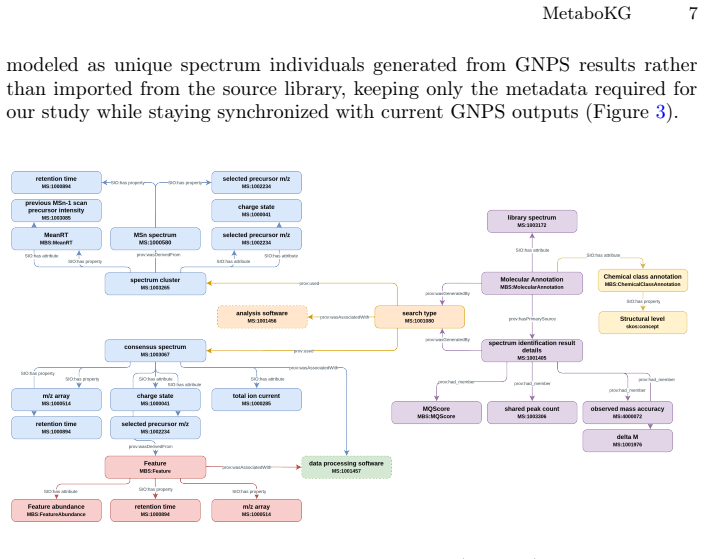
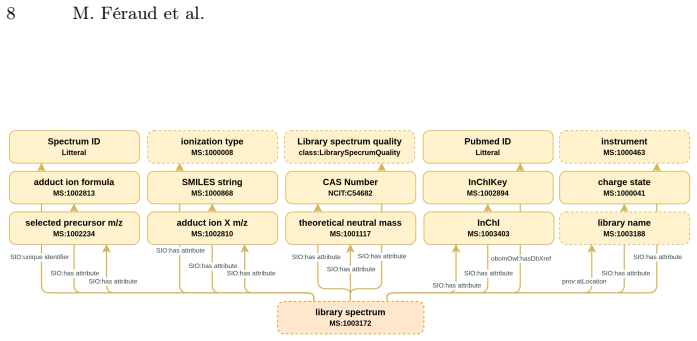
MetaboKG contributes a transformation workflow that preserves links between repository exports, analytical files, spectra, features, and annotation results; a semantic model grounded in PROV-O and SIO aligned with domain ontologies to represent provenance, analytical evidence, metadata attributes, and controlled vocabulary terms; and a Universal Annotation Identifier strategy extending the Universal Spectrum Identifier with workflow-specific components for late binding, incremental ingestion, and post hoc linkage across analyses. Demonstration at public-repository scale on 680 GNPS molecular networking results shows that graph-based integration supports traceable annotation reuse and reprodu
What carries the argument
The Universal Annotation Identifier strategy extending the Universal Spectrum Identifier with workflow-specific components for late binding, incremental ingestion, and post hoc linkage across analyses.
If this is right
- Traceable reuse of annotations across multiple analyses becomes feasible through the preserved links.
- Reproducible SPARQL queries can explore biochemical relationships, environmental specificity, and analytical variation.
- Competency questions covering biochemical enrichment and cross-instrument variation can be answered directly on the integrated graph.
- The approach operates at the scale of hundreds of molecular networking results from public repositories.
Where Pith is reading between the lines
- The identifier strategy could extend to other scientific domains where data fragments across repositories and workflows.
- Incremental updates to the graph might support ongoing addition of new analyses without rebuilding from scratch.
- Query results could feed into downstream tools for automated validation of annotations against environmental or taxonomic context.
Load-bearing premise
The semantic model based on PROV-O, SIO, and the aligned ontologies can faithfully represent all necessary analytical evidence, metadata, and vocabulary terms from the original scattered repository and tabular artifacts without material loss or distortion of provenance and confidence information.
What would settle it
Build the graph from the 680 GNPS results, run the competency questions via SPARQL, and verify whether every returned annotation and relationship correctly traces back to its originating spectra, features, and files without broken links or lost context; any systematic failure to retrieve complete provenance would falsify the framework's utility.
Figures


read the original abstract
Untargeted metabolomics generates large volumes of tandem mass spectrometry (MS/MS) data and computational annotations that can reveal molecular mechanisms across organisms and environments. Public reuse has improved through harmonized repository metadata and access infrastructures such as Pan-ReDU, and through metabolomics knowledge graphs such as ENPKG and METRIN-KG. Yet the analytical layer remains fragmented: spectra, features, workflow outputs, annotations, confidence evidence, and contextual metadata are still scattered across repositories and tabular artifacts. We present MetaboKG, an analysis-centric knowledge graph framework for engineering reusable metabolomics knowledge from public repositories, metadata, and GNPS molecular network results. MetaboKG contributes a transformation workflow that preserves links between repository exports, analytical files, spectra, features, and annotation results; a semantic model grounded in PROV-O and SIO and aligned with the Mass Spectrometry ontology (MS), ChEBI, NCBITaxon, ENVO, and NCIT to represent provenance, analytical evidence, metadata attributes, and controlled vocabulary terms; and a Universal Annotation Identifier strategy extending the Universal Spectrum Identifier (USI) with workflow-specific components for late binding, incremental ingestion, and post hoc linkage across analyses. We demonstrate MetaboKG at the public-repository scale on 680 GNPS molecular networking results and evaluate it through competency questions covering biochemical enrichment, environmental specificity, and cross instrument analytical variation. Results show that graph-based integration supports traceable annotation reuse and reproducible SPARQL exploration of biochemical relationships that remain fragmented across repository-native resources.
Editorial analysis
A structured set of objections, weighed in public.
Referee Report
Summary. The manuscript presents MetaboKG, an analysis-centric knowledge graph framework for untargeted metabolomics. It contributes (1) a transformation workflow that preserves links between repository exports, analytical files, spectra, features, and annotation results from sources such as GNPS; (2) a semantic model grounded in PROV-O and SIO and aligned with the MS, ChEBI, NCBITaxon, ENVO, and NCIT ontologies to represent provenance, analytical evidence, metadata, and controlled terms; and (3) a Universal Annotation Identifier extending the USI with workflow-specific components for late binding and incremental ingestion. The framework is demonstrated at scale on 680 GNPS molecular networking results and evaluated via competency questions on biochemical enrichment, environmental specificity, and cross-instrument variation, with the claim that the resulting graph supports traceable annotation reuse and reproducible SPARQL exploration of relationships fragmented in repository-native resources.
Significance. If the preservation and fidelity claims hold, the work would offer a practical contribution to metabolomics data integration by enabling graph-based, provenance-aware reuse of analytical outputs that are currently scattered across repositories and tabular files. The explicit grounding in established ontologies (PROV-O, SIO, MS, ChEBI) and the extension of the USI identifier are strengths, as is the demonstration at the scale of 680 public results together with competency-question evaluation showing that SPARQL queries can traverse biochemical and environmental relationships. These elements could support reproducible downstream analyses if the mapping is shown to be lossless.
major comments (2)
- [Demonstration on 680 GNPS results and competency-question evaluation] The demonstration on 680 GNPS molecular networking results and the competency-question evaluation (described in the abstract and results): while the queries illustrate that integration and exploration are possible, the evaluation supplies no metrics, example mappings, or tests confirming that every original field—such as per-feature confidence scores, workflow-specific parameters, or non-controlled metadata—is preserved without loss or coarsening when mapped to the PROV-O/SIO representation. This is load-bearing for the central claim that the transformation workflow 'preserves links' and supports 'traceable annotation reuse' without material distortion.
- [Semantic model description] Semantic model section: the alignment with PROV-O, SIO, MS, ChEBI, NCBITaxon, ENVO, and NCIT is described at the level of high-level classes and relations, but no explicit mapping table, schema diagram, or worked example is provided showing how a complete GNPS export (including all analytical evidence and metadata attributes) is transformed into RDF. Without this, it remains unclear whether the model can represent the full set of original attributes without omission.
minor comments (1)
- [Results] The manuscript would benefit from a table or figure summarizing the 680-result corpus (e.g., number of features, annotations, and instruments represented) to allow readers to assess the scale and diversity of the demonstration.
Simulated Author's Rebuttal
We thank the referee for their thorough review and constructive feedback on our manuscript. We address each of the major comments below and commit to revisions that will strengthen the presentation of our evaluation and semantic model.
read point-by-point responses
-
Referee: [Demonstration on 680 GNPS results and competency-question evaluation] The demonstration on 680 GNPS molecular networking results and the competency-question evaluation (described in the abstract and results): while the queries illustrate that integration and exploration are possible, the evaluation supplies no metrics, example mappings, or tests confirming that every original field—such as per-feature confidence scores, workflow-specific parameters, or non-controlled metadata—is preserved without loss or coarsening when mapped to the PROV-O/SIO representation. This is load-bearing for the central claim that the transformation workflow 'preserves links' and supports 'traceable annotation reuse' without material distortion.
Authors: We agree that explicit documentation of data preservation is essential to support our claims of lossless transformation and traceable reuse. Although the competency questions demonstrate practical utility of the integrated graph, we acknowledge the absence of direct fidelity metrics in the current version. In the revised manuscript, we will add a new subsection under Results that provides example mappings for representative GNPS fields (including confidence scores, workflow parameters, and metadata), along with verification tests or counts showing that these attributes are preserved in the RDF representation without coarsening. This will be accompanied by supplementary data files containing the mappings. revision: yes
-
Referee: [Semantic model description] Semantic model section: the alignment with PROV-O, SIO, MS, ChEBI, NCBITaxon, ENVO, and NCIT is described at the level of high-level classes and relations, but no explicit mapping table, schema diagram, or worked example is provided showing how a complete GNPS export (including all analytical evidence and metadata attributes) is transformed into RDF. Without this, it remains unclear whether the model can represent the full set of original attributes without omission.
Authors: We recognize that the current description of the semantic model is at a high level and would benefit from more concrete illustrations. To address this, we will revise the Semantic Model section to include: (1) an explicit mapping table that lists GNPS export attributes and their corresponding ontology classes/properties; (2) a schema diagram (to be added as a new figure) depicting the key classes, relations, and ontology alignments; and (3) a worked example showing the transformation of a complete GNPS molecular networking result into RDF triples. These additions will clarify the model's capacity to represent the full set of attributes. revision: yes
Circularity Check
No circularity: framework construction with external ontologies and no fitted derivations
full rationale
The paper describes a construction (transformation workflow, PROV-O/SIO semantic model aligned to external ontologies MS/ChEBI/NCBITaxon/ENVO/NCIT, and USI-extending identifier strategy) rather than any derivation chain. No equations, parameters, predictions, or self-citations appear as load-bearing steps that reduce the central claims to inputs by construction. The 680-result demonstration and competency-question evaluation are presented as empirical validation of the built artifact, not as outputs forced by prior fits or author-unique theorems. The approach is self-contained against external benchmarks (standard ontologies and repository data).
Axiom & Free-Parameter Ledger
Reference graph
Works this paper leans on
-
[1]
Ashburner, M., Ball, C.A., Blake, J.A., Botstein, D., Butler, H., Cherry, J.M., Davis, A.P., Dolinski, K., Dwight, S.S., Eppig, J.T., Harris, M.A., Hill, D.P., Issel- Tarver, L., Kasarskis, A., Lewis, S., Matese, J.C., Richardson, J.E., Ringwald, M., Rubin, G.M., Sherlock, G.: Gene ontology: tool for the unification of biology. The Gene Ontology Consortiu...
-
[2]
Nature Reviews Drug Discovery 20(3), 200–216 (Mar 2021)
Atanasov, A.G., Zotchev, S.B., Dirsch, V.M., Supuran, C.T.: Natural products in drug discovery: advances and opportunities. Nature Reviews Drug Discovery 20(3), 200–216 (Mar 2021). https://doi.org/10.1038/s41573-020-00114-z, https: //doi.org/10.1038/s41573-020-00114-z
-
[3]
Metabolomics : Official journal of the Metabolomic Society18(12), 94 (Nov 2022)
Bittremieux, W., Wang, M., Dorrestein, P.C.: The critical role that spectral li- braries play in capturing the metabolomics community knowledge. Metabolomics : Official journal of the Metabolomic Society18(12), 94 (Nov 2022). https: //doi.org/10.1007/s11306-022-01947-y, https://pmc.ncbi.nlm.nih.gov/article s/PMC10284100/
-
[4]
Journal of Separation Science33(3), 290–304 (Feb 2010)
Boccard, J., Veuthey, J.L., Rudaz, S.: Knowledge discovery in metabolomics: an overview of MS data handling. Journal of Separation Science33(3), 290–304 (Feb 2010). https://doi.org/10.1002/jssc.200900609
-
[5]
Journal of Biomedical Semantics4(1), 43 (Dec 2013)
Buttigieg, P.L., Morrison, N., Smith, B., Mungall, C.J., Lewis, S.E., the ENVO Consortium: The environment ontology: contextualising biological and biomedical entities. Journal of Biomedical Semantics4(1), 43 (Dec 2013). https://doi.org/10 .1186/2041-1480-4-43, https://doi.org/10.1186/2041-1480-4-43
-
[6]
Briefings in Bioinformatics18(3), 498–510 (2017)
Cambiaghi, A., Ferrario, M., Masseroli, M.: Analysis of metabolomic data: tools, current strategies and future challenges for omics data integration. Briefings in Bioinformatics18(3), 498–510 (2017). https://doi.org/10.1093/bib/bbw031
-
[7]
Current Opin- ion in Biotechnology55, 44–50 (Feb 2019)
Chaleckis, R., Meister, I., Zhang, P., Wheelock, C.E.: Challenges, progress and promises of metabolite annotation for LC–MS-based metabolomics. Current Opin- ion in Biotechnology55, 44–50 (Feb 2019). https://doi.org/10.1016/j.copbio.201 8.07.010, https://www.sciencedirect.com/science/article/pii/S0958166918300764
-
[8]
Nature Proto- cols20(10), 2960–2993 (Oct 2025)
Charron-Lamoureux, V., Mannochio-Russo, H., Lamichhane, S., Xing, S., Patan, A., Portal Gomes, P.W., Rajkumar, P., Deleray, V., Caraballo-Rodríguez, A.M., Chua, K.V., Lee, L.S., Liu, Z., Ching, J., Wang, M., Dorrestein, P.C.: A guide to reverse metabolomics—a framework for big data discovery strategy. Nature Proto- cols20(10), 2960–2993 (Oct 2025). https:...
-
[9]
Transactions on Graph Data and Knowledge1(1), 5:1–5:33 (2023)
Chen, J., Dong, H., Hastings, J., Jiménez-Ruiz, E., López, V., Monnin, P., Pesquita, C., Škoda, P., Tamma, V.: Knowledge Graphs for the Life Sciences: Re- cent Developments, Challenges and Opportunities. Transactions on Graph Data and Knowledge1(1), 5:1–5:33 (2023). https://doi.org/10.4230/TGDK.1.1.5, https://doi.org/10.4230/TGDK.1.1.5
-
[10]
Computational and structural biotechnology journal4, e201301007 (Feb 2013)
Commisso, M., Strazzer, P., Toffali, K., Stocchero, M., Guzzo, F.: Untargeted metabolomics: An emerging approach to determine the composition of herbal products. Computational and structural biotechnology journal4, e201301007 (Feb 2013). https://doi.org/10.5936/csbj.201301007
-
[11]
The New phytologist241(5), 1910–1921 (Mar 2024)
Delory, B.M., Callaway, R.M., Semchenko, M.: A trait-based framework linking the soil metabolome to plant-soil feedbacks. The New phytologist241(5), 1910–1921 (Mar 2024). https://doi.org/10.1111/nph.19490, http://fox.leuphana.de/portal/d e/publications/a-traitbased-framework-linking-the-soil-metabolome-to-plantsoil -feedbacks(9bce25d9-48c2-4f37-bed4-ab54e...
-
[12]
Nature Meth- ods16(4), 299–302 (Apr 2019)
Dührkop, K., Fleischauer, M., Ludwig, M., Aksenov, A.A., Melnik, A.V., Meusel, M., Dorrestein, P.C., Rousu, J., Böcker, S.: SIRIUS 4: a rapid tool for turn- ing tandem mass spectra into metabolite structure information. Nature Meth- ods16(4), 299–302 (Apr 2019). https://doi.org/10.1038/s41592-019-0344-8, https://www.nature.com/articles/s41592-019-0344-8
-
[13]
Nature Biotechnology39(4), 462–471 (Apr 2021)
Dührkop, K., Nothias, L.F., Fleischauer, M., Reher, R., Ludwig, M., Hoffmann, M.A., Petras, D., Gerwick, W.H., Rousu, J., Dorrestein, P.C., Böcker, S.: Sys- tematic classification of unknown metabolites using high-resolution fragmentation mass spectra. Nature Biotechnology39(4), 462–471 (Apr 2021). https://doi.org/ 10.1038/s41587-020-0740-8, https://www.n...
-
[14]
uhrkop, K., Shen, H., Meusel, M., Rousu, J., B
D"uhrkop, K., Shen, H., Meusel, M., Rousu, J., B"ocker, S.: Searching molecular structure databases with tandem mass spectra using CSI:FingerID. Proceedings of the National Academy of Sciences112(41), 12580–12585 (Oct 2015). https: //doi.org/10.1073/pnas.1509788112, https://www.pnas.org/doi/full/10.1073/pn as.1509788112
-
[15]
Journal of Biomedical Semantics5(1), 14 (Mar 2014)
Dumontier, M., Baker, C.J., Baran, J., Callahan, A., Chepelev, L., Cruz-Toledo, J., Del Rio, N.R., Duck, G., Furlong, L.I., Keath, N., Klassen, D., McCusker, J.P., Queralt-Rosinach, N., Samwald, M., Villanueva-Rosales, N., Wilkinson, M.D., Hoehndorf, R.: The Semanticscience Integrated Ontology (SIO) for biomedical re- search and knowledge discovery. Journ...
-
[16]
Nature Communications16(1), 4838 (May 2025)
El Abiead, Y., Strobel, M., Payne, T., Fahy, E., O’Donovan, C., Subramamiam, S., Vizcaíno, J.A., Yurekten, O., Deleray, V., Zuffa, S., Xing, S., Mannochio-Russo, H., Mohanty,I.,Zhao,H.N.,Caraballo-Rodriguez,A.M.,Gomes,P.W.P.,Avalon,N.E., Northen, T.R., Bowen, B.P., Louie, K.B., Dorrestein, P.C., Wang, M.: Enabling pan-repository reanalysis for big data sc...
-
[17]
Nucleic Acids Research40(Database issue), D136–D143 (Jan 2012)
Federhen, S.: The NCBI Taxonomy database. Nucleic Acids Research40(Database issue), D136–D143 (Jan 2012). https://doi.org/10.1093/nar/gkr1178, https: //doi.org/10.1093/nar/gkr1178
-
[18]
Fiehn,O.:Metabolomics–thelinkbetweengenotypesandphenotypes.PlantMolec- ular Biology48(1-2), 155–171 (Jan 2002)
2002
-
[19]
Bioinformatics40(4), btae174 (Apr 2024)
Galgonek, J., Vondrážek, J.: The IDSM mass spectrometry extension: searching mass spectra using SPARQL. Bioinformatics40(4), btae174 (Apr 2024). https: 18 M. Féraud et al. //doi.org/10.1093/bioinformatics/btae174, https://pmc.ncbi.nlm.nih.gov/article s/PMC11034985/
-
[20]
ACS Central Science10(3), 494–510 (Mar 2024)
Gaudry, A., Pagni, M., Mehl, F., Moretti, S., Quiros-Guerrero, L.M., Cappelletti, L., Rutz, A., Kaiser, M., Marcourt, L., Queiroz, E.F., Ioset, J.R., Grondin, A., David, B., Wolfender, J.L., Allard, P.M.: A Sample-Centric and Knowledge-Driven Computational Framework for Natural Products Drug Discovery. ACS Central Science10(3), 494–510 (Mar 2024). https:/...
-
[21]
Nature626(7998), 419–426 (Feb 2024)
Gentry, E.C., Collins, S.L., Panitchpakdi, M., Belda-Ferre, P., Stewart, A.K., Carrillo Terrazas, M., Lu, H.h., Zuffa, S., Yan, T., Avila-Pacheco, J., Plichta, D.R., Aron, A.T., Wang, M., Jarmusch, A.K., Hao, F., Syrkin-Nikolau, M., Vla- makis, H., Ananthakrishnan, A.N., Boland, B.S., Hemperly, A., Vande Casteele, N., Gonzalez, F.J., Clish, C.B., Xavier, ...
-
[22]
https://doi.org/10.2 139/ssrn.3199007, https://papers.ssrn.com/abstract=3199007
Golbeck, J., Fragoso, G., Hartel, F., Hendler, J., Oberthaler, J., Parsia, B.: The National Cancer Institute’s Thesaurus and Ontology (2003). https://doi.org/10.2 139/ssrn.3199007, https://papers.ssrn.com/abstract=3199007
2003
-
[23]
Metabolomics3(3), 231–241 (Sep 2007)
Goodacre, R., Broadhurst, D., Smilde, A.K., Kristal, B.S., Baker, J.D., Beger, R., Bessant, C., Connor, S., Capuani, G., Craig, A., Ebbels, T., Kell, D.B., Manetti, C., Newton, J., Paternostro, G., Somorjai, R., Sj"ostr"om, M., Trygg, J., Wulfert, F.: Proposed minimum reporting standards for data analysis in metabolomics. Metabolomics3(3), 231–241 (Sep 20...
-
[24]
World Wide Web Consortium (10 2017), https://www
Haller, A., Janowicz, K., Cox, S., Phuoc, D., Taylor, K., Lefrançois, M.: Semantic Sensor Network Ontology. World Wide Web Consortium (10 2017), https://www. w3.org/TR/vocab-ssn/
2017
-
[25]
Nucleic Acids Research41(D1), D456–D463 (Jan 2013)
Hastings, J., de Matos, P., Dekker, A., Ennis, M., Harsha, B., Kale, N., Muthukr- ishnan, V., Owen, G., Turner, S., Williams, M., Steinbeck, C.: The ChEBI reference database and ontology for biologically relevant chemistry: Enhancements for 2013. Nucleic Acids Research41(D1), D456–D463 (Jan 2013). https://doi.org/10.1093/ nar/gks1146
2013
-
[26]
Nucleic Acids Research48(D1), D440–D444 (Jan 2020)
Haug, K., Cochrane, K., Nainala, V.C., Williams, M., Chang, J., Jayaseelan, K.V., O’Donovan, C.: MetaboLights: a resource evolving in response to the needs of its scientific community. Nucleic Acids Research48(D1), D440–D444 (Jan 2020). https://doi.org/10.1093/nar/gkz1019, https://doi.org/10.1093/nar/gkz1019
-
[27]
Hoffmann, N., Rein, J., Sachsenberg, T., Hartler, J., Haug, K., Mayer, G., Alka, O., Dayalan, S., Pearce, J.T.M., Rocca-Serra, P., Qi, D., Eisenacher, M., Perez-Riverol, Y., Vizcaíno, J.A., Salek, R.M., Neumann, S., Jones, A.R.: mzTab-M: A Data Standard for Sharing Quantitative Results in Mass Spectrometry Metabolomics. Analytical Chemistry91(5), 3302–331...
work page doi:10.1021/acs 2019
-
[28]
Nature Methods17(9), 901–904 (Sep 2020)
Jarmusch, A.K., Wang, M., Aceves, C.M., Advani, R.S., Aguirre, S., Aksenov, A.A., Aleti, G., Aron, A.T., Bauermeister, A., Bolleddu, S., Bouslimani, A., Cara- ballo Rodriguez, A.M., Chaar, R., Coras, R., Elijah, E.O., Ernst, M., Gauglitz, J.M., Gentry, E.C., Husband, M., Jarmusch, S.A., Jones, K.L., Kamenik, Z., Le Gouellec, A., Lu, A., McCall, L.I., McPh...
-
[29]
Bioinformatics Advances12(1), vbac029 (Jan 2022)
Johnson, D., Gonzalez-Beltran, A., Rocca-Serra, P., Sansone, S.A.: ISA API: An open platform for interoperable life science experimental metadata. Bioinformatics Advances12(1), vbac029 (Jan 2022). https://doi.org/10.1093/bioinformatics/bta b560, https://pmc.ncbi.nlm.nih.gov/articles/PMC8964007/
-
[30]
Datenbank- Spektrum24(1), 43–52 (Mar 2024)
Kleinsteuber, E., Al Mustafa, T., Zander, F., K"onig-Ries, B., Babalou, S.: Man- aging Provenance Data in Knowledge Graph Management Platforms. Datenbank- Spektrum24(1), 43–52 (Mar 2024). https://doi.org/10.1007/s13222-023-00463-0, https://doi.org/10.1007/s13222-023-00463-0
-
[31]
https://github.com/skorokithakis/shortuuid (2011)
Korokithakis, S.: shortuuid: A generator library for concise, unambiguous and URL-safe UUIDs. https://github.com/skorokithakis/shortuuid (2011)
2011
-
[32]
W3C Recommendation, World Wide Web Consortium, United States (Apr 2013), https://www.w3.org/TR/prov-o/
Lebo, T., Sahoo, S., McGuinness, D., Belhajjame, K., Cheney, J., Corsar, D., Gar- ijo, D., Soiland-Reyes, S., Zednik, S., Zhao, J.: PROV-O: The PROV Ontology. W3C Recommendation, World Wide Web Consortium, United States (Apr 2013), https://www.w3.org/TR/prov-o/
2013
-
[33]
Scientific Reports9(1), 2741 (Feb 2019)
Manier, S.K., Keller, A., Sch"aper, J., Meyer, M.R.: Untargeted metabolomics by high resolution mass spectrometry coupled to normal and reversed phase liquid chromatography as a tool to study the in vitro biotransformation of new psychoac- tive substances. Scientific Reports9(1), 2741 (Feb 2019). https://doi.org/10.103 8/s41598-019-39235-w, https://www.na...
2019
-
[34]
Molecular & Cellular Proteomics10(1), R110.000133 (Jan 2011)
Martens, L., Chambers, M., Sturm, M., Kessner, D., Levander, F., Shofstahl, J., Tang, W.H., Römpp, A., Neumann, S., Pizarro, A.D., Montecchi-Palazzi, L., Tasman, N., Coleman, M., Reisinger, F., Souda, P., Hermjakob, H., Binz, P.A., Deutsch, E.W.: mzML—a Community Standard for Mass Spectrometry Data*. Molecular & Cellular Proteomics10(1), R110.000133 (Jan ...
-
[35]
Bioinformatics41(5), btaf279 (May 2025)
McLaughlin, J., Lagrimas, J., Iqbal, H., Parkinson, H., Harmse, H.: OLS4: a new Ontology Lookup Service for a growing interdisciplinary knowledge ecosystem. Bioinformatics41(5), btaf279 (May 2025). https://doi.org/10.1093/bioinformati cs/btaf279, https://doi.org/10.1093/bioinformatics/btaf279
-
[36]
Metz, T.O., Chang, C.H., Gautam, V., Anjum, A., Tian, S., Wang, F., Colby, S.M., Nunez, J.R., Blumer, M.R., Edison, A.S., Fiehn, O., Jones, D.P., Li, S., Morgan, E.T., Patti, G.J., Ross, D.H., Shapiro, M.R., Williams, A.J., Wishart, D.S.: Intro- ducing “Identification Probability” for Automated and Transferable Assessment of Metabolite Identification Conf...
-
[37]
GigaScience15, giaf152 (Jan 2026)
Moxon,S.A.T.,Solbrig,H.,Harris,N.L.,Kalita,P.,Miller,M.A.,Patil,S.,Schaper, K., Bizon, C., Caufield, J.H., Cuesta, S.C., Cox, C., Dekervel, F., Dooley, D.M., Duncan, W.D., Fliss, T., Gehrke, S., Graefe, A.S.L., Hegde, H., Ireland, A.J., Jacobsen, J.O.B., Krishnamurthy, M., Kroll, C., Linke, D., Ly, R., Matentzoglu, N., Overton, J.A., Saunders, J.L., Unni,...
-
[38]
Nature Methods17(9), 905–908 (Sep 2020)
Nothias, L.F., Petras, D., Schmid, R., Dührkop, K., Rainer, J., Sarvepalli, A., Prot- syuk,I.,Ernst,M.,Tsugawa,H.,Fleischauer,M.,Aicheler,F.,Aksenov,A.A.,Alka, O., Allard, P.M., Barsch, A., Cachet, X., Caraballo-Rodriguez, A.M., Da Silva, R.R., Dang, T., Garg, N., Gauglitz, J.M., Gurevich, A., Isaac, G., Jarmusch, A.K., Kameník, Z., Kang, K.B., Kessler, N...
-
[39]
https://www.w3.org/TR/swbp-n-aryRelations/ (2013)
Noy, R.: Defining N-ary Relations on the Semantic Web. https://www.w3.org/TR/swbp-n-aryRelations/ (2013)
2013
-
[40]
Rücknagel, J., Vierkant, P., Ulrich, R., Kloska, G., Schnepf, E., Fichtmüller, D., Reuter, E., Semrau, A., Kindling, M., Pampel, H., Witt, M., Fritze, F., Van De Sandt, S., Klump, J., Goebelbecker, H.J., Skarupianski, M., Bertelmann, R., Schirmbacher, P., Scholze, F., Kramer, C., Fuchs, C., Spier, S., Kirchhoff, A.: Metadata Schema for the Description of ...
-
[41]
Rutz, A., Sorokina, M., Galgonek, J., Mietchen, D., Willighagen, E., Gaudry, A., Graham, J.G., Stephan, R., Page, R., Vondrážek, J., Steinbeck, C., Pauli, G.F., Wolfender, J.L., Bisson, J., Allard, P.M.: The LOTUS initiative for open knowledge management in natural products research. eLife11, e70780 (May 2022). https: //doi.org/10.7554/eLife.70780, https:...
-
[42]
Nature Biotechnology 25(8), 846–848 (Aug 2007)
Sansone, S.A., Fan, T., Goodacre, R., Griffin, J.L., Hardy, N.W., Kaddurah-Daouk, R., Kristal, B.S., Lindon, J., Mendes, P., Morrison, N., Nikolau, B., Robertson, D., Sumner, L.W., Taylor, C., van der Werf, M., van Ommen, B., Fiehn, O., MSI Board Members:: The Metabolomics Standards Initiative. Nature Biotechnology 25(8), 846–848 (Aug 2007). https://doi.o...
-
[43]
BioChem4(2), 90–114 (Jun 2024)
Santamaria, G., Pinto, F.R.: Bioinformatic Analysis of Metabolomic Data: From Raw Spectra to Biological Insight. BioChem4(2), 90–114 (Jun 2024). https://do i.org/10.3390/biochem4020005, https://doi.org/10.3390/biochem4020005
-
[44]
Nature Biotechnology40(5), 692–702 (May 2022)
Santos, A., Colaço, A.R., Nielsen, A.B., Niu, L., Strauss, M., Geyer, P.E., Coscia, F., Wewer Albrechtsen, N.J., Mundt, F., Jensen, L.J., Mann, M.: A knowledge graph to interpret clinical proteomics data. Nature Biotechnology40(5), 692–702 (May 2022). https://doi.org/10.1038/s41587-021-01145-6, https://doi.org/10.103 8/s41587-021-01145-6
-
[45]
https://www.w3.org/TR/cooluris/ (2013)
Sauermann, C.: Cool URIs for the Semantic Web. https://www.w3.org/TR/cooluris/ (2013)
2013
-
[46]
Metabolomics 18(1), 4 (Jan 2022)
Stancliffe, E., Patti, G.J.: Quick tips for re-using metabolomics data. Metabolomics 18(1), 4 (Jan 2022). https://doi.org/10.1007/s11306-021-01899-9, https://doi.or g/10.1007/s11306-021-01899-9
-
[47]
Nucleic Acids Research44(D1), D463–D470 (Jan 2016)
Sud,M.,Fahy,E.,Cotter,D.,Azam,K.,Vadivelu,I.,Burant,C.,Edison,A.,Fiehn, O., Higashi, R., Nair, K.S., Sumner, S., Subramaniam, S.: Metabolomics Work- bench: An international repository for metabolomics data and metadata, metabo- MetaboKG 21 lite standards, protocols, tutorials and training, and analysis tools. Nucleic Acids Research44(D1), D463–D470 (Jan 2...
-
[48]
Tandon, D., De Farias, T.M., Allard, P.M., Defossez, E.: METRIN-KG: A knowl- edge graph integrating plant metabolites, traits, and biotic interactions. Giga- Science p. giag051 (Apr 2026). https://doi.org/10.1093/gigascience/giag051, https://doi.org/10.1093/gigascience/giag051
-
[49]
arXiv.org (Jul 2024)
Thalhammer, A.: Cool URIs for FAIR Knowledge Graphs. arXiv.org (Jul 2024)
2024
-
[50]
Trends in analytical chemistry : TRAC69, 52–61 (Jun 2015)
Vaniya, A., Fiehn, O.: Using fragmentation trees and mass spectral trees for iden- tifying unknown compounds in metabolomics. Trends in analytical chemistry : TRAC69, 52–61 (Jun 2015). https://doi.org/10.1016/j.trac.2015.04.002, https://pmc.ncbi.nlm.nih.gov/articles/PMC4509603/
-
[51]
Journal of Ecology110(1), 4–20 (Jan 2022)
Walker, T.W.N., Alexander, J.M., Allard, P.M., Baines, O., Baldy, V., Bardgett, R.D., Capdevila, P., Coley, P.D., David, B., Defossez, E., Endara, M.J., Ernst, M., Fernandez, C., Forrister, D., Gargallo-Garriga, A., Jassey, V.E.J., Marr, S., Neumann, S., Pellissier, L., Peñuelas, J., Peters, K., Rasmann, S., Roessner, U., Sardans, J., Schrodt, F., Schuman...
-
[52]
Nature Biotechnology34(8), 828–837 (Aug 2016)
Wang, M., Carver, J.J., Phelan, V.V., Sanchez, L.M., Garg, N., Peng, Y., Nguyen, D.D., Watrous, J., Kapono, C.A., Luzzatto-Knaan, T., Porto, C., Bouslimani, A., Melnik, A.V., Meehan, M.J., Liu, W.T., Cr"usemann, M., Boudreau, P.D., Esque- nazi, E., Sandoval-Calderón, M., Kersten, R.D., Pace, L.A., Quinn, R.A., Dun- can, K.R., Hsu, C.C., Floros, D.J., Gavi...
-
[53]
Wilkinson, M.D., Dumontier, M., Aalbersberg, I.J., Appleton, G., Axton, M., Baak, A., Blomberg, N., Boiten, J.W., da Silva Santos, L.B., Bourne, P.E., Bouw- man, J., Brookes, A.J., Crosas, M., Dillo, I., Dumon, O., Edmunds, S., Evelo, C.T., Finkers, R., Gonzalez-Beltran, A., Gray, A.J.G., Groth, P., Goble, C., Grethe, J.S., Heringa, J., Hoen, P.A.C.t., Ho...
-
[54]
Xu, R., Zhu, J.: Unveiling the dark matter of the metabolome: A narrative review of bioinformatics tools for LC-HRMS-based compound annotation. Talanta295, 128327 (Dec 2025). https://doi.org/10.1016/j.talanta.2025.128327, https://www. sciencedirect.com/science/article/pii/S0039914025008173
-
[55]
Nucleic Acids Research52(D1), D640–D646 (Jan 2024)
Yurekten, O., Payne, T., Tejera, N., Amaladoss, F.X., Martin, C., Williams, M., O’Donovan, C.: MetaboLights: open data repository for metabolomics. Nucleic Acids Research52(D1), D640–D646 (Jan 2024). https://doi.org/10.1093/nar/gk ad1045, https://doi.org/10.1093/nar/gkad1045
discussion (0)
Sign in with ORCID, Apple, or X to comment. Anyone can read and Pith papers without signing in.