Clustering as Reasoning: A k-Means Interpretation of Chain-of-Thought Graph Learning
Pith reviewed 2026-06-30 11:36 UTC · model grok-4.3
The pith
A Transformer block is mathematically equivalent to one step of the k-means algorithm, turning chain-of-thought on graphs into iterative clustering.
A machine-rendered reading of the paper's core claim, the machinery that carries it, and where it could break.
Core claim
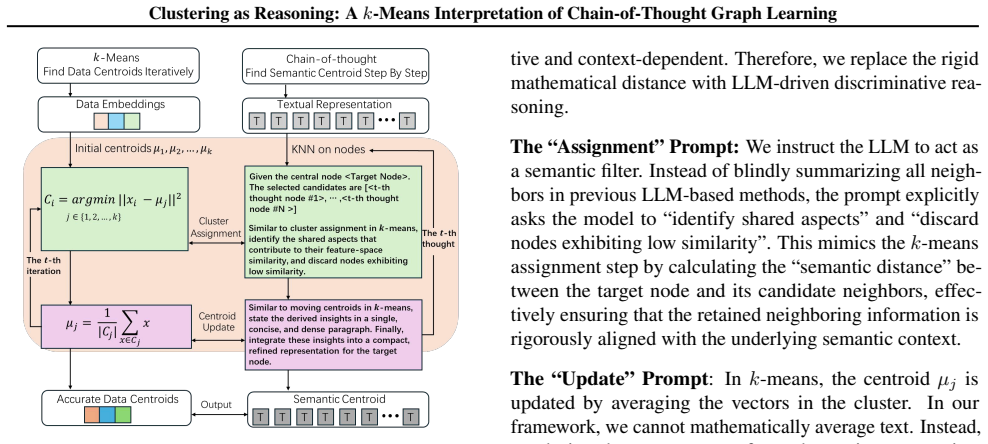
Our key theoretical result reveals a formal mathematical correspondence between a Transformer block and the k-means algorithm, allowing reasoning to be interpreted as iterative assignment and update steps. Based on this insight, we introduce a Semantic Discriminating Prompt that explicitly formulates these steps as structured CoT reasoning, together with a structure-grounded alignment strategy to fuse topological priors with evolving thought-conditioned representations.
What carries the argument
the formal mathematical correspondence between a Transformer block and the k-means algorithm, which recasts each reasoning step as a cluster assignment followed by a centroid update
If this is right
- Reasoning becomes an explicit sequence of assignment and update operations that can be inspected at each step.
- Semantic and topological information interact continuously inside one model instead of through separate modules.
- The same clustering view supplies a concrete prompt template and an alignment loss that together improve accuracy on graph reasoning benchmarks.
Where Pith is reading between the lines
- The same block-to-algorithm mapping could be checked in Transformers used for non-graph sequential reasoning tasks.
- If the equivalence is tight, replacing k-means with other iterative partitioning methods inside the same framework would be a direct next test.
Load-bearing premise
Existing graph CoT methods are limited by disjoint architectures and fixed representations, and the Transformer-k-means correspondence directly supplies a unified framework with explicit semantic-topological interaction.
What would settle it
Run the proposed KCoT model on a small labeled graph while recording the exact cluster assignments and centroid shifts at each Transformer layer; if these do not match the standard k-means iterations on the same node features and adjacency, the claimed correspondence does not hold.
Figures




read the original abstract
Chain-of-Thought (CoT) prompting has shown promise in enhancing the reasoning capabilities of large language models (LLMs) on text-attributed graphs (TAGs). This work reframes CoT-based graph learning through the principle of clustering as reasoning, offering a $k$-means interpretation of how iterative reasoning operates over graph-structured data. We observe that existing graph CoT methods rely on disjoint architectures and fixed graph representations, limiting step-by-step semantic-topological interaction and interpretability. To overcome this limitation, we propose a unified framework named KCoT that integrates CoT reasoning with graph representation learning. Our key theoretical result reveals a formal mathematical correspondence between a Transformer block and the $k$-means algorithm, allowing reasoning to be interpreted as iterative assignment and update steps. Based on this insight, we introduce a Semantic Discriminating Prompt that explicitly formulates these steps as structured CoT reasoning, together with a structure-grounded alignment strategy to fuse topological priors with evolving thought-conditioned representations. Experiments on standard benchmarks demonstrate consistent improvements over state-of-the-art methods, validating clustering as a principled mechanism for CoT-based graph learning.
Editorial analysis
A structured set of objections, weighed in public.
Referee Report
Summary. The paper reframes Chain-of-Thought (CoT) prompting on text-attributed graphs as a clustering process, asserting a formal mathematical correspondence between a Transformer block and the k-means algorithm that interprets iterative reasoning as assignment and centroid-update steps. It proposes the KCoT unified framework incorporating a Semantic Discriminating Prompt to formulate these steps explicitly and a structure-grounded alignment strategy to fuse topological priors with evolving representations, reporting consistent benchmark gains over prior graph CoT methods.
Significance. If the claimed correspondence is rigorously derived, the work supplies a principled theoretical basis for viewing CoT as clustering, which could unify graph representation learning with step-by-step reasoning and improve both interpretability and semantic-topological interaction. The reported empirical improvements would then constitute supporting evidence for the framework's practical value.
major comments (1)
- [Abstract (key theoretical result)] Abstract (key theoretical result): The manuscript states a 'formal mathematical correspondence between a Transformer block and the k-means algorithm' but supplies no equations, derivation, or explicit mapping (e.g., equating attention to hard nearest-centroid assignment or FFN layers to mean updates). Without this, the equivalence remains interpretive rather than formal, which is load-bearing for the interpretation of CoT steps as clustering iterations and for the construction of the Semantic Discriminating Prompt.
Simulated Author's Rebuttal
We thank the referee for the constructive feedback on the theoretical foundation of our work. We address the major comment point by point below and will revise the manuscript accordingly.
read point-by-point responses
-
Referee: Abstract (key theoretical result): The manuscript states a 'formal mathematical correspondence between a Transformer block and the k-means algorithm' but supplies no equations, derivation, or explicit mapping (e.g., equating attention to hard nearest-centroid assignment or FFN layers to mean updates). Without this, the equivalence remains interpretive rather than formal, which is load-bearing for the interpretation of CoT steps as clustering iterations and for the construction of the Semantic Discriminating Prompt.
Authors: We agree that the abstract and main text would benefit from an explicit derivation to substantiate the claimed formal correspondence. In the revised manuscript we will add a new subsection (Section 3.2) that derives the mapping: self-attention as hard nearest-centroid assignment via the argmax operation on similarity scores, and the FFN as the mean-update step for centroid recomputation. We will also include the full set of equations linking one Transformer block iteration to one k-means iteration, making the equivalence rigorous rather than interpretive. This addition will directly support the Semantic Discriminating Prompt construction. revision: yes
Circularity Check
No significant circularity; theoretical correspondence presented as independent derivation
full rationale
The abstract and available text present the core result as a 'formal mathematical correspondence between a Transformer block and the k-means algorithm' derived to interpret reasoning steps, with no shown equations, self-citations, or fitted parameters that reduce the claim to its own inputs by construction. No load-bearing steps match the enumerated circularity patterns; the framework builds on the claimed insight without tautological redefinition or renaming of known results. This is the expected non-finding for a paper whose central claim is offered as a derived theoretical mapping rather than a statistical fit or self-referential premise.
Axiom & Free-Parameter Ledger
axioms (1)
- domain assumption Formal mathematical correspondence exists between a Transformer block and the k-means algorithm
Reference graph
Works this paper leans on
-
[1]
arXiv preprint arXiv:2309.15402 , year=
Chen, R., Zhao, T., Jaiswal, A. K., Shah, N., and Wang, Z. LLaGA: Large language and graph assistant. InProceed- ings of the 41st International Conference on Machine Learning, volume 235 ofProceedings of Machine Learn- ing Research, pp. 7809–7823. PMLR, 21–27 Jul 2024a. Chen, Z., Mao, H., Li, H., Jin, W., Wen, H., Wei, X., Wang, S., Yin, D., Fan, W., Liu,...
-
[2]
Diaz-Rodriguez, J. Summaries as centroids for inter- pretable and scalable text clustering.arXiv preprint arXiv:2502.09667,
-
[3]
Guo, J., Du, L., Liu, H., Zhou, M., He, X., and Han, S. Gpt4graph: Can large language models understand graph structured data? an empirical evaluation and benchmark- ing.arXiv preprint arXiv:2305.15066,
-
[4]
Disen- tangling homophily and heterophily in multimodal graph clustering
Guo, Z., Shen, Z., Xie, X., Wen, L., and Kang, Z. Disen- tangling homophily and heterophily in multimodal graph clustering. InProceedings of the 33rd ACM International Conference on Multimedia, pp. 2044–2053,
2044
-
[5]
Huang, J., Zhang, X., Mei, Q., and Ma, J. Can llms ef- fectively leverage graph structural information through prompts, and why?arXiv preprint arXiv:2309.16595,
-
[6]
Hetgcot: Heterogeneous graph-enhanced chain-of-thought llm rea- soning for academic question answering
Jia, R., Wu, M., Ding, Y ., Lu, J., and Zhang, Y . Hetgcot: Heterogeneous graph-enhanced chain-of-thought llm rea- soning for academic question answering. InFindings of the Association for Computational Linguistics: EMNLP 2025, pp. 15950–15963,
2025
-
[7]
arXiv preprint arXiv:2404.07103 (2024)
Jin, B., Xie, C., Zhang, J., Roy, K. K., Zhang, Y ., Li, Z., Li, R., Tang, X., Wang, S., Meng, Y ., et al. Graph chain-of- thought: Augmenting large language models by reason- ing on graphs.arXiv preprint arXiv:2404.07103,
-
[8]
Evaluating large language models on graphs: Perfor- mance insights and comparative analysis,
Liu, C. and Wu, B. Evaluating large language models on graphs: Performance insights and comparative analysis. arXiv preprint arXiv:2308.11224,
-
[9]
Luo, Z., Song, X., Huang, H., Lian, J., Zhang, C., Jiang, J., Xie, X., and Jin, H. Graphinstruct: Empowering large language models with graph understanding and reasoning capability.arXiv preprint arXiv:2403.04483,
-
[10]
Wang, H., Feng, S., He, T., Tan, Z., Han, X., and Tsvetkov, Y . Can language models solve graph problems in natural language?Advances in Neural Information Processing Systems, 36:30840–30861, 2023a. Wang, X., Wei, J., Schuurmans, D., Le, Q., Chi, E., Narang, S., Chowdhery, A., and Zhou, D. Self-consistency im- proves chain of thought reasoning in language...
-
[11]
Lan- guage is all a graph needs
Ye, R., Zhang, C., Wang, R., Xu, S., and Zhang, Y . Lan- guage is all a graph needs. InFindings of the association for computational linguistics: EACL 2024, pp. 1955– 1973,
2024
discussion (0)
Sign in with ORCID, Apple, or X to comment. Anyone can read and Pith papers without signing in.