Thermal Spin Polarization Driven by Nuclear Spin-Orbit Coupling in Neutron Star Pasta
Pith reviewed 2026-06-29 23:41 UTC · model grok-4.3
The pith
Nuclear pasta surfaces develop spin polarization from thermal inhomogeneity via nuclear spin-orbit coupling even without a magnetic field.
A machine-rendered reading of the paper's core claim, the machinery that carries it, and where it could break.
Core claim
Starting from a single-particle Hamiltonian with a central potential and a standard nuclear spin-orbit interaction, the surface spin polarization occurs due to the thermal inhomogeneity even in the absence of a magnetic field, because the density gradient normal to the pasta surface generates a Rashba-type spin-orbit hybridization.
What carries the argument
Effective two-band model of surface-localized neutrons, in which the neutron-nucleus spin-orbit force plus the density gradient produces Rashba-type spin-orbit hybridization.
If this is right
- Surface spin polarization appears on nuclear pasta without any applied magnetic field.
- The polarization is produced by thermal inhomogeneity across the pasta surface.
- The mechanism supplies a spintronics-style effect inside neutron-star matter.
- Spin dynamics in the pasta phase can be influenced by temperature gradients alone.
Where Pith is reading between the lines
- The polarization may alter how the pasta phase couples to the overall magnetic field structure of the star.
- Analogous thermal-gradient-driven polarization could be searched for in laboratory systems that mimic strong density gradients.
- The effect suggests temperature-dependent contributions to transport or magnetic response in the inner crust.
Load-bearing premise
The strong density gradient normal to the pasta surface generates a significant Rashba-type spin-orbit hybridization from the neutron-nucleus spin-orbit force.
What would settle it
Compute the local spin density for neutrons in an explicit pasta slab geometry that includes a realistic temperature gradient but zero external magnetic field; net surface polarization should appear if the claim holds.
Figures

read the original abstract
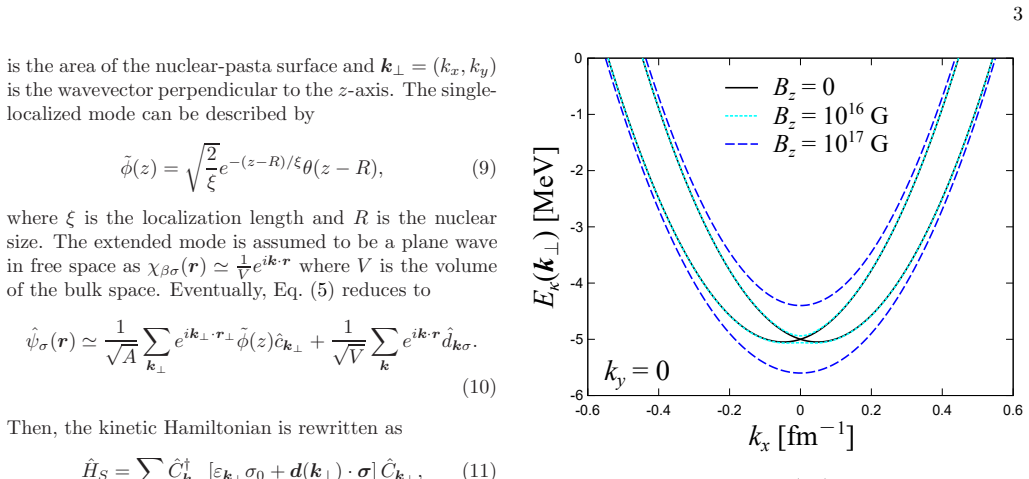
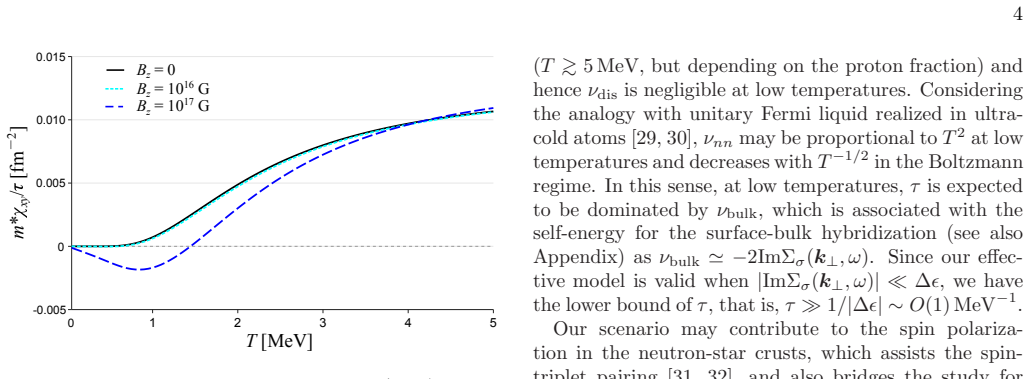
We discuss anomalous spin polarization on the surface of nuclear pasta in a neutron star, driven by a nuclear spin-orbit interaction. We present an effective two-band model of surface-localized neutrons near the nuclear pasta. The central point is the emergence of a Rashba-type spin-orbit hybridization generated by the neutron--nucleus spin-orbit force in the presence of the strong density gradient normal to the pasta surface. Starting from a single-particle Hamiltonian with a central potential and a standard nuclear spin-orbit interaction, we show that the surface spin polarization occurs due to the thermal inhomogeneity even in the absence of a magnetic field. Our study links neutron-star physics and solid-state spintronics and would contribute to understanding the interplay between spin dynamics and strong magnetic fields.
Editorial analysis
A structured set of objections, weighed in public.
Referee Report
Summary. The manuscript claims that nuclear pasta surfaces in neutron stars exhibit anomalous spin polarization driven by the nuclear spin-orbit interaction. An effective two-band model is constructed for surface-localized neutrons in which the standard nuclear spin-orbit term, combined with the sharp density gradient normal to the pasta surface, generates a Rashba-type spin-orbit hybridization. Starting from a single-particle Hamiltonian containing a central potential plus the conventional nuclear SO interaction, the authors conclude that thermal inhomogeneity produces net surface spin polarization even in the absence of an external magnetic field, thereby connecting neutron-star physics to solid-state spintronics.
Significance. If the central reduction to a usable Rashba term is valid and the induced splitting is appreciable relative to the thermal scale, the result would constitute a novel, parameter-free mechanism for spin polarization in neutron-star matter. It would strengthen the analogy between nuclear pasta and spintronic systems and could influence models of neutron-star magnetic-field evolution. The paper's strength lies in its direct use of the established nuclear SO operator without additional ad-hoc terms.
major comments (2)
- [effective two-band model] The reduction from the single-particle Hamiltonian (central potential plus standard nuclear SO term ∼(1/r)dV/dr L·S) to the effective Rashba operator α(p×n)·σ is load-bearing for the entire polarization claim. The manuscript must supply the explicit operator projection or perturbative derivation together with the regime of validity for the momentum and gradient scales characteristic of neutron-star pasta; without this, it remains unclear whether the resulting splitting exceeds the thermal energy set by the inhomogeneous Fermi distribution.
- [thermal polarization calculation] The abstract asserts that surface spin polarization arises from thermal inhomogeneity alone. The quantitative demonstration that the thermal distribution over the Rashba-split bands yields a net polarization (rather than canceling) must be shown explicitly, including the dependence on temperature and density contrast across the pasta surface.
minor comments (1)
- Notation for the unit normal n and the Rashba coefficient α should be introduced with a clear definition when the effective Hamiltonian is first written.
Simulated Author's Rebuttal
We thank the referee for their thorough review and valuable suggestions, which will help clarify key aspects of our work. We address each major comment below and will revise the manuscript to incorporate the requested details.
read point-by-point responses
-
Referee: [effective two-band model] The reduction from the single-particle Hamiltonian (central potential plus standard nuclear SO term ∼(1/r)dV/dr L·S) to the effective Rashba operator α(p×n)·σ is load-bearing for the entire polarization claim. The manuscript must supply the explicit operator projection or perturbative derivation together with the regime of validity for the momentum and gradient scales characteristic of neutron-star pasta; without this, it remains unclear whether the resulting splitting exceeds the thermal energy set by the inhomogeneous Fermi distribution.
Authors: We agree that an explicit derivation is essential for rigor. In the revised manuscript we will add a dedicated subsection deriving the effective Rashba term via perturbative projection of the nuclear spin-orbit operator onto surface-localized neutron states. The derivation starts from the standard (1/r) dV/dr L·S term, incorporates the sharp density gradient normal to the pasta surface, and yields the α(p × n)·σ form under the two-band approximation. We will also specify the validity regime: surface gradients ~1 fm^{-1}, neutron momenta near the local Fermi momentum (200–400 MeV/c), and show that the resulting spin splitting reaches several MeV, which exceeds typical thermal energies (0.1–1 MeV) in the pasta layer. This confirms the effect is physically relevant. revision: yes
-
Referee: [thermal polarization calculation] The abstract asserts that surface spin polarization arises from thermal inhomogeneity alone. The quantitative demonstration that the thermal distribution over the Rashba-split bands yields a net polarization (rather than canceling) must be shown explicitly, including the dependence on temperature and density contrast across the pasta surface.
Authors: We will expand the manuscript with an explicit calculation of the net thermal spin polarization. This will involve computing the difference in Fermi-Dirac occupations between the Rashba-split bands, integrated over the inhomogeneous density profile at the pasta surface. The revised text will present analytic expressions and numerical results showing the temperature and density-contrast dependence, demonstrating that the gradient-induced band asymmetry produces a nonzero net polarization that does not cancel. These results will be added as a new figure and accompanying discussion. revision: yes
Circularity Check
No significant circularity; derivation presented as independent from standard inputs
full rationale
The paper states it begins from a single-particle Hamiltonian containing a central potential plus the conventional nuclear spin-orbit term and derives the Rashba-type hybridization from the density gradient normal to the pasta surface, after which thermal inhomogeneity produces surface spin polarization. No load-bearing self-citation, fitted parameter renamed as prediction, or self-definitional step is indicated in the abstract or description. The central claim is framed as a consequence of the starting Hamiltonian rather than an input or tautology, satisfying the criteria for a self-contained derivation against external benchmarks.
Axiom & Free-Parameter Ledger
axioms (1)
- domain assumption A standard nuclear spin-orbit interaction is included in the single-particle Hamiltonian for neutrons.
Reference graph
Works this paper leans on
-
[1]
Enoto, S
T. Enoto, S. Kisaka, and S. Shibata, Rep. Prog. Phys. 82, 106901 (2019)
2019
-
[2]
D. G. Ravenhall, C. J. Pethick, and J. R. Wilson, Phys. Rev. Lett. 50, 2066 (1983)
2066
-
[3]
Hashimoto, H
M.-a. Hashimoto, H. Seki, and M. Yamada, Prog. Theor. Phys. 71, 320 (1984)
1984
-
[4]
R. C. Duncan and C. Thompson, Astrophys. J. Lett. 392, L9 (1992)
1992
-
[5]
V. M. Kaspi and A. M. Beloborodov, Annu. Rev. Astron. Astrophys. 55, 261 (2017)
2017
-
[6]
M. G. Mayer, Phys. Rev. 75, 1969 (1949)
1969
-
[7]
Haxel, J
O. Haxel, J. H. D. Jensen, and H. E. Suess, Phys. Rev. 75, 1766 (1949)
1949
-
[8]
Mondal, X
C. Mondal, X. Vi˜ nas, M. Centelles, and J. N. De, Phys. Rev. C 102, 015802 (2020)
2020
-
[9]
Y. A. Bychkov and E. I. Rashba, J. Phys. C: Solid State Phys. 17, 6039 (1984)
1984
-
[10]
Manchon, H
A. Manchon, H. C. Koo, J. Nitta, S. M. Frolov, and R. A. Duine, Nat. Mater. 14, 871 (2015)
2015
-
[11]
V. M. Edelstein, Solid State Commun. 73, 233 (1990)
1990
-
[12]
Johansson, J
A. Johansson, J. Henk, and I. Mertig, Phys. Rev. B 93, 195440 (2016)
2016
-
[13]
C. L. Yang, H. T. He, L. Ding, L. J. Cui, Y. P. Zeng, J. N. Wang, and W. K. Ge, Phys. Rev. Lett. 96, 186605 (2006)
2006
-
[14]
J. C. Rojas Sanchez, L. Vila, G. Desfonds, S. Gambarelli, J. P. Attane, J. M. De Teresa, C. Magen, and A. Fert, Nat. Commun. 4, 2944 (2013)
2013
-
[15]
Lesne, Y
E. Lesne, Y. Fu, S. Oyarzun, J. C. Rojas-Sanchez, D. C. Vaz, H. Naganuma, G. Sicoli, J.-P. Attane, M. Jamet, E. Jacquet, J.-M. George, A. Barthelemy, H. Jaffres, A. Fert, M. Bibes, and L. Vila, Nat. Mater. 15, 1261 (2016)
2016
- [16]
-
[17]
Spin effects in superfluidity, neutron matter and neutron stars
A. Sedrakian and P. B. Rau, arXiv preprint arXiv:2604.02782 (2026)
work page internal anchor Pith review Pith/arXiv arXiv 2026
-
[18]
Smidman, M
M. Smidman, M. Salamon, H. Yuan, and D. Agterberg, Rep. Prog. Phys. 80, 036501 (2017)
2017
-
[19]
V. M. Edelstein, Phys. Rev. Lett. 75, 2004 (1995)
2004
-
[20]
Vautherin and D
D. Vautherin and D. M. Brink, Phys. Rev. C 5, 626 (1972)
1972
-
[21]
Ring and P
P. Ring and P. Schuck, The Nuclear Many-Body Problem (Springer, 1983)
1983
-
[22]
Bender, P.-H
M. Bender, P.-H. Heenen, and P.-G. Reinhard, Rev. Mod. Phys. 75, 121 (2003)
2003
-
[23]
Rashba, Sov
E. Rashba, Sov. Phys.-Solid State 2, 1109 (1960)
1960
- [24]
-
[25]
Sedrakian and J
A. Sedrakian and J. W. Clark, Eur. Phys. J. A 55, 167 (2019)
2019
-
[26]
Sonoda, G
H. Sonoda, G. Watanabe, K. Sato, K. Yasuoka, and T. Ebisuzaki, Phys. Rev. C 77, 035806 (2008)
2008
-
[27]
Schuetrumpf, M
B. Schuetrumpf, M. A. Klatt, K. Iida, J. A. Maruhn, K. Mecke, and P.-G. Reinhard, Phys. Rev. C 87, 055805 (2013)
2013
-
[28]
C.-J. Xia, T. Maruyama, N. Yasutake, and T. Tatsumi, Phys. Rev. D 106, 063020 (2022)
2022
-
[29]
Z. Yan, P. B. Patel, B. Mukherjee, R. J. Fletcher, J. Struck, and M. W. Zwierlein, Phys. Rev. Lett. 122, 093401 (2019)
2019
-
[30]
Tajima and S
H. Tajima and S. Uchino, Phys. Rev. A 99, 063606 (2019)
2019
-
[31]
Tajima, H
H. Tajima, H. Funaki, Y. Sekino, N. Yasutake, and M. Matsuo, Phys. Rev. C 108, L052802 (2023)
2023
-
[32]
K. Yoshimura and K. Sekizawa, arXiv preprint arXiv:2601.13636 (2026)
-
[33]
Hinohara, T
N. Hinohara, T. Oishi, and K. Yoshida, Phys. Rev. C 109, 034302 (2024)
2024
-
[34]
B. Ko, J. W. Park, and Y.-i. Shin, Nat. Phys. 15, 1227 (2019)
2019
-
[35]
Bagchi, B
P. Bagchi, B. Layek, D. Saini, A. Sarkar, A. M. Srivastava, and D. G. Venkata, Mon. Not. R. Astron. Soc. 532, 2934 (2024) , https://academic.oup.com/mnras/article-pdf/532/3/2934/58597192/s
2024
-
[36]
Sekizawa, S
K. Sekizawa, S. Kobayashi, and M. Matsuo, Phys. Rev. C 105, 045807 (2022)
2022
-
[37]
Zhai, Phys
X. Zhai, Phys. Rev. B 105, 205429 (2022) . Hybridization term The hybridization term between surface-localized and extended-bulk modes is taken to be spin independent and 6 expressed as HSB = ∑ k⊥ ,k z [ C† k⊥ Λ kσ0Dk +D† kΛ ∗ kσ0Ck⊥ ] , (23) where Λ k = ⟨φ k⊥ σ |ˆh|χ kσ ⟩ is the transition matrix ele- ment. Within the second-order perturbation, we obtain...
2022
discussion (0)
Sign in with ORCID, Apple, or X to comment. Anyone can read and Pith papers without signing in.