Grey-Body Factors and Thermodynamics of Asymptotically de Sitter Black Holes in Generalized Proca Theory
Pith reviewed 2026-06-29 23:56 UTC · model grok-4.3
The pith
Couplings in generalized Proca theory considerably affect the grey-body factors and thermodynamics of asymptotically de Sitter black holes carrying primary vector hair.
A machine-rendered reading of the paper's core claim, the machinery that carries it, and where it could break.
Core claim
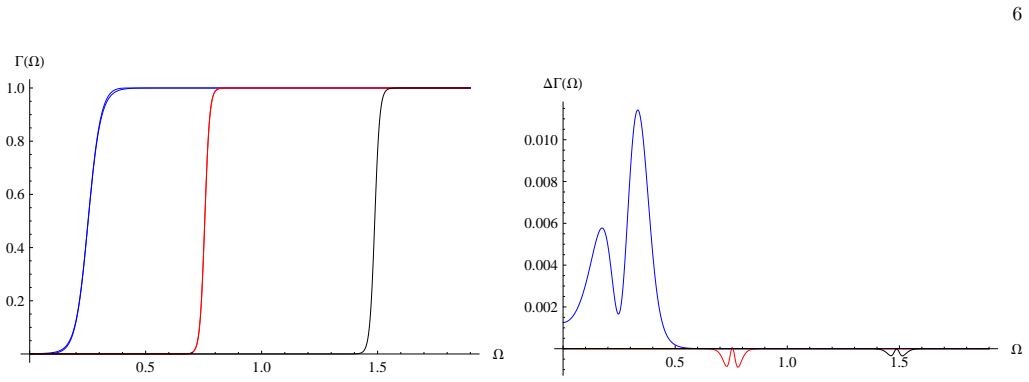
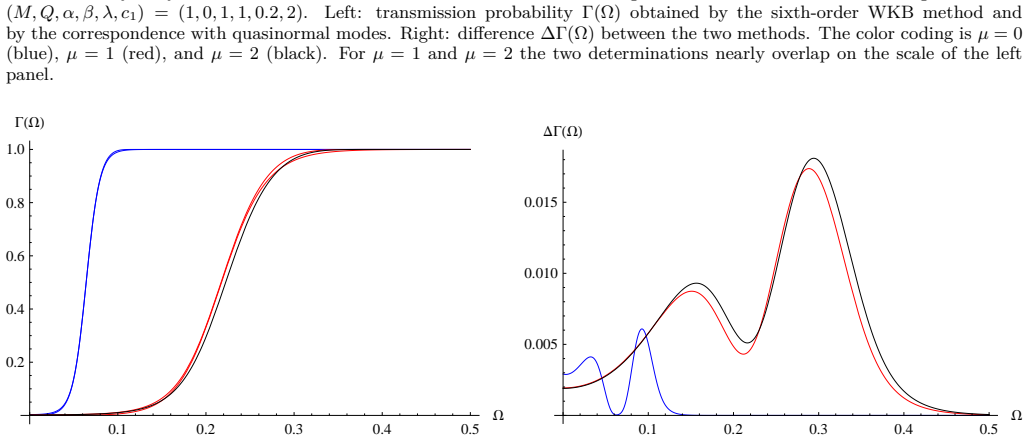
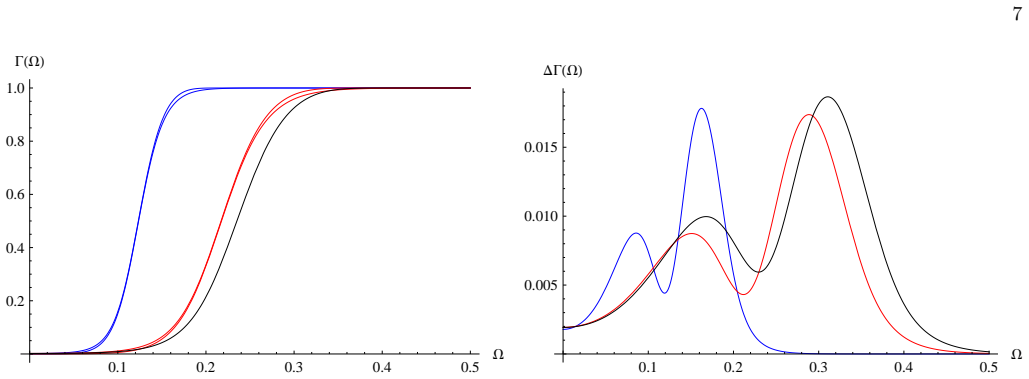
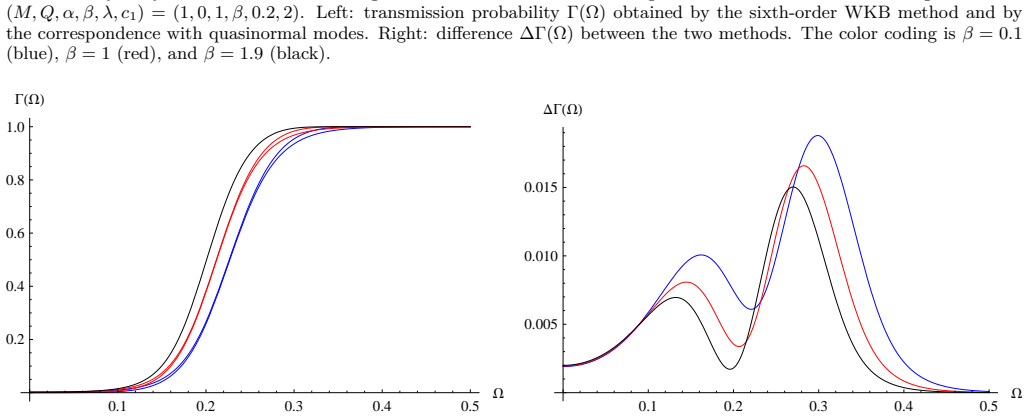
In the asymptotically de Sitter solutions of generalized Proca theory, where the de Sitter scale is generated by the vector sector, the grey-body factors for test fields are obtained from sixth-order WKB barrier calculations. These factors and the associated absorption cross-sections depend on the theory's couplings, which also affect the black hole thermodynamics. The transmission curves mostly agree with quasinormal-mode reconstruction except at lower multipoles.
What carries the argument
Sixth-order WKB approximation applied to the effective potentials for test fields propagating on the vector-hairy de Sitter black hole spacetime.
If this is right
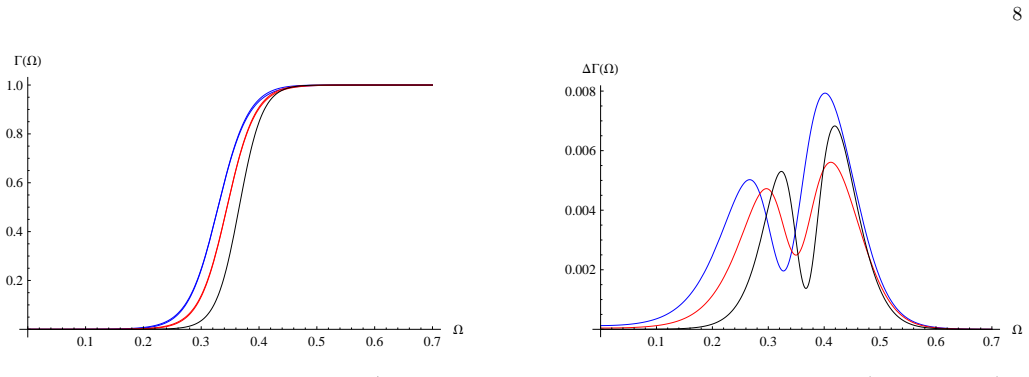
- Increasing the scalar mass raises and broadens the barrier, suppressing transmission at fixed frequency and shifting efficient transmission to higher frequencies.
- The couplings in the theory considerably affect the grey-body factors.
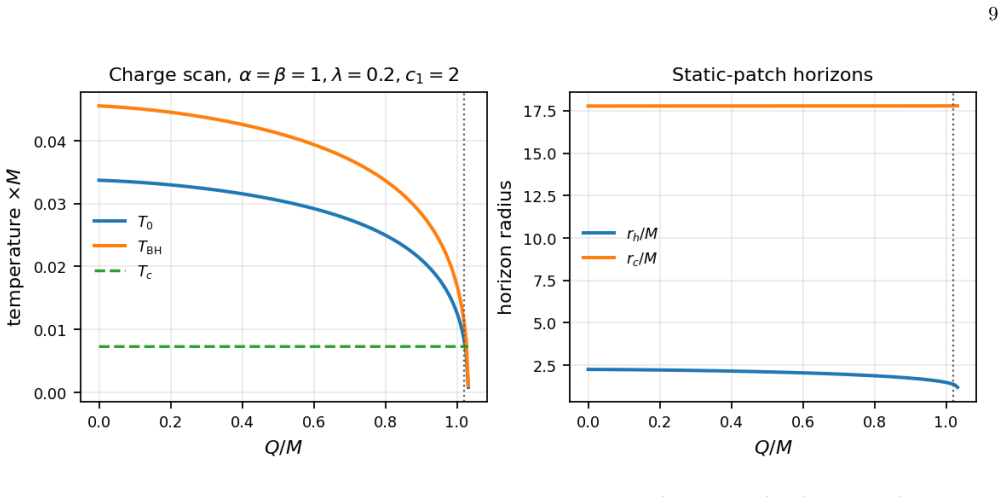
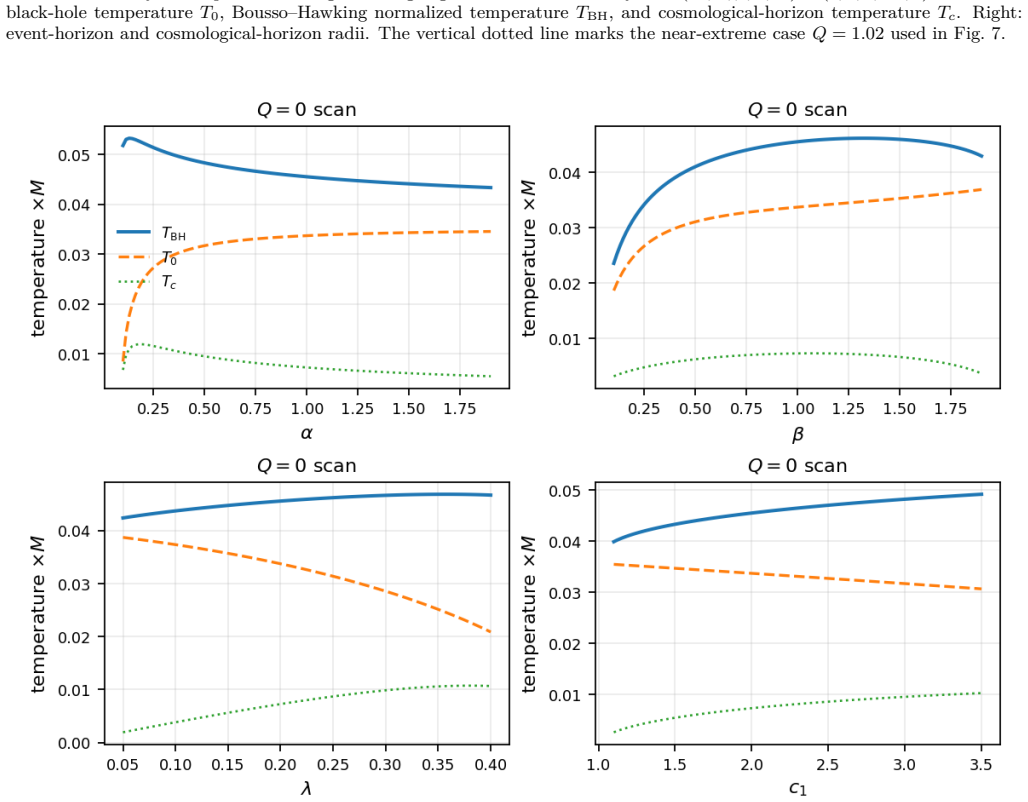
- The black hole thermodynamics is impacted by these couplings.
- The WKB results agree with quasinormal-mode reconstruction with small differences at lower multipoles.
Where Pith is reading between the lines
- If the couplings affect grey-body factors as described, this could lead to observable differences in the Hawking radiation spectra from such black holes compared to standard general relativity solutions.
- Similar computations could be performed for other test fields or in different branches of the theory to test the generality of the effect.
- The agreement between WKB and quasinormal modes suggests that these methods can be reliably used for more complex backgrounds in modified gravity.
Load-bearing premise
The asymptotically de Sitter black-hole solutions with primary vector hair exist and remain stable when the de Sitter scale is generated by the vector sector.
What would settle it
A calculation or observation showing that varying the Proca couplings leaves the grey-body factors and thermodynamic quantities unchanged would falsify the claim.
Figures

read the original abstract
Generalized Proca theory supplements gravity with a massive vector field whose derivative self-interactions can support black holes carrying primary vector hair. In the asymptotically de Sitter branch considered here, the de Sitter scale is effective: it is generated by the vector sector rather than imposed through a bare cosmological-constant term. We compute grey-body factors and effective absorption cross-sections for massive scalar, electromagnetic, and massless Dirac test fields on this background. The transmission curves are obtained from a sixth-order WKB barrier calculation and are compared with the quasinormal-mode reconstruction; the two descriptions mostly agree, with small visible differences at lower mutlipoles. Increasing the scalar mass raises and broadens the scalar barrier, suppresses transmission at fixed frequency, and shifts efficient transmission to higher frequencies. The couplings considerably affect the grey-body factors and black hole thermodynamics.
Editorial analysis
A structured set of objections, weighed in public.
Referee Report
Summary. The paper computes grey-body factors and effective absorption cross-sections for massive scalar, electromagnetic, and massless Dirac test fields on asymptotically de Sitter black-hole backgrounds in generalized Proca theory, where the de Sitter scale arises from vector self-interactions rather than a bare cosmological constant. Transmission probabilities are obtained via sixth-order WKB approximation and cross-checked against quasinormal-mode reconstruction; the couplings are reported to affect both the grey-body factors and the black-hole thermodynamics.
Significance. If the claimed backgrounds exist and are stable, the work would illustrate how primary vector hair and the theory's couplings modify transmission probabilities and thermodynamic relations relative to standard de Sitter solutions, adding to the literature on grey-body factors in modified gravity. The WKB-QNM comparison is a standard and useful cross-check.
major comments (2)
- [Abstract] Abstract: the central claim presupposes the existence of asymptotically de Sitter black-hole solutions carrying primary vector hair with the effective cosmological horizon generated entirely by the vector sector and no bare cosmological-constant term. No metric functions, vector profiles, or explicit verification that the field equations are satisfied in this branch are supplied, rendering all subsequent WKB and thermodynamic calculations unsupported.
- [Abstract] Abstract: the sixth-order WKB barrier calculation and its comparison to quasinormal-mode reconstruction are presented without explicit effective potentials for the test fields, error estimates, convergence data, or tabulated transmission coefficients. This absence prevents independent assessment of the accuracy of the reported curves and the statement that the two methods 'mostly agree'.
Simulated Author's Rebuttal
We thank the referee for the thorough review and valuable feedback on our manuscript concerning grey-body factors for test fields on generalized Proca black holes. We address each major comment below and will incorporate the necessary clarifications and additions in a revised version to strengthen the presentation and support for our results.
read point-by-point responses
-
Referee: [Abstract] Abstract: the central claim presupposes the existence of asymptotically de Sitter black-hole solutions carrying primary vector hair with the effective cosmological horizon generated entirely by the vector sector and no bare cosmological-constant term. No metric functions, vector profiles, or explicit verification that the field equations are satisfied in this branch are supplied, rendering all subsequent WKB and thermodynamic calculations unsupported.
Authors: The asymptotically de Sitter backgrounds with primary vector hair in generalized Proca theory are obtained by solving the field equations with the vector self-interactions generating an effective cosmological scale, as established in prior works on this model. To ensure the manuscript is fully self-contained, we will add the explicit metric ansatz, the vector field profile functions, and a direct substitution check confirming they satisfy the equations of motion in the revised version. This will explicitly ground the subsequent grey-body and thermodynamic computations. revision: yes
-
Referee: [Abstract] Abstract: the sixth-order WKB barrier calculation and its comparison to quasinormal-mode reconstruction are presented without explicit effective potentials for the test fields, error estimates, convergence data, or tabulated transmission coefficients. This absence prevents independent assessment of the accuracy of the reported curves and the statement that the two methods 'mostly agree'.
Authors: We agree that the effective potentials, WKB error estimates, convergence checks, and sample tabulated transmission probabilities were omitted from the original submission. In the revision we will include the explicit effective potentials for the massive scalar, electromagnetic, and massless Dirac perturbations, report the WKB error estimates and convergence behavior with respect to the order, and provide tables of transmission coefficients at representative frequencies. These additions will allow direct verification of the reported curves and the level of agreement with the quasinormal-mode reconstruction. revision: yes
Circularity Check
No significant circularity; grey-body and thermodynamic calculations are independent
full rationale
The paper computes grey-body factors for test fields via sixth-order WKB on an asserted asymptotically de Sitter background in generalized Proca theory, compares transmission curves to quasinormal-mode reconstruction, and reports thermodynamic quantities. No quoted equation or procedure shows a reported transmission coefficient, absorption cross-section, or thermodynamic quantity being defined in terms of a fitted parameter taken from the same data, nor does any step reduce by construction to its own inputs. The existence of the background solutions is presupposed rather than re-derived here, but this does not create self-definitional or fitted-input circularity in the reported results. A score of 2 accounts for possible routine self-citation of prior background solutions without that citation being load-bearing for the grey-body or thermodynamic claims.
Axiom & Free-Parameter Ledger
axioms (1)
- domain assumption Asymptotically de Sitter black-hole solutions with primary vector hair exist in generalized Proca theory and generate an effective de Sitter scale from the vector sector.
Forward citations
Cited by 3 Pith papers
-
Hawking Emission from Black Holes Evaporating toward Wormholes and the Accuracy of the WKB Approximation
Numerical greybody factors for photons and massless Dirac fields in Simpson-Visser and Casadio-Fabbri-Mazzacurati geometries reveal that WKB overestimates luminosities by orders of magnitude near wormhole endpoints, i...
-
Hawking Radiation from the Dymnikova Regular Black Hole
Numerical greybody factors for the Dymnikova black hole show temperature-driven luminosity suppression near the extremal remnant, with increasing fermion dominance in the residual massless flux.
-
Scattering and Hawking Radiation from Einstein--Euler--Heisenberg--de Sitter Black Holes
Numerical scattering calculations for neutral scalar and Dirac fields on Einstein-Euler-Heisenberg-de Sitter black holes show that Euler-Heisenberg coupling raises barriers and shifts transmission frequencies upward w...
Reference graph
Works this paper leans on
-
[1]
D. N. Page, Phys. Rev. D 13, 198 (1976)
1976
-
[2]
D. N. Page, Phys. Rev. D 14, 3260 (1976)
1976
-
[3]
Black Holes in Theories with Large Extra Dimensions: a Review
P. Kanti, Int. J. Mod. Phys. A 19, 4899 (2004), arXiv:hep-ph/0402168
work page internal anchor Pith review Pith/arXiv arXiv 2004
-
[4]
S. W. Hawking, Commun. Math. Phys. 43, 199 (1975)
1975
- [5]
-
[6]
M. Skvortsova, Fortsch. Phys. 72, 2400036 (2024), arXiv:2311.11650 [gr-qc]
-
[7]
R. A. Konoplya and A. Zhidenko, JCAP 05, 050 (2017), arXiv:1705.01656 [hep-th]
work page internal anchor Pith review Pith/arXiv arXiv 2017
-
[8]
Y. Mo, Y. Tian, B. Wang, H. Zhang, and Z. Zhong, Phys. Rev. D 98, 124025 (2018), arXiv:1808.03635 [gr- qc]
work page internal anchor Pith review Pith/arXiv arXiv 2018
-
[9]
M. Skvortsova, Grav. Cosmol. 30, 68 (2024), arXiv:2311.02729 [gr-qc]
-
[10]
R. A. Konoplya and A. Zhidenko, JHEP 06, 037 (2004), arXiv:hep-th/0402080
work page internal anchor Pith review Pith/arXiv arXiv 2004
-
[11]
Quasi-normal modes and exponential energy decay for the Kerr-de Sitter black hole
S. Dyatlov, Commun. Math. Phys. 306, 119 (2011), arXiv:1003.6128 [math.AP]
work page internal anchor Pith review Pith/arXiv arXiv 2011
-
[12]
A. Jansen, Eur. Phys. J. Plus 132, 546 (2017), arXiv:1709.09178 [gr-qc]
work page internal anchor Pith review Pith/arXiv arXiv 2017
-
[13]
R. A. Konoplya and A. Zhidenko, Phys. Rev. D 90, 064048 (2014), arXiv:1406.0019 [hep-th]
work page internal anchor Pith review Pith/arXiv arXiv 2014
-
[14]
R. A. Konoplya and A. Zhidenko, Nucl. Phys. B 777, 182 (2007), arXiv:hep-th/0703231. 11
work page internal anchor Pith review Pith/arXiv arXiv 2007
- [15]
-
[16]
A. Zhidenko, Class. Quant. Grav. 21, 273 (2004), arXiv:gr-qc/0307012
- [17]
-
[18]
R. A. Konoplya and A. Zhidenko, Phys. Rev. D 76, 084018 (2007), [Erratum: Phys.Rev.D 90, 029901 (2014)], arXiv:0707.1890 [hep-th]
work page internal anchor Pith review Pith/arXiv arXiv 2007
- [19]
-
[20]
Quasi-Normal Modes of Brane-Localised Standard Model Fields
P. Kanti and R. A. Konoplya, Phys. Rev. D 73, 044002 (2006), arXiv:hep-th/0512257
work page internal anchor Pith review Pith/arXiv arXiv 2006
-
[21]
R. A. Konoplya and A. Zhidenko, Phys. Rev. D 95, 104005 (2017), arXiv:1701.01652 [hep-th]
work page internal anchor Pith review Pith/arXiv arXiv 2017
-
[22]
R. A. Konoplya and A. Zhidenko, Phys. Rev. D 89, 024011 (2014), arXiv:1309.7667 [hep-th]
work page internal anchor Pith review Pith/arXiv arXiv 2014
- [23]
-
[24]
Heisenberg, JCAP 05, 015 (2014), arXiv:1402.7026 [hep-th]
L. Heisenberg, JCAP 05, 015 (2014), arXiv:1402.7026 [hep-th]
-
[25]
C. Charmousis, P. G. S. Fernandes, and M. Has- saine, arXiv e-prints (2025), arXiv:2504.13084 [gr-qc], arXiv:2504.13084 [gr-qc]
-
[26]
C. Charmousis, P. G. S. Fernandes, and M. Hassaine, arXiv e-prints (2026), 10.48550/arXiv.2603.25598, arXiv:2603.25598 [gr-qc], 2603.25598
-
[27]
Beyond generalized Proca theories
L. Heisenberg, R. Kase, and S. Tsujikawa, Phys. Lett. B 760, 617 (2016), arXiv:1605.05565 [hep-th]
work page internal anchor Pith review Pith/arXiv arXiv 2016
-
[28]
Cosmology in generalized Proca theories
A. De Felice, L. Heisenberg, R. Kase, S. Mukohyama, S. Tsujikawa, and Y.-l. Zhang, JCAP 06, 048 (2016), arXiv:1603.05806 [hep-th]
work page internal anchor Pith review Pith/arXiv arXiv 2016
-
[29]
Screening fifth forces in generalized Proca theories
A. De Felice, L. Heisenberg, R. Kase, S. Tsujikawa, Y.- l. Zhang, and G.-B. Zhao, Phys. Rev. D 93, 104016 (2016), arXiv:1602.00371 [gr-qc]
work page internal anchor Pith review Pith/arXiv arXiv 2016
-
[30]
K. D. Kokkotas and B. G. Schmidt, Living Rev. Rel. 2, 2 (1999), arXiv:gr-qc/9909058
work page internal anchor Pith review Pith/arXiv arXiv 1999
-
[31]
Quasinormal modes of black holes and black branes
E. Berti, V. Cardoso, and A. O. Starinets, Class. Quant. Grav. 26, 163001 (2009), arXiv:0905.2975 [gr-qc]
work page internal anchor Pith review Pith/arXiv arXiv 2009
-
[32]
R. A. Konoplya and A. Zhidenko, Rev. Mod. Phys. 83, 793 (2011), arXiv:1102.4014 [gr-qc]
work page internal anchor Pith review Pith/arXiv arXiv 2011
-
[33]
S. V. Bolokhov and M. Skvortsova, Grav. Cosmol. 31, 423 (2025)
2025
-
[34]
S. V. Bolokhov, (2026), arXiv:2605.21533 [gr-qc]
work page internal anchor Pith review Pith/arXiv arXiv 2026
-
[35]
M. Skvortsova, (2026), arXiv:2605.12113 [gr-qc]
work page internal anchor Pith review Pith/arXiv arXiv 2026
- [36]
- [37]
- [38]
-
[39]
M. Skvortsova, arXiv e-prints (2026), 10.48550/arXiv.2605.12113, arXiv:2605.12113 [gr- qc]
work page internal anchor Pith review Pith/arXiv arXiv doi:10.48550/arxiv.2605.12113 2026
-
[40]
Carter, Commun
B. Carter, Commun. Math. Phys. 10, 280 (1968)
1968
-
[41]
R. A. Konoplya, Z. Stuchlík, and A. Zhidenko, Phys. Rev. D 97, 084044 (2018), arXiv:1801.07195 [gr-qc]
work page internal anchor Pith review Pith/arXiv arXiv 2018
-
[42]
Dirac quasinormal modes of D-dimensional de Sitter spacetime
A. López-Ortega, Gen. Relativ. Gravit. 39, 1011 (2007), arXiv:0704.2468 [gr-qc]
work page internal anchor Pith review Pith/arXiv arXiv 2007
-
[43]
R. A. Konoplya and A. Zhidenko, JCAP 09, 068 (2024), arXiv:2406.11694 [gr-qc]
work page internal anchor Pith review Pith/arXiv arXiv 2024
- [44]
-
[45]
Malik, JCAP 04, 042 (2025), arXiv:2412.19443 [gr- qc]
Z. Malik, JCAP 04, 042 (2025), arXiv:2412.19443 [gr- qc]
- [46]
-
[47]
M. Skvortsova, Eur. Phys. J. C 85, 854 (2025), arXiv:2411.06007 [gr-qc]
-
[48]
R. A. Konoplya and A. Zhidenko, Phys. Rev. D 82, 084003 (2010), arXiv:1004.3772 [hep-th]
work page internal anchor Pith review Pith/arXiv arXiv 2010
-
[49]
A. Dubinsky, Mod. Phys. Lett. A 40, 2550111 (2025), arXiv:2412.00625 [gr-qc]
- [50]
- [51]
-
[52]
Z. Malik, Int. J. Theor. Phys. 64, 314 (2025), arXiv:2508.19178 [gr-qc]
- [53]
- [54]
-
[55]
Malik, arXiv e-prints (2024), arXiv:2412.13385 [gr- qc]
Z. Malik, arXiv e-prints (2024), arXiv:2412.13385 [gr- qc]
- [56]
- [57]
-
[58]
S. V. Bolokhov, (2026), arXiv:2605.11013 [gr-qc]
work page internal anchor Pith review Pith/arXiv arXiv 2026
-
[59]
S. V. Bolokhov, (2026), arXiv:2605.03137 [gr-qc]
work page internal anchor Pith review Pith/arXiv arXiv 2026
- [60]
-
[61]
R. A. Konoplya and A. Zhidenko, JHEP 09, 139 (2017), arXiv:1705.07732 [hep-th]
work page internal anchor Pith review Pith/arXiv arXiv 2017
-
[62]
Catastrophic Instability of Small Lovelock Black Holes
T. Takahashi and J. Soda, Prog. Theor. Phys. 124, 711 (2010), arXiv:1008.1618 [gr-qc]
work page internal anchor Pith review Pith/arXiv arXiv 2010
-
[63]
Gravitational instability of Einstein-Gauss-Bonnet black holes under tensor mode perturbations
G. Dotti and R. J. Gleiser, Class. Quant. Grav. 22, L1 (2005), arXiv:gr-qc/0409005
work page internal anchor Pith review Pith/arXiv arXiv 2005
-
[64]
B. C. Lütfüoğlu, J. Rayimbaev, S. Murodov, J. Kur- banov, and M. Matyoqubov, (2026), arXiv:2605.11364 [gr-qc]
work page internal anchor Pith review Pith/arXiv arXiv 2026
- [65]
- [66]
- [67]
- [68]
- [69]
-
[70]
A. Pathrikar, Int. J. Grav. Theor. Phys. 1, 1 (2026), arXiv:2510.01376 [gr-qc]
- [71]
-
[72]
Skvortsova, EPL 149, 59001 (2025), arXiv:2503.03650 [gr-qc]
M. Skvortsova, EPL 149, 59001 (2025), arXiv:2503.03650 [gr-qc]
-
[73]
M. Skvortsova, Fortsch. Phys. 72, 2400132 (2024), arXiv:2405.06390 [gr-qc]
-
[74]
S. V. Bolokhov, Phys. Rev. D 109, 064017 (2024)
2024
- [75]
-
[76]
M. Skvortsova, Grav. Cosmol. 30, 279 (2024), arXiv:2405.15807 [gr-qc]
- [77]
-
[78]
Bolokhov, Eur
S. Bolokhov, Eur. Phys. J. C 85, 1166 (2025)
2025
- [79]
-
[80]
Malik, Grav
Z. Malik, Grav. Cosmol. 32, 122 (2026)
2026
discussion (0)
Sign in with ORCID, Apple, or X to comment. Anyone can read and Pith papers without signing in.