Effective Phantom Dark Energy: What Cosmological Reconstruction Does and Does Not Imply
Pith reviewed 2026-06-29 15:23 UTC · model grok-4.3
The pith
Effective phantom dark energy from cosmological reconstruction does not require fundamental phantom fields or instabilities.
A machine-rendered reading of the paper's core claim, the machinery that carries it, and where it could break.
Core claim
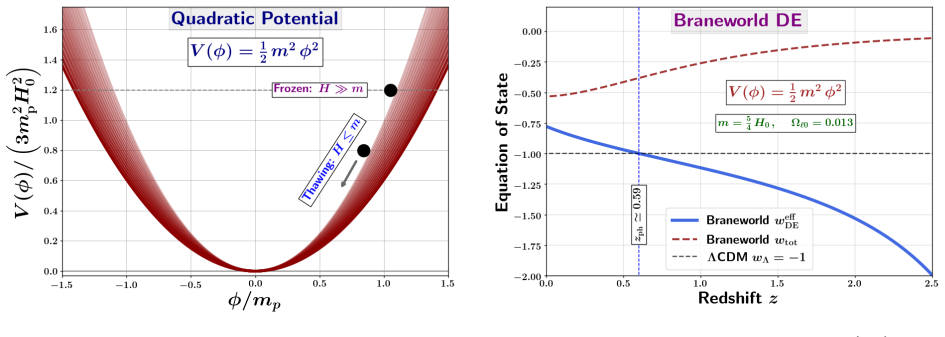
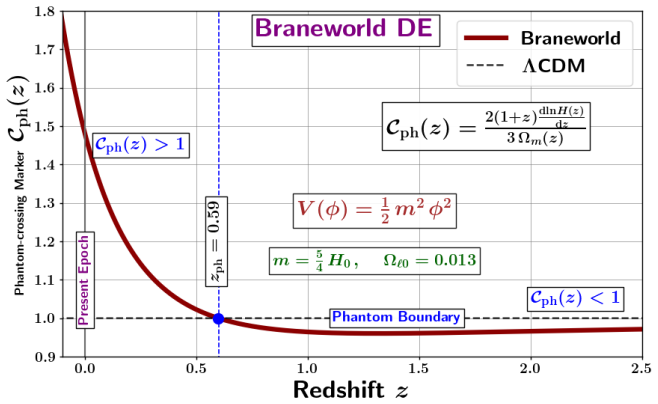
Effective phantom behaviour does not necessarily imply the existence of a fundamental phantom field, microscopic ghost instabilities, violation of the null energy condition by the fundamental stress tensor, or a catastrophic cosmic future. These points follow from the definition of effective dark energy in the FLRW framework, the interpretation of phantom and phantom-crossing evolution, a kinematic criterion based directly on the expansion history, and the availability of physical mechanisms such as modified gravity or sector interactions that generate effective phantom behaviour without fundamental pathologies.
What carries the argument
The effective equation-of-state parameter for dark energy reconstructed via the Friedmann equation from the observed expansion history under FLRW assumptions.
If this is right
- Phantom or phantom-crossing values in the reconstructed equation of state can occur while the fundamental total stress tensor satisfies the null energy condition.
- No automatic requirement for a big rip or other future singularity arises from effective phantom evolution alone.
- Mechanisms such as modified gravity or interactions between sectors can generate the observed effective behaviour without introducing fundamental instabilities.
- A kinematic test applied directly to the scale factor history can identify effective phantom phases independently of any specific model.
Where Pith is reading between the lines
- Model builders should prioritize frameworks that match the effective reconstruction while keeping fundamental fields stable.
- Distinctions between quintessence and phantom models need explicit separation of effective versus fundamental levels when confronting data.
- If future surveys confirm dynamical dark energy, the same effective-fundamental split will apply to any proposed explanation.
Load-bearing premise
The distinctions between effective and fundamental quantities remain valid under the standard assumptions of FLRW metric, Friedmann equation, and separately conserved non-relativistic matter at late times.
What would settle it
An explicit demonstration that any reconstruction yielding effective phantom evolution must produce a fundamental null energy condition violation or microscopic ghost that cannot be decoupled from the effective description would settle the claim against it.
Figures


read the original abstract
In observational cosmology, the dark energy density and equation of state are effective quantities reconstructed at the background level under a set of assumptions. These include the FLRW framework, the standard Friedmann equation of General Relativity, and separately conserved non-relativistic matter at late times. Recent analyses involving DESI BAO measurements combined with CMB and supernova data have shown mild preference for dynamical dark energy featuring phantom or phantom-crossing behaviour. While the statistical significance of these trends remains limited, and unresolved systematics or modelling uncertainties may still be important, the resulting discussions have highlighted the need for a clearer interpretation of effective dark energy reconstruction. In particular, effective phantom behaviour does not necessarily imply the existence of a fundamental phantom field, microscopic ghost instabilities, violation of the null energy condition by the fundamental stress tensor, or a catastrophic cosmic future. The purpose of this work is to clarify these distinctions, independently of whether the current observational preference for dynamical dark energy survives future data. We discuss the definition of effective dark energy in cosmology, the interpretation of phantom and phantom-crossing behaviour, introduce a simple kinematic criterion for identifying effective phantom evolution directly from the expansion history, and review physical mechanisms through which effective phantom behaviour may arise without fundamental pathologies. While familiar within the dark energy reconstruction community, these distinctions are often left implicit in broader discussions of dynamical dark energy. We hope that this work will remain useful beyond the present observational situation as a clarification of what observationally reconstructed dark energy does and does not imply.
Editorial analysis
A structured set of objections, weighed in public.
Referee Report
Summary. The manuscript clarifies the meaning of effective dark energy quantities reconstructed at the background level under the standard assumptions of an FLRW metric, the GR Friedmann equation, and separately conserved non-relativistic matter. It argues that an effective equation-of-state parameter w_DE < -1 or phantom-crossing does not entail a fundamental phantom scalar field, ghost instabilities, null-energy-condition violation by the fundamental stress tensor, or a doomsday scenario. The paper defines effective dark energy, introduces a kinematic criterion based directly on the expansion history H(z) and its derivatives, and reviews existing mechanisms (interactions, modified gravity effective descriptions) that realize effective phantom behavior without fundamental pathologies.
Significance. If the distinctions hold, the paper supplies a timely and useful reference for interpreting recent DESI BAO + CMB + supernova analyses that mildly favor dynamical dark energy with phantom features. Its value lies in making standard but often implicit distinctions explicit without new parameters, fits, or derivations, thereby reducing the risk of over-interpreting effective quantities as fundamental. The work is independent of whether the current observational trend persists and is therefore likely to remain relevant.
minor comments (2)
- [Abstract] The abstract states that a 'simple kinematic criterion' is introduced, but the manuscript would be clearer if this criterion were given an explicit equation number and a short dedicated paragraph in the main text rather than being left implicit in the discussion of H(z).
- A brief table or bullet list summarizing the reviewed mechanisms (interactions, modified gravity, etc.) and the specific way each evades fundamental pathologies would improve readability for readers outside the reconstruction community.
Simulated Author's Rebuttal
We thank the referee for their positive assessment of the manuscript, accurate summary of its scope, and recommendation to accept. The report correctly identifies the paper's focus on clarifying the interpretation of effective dark energy quantities without introducing new parameters or derivations.
Circularity Check
No significant circularity identified
full rationale
The paper advances no derivations, quantitative predictions, or fitted parameters; its content consists of definitional clarifications, a kinematic criterion defined directly from H(z) and derivatives under explicit FLRW + Friedmann + conserved-matter assumptions, and a review of existing mechanisms. No step reduces by construction to its own inputs, no self-citation is load-bearing for a central claim, and the distinctions drawn are independent of any fitted values or prior author results. The analysis is therefore self-contained with no circular reductions.
Axiom & Free-Parameter Ledger
Forward citations
Cited by 2 Pith papers
-
Data-Driven Discovery of a Simple Phantom-Crossing Dark Energy Parametrization
Bayesian reconstruction and exhaustive symbolic regression on CMB, BAO, and supernova data yield the one-parameter dark energy parametrization w(a) = w0 / sqrt(a) that fits observations comparably to CPL and better th...
-
Late-Time Oscillating Quintessence in Light of DESI
A late-onset oscillating quintessence model improves the fit to DESI plus supernova and CMB data by Delta chi squared of about 9 over Lambda CDM, driven by background expansion.
Reference graph
Works this paper leans on
-
[1]
The Observational case for a low density universe with a nonzero cosmological constant
J. P. Ostriker and P. J. Steinhardt. “The Observational case for a low density universe with a nonzero cosmological constant”. In:Nature377 (1995), pp. 600–602.doi:10.1038/ 377600a0
1995
-
[2]
Observational Evidence from Supernovae for an Accelerating Universe and a Cosmological Constant
A. G. Riess et al. “Observational evidence from supernovae for an accelerating universe and a cosmological constant”. In:Astron. J.116 (1998), pp. 1009–1038.doi:10.1086/300499. arXiv:astro-ph/9805201
work page internal anchor Pith review Pith/arXiv arXiv doi:10.1086/300499 1998
-
[3]
S. Perlmutter et al. “Measurements ofΩandΛfrom 42 High Redshift Supernovae”. In: Astrophys. J.517 (1999), pp. 565–586.doi:10.1086/307221. arXiv:astro-ph/9812133
work page internal anchor Pith review Pith/arXiv arXiv doi:10.1086/307221 1999
-
[5]
Amendola and S
L. Amendola and S. Tsujikawa.Dark Energy: Theory and Observations. Cambridge Uni- versity Press, Jan. 2015.isbn: 978-1-107-45398-2
2015
-
[6]
Nine YearWilkinson Microwave Anisotropy Probe(WMAP) Observa- tions: Cosmological Parameter Results
G. Hinshaw et al. “Nine YearWilkinson Microwave Anisotropy Probe(WMAP) Observa- tions: Cosmological Parameter Results”. In:The Astrophysical Journal Supplement Series 208.2 (2013), p. 19.issn: 1538-4365.doi:10.1088/0067- 0049/208/2/19.url:http: //dx.doi.org/10.1088/0067-0049/208/2/19
-
[7]
Planck 2018 results. I. Overview and the cosmological legacy of Planck
N. Aghanim et al. “Planck 2018 results. I. Overview and the cosmological legacy of Planck”. In:Astron. Astrophys.641 (2020), A1.doi:10 . 1051 / 0004 - 6361 / 201833880. arXiv: 1807.06205 [astro-ph.CO]
work page internal anchor Pith review Pith/arXiv arXiv 2018
-
[8]
The Atacama Cosmology Telescope: DR6 Power Spectra, Likelihoods and $\Lambda$CDM Parameters
T. Louis et al. “The Atacama Cosmology Telescope: DR6 power spectra, likelihoods and ΛCDM parameters”. In:JCAP11 (2025), p. 062.doi:10.1088/1475-7516/2025/11/062. arXiv:2503.14452 [astro-ph.CO]
work page internal anchor Pith review Pith/arXiv arXiv doi:10.1088/1475-7516/2025/11/062 2025
-
[9]
E. Camphuis et al. “SPT-3G D1: CMB temperature and polarization power spectra and cosmology from 2019 and 2020 observations of the SPT-3G main field”. In:Phys. Rev. D 113.8 (2026), p. 083504.doi:10.1103/7wt3-9v2y. arXiv:2506.20707 [astro-ph.CO]
work page internal anchor Pith review Pith/arXiv arXiv doi:10.1103/7wt3-9v2y 2019
-
[10]
The Cosmological constant and the theory of elementary particles
Y. B. Zel’dovich. “The Cosmological constant and the theory of elementary particles”. In: Sov. Phys. Usp.11 (1968), pp. 381–393.doi:10.1007/s10714-008-0624-6
-
[11]
S. Weinberg. “The Cosmological Constant Problem”. In:Rev. Mod. Phys.61 (1989). Ed. by J.-P. Hsu and D. Fine, pp. 1–23.doi:10.1103/RevModPhys.61.1
-
[12]
The Case for a Positive Cosmological Lambda-term
V. Sahni and A. A. Starobinsky. “The Case for a positive cosmological Lambda term”. In: Int. J. Mod. Phys. D9 (2000), pp. 373–444.doi:10.1142/S0218271800000542. arXiv: astro-ph/9904398. 25
work page internal anchor Pith review Pith/arXiv arXiv doi:10.1142/s0218271800000542 2000
-
[13]
Cosmological constant—the weight of the vacuum
T. Padmanabhan. “Cosmological constant—the weight of the vacuum”. In:Physics Reports 380.5–6 (July 2003), pp. 235–320.issn: 0370-1573.doi:10.1016/s0370-1573(03)00120- 0.url:http://dx.doi.org/10.1016/S0370-1573(03)00120-0
-
[14]
R. Bousso. “The cosmological constant”. In:General Relativity and Gravitation40.2–3 (Dec. 2007), pp. 607–637.issn: 1572-9532.doi:10 . 1007 / s10714 - 007 - 0557 - 5.url:http : //dx.doi.org/10.1007/s10714-007-0557-5
-
[15]
Lectures on the Cosmological Constant Problem
A. Padilla. “Lectures on the Cosmological Constant Problem”. In: (Feb. 2015). arXiv:1502. 05296 [hep-th]
2015
-
[16]
Cosmological Consequences of a Rolling Homogeneous Scalar Field
B. Ratra and P. J. E. Peebles. “Cosmological Consequences of a Rolling Homogeneous Scalar Field”. In:Phys. Rev. D37 (1988), p. 3406.doi:10.1103/PhysRevD.37.3406
-
[17]
Cosmology with Ultra-light Pseudo-Nambu-Goldstone Bosons
J. A. Frieman et al. “Cosmology with Ultralight Pseudo Nambu-Goldstone Bosons”. In: Phys. Rev. Lett.75 (1995), pp. 2077–2080.doi:10.1103/PhysRevLett.75.2077. arXiv: astro-ph/9505060
work page internal anchor Pith review Pith/arXiv arXiv doi:10.1103/physrevlett.75.2077 1995
-
[18]
The Cosmological Constant and Dark Energy
P. J. E. Peebles and B. Ratra. “The Cosmological Constant and Dark Energy”. In:Rev. Mod. Phys.75 (2003). Ed. by J.-P. Hsu and D. Fine, pp. 559–606.doi:10.1103/RevModPhys. 75.559. arXiv:astro-ph/0207347
work page internal anchor Pith review Pith/arXiv arXiv doi:10.1103/revmodphys 2003
-
[19]
Cosmology with a Time Variable Cosmological Constant
P. J. E. Peebles and B. Ratra. “Cosmology with a Time Variable Cosmological Constant”. In:Astrophys. J. Lett.325 (1988), p. L17.doi:10.1086/185100
-
[20]
Copeland, Edmund J. and Sami, M. and Tsujikawa, Shinji. “Dynamics of dark energy”. In: Int. J. Mod. Phys. D15 (2006), pp. 1753–1936.doi:10.1142/S021827180600942X. arXiv: hep-th/0603057
work page internal anchor Pith review Pith/arXiv arXiv doi:10.1142/s021827180600942x 2006
-
[22]
Dark Energy and the Accelerating Universe
J. A. Frieman, M. S. Turner, and D. Huterer. “Dark Energy and the Accelerating Universe”. In:Annual Review of Astronomy and Astrophysics46.1 (Sept. 2008), pp. 385–432.issn: 1545-4282.doi:10.1146/annurev.astro.46.060407.145243.url:http://dx.doi.org/ 10.1146/annurev.astro.46.060407.145243
work page doi:10.1146/annurev.astro.46.060407.145243.url:http://dx.doi.org/ 2008
-
[23]
Dark Energy and Modified Gravity
R. Durrer and R. Maartens.Dark Energy and Modified Gravity. 2008. arXiv:0811.4132 [astro-ph].url:https://arxiv.org/abs/0811.4132
work page internal anchor Pith review Pith/arXiv arXiv 2008
-
[24]
M. Li et al. “Dark Energy”. In:Communications in Theoretical Physics56.3 (Sept. 2011), pp. 525–604.issn: 0253-6102.doi:10.1088/0253-6102/56/3/24.url:http://dx.doi. org/10.1088/0253-6102/56/3/24
work page doi:10.1088/0253-6102/56/3/24.url:http://dx.doi 2011
-
[25]
Unified cosmic history in modified gravity: From F(R) theory toLorentznon-invariantmodels
S. Nojiri and S. D. Odintsov. “Unified cosmic history in modified gravity: From F(R) theory toLorentznon-invariantmodels”.In:Physics Reports505.2–4(Aug.2011),pp.59–144.issn: 0370-1573.doi:10.1016/j.physrep.2011.04.001.url:http://dx.doi.org/10.1016/ j.physrep.2011.04.001
work page doi:10.1016/j.physrep.2011.04.001.url:http://dx.doi.org/10.1016/ 2011
-
[26]
Modified gravity and cosmology
T. Clifton et al. “Modified gravity and cosmology”. In:Physics Reports513.1–3 (Mar. 2012), pp. 1–189.issn: 0370-1573.doi:10.1016/j.physrep.2012.01.001.url:http: //dx.doi.org/10.1016/j.physrep.2012.01.001
-
[27]
R. R. Caldwell and E. V. Linder. “The Limits of quintessence”. In:Phys. Rev. Lett.95 (2005), p. 141301.doi:10.1103/PhysRevLett.95.141301. arXiv:astro-ph/0505494. 26
work page internal anchor Pith review Pith/arXiv arXiv doi:10.1103/physrevlett.95.141301 2005
-
[28]
K. Bamba et al. “Dark energy cosmology: the equivalent description via different theoretical models and cosmography tests”. In:Astrophys. Space Sci.342 (2012), pp. 155–228.doi: 10.1007/s10509-012-1181-8. arXiv:1205.3421 [gr-qc]
work page internal anchor Pith review Pith/arXiv arXiv doi:10.1007/s10509-012-1181-8 2012
-
[29]
DESI 2024 VI: Cosmological Constraints from the Measurements of Baryon Acoustic Oscillations
A. G. Adame et al. “DESI 2024 VI: cosmological constraints from the measurements of baryon acoustic oscillations”. In:JCAP02 (2025), p. 021.doi:10.1088/1475-7516/2025/ 02/021. arXiv:2404.03002 [astro-ph.CO]
work page internal anchor Pith review Pith/arXiv arXiv doi:10.1088/1475-7516/2025/ 2024
-
[30]
DESI 2024: reconstructing dark energy using crossing statistics with DESI DR1 BAO data
R. Calderon et al. “DESI 2024: reconstructing dark energy using crossing statistics with DESI DR1 BAO data”. In:JCAP10 (2024), p. 048.doi:10.1088/1475-7516/2024/10/
- [31]
-
[32]
DESI DR2 Results II: Measurements of Baryon Acoustic Oscillations and Cosmological Constraints
M. Abdul Karim et al. “DESI DR2 Results II: Measurements of Baryon Acoustic Oscilla- tions and Cosmological Constraints”. In: (Mar. 2025). arXiv:2503.14738 [astro-ph.CO]
work page internal anchor Pith review Pith/arXiv arXiv 2025
-
[33]
Planck2018 results: V. CMB power spectra and likelihoods
N. Aghanim et al. “Planck2018 results: V. CMB power spectra and likelihoods”. In:As- tronomy & Astrophysics641 (Sept. 2020), A5.issn: 1432-0746.doi:10 . 1051 / 0004 - 6361/201936386.url:http://dx.doi.org/10.1051/0004-6361/201936386
-
[34]
Union Through UNITY: Cosmology with 2,000 SNe Using a Unified Bayesian Framework
D. Rubin et al. “Union Through UNITY: Cosmology with 2,000 SNe Using a Unified Bayesian Framework”. In: (Nov. 2023). arXiv:2311.12098 [astro-ph.CO]
work page internal anchor Pith review Pith/arXiv arXiv 2023
-
[35]
The Pantheon+ Analysis: Cosmological Constraints
D.Broutetal.“ThePantheon+Analysis:CosmologicalConstraints”.In:Astrophys. J.938.2 (2022), p. 110.doi:10.3847/1538-4357/ac8e04. arXiv:2202.04077 [astro-ph.CO]
work page internal anchor Pith review Pith/arXiv arXiv doi:10.3847/1538-4357/ac8e04 2022
-
[36]
T. M. C. Abbott et al. “The Dark Energy Survey: Cosmology Results With ~1500 New High-redshift Type Ia Supernovae Using The DESI 2024 VI: Cosmological Constraints from the Measure-Full 5-year Dataset”. In: (Jan. 2024). arXiv:2401.02929 [astro-ph.CO]
work page internal anchor Pith review Pith/arXiv arXiv 2024
-
[37]
W. J. Wolf, C. García-García, and P. G. Ferreira. “Robustness of dark energy phenomenol- ogy across different parameterizations”. In:JCAP05 (2025), p. 034.doi:10.1088/1475- 7516/2025/05/034. arXiv:2502.04929 [astro-ph.CO]
-
[39]
Assessing observational constraints on dark energy
D. Shlivko and P. J. Steinhardt. “Assessing observational constraints on dark energy”. In: Phys. Lett. B855 (2024), p. 138826.doi:10 . 1016 / j . physletb . 2024 . 138826. arXiv: 2405.03933 [astro-ph.CO]
work page internal anchor Pith review Pith/arXiv arXiv 2024
-
[40]
Doobservationspreferthawingquintessence?
G.Payeur,E.McDonough,andR.Brandenberger.“Doobservationspreferthawingquintessence?” In:Phys. Rev. D111.12 (2025), p. 123541.doi:10.1103/bggr-61nr. arXiv:2411.13637 [astro-ph.CO]
-
[41]
R. E. Keeley et al. “The Preference for Evolving Dark Energy from Cosmological Distance Measurements and Possible Signatures in the Growth Rate of Perturbations”. In: (Feb. 2025). arXiv:2502.12667 [astro-ph.CO]
-
[42]
Cosmological constraints on curved quintessence
S. Bhattacharya et al. “Cosmological constraints on curved quintessence”. In:JCAP09 (2024),p.073.doi:10.1088/1475-7516/2024/09/073.arXiv:2405.17396 [astro-ph.CO]
work page doi:10.1088/1475-7516/2024/09/073.arxiv:2405.17396 2024
-
[43]
J.-Q. Jiang et al. “Nonparametric late-time expansion history reconstruction and implica- tions for the Hubble tension in light of recent DESI and type Ia supernovae data”. In:Phys. Rev. D110.12 (2024), p. 123519.doi:10.1103/PhysRevD.110.123519. arXiv:2408.02365 [astro-ph.CO]. 27
-
[44]
Simple quintessence models in light of DESI-BAO observations
J. M. Cline and V. Muralidharan. “Simple quintessence models in light of DESI-BAO observations”. In:Phys. Rev. D112.6 (2025), p. 063539.doi:10.1103/8z2m-nbv6. arXiv: 2506.13047 [astro-ph.CO]
-
[45]
Quintessence and phantoms in light of DESI 2025
I. D. Gialamas et al. “Quintessence and phantoms in light of DESI 2025”. In: (June 2025). arXiv:2506.21542 [astro-ph.CO]
-
[46]
Accelerating universes with scaling dark matter
M. Chevallier and D. Polarski. “Accelerating universes with scaling dark matter”. In:Int. J. Mod. Phys. D10 (2001), pp. 213–224.doi:10.1142/S0218271801000822. arXiv:gr- qc/0009008
-
[47]
Exploring the Expansion History of the Universe
E. V. Linder. “Exploring the expansion history of the universe”. In:Phys. Rev. Lett.90 (2003), p. 091301.doi:10.1103/PhysRevLett.90.091301. arXiv:astro-ph/0208512
work page internal anchor Pith review Pith/arXiv arXiv doi:10.1103/physrevlett.90.091301 2003
-
[48]
Extended Dark Energy analysis using DESI DR2 BAO measurements
K. Lodha et al. “Extended Dark Energy analysis using DESI DR2 BAO measurements”. In: (Mar. 2025). arXiv:2503.14743 [astro-ph.CO]
work page internal anchor Pith review Pith/arXiv arXiv 2025
-
[49]
Popovicet al., arXiv e-prints , arXiv:2506.05471 (2025), arXiv:2506.05471 [astro-ph.CO]
B. Popovic et al. “A Reassessment of the Pantheon+ and DES 5YR Calibration Uncertain- ties: Dovekie”. In: (June 2025). arXiv:2506.05471 [astro-ph.CO]
-
[50]
B.Popovicetal.“TheDarkEnergySurveySupernovaProgram:AReanalysisOfCosmology Results And Evidence For Evolving Dark Energy With An Updated Type Ia Supernova Calibration”. In:Mon. Not. Roy. Astron. Soc.548 (2026), stag632.doi:10.1093/mnras/ stag632. arXiv:2511.07517 [astro-ph.CO]
work page internal anchor Pith review Pith/arXiv arXiv doi:10.1093/mnras/ 2026
-
[51]
On DESI’s DR2 exclusion ofΛCDM
M. Cortês and A. R. Liddle. “On DESI’s DR2 exclusion ofΛCDM”. In: (2025). arXiv: 2504.15336 [astro-ph.CO].url:https://arxiv.org/abs/2504.15336
-
[52]
Baryon acoustic oscillations from a different angle
G. Efstathiou. “Baryon acoustic oscillations from a different angle”. In:Mon. Not. Roy. Astron. Soc.540.3 (2025), pp. 2844–2852.doi:10.1093/mnras/staf906. arXiv:2505. 02658 [astro-ph.CO]
-
[53]
Interpreting DESI 2024 BAO: Late-time dynamical dark energy or a local effect?
I. D. Gialamas et al. “Interpreting DESI 2024 BAO: Late-time dynamical dark energy or a local effect?” In:Phys. Rev. D111.4 (2025), p. 043540.doi:10.1103/PhysRevD.111. 043540. arXiv:2406.07533 [astro-ph.CO]
-
[54]
Evolving dark energy or supernovae systematics?
G. Efstathiou. “Evolving dark energy or supernovae systematics?” In:Mon. Not. Roy. As- tron. Soc.538.2 (2025), pp. 875–882.doi:10.1093/mnras/staf301. arXiv:2408.07175 [astro-ph.CO]
-
[55]
Bayesian and frequentist perspectives agree on dynamical dark energy
L. Herold and T. Karwal. “Bayesian and frequentist perspectives agree on dynamical dark energy”. In: (June 2025). arXiv:2506.12004 [astro-ph.CO]
-
[56]
A Bayesian Perspective on Evidence for Evolving Dark Energy
D. D. Y. Ong, D. Yallup, and W. Handley. “A Bayesian Perspective on Evidence for Evolv- ing Dark Energy”. In: (Nov. 2025). arXiv:2511.10631 [astro-ph.CO]
work page internal anchor Pith review Pith/arXiv arXiv 2025
-
[57]
D. D. Y. Ong, D. Yallup, and W. Handley. “The Bayesian view of DESI DR2 with unim- peded: Evidence and tension in a combined analysis with CMB and supernovae across cosmological models”. In: (Mar. 2026). arXiv:2603.05472 [astro-ph.CO]
work page internal anchor Pith review Pith/arXiv arXiv 2026
-
[58]
Could We Be Fooled about Phantom Crossing?
R. E. Keeley, A. Shafieloo, and W. L. Matthewson. “Could We Be Fooled about Phantom Crossing?” In: (June 2025). arXiv:2506.15091 [astro-ph.CO]
-
[59]
Model-independent consistency tests of DESI DR2 BAO and SN Ia
H. Woo, W. L. Matthewson, and A. Shafieloo. “Model-independent consistency tests of DESI DR2 BAO and SN Ia”. In: (Apr. 2026). arXiv:2604.19393 [astro-ph.CO]. 28
work page internal anchor Pith review Pith/arXiv arXiv 2026
-
[60]
How much has DESI dark energy evolved since DR1?
E. Ó. Colgáin et al. “How much has DESI dark energy evolved since DR1?” In:Phys. Dark Univ.52 (2026), p. 102268.doi:10 . 1016 / j . dark . 2026 . 102268. arXiv:2504 . 04417 [astro-ph.CO]
2026
-
[61]
S. Das, S. More, and S. Alam. “Cosmology-Independent Constraints on the Etherington RelationandSNeIaAbsoluteMagnitudeEvolutionfromDESI-DR2”.In:(Apr.2026).arXiv: 2604.02433 [astro-ph.CO]
work page internal anchor Pith review Pith/arXiv arXiv 2026
-
[62]
E. Di Valentino et al. “The CosmoVerse White Paper: Addressing observational tensions in cosmology with systematics and fundamental physics”. In:Phys. Dark Univ.49 (2025), p. 101965.doi:10.1016/j.dark.2025.101965. arXiv:2504.01669 [astro-ph.CO]
-
[63]
R. R. Caldwell. “A Phantom menace?” In:Phys. Lett. B545 (2002), pp. 23–29.doi:10. 1016/S0370-2693(02)02589-3. arXiv:astro-ph/9908168
work page internal anchor Pith review Pith/arXiv arXiv 2002
-
[64]
Null energy condition and superluminal propagation
S. Dubovsky et al. “Null energy condition and superluminal propagation”. In:JHEP03 (2006), p. 025.doi:10.1088/1126-6708/2006/03/025. arXiv:hep-th/0512260
work page internal anchor Pith review Pith/arXiv arXiv doi:10.1088/1126-6708/2006/03/025 2006
-
[65]
The Null energy condition and instability
R. V. Buniy, S. D. H. Hsu, and B. M. Murray. “The Null energy condition and instability”. In:Phys. Rev. D74 (2006), p. 063518.doi:10.1103/PhysRevD.74.063518. arXiv:hep- th/0606091
-
[66]
Instabilities and the null energy condition
R. V. Buniy and S. D. H. Hsu. “Instabilities and the null energy condition”. In:Phys. Lett. B632 (2006), pp. 543–546.doi:10.1016/j.physletb.2005.10.075. arXiv:hep- th/0502203
-
[67]
Null energy conditions in quantum field theory
C. J. Fewster and T. A. Roman. “Null energy conditions in quantum field theory”. In: Phys. Rev. D67 (2003). [Erratum: Phys.Rev.D 80, 069903 (2009)], p. 044003.doi:10. 1103/PhysRevD.67.044003. arXiv:gr-qc/0209036
work page internal anchor Pith review Pith/arXiv arXiv 2003
-
[68]
The Classical Singularity Theorems and their Quantum Loopholes
L. H. Ford. “The Classical singularity theorems and their quantum loop holes”. In:Int. J. Theor. Phys.42 (2003). Ed. by G. Dvali, E. Gunzig, and E. Verdaguer, pp. 1219–1227.doi: 10.1023/A:1025754515197. arXiv:gr-qc/0301045
work page internal anchor Pith review Pith/arXiv arXiv doi:10.1023/a:1025754515197 2003
-
[69]
From Satisfying to Violating the Null Energy Condition
B. Elder, A. Joyce, and J. Khoury. “From Satisfying to Violating the Null Energy Condi- tion”. In:Phys. Rev. D89.4 (2014), p. 044027.doi:10.1103/PhysRevD.89.044027. arXiv: 1311.5889 [hep-th]
work page internal anchor Pith review Pith/arXiv arXiv doi:10.1103/physrevd.89.044027 2014
-
[70]
Phantom Energy and Cosmic Doomsday
R. R. Caldwell, M. Kamionkowski, and N. N. Weinberg. “Phantom energy and cosmic doomsday”. In:Phys. Rev. Lett.91 (2003), p. 071301.doi:10.1103/PhysRevLett.91. 071301. arXiv:astro-ph/0302506
work page internal anchor Pith review Pith/arXiv arXiv doi:10.1103/physrevlett.91 2003
-
[71]
S. Nojiri and S. D. Odintsov. “Effective equation of state and energy conditions in phantom / tachyon inflationary cosmology perturbed by quantum effects”. In:Phys. Lett. B571 (2003), pp. 1–10.doi:10.1016/j.physletb.2003.08.013. arXiv:hep-th/0306212
work page internal anchor Pith review Pith/arXiv arXiv doi:10.1016/j.physletb.2003.08.013 2003
-
[72]
Cosmological Dynamics of Phantom Field
P. Singh, M. Sami, and N. Dadhich. “Cosmological dynamics of phantom field”. In:Phys. Rev. D68 (2003), p. 023522.doi:10.1103/PhysRevD.68.023522. arXiv:hep-th/0305110
work page internal anchor Pith review Pith/arXiv arXiv doi:10.1103/physrevd.68.023522 2003
-
[73]
M. P. Dabrowski, T. Stachowiak, and M. Szydlowski. “Phantom cosmologies”. In:Phys. Rev. D68 (2003), p. 103519.doi:10.1103/PhysRevD.68.103519. arXiv:hep-th/0307128
work page internal anchor Pith review Pith/arXiv arXiv doi:10.1103/physrevd.68.103519 2003
-
[74]
V. B. Johri. “Phantom cosmologies”. In:Phys. Rev. D70 (2004), p. 041303.doi:10.1103/ PhysRevD.70.041303. arXiv:astro-ph/0311293
work page internal anchor Pith review Pith/arXiv arXiv 2004
-
[75]
You need not be afraid of phantom energy
P. F. Gonzalez-Diaz. “You need not be afraid of phantom energy”. In:Phys. Rev. D68 (2003), p. 021303.doi:10.1103/PhysRevD.68.021303. arXiv:astro-ph/0305559. 29
work page internal anchor Pith review Pith/arXiv arXiv doi:10.1103/physrevd.68.021303 2003
-
[76]
Phantom Field and the Fate of Universe
M. Sami and A. Toporensky. “Phantom field and the fate of universe”. In:Mod. Phys. Lett. A19 (2004), p. 1509.doi:10.1142/S0217732304013921. arXiv:gr-qc/0312009
work page internal anchor Pith review Pith/arXiv arXiv doi:10.1142/s0217732304013921 2004
-
[77]
Constructing Phantom Cosmologies from Standard Scalar Field Universes
L. P. Chimento and R. Lazkoz. “On the link between phantom and standard cosmologies”. In:Phys. Rev. Lett.91 (2003), p. 211301.doi:10.1103/PhysRevLett.91.211301. arXiv: gr-qc/0307111
work page internal anchor Pith review Pith/arXiv arXiv doi:10.1103/physrevlett.91.211301 2003
-
[78]
J. D. Barrow. “Sudden future singularities”. In:Class. Quant. Grav.21 (2004), pp. L79–L82. doi:10.1088/0264-9381/21/11/L03. arXiv:gr-qc/0403084
work page internal anchor Pith review Pith/arXiv arXiv doi:10.1088/0264-9381/21/11/l03 2004
-
[79]
The viability of phantom dark energy: A review
K. J. Ludwick. “The viability of phantom dark energy: A review”. In:Mod. Phys. Lett. A32.28 (2017), p. 1730025.doi:10 . 1142 / S0217732317300257. arXiv:1708 . 06981 [astro-ph.CO]
2017
-
[80]
L. P. Chimento and R. Lazkoz. “On big rip singularities”. In:Mod. Phys. Lett. A19 (2004), pp. 2479–2484.doi:10.1142/S0217732304015646. arXiv:gr-qc/0405020
work page internal anchor Pith review Pith/arXiv arXiv doi:10.1142/s0217732304015646 2004
-
[81]
F. Sbisà. “Classical and quantum ghosts”. In:Eur. J. Phys.36 (2015), p. 015009.doi: 10.1088/0143-0807/36/1/015009. arXiv:1406.4550 [hep-th]
work page internal anchor Pith review Pith/arXiv arXiv doi:10.1088/0143-0807/36/1/015009 2015
-
[83]
Ghosts in the self-accelerating universe
K. Koyama. “Ghosts in the self-accelerating universe”. In:Class. Quant. Grav.24.24 (2007), R231–R253.doi:10.1088/0264-9381/24/24/R01. arXiv:0709.2399 [hep-th]
work page internal anchor Pith review Pith/arXiv arXiv doi:10.1088/0264-9381/24/24/r01 2007
-
[84]
Avoiding Dark Energy with 1/R Modifications of Gravity
R. P. Woodard. “Avoiding dark energy with 1/r modifications of gravity”. In:Lect. Notes Phys.720 (2007). Ed. by L. Papantonopoulos, pp. 403–433.doi:10.1007/978- 3- 540- 71013-4_14. arXiv:astro-ph/0601672
work page internal anchor Pith review Pith/arXiv arXiv doi:10.1007/978- 2007
discussion (0)
Sign in with ORCID, Apple, or X to comment. Anyone can read and Pith papers without signing in.