Mahalanobis PatchCore: Covariance-Aware and Streaming-Compatible Industrial Anomaly Detection
Pith reviewed 2026-06-29 17:52 UTC · model grok-4.3
The pith
Mahalanobis PatchCore maintains PatchCore accuracy in anomaly detection while halving peak memory through incremental covariance estimation.
A machine-rendered reading of the paper's core claim, the machinery that carries it, and where it could break.
Core claim
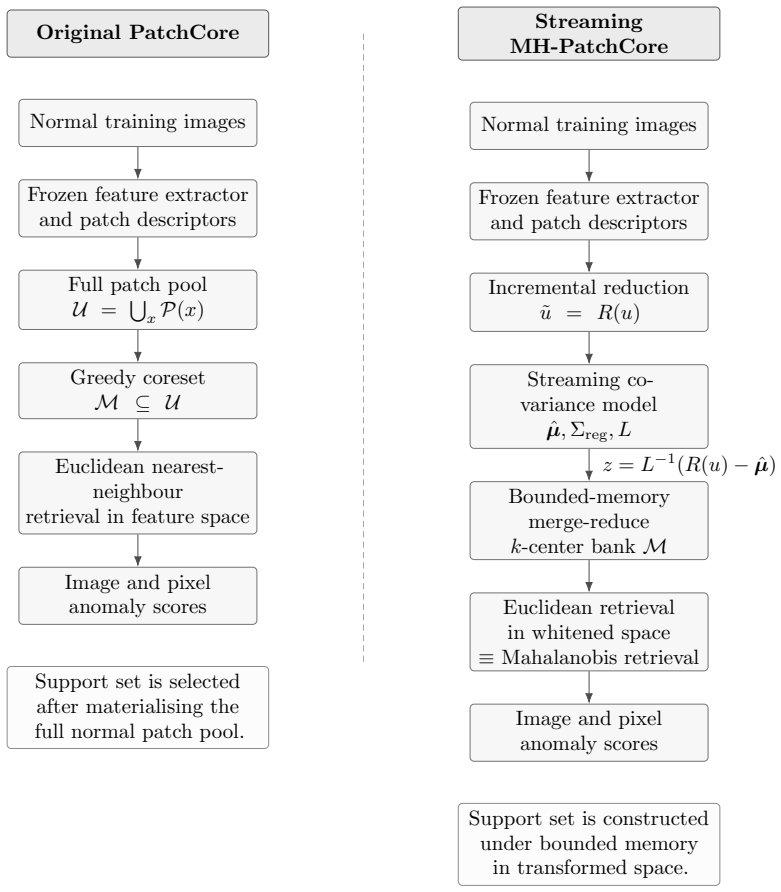
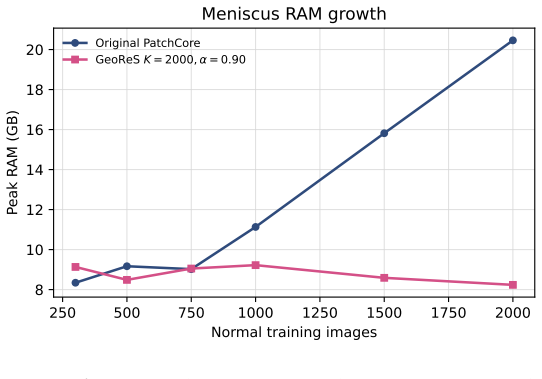
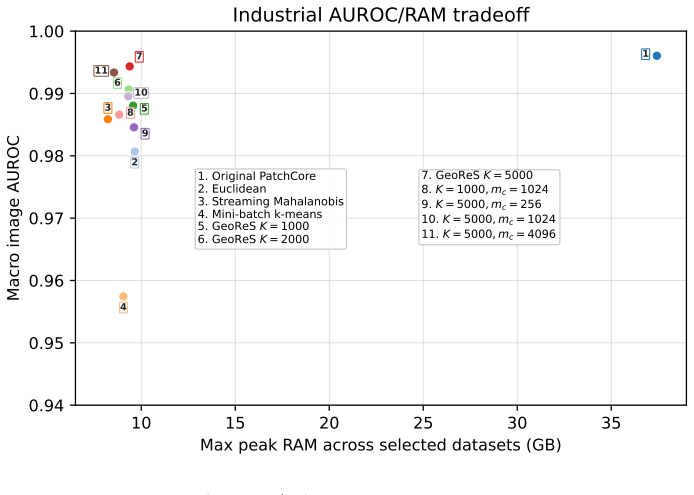
Mahalanobis PatchCore estimates a regularised covariance model in reduced feature space and whitens embeddings so that Euclidean nearest-neighbour search after transformation implements Mahalanobis retrieval. A bounded-memory, re-iterable training pipeline builds the memory bank without storing all normal patches at once, using incremental dimensionality reduction, online covariance estimation, and streaming aggregation. This preserves most offline PatchCore image-level performance on the public benchmark while reducing peak memory from 5.41 to 2.78 GB, and improves the selected industrial mean image area under the receiver operating characteristic curve from 0.981 to 0.986.
What carries the argument
regularised covariance estimation in reduced feature space with whitening, combined with incremental dimensionality reduction and streaming aggregation to build the memory bank
If this is right
- The method enables accurate anomaly detection under practical memory limits in automated industrial inspection.
- It achieves comparable or higher image-level AUC than standard PatchCore on both public and proprietary industrial data.
- The streaming pipeline avoids materialising the complete patch pool before subsampling.
- Covariance-aware retrieval becomes feasible without requiring the full offline memory bank.
Where Pith is reading between the lines
- The same incremental covariance technique could be applied to other distance-based one-class detectors that currently ignore feature correlations.
- The whitening transformation might be computed once on an existing memory bank to retrofit covariance awareness without retraining.
- If normal data distributions drift over time, the online covariance update could support periodic refresh without restarting from scratch.
Load-bearing premise
The regularized covariance estimated incrementally in reduced feature space remains sufficiently accurate to produce Mahalanobis distances that match the quality of an offline full-covariance model.
What would settle it
A side-by-side run of the full offline PatchCore with true Mahalanobis distances on the same datasets that shows substantially lower AUC than the streaming incremental version would falsify the accuracy claim.
Figures

read the original abstract
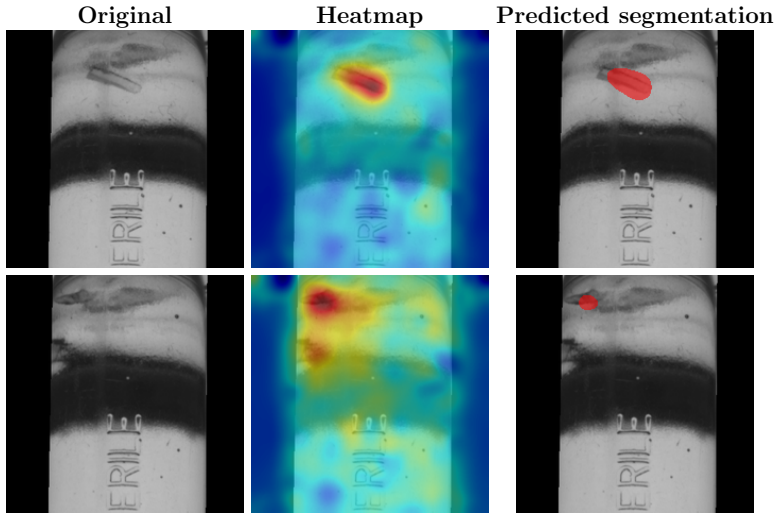
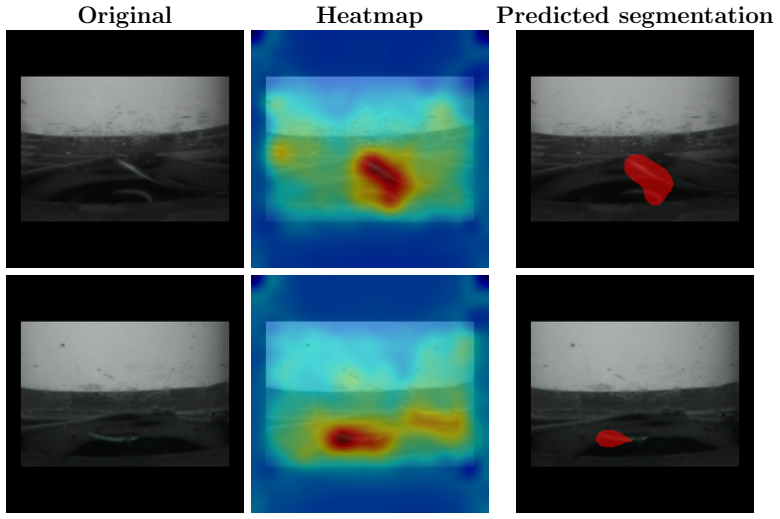
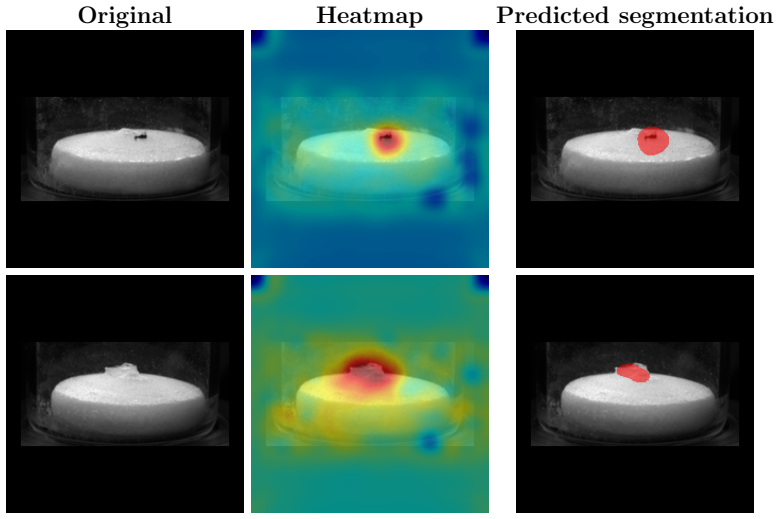
Industrial visual anomaly detection is usually one-class: normal images are abundant, while defects are rare, heterogeneous, and often unavailable during system design. PatchCore-style retrieval suits this setting because it scores test images from a memory bank of normal patch features, but the standard Euclidean geometry ignores feature correlations and its offline construction materialises the full patch pool before subsampling. We introduce Mahalanobis PatchCore, a covariance-aware, streaming-compatible extension of PatchCore. Its artificial intelligence contribution is a retrieval detector that estimates a regularised covariance model in reduced feature space and whitens embeddings, so Euclidean nearest-neighbour search after transformation implements Mahalanobis retrieval. A bounded-memory, re-iterable training pipeline builds the memory bank without storing all normal patches at once, using incremental dimensionality reduction, online covariance estimation, and streaming aggregation. The engineering application is automated industrial inspection, where visual anomaly detection must remain accurate under practical memory limits. We evaluate the method on a public 15-category industrial anomaly-detection benchmark and three industrial datasets covering blow-fill-seal strip-ampoule meniscus inspection, amber-glass-ampoule bottom inspection, and lyophilised-cake vial inspection. Mahalanobis PatchCore preserves most offline PatchCore image-level performance on the public benchmark while reducing peak memory from 5.41 to 2.78 GB, and improves the selected industrial mean image area under the receiver operating characteristic curve from 0.981 to 0.986.
Editorial analysis
A structured set of objections, weighed in public.
Referee Report
Summary. The manuscript presents Mahalanobis PatchCore as a covariance-aware extension of PatchCore for one-class industrial anomaly detection. It estimates a regularized covariance in reduced feature space to implement Mahalanobis retrieval via whitening and Euclidean NN, while using incremental dimensionality reduction and online covariance estimation for a streaming, bounded-memory training pipeline. On a public 15-category benchmark it reduces peak memory from 5.41 GB to 2.78 GB while preserving image-level AUC, and on three industrial datasets it raises mean image AUC from 0.981 to 0.986.
Significance. Should the incremental covariance estimate prove sufficiently faithful to the batch version, the approach would offer a practical way to incorporate feature correlations into memory-bank retrieval methods without prohibitive memory costs, which is valuable for real-world industrial inspection systems operating under hardware constraints.
major comments (3)
- [Abstract] Abstract: The concrete numeric claims (memory reduction to 2.78 GB and AUC increase to 0.986) are presented without derivation, error bars, or ablation of the regularization strength (a free parameter), leaving the central performance assertions unsupported by visible evidence.
- [§3 (Method)] §3 (Method): The description of the online covariance estimation in reduced space lacks a quantitative validation (e.g., distance distribution comparison or nearest-neighbor ranking preservation) against the offline full-covariance baseline; this is load-bearing for the claim that Mahalanobis distances match offline quality.
- [§4 (Experiments)] §4 (Experiments): No ablation study or sensitivity analysis is shown for the choice of reduced dimension or regularization parameter, despite these being critical to both memory savings and detection quality.
minor comments (2)
- [§2] §2: Notation for the whitening transformation could be made more explicit by defining the transformation matrix in terms of the estimated covariance.
- [Figure 1] Figure 1: The pipeline diagram would benefit from explicit indication of which steps are performed incrementally versus in batch.
Simulated Author's Rebuttal
We thank the referee for the constructive feedback. The comments identify opportunities to improve the clarity of result derivation and the validation of the streaming components. We respond point-by-point below and indicate planned revisions.
read point-by-point responses
-
Referee: [Abstract] Abstract: The concrete numeric claims (memory reduction to 2.78 GB and AUC increase to 0.986) are presented without derivation, error bars, or ablation of the regularization strength (a free parameter), leaving the central performance assertions unsupported by visible evidence.
Authors: The memory and AUC figures are obtained directly from the peak-memory measurements and image-level AUC computations reported in §4 on the 15-category benchmark and the three industrial datasets. We will revise the abstract to include explicit cross-references to the relevant tables and sections. Error bars from repeated runs with different seeds can be added in revision. A brief note on the regularization parameter (chosen for positive-definiteness) and a limited sensitivity check will also be included. revision: partial
-
Referee: [§3 (Method)] §3 (Method): The description of the online covariance estimation in reduced space lacks a quantitative validation (e.g., distance distribution comparison or nearest-neighbor ranking preservation) against the offline full-covariance baseline; this is load-bearing for the claim that Mahalanobis distances match offline quality.
Authors: End-to-end benchmark performance preservation currently serves as the primary support for the online estimate. We agree that a direct quantitative comparison would strengthen the claim and will add, in the revised §3, a side-by-side evaluation of distance distributions and nearest-neighbor rank preservation between the incremental and batch covariance versions. revision: yes
-
Referee: [§4 (Experiments)] §4 (Experiments): No ablation study or sensitivity analysis is shown for the choice of reduced dimension or regularization parameter, despite these being critical to both memory savings and detection quality.
Authors: The reduced dimension and regularization values were selected to satisfy memory bounds while maintaining numerical stability. We acknowledge the absence of a dedicated sensitivity study and will add an ablation table in the revised §4 examining the effect of these hyperparameters on memory and AUC. revision: yes
Circularity Check
No circularity: empirical extension with independent benchmark results
full rationale
The paper introduces Mahalanobis PatchCore as an additive method that augments PatchCore with regularized covariance estimation in reduced space, whitening, and streaming aggregation. Performance numbers (AUC preservation on public benchmark, memory reduction from 5.41 GB to 2.78 GB, industrial mean AUC lift from 0.981 to 0.986) are presented as outcomes of empirical evaluation on external datasets, not as quantities algebraically forced by the same fitted parameters or self-citations. No load-bearing step equates a prediction to its own input by construction, and the derivation chain remains self-contained against the stated benchmarks.
Axiom & Free-Parameter Ledger
free parameters (1)
- regularization strength for covariance
axioms (1)
- domain assumption Covariance structure in the reduced feature space is stable enough for incremental online estimation to approximate the offline matrix
Reference graph
Works this paper leans on
-
[1]
P. Bergmann, M. Fauser, D. Sattlegger, C. Steger, MVTec AD – A comprehensive real-world dataset for unsupervised anomaly detection, in: Proceedings of the IEEE/CVF Conference on Computer Vision and Pattern Recognition, 2019, pp. 9592–9600. doi:10.1109/CVPR.2019. 00982. URL https://openaccess.thecvf.com/content_CVPR_2019/html/B ergmann_MVTec_AD_--_A_Compre...
-
[2]
D. Gudovskiy, S. Ishizaka, K. Kozuka, CFLOW-AD: Real-time unsuper- vised anomaly detection with localization via conditional normalizing flows, in: Proceedings of the IEEE/CVF Winter Conference on Applica- tions of Computer Vision, 2022, pp. 98–107. doi:10.1109/WACV51458. 2022.00188. URL https://openaccess.thecvf.com/content/WACV2022/html/Gu dovskiy_CFLOW...
-
[3]
K. Batzner, L. Heckler, R. K¨ onig, EfficientAD: Accurate visual anomaly detection at millisecond-level latencies, in: Proceedings of the 47 IEEE/CVF Winter Conference on Applications of Computer Vision, 2024, pp. 128–138.doi:10.1109/WACV57701.2024.00020. URL https://openaccess.thecvf.com/content/WACV2024/html/Ba tzner_EfficientAD_Accurate_Visual_Anomaly_...
-
[4]
K. Roth, L. Pemula, J. Zepeda, B. Sch¨ olkopf, T. Brox, P. Gehler, To- wards total recall in industrial anomaly detection, in: Proceedings of the IEEE/CVF Conference on Computer Vision and Pattern Recognition, 2022, pp. 14318–14328.doi:10.1109/CVPR52688.2022.01392. URL https://openaccess.thecvf.com/content/CVPR2022/html/Ro th_Towards_Total_Recall_in_Indus...
-
[5]
N. Cohen, Y. Hoshen, Sub-image anomaly detection with deep pyramid correspondences (2020). arXiv:2005.02357 , doi:10.48550/arXiv.2 005.02357. URLhttps://arxiv.org/abs/2005.02357
-
[6]
T. Reiss, N. Cohen, L. Bergman, Y. Hoshen, PANDA: Adapting pre- trained features for anomaly detection and segmentation, in: Proceedings of the IEEE/CVF Conference on Computer Vision and Pattern Recog- nition, 2021, pp. 2806–2814.doi:10.1109/CVPR46437.2021.00283. URL https://openaccess.thecvf.com/content/CVPR2021/html/Re iss_PANDA_Adapting_Pretrained_Feat...
-
[7]
T. Defard, A. Setkov, A. Loesch, R. Audigier, PaDiM: A patch distri- bution modeling framework for anomaly detection and localization, in: Pattern Recognition. ICPR International Workshops and Challenges, Vol. 12664 of Lecture Notes in Computer Science, Springer, 2021, pp. 475–489.doi:10.1007/978-3-030-68799-1_35. URLhttps://doi.org/10.1007/978-3-030-68799-1_35
-
[8]
S. Ak¸ cay, A. Atapour-Abarghouei, T. P. Breckon, GANomaly: Semi- supervised anomaly detection via adversarial training, in: Computer Vision – ACCV 2018, Lecture Notes in Computer Science, Springer, 2019, pp. 622–637.doi:10.1007/978-3-030-20893-6_39. URLhttps://doi.org/10.1007/978-3-030-20893-6_39 48
-
[9]
S. Ak¸ cay, A. Atapour-Abarghouei, T. P. Breckon, Skip-GANomaly: Skip connected and adversarially trained encoder-decoder anomaly detection, in: International Joint Conference on Neural Networks (IJCNN), 2019, pp. 1–8.doi:10.1109/IJCNN.2019.8851808. URLhttps://ieeexplore.ieee.org/document/8851808
-
[10]
H. Deng, X. Li, Anomaly detection via reverse distillation from one-class embedding, in: Proceedings of the IEEE/CVF Conference on Computer Vision and Pattern Recognition, 2022, pp. 9737–9746. doi:10.1109/CV PR52688.2022.00951. URL https://openaccess.thecvf.com/content/CVPR2022/html/De ng_Anomaly_Detection_via_Reverse_Distillation_From_One-Cla ss_Embeddin...
work page doi:10.1109/cv 2022
-
[11]
V. Zavrtanik, M. Kristan, D. Skoˇ caj, DRAEM – A discriminatively trained reconstruction embedding for surface anomaly detection, in: Pro- ceedings of the IEEE/CVF International Conference on Computer Vision, 2021, pp. 8330–8339.doi:10.1109/ICCV48922.2021.00822. URL https://openaccess.thecvf.com/content/ICCV2021/html/Za vrtanik_DRAEM_-_A_Discriminatively_...
-
[12]
N. Ferrari, M. Fraccaroli, E. Lamma, Grd-net: Generative-reconstructive- discriminative anomaly detection with region of interest attention mod- ule, International Journal of Intelligent Systems 2023 (1) (2023) 7773481. doi:10.1155/2023/7773481. URL https://onlinelibrary.wiley.com/doi/abs/10.1155/2023/7 773481
-
[13]
N. Ferrari, N. Zanarini, M. Fraccaroli, A. Bizzarri, E. Lamma, Inte- gration of deep generative Anomaly Detection algorithm in high-speed industrial line, updated and expanded version of SSRN preprint 4858664 (2026).arXiv:2603.07577,doi:10.48550/arXiv.2603.07577. URLhttps://arxiv.org/abs/2603.07577
-
[14]
Q. Chen, H. Luo, C. Lv, Z. Zhang, A unified anomaly synthesis strategy with gradient ascent for industrial anomaly detection and localization, in: Computer Vision – ECCV 2024, Springer, 2024, pp. 37–54. doi: 10.1007/978-3-031-72855-6_3. 49 URL https://www.ecva.net/papers/eccv_2024/papers_ECCV/html /8382_ECCV_2024_paper.php
-
[15]
P. C. Mahalanobis, On the generalised distance in statistics, Proceedings of the National Institute of Sciences of India 2 (1) (1936) 49–55
1936
-
[16]
P. J. Rousseeuw, B. C. van Zomeren, Unmasking multivariate outliers and leverage points, Journal of the American Statistical Association 85 (411) (1990) 633–639.doi:10.1080/01621459.1990.10474920
-
[17]
R. De Maesschalck, D. Jouan-Rimbaud, D. L. Massart, The mahalanobis distance, Chemometrics and Intelligent Laboratory Systems 50 (1) (2000) 1–18.doi:10.1016/S0169-7439(99)00047-7
-
[18]
O. Rippel, P. Mertens, E. K¨ onig, D. Merhof, Gaussian anomaly detec- tion by modeling the distribution of normal data in pretrained deep features, IEEE Transactions on Instrumentation and Measurement 70 (2021) 5014213.doi:10.1109/TIM.2021.3098381. URLhttps://publications.rwth-aachen.de/record/834048
-
[19]
A. Dini, E. Rahtu, Visual anomaly detection and localization with a patch-wise transformer and convolutional model, in: Proceedings of the 18th International Joint Conference on Computer Vision, Imaging and Computer Graphics Theory and Applications (VISIGRAPP) – Volume 5: VISAPP, SciTePress, 2023, pp. 144–152. doi:10.5220/0011669400 003417. URL https://ww...
-
[20]
Johnson, M
J. Johnson, M. Douze, H. J´ egou, Billion-scale similarity search with GPUs, IEEE Transactions on Big Data 7 (3) (2021) 535–547
2021
-
[21]
S. Zagoruyko, N. Komodakis, Wide residual networks, arXiv preprint arXiv:1605.07146 (2016)
work page internal anchor Pith review Pith/arXiv arXiv 2016
-
[22]
J. Deng, W. Dong, R. Socher, L.-J. Li, K. Li, L. Fei-Fei, ImageNet: A large-scale hierarchical image database, in: Proceedings of the IEEE Conference on Computer Vision and Pattern Recognition, 2009, pp. 248– 255. 50
2009
-
[23]
Y. Chen, A. Wiesel, Y. C. Eldar, A. O. Hero, Shrinkage algorithms for MMSE covariance estimation, IEEE Transactions on Signal Processing 58 (10) (2010) 5016–5029
2010
-
[24]
Ledoit, M
O. Ledoit, M. Wolf, A well-conditioned estimator for large-dimensional covariance matrices, Journal of Multivariate Analysis 88 (2) (2004) 365– 411
2004
-
[25]
D. Sculley, Web-scale K-means clustering, in: Proceedings of the 19th International Conference on World Wide Web, ACM, 2010, pp. 1177– 1178.doi:10.1145/1772690.1772862
-
[26]
B. P. Welford, Note on a method for calculating corrected sums of squares and products, Technometrics 4 (3) (1962) 419–420
1962
-
[27]
T. F. Chan, G. H. Golub, R. J. LeVeque, Updating formulae and a pairwise algorithm for computing sample variances, Tech. Rep. STAN- CS-79-773, Stanford University (1979). 51 Appendix A. Notation Summary Symbol Meaning xInput image. P(x) = {u(j)}nx j=1 Patch set extracted from imagex. u∈R d0 Patch embedding before reduction. RFitted dimensionality reducer,...
1979
discussion (0)
Sign in with ORCID, Apple, or X to comment. Anyone can read and Pith papers without signing in.