Improving Evaluation of Recombination-based Cartesian Genetic Programming
Pith reviewed 2026-06-29 09:28 UTC · model grok-4.3
The pith
Hyperparameter optimization improves performance of recombination-based Cartesian Genetic Programming.
A machine-rendered reading of the paper's core claim, the machinery that carries it, and where it could break.
Core claim
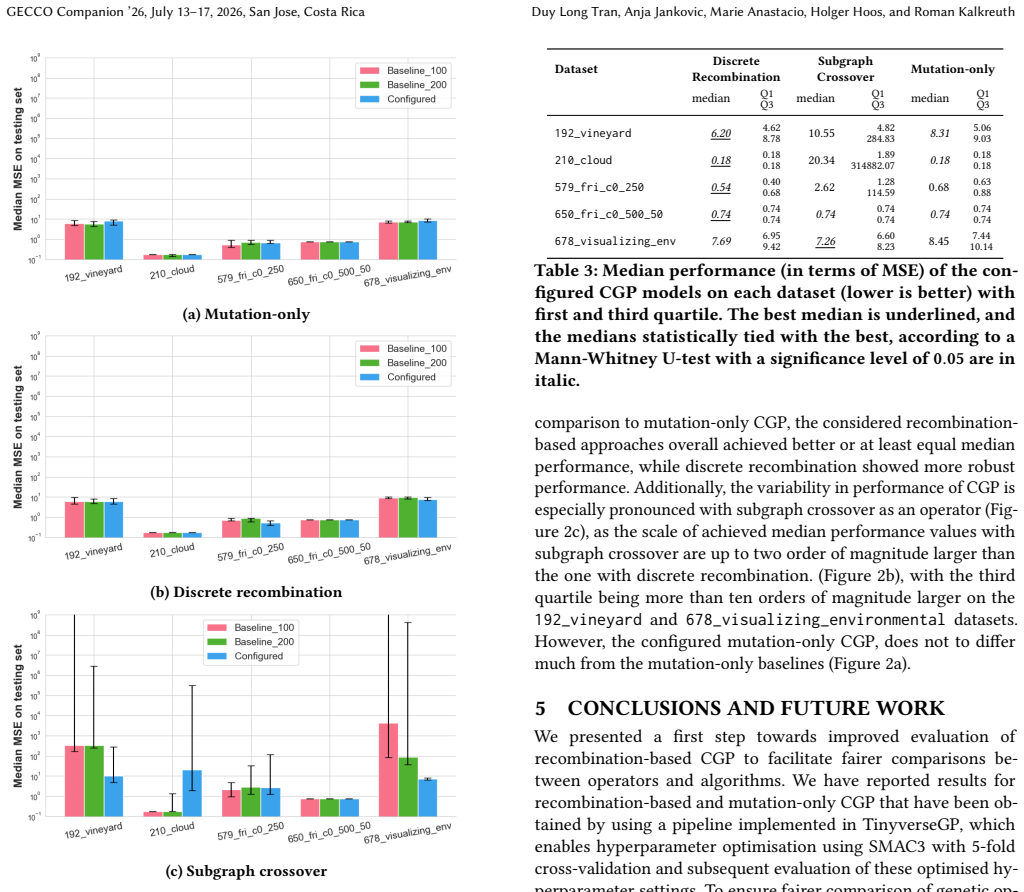
Our work demonstrates that hyperparameter optimisation can lead to improvements in performance for recombination-based Cartesian Genetic Programming. This is achieved by testing subgraph crossover and discrete phenotypic recombination on SRBench after tuning hyperparameters for the respective representations using the TinyverseGP implementations.
What carries the argument
Hyperparameter optimization of representations that employ subgraph crossover and discrete phenotypic recombination in Cartesian Genetic Programming.
If this is right
- Recombination operators can deliver performance gains in Cartesian Genetic Programming once hyperparameters are tuned.
- Earlier conclusions against recombination may have rested on evaluations that did not optimize the underlying representations.
- Symbolic regression tasks on SRBench can benefit from the tuned recombination-based variants.
- The TinyverseGP framework provides usable implementations for conducting such operator-specific tuning.
Where Pith is reading between the lines
- The same optimization approach could be tested on other genetic programming variants or benchmark suites to check generality.
- Future comparisons of mutation versus recombination in CGP should include hyperparameter tuning for both to avoid biased results.
- If the gains persist under stricter validation, hybrid mutation-plus-recombination schedules may become standard in CGP practice.
Load-bearing premise
The hyperparameter optimization was performed without selection bias or overfitting and the TinyverseGP implementations faithfully represent the two recombination operators under test.
What would settle it
A replication that performs the identical hyperparameter optimization on the same two operators but records no performance improvement on SRBench, or that shows the chosen parameters overfit the benchmark data.
Figures

read the original abstract
Cartesian Genetic Programming has traditionally been using mutation as its main and often sole genetic operator to drive evolutionary search. Despite advancements in recent years, recombinationbased approaches have long been avoided, due to apparent lack of performance gains. This study examines two recently suggested recombination-based operators, subgraph crossover and discrete phenotypic recombination on SRBench, a benchmarking platform for symbolic regression. Using the implementations provided in the TinyverseGP framework, we perform hyperparameter optimisation of the respective representations with these two operators. Our work demonstrates that hyperparameter optimisation can lead to improvements in performance for recombination-based Cartesian Genetic Programming.
Editorial analysis
A structured set of objections, weighed in public.
Referee Report
Summary. The manuscript evaluates two recombination operators (subgraph crossover and discrete phenotypic recombination) for Cartesian Genetic Programming on the SRBench symbolic regression benchmark, using TinyverseGP implementations. It claims that hyperparameter optimization of the respective representations with these operators produces performance improvements, challenging the traditional view that recombination yields no gains in CGP.
Significance. If substantiated with proper controls, the result would indicate that recombination-based CGP can be competitive when hyperparameters are tuned, potentially broadening the set of viable genetic operators in the field and motivating further operator development.
major comments (2)
- [Abstract] Abstract: the central claim that hyperparameter optimisation 'can lead to improvements in performance' is asserted without any reported data, tables, statistical tests, baseline comparisons, or experimental details, so the demonstration cannot be evaluated from the text.
- [Experimental procedure] Experimental procedure (hyperparameter optimisation section): no information is given on whether tuning used a held-out validation split, cross-validation, or was performed directly on the final SRBench test problems; without this, any reported gains are at risk of reflecting selection bias or overfitting rather than genuine operator improvement.
minor comments (1)
- The implementations are taken from TinyverseGP; the manuscript should explicitly confirm that these match the operator definitions in the cited source papers to ensure the comparison is faithful.
Simulated Author's Rebuttal
We thank the referee for their constructive comments and the opportunity to clarify our work. We address each major comment below.
read point-by-point responses
-
Referee: [Abstract] Abstract: the central claim that hyperparameter optimisation 'can lead to improvements in performance' is asserted without any reported data, tables, statistical tests, baseline comparisons, or experimental details, so the demonstration cannot be evaluated from the text.
Authors: We acknowledge that the abstract is concise and does not embed specific numerical results or statistical details. The full manuscript reports these elements in the results section, including performance tables, baseline comparisons on SRBench, and statistical tests. We will revise the abstract to briefly reference the key observed improvements and their statistical support for better self-containment. revision: yes
-
Referee: [Experimental procedure] Experimental procedure (hyperparameter optimisation section): no information is given on whether tuning used a held-out validation split, cross-validation, or was performed directly on the final SRBench test problems; without this, any reported gains are at risk of reflecting selection bias or overfitting rather than genuine operator improvement.
Authors: We agree this detail should have been explicit. Hyperparameter tuning was performed on held-out validation splits drawn from the SRBench problems (separate from the final test sets) to mitigate overfitting risk. We will revise the hyperparameter optimisation section to document the exact procedure, including validation split usage and any cross-validation steps employed. revision: yes
Circularity Check
No circularity: empirical hyperparameter study with no derivation chain
full rationale
The paper reports an empirical study applying hyperparameter optimization to two recombination operators in Cartesian Genetic Programming and evaluating on SRBench. The abstract and description contain no equations, no fitted parameters presented as predictions, and no load-bearing self-citations or uniqueness theorems. The central claim (that hyperparameter optimization yields performance improvements) is an experimental outcome, not a quantity that reduces to its own inputs by construction. No steps match any of the enumerated circularity patterns.
Axiom & Free-Parameter Ledger
Reference graph
Works this paper leans on
-
[1]
Benchmarking in optimization: Best practice and open issues.arXiv preprint arXiv:2007.03488, 2020
T. Bartz-Beielstein, C. Doerr, D. van den Berg, J. Bossek, S. Chandrasekaran, T. Ef- timov, A. Fischbach, P. Kerschke, W. La Cava, M. López-Ibáñez, K. M. Malan, J. H. Moore, B. Naujoks, P. Orzechowski, V. Volz, M. Wagner, and T. Weise. 2020. Bench- marking in Optimization: Best Practice and Open Issues. arXiv:2007.03488 [cs.NE] Improving Evaluation of Rec...
-
[2]
Bergstra and Y
J. Bergstra and Y. Bengio. 2012. Random Search for Hyper-Parameter Optimiza- tion.Journal of Machine Learning Research13 (2012), 281–305
2012
-
[3]
W. G. La Cava, P. Orzechowski, B. Burlacu, F. O. de França, M. Virgolin, Y. Jin, M. Kommenda, and J. H. Moore. 2021. Contemporary Symbolic Regression Methods and their Relative Performance. InProceedings of the 35th International Conference on Neural Information Processing Systems (NeurIPS 2021) Track on Datasets and Benchmarks
2021
-
[4]
Clegg, J
J. Clegg, J. A. Walker, and J. F. Miller. 2007. A New Crossover Technique for Cartesian Genetic Programming. InProceedings of the Genetic and Evolutionary Computation Conference (GECCO’07). 1580–1587
2007
-
[5]
N. L. Cramer. 1985. A Representation for the Adaptive Generation of Simple Sequential Programs. InProceedings of the 1st International Conference on Genetic Algorithms. 183–187
1985
-
[6]
Dickmanns, J
D. Dickmanns, J. Schmidhuber, and A. Winklhofer. 1987.Der genetische Algorith- mus: Eine Implementierung in Prolog. Fortgeschrittenenpraktikum. Institut für Informatik, Technische Universität Mänchen
1987
-
[7]
P. I. Frazier. 2018. A Tutorial on Bayesian Optimization.CoRRabs/1807.02811 (2018). arXiv:1807.02811
work page internal anchor Pith review Pith/arXiv arXiv 2018
-
[8]
R. Garnett. 2023.Bayesian Optimization. Cambridge University Press
2023
-
[9]
S Imai Aldeia, H
G. S Imai Aldeia, H. Zhang, G. Bomarito, M. Cranmer, A. Fonseca, B. Burlacu, W. G. La Cava, and F. O. de França. 2025. Call for Action: Towards the next generation of symbolic regression benchmarks. InProceedings of the Genetic and Evolutionary Computation Conference (GECCO’25) Companion. 2529–2538
2025
-
[10]
Kalkreuth
R. Kalkreuth. 2020. A Comprehensive Study on Subgraph Crossover in Cartesian Genetic Programming. InProceedings of the 12th International Joint Conference on Computational Intelligence (IJCCI 2020). 59–70
2020
-
[11]
Kalkreuth
R. Kalkreuth. 2022. Towards Discrete Phenotypic Recombination in Cartesian Genetic Programming. InProceedings of the International Conference on Parallel Problem Solving from Nature (PPSN’22). 63–77
2022
-
[12]
Kalkreuth, F
R. Kalkreuth, F. O. de França, J. Dierkes, M. Anastacio, A. Jankovic, Z. Vasícek, and H. H. Hoos. 2025. TinyverseGP: Towards a Modular Cross-domain Bench- marking Framework for Genetic Programming. InProceedings of the Genetic and Evolutionary Computation Conference Companion (GECCO ’25 Companion). 127–130
2025
-
[13]
Kalkreuth, G
R. Kalkreuth, G. Rudolph, and A. Droschinsky. 2017. A New Subgraph Crossover for Cartesian Genetic Programming. InGenetic Programming - 20th European Con- ference, EuroGP 2017, Amsterdam, The Netherlands, April 19-21, 2017, Proceedings, Vol. 10196. 294–310
2017
-
[14]
Kocherovsky and W
M. Kocherovsky and W. Banzhaf. 2024. Crossover Destructiveness in Cartesian versus Linear Genetic Programming. InProceedings of the Artificial Life Conference (ALIFE 2024), Vol. ALIFE 2024: Proceedings of the 2024 Artificial Life Conference
2024
-
[15]
J. R. Koza. 1992. Genetic Programming: On the Programming of Computers by Means of Natural Selection.MA: MIT Press.(1992), 1–840
1992
-
[16]
Kronberger, B
G. Kronberger, B. Burlacu, M. Kommenda, S. M. Winkler, and M. Affenzeller. 2024. Basics of Symbolic Regression. InSymbolic Regression. 21–34
2024
-
[17]
Niklas Lavesson and Paul Davidsson. 2006. Quantifying the Impact of Learning Algorithm Parameter Tuning. InProceedings of the 21st National Conference on Artificial Intelligence(AAAI). 395–400
2006
-
[18]
Lindauer, K
M. Lindauer, K. Eggensperger, M. Feurer, A. Biedenkapp, D. Deng, C. Benjamins, T. Ruhkopf, R. Sass, and F. Hutter. 2022. SMAC3: A Versatile Bayesian Optimization Package for Hyperparameter Optimization.Journal of Machine Learning Research 23 (2022), 1–9
2022
-
[19]
S. Luke. 1998. ECJ Evolutionary Computation Library. http://cs.gmu.edu/$\ sim$eclab/projects/ecj/
1998
-
[20]
J. F. Miller. 2011. Cartesian Genetic Programming. InCartesian Genetic Program- ming. 17–34
2011
-
[21]
J. F. Miller and P. Thomson. 2000. Cartesian Genetic Programming. InGenetic Programming, European Conference, Edinburgh, Scotland, UK, April 15-16, 2000, Proceedings, Vol. 1802. 121–132
2000
-
[22]
Q. U. Nguyen, X. H. Nguyen, M. O’Neill, R. I. McKay, and E. Galván López. 2011. Semantically-based Crossover in Genetic Programming: Application to Real- Valued Symbolic Regression.Genetic Programming and Evolvable Machines12, 2 (2011), 91–119
2011
-
[23]
R. S. Olson, W. La Cava, P. Orzechowski, R. J. Urbanowicz, and J. H. Moore
-
[24]
PMLB: A Large Benchmark Suite for Machine Learning Evaluation and Comparison.BioData Mining10, 1 (2017), 1–36
2017
- [25]
-
[26]
E. O. Scott and S. Luke. 2019. ECJ at 20: Toward a General Metaheuristics Toolkit. InProceedings of the Genetic and Evolutionary Computation Conference Companion, GECCO 2019, Prague, Czech Republic, July 13-17, 2019. 1391–1398
2019
-
[27]
Snoek, H
J. Snoek, H. Larochelle, and R. P. Adams. 2012. Practical Bayesian Optimization of Machine Learning Algorithms. InProceedings of the 26th Conference on Advances in Neural Information Processing Systems (NeurIPS), Vol. 25
2012
-
[28]
Vladislavleva, G
E. Vladislavleva, G. Smits, and D. den Hertog. 2009. Order of Nonlinearity as a Complexity Measure for Models Generated by Symbolic Regression via Pareto Genetic Programming.IEEE Transactions on Evolutionary Computation13, 2 (2009), 333–349
2009
-
[29]
D. R. White, J. McDermott, M. Castelli, L. Manzoni, B. W. Goldman, G. Kron- berger, W. Jaskowski, U.-M. O’Reilly, and S. Luke. 2013. Better GP Benchmarks: Community Survey Results and Proposals.Genetic Programming and Evolvable Machines14, 1 (2013), 3–29. GECCO Companion ’26, July 13–17, 2026, San Jose, Costa Rica Duy Long Tran, Anja Jankovic, Marie Anast...
2013
discussion (0)
Sign in with ORCID, Apple, or X to comment. Anyone can read and Pith papers without signing in.