Signatures of loop quantum gravity in primordial black hole cosmologies
Pith reviewed 2026-06-29 10:19 UTC · model grok-4.3
The pith
Primordial black holes near 10^3 kg mass let their remnants form all dark matter after natural reheating.
A machine-rendered reading of the paper's core claim, the machinery that carries it, and where it could break.
Core claim
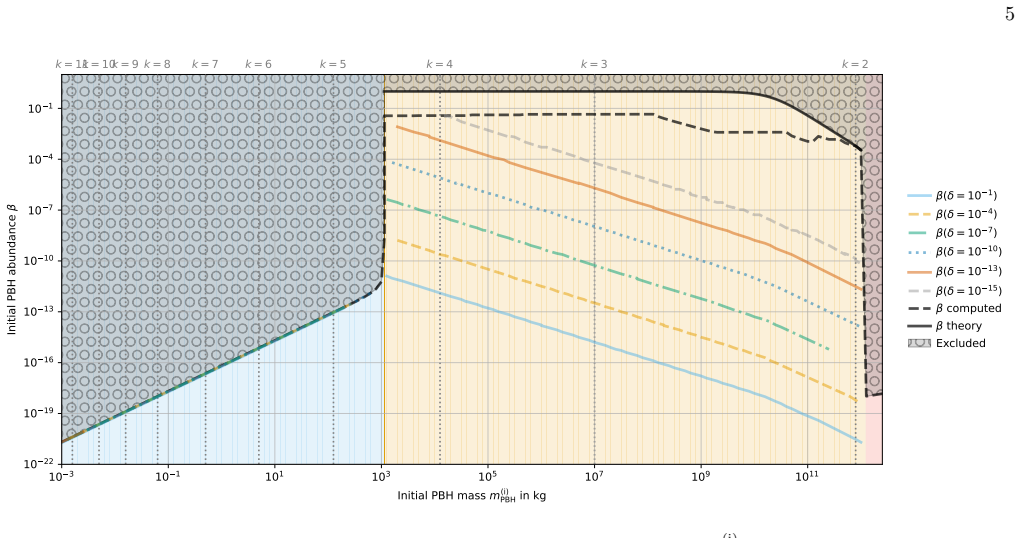
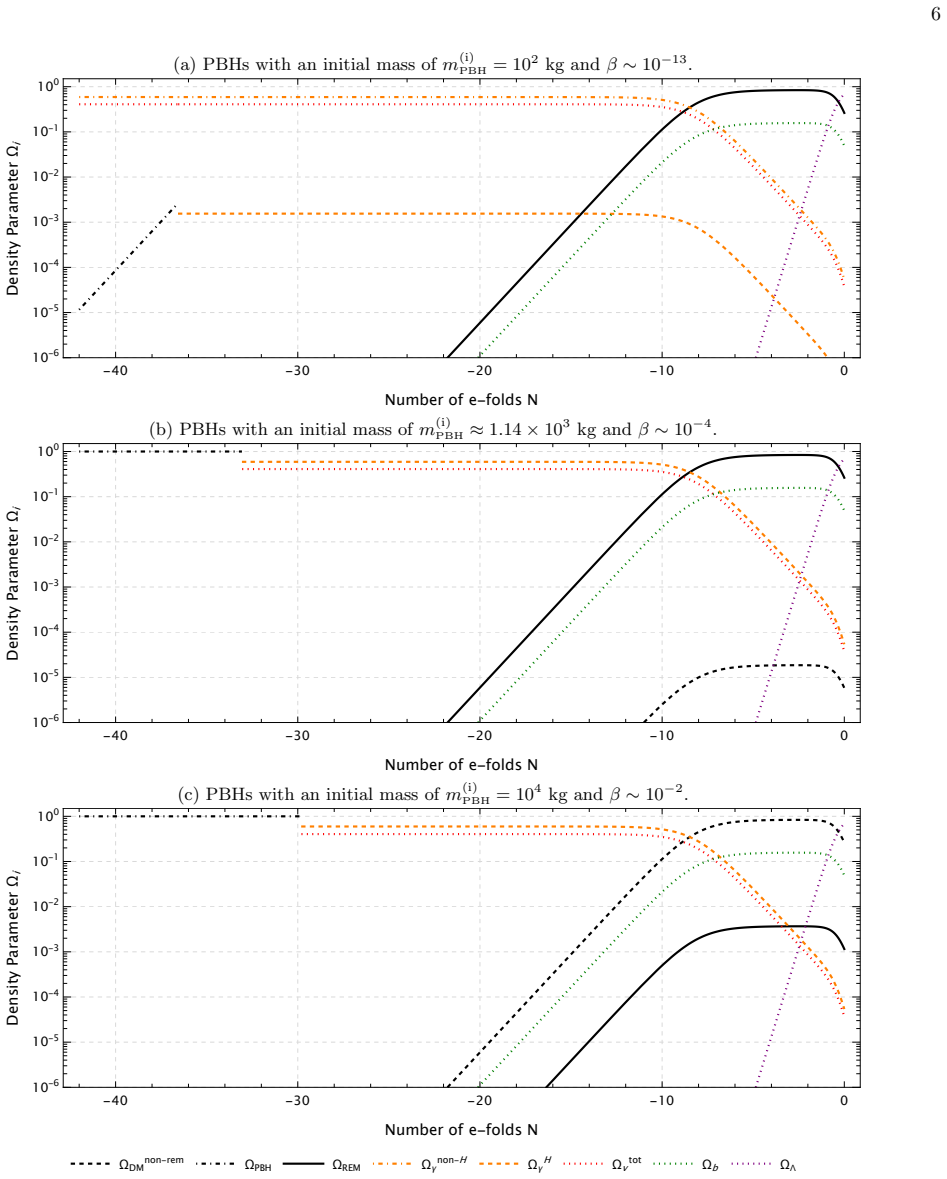
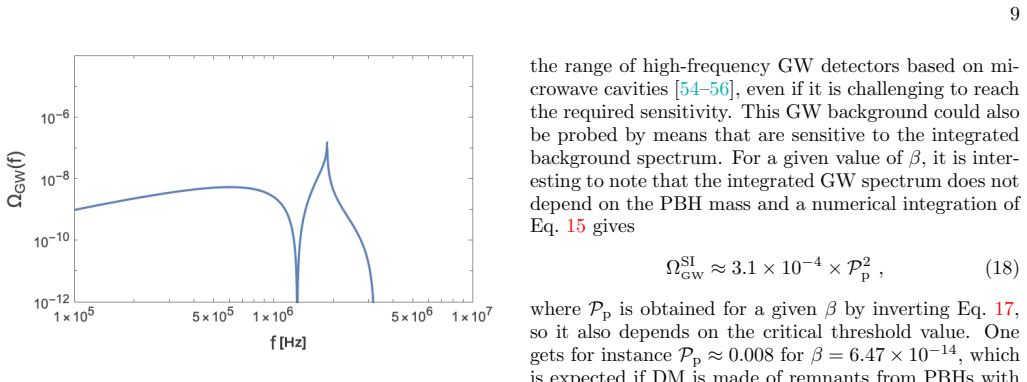
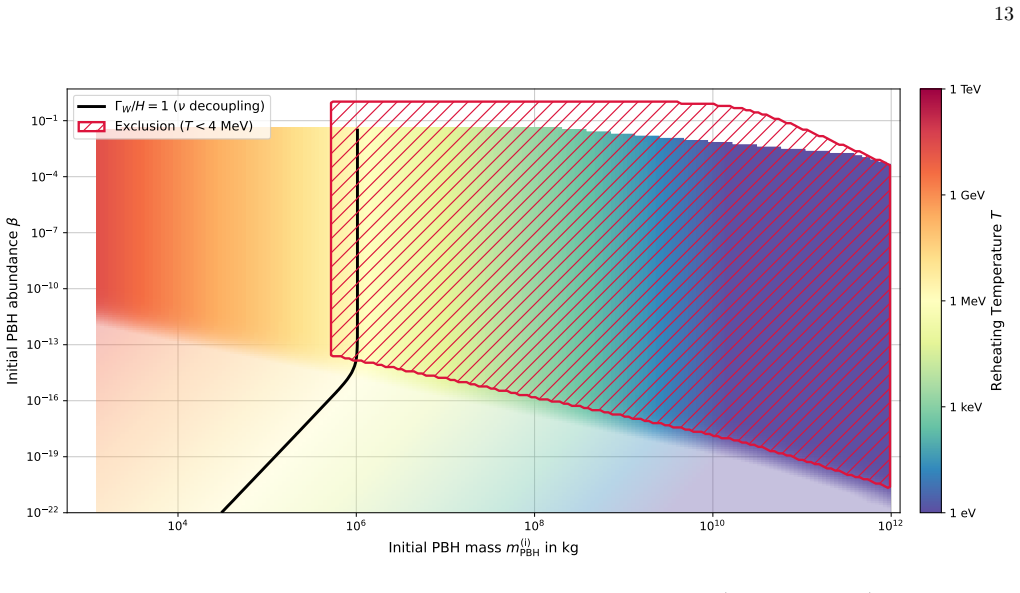
A PBH mass around 10^3 kg allows Hawking evaporation to reheat the Universe while the remnants entirely constitute the present-day DM. This scenario does not require fine-tuning the initial abundance of PBHs of this mass, which could range from 10^{-10} to order one. These early-Universe cosmologies produce distinct observational signatures through scalar-induced gravitational waves sourced by primordial or Poisson fluctuations amplified by the early PBH-dominated era, and through constraints on the effective number of relativistic degrees of freedom.
What carries the argument
Mass-dependent Hawking evaporation of primordial black holes that leaves stable Planckian remnants, whose abundance is limited by overproduction or underproduction constraints and whose early dominance creates an amplified gravitational-wave background.
If this is right
- Any observational evidence for PBHs lighter than 10^3 kg would overproduce Planckian relics and thereby challenge models with quasi-stable remnants.
- Hawking radiation from PBHs between 10^3 kg and 10^12 kg restricts Planckian relics to a highly subdominant dark-matter component.
- The early PBH-dominated era amplifies scalar-induced gravitational waves that current and future detectors (LIGO/Virgo/KAGRA, Einstein Telescope, LISA) can observe.
- Measurements of the effective number of relativistic degrees of freedom together with gravitational-wave data can jointly bound both the initial PBH abundance and the present-day relic abundance.
Where Pith is reading between the lines
- The narrow viable mass window implies that any confirmation would tie loop-quantum-gravity remnants to dark matter in a way that is robust against variations in initial conditions.
- The amplified gravitational-wave spectrum may carry a distinct shape set by the duration of the PBH-dominated phase, offering a potential discriminator from other early-matter-domination models.
- Non-detection of the predicted waves in the relevant frequency bands could exclude this remnant-dark-matter channel even before direct relic searches become feasible.
Load-bearing premise
Loop quantum gravity yields stable Planckian remnants from primordial black hole evaporation that persist unchanged to the present day and can serve as dark matter.
What would settle it
Detection of primordial black holes with masses well below or above the 10^3 kg window together with a relic density inconsistent with the predicted range, or the absence of the expected gravitational-wave background from an early PBH-dominated era, would falsify the central claim.
Figures





read the original abstract
The possibility that Dark Matter (DM) is partially or totally constituted by stable Planckian remnants of light Primordial Black Holes (PBHs), suggested for instance by Loop Quantum Gravity (LQG), is investigated. Distinct phenomenological regimes are identified, including scenarios that trigger an early matter-dominated epoch. New constraints are derived on the initial PBH and final remnant abundances. We show that a significant initial abundance of PBHs lighter than $10^3$ kg would overproduce Planckian relics, implying that any observational evidence for such PBHs would challenge models with quasi-stable remnants. Conversely, the products of Hawking radiation from PBHs with masses between $10^3$ and $10^{12}$ kg impose that Planckian relics could only be a highly subdominant DM component. We identify a PBH mass around $10^3$ kg for which Hawking evaporation naturally reheats the Universe while the remnants entirely constitute the present-day DM. Such a scenario does not require fine-tuning the initial abundance of PBH of this mass, which could range from $10^{-10}$ to order one. These early-Universe cosmologies yield distinct observational signatures: scalar-induced gravitational waves sourced by primordial or Poisson fluctuations that are amplified by the early PBH-dominated era. Current and future observations of LIGO/Virgo/KAGRA, the Einstein Telescope and LISA, as well as probes of the effective number of relativistic degrees of freedom, can be used to probe and constrain the initial PBH abundance and the present-day abundance of Planckian relics.
Editorial analysis
A structured set of objections, weighed in public.
Referee Report
Summary. The manuscript investigates the possibility that dark matter consists of stable Planckian remnants from evaporating light primordial black holes (PBHs), as suggested by loop quantum gravity. It identifies distinct phenomenological regimes (including early matter-dominated epochs), derives constraints on initial PBH and final remnant abundances, and highlights a specific PBH mass window around 10^3 kg where Hawking evaporation reheats the universe while the remnants account for all present-day dark matter without fine-tuning the initial abundance (allowed range 10^{-10} to O(1)). The work also predicts observable signatures in scalar-induced gravitational waves (amplified by the PBH-dominated era) and the effective number of relativistic degrees of freedom, testable with LIGO/Virgo/KAGRA, Einstein Telescope, LISA, and cosmological probes.
Significance. If the remnant-stability assumption holds, the paper supplies a concrete, falsifiable link between LQG-motivated remnants and early-universe cosmology. The identification of a natural reheating + DM-matching window at ~10^3 kg, together with the broad allowed initial-abundance range and the explicit GW and N_eff signatures, constitutes a strength. The work is grounded in standard Hawking evaporation and cosmology applied to the remnant hypothesis and offers clear observational targets.
major comments (2)
- [Abstract and Introduction] Abstract (opening sentence) and §1: The entire scenario, including the reheating calculation and the DM abundance matching at the ~10^3 kg mass, rests on the assumption that LQG produces stable, non-evaporating Planckian remnants. No derivation from LQG area quantization, effective dynamics, or specific model is supplied to justify why the remnant does not continue to radiate or decay after reaching the Planck scale. This is load-bearing for the central claim.
- [Abstract] Abstract (paragraph on the 10^3 kg window): The statement that the initial PBH abundance 'could range from 10^{-10} to order one' without fine-tuning is asserted but not demonstrated via explicit evolution equations for the abundance; the supporting calculation that maps the evaporation endpoint to the observed DM density is not shown in the provided text and is required to substantiate the 'no fine-tuning' claim.
minor comments (2)
- [Abstract] The abstract refers to 'distinct phenomenological regimes' but does not enumerate them; adding a short list or table in the introduction would improve readability.
- [Abstract] Notation for the initial PBH fraction and remnant fraction should be defined consistently when first introduced; the transition between the two is not always clear from the abstract alone.
Simulated Author's Rebuttal
We thank the referee for their careful reading, positive assessment of the manuscript's significance, and constructive comments. We address each major comment below.
read point-by-point responses
-
Referee: [Abstract and Introduction] Abstract (opening sentence) and §1: The entire scenario, including the reheating calculation and the DM abundance matching at the ~10^3 kg mass, rests on the assumption that LQG produces stable, non-evaporating Planckian remnants. No derivation from LQG area quantization, effective dynamics, or specific model is supplied to justify why the remnant does not continue to radiate or decay after reaching the Planck scale. This is load-bearing for the central claim.
Authors: We agree that remnant stability is a foundational assumption of the scenario. The manuscript explicitly frames the work as an investigation of the phenomenological consequences of stable Planckian remnants 'suggested for instance by Loop Quantum Gravity (LQG)', rather than a derivation of that stability from first principles. A full derivation from LQG area quantization or effective dynamics lies outside the scope of this cosmology-focused paper and would require a separate quantum-gravity analysis. revision: no
-
Referee: [Abstract] Abstract (paragraph on the 10^3 kg window): The statement that the initial PBH abundance 'could range from 10^{-10} to order one' without fine-tuning is asserted but not demonstrated via explicit evolution equations for the abundance; the supporting calculation that maps the evaporation endpoint to the observed DM density is not shown in the provided text and is required to substantiate the 'no fine-tuning' claim.
Authors: The referee is correct that the explicit evolution equations and the mapping from evaporation endpoint to present-day DM density should be shown more transparently to support the no-fine-tuning statement. In the revised manuscript we will insert the relevant Boltzmann equations for the PBH and remnant energy densities together with the analytic mapping that yields the quoted abundance window for a PBH mass of ~10^3 kg. revision: yes
Circularity Check
No significant circularity; standard cosmology applied to external LQG hypothesis
full rationale
The paper takes the stability of Planckian remnants as a motivating hypothesis suggested by LQG without deriving it internally or via self-citation chains. All constraints on PBH abundances, reheating, and DM matching follow from standard Hawking evaporation rates and cosmological evolution equations applied to this assumption. No predictions reduce to fitted parameters by the paper's own equations, and no load-bearing steps invoke self-citations or ansatze smuggled from prior work. The derivation chain is independent and self-contained against external benchmarks.
Axiom & Free-Parameter Ledger
axioms (2)
- domain assumption Loop quantum gravity produces stable Planckian remnants that do not evaporate further
- standard math Standard Hawking radiation and cosmological evolution apply to PBHs
invented entities (1)
-
Planckian relics as dark matter component
no independent evidence
Reference graph
Works this paper leans on
-
[1]
Planckian remnants: a fractionϵof the PBH mass stabilizes in remnants. In the LQG scenario, the remnant mass is fixed by the Planck scalem P and ϵis given by: ϵ= mREM mPBH(Nb) = q 3 √ 3γLQG/2 mP mPBH(Ni) ,(5) whereγ LQG is called the Barbero-Immirzi parame- ter, assumed here to be of order one without loss of generality. Compared to the memory burden effe...
-
[2]
sweet spot
Hawking radiation products: the remaining mass fraction (1−ϵ) is converted into Standard Model particles and gravitons, but not into beyond Stan- dard Model particles. In order to accurately model this injection, we use theBlackHawkcode [46, 47] to compute the spectra for each species that we then integrate over time and frequency. More pre- cisely,BlackH...
-
[3]
Computation of theαparameters Theαparameters are computed by requiring that the observed density of photonsρ obs γ , baryonic matterρ obs b and DMρ obs DM are consistent with the prediction of the model. The initial conditions are parametrized, for each background speciesA, by ρA(N − i )≡α Ae−3(1+wA)Ni ρobs A ,(A1) except for the neutrino density which is...
-
[4]
S. Bird, I. Cholis, J. B. Mu˜ noz, Y. Ali-Ha¨ ımoud, M. Kamionkowski, E. D. Kovetz, A. Raccanelli, and A. G. Riess, Did LIGO detect dark matter?, Phys. Rev. Lett.116, 201301 (2016), arXiv:1603.00464 [astro- ph.CO]
work page internal anchor Pith review Pith/arXiv arXiv 2016
-
[5]
S. Clesse and J. Garc´ ıa-Bellido, The clustering of mas- sive Primordial Black Holes as Dark Matter: measuring their mass distribution with Advanced LIGO, Phys. Dark Univ.15, 142 (2017), arXiv:1603.05234 [astro-ph.CO]
work page internal anchor Pith review Pith/arXiv arXiv 2017
-
[6]
Primordial Black Hole Scenario for the Gravitational-Wave Event GW150914
M. Sasaki, T. Suyama, T. Tanaka, and S. Yokoyama, Primordial Black Hole Scenario for the Gravitational- Wave Event GW150914, Phys. Rev. Lett.117, 061101 (2016), [Erratum: Phys.Rev.Lett. 121, 059901 (2018)], arXiv:1603.08338 [astro-ph.CO]
work page internal anchor Pith review Pith/arXiv arXiv 2016
-
[7]
Hawking, Gravitationally collapsed objects of very low mass, Mon
S. Hawking, Gravitationally collapsed objects of very low mass, Mon. Not. Roy. Astron. Soc.152, 75 (1971)
1971
-
[8]
B. J. Carr and S. W. Hawking, Black holes in the early Universe, Mon. Not. Roy. Astron. Soc.168, 399 (1974)
1974
-
[9]
Meszaros, Primeval black holes and galaxy formation, Astron
P. Meszaros, Primeval black holes and galaxy formation, Astron. Astrophys.38, 5 (1975)
1975
-
[10]
G. F. Chapline, Cosmological effects of primordial black holes, Nature253, 251 (1975)
1975
-
[11]
Byrnes, G
C. Byrnes, G. Franciolini, T. Harada, P. Pani, and M. Sasaki, eds.,Primordial Black Holes, Springer Series in Astrophysics and Cosmology (Springer, 2025)
2025
-
[12]
E. Baguiet al.(LISA Cosmology Working Group), Pri- mordial black holes and their gravitational-wave signa- tures, Living Rev. Rel.28, 1 (2025), arXiv:2310.19857 [astro-ph.CO]
-
[13]
Primordial Black Holes as Dark Matter: Recent Developments
B. Carr and F. Kuhnel, Primordial Black Holes as Dark Matter: Recent Developments, Ann. Rev. Nucl. Part. Sci. 70, 355 (2020), arXiv:2006.02838 [astro-ph.CO]
work page internal anchor Pith review Pith/arXiv arXiv 2020
- [14]
- [15]
-
[16]
Seven Hints for Primordial Black Hole Dark Matter
S. Clesse and J. Garc´ ıa-Bellido, Seven Hints for Primor- dial Black Hole Dark Matter, Phys. Dark Univ.22, 137 (2018), arXiv:1711.10458 [astro-ph.CO]
work page internal anchor Pith review Pith/arXiv arXiv 2018
-
[17]
J. H. MacGibbon, Can Planck-mass relics of evaporating black holes close the universe?, Nature329, 308 (1987)
1987
-
[18]
Black hole metamorphosis and stabilization by memory burden,
G. Dvali, L. Eisemann, M. Michel, and S. Zell, Black hole metamorphosis and stabilization by memory burden, Phys. Rev. D102, 103523 (2020), arXiv:2006.00011 [hep- th]
-
[19]
White Holes as Remnants: A Surprising Scenario for the End of a Black Hole
E. Bianchi, M. Christodoulou, F. D’Ambrosio, H. M. Haggard, and C. Rovelli, White holes as remnants: a sur- prising scenario for the end of a black hole, Class. Quant. Grav.35, 225003 (2018), arXiv:1802.04264 [gr-qc]
work page internal anchor Pith review Pith/arXiv arXiv 2018
-
[20]
M. Christodoulou, A. Perez, and C. Rovelli, Detecting Planck-Scale Dark Matter with Quantum Interference, Phys. Rev. Lett.133, 111001 (2024), arXiv:2309.08238 [gr-qc]
-
[21]
C. Rovelli and F. Vidotto, Planck stars, White Holes, Remnants and Planck-mass quasi-particles. The quan- tum gravity phase in black holes’ evolution and its man- ifestations, arXiv e-prints (2024), arXiv:2407.09584 [gr- qc]
-
[22]
Small black/white hole stability and dark matter
C. Rovelli and F. Vidotto, Small black/white hole stability and dark matter, Universe4, 127 (2018), arXiv:1805.03872 [gr-qc]
work page internal anchor Pith review Pith/arXiv arXiv 2018
-
[23]
N. F. Bell and R. R. Volkas, Mirror matter and primordial black holes, Phys. Rev. D59, 107301 (1999), arXiv:astro- ph/9812301. 17 10 3 10 1 101 103 105 107 109 1011 1013 initial mass of the PBHs mi PBH in kg 10 19 10 16 10 13 10 10 10 7 10 4 10 1 c PBH ( = 1e 15) ( = 1e 20) ( = 1e 22) ( = 1e 24) = FIG. 9. Simulation results for the maximum initial PBH abu...
-
[24]
Baryon Asymmetry, Dark Matter, and Density Perturbation from PBH
T. Fujita, M. Kawasaki, K. Harigaya, and R. Matsuda, Baryon asymmetry, dark matter, and density pertur- bation from primordial black holes, Phys. Rev. D89, 103501 (2014), arXiv:1401.1909 [astro-ph.CO]
work page internal anchor Pith review Pith/arXiv arXiv 2014
-
[25]
Non-thermal Production of Dark Matter from Primordial Black Holes
R. Allahverdi, J. Dent, and J. Osinski, Nonthermal pro- duction of dark matter from primordial black holes, Phys. Rev. D97, 055013 (2018), arXiv:1711.10511 [astro- ph.CO]
work page internal anchor Pith review Pith/arXiv arXiv 2018
- [26]
-
[27]
Masina, Dark matter and dark radiation from evap- orating primordial black holes, Eur
I. Masina, Dark matter and dark radiation from evap- orating primordial black holes, Eur. Phys. J. Plus135, 552 (2020), arXiv:2004.04740 [hep-ph]
- [28]
- [29]
- [30]
-
[31]
O. Trivedi and A. Loeb, Gaussian Planck relics are ruled- out as dark matter by LIGO, Phys. Dark Univ.50, 102174 (2025), arXiv:2509.20533 [astro-ph.CO]
-
[32]
Quantum-gravity phenomenology with primordial black holes
F. Vidotto, A. Barrau, B. Bolliet, M. Shutten, and C. Weimer, Quantum-gravity phenomenology with pri- mordial black holes, Springer Proc. Phys.208, 157 (2018), arXiv:1609.02159 [gr-qc]
work page internal anchor Pith review Pith/arXiv arXiv 2018
-
[33]
A. Barrau, K. Martineau, and F. Moulin, A status re- port on the phenomenology of black holes in loop quan- tum gravity: Evaporation, tunneling to white holes, dark matter and gravitational waves, Universe4, 102 (2018), arXiv:1808.08857 [gr-qc]
work page internal anchor Pith review Pith/arXiv arXiv 2018
-
[34]
B. J. Carr and A. A. Coley, Persistence of black holes through a cosmological bounce, Int. J. Mod. Phys. D20, 2733 (2011), arXiv:1104.3796 [astro-ph.CO]
work page internal anchor Pith review Pith/arXiv arXiv 2011
-
[35]
Black hole formation in a contracting universe
J. Quintin and R. H. Brandenberger, Black hole for- mation in a contracting universe, JCAP11(11), 029, arXiv:1609.02556 [astro-ph.CO]
work page internal anchor Pith review Pith/arXiv arXiv
- [36]
-
[37]
Papanikolaou, Primordial black holes in loop quantum cosmology: the effect on the threshold, Class
T. Papanikolaou, Primordial black holes in loop quantum cosmology: the effect on the threshold, Class. Quant. Grav.40, 134001 (2023), arXiv:2301.11439 [gr-qc]
-
[38]
Quasi-dust ekpyrotic scenario in Loop Quantum Cosmology
E. Frion, M. Pascual, and F. Vidotto, Quasi-dust ekpy- rotic scenario in loop quantum cosmology, Class. Quant. Grav.43, 055012 (2026), arXiv:2509.06148 [gr-qc]
work page internal anchor Pith review Pith/arXiv arXiv 2026
-
[39]
G. Dom` enech and M. Sasaki, Gravitational wave hints black hole remnants as dark matter, Class. Quant. Grav. 40, 177001 (2023), arXiv:2303.07661 [gr-qc]
-
[40]
S. W. Hawking, Black hole explosions, Nature248, 30 (1974)
1974
- [41]
-
[42]
M. Christodoulou and F. D’Ambrosio, Characteristic time scales for the geometry transition of a black hole to a white hole from spinfoams, Class. Quant. Grav.41, 195030 (2024), arXiv:1801.03027 [gr-qc]
-
[43]
M. Christodoulou and C. Rovelli, How big is a black hole?, Phys. Rev. D91, 064046 (2015), arXiv:1411.2854 18 [gr-qc]
work page internal anchor Pith review Pith/arXiv arXiv 2015
-
[44]
P. Martin-Dussaud, The lifetime of white hole remnants isM 5, arXiv e-prints (2025), arXiv:2504.05492 [gr-qc]
-
[45]
Minimum lifetime of a black hole
E. Bianchi, M. Brandsema, K. Czuprynski, and D. E. Paraizo, Minimum lifetime of a black hole, arXiv e-prints (2026), arXiv:2605.03922 [gr-qc]
work page internal anchor Pith review Pith/arXiv arXiv 2026
-
[46]
B. J. Carr, K. Kohri, Y. Sendouda, and J. Yokoyama, New cosmological constraints on primordial black holes, Phys. Rev. D81, 104019 (2010), arXiv:0912.5297 [astro- ph.CO]
work page internal anchor Pith review Pith/arXiv arXiv 2010
-
[47]
B. Carr, K. Kohri, Y. Sendouda, and J. Yokoyama, Con- straints on primordial black holes, Rept. Prog. Phys.84, 116902 (2021), arXiv:2002.12778 [astro-ph.CO]
work page internal anchor Pith review Pith/arXiv arXiv 2021
-
[48]
Dierckx, pbh-rem: Primordial Black Hole Rem- nant Evolution Model,https://github.com/adierckx/ pbh-rem(2025), gitHub repository
A. Dierckx, pbh-rem: Primordial Black Hole Rem- nant Evolution Model,https://github.com/adierckx/ pbh-rem(2025), gitHub repository
2025
-
[49]
A. Arbey and J. Auffinger, BlackHawk: A public code for calculating the Hawking evaporation spectra of any black hole distribution, Eur. Phys. J. C79, 693 (2019), arXiv:1905.04268 [gr-qc]
-
[50]
Physics Beyond the Standard Model with BlackHawk v2.0,
A. Arbey and J. Auffinger, Physics Beyond the Standard Model with BlackHawk v2.0, Eur. Phys. J. C81, 910 (2021), arXiv:2108.02737 [gr-qc]
-
[51]
Do Black Holes Destroy Information?
J. Preskill, Do black holes destroy information?, inInter- national Symposium on Black holes, Membranes, Worm- holes and Superstrings(1992) arXiv:hep-th/9209058
work page internal anchor Pith review Pith/arXiv arXiv 1992
-
[52]
Z.-M. Zeng, C.-J. Fang, and Z.-K. Guo, Critical behav- ior and ultraviolet scaling of induced gravitational waves from an early matter-dominated era, Phys. Rev. D112, 123517 (2025), arXiv:2504.01397 [gr-qc]
-
[53]
K. Inomata, K. Kohri, and T. Terada, The poltergeist mechanism – Enhancement of scalar-induced gravita- tional waves with early matter-dominated era, arXiv e- prints (2025), arXiv:2511.07266 [astro-ph.CO]
-
[54]
K. Kohri and T. Terada, Semianalytic calculation of gravitational wave spectrum nonlinearly induced from primordial curvature perturbations, Phys. Rev. D97, 123532 (2018), arXiv:1804.08577 [gr-qc]
work page internal anchor Pith review Pith/arXiv arXiv 2018
-
[55]
Threshold of primordial black hole formation
T. Harada, C.-M. Yoo, and K. Kohri, Threshold of pri- mordial black hole formation, Phys. Rev. D88, 084051 (2013), [Erratum: Phys.Rev.D 89, 029903 (2014)], arXiv:1309.4201 [astro-ph.CO]
work page internal anchor Pith review Pith/arXiv arXiv 2013
-
[56]
T. Papanikolaou, S. Banerjee, Y.-F. Cai, S. Capozziello, and E. N. Saridakis, Primordial black holes and induced gravitational waves in non-singular matter bouncing cos- mology, JCAP06(06), 066, arXiv:2404.03779 [gr-qc]
- [57]
- [58]
- [59]
-
[60]
J. Cang, Y.-Z. Ma, and Y. Gao, Implications for Pri- mordial Black Holes from Cosmological Constraints on Scalar-induced Gravitational Waves, Astrophys. J.949, 64 (2023), arXiv:2210.03476 [astro-ph.CO]
-
[61]
Planck 2018 results. VI. Cosmological parameters
N. Aghanimet al.(Planck), Planck 2018 results. VI. Cosmological parameters, Astron. Astrophys.641, A6 (2020), [Erratum: Astron.Astrophys. 652, C4 (2021)], arXiv:1807.06209 [astro-ph.CO]
work page internal anchor Pith review Pith/arXiv arXiv 2018
-
[62]
Sakr, A Short Review on the Latest Neutrinos Mass and Number Constraints from Cosmological Observables, Universe8, 284 (2022)
Z. Sakr, A Short Review on the Latest Neutrinos Mass and Number Constraints from Cosmological Observables, Universe8, 284 (2022)
2022
-
[63]
T. Papanikolaou, V. Vennin, and D. Langlois, Grav- itational waves from a universe filled with primordial black holes, JCAP03(03), 053, arXiv:2010.11573 [astro- ph.CO]
-
[64]
Cosmological Backgrounds of Gravitational Waves
C. Caprini and D. G. Figueroa, Cosmological back- grounds of gravitational waves, Class. Quant. Grav.35, 163001 (2018), arXiv:1801.04268 [astro-ph.CO]
work page internal anchor Pith review Pith/arXiv arXiv 2018
-
[65]
N. Bhaumik, A. Ghoshal, R. K. Jain, and M. Lewicki, Distinct signatures of spinning PBH domination and evaporation: doubly peaked gravitational waves, dark relics and CMB complementarity, JHEP05(05), 169, arXiv:2212.00775 [astro-ph.CO]
- [66]
-
[67]
A. Chaudhuri and K. Loho, Primordial black hole evap- oration in a thermal bath and gravitational waves, arXiv e-prints (2026), arXiv:2602.15441 [hep-ph]
-
[68]
J. Garcia-Bellido, A. D. Linde, and D. Wands, Den- sity perturbations and black hole formation in hybrid inflation, Phys. Rev. D54, 6040 (1996), arXiv:astro- ph/9605094
-
[69]
M. Riajul Haque, E. Kpatcha, D. Maity, and Y. Mam- brini, Primordial black hole reheating, Phys. Rev. D108, 063523 (2023), arXiv:2305.10518 [hep-ph]
- [70]
-
[71]
Hannestad, What is the lowest possible reheating tem- perature?, Phys
S. Hannestad, What is the lowest possible reheating tem- perature?, Phys. Rev. D70, 043506 (2004), arXiv:astro- ph/0403291
discussion (0)
Sign in with ORCID, Apple, or X to comment. Anyone can read and Pith papers without signing in.