Quiver Approach to Symmetry Theories
Pith reviewed 2026-06-29 06:11 UTC · model grok-4.3
The pith
The path algebra of branes probing a Calabi-Yau cone encodes global symmetry anomalies of the associated 5D SCFT.
A machine-rendered reading of the paper's core claim, the machinery that carries it, and where it could break.
Core claim
For 5D SCFTs engineered from M-theory backgrounds given by a Calabi-Yau cone X, the global symmetry anomaly data packaged as couplings of a higher-dimensional symmetry theory can be extracted from the path algebra of branes probing X, equivalently to explicit geometric computations.
What carries the argument
The path algebra of the quiver associated to branes probing the Calabi-Yau cone X, which carries the global symmetry anomaly data.
If this is right
- The algebraic method applies when geometric computations are unknown or combinatorially unwieldy.
- It covers toric threefold examples including orbifolds of C^3 by finite groups.
- It covers non-orbifold Calabi-Yau cones of Sasaki-Einstein five-manifolds.
Where Pith is reading between the lines
- The quiver method could be tested on further non-toric examples to check consistency beyond the cases shown.
- Algebraic extraction might reduce the computational cost of anomaly calculations in string compactifications where resolutions become intractable.
Load-bearing premise
The path algebra of the quiver encodes the global symmetry anomaly data equivalently to computations from triple intersections or eta-invariants.
What would settle it
For any specific Calabi-Yau cone where both methods are feasible, compute the anomaly coefficients from the path algebra and from the resolved geometry or boundary eta-invariant and verify numerical agreement.
Figures




read the original abstract
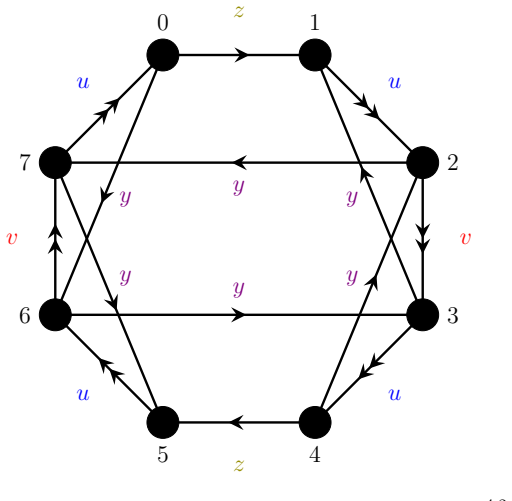
Global symmetry anomalies of a quantum field theory (QFT) can be packaged as specific couplings of a higher-dimensional symmetry theory (SymTh). In this work we show that for 5D superconformal field theories (SCFTs) engineered from M-theory backgrounds $X$ a Calabi-Yau cone, this data can be extracted from the path algebra of branes probing $X$. This provides a complementary algebraic approach compared with more geometric computations based on the explicit calculation of triple intersection numbers in a resolved geometry and / or $\eta$-invariants extracted from the boundary geometry $\partial X$. Our method applies in situations where the counterpart geometric computation is either unknown or combinatorially unwieldy. We illustrate with several toric threefold examples, including orbifolds $\mathbb{C}^{3} / \Gamma$ and more general non-orbifold Calabi-Yau cones of Sasaki-Einstein five-manifolds.
Editorial analysis
A structured set of objections, weighed in public.
Referee Report
Summary. The manuscript claims that for 5D SCFTs engineered from M-theory on a Calabi-Yau cone X, global symmetry anomaly data packaged in a higher-dimensional SymTh can be extracted from the path algebra of the quiver associated to branes probing X. This algebraic method is presented as complementary to geometric computations of triple intersection numbers in resolved geometries or eta-invariants on the boundary ∂X, and is illustrated on toric threefold examples including orbifolds ℂ³/Γ and non-orbifold Sasaki-Einstein cones.
Significance. If the equivalence between the path-algebra extraction and the geometric anomaly data holds, the approach supplies a useful computational alternative precisely when resolutions are unknown or combinatorially expensive, extending the toolkit for symmetry anomalies in 5D SCFTs. The explicit toric illustrations and the parameter-free algebraic character of the construction are strengths.
major comments (1)
- [abstract, §1] The central claim that the path algebra encodes the same anomaly data as triple intersections or η-invariants (abstract and §1) requires an explicit statement of the dictionary between generators of the path algebra and the anomaly coefficients; without this dictionary the equivalence remains formal rather than operational.
minor comments (2)
- [§2] Notation for the path algebra and its relations should be introduced with a short self-contained paragraph before the first toric example.
- [§4] The toric examples would benefit from a table comparing the algebraic anomaly coefficients with the known geometric values for at least one case.
Simulated Author's Rebuttal
We thank the referee for their careful reading of the manuscript and for the constructive suggestion. We address the single major comment below.
read point-by-point responses
-
Referee: [abstract, §1] The central claim that the path algebra encodes the same anomaly data as triple intersections or η-invariants (abstract and §1) requires an explicit statement of the dictionary between generators of the path algebra and the anomaly coefficients; without this dictionary the equivalence remains formal rather than operational.
Authors: We agree that an explicit dictionary between the path-algebra generators and the anomaly coefficients would make the equivalence operational rather than formal. In the revised manuscript we will add a short subsection (placed after the definition of the path algebra in §2) that states the precise correspondence: the basis elements of the path algebra associated to the fractional branes map to the generators of the SymTh, the relations in the quiver encode the anomaly inflow, and the resulting algebraic invariants are identified with the triple-intersection numbers and boundary η-invariants. The mapping will be tabulated for the toric examples already treated in the paper. revision: yes
Circularity Check
No significant circularity; algebraic method presented as independent complement to geometry
full rationale
The abstract and available description frame the path-algebra extraction as a complementary algebraic route to the same anomaly data, without any indication that the algebraic quantities are defined in terms of the geometric ones (triple intersections or eta-invariants) or obtained by fitting. No self-citations, ansatze, or fitted-input predictions are referenced in the provided text. The derivation chain therefore remains self-contained against external geometric benchmarks, consistent with the default expectation that most papers exhibit no circularity.
Axiom & Free-Parameter Ledger
axioms (1)
- domain assumption The path algebra of branes probing the Calabi-Yau cone encodes the symmetry anomaly data of the 5D SCFT.
Reference graph
Works this paper leans on
-
[1]
D. Gaiotto, A. Kapustin, N. Seiberg, and B. Willett, “Generalized Global Symmetries,”JHEP02(2015) 172,arXiv:1412.5148 [hep-th]
work page internal anchor Pith review Pith/arXiv arXiv 2015
-
[2]
Notes on generalized global symmetries in QFT
E. Sharpe, “Notes on generalized global symmetries in QFT,”Fortsch. Phys.63 (2015) 659–682,arXiv:1508.04770 [hep-th]
work page internal anchor Pith review Pith/arXiv arXiv 2015
-
[3]
Generalized Symmetries in Condensed Matter,
J. McGreevy, “Generalized Symmetries in Condensed Matter,”arXiv:2204.03045 [cond-mat.str-el]
-
[4]
Introduction to topological symmetry in QFT,
D. S. Freed, “Introduction to topological symmetry in QFT,”arXiv:2212.00195 [hep-th]
-
[5]
An introduction to higher-form symmetries,
P. R. S. Gomes, “An introduction to higher-form symmetries,”SciPost Phys. Lect. Notes74(2023) 1,arXiv:2303.01817 [hep-th]
-
[6]
Introduction to Generalized Global Symmetries in QFT and Particle Physics,
T. D. Brennan and S. Hong, “Introduction to Generalized Global Symmetries in QFT and Particle Physics,”arXiv:2306.00912 [hep-ph]
-
[7]
Lectures on Generalized Symmetries
L. Bhardwaj, L. E. Bottini, L. Fraser-Taliente, L. Gladden, D. S. W. Gould, A. Platschorre, and H. Tillim, “Lectures on Generalized Symmetries,” arXiv:2307.07547 [hep-th]
work page internal anchor Pith review Pith/arXiv arXiv
-
[8]
What's Done Cannot Be Undone: TASI Lectures on Non-Invertible Symmetries
S.-H. Shao, “What’s Done Cannot Be Undone: TASI Lectures on Non-Invertible Symmetry,”arXiv:2308.00747 [hep-th]
work page internal anchor Pith review Pith/arXiv arXiv
-
[9]
Simons Lectures on Categorical Symmetries,
D. Costaet al., “Simons Lectures on Categorical Symmetries,”arXiv:2411.09082 [math-ph]
-
[10]
Introduction to Generalized Symmetries,
J. Kaidi, “Introduction to Generalized Symmetries,”arXiv:2603.08798 [hep-th]
-
[11]
D. S. Freed and C. Teleman, “Relative quantum field theory,”Commun. Math. Phys. 326(2014) 459–476,arXiv:1212.1692 [hep-th]
work page internal anchor Pith review Pith/arXiv arXiv 2014
-
[12]
Invariants of three manifolds via link polynomials and quantum groups,
N. Reshetikhin and V. G. Turaev, “Invariants of three manifolds via link polynomials and quantum groups,”Invent. Math.103(1991) 547–597
1991
-
[13]
State sum invariants of 3 manifolds and quantum 6j symbols,
V. Turaev and O. Y. Viro, “State sum invariants of 3 manifolds and quantum 6j symbols,”Topology31(1992) 865–902
1992
-
[14]
Invariants of Piecewise-Linear 3-Manifolds
J. W. Barrett and B. W. Westbury, “Invariants of piecewise linear three manifolds,” Trans. Am. Math. Soc.348(1996) 3997–4022,arXiv:hep-th/9311155
work page internal anchor Pith review Pith/arXiv arXiv 1996
-
[15]
AdS/CFT Correspondence And Topological Field Theory
E. Witten, “AdS/CFT correspondence and topological field theory.,”JHEP12 (1998) 012,arXiv:hep-th/9812012. 56
work page internal anchor Pith review Pith/arXiv arXiv 1998
-
[16]
TFT construction of RCFT correlators I: Partition functions
J. Fuchs, I. Runkel, and C. Schweigert, “TFT construction of RCFT correlators 1. Partition functions,”Nucl. Phys. B646(2002) 353–497,arXiv:hep-th/0204148
work page internal anchor Pith review Pith/arXiv arXiv 2002
-
[17]
Turaev-Viro invariants as an extended TQFT
A. Kirillov, Jr. and B. Balsam, “Turaev-Viro invariants as an extended TQFT,” arXiv:1004.1533 [math.GT]
work page internal anchor Pith review Pith/arXiv arXiv
-
[18]
Surface operators in 3d Topological Field Theory and 2d Rational Conformal Field Theory
A. Kapustin and N. Saulina, “Surface operators in 3d Topological Field Theory and 2d Rational Conformal Field Theory,”arXiv:1012.0911 [hep-th]
work page internal anchor Pith review Pith/arXiv arXiv
-
[19]
Models for gapped boundaries and domain walls,
A. Kitaev and L. Kong, “Models for gapped boundaries and domain walls,” Communications in Mathematical Physics313no. 2, (June, 2012) 351–373
2012
-
[20]
Bicategories for boundary conditions and for surface defects in 3-d TFT
J. Fuchs, C. Schweigert, and A. Valentino, “Bicategories for boundary conditions and for surface defects in 3-d TFT,”Commun. Math. Phys.321(2013) 543–575, arXiv:1203.4568 [hep-th]
work page internal anchor Pith review Pith/arXiv arXiv 2013
-
[21]
Topological dualities in the Ising model,
D. S. Freed and C. Teleman, “Topological dualities in the Ising model,”Geom. Topol. 26(2022) 1907–1984,arXiv:1806.00008 [math.AT]
-
[22]
Topological symmetry in quantum field theory
D. S. Freed, G. W. Moore, and C. Teleman, “Topological symmetry in quantum field theory,”arXiv:2209.07471 [hep-th]
work page internal anchor Pith review Pith/arXiv arXiv
-
[23]
6D Fractional Quantum Hall Effect
J. J. Heckman and L. Tizzano, “6D Fractional Quantum Hall Effect,”JHEP05 (2018) 120,arXiv:1708.02250 [hep-th]
work page internal anchor Pith review Pith/arXiv arXiv 2018
-
[24]
D. Gaiotto and J. Kulp, “Orbifold groupoids,”JHEP02(2021) 132, arXiv:2008.05960 [hep-th]
-
[25]
Symmetry TFTs from String Theory
F. Apruzzi, F. Bonetti, I. Garc´ ıa Etxebarria, S. S. Hosseini, and S. Schafer-Nameki, “Symmetry TFTs from String Theory,”Commun. Math. Phys.402no. 1, (2023) 895–949,arXiv:2112.02092 [hep-th]
work page internal anchor Pith review Pith/arXiv arXiv 2023
-
[26]
Symmetry TFTs for Non-invertible Defects,
J. Kaidi, K. Ohmori, and Y. Zheng, “Symmetry TFTs for Non-invertible Defects,” Commun. Math. Phys.404no. 2, (2023) 1021–1124,arXiv:2209.11062 [hep-th]
-
[27]
A SymTFT for continuous symmetries,
T. D. Brennan and Z. Sun, “A SymTFT for continuous symmetries,”JHEP12 (2024) 100,arXiv:2401.06128 [hep-th]
-
[28]
On the symmetry TFT of Yang-Mills-Chern-Simons theory,
R. Argurio, F. Benini, M. Bertolini, G. Galati, and P. Niro, “On the symmetry TFT of Yang-Mills-Chern-Simons theory,”JHEP07(2024) 130,arXiv:2404.06601 [hep-th]
-
[29]
Remarks on geometric engineering, symmetry TFTs and anomalies,
M. Del Zotto, S. N. Meynet, and R. Moscrop, “Remarks on geometric engineering, symmetry TFTs and anomalies,”JHEP07(2024) 220,arXiv:2402.18646 [hep-th]. 57
-
[30]
SymTh for non-finite symmetries,
F. Apruzzi, F. Bedogna, and N. Dondi, “SymTh for non-finite symmetries,”JHEP 04(2026) 153,arXiv:2402.14813 [hep-th]
-
[31]
The holography of non-invertible self-duality symmetries,
A. Antinucci, F. Benini, C. Copetti, G. Galati, and G. Rizi, “The holography of non-invertible self-duality symmetries,”JHEP03(2025) 052,arXiv:2210.09146 [hep-th]
-
[32]
Intermediate defect groups, polarization pairs, and noninvertible duality defects,
C. Lawrie, X. Yu, and H. Y. Zhang, “Intermediate defect groups, polarization pairs, and noninvertible duality defects,”Phys. Rev. D109no. 2, (2024) 026005, arXiv:2306.11783 [hep-th]
-
[33]
SymTrees and Multi-Sector QFTs,
F. Baume, J. J. Heckman, M. H¨ ubner, E. Torres, A. P. Turner, and X. Yu, “SymTrees and Multi-Sector QFTs,”Phys. Rev. D109no. 10, (2024) 106013, arXiv:2310.12980 [hep-th]
-
[34]
Noninvertible symmetries in 2D from type IIB string theory,
X. Yu, “Noninvertible symmetries in 2D from type IIB string theory,”Phys. Rev. D 110no. 6, (2024) 065008,arXiv:2310.15339 [hep-th]
-
[35]
Anomalies and gauging of U(1) symmetries,
A. Antinucci and F. Benini, “Anomalies and gauging of U(1) symmetries,”Phys. Rev. B111no. 2, (2025) 024110,arXiv:2401.10165 [hep-th]
-
[36]
Celestial Topology, Symmetry Theories, and Evidence for a NonSUSY D3-Brane CFT,
J. J. Heckman and M. H¨ ubner, “Celestial Topology, Symmetry Theories, and Evidence for a NonSUSY D3-Brane CFT,”Fortsch. Phys.73no. 4, (2025) 2400270, arXiv:2406.08485 [hep-th]
-
[37]
S. Franco and X. Yu, “Generalized symmetries in 2D from string theory: SymTFTs, intrinsic relativeness, and anomalies of non-invertible symmetries,”JHEP11(2024) 004,arXiv:2404.19761 [hep-th]
-
[38]
SymTFTs forU(1) symmetries from descent,
F. Gagliano and I. Garc´ ıa Etxebarria, “SymTFTs forU(1) symmetries from descent,”arXiv:2411.15126 [hep-th]
-
[39]
Cornering relative symmetry theories,
M. Cvetiˇ c, R. Donagi, J. J. Heckman, M. H¨ ubner, and E. Torres, “Cornering relative symmetry theories,”Phys. Rev. D111no. 8, (2025) 085026,arXiv:2408.12600 [hep-th]
-
[40]
Representation Theory of Solitons
C. Cordova, N. Holfester, and K. Ohmori, “Representation theory of solitons,”JHEP 06(2025) 001,arXiv:2408.11045 [hep-th]
work page internal anchor Pith review Pith/arXiv arXiv 2025
-
[41]
SymTFTs for continuous non-Abelian symmetries,
F. Bonetti, M. Del Zotto, and R. Minasian, “SymTFTs for continuous non-Abelian symmetries,”Phys. Lett. B871(2025) 140010,arXiv:2402.12347 [hep-th]
-
[42]
L. Bhardwaj, C. Copetti, D. Pajer, and S. Schafer-Nameki, “Boundary SymTFT,” SciPost Phys.19no. 2, (2025) 061,arXiv:2409.02166 [hep-th]. 58
-
[43]
Symmetry Topological Field Theory for Flavor Symmetry,
Q. Jia, R. Luo, J. Tian, Y.-N. Wang, and Y. Zhang, “Symmetry Topological Field Theory for Flavor Symmetry,”arXiv:2503.04546 [hep-th]
-
[44]
Gauging in parameter space: A top-down perspective,
X. Yu, “Gauging in parameter space: A top-down perspective,”Phys. Rev. D112 no. 2, (2025) 025020,arXiv:2411.14997 [hep-th]
-
[45]
Aspects of categorical symmetries from branes: SymTFTs and generalized charges,
F. Apruzzi, F. Bonetti, D. S. W. Gould, and S. Schafer-Nameki, “Aspects of categorical symmetries from branes: SymTFTs and generalized charges,”SciPost Phys.17no. 1, (2024) 025,arXiv:2306.16405 [hep-th]
-
[46]
SymTFT construction of gapless exotic-foliated dual models
F. Apruzzi, F. Bedogna, and S. Mancani, “SymTFT construction of gapless exotic-foliated dual models,”arXiv:2504.11449 [cond-mat.str-el]
work page internal anchor Pith review Pith/arXiv arXiv
-
[47]
On the holographic dual of a topological symmetry operator,
J. J. Heckman, M. H¨ ubner, and C. Murdia, “On the holographic dual of a topological symmetry operator,”Phys. Rev. D110no. 4, (2024) 046007,arXiv:2401.09538 [hep-th]
-
[48]
Symmetry theories, Wigner’s function, compactification, and holography,
J. J. Heckman, M. H¨ ubner, and C. Murdia, “Symmetry theories, Wigner’s function, compactification, and holography,”Phys. Rev. D113no. 2, (2026) 026003, arXiv:2505.23887 [hep-th]
-
[49]
Symmetry TFTs for Continuous Spacetime Symmetries,
F. Apruzzi, N. Dondi, I. Garc´ ıa Etxebarria, H. T. Lam, and S. Schafer-Nameki, “Symmetry TFTs for Continuous Spacetime Symmetries,”arXiv:2509.07965 [hep-th]
-
[50]
SymTFT Entanglement and Holographic (Non)-Factorization,
E. Torres and X. Yu, “SymTFT Entanglement and Holographic (Non)-Factorization,”arXiv:2510.06319 [hep-th]
-
[51]
On the SymTFTs of Finite Non-Abelian Symmetries
O. Bergman, J. J. Heckman, M. H¨ ubner, D. Migliorati, X. Yu, and H. Y. Zhang, “On the SymTFTs of Finite Non-Abelian Symmetries,”arXiv:2603.12323 [hep-th]
work page internal anchor Pith review Pith/arXiv arXiv
-
[52]
On Lagrangians of Non-abelian Dijkgraaf-Witten Theories
Y. Xue and E. Y. Yang, “On Lagrangians of Non-abelian Dijkgraaf-Witten Theories,”arXiv:2604.02414 [hep-th]
work page internal anchor Pith review Pith/arXiv arXiv
-
[53]
Candidate Gaugings of Categorical Continuous Symmetry
Q. Jia, C. Ma, and J. Tian, “Candidate Gaugings of Categorical Continuous Symmetry,”arXiv:2604.25820 [hep-th]
work page internal anchor Pith review Pith/arXiv arXiv
-
[54]
Categorical Symmetries via Operator Algebras
Q. Jia, R. Luo, J. Tian, Y.-N. Wang, and Y. Zhang, “Categorical Symmetries via Operator Algebras,”arXiv:2604.25821 [hep-th]
work page internal anchor Pith review Pith/arXiv arXiv
-
[55]
Metric isometries, holography, and continuous symmetry operators,
M. Cvetiˇ c, J. J. Heckman, M. H¨ ubner, and C. Murdia, “Metric isometries, holography, and continuous symmetry operators,”Phys. Rev. D112no. 10, (2025) 106020,arXiv:2501.17911 [hep-th]
-
[56]
Symmetries beyond branes: geometric engineering and isometries,
M. De Marco and S. N. Meynet, “Symmetries beyond branes: geometric engineering and isometries,”JHEP08(2025) 082,arXiv:2503.19022 [hep-th]. 59
-
[57]
The Topological Equivalence Principle: On Decoupling TFTs from Gravity,
C. Cummings and J. J. Heckman, “The Topological Equivalence Principle: On Decoupling TFTs from Gravity,”arXiv:2601.09781 [hep-th]
-
[58]
Generalized Complexity Distances and Non-Invertible Symmetries
J. J. Heckman, R. J. Hicks, and C. Murdia, “Generalized Complexity Distances and Non-Invertible Symmetries,”arXiv:2604.14275 [hep-th]
work page internal anchor Pith review Pith/arXiv arXiv
-
[59]
From Baby Universes to Narain Moduli: Topological Boundary Averaging in SymTFTs
X. Yu, “From Baby Universes to Narain Moduli: Topological Boundary Averaging in SymTFTs,”arXiv:2605.06653 [hep-th]
work page internal anchor Pith review Pith/arXiv arXiv
-
[60]
On the Defect Group of a 6D SCFT
M. Del Zotto, J. J. Heckman, D. S. Park, and T. Rudelius, “On the Defect Group of a 6D SCFT,”Lett. Math. Phys.106no. 6, (2016) 765–786,arXiv:1503.04806 [hep-th]
work page internal anchor Pith review Pith/arXiv arXiv 2016
-
[61]
Higher Form Symmetries and M-theory,
F. Albertini, M. Del Zotto, I. Garc´ ıa Etxebarria, and S. S. Hosseini, “Higher Form Symmetries and M-theory,”JHEP12(2020) 203,arXiv:2005.12831 [hep-th]
-
[62]
D. R. Morrison, S. Schafer-Nameki, and B. Willett, “Higher-Form Symmetries in 5d,” JHEP09(2020) 024,arXiv:2005.12296 [hep-th]
-
[63]
Noninvertible Symmetries from Holography and Branes,
F. Apruzzi, I. Bah, F. Bonetti, and S. Schafer-Nameki, “Noninvertible Symmetries from Holography and Branes,”Phys. Rev. Lett.130no. 12, (2023) 121601, arXiv:2208.07373 [hep-th]
-
[64]
Branes and Non-Invertible Symmetries,
I. Garc´ ıa Etxebarria, “Branes and Non-Invertible Symmetries,”Fortsch. Phys.70 no. 11, (2022) 2200154,arXiv:2208.07508 [hep-th]
-
[65]
The Branes Behind Generalized Symmetry Operators,
J. J. Heckman, M. H¨ ubner, E. Torres, and H. Y. Zhang, “The Branes Behind Generalized Symmetry Operators,”Fortsch. Phys.71no. 1, (2023) 2200180, arXiv:2209.03343 [hep-th]
-
[66]
Top down approach to topological duality defects,
J. J. Heckman, M. Hubner, E. Torres, X. Yu, and H. Y. Zhang, “Top down approach to topological duality defects,”Phys. Rev. D108no. 4, (2023) 046015, arXiv:2212.09743 [hep-th]
-
[67]
Fluxbranes, generalized symmetries, and Verlinde’s metastable monopole,
M. Cvetiˇ c, J. J. Heckman, M. H¨ ubner, and E. Torres, “Fluxbranes, generalized symmetries, and Verlinde’s metastable monopole,”Phys. Rev. D109no. 4, (2024) 046007,arXiv:2305.09665 [hep-th]
-
[68]
Non-BPS branes and continuous symmetries,
O. Bergman, E. Garcia-Valdecasas, F. Mignosa, and D. Rodriguez-Gomez, “Non-BPS branes and continuous symmetries,”JHEP02(2025) 066,arXiv:2407.00773 [hep-th]
-
[69]
Non-Abelian Symmetry Operators from Hanging Branes inAdS 5 ×S 5,
I. Bah, F. Bonetti, M. Chitoto, and E. Leung, “Non-Abelian Symmetry Operators from Hanging Branes inAdS 5 ×S 5,”arXiv:2510.19812 [hep-th]. 60
-
[70]
Continuous symmetries and charge measurement of boundary operators in holography,
I. Bah, F. Bonetti, M. Chitoto, and E. Leung, “Continuous symmetries and charge measurement of boundary operators in holography,”arXiv:2602.22377 [hep-th]
-
[71]
Extra-Dimensional η-Invariants and Anomaly Theories,
M. Cvetiˇ c, R. Donagi, J. J. Heckman, and M. H¨ ubner, “Extra-Dimensional η-Invariants and Anomaly Theories,”arXiv:2512.17906 [hep-th]
-
[72]
Higher symmetries of 5D orbifold SCFTs,
M. Del Zotto, J. J. Heckman, S. N. Meynet, R. Moscrop, and H. Y. Zhang, “Higher symmetries of 5D orbifold SCFTs,”Phys. Rev. D106no. 4, (2022) 046010, arXiv:2201.08372 [hep-th]
-
[73]
Global structures from the infrared,
M. Del Zotto and I. Garc´ ıa Etxebarria, “Global structures from the infrared,”JHEP 11(2023) 058,arXiv:2204.06495 [hep-th]
-
[74]
Equivalence of A-Maximization and Volume Minimization
R. Eager, “Equivalence of A-Maximization and Volume Minimization,”JHEP01 (2014) 089,arXiv:1011.1809 [hep-th]
work page internal anchor Pith review Pith/arXiv arXiv 2014
-
[75]
Sasaki-Einstein Manifolds and Volume Minimisation
D. Martelli, J. Sparks, and S.-T. Yau, “Sasaki-Einstein manifolds and volume minimisation,”Commun. Math. Phys.280(2008) 611–673,arXiv:hep-th/0603021
work page internal anchor Pith review Pith/arXiv arXiv 2008
-
[76]
Eta-invariants from molien series,
A. Degeratu, “Eta-invariants from molien series,”The Quarterly Journal of Mathematics60no. 3, (06, 2008) 303–311
2008
-
[77]
Sasaki-Einstein Metrics on S^2 x S^3
J. P. Gauntlett, D. Martelli, J. Sparks, and D. Waldram, “Sasaki-Einstein metrics on S2 ×S 3,”Adv. Theor. Math. Phys.8no. 4, (2004) 711–734,arXiv:hep-th/0403002
work page internal anchor Pith review Pith/arXiv arXiv 2004
-
[78]
The eta invariant of a circle bundle on a Fano manifold
N. Savale, “The eta invariant of a circle bundle on a fano manifold,” arXiv:2604.07556 [math.DG]
work page internal anchor Pith review Pith/arXiv arXiv
-
[79]
Five Dimensional SUSY Field Theories, Non-trivial Fixed Points and String Dynamics
N. Seiberg, “Five-dimensional SUSY field theories, nontrivial fixed points and string dynamics,”Phys. Lett. B388(1996) 753–760,arXiv:hep-th/9608111
work page internal anchor Pith review Pith/arXiv arXiv 1996
-
[80]
Small Instantons, del Pezzo Surfaces and Type I' theory
M. R. Douglas, S. H. Katz, and C. Vafa, “Small Instantons, Del Pezzo Surfaces and Type I′ Theory,”Nucl. Phys. B497(1997) 155–172,arXiv:hep-th/9609071
work page internal anchor Pith review Pith/arXiv arXiv 1997
discussion (0)
Sign in with ORCID, Apple, or X to comment. Anyone can read and Pith papers without signing in.