Diffusion-Robust Optimization over Graphs
Pith reviewed 2026-06-28 21:47 UTC · model grok-4.3
The pith
Diffusion uncertainty on graphs makes robust shortest path tractability depend on propagation depth while TSP complexity stays the same.
A machine-rendered reading of the paper's core claim, the machinery that carries it, and where it could break.
Core claim
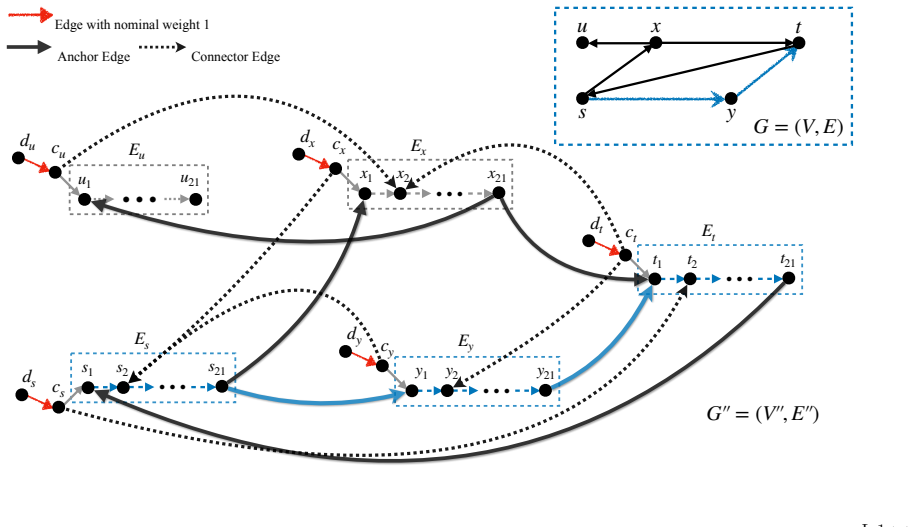
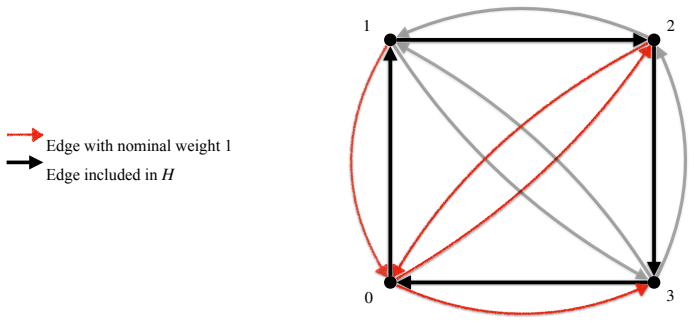
For shortest path, propagation depth induces a sharp transition between tractable and intractable robust counterparts. For the traveling salesman problem, robustness often adds no computational complexity beyond ordinary TSP, because the structure of Hamiltonian cycles makes the fixed-tour adversarial problem collapse to explicit formulas.
What carries the argument
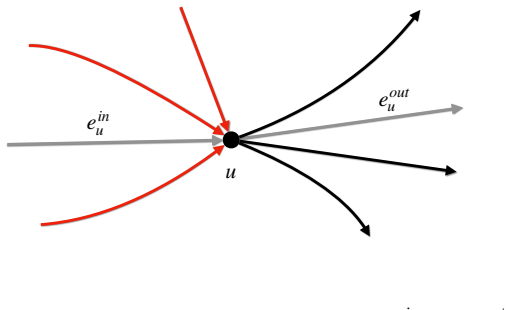
The diffusion-based uncertainty model in which perturbations of edge weights propagate along adjacent edges and satisfy conservation constraints at nodes.
If this is right
- For shortest path problems, there exists a critical propagation depth beyond which the robust counterpart becomes computationally intractable.
- The traveling salesman problem under this uncertainty model has the same computational complexity as the nominal version due to explicit formulas for the adversarial cost.
- Tractability in robust graph optimization is governed by the interaction between propagation depth, budget geometry, and the structure of feasible solutions.
- The topology-aware uncertainty fundamentally alters the computational landscape compared to standard robust optimization.
Where Pith is reading between the lines
- This model could be extended to other combinatorial problems on graphs such as minimum spanning tree or network flow to see similar transitions.
- Practitioners in logistics might use low-depth diffusion models to keep robust shortest path computations efficient.
- Further research could identify the exact threshold depth where the transition occurs for specific graph classes.
Load-bearing premise
The diffusion-based uncertainty model with propagation along edges and conservation constraints at nodes accurately captures the relevant uncertainty structure in the target networked systems.
What would settle it
Solve the robust shortest path for increasing propagation depths on a small directed graph and check if there is a point where it switches from polynomial to NP-hard.
Figures
read the original abstract
We introduce a diffusion-based uncertainty model for robust optimization on directed graphs, in which perturbations of edge weights propagate along adjacent edges and satisfy conservation constraints at nodes. This topology-aware structure is natural in networked systems where uncertainty is induced by flows and local interactions, including transportation, logistics, communication, and energy networks. We analyze how such diffusive uncertainty reshapes the computational landscape of robust graph optimization. We focus on two canonical combinatorial graph problems, shortest path and the traveling salesman problem (TSP), which provide complementary benchmarks: shortest path is polynomial-time solvable in the nominal setting, whereas TSP is already NP-hard. We show that, for shortest path, propagation depth induces a sharp transition between tractable and intractable robust counterparts. For the traveling salesman problem, robustness often adds no computational complexity beyond ordinary TSP, because the structure of Hamiltonian cycles makes the fixed-tour adversarial problem collapse to explicit formulas. Together, these results show that topology-aware uncertainty can fundamentally change robust combinatorial optimization, with tractability governed by the interaction between propagation, budget geometry, and the structure of feasible solutions.
Editorial analysis
A structured set of objections, weighed in public.
Referee Report
Summary. The paper introduces a diffusion-based uncertainty model for robust optimization on directed graphs, where edge-weight perturbations propagate along adjacent edges subject to conservation constraints at nodes. It analyzes the resulting robust counterparts of two canonical problems: for shortest paths, propagation depth induces a sharp tractability transition; for TSP, the fixed-tour adversarial subproblem collapses to explicit formulas, so that robustness adds no computational complexity beyond ordinary TSP.
Significance. If the claimed sharp transition and complexity equivalence hold, the work would be significant for robust combinatorial optimization on networks. It demonstrates that the interaction between uncertainty geometry (propagation depth and budget) and feasible-set structure can qualitatively alter tractability, offering a topology-aware alternative to standard budgeted or ellipsoidal uncertainty sets. The modeling choice is presented as a deliberate modeling decision rather than a fitted parameter.
minor comments (2)
- The abstract states that robustness 'often adds no computational complexity' for TSP; the precise conditions (e.g., which budgets or propagation depths) under which the collapse to explicit formulas occurs should be stated explicitly in the introduction or main theorem statement.
- The diffusion model is introduced as a modeling choice; a short paragraph contrasting it with standard budgeted or polyhedral uncertainty sets would help readers situate the contribution.
Simulated Author's Rebuttal
We thank the referee for their positive assessment of our work on diffusion-robust optimization over graphs and for recommending minor revision. The referee summary accurately captures the core contributions regarding the diffusion-based uncertainty model, the tractability transition for shortest paths, and the complexity equivalence for TSP. No specific major comments were provided in the report.
Circularity Check
No significant circularity detected
full rationale
The paper introduces a new diffusion-based uncertainty model defined via propagation along edges and node conservation constraints, then derives complexity results for shortest-path and TSP by analyzing how this model interacts with the feasible sets of each problem. The tractability transition for shortest path is tied to propagation depth, and the TSP claim rests on the explicit collapse of the adversarial subproblem for fixed tours; neither reduces by construction to fitted parameters, self-definitions, or prior self-citations. The modeling premise is stated as an explicit choice whose consequences are then examined mathematically, rendering the derivation chain self-contained against external benchmarks.
Axiom & Free-Parameter Ledger
free parameters (1)
- propagation depth
axioms (1)
- domain assumption Perturbations of edge weights propagate along adjacent edges and satisfy conservation constraints at nodes
invented entities (1)
-
diffusion-based uncertainty model
no independent evidence
Reference graph
Works this paper leans on
-
[1]
R. K. Ahuja, T. L. Magnanti, and J. B. Orlin.Network flows. Cambridge, Mass.: Alfred P. Sloan School of Management, Massachusetts, 1988. 23
1988
-
[2]
Min–maxandmin–maxregretversionsofcombinatorial optimizationproblems: Asurvey.European Journal of Operational Research, 197(2):427–438, 2009
H.Aissi, C.Bazgan, andD.Vanderpooten. Min–maxandmin–maxregretversionsofcombinatorial optimizationproblems: Asurvey.European Journal of Operational Research, 197(2):427–438, 2009
2009
-
[3]
Alves Pessoa, L
A. Alves Pessoa, L. Di Puglia Pugliese, F. Guerriero, and M. Poss. Robust constrained shortest path problems under budgeted uncertainty.Networks, 66(2):98–111, 2015
2015
-
[4]
Atamtürk and M
A. Atamtürk and M. Zhang. Two-stage robust network flow and design under demand uncertainty. Operations research, 55(4):662–673, 2007
2007
-
[5]
Averbakh and V
I. Averbakh and V. Lebedev. Interval data minmax regret network optimization problems.Discrete Applied Mathematics, 138(3):289–301, 2004
2004
-
[6]
Bartolini, D
E. Bartolini, D. Goeke, M. Schneider, and M. Ye. The robust traveling salesman problem with time windows under knapsack-constrained travel time uncertainty.Transportation Science, 55(2): 371–394, 2021
2021
-
[7]
Ben-Tal and A
A. Ben-Tal and A. Nemirovski. Robust convex optimization.Mathematics of operations research, 23(4):769–805, 1998
1998
-
[8]
Ben-Tal and A
A. Ben-Tal and A. Nemirovski. Robust solutions of uncertain linear programs.Operations Research Letters, 25(1):1–13, 1999
1999
-
[9]
Ben-Tal, A
A. Ben-Tal, A. Nemirovski, and L. El Ghaoui.Robust Optimization. Princeton university press, 2009
2009
-
[10]
D. P. Bertsekas. Robust shortest path planning and semicontractive dynamic programming.Naval Research Logistics (NRL), 66(1):15–37, 2019
2019
-
[11]
Bertsimas and M
D. Bertsimas and M. Sim. Robust discrete optimization and network flows.Mathematical Pro- gramming, 98(1):49–71, 2003
2003
-
[12]
Bertsimas, D
D. Bertsimas, D. B. Brown, and C. Caramanis. Theory and applications of robust optimization. SIAM review, 53(3):464–501, 2011
2011
-
[13]
Bertsimas, E
D. Bertsimas, E. Nasrabadi, and S. Stiller. Robust and adaptive network flows.Operations Research, 61(5):1218–1242, 2013
2013
-
[14]
M. E. Bruni and F. Guerriero. An enhanced exact procedure for the absolute robust shortest path problem.International Transactions in Operational Research, 17(2):207–220, 2010
2010
-
[15]
C. Büsing. Recoverable robust shortest path problems.Networks, 59(1):181–189, 2012
2012
-
[16]
J. G. Carlsson, M. Behroozi, and K. Mihic. Wasserstein distance and the distributionally robust TSP.Operations Research, 66(6):1603–1624, 2018
2018
-
[17]
Catanzaro, M
D. Catanzaro, M. Labbe, and M. Salazar-Neumann. Reduction approaches for robust shortest path problems.Computers & Operations Research, 38(11):1610–1619, 2011
2011
-
[18]
Chassein and M
A. Chassein and M. Goerigk. On the recoverable robust traveling salesman problem.Optimization Letters, 10(7):1479–1492, 2016. 24
2016
-
[19]
Chassein, T
A. Chassein, T. Dokka, and M. Goerigk. Algorithms and uncertainty sets for data-driven robust shortest path problems.European Journal of Operational Research, 274(2):671–686, 2019
2019
-
[20]
Chechik, M
S. Chechik, M. P. Johnson, M. Parter, and D. Peleg. Secluded connectivity problems.Algorithmica, 79(3):708–741, 2017
2017
-
[21]
Cheng, A
J. Cheng, A. Lisser, and M. Letournel. Distributionally robust stochastic shortest path problem. Electronic Notes in Discrete Mathematics, 41:511–518, 2013
2013
-
[22]
Cheng, J
J. Cheng, J. Leung, and A. Lisser. New reformulations of distributionally robust shortest path problem.Computers & Operations Research, 74:196–204, 2016
2016
-
[23]
Di Puglia Pugliese, F
L. Di Puglia Pugliese, F. Guerriero, and M. Poss. The resource constrained shortest path prob- lem with uncertain data: A robust formulation and optimal solution approach.Computers & Operations Research, 107:140–155, 2019
2019
-
[24]
Duque and A
D. Duque and A. L. Medaglia. An exact method for a class of robust shortest path problems with scenarios.Networks, 74(4):360–373, 2019
2019
-
[25]
Filippi, F
C. Filippi, F. Maggioni, and M. G. Speranza. Robust and distributionally robust shortest path problems: A survey.Computers & Operations Research, 182:107096, 2025
2025
-
[26]
Gabrel, C
V. Gabrel, C. Murat, and A. Thiele. Recent advances in robust optimization: An overview. European Journal of Operational Research, 235(3):471–483, 2014
2014
-
[27]
Ganesh, B
A. Ganesh, B. M. Maggs, and D. Panigrahi. Robust algorithms for TSP and Steiner tree.ACM Transactions on Algorithms, 19(2):1–37, 2023
2023
-
[28]
Ghosal and W
S. Ghosal and W. Wiesemann. The distributionally robust chance-constrained vehicle routing problem.Operations Research, 68(3):716–732, 2020
2020
-
[29]
Goerigk and M
M. Goerigk and M. Hartisch. An introduction to robust combinatorial optimization.International Series in Operations Research and Management Science, 2024
2024
-
[30]
Goerigk and M
M. Goerigk and M. Khosravi. Benchmarking problems for robust discrete optimization.Computers & Operations Research, 166:106608, 2024
2024
-
[31]
M. Goerigk, S. Lendl, and L. Wulf. On the recoverable traveling salesman problem.arXiv preprint arXiv:2111.09691, 2021
arXiv 2021
-
[32]
Golovin, V
D. Golovin, V. Goyal, V. Polishchuk, R. Ravi, and M. Sysikaski. Improved approximations for two-stage min-cut and shortest path problems under uncertainty.Mathematical Programming, 149 (1):167–194, 2015
2015
-
[33]
C. E. Gounaris, W. Wiesemann, and C. A. Floudas. The robust capacitated vehicle routing problem under demand uncertainty.Operations Research, 61(3):677–693, 2013
2013
-
[34]
Hansknecht, A
C. Hansknecht, A. Richter, and S. Stiller. Fast robust shortest path computations. In18th Workshop on Algorithmic Approaches for Transportation Modelling, Optimization, and Systems (ATMOS 2018), pages 5–1. Schloss Dagstuhl–Leibniz-Zentrum für Informatik, 2018. 25
2018
-
[35]
C. Hu, J. Lu, X. Liu, and G. Zhang. Robust vehicle routing problem with hard time windows under demand and travel time uncertainty.Computers & Operations Research, 94:139–153, 2018
2018
-
[36]
Jackiewicz, A
M. Jackiewicz, A. Kasperski, and P. Zieliński. Computational complexity of the recoverable robust shortest path problem with discrete recourse.Discrete Applied Mathematics, 370:103–110, 2025
2025
-
[37]
O. E. Karaşan, M. C. Pınar, and H. Yaman. The robust shortest path problem with interval data. Technical report, Bilkent University, Department of Industrial Engineering, Ankara, Turkey, 2001. Technical report
2001
-
[38]
Kasperski and P
A. Kasperski and P. Zieliński. The robust shortest path problem in series–parallel multidigraphs with interval data.Operations Research Letters, 34(1):69–76, 2006
2006
-
[39]
Kasperski and P
A. Kasperski and P. Zieliński. Robust discrete optimization under discrete and interval uncertainty: A survey. InRobustness Analysis in Decision Aiding, Optimization, and Analytics, pages 113–143. Springer, 2016
2016
-
[40]
S. S. Ketkov. On the multistage shortest path problem under distributional uncertainty.Journal of Optimization Theory and Applications, 197(1):277–308, 2023
2023
-
[41]
S. S. Ketkov, O. A. Prokopyev, and E. P. Burashnikov. An approach to the distributionally robust shortest path problem.Computers & Operations Research, 130:105212, 2021
2021
-
[42]
Kouvelis and G
P. Kouvelis and G. Yu.Robust Discrete Optimization and its Applications, volume 14. Springer Science & Business Media, 2013
2013
-
[43]
C. Kwon, T. Lee, and P. Berglund. Robust shortest path problems with two uncertain multiplica- tive cost coefficients.Naval Research Logistics (NRL), 60(5):375–394, 2013
2013
-
[44]
J.-Q. Li, N. Kong, X. Hu, and L. Liu. Large-scale transit itinerary planning under uncertainty. Transportation Research Part C: Emerging Technologies, 60:397–415, 2015
2015
-
[45]
Liebchen, M
C. Liebchen, M. Lübbecke, R. Möhring, and S. Stiller. The concept of recoverable robustness, linear programming recovery, and railway applications. InRobust and Online Large-Scale Optimization: Models and Techniques for Transportation Systems, pages 1–27. Springer, 2009
2009
-
[46]
Montemanni and L
R. Montemanni and L. M. Gambardella. An exact algorithm for the robust shortest path problem with interval data.Computers & Operations Research, 31(10):1667–1680, 2004
2004
-
[47]
Montemanni and L
R. Montemanni and L. M. Gambardella. The robust shortest path problem with interval data via Benders decomposition.4or, 3(4):315–328, 2005
2005
-
[48]
Montemanni, L
R. Montemanni, L. M. Gambardella, and A. V. Donati. A branch and bound algorithm for the robust shortest path problem with interval data.Operations Research Letters, 32(3):225–232, 2004
2004
-
[49]
Montemanni, J
R. Montemanni, J. Barta, M. Mastrolilli, and L. M. Gambardella. The robust traveling salesman problem with interval data.Transportation Science, 41(3):366–381, 2007
2007
-
[50]
Munari, A
P. Munari, A. Moreno, J. De La Vega, D. Alem, J. Gondzio, and R. Morabito. The robust vehicle routing problem with time windows: Compact formulation and branch-price-and-cut method. Transportation Science, 53(4):1043–1066, 2019. 26
2019
-
[51]
Murthy and S.-S
I. Murthy and S.-S. Her. Solving min-max shortest-path problems on a network.Naval Research Logistics (NRL), 39(5):669–683, 1992
1992
-
[52]
E. Nasrabadi and J. B. Orlin. Robust optimization with incremental recourse.arXiv preprint arXiv:1312.4075, 2013
Pith/arXiv arXiv 2013
-
[53]
F. Ordóñez. Robust vehicle routing. InRisk and Optimization in an Uncertain World, pages 153–178. INFORMS, 2010
2010
-
[54]
C. H. Papadimitriou and K. Steiglitz.Combinatorial Optimization: Algorithms and Complexity. Courier Corporation, 1998
1998
-
[55]
Raith, M
A. Raith, M. Schmidt, A. Schöbel, and L. Thom. Extensions of labeling algorithms for multi- objective uncertain shortest path problems.Networks, 72(1):84–127, 2018
2018
-
[56]
Şeref, R
O. Şeref, R. K. Ahuja, and J. B. Orlin. Incremental network optimization: Theory and algorithms. Operations Research, 57(3):586–594, 2009
2009
-
[57]
Shahabi, A
M. Shahabi, A. Unnikrishnan, and S. D. Boyles. Robust optimization strategy for the shortest path problem under uncertain link travel cost distribution.Computer-Aided Civil and Infrastructure Engineering, 30(6):433–448, 2015
2015
-
[58]
Z. Wang, K. You, S. Song, and Y. Zhang. Wasserstein distributionally robust shortest path problem.European Journal of Operational Research, 284(1):31–43, 2020
2020
-
[59]
Xing and X
T. Xing and X. Zhou. Reformulation and solution algorithms for absolute and percentile robust shortest path problems.IEEE Transactions on Intelligent Transportation Systems, 14(2):943–954, 2013
2013
-
[60]
Xu and X
B. Xu and X. Zhou. Dynamic relative robust shortest path problem.Computers & Industrial Engineering, 148:106651, 2020
2020
-
[61]
Yu and J
G. Yu and J. Yang. On the robust shortest path problem.Computers & Operations Research, 25 (6):457–468, 1998
1998
-
[62]
Zieliński
P. Zieliński. The computational complexity of the relative robust shortest path problem with interval data.European Journal of Operational Research, 158(3):570–576, 2004. A Proofs A.1 Proofs for Section 2 A.1.1 Proof of Theorem 2.1 Assertions (i) and (ii) follow from Proposition 2.2. Assertion (iii) follows from Proposition 2.5. Asser- tion (iv) follows f...
2004
discussion (0)
Sign in with ORCID, Apple, or X to comment. Anyone can read and Pith papers without signing in.