On the Negation of a Hyperbolic-Valued Probability Distribution
Pith reviewed 2026-06-28 19:55 UTC · model grok-4.3
The pith
Hyperbolic probability distributions majorize their negations under generated negators.
A machine-rendered reading of the paper's core claim, the machinery that carries it, and where it could break.
Core claim
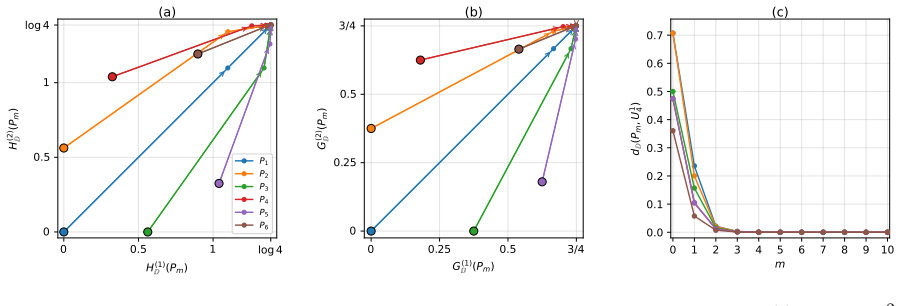
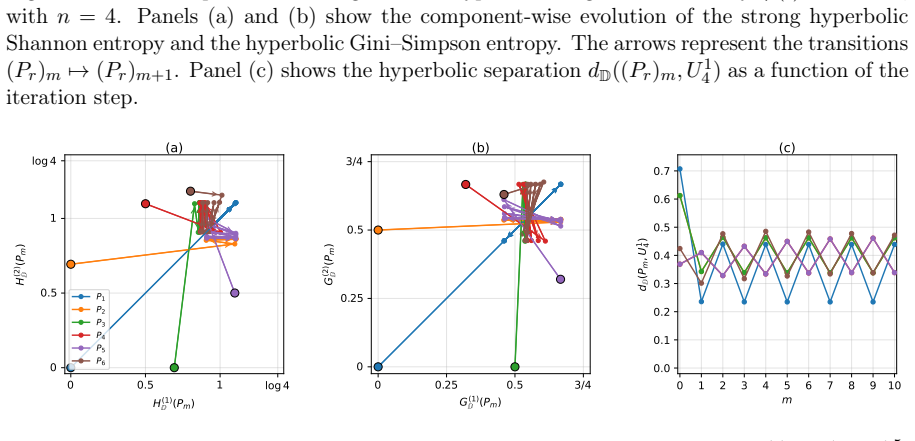
For a broad class of generated negators the original hyperbolic-valued probability distribution majorizes its negation. This comparison yields entropy increase for the strong hyperbolic Shannon entropy and the hyperbolic Gini-Simpson entropy and implies component-wise uniformization of the iterated negation. Involutive negators are shown to be structurally distinct from the generated negators that produce the entropy increase.
What carries the argument
Hyperbolic majorization, defined from the partial order induced by the idempotent decomposition of hyperbolic numbers, which supplies the comparison between a distribution and its negation.
If this is right
- The strong hyperbolic Shannon entropy increases when the distribution is replaced by its negation.
- The hyperbolic Gini-Simpson entropy increases under the same replacement.
- Repeated application of a generated negator makes the distribution components approach one another.
- Involutive negators cannot be used to obtain the entropy increase that generated negators produce.
Where Pith is reading between the lines
- The same majorization relation might be checked for additional entropy functionals defined on hyperbolic distributions.
- The uniformization effect could be quantified by tracking the variance of the component values after each iteration.
- The structural distinction between involutive and generated negators suggests two separate families of operations whose interaction with other hyperbolic probabilistic concepts remains open.
Load-bearing premise
The partial order induced by the idempotent structure of hyperbolic numbers is suitable for defining majorization and negation operations on these probability distributions.
What would settle it
A concrete generated negator together with a hyperbolic-valued distribution for which the original does not majorize the negation would disprove the central comparison.
Figures
read the original abstract
In the context of hyperbolic numbers we define the concept of negation of finite hyperbolicvalued probability distributions that is based on the partial order induced by the idempotent structure of hyperbolic numbers. Then, a hyperbolic majorization and general hyperbolic negators are introduced. For a broad class of generated negators, we prove that the original distribution majorizes its negation. This comparison yields that entropy increase for the strong hyperbolic Shannon entropy and the hyperbolic Gini-Simpson entropy, and it implies component-wise uniformization of the iterated negation. Finally, we analyze involutive property of hyperbolic negators and prove that are structurally distinct from the generated negators responsible for the entropy increase. These results show that hyperbolic probabilistic negation is not merely a component-wise copy of the real case, but a theory governed by the interaction between idempotent decomposition, partial order, and entropy measure.
Editorial analysis
A structured set of objections, weighed in public.
Referee Report
Summary. The paper defines negation for finite hyperbolic-valued probability distributions via the partial order induced by the idempotent decomposition of hyperbolic numbers. It introduces hyperbolic majorization and a class of generated negators, proving that for a broad class of such negators the original distribution majorizes its negation. This yields monotonicity (increase) of the strong hyperbolic Shannon entropy and the hyperbolic Gini-Simpson entropy under negation, together with component-wise uniformization under iterated negation. The paper further examines involutive negators and establishes that they are structurally distinct from the generated negators that produce the entropy increase, arguing that the resulting theory is governed by the interaction of idempotent decomposition, partial order, and entropy rather than being a direct copy of the real-valued case.
Significance. If the central proofs are correct, the work supplies a non-trivial algebraic extension of majorization and entropy monotonicity to hyperbolic-valued probabilities. The explicit use of the idempotent structure to define both the partial order and the generated negators, together with the distinction between involutive and entropy-increasing negators, constitutes a genuine departure from the real case and could serve as a template for similar constructions in other algebraic probability settings.
major comments (2)
- [§3] §3, Definition 3.4 and Theorem 3.7: the proof that p ≽ neg(p) for generated negators relies on the specific form of the negator in Eq. (12); it is not immediately clear whether the argument extends to all negators satisfying only the three listed axioms or whether an additional monotonicity condition on the generating function is tacitly used.
- [§4.2] §4.2, Theorem 4.3: the claimed entropy increase for the strong hyperbolic Shannon entropy is shown only after establishing majorization; if the partial order is not total, the standard majorization-entropy implication (used in the real case) requires an additional verification that the entropy functional is Schur-concave with respect to this specific order.
minor comments (3)
- [§2] Notation for the two components of a hyperbolic number is introduced in §2 but then used interchangeably with (x,y) and x + y j; a single consistent notation throughout would improve readability.
- [§5] The statement of Corollary 5.2 on iterated negation would benefit from an explicit reference to the component-wise uniformization already proved in Theorem 4.5 rather than repeating the argument.
- [§3] Several displayed equations in §3 lack equation numbers, making cross-references in the proofs harder to follow.
Simulated Author's Rebuttal
We thank the referee for the careful reading, positive assessment of significance, and constructive comments. We address the two major comments point by point below. Both can be resolved with minor revisions that clarify the scope of the results without altering the core claims.
read point-by-point responses
-
Referee: [§3] §3, Definition 3.4 and Theorem 3.7: the proof that p ≽ neg(p) for generated negators relies on the specific form of the negator in Eq. (12); it is not immediately clear whether the argument extends to all negators satisfying only the three listed axioms or whether an additional monotonicity condition on the generating function is tacitly used.
Authors: The statement of Theorem 3.7 is explicitly restricted to the class of generated negators introduced via the construction in Eq. (12), which is a subclass of the negators satisfying the three axioms in Definition 3.4. The proof of majorization p ≽ neg(p) uses the explicit functional form of the generator to compare components after idempotent decomposition. We agree that the argument does not automatically extend to arbitrary negators obeying only the three axioms. We will revise the text preceding Theorem 3.7 to emphasize this scope and add a short remark noting that an additional monotonicity assumption on the generator would be needed for a more general result. This clarification does not change the theorem itself. revision: yes
-
Referee: [§4.2] §4.2, Theorem 4.3: the claimed entropy increase for the strong hyperbolic Shannon entropy is shown only after establishing majorization; if the partial order is not total, the standard majorization-entropy implication (used in the real case) requires an additional verification that the entropy functional is Schur-concave with respect to this specific order.
Authors: We accept the point that the partial order induced by the idempotent decomposition is not total, so the usual majorization-to-entropy monotonicity argument requires explicit justification of Schur-concavity on this poset. In the current proof we derive the entropy increase directly from the component-wise inequalities supplied by majorization together with the explicit expression for the strong hyperbolic Shannon entropy. To make the reasoning fully rigorous and parallel to the classical case, we will insert a brief lemma in §4.2 verifying Schur-concavity of the entropy with respect to hyperbolic majorization. This addition strengthens the presentation without affecting the validity of Theorem 4.3. revision: yes
Circularity Check
No significant circularity; definitions yield independent proofs
full rationale
The paper defines negation of hyperbolic-valued distributions via the partial order from idempotent decomposition, introduces majorization and generated negators as new constructs, then proves majorization p ≽ neg(p) for a class of negators along with consequent entropy monotonicity. These steps are presented as following directly from the definitions without reducing to fitted inputs, self-citations, or renamings by construction. No load-bearing premise relies on prior author work as an unverified uniqueness theorem, and the entropy increase is derived rather than presupposed. The derivation chain is self-contained against the introduced axioms.
Axiom & Free-Parameter Ledger
axioms (1)
- domain assumption Hyperbolic numbers possess an idempotent structure that induces a partial order suitable for probability distributions.
Reference graph
Works this paper leans on
-
[1]
D. Alpay and I. Cho. Probabilities with values in scaled hyperbolic numbers.Advances in Applied Clifford Algebras, 35:32, 2025.https://doi.org/10.1007/s00006-025-01394-7
-
[2]
D. Alpay, M. E. Luna-Elizarrarás, and M. Shapiro. Kolmogorov’s axioms for probabilities with values in hyperbolic numbers.Advances in Applied Clifford Algebras, 27(2):913–929, 2017.https://doi.org/10.1007/s00006-016-0706-6. 27
-
[3]
I. Batyrshin, L. A. Villa-Vargas, M. A. Ramírez-Salinas, M. Salinas-Rosales, and N. Kuby- sheva. Generating negations of probability distributions.Soft Computing, 25(12):7929–7935, 2021.https://doi.org/10.1007/s00500-021-05802-5
-
[4]
I. Batyrshin, I. Rudas, and N. Kubysheva. Parametric negations of probability distributions and fuzzy distribution sets.Computación y Sistemas, 27(3):619–625, 2023.https://doi. org/10.13053/cys-27-3-4709
-
[5]
I. Z. Batyrshin. Contracting and involutive negations of probability distributions.Mathe- matics, 9(19):2389, 2021.https://doi.org/10.3390/math9192389
-
[6]
I. Z. Batyrshin, N. I. Kubysheva, V. R. Bayrasheva, O. Kosheleva, and V. Kreinovich. Negations of probability distributions: A survey.Computación y Sistemas, 25(4):775–781, 2021.https://doi.org/10.13053/cys-25-4-4094
-
[7]
J. Cockle. On certain functions resembling quaternions, and on a new imaginary in algebra. The London, Edinburgh, and Dublin Philosophical Magazine and Journal of Science, 33:435– 439, 1848.https://doi.org/10.1080/14786444808646139
-
[8]
X. Deng and W. Jiang. On the negation of a Dempster–Shafer belief structure based on maximum uncertainty allocation.Information Sciences, 516:346–352, 2020.https://doi. org/10.1016/j.ins.2019.12.080
-
[9]
M. E. Ensastegui-Ortega, I. Batyrshin, A. Gelbukh, and N. Kubysheva. Analysis of re- lationships between co-symmetric dissimilarity measures of probability distributions with involutive negations.Computación y Sistemas, 28(2):701–707, 2024.https://doi.org/10. 13053/cys-28-2-5049
2024
-
[10]
P. Fjelstad. Extending special relativity via the perplex numbers.American Journal of Physics, 54(5):416–422, 1986.https://doi.org/10.1119/1.14605
-
[11]
X. Gao and Y. Deng. The generalization negation of probability distribution and its applica- tionintargetrecognitionbasedonsensorfusion.International Journal of Distributed Sensor Networks, 15(5):1550147719849381, 2019.https://doi.org/10.1177/1550147719849381
-
[12]
Gini.Variabilit‘a e mutabilit‘a: contributo allo studio delle distribuzioni e delle relazioni statistiche
C. Gini.Variabilit‘a e mutabilit‘a: contributo allo studio delle distribuzioni e delle relazioni statistiche. Tipografia di Paolo Cuppini, Bologna, 1912
1912
-
[13]
G. H. Hardy, J. E. Littlewood, and G. Pólya.Inequalities. Cambridge University Press, Cambridge, 1934
1934
-
[14]
M.KaurandA.Srivastava.Anoteonnegationofaprobabilitydistribution.Soft Computing, 27(2):667–676, 2023.https://doi.org/10.1007/s00500-022-07635-2
-
[15]
C. J. Keylock. Simpson diversity and the Shannon–Wiener index as special cases of a gen- eralized entropy.Oikos, 109(1):203–207, 2005.https://doi.org/10.1111/j.0030-1299. 2005.13735.x
-
[16]
V. V. Kisil.Geometry of M"obius Transformations: Elliptic, Parabolic and Hyperbolic Ac- tions of SL2(R). Imperial College Press, London, 2012.https://doi.org/10.1142/p835
-
[17]
I. Klein. Some technical remarks on negations of discrete probability distributions and their information loss.Mathematics, 10(20):3893, 2022.https://doi.org/10.3390/ math10203893
2022
-
[18]
J. Liu and F. Xiao. On the maximum extropy negation of a probability distribution. Communications in Statistics – Simulation and Computation, 53(1):234–246, 2024.https: //doi.org/10.1080/03610918.2021.2014889. 28
-
[19]
R. Liu, Y. Deng, and Z. Li. The maximum entropy negation of basic probabil- ity assignment.Soft Computing, 27(11):7011–7021, 2023.https://doi.org/10.1007/ s00500-023-08038-7
2023
-
[20]
Z. Luo and Y. Deng. A matrix method of basic belief assignment’s negation in Dempster– Shafer theory.IEEE Transactions on Fuzzy Systems, 28(9):2270–2276, 2020.https://doi. org/10.1109/TFUZZ.2019.2930027
-
[21]
A. W. Marshall, I. Olkin, and B. C. Arnold.Inequalities: Theory of Majorization and Its Applications. Springer Series in Statistics. Springer, New York, 2nd edition, 2011.https: //doi.org/10.1007/978-0-387-68276-1
-
[22]
U. Pham, I. Batyrshin, N. Kubysheva, and O. Kosheleva. Estimating a probability distribu- tion corresponding to the negation of a property.Soft Computing, 25(12):7975–7983, 2021. https://doi.org/10.1007/s00500-021-05728-y
-
[23]
E. H. Simpson. Measurement of diversity.Nature, 163:688, 1949.https://doi.org/10. 1038/163688a0
1949
-
[24]
G. Sobczyk. The hyperbolic number plane.The College Mathematics Journal, 26(4):268– 280, 1995.https://doi.org/10.1080/07468342.1995.11973712
-
[25]
G. Sobczyk. Complex and hyperbolic numbers. InNew Foundations in Mathematics, pages 23–42. Birkh"auser, Boston, 2013.https://doi.org/10.1007/978-0-8176-8385-6_2
-
[26]
Srivastava and L
A. Srivastava and L. Kaur. Uncertainty and negation—information theoretic applications. International Journal of Intelligent Systems, 34(6):1248–1260, 2019.https://doi.org/10. 1002/int.22094
2019
-
[27]
A. Srivastava and S. Maheshwari. Some new properties of negation of a probability dis- tribution.International Journal of Intelligent Systems, 33(6):1133–1145, 2018.https: //doi.org/10.1002/int.21882
-
[28]
https://doi.org/10.1002/int.22364
A.SrivastavaandP.Tanwar.Interplaybetweensymmetry, convexityandnegationofaprob- ability distribution.International Journal of Intelligent Systems, 36(4):1876–1897, 2021. https://doi.org/10.1002/int.22364
-
[29]
C. Sun, S. Li, and Y. Deng. Determining weights in multi-criteria decision making based on negation of probability distribution under uncertain environment.Mathematics, 8(2):191, 2020.https://doi.org/10.3390/math8020191
-
[30]
P. Tanwar and A. Srivastava. Generalization of negation of a probability distribution.In- ternational Journal of System Assurance Engineering and Management, 14(Suppl. 1):S447– S454, 2023a.https://doi.org/10.1007/s13198-023-01874-8
-
[31]
P.TanwarandA.Srivastava.Negationandredistributionwithapreference—aninformation theoretic analysis.Chaos, Solitons & Fractals, 172:113557, 2023b.https://doi.org/10. 1016/j.chaos.2023.113557
-
[32]
G. Y. Téllez-Sánchez and J. Bory-Reyes. Extensions of the Shannon entropy and the chaos game algorithm to hyperbolic numbers plane.Fractals, 29(1):2150013, 2021.https://doi. org/10.1142/S0218348X21500134
-
[33]
C. Tsallis. Possible generalization of Boltzmann–Gibbs statistics.Journal of Statistical Physics, 52(1–2):479–487, 1988.https://doi.org/10.1007/BF01016429. 29
-
[34]
J. C. Vignaux and A. Durañona y Vedia. Sobre la teoría de las funciones de una variable compleja hiperbólica.Universidad Nacional de La Plata, Publicaciones de la Facultad de Ciencias Físico-Matemáticas, 104:139–183, 1935
1935
-
[35]
Q. Wu, Y. Deng, and N. Xiong. Exponential negation of a probability distribution.Soft Computing, 26(5):2147–2156, 2022.https://doi.org/10.1007/s00500-021-06658-5
-
[37]
R.R.Yager.Onthemaximumentropynegationofaprobabilitydistribution.IEEE Transac- tions on Fuzzy Systems, 23(5):1899–1902, 2015.https://doi.org/10.1109/TFUZZ.2014. 2374211
-
[38]
L. Yin, X. Deng, and Y. Deng. The negation of a basic probability assignment.IEEE Transactions on Fuzzy Systems, 27(1):135–143, 2019.https://doi.org/10.1109/TFUZZ. 2018.2871756
-
[39]
J. Zhang, R. Liu, J. Zhang, and B. Kang. Extension of Yager’s negation of a probability distribution based on Tsallis entropy.International Journal of Intelligent Systems, 35(1):72– 84, 2020.https://doi.org/10.1002/int.22198. 30
discussion (0)
Sign in with ORCID, Apple, or X to comment. Anyone can read and Pith papers without signing in.