Twin Algebras: Condensable Algebras beyond Anyons
Pith reviewed 2026-06-28 20:48 UTC · model grok-4.3
The pith
Twin condensable algebras with identical anyon sets but inequivalent structures label distinct symmetric phases with different order parameters.
A machine-rendered reading of the paper's core claim, the machinery that carries it, and where it could break.
Core claim
A condensable algebra is fixed by both its anyon content and its algebra structure. Twin condensable algebras share the anyon decomposition but carry inequivalent algebra structures. In the setting of Z(Vec_G^ω) they arise from multiple sources and can produce reduced topological orders that remain inequivalent even when anyon content is identical. Physically the twins realize distinct symmetric phases with matching ground-state degeneracy yet inequivalent order parameters; relative spontaneous symmetry breaking never occurs between them, so transitions stay outside the Landau classification.
What carries the argument
Twin condensable algebras, condensable algebras that share anyon content but possess inequivalent algebra structures, serving to distinguish symmetric phases.
If this is right
- Twin phases possess isomorphic ground-state spaces yet inequivalent order parameters.
- Twin phases never exhibit relative spontaneous symmetry breaking.
- Transitions between twin phases can be constructed without hidden symmetry breaking.
- These transitions lie intrinsically beyond the Landau classification.
- In some Gassmann-triple examples the reduced topological orders remain inequivalent despite identical anyon content.
Where Pith is reading between the lines
- Twin structures could appear in topological orders outside the group-theoretical class.
- Explicit lattice Hamiltonians for twin phases would allow direct computation of differing order parameters.
- The absence of relative symmetry breaking might constrain the possible critical theories between twin phases.
Load-bearing premise
Inequivalent algebra structures placed on the same anyon set produce physically distinct phases whose order parameters differ and whose transitions lack hidden symmetry breaking.
What would settle it
An explicit lattice model realizing a pair of twin phases in which the order parameters turn out to be equivalent or a transition displays relative spontaneous symmetry breaking would falsify the claim.
Figures

read the original abstract
Condensable algebras in 2+1d non-chiral topological orders characterize gapped boundary conditions and interfaces. Applied to the Symmetry Topological Field Theory, they allow classification of symmetric gapped phases and impose sharp constraints on possible phase transitions. A condensable algebra is specified not only by its underlying set of anyons, which end on the boundary or interface, but also by its algebra structure. We introduce the concept of twin condensable algebras, which have the same anyon decomposition, but inequivalent algebra structure. We revisit the classification of condensable algebras in $\mathcal{Z}(\text{Vec}_G^\omega)$, i.e. in group-theoretical topological orders for finite groups $G$ with anomaly $\omega$. In this context we are able to identify twin algebras that arise from different mechanisms, such as subgroup data, SPT cocycles, and symmetry actions. In particular, we construct infinite families of examples of twins from so-called Gassmann triples, and exhibit cases in which the reduced topological orders are inequivalent despite having identical anyon content. Physically, twin algebras describe distinct symmetric phases that have isomorphic spaces of ground states, but inequivalent order parameters. Such twin phases never exhibit relative spontaneous symmetry breaking, and can be used to construct phase transitions without hidden symmetry breaking, which are intrinsically beyond Landau transitions.
Editorial analysis
A structured set of objections, weighed in public.
Referee Report
Summary. The paper introduces twin condensable algebras in 2+1d non-chiral topological orders: these share the same anyon decomposition but possess inequivalent algebra structures (multiplication maps). It revisits the classification of condensable algebras in group-theoretical topological orders Z(Vec_G^ω), constructs infinite families of twins via Gassmann triples (and other mechanisms such as subgroup data and SPT cocycles), and exhibits cases where the reduced topological orders are inequivalent despite identical anyon content. Physically, the authors claim that twin algebras label distinct symmetric gapped phases whose ground-state Hilbert spaces are isomorphic but whose order parameters are inequivalent, that such phases exhibit no relative spontaneous symmetry breaking, and that they enable phase transitions intrinsically beyond the Landau paradigm.
Significance. If the asserted physical distinction between twin algebras holds and can be tied to measurable order parameters, the work supplies a new organizing principle for symmetric phases and interfaces that goes beyond anyon content alone. This could constrain possible phase transitions in symmetry-enriched topological orders and provide concrete examples of transitions without hidden symmetry breaking.
major comments (2)
- [Abstract] Abstract (final paragraph) and the Gassmann-triple constructions: the central claim that inequivalent algebra structures on the same anyon set produce physically inequivalent order parameters (distinct from merely distinct mathematical condensations) is asserted rather than derived. No explicit map is supplied from the multiplication tables of the two algebras to a measurable quantity such as the expectation value of a local operator, the fusion rules of the condensed anyons after gauging, or the action of the residual symmetry on the ground-state space. Without such a derivation, it remains possible that the two structures induce identical condensed anyons with identical multiplicities and identical residual symmetry actions, rendering the phases physically identical.
- [Abstract] The statement that twin phases 'never exhibit relative spontaneous symmetry breaking' is presented as a consequence of the twin construction, yet no proof or explicit check against the definition of relative SSB (e.g., via the symmetry action on the common ground-state space) is indicated in the provided abstract. This claim is load-bearing for the assertion that the transitions are 'intrinsically beyond Landau transitions.'
minor comments (1)
- The abstract refers to 'reduced topological orders' being inequivalent despite identical anyon content; a brief clarification of the precise notion of equivalence (e.g., whether it includes the braiding or only the fusion rules) would aid readability.
Simulated Author's Rebuttal
We thank the referee for the careful reading and constructive comments on our manuscript. We address the two major comments below, clarifying the physical content of the twin construction while noting where the abstract can be strengthened for readability.
read point-by-point responses
-
Referee: [Abstract] Abstract (final paragraph) and the Gassmann-triple constructions: the central claim that inequivalent algebra structures on the same anyon set produce physically inequivalent order parameters (distinct from merely distinct mathematical condensations) is asserted rather than derived. No explicit map is supplied from the multiplication tables of the two algebras to a measurable quantity such as the expectation value of a local operator, the fusion rules of the condensed anyons after gauging, or the action of the residual symmetry on the ground-state space. Without such a derivation, it remains possible that the two structures induce identical condensed anyons with identical multiplicities and identical residual symmetry actions, rendering the phases physically identical.
Authors: The algebra structure (multiplication map) enters the physical data through the definition of the condensed phase: it fixes which linear combinations of anyon operators acquire nonzero expectation values on the boundary and determines the fusion rules obeyed by the condensed excitations. In the Gassmann-triple examples the two structures produce distinct reduced topological orders (different modular data after condensation), which are measurable via the spectrum of anyonic excitations above the symmetric phase. We will revise the abstract to include a one-sentence pointer to this map and to the explicit calculations in Sections 4–5, where the multiplication tables are written out and the resulting order parameters are compared. revision: partial
-
Referee: [Abstract] The statement that twin phases 'never exhibit relative spontaneous symmetry breaking' is presented as a consequence of the twin construction, yet no proof or explicit check against the definition of relative SSB (e.g., via the symmetry action on the common ground-state space) is indicated in the provided abstract. This claim is load-bearing for the assertion that the transitions are 'intrinsically beyond Landau transitions.'
Authors: By definition a twin pair shares the identical anyon decomposition and therefore the identical residual symmetry action on the common ground-state space; relative SSB would require a mismatch in either the Hilbert space or the symmetry representation, which is excluded by construction. We will add a brief clarifying clause to the abstract that recalls this definition (already stated in Section 2) so that the claim is no longer presented without context. revision: yes
Circularity Check
Definitional distinction between algebra structures presented as physical phase inequivalence; no reduction by construction or self-citation load-bearing
full rationale
The paper introduces twin condensable algebras by definition as objects with identical anyon support but inequivalent multiplication maps. It then asserts that these correspond to distinct symmetric phases with inequivalent order parameters but isomorphic ground-state spaces. This mapping from mathematical data to physical distinction is presented directly from the definition of condensable algebras in the SymTFT context, without any fitted parameters, equations that equate a prediction to its input, or load-bearing self-citations. The Gassmann-triple constructions are mathematical identifications within the group-theoretical classification, and the physical claims follow as interpretation rather than derived equality. No circular steps are exhibited.
Axiom & Free-Parameter Ledger
Reference graph
Works this paper leans on
-
[1]
= (−1)i−1 .(VI.14) It can distinguish the gapless SPT twin phasesP VecG32 A⟨g1 ⟩ i , i= 1,2. Example 2: Gapless SPT Twins.Since these are very peculiar phases, let us consider another example for gapless SPT twins: consider the non-maximal twins A⟨g1g3⟩ 1 :=A(G 32,⟨g 1g3⟩,1,1),(VI.15) A⟨g1g3⟩ 2 :=A(G 32,⟨g 1g3⟩,1, ϵ ⟨g1g3⟩ 2 ),(VI.16) where⟨g 1g3⟩ ∼= Z8, ...
-
[2]
= (−1)i−1 .(VI.20) This distinguishes the gapless SPT twin phasesP VecG32 A⟨g1 g3 ⟩ i . C.H-type Twin Algebras with Non-Trivialω We now consider non-maximal Gassmann-triple twin algebras (see Proposition III.4) inZ(Vec ω G32), and their correspondingVec ω G32-symmetric gapless twin phases, for anyω∈H 3(G32, U(1)). We discuss the symmetry action and OPE of...
-
[3]
Character table for the groupG 32 = (Z2 ×Z 2)⋉ Z 8
[g1g2g3] [g 2g3] [g 3] [g 2 1] [g 4 1] [g 1] [g 1g2] [g 2] [g 3g2 1] [g 1g3] 1 1 1 1 1 1 1 1 1 1 1 1 r1 1−1 1 1 1 1−1−1 1 1−1 r2 1 1−1 1 1 1−1 1−1 1−1 r3 1−1−1 1 1 1 1−1−1 1 1 r4 1 1 1−1 1 1 1−1−1−1−1 r5 1−1 1−1 1 1−1 1−1−1 1 r6 1 1−1−1 1 1−1−1 1−1 1 r7 1−1−1−1 1 1 1 1 1−1−1 r8 2 0 0 2−2 2 0 0 0−2 0 r9 2 0 0−2−2 2 0 0 0 2 0 r10 4 0 0 0 0−4 0 0 0 0 0 Table...
-
[4]
universe
Basis of Idempotents: DifferentG 32-action but Same OPEs Following Section II A, a basis forA(H i,1,1,1),i= 1,2, inZ(Vec ω G32), is A(Hi,1,1,1) = span{v i gk 1 ,1 |k∈Z 8}.(VI.24) We introduce short-hand notation vi k :=v i gk 1 ,1 (VI.25) withi= 1,2 labeling the algebra andk= 0,· · ·,7 labeling the basis elements. Physically, in the Vecω G32-symmetric gap...
-
[5]
This basis also makes the anyon decomposition (VI.22) of A(Hi,1,1,1) more transparent
Basis of Local Operators: SameG 32-action but Different OPEs Here we provide an alternative basis of local operators on which the symmetry action takes identical form. This basis also makes the anyon decomposition (VI.22) of A(Hi,1,1,1) more transparent. From theG 32-action pre- sented above, consider the following change of basis wi m := 7X n=0 ζ nm 8 vi...
-
[6]
Twin Lagrangian Algebras from Lagrangians in Reduced TO For the purpose of studying gapped phases, we focus on twin Lagrangian algebras Aω 15 =A(H 1, H1,1,1) Aω 16 =A(H 2, H2,1,1) (VI.50) whose anyon decomposition is (i= 15,16) Aω i ∼= ([1],1)⊕([1], r 1)⊕([1], r 8)⊕([1], r 10) ⊕([g 2g3],2)⊕([g 3],2g 6 1 =− √ 2ζ16) ⊕([g 2],2)⊕([g 3],2g 6 1 = √ 2ζ16).(VI.51...
-
[7]
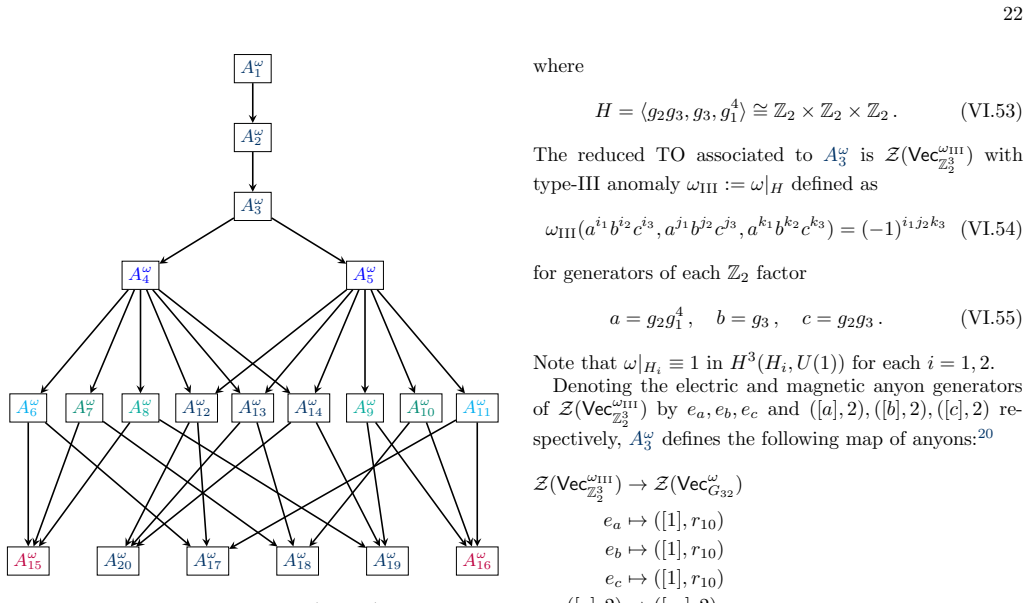
admitA ω 3 as a com- mon subalgebra. where H=⟨g 2g3, g3, g4 1⟩ ∼= Z2 ×Z 2 ×Z 2 .(VI.53) The reduced TO associated toA ω 3 isZ(Vec ωIII Z3 2 ) with type-III anomalyω III :=ω| H defined as ωIII(ai1 bi2 ci3 , aj1 bj2 cj3 , ak1 bk2 ck3) = (−1)i1j2k3 (VI.54) for generators of eachZ 2 factor a=g 2g4 1 , b=g 3 , c=g 2g3 .(VI.55) Note thatω| Hi ≡1 inH 3(Hi, U(1))...
-
[8]
Denote the gappedVec ω G32-symmetric twin phases obtained fromA ω 15 andA ω 16 byP Vecω G32 Aω 15 and P Vecω G32 Aω 16 , respectively
Phase Transitions Respecting Group Symmetries Fixing the symmetry Lagrangian algebra of the SymTFT to beA ω 20=L(1,1) defines the DirichletVec ω G32 sym- metry boundary. Denote the gappedVec ω G32-symmetric twin phases obtained fromA ω 15 andA ω 16 byP Vecω G32 Aω 15 and P Vecω G32 Aω 16 , respectively. As in (VI.25), denote vacua ob- tained from untwiste...
-
[9]
Phase Transitions Respecting Non-Invertible Symmetries We now consider symmetric phases associated to the twin algebras with respect to a non-invertible symmetry S ω := (Vecω G32)∗ M(H1,1), obtained by taking the symme- try Lagrangian algebra of the SymTFT to beA ω 15 Aω 15 =A(H 1, H1,1,1) (VI.65) ∼= ([1],1)⊕([1], r 1)⊕([1], r 8)⊕([1], r 10) ⊕([g 2g3],2)⊕...
-
[10]
Next, we con- densing the anyons ([c],2),([b],2),([bc],2) in the re- duced TOZ(Vec ωIII Z3 2 ). Using the map of anyons to Z(Vecω G) (C 2), we obtain four new idempotents, since ([c],2),([bc],2) are each mapped to an anyon inA ω 15, while ([b],2) is mapped to two distinct anyons inA ω
-
[11]
•ForP S ω Aω 16 , adding toP ωIII CFT the local relevant defor- matione b spontaneously breaksZ ⟨b⟩ 2
We thus obtain the gapped phase P S ω Aω 15 (VI.59) with eight vacua. •ForP S ω Aω 16 , adding toP ωIII CFT the local relevant defor- matione b spontaneously breaksZ ⟨b⟩ 2 . This leads to the gapless phase corresponding to the alge- braA ω 5 , which has four universes, with an extra idempotent corresponding tov 1
-
[12]
Next, we con- densing the anyons ([c],2),([a],2),([ac],2) in the reduced TOZ(Vec ωIII Z3 2 ). Using the map of anyons toZ(Vec ω G) (C 2), we obtain four new idempotents, since ([c],2),([a],2) are each mapped to an anyon inA ω 16, while ([ac],2) is mapped to two distinct anyons inA ω
-
[13]
General- ized Symmetries in Quantum Field Theory and Quantum Gravity
We thus obtain the gapped phase P S ω Aω 16 (VI.61) with eight vacua. P S ω Aω 3 P S ω Aω 15 ⟨AZ3 2,ωIII 15 7→A ω 15⟩ ̸= 0 ⟨AZ3 2,ωIII 16 7→A ω 16⟩ ̸= 0 P S ω Aω 16 (VI.75) The different order/disorder parameters (VI.57)-(VI.58) for the input transition on theZ(Vec ωIII Z3 2 ) physical boundary are mapped to the same anyons in the twin Lagrangian algebras...
-
[14]
Here we present the following definitions in an algebraic way, see
Definition of Condensable Algebras We assume some familiarity with basic knowledge on tensor categories and algebras, see e.g., [68–70]. Here we present the following definitions in an algebraic way, see
-
[15]
Definition A.1.Analgebra(A, µ, ι) in a tensor cat- egoryCconsists of an objectAinC, multiplication µ∈Hom C(A⊗A, A) and unitι∈Hom C(1C, A) satis- fying compatibility conditions
for the same definitions using string diagrams. Definition A.1.Analgebra(A, µ, ι) in a tensor cat- egoryCconsists of an objectAinC, multiplication µ∈Hom C(A⊗A, A) and unitι∈Hom C(1C, A) satis- fying compatibility conditions. Similarly, acoalgebra(A,∆, ϵ) in a tensor category Cconsists of an objectAinC, comultiplication ∆∈ HomC(A, A⊗A) and counitϵ∈Hom C(A,...
-
[16]
Classification Data of Condensable Algebras in Z(Vecω G) This appendix consists of the technical details in the classification of condensable algebras and their reduced TOs inZ(Vec ω G). From Theorem II.1, such a condensable algebra can be labeled by (H, N, γ, ϵ), whereH⊂Ga subgroup,N ◁ Ha normal subgroup,γ:N×N→U(1) 27 such thatdγ=ω| N andϵ:H×N→U(1) satis...
-
[17]
an algebraAinVec ω G
Isomorphic Condensable Algebras Here we prove Lemma II.5. This is achieved via Morita equivalence relation on algebras23, which is equivalent to isomorphism relation for condensable algebras. In Section B 1 a, we give details on conjugation ac- tion ad g onVec ω G following [30]. In Section B 1 b, we induce braided autoequivalencefadg1,g2 onZ(Vec ω G) fro...
-
[18]
Partial Order on Condensable Algebras The proof of Proposition II.11 on the partial ordering of condensable algebras uses tools developed in Ref. [20]. Rather than reproducing such constructions in full, we refer readers to that work and provide only the necessary elements for our proof. Recall the definition of the condensable algebra A(H, N, γ, ϵ) inZ(V...
-
[19]
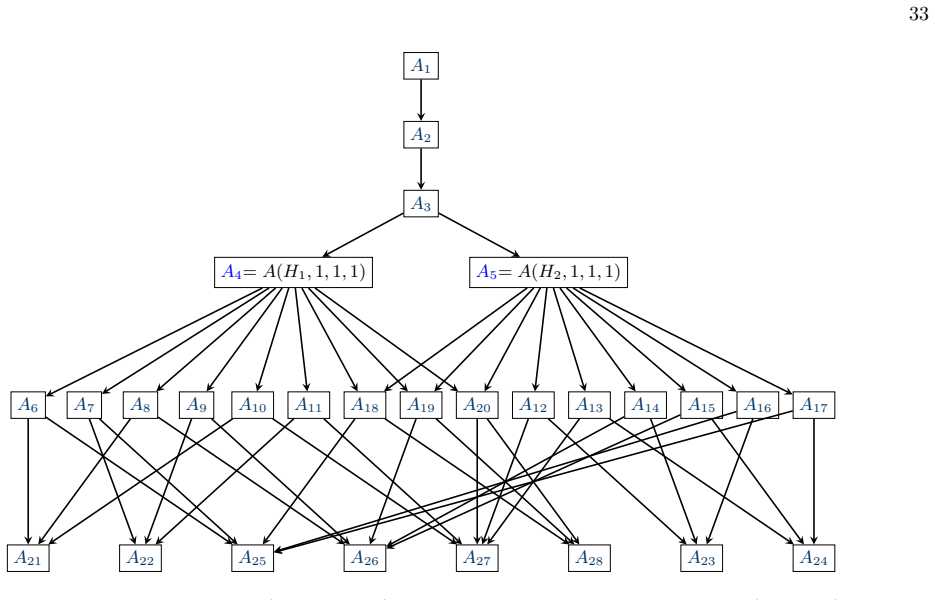
Part of the Hasse diagram forZ(Vec (Z2×Z2)⋉Z8) that connects to the twin algebrasA 4 =A(H 1,1,1,1) andA 5 = A(H2,1,1,1)
Maps of Anyons Aω 3 defines a map of anyons to be: 17→1⊕([1], r 1)⊕([1], r 8) eac 7→([1], r 2)⊕([1], r 3)⊕([1], r 8) eab 7→([1], r 4)⊕([1], r 5)⊕([1], r 9) ebc 7→([1], r 6)⊕([1], r 7)⊕([1], r 9) ea 7→([1], r 10) ec 7→([1], r 10) eb 7→([1], r 10) eabc 7→([1], r 10) ([c],2)7→([g 2g3],2) ([c],−2)7→([g 2g3],−2) ([b],2)7→([g 3],2g 6 1 =− √ 2ζ16)⊕([g 3],2g 6 1 ...
-
[20]
D. Gaiotto, A. Kapustin, N. Seiberg, and B. Willett, “Generalized Global Symmetries,”JHEP02(2015) 172, arXiv:1412.5148 [hep-th]
work page internal anchor Pith review Pith/arXiv arXiv 2015
-
[21]
ICTP Lectures on (Non-)Invertible Generalized Symmetries
S. Schafer-Nameki, “ICTP lectures on (non-)invertible generalized symmetries,”Phys. Rept.1063(2024) 1–55, arXiv:2305.18296 [hep-th]
work page internal anchor Pith review Pith/arXiv arXiv 2024
-
[22]
What's Done Cannot Be Undone: TASI Lectures on Non-Invertible Symmetries
S.-H. Shao, “What’s Done Cannot Be Undone: TASI Lectures on Non-Invertible Symmetry,” arXiv:2308.00747 [hep-th]
work page internal anchor Pith review Pith/arXiv arXiv
-
[23]
Lectures on Generalized Symmetries
L. Bhardwaj, L. E. Bottini, L. Fraser-Taliente, L. Gladden, D. S. W. Gould, A. Platschorre, and H. Tillim, “Lectures on Generalized Symmetries,” arXiv:2307.07547 [hep-th]
work page internal anchor Pith review Pith/arXiv arXiv
-
[24]
W. Ji and X.-G. Wen, “Categorical symmetry and noninvertible anomaly in symmetry-breaking and topological phase transitions,”Phys. Rev. Res.2no. 3, (2020) 033417,arXiv:1912.13492 [cond-mat.str-el]
-
[25]
D. Gaiotto and J. Kulp, “Orbifold groupoids,”JHEP 02(2021) 132,arXiv:2008.05960 [hep-th]
-
[26]
Symmetry TFTs from String Theory
F. Apruzzi, F. Bonetti, I. n. G. Etxebarria, S. S. Hosseini, and S. Schafer-Nameki, “Symmetry TFTs from String Theory,”arXiv:2112.02092 [hep-th]
work page internal anchor Pith review Pith/arXiv arXiv
-
[27]
Topological symmetry in quantum field theory
D. S. Freed, G. W. Moore, and C. Teleman, “Topological symmetry in quantum field theory,” arXiv:2209.07471 [hep-th]
work page internal anchor Pith review Pith/arXiv arXiv
-
[28]
Hasse Diagrams for Gapless SPT and SSB Phases with Non-Invertible Symmetries,
L. Bhardwaj, D. Pajer, S. Schafer-Nameki, and A. Warman, “Hasse Diagrams for Gapless SPT and SSB Phases with Non-Invertible Symmetries,”SciPost Phys. 19(2025) 113,arXiv:2403.00905 [cond-mat.str-el]
-
[29]
Illustrating the categorical Landau paradigm in lattice models,
L. Bhardwaj, L. E. Bottini, S. Schafer-Nameki, and A. Tiwari, “Illustrating the categorical Landau paradigm in lattice models,”Phys. Rev. B111no. 5, (2025) 054432,arXiv:2405.05302 [cond-mat.str-el]
-
[30]
Lattice Models for Phases and Transitions with Non-Invertible Symmetries
L. Bhardwaj, L. E. Bottini, S. Schafer-Nameki, and A. Tiwari, “Lattice Models for Phases and Transitions with Non-Invertible Symmetries,”SciPost Phys.20 (2026) 134,arXiv:2405.05964 [cond-mat.str-el]
work page internal anchor Pith review Pith/arXiv arXiv 2026
-
[31]
Quantum phases and transitions in spin chains with non-invertible symmetries,
A. Chatterjee, ¨O. M. Aksoy, and X.-G. Wen, “Quantum phases and transitions in spin chains with non-invertible symmetries,”SciPost Phys.17no. 4, (2024) 115, arXiv:2405.05331 [cond-mat.str-el]
-
[32]
Categorical Symmetries in Spin Models with Atom Arrays,
A. Warman, F. Yang, A. Tiwari, H. Pichler, and S. Schafer-Nameki, “Categorical Symmetries in Spin Models with Atom Arrays,”Phys. Rev. Lett.135no. 20, (2025) 206503,arXiv:2412.15024 [cond-mat.str-el]
-
[33]
Construction of a Gapless Phase with Haagerup Symmetry,
L. E. Bottini and S. Schafer-Nameki, “Construction of a Gapless Phase with Haagerup Symmetry,”Phys. Rev. Lett.134no. 19, (2025) 191602,arXiv:2410.19040 [hep-th]
-
[34]
A. Chatterjee and X.-G. Wen, “Holographic theory for continuous phase transitions: Emergence and symmetry protection of gaplessness,”Phys. Rev. B108no. 7, (2023) 075105,arXiv:2205.06244 [cond-mat.str-el]
-
[35]
The club sandwich: Gapless phases and phase transitions with non-invertible symmetries,
L. Bhardwaj, L. E. Bottini, D. Pajer, and S. Schafer-Nameki, “The club sandwich: Gapless phases and phase transitions with non-invertible symmetries,” SciPost Phys.18no. 5, (2025) 156,arXiv:2312.17322 [hep-th]
-
[36]
Classification of 1+1D gapless symmetry protected phases via topological holography,
R. Wen and A. C. Potter, “Classification of 1+1D gapless symmetry protected phases via topological holography,”arXiv:2311.00050 [cond-mat.str-el]
-
[37]
Warman, S
A. Warman, S. Schafer-Nameki, and Y. Gai. Twin Phases: Phase Transitions Without Hidden Symmetry Breaking (to appear)
-
[38]
Modular invariants for group-theoretical modular data. i,
A. Davydov, “Modular invariants for group-theoretical modular data. i,”Journal of Algebra323(2009) 1321–1348
2009
-
[39]
On lagrangian algebras in group-theoretical braided fusion categories,
A. Davydov and D. Simmons, “On lagrangian algebras in group-theoretical braided fusion categories,”Journal of Algebra471(2017) 149–175
2017
-
[40]
Frobenius Monoidal Functors of Dijkgraaf-Witten Categories and Rigid Frobenius Algebras,
S. Hannah, R. Laugwitz, and A. R. Camacho, “Frobenius Monoidal Functors of Dijkgraaf-Witten Categories and Rigid Frobenius Algebras,”SIGMA19 (2023) 075,arXiv:2303.04493
-
[41]
Riemannian coverings and isospectral manifolds,
T. Sunada and Y. Matsushima, “Riemannian coverings and isospectral manifolds,”Annals of Mathematics121 (1985) 169
1985
-
[42]
Bemerkungen zur vorstehenden Arbeit von Hurwitz ( ¨Uber Beziehungen zwischen den Primidealen eines algebraischen K¨ orpers und den Substitutionen seiner Gruppe),
F. Gassmann, “Bemerkungen zur vorstehenden Arbeit von Hurwitz ( ¨Uber Beziehungen zwischen den Primidealen eines algebraischen K¨ orpers und den Substitutionen seiner Gruppe),”Math. Z.25(1926) 665–675
1926
-
[43]
Detection of symmetry-protected topological phases in one dimension,
F. Pollmann and A. M. Turner, “Detection of symmetry-protected topological phases in one dimension,”Physical Review B86no. 12, (Sept., 2012)
2012
-
[44]
Bogomolov multiplier, double class-preserving automorphisms and modular invariants for orbifolds
A. Davydov, “Bogomolov multiplier, double class-preserving automorphisms, and modular invariants for orbifolds,”J. Math. Phys.55(2014) 092305, arXiv:1312.7466 [math.CT]
work page internal anchor Pith review Pith/arXiv arXiv 2014
-
[45]
Soft symmetries of topological orders,
R. Kobayashi and M. Barkeshli, “Soft symmetries of topological orders,”arXiv:2501.03314 [cond-mat.str-el]
-
[46]
Projective Representations, Bogomolov Multiplier, and Their Applications in Physics,
R. Kobayashi and H. Watanabe, “Projective Representations, Bogomolov Multiplier, and Their Applications in Physics,”arXiv:2507.12515 [cond-mat.str-el]
-
[47]
Deconfined quantum critical points: a review,
T. Senthil, “Deconfined quantum critical points: a review,”arXiv:2306.12638 [cond-mat.str-el]
-
[48]
The witt group of non-degenerate braided fusion categories,
A. Davydov, M. M¨ uger, D. Nikshych, and V. Ostrik, “The witt group of non-degenerate braided fusion categories,”Journal f¨ ur die reine und angewandte Mathematik (Crelles Journal)2013no. 677, (2013) 135–177
2013
-
[49]
On the equivalence of module categories over a group-theoretical fusion category,
S. Natale, “On the equivalence of module categories over a group-theoretical fusion category,”Symmetry, Integrability and Geometry: Methods and Applications (June, 2017)
2017
-
[50]
Module categories over the Drinfeld double of a finite group,
V. Ostrik, “Module categories over the Drinfeld double of a finite group,”arXiv Mathematics e-prints(Feb.,
-
[51]
math/0202130,arXiv:math/0202130 [math.QA]. 37
work page internal anchor Pith review Pith/arXiv arXiv
-
[52]
Algebraic Aspects of Orbifold Models
P. Bantay, “Algebraic aspects of orbifold models,”Int. J. Mod. Phys. A9(1994) 1443–1456, arXiv:hep-th/9303009
work page internal anchor Pith review Pith/arXiv arXiv 1994
-
[53]
Computing modular data for pointed fusion categories,
A. Gruen and S. Morrison, “Computing modular data for pointed fusion categories,”Indiana University Mathematics Journal70no. 2, (2021) 561–593, arXiv:1808.05060 [math.QA]
-
[54]
The Quantum Double Model with Boundary: Condensations and Symmetries
S. Beigi, P. W. Shor, and D. Whalen, “The Quantum Double Model with Boundary: Condensations and Symmetries,”Commun. Math. Phys.306no. 3, (2011) 663–694,arXiv:1006.5479 [quant-ph]
work page internal anchor Pith review Pith/arXiv arXiv 2011
-
[55]
Gapless Phases in (2+1)d with Non-Invertible Symmetries
L. Bhardwaj, Y. Gai, S.-J. Huang, K. Inamura, S. Schafer-Nameki, A. Tiwari, and A. Warman, “Gapless Phases in (2+1)d with Non-Invertible Symmetries,”arXiv:2503.12699 [cond-mat.str-el]
work page internal anchor Pith review Pith/arXiv arXiv
-
[56]
Classification of modular data up to rank 12,
S.-H. Ng, E. C. Rowell, and X.-G. Wen, “Classification of modular data up to rank 12,”arXiv:2308.09670 [math.QA]
-
[57]
Modular categories are not determined by their modular data,
M. Mignard and P. Schauenburg, “Modular categories are not determined by their modular data,”Letters in Mathematical Physics111no. 3, (2021) 60
2021
-
[58]
Zesting produces modular isotopes and explains their topological invariants,
C. Delaney, S. Kim, and J. Plavnik, “Zesting produces modular isotopes and explains their topological invariants,”arXiv:2107.11374 [math.QA]
-
[59]
Hamiltonian and Algebraic Theories of Gapped Boundaries in Topological Phases of Matter
I. Cong, M. Cheng, and Z. Wang, “Hamiltonian and Algebraic Theories of Gapped Boundaries in Topological Phases of Matter,”Commun. Math. Phys.355(2017) 645–689,arXiv:1707.04564 [cond-mat.str-el]
work page internal anchor Pith review Pith/arXiv arXiv 2017
-
[60]
Hall,Combinatorial theory
M. Hall,Combinatorial theory. Wiley classics library. Wiley, New York, NY, 2. ed., [nachdr.] ed., 1998
1998
-
[61]
Serre,Linear Representations of Finite Groups, vol
J.-P. Serre,Linear Representations of Finite Groups, vol. 42 ofGraduate Texts in Mathematics. Springer New York, New York, NY, 1977.http: //link.springer.com/10.1007/978-1-4684-9458-7
-
[62]
On arithmetically equivalent number fields of small degree,
W. Bosma and B. de Smit, “On arithmetically equivalent number fields of small degree,” in Algorithmic Number Theory, C. Fieker and D. R. Kohel, eds., pp. 67–79. Springer Berlin Heidelberg, Berlin, Heidelberg, 2002
2002
-
[63]
The subgroups of m24, or how to compute the table of marks of a finite group,
G. Pfeiffer, “The subgroups of m24, or how to compute the table of marks of a finite group,”Experimental Mathematics6no. 3, (1997) 247–270, https://doi.org/10.1080/10586458.1997.10504613
-
[64]
Categorical morita equivalence for group-theoretical categories,
D. V. Naidu, “Categorical morita equivalence for group-theoretical categories,”Communications in Algebra35(2006) 3544 – 3565
2006
-
[65]
Stronger arithmetic equivalence,
A. V. Sutherland, “Stronger arithmetic equivalence,” Discrete Analysis(Nov 15, 2021)
2021
-
[66]
The brauer group of quotient spaces by linear group actions,
F. A. Bogomolov, “The brauer group of quotient spaces by linear group actions,”Mathematics of the USSR-Izvestiya30no. 3, (Jun, 1988) 455
1988
-
[67]
An order parameter for symmetry-protected phases in one dimension
J. Haegeman, D. Perez-Garcia, I. Cirac, and N. Schuch, “Order Parameter for Symmetry-Protected Phases in One Dimension,”Phys. Rev. Lett.109no. 5, (2012) 050402,arXiv:1201.4174 [cond-mat.str-el]
work page internal anchor Pith review Pith/arXiv arXiv 2012
-
[68]
Algebras of order parameters in one-dimensional spin systems
A. Chavda, C. Delcamp, A. Turzillo, and M. You, “Algebras of order parameters in one-dimensional spin systems,”arXiv:2605.27193 [cond-mat.str-el]
work page internal anchor Pith review Pith/arXiv arXiv
-
[69]
Gapped phases with non-invertible symmetries: (1+1)d,
L. Bhardwaj, L. E. Bottini, D. Pajer, and S. Sch¨ afer-Nameki, “Gapped phases with non-invertible symmetries: (1+1)d,”SciPost Phys.18no. 1, (2025) 032,arXiv:2310.03784 [hep-th]
-
[70]
Generalized charges, part II: Non-invertible symmetries and the symmetry TFT,
L. Bhardwaj and S. Schafer-Nameki, “Generalized Charges, Part II: Non-Invertible Symmetries and the Symmetry TFT,”arXiv:2305.17159 [hep-th]
-
[71]
Beyond Wigner: Non-Invertible Symmetries Preserve Probabilities,
T. Bartsch, Y. Gai, and S. Schafer-Nameki, “Beyond Wigner: Non-Invertible Symmetries Preserve Probabilities,”arXiv:2602.07110 [quant-ph]
-
[72]
Non-invertible Symmetries and Higher Representation Theory I,
T. Bartsch, M. Bullimore, A. E. V. Ferrari, and J. Pearson, “Non-invertible Symmetries and Higher Representation Theory I,”arXiv:2208.05993 [hep-th]
-
[73]
Representation theory for categorical symmetries,
T. Bartsch, M. Bullimore, and A. Grigoletto, “Representation theory for categorical symmetries,” arXiv:2305.17165 [hep-th]
-
[74]
Hidden Z2×Z2 symmetry breaking in Haldane-gap antiferromagnets,
T. Kennedy and H. Tasaki, “Hidden Z2×Z2 symmetry breaking in Haldane-gap antiferromagnets,”Phys. Rev. B45no. 1, (1992) 304
1992
-
[75]
Fusion Category Symmetry I: Anomaly In-Flow and Gapped Phases
R. Thorngren and Y. Wang, “Fusion category symmetry. Part I. Anomaly in-flow and gapped phases,” JHEP04(2024) 132,arXiv:1912.02817 [hep-th]
work page internal anchor Pith review Pith/arXiv arXiv 2024
-
[76]
On the adele rings of algebraic number fields.,
K. Komatsu, “On the adele rings of algebraic number fields.,”K¯ odai Mathematical Seminar Reports28no. 1, (1976) 78
1976
-
[77]
GAP – Groups, Algorithms, and Programming, Version 4.15.1,
“GAP – Groups, Algorithms, and Programming, Version 4.15.1,” 2025.https://www.gap-system.org
2025
-
[78]
HAP, Homological Algebra Programming, Version 1.73
G. Ellis, “HAP, Homological Algebra Programming, Version 1.73.”https://gap-packages.github.io/hap. GAP package
-
[79]
Morita equivalence of pointed fusion categories of small rank
M. Mignard and P. Schauenburg, “Morita equivalence of pointed fusion categories of small rank,” 2017. https://arxiv.org/abs/1708.06538
work page internal anchor Pith review Pith/arXiv arXiv 2017
-
[80]
Symmetry Spans and Enforced Gaplessness
T. Ando and K. Ohmori, “Symmetry Spans and Enforced Gaplessness,”arXiv:2602.11696 [cond-mat.str-el]
work page internal anchor Pith review Pith/arXiv arXiv
discussion (0)
Sign in with ORCID, Apple, or X to comment. Anyone can read and Pith papers without signing in.