Beyond Tool Adoption: A Practical Five-Stage Developmental Continuum for AI Literacy in Higher Education
Pith reviewed 2026-07-01 09:11 UTC · model grok-4.3
The pith
A five-stage continuum tracks how students progress from avoiding or uncritically using AI toward critical evaluation and responsible improvement.
A machine-rendered reading of the paper's core claim, the machinery that carries it, and where it could break.
Core claim
The paper claims that AI literacy is best understood as a developmental capacity to understand, evaluate, and responsibly apply AI systems in disciplinary and societal contexts, rather than as tool adoption alone, and that the five-stage continuum supplies educators with a diagnostic and instructional pathway aligned with UNESCO and OECD frameworks.
What carries the argument
The five-stage AI Literacy Continuum (Not Yet Engaged, Uncritical Use, Informed Use, Critical Evaluation, Improvement), which classifies learner orientations and guides instructional design.
If this is right
- Educators can diagnose a student's current stage and select activities that match that position.
- Credit-bearing courses and hands-on workshops support progression when they are sustained and embedded in a discipline.
- Assessment can focus on observable behaviors that indicate critical evaluation or improvement-oriented practice.
- Curricular pathways can be built around the stages to move learners beyond initial avoidance or uncritical reliance.
Where Pith is reading between the lines
- The same staging approach might be tested in professional development settings outside universities.
- Discipline-specific versions of the continuum could be developed for fields with heavy AI use such as engineering or social sciences.
- Institutional policies could adopt the stages as a common language for tracking AI literacy across programs.
Load-bearing premise
Behaviors observed in one university's courses and workshops reflect genuine movement through the stages even without validated pre/post measures or a comparison group.
What would settle it
A study using a validated instrument before and after similar courses that finds no consistent shift from lower to higher stages would undermine the continuum.
Figures

read the original abstract
Artificial intelligence (AI) literacy is increasingly recognized as a foundational competency for all university graduates. Yet students' engagement with AI tools often clusters at two extremes: avoidance driven by fear, mistrust, ethical concern, or lack of access, and uncritical reliance that produces fluent output while masking misunderstanding. Existing AI literacy frameworks provide valuable competency definitions, but most offer limited guidance for diagnosing where learners begin and how they progress toward responsible, critical engagement. This paper proposes a five-stage AI Literacy Continuum: 0) Not Yet Engaged, 1) Uncritical Use, 2) Informed Use, 3) Critical Evaluation, and 4) Improvement --that describes developmental orientations toward AI use in higher education. The continuum complements dimensional frameworks by providing educators with a practical diagnostic and instructional pathway aligned with international frameworks, including UNESCO and OECD. We present a design-based implementation case from North Carolina State University, where credit-bearing courses and intensive hands-on workshops engaged more than 330 participants between Fall 2024 and Spring 2026. Because the implementation did not use a validated pre/post instrument or comparison group, we frame the findings as observational and practice-based: participants exhibited behaviors consistent with movement from non-engagement or uncritical use toward informed engagement, while sustained and discipline-embedded experiences produced stronger evidence of critical evaluation and improvement-oriented practice. We discuss curricular pathways, opportunity considerations, assessment strategies, and argue that AI literacy should be understood not as tool adoption alone but as a developmental capacity to understand, evaluate, and responsibly apply AI systems in disciplinary and societal contexts.
Editorial analysis
A structured set of objections, weighed in public.
Referee Report
Summary. The paper claims that existing AI literacy frameworks provide competency definitions but limited guidance on diagnosing starting points and progression, and proposes a five-stage developmental continuum (Not Yet Engaged, Uncritical Use, Informed Use, Critical Evaluation, Improvement) as a practical diagnostic and instructional pathway for higher education AI literacy. The continuum is positioned as complementary to dimensional frameworks and aligned with UNESCO and OECD standards. It is illustrated via an observational, practice-based case study from North Carolina State University involving credit-bearing courses and workshops with over 330 participants (Fall 2024–Spring 2026), where behaviors were noted as consistent with movement toward informed, critical, and improvement-oriented engagement, with explicit acknowledgment that no validated pre/post instrument or comparison group was used.
Significance. If the continuum functions as a useful heuristic, it would give educators a structured, actionable way to diagnose and scaffold students' AI engagement beyond tool adoption or avoidance, supporting curriculum design and assessment in higher education. The explicit alignment with international frameworks and the transparent framing of the NCSU case as observational practice-based evidence (rather than causal proof) are strengths that increase its immediate utility for practitioners. The focus on developmental orientations rather than static competencies addresses a recognized gap in the literature.
major comments (1)
- [Abstract and Implementation Case] Abstract and Implementation Case section: The central narrative that the continuum 'describes developmental orientations' and that participants 'exhibited behaviors consistent with movement' toward informed engagement rests on unvalidated observational data without pre/post instruments or comparison groups. While the paper appropriately qualifies the evidence as practice-based, this still limits the support for interpreting the stages as a genuine progression rather than a descriptive taxonomy.
minor comments (2)
- The alignment with UNESCO and OECD is stated but would be strengthened by a brief table or explicit mapping of the five stages to specific elements of those frameworks.
- Stage definitions would benefit from one or two concrete example behaviors or diagnostic indicators per stage to make the continuum more immediately usable by educators.
Simulated Author's Rebuttal
We thank the referee for the constructive review and recommendation of minor revision. We address the single major comment below.
read point-by-point responses
-
Referee: [Abstract and Implementation Case] Abstract and Implementation Case section: The central narrative that the continuum 'describes developmental orientations' and that participants 'exhibited behaviors consistent with movement' toward informed engagement rests on unvalidated observational data without pre/post instruments or comparison groups. While the paper appropriately qualifies the evidence as practice-based, this still limits the support for interpreting the stages as a genuine progression rather than a descriptive taxonomy.
Authors: We appreciate the referee's emphasis on this distinction. The manuscript already qualifies the NCSU implementation explicitly as an observational, practice-based case study without pre/post instruments or comparison groups, and uses the phrasing 'behaviors consistent with movement' rather than claiming validated or causal progression. The continuum is positioned as a proposed practical heuristic for diagnosis and instruction, complementary to dimensional competency frameworks, and derived from design-based observations rather than experimental validation. This is consistent with the paper's framing as a practice-oriented contribution. To address the concern directly, we will revise the Abstract and Implementation Case section to more explicitly state that the five stages are offered as a descriptive and instructional taxonomy with developmental implications, not as an empirically demonstrated progression sequence. This clarification will prevent overinterpretation while preserving the heuristic value for educators. revision: yes
Circularity Check
No significant circularity
full rationale
The paper offers a conceptual five-stage AI Literacy Continuum as a diagnostic heuristic aligned with external international frameworks (UNESCO, OECD) rather than deriving the stages from its own case data or any internal equations. The implementation case at North Carolina State University is explicitly framed as observational and practice-based, with direct acknowledgment that no validated pre/post instrument or comparison group was used; no behaviors are claimed to prove progression. No self-citations, fitted parameters, ansatzes, or uniqueness theorems appear as load-bearing elements. The central claim remains independent of the reported observations and does not reduce to its inputs by construction.
Axiom & Free-Parameter Ledger
axioms (1)
- domain assumption AI engagement develops through distinct sequential stages from non-engagement to critical improvement
Reference graph
Works this paper leans on
-
[1]
performance without learning
Introduction Artificial intelligence has become deeply embedded in knowledge production, professional practice, and everyday decision-making. From scientific discovery and engineering design to writing, coding, legal analysis, and data interpretation, AI systems increasingly mediate how students learn and how they demonstrate understanding (Kasneci, et al...
2023
-
[2]
Big Ideas
Related Work 2.1 Defining AI Literacy AI literacy has been defined in multiple ways across disciplines and has evolved substantially over the past decade. In the 2010s, the focus largely centered in the tech/STEM community on machine learning to solve image processing, classification/clustering, anomaly detection and recommendation systems. The Netflix Pr...
2020
-
[3]
using AI is cheating
The AI Literacy Continuum To bridge the gap between abstract competency definitions and classroom practice, this section proposes a five-stage AI Literacy Continuum (Figure 1). The continuum describes typical patterns of learner engagement with AI systems in higher education, moving from complete avoidance through increasingly sophisticated and responsibl...
2025
-
[4]
The Understand level corresponds primarily to Stage 2 (Informed Use), where students develop foundational understanding of AI systems and their implications
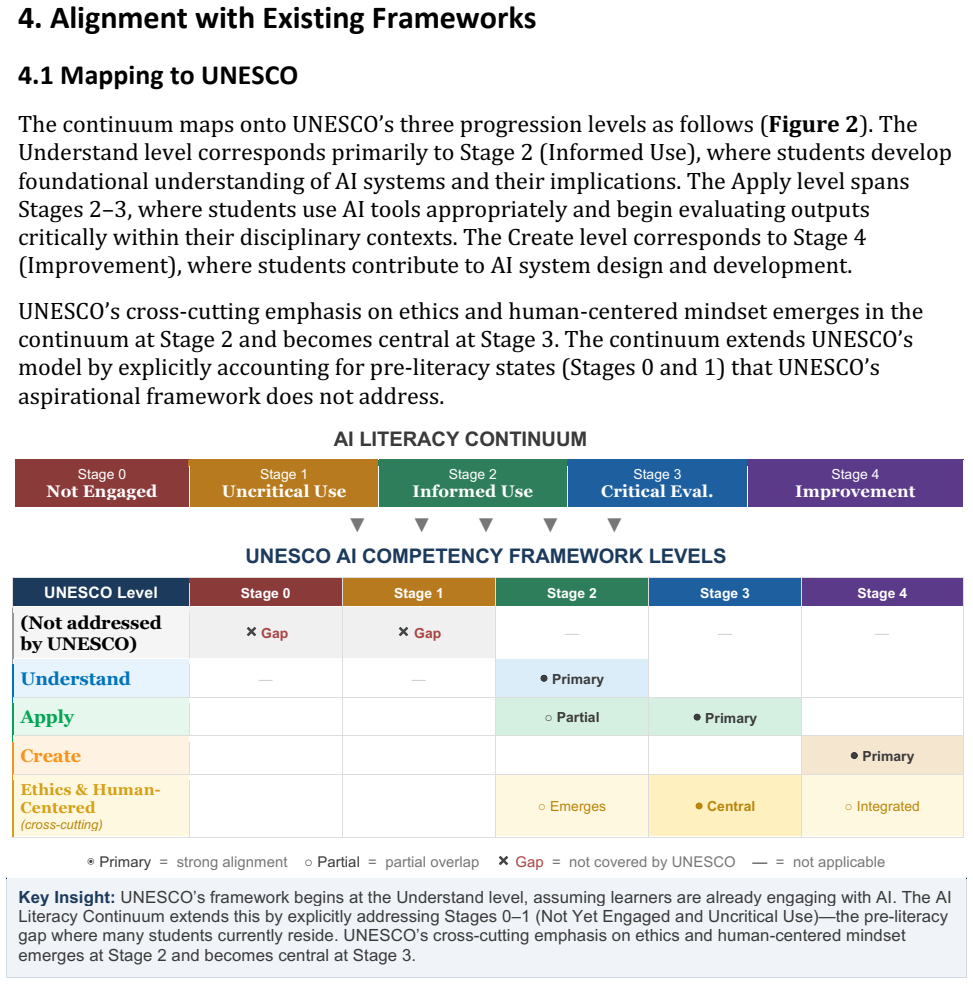
Alignment with Existing Frameworks 4.1 Mapping to UNESCO The continuum maps onto UNESCO’s three progression levels as follows (Figure 2). The Understand level corresponds primarily to Stage 2 (Informed Use), where students develop foundational understanding of AI systems and their implications. The Apply level spans Stages 2–3, where students use AI tools...
2025
-
[5]
General education courses serve as the primary mechanism for preventing the dominance of Stage 1 engagement
Educational Design Implications 5.1 Curriculum Integration The AI Literacy continuum supports differentiated curricular pathways matched to institutional context, domain relevance and student needs. General education courses serve as the primary mechanism for preventing the dominance of Stage 1 engagement. Required courses or modules on AI literacy should...
2024
-
[6]
Assessment Strategies Effective AI literacy assessment requires a mixed-methods approach that combines existing validated instruments with performance-based assessments aligned to the continuum. Because the continuum describes observable orientations rather than fixed psychological types, assessment should triangulate self-report, artifact analysis, and p...
2022
-
[7]
Generative AI for Science,
Design-Based Implementation Case: AI Literacy Development at NC State University 7.1 Institutional Context and Program Design To illustrate the practical feasibility of the AI Literacy Continuum, we present a design-based implementation case of AI literacy initiatives at North Carolina State University (NC State) through the Data Science and AI Academy (D...
2024
-
[8]
First, it clarifies a critical distinction that is often blurred in practice: AI use is not AI literacy
Discussion 8.1 Contributions The AI Literacy Continuum makes four primary contributions. First, it clarifies a critical distinction that is often blurred in practice: AI use is not AI literacy. By explicitly identifying uncritical use as a distinct stage that precedes literacy, the continuum provides conceptual clarity that supports more precise education...
-
[9]
Scale for the Assessment of Non-experts’ AI Literacy
Conclusion AI literacy is best understood as a developmental capability that progresses from avoidance or uncritical use toward informed judgment and responsible application. The five-stage AI Literacy Continuum proposed in this paper: Not Yet Engaged, Uncritical Use, Informed Use, Critical Evaluation, and Improvement offers a practical bridge between int...
discussion (0)
Sign in with ORCID, Apple, or X to comment. Anyone can read and Pith papers without signing in.