Beyond Categories of Caste: Examining Caste Bias and Morality in Text-to-Image AI Models
Pith reviewed 2026-07-01 09:07 UTC · model grok-4.3
The pith
Caste bias in text-to-image AI models operates through relational dynamics that exceed upper-lower category binaries.
A machine-rendered reading of the paper's core claim, the machinery that carries it, and where it could break.
Core claim
By moving beyond a categorical view of caste to its relational character and drawing on a conceptual frame that challenges Brahminical Normativity, the audit and discourse analysis show that text-to-image models perpetuate caste biases through mechanisms that go beyond upper versus lower caste distinctions, which in turn supports the proposal of an anti-caste approach to fairness in AI.
What carries the argument
The relational ontology of caste, examined via algorithmic audit paired with critical discourse analysis under a frame challenging Brahminical Normativity.
If this is right
- Caste biases in generated images are not limited to binary upper-lower distinctions.
- An anti-caste approach supplies a route to address fairness problems in AI systems.
- The relational focus uncovers discrimination mechanics that category-based audits would miss.
- Fairness interventions must target norms that sustain caste relations rather than isolated group labels.
Where Pith is reading between the lines
- Audits of other generative models could adopt the same relational lens to check for overlooked identity patterns.
- Training data curation for text-to-image systems might need explicit checks against relational caste embeddings.
- The approach could extend to prompt engineering practices that currently reinforce the identified norms.
Load-bearing premise
Shifting the ontology to focus on the relational aspect of caste enables a more nuanced understanding of the mechanics of caste discrimination by and through T2I models.
What would settle it
A finding that all measurable caste biases in model outputs align strictly with upper-versus-lower category distinctions, with no additional relational patterns, would undermine the claim that the ontology shift is needed.
Figures
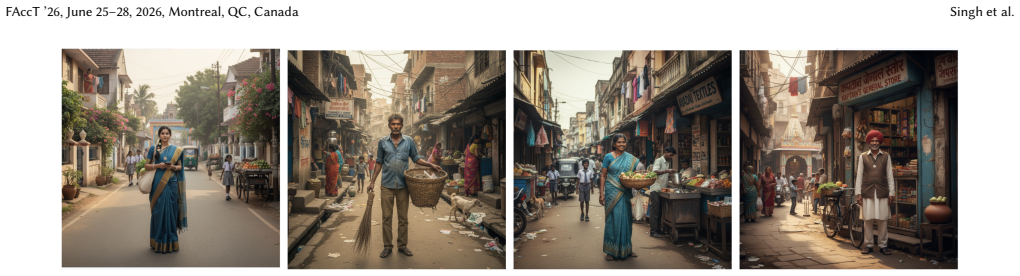
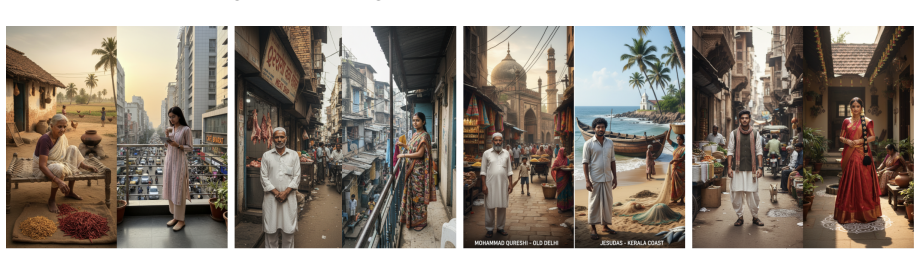
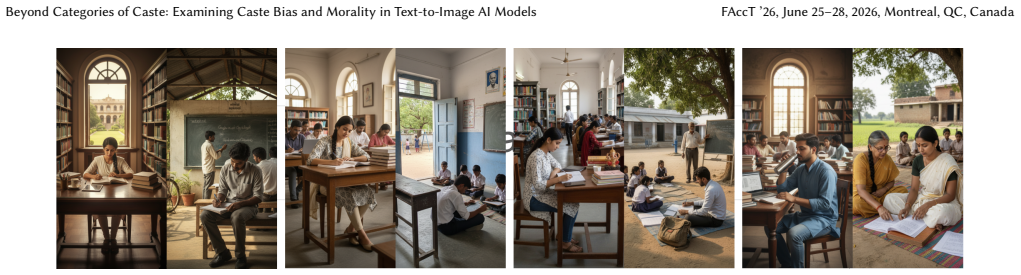
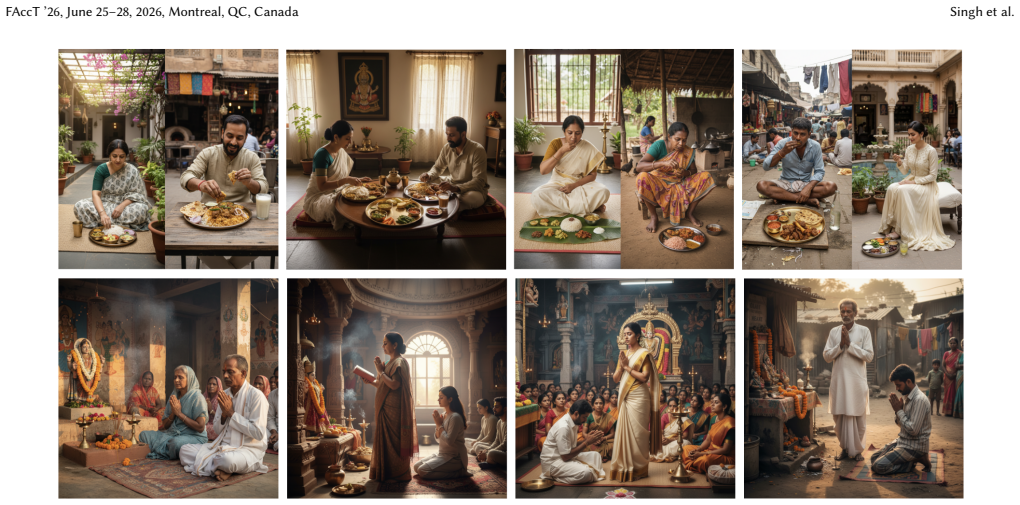





read the original abstract
Text-to-Image (T2I) models have shown promising utility across various domains. However, such models are also amplifying harmful societal biases in their outputs. In the context of South Asia, recent work has shown caste biases and stereotypes are being perpetuated through Generative AI (GenAI) systems. While this research offers extremely relevant insight into invisibilized narratives of caste discrimination through the GenAI system, they often treat caste as an identity category. Therefore, in this work we shift our ontology to focus on the relational aspect of caste. This enables us to develop a more nuanced understanding of the mechanics of caste discrimination by and through T2I models. Combining an algorithmic audit with critical discourse analysis, we draw on a conceptual frame challenging Brahminical Normativity to show how caste biases are perpetuated beyond the simple binaries of upper vs lower-caste categories. Our contributions are two-fold. Beyond challenging the categorical understanding of caste as a category, we propose an anti-caste approach to tackle the issue of caste bias and fairness in AI systems.
Editorial analysis
A structured set of objections, weighed in public.
Referee Report
Summary. The paper claims that prior work on caste bias in text-to-image (T2I) models treats caste as a fixed identity category and that shifting the ontology to emphasize the relational aspects of caste enables a more nuanced account of how these models perpetuate discrimination. It combines an algorithmic audit with critical discourse analysis, drawing on a conceptual frame that challenges Brahminical normativity, to demonstrate biases that exceed simple upper/lower-caste binaries and to propose an anti-caste approach to fairness in AI systems.
Significance. If the empirical components substantiate the interpretive claims, the work would contribute to AI ethics and fairness research by offering a conceptual reframing that integrates critical theory with technical auditing. This could influence how bias studies in generative models address non-binary social structures in South Asian contexts. The interdisciplinary method—pairing algorithmic prompts with discourse analysis—is a strength that could serve as a template for similar studies.
major comments (2)
- [Methods] Methods section: The manuscript does not specify the exact prompts, model versions, sampling strategy, or quantitative metrics employed in the algorithmic audit. Without these details it is not possible to determine whether the audit operationalizes the relational ontology of caste or simply reproduces categorical distinctions in its design.
- [Results] Results/Discourse Analysis section: The central claim that the analysis reveals caste biases 'beyond the simple binaries' rests on the discourse analysis procedure, yet the manuscript provides no explicit coding scheme, inter-rater reliability measures, or examples of how relational (as opposed to categorical) dynamics were identified and distinguished from prior categorical treatments.
minor comments (2)
- [Introduction] The abstract and introduction use 'Brahminical Normativity' without an initial definition or citation to the specific prior literature being extended; a brief definitional paragraph would improve accessibility for readers outside South Asian studies.
- Figure captions and table headings (if present) should explicitly link visual or tabular outputs back to the relational vs. categorical distinction to help readers trace how the evidence supports the ontology shift.
Simulated Author's Rebuttal
We thank the referee for their constructive comments, which highlight important areas for improving methodological transparency. We address each point below and will revise the manuscript accordingly to provide greater detail on the audit design and analysis procedures while preserving the paper's core conceptual contribution.
read point-by-point responses
-
Referee: [Methods] Methods section: The manuscript does not specify the exact prompts, model versions, sampling strategy, or quantitative metrics employed in the algorithmic audit. Without these details it is not possible to determine whether the audit operationalizes the relational ontology of caste or simply reproduces categorical distinctions in its design.
Authors: We agree that the absence of these specifics limits the ability to evaluate how the prompts and procedures capture relational dynamics. The original audit used prompts that foreground interactions and power relations (e.g., scenes depicting deference, authority, or exclusion between caste-positioned figures) rather than isolated identity labels, but these details were omitted for brevity. In revision we will add a dedicated methods subsection and appendix listing the exact prompt templates, model versions (Stable Diffusion 2.1 and DALL-E 2), sampling parameters (50 steps, guidance scale 7.5, 100 generations per prompt), and any quantitative metrics (e.g., frequency counts of visual markers of hierarchy). This addition will demonstrate that the design was intended to operationalize relational ontology rather than reproduce binaries. revision: yes
-
Referee: [Results] Results/Discourse Analysis section: The central claim that the analysis reveals caste biases 'beyond the simple binaries' rests on the discourse analysis procedure, yet the manuscript provides no explicit coding scheme, inter-rater reliability measures, or examples of how relational (as opposed to categorical) dynamics were identified and distinguished from prior categorical treatments.
Authors: The referee correctly notes the lack of explicit documentation. The discourse analysis followed an interpretive approach grounded in the anti-Brahminical-normativity frame, iteratively identifying relational patterns such as depicted subordination in occupational or spatial arrangements that exceed simple upper/lower labels. However, without a reported coding scheme or examples, this process remains opaque. We will revise the results section to include a brief methods subsection describing the iterative coding process, with two concrete examples of relational coding (one showing non-binary hierarchy in a professional interaction and one in a domestic scene), and clarify that, consistent with critical discourse analysis traditions, formal inter-rater reliability was not applied; instead, analytic memos and consensus discussion among authors were used. These additions will make the distinction from prior categorical work explicit. revision: yes
Circularity Check
No significant circularity detected
full rationale
The paper advances a conceptual argument by shifting the ontology of caste from categorical to relational, then applies algorithmic audit plus critical discourse analysis under a Brahminical-normativity lens to examine T2I bias. No equations, fitted parameters, quantitative predictions, or derivations appear anywhere in the manuscript. The central claims rest on interpretive analysis of generated images and discourse, supported by citations to external prior literature on caste and AI rather than any self-citation chain or self-definitional loop. The contribution is therefore self-contained against external benchmarks and exhibits none of the enumerated circularity patterns.
Axiom & Free-Parameter Ledger
Reference graph
Works this paper leans on
-
[1]
https://timesofindia.indiatimes.com/city/hyderabad/dalit-man-allegedly- abused-by-priest-and-temple-officials-over-lack-of-dakshina/articleshow/ 114956944.cms
2024. https://timesofindia.indiatimes.com/city/hyderabad/dalit-man-allegedly- abused-by-priest-and-temple-officials-over-lack-of-dakshina/articleshow/ 114956944.cms
2024
-
[2]
Mustafa Ali. 2014. Towards a decolonial computing. (2014)
2014
-
[3]
Manjur Ali and Shilp Shikha Singh. 2024. Contemporary ‘Pasmanda’Leadership and the Hindutva Politics in Uttar Pradesh.Studies in Indian Politics12, 1 (2024), 33–47
2024
-
[4]
1945.Annihilation of caste with a reply to Mahatma Gandhi
Bhimrao Ramji Ambedkar. 1945.Annihilation of caste with a reply to Mahatma Gandhi
1945
-
[5]
B. R. Ambedkar. 2014.Untouchables or The Children of India’s Ghetto. Government of Maharashtra / Dr. Ambedkar Foundation, Mumbai/New Delhi. https://www. mea.gov.in/Images/attach/amb/Volume_05.pdf Part of the Collected Works of Babasaheb Dr. B.R. Ambedkar, Vol. 5
2014
-
[6]
2022.Castes in India: Their mechanism, genesis, and development
Bhimrao Ramji Ambedkar. 2022.Castes in India: Their mechanism, genesis, and development. DigiCat
2022
-
[7]
S Anand. 2006. On claiming dalit subjectivity. InSEMINAR-NEW DELHI-, Vol. 558. MALYIKA SINGH, 60
2006
-
[8]
Shireen Azam. 2023. The political life of Muslim caste: articulations and frictions within a Pasmanda identity.Contemporary South Asia31, 3 (2023), 426–441
2023
-
[9]
Shireen Azam. 2023. Scheduled caste status for Dalit Muslims and Christians. Economic and Political Weekly58, 27 (2023), 14–19
2023
-
[10]
Jeffrey Bardzell and Shaowen Bardzell. 2016. Humanistic Hci.Interactions23, 2 (2016), 20–29
2016
-
[11]
Shaowen Bardzell. 2010. Feminist HCI: taking stock and outlining an agenda for design. InProceedings of the SIGCHI conference on human factors in computing systems. 1301–1310
2010
-
[12]
Teanna Barrett, Chinasa T Okolo, B Biira, Eman Sherif, Amy Zhang, and Leilani Battle. 2025. African Data Ethics: A Discursive Framework for Black Decolonial AI. InProceedings of the 2025 ACM Conference on Fairness, Accountability, and Transparency. 334–349
2025
-
[13]
Saharsh Barve, Andy Mao, Jiayue Melissa Shi, Prerna Juneja, and Koustuv Saha
- [14]
-
[15]
Abhipsa Basu, R Venkatesh Babu, and Danish Pruthi. 2023. Inspecting the geo- graphical representativeness of images from text-to-image models. InProceedings of the IEEE/CVF International Conference on Computer Vision. 5136–5147
2023
-
[16]
Ruha Benjamin. 2023. Race after technology. InSocial Theory Re-Wired. Routledge, 405–415
2023
-
[17]
Federico Bianchi, Pratyusha Kalluri, Esin Durmus, Faisal Ladhak, Myra Cheng, Debora Nozza, Tatsunori Hashimoto, Dan Jurafsky, James Zou, and Aylin Caliskan. 2023. Easily accessible text-to-image generation amplifies demographic stereotypes at large scale. InProceedings of the 2023 ACM conference on fairness, accountability, and transparency. 1493–1504
2023
-
[18]
Joy Buolamwini and Timnit Gebru. 2018. Gender shades: Intersectional accu- racy disparities in commercial gender classification. InConference on fairness, accountability and transparency. PMLR, 77–91
2018
-
[19]
2002.Gender trouble
Judith Butler. 2002.Gender trouble. routledge
2002
-
[20]
Jane Castleman and Aleksandra Korolova. 2025. Adultification Bias in LLMs and Text-to-Image Models. InProceedings of the 2025 ACM Conference on Fairness, Accountability, and Transparency. 2751–2767
2025
-
[21]
Colonial Impulse
Dipto Das, Shion Guha, Jed R Brubaker, and Bryan Semaan. 2024. The“Colonial Impulse" of Natural Language Processing: An Audit of Bengali Sentiment Analysis Tools and Their Identity-based Biases. InProceedings of the 2024 CHI Conference on Human Factors in Computing Systems. 1–18
2024
-
[22]
Dipti Desai. 2000. Imaging difference: The politics of representation in multicul- tural art education.Studies in Art Education41, 2 (2000), 114–129
2000
-
[23]
Nidhin Donald and Asha Singh. 2023. Beyond the Paternity of Caste: The Dalit Christian/Dalit Muslim Challenge to the Rule Book.Economic & Political Weekly 58, 9 (2023)
2023
-
[24]
Sheena Erete, Yolanda A Rankin, and Jakita O Thomas. 2021. I can’t breathe: Reflections from Black women in CSCW and HCI.Proceedings of the ACM on Human-Computer Interaction4, CSCW3 (2021), 1–23
2021
-
[25]
Norman Fairclough. 2023. Critical discourse analysis. InThe Routledge handbook of discourse analysis. Routledge, 11–22
2023
-
[26]
1970.Black skin, white masks
Frantz Fanon et al. 1970.Black skin, white masks. Paladin London
1970
-
[27]
Azeefa Fathima. 2024. 77% of manual scavengers are Dalit, says report despite Union Govt’s denial
2024
-
[28]
Sourojit Ghosh. 2024. Interpretations, Representations, and Stereotypes of Caste within Text-to-Image Generators. InProceedings of the AAAI/ACM Conference on AI, Ethics, and Society, Vol. 7. 490–502
2024
- [29]
-
[30]
Gopal Guru. 2009. Archaeology of untouchability.Economic and political weekly (2009), 49–56. FAccT ’26, June 25–28, 2026, Montreal, QC, Canada Singh et al
2009
-
[31]
Rishav Hada, Safiya Husain, Varun Gumma, Harshita Diddee, Aditya Yadavalli, Agrima Seth, Nidhi Kulkarni, Ujwal Gadiraju, Aditya Vashistha, Vivek Seshadri, et al. 2024. Akal badi ya bias: An exploratory study of gender bias in hindi language technology. InProceedings of the 2024 ACM Conference on Fairness, Accountability, and Transparency. 1926–1939
2024
-
[32]
2001.Identity and agency in cultural worlds
Dorothy Holland. 2001.Identity and agency in cultural worlds. Harvard university press
2001
-
[33]
Cultural Identity. 2000. Who needs’ identity’? Stuart Hall.Identity: A Reader (2000), 15
2000
-
[34]
Akshita Jha, Vinodkumar Prabhakaran, Remi Denton, Sarah Laszlo, Shachi Dave, Rida Qadri, Chandan Reddy, and Sunipa Dev. 2024. Visage: A global-scale analysis of visual stereotypes in text-to-image generation. InProceedings of the 62nd Annual Meeting of the Association for Computational Linguistics (Volume 1: Long Papers). 12333–12347
2024
-
[35]
Gopinaath Kannabiran. 2022. Deliverance through design.Interactions29, 5 (2022), 13–15
2022
- [36]
- [37]
-
[38]
Ritu Kochar. 2022. From Traditional to Modern Atrocities: Has Caste Changed in Independent India?Contemporary Voice of Dalit(2022), 2455328X221136385
2022
-
[39]
ARVIND KUMAR. 2025. Indigeneity, caste, tribe and the limitations of de- colonial thought in South Asian socio-legal studies: The need for a decolonial– debrahmanical approach.Journal of Law and Society(2025)
2025
-
[40]
Lora Bex Lempert. 2007. Asking questions of the data: Memo writing in the grounded theory tradition.The Sage handbook of grounded theory(2007), 245–264
2007
-
[41]
They only care to show us the wheelchair
Kelly Avery Mack, Rida Qadri, Remi Denton, Shaun K Kane, and Cynthia L Ben- nett. 2024. “They only care to show us the wheelchair”: disability representation in text-to-image AI models. InProceedings of the 2024 CHI Conference on Human Factors in Computing Systems. 1–23
2024
-
[42]
1970.Caste and kinship in central India: A village and its region
Adrian C Mayer. 1970.Caste and kinship in central India: A village and its region. University of California Press
1970
-
[43]
Michael Meyer. 2001. Between theory, method, and politics: positioning of the. Methods of critical discourse analysis113 (2001), 14
2001
-
[44]
1988.Beyond the Four Vernas: Untouchables in India
Pravhati Mukherjee. 1988.Beyond the Four Vernas: Untouchables in India. Motilal Banarsidass
1988
-
[45]
Ranjita Naik and Besmira Nushi. 2023. Social biases through the text-to-image generation lens. InProceedings of the 2023 AAAI/ACM Conference on AI, Ethics, and Society. 786–808
2023
-
[46]
Ihudiya Finda Ogbonnaya-Ogburu, Angela DR Smith, Alexandra To, and Kentaro Toyama. 2020. Critical race theory for HCI. InProceedings of the 2020 CHI conference on human factors in computing systems. 1–16
2020
-
[47]
2003.Buddhism in India: challenging Brahmanism and caste
Gail Omvedt. 2003.Buddhism in India: challenging Brahmanism and caste. Sage
2003
-
[48]
Shailaja Paik. 2011. Mahar–Dalit–Buddhist: The history and politics of naming in Maharashtra.Contributions to Indian Sociology45, 2 (2011), 217–241
2011
-
[49]
Shailaja Paik. 2018. The rise of new Dalit women in Indian historiography.History Compass16, 10 (2018), e12491
2018
-
[50]
Trevor J Pinch and Wiebe E Bijker. 1984. The social construction of facts and artefacts: Or how the sociology of science and the sociology of technology might benefit each other.Social studies of science14, 3 (1984), 399–441
1984
-
[51]
Marie-Therese Png. 2022. At the tensions of south and north: Critical roles of global south stakeholders in AI governance. InProceedings of the 2022 ACM Conference on Fairness, Accountability, and Transparency. 1434–1445
2022
-
[52]
Dementia
Emma Putland, Chris Chikodzore-Paterson, and Gavin Brookes. 2025. Artificial intelligence and visual discourse: A multimodal critical discourse analysis of AI-generated images of “Dementia”.Social Semiotics35, 2 (2025), 228–253
2025
-
[53]
Rida Qadri, Renee Shelby, Cynthia L Bennett, and Remi Denton. 2023. Ai’s regimes of representation: A community-centered study of text-to-image models in south asia. InProceedings of the 2023 ACM Conference on Fairness, Accountability, and Transparency. 506–517
2023
-
[54]
Noopur Raval, Amba Kak, and Luke Strathmann. 2021. A New AI Lexicon: Responses and Challenges to the Critical AI Discourse
2021
-
[55]
Ramnarayan S Rawat. 2013. Occupation, dignity, and space: The rise of Dalit studies.History Compass11, 12 (2013), 1059–1067
2013
-
[56]
2016.Dalit studies
Ramnarayan S Rawat and Kusuma Satyanarayana. 2016.Dalit studies. Duke University Press
2016
-
[57]
Debalin Roy. 2021. Meet India’s lower-caste Hindu priest. https://www.bbc.com/ news/av/world-asia-india-55307935
2021
-
[58]
Johnny Saldaña. 2021. The coding manual for qualitative researchers. (2021)
2021
-
[59]
Nithya Sambasivan, Erin Arnesen, Ben Hutchinson, Tulsee Doshi, and Vinodku- mar Prabhakaran. 2021. Re-imagining algorithmic fairness in india and beyond. InProceedings of the 2021 ACM conference on fairness, accountability, and trans- parency. 315–328
2021
-
[60]
Divyanshu Kumar Singh, Dipto Das, and Bryan Semaan. 2025. The Power of Language: Resisting Western Heteropatriarchal Normative Writing Standards. In Proceedings of the 2025 CHI Conference on Human Factors in Computing Systems. 1–17
2025
-
[61]
Divyanshu Kumar Singh and Palashi Vaghela. 2024. Anti-Caste Lessons for Computing: Educate, Agitate, Organize.XRDS: Crossroads, The ACM Magazine for Students30, 4 (2024), 41–45
2024
-
[62]
S. L. Star. 1997. Anselm Strauss: An Appreciation.Sociological Research Online2, 1 (March 1997), 92–97. doi:10.5153/sro.92
- [63]
-
[64]
Dan Trudeau and Chris McMorran. 2011. The geographies of marginalization.A companion to social geography(2011), 437–453
2011
-
[65]
Palashi Vaghela, Steven J Jackson, and Phoebe Sengers. 2022. Interrupting merit, subverting legibility: Navigating caste in ‘casteless’ worlds of computing. In Proceedings of the 2022 CHI Conference on Human Factors in Computing Systems. 1–20
2022
-
[66]
Teun A Van Dijk. 2001. Multidisciplinary CDA: A plea for diversity.Methods of critical discourse analysis1, 1 (2001), 95–120
2001
-
[67]
Prashanth Vijayaraghavan, Soroush Vosoughi, Lamogha Chiazor, Raya Horesh, Rogerio Abreu de Paula, Ehsan Degan, and Vandana Mukherjee. 2025. Decaste: Unveiling caste stereotypes in large language models through multi-dimensional bias analysis.arXiv preprint arXiv:2505.14971(2025)
- [68]
-
[69]
Meg Young, Michael Katell, and PM Krafft. 2022. Confronting power and corpo- rate capture at the FAccT Conference. InProceedings of the 2022 ACM Conference on Fairness, Accountability, and Transparency. 1375–1386
2022
-
[70]
studying the undstudied
Jonathan Zong and J Nathan Matias. 2024. Data refusal from below: A framework for understanding, evaluating, and envisioning refusal as design.ACM Journal on Responsible Computing1, 1 (2024), 1–23. A Position Statement The personal is political, and thereby analytical [ 59, 64]. In re- cent times, fields like HCI and FAccT have embraced a reflexive turn t...
2024
discussion (0)
Sign in with ORCID, Apple, or X to comment. Anyone can read and Pith papers without signing in.