Effects of Varying LLM Access on Essay Writing Behavior
Pith reviewed 2026-06-28 22:00 UTC · model grok-4.3
The pith
Limiting LLM access during essay writing preserves students' sense of ownership while keeping quality the same.
A machine-rendered reading of the paper's core claim, the machinery that carries it, and where it could break.
Core claim
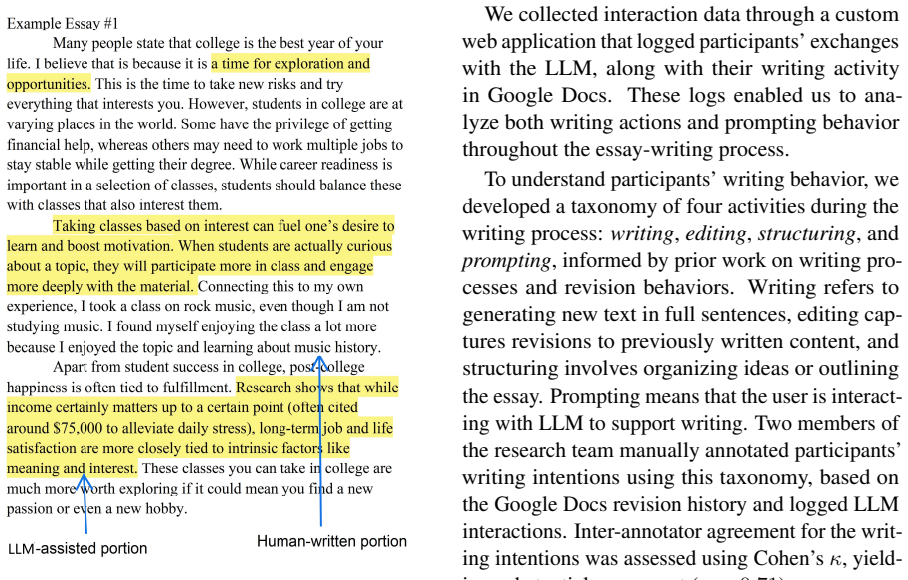
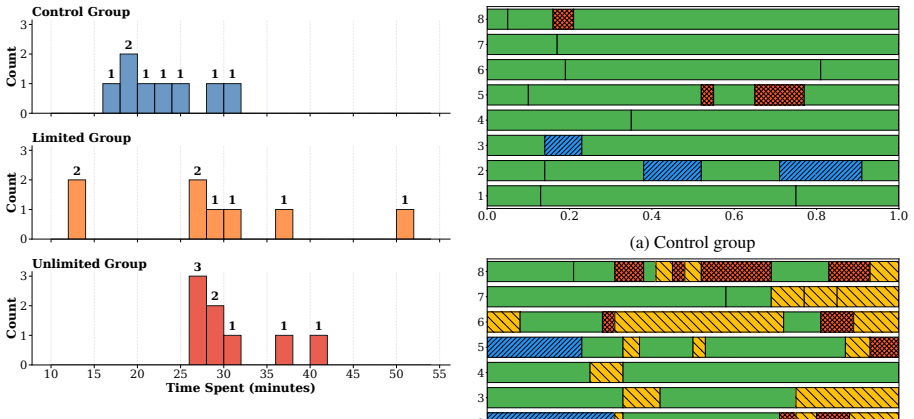
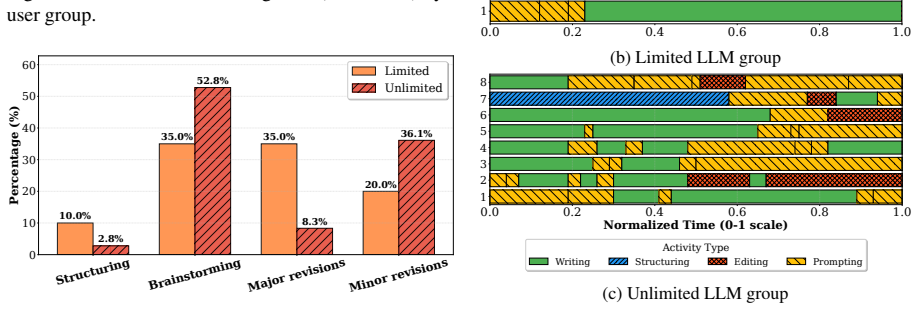
In the pilot, 24 students were randomly assigned to write an essay with no LLM access, limited access (at most three prompts, each capped at 100 words), or unlimited access. Overall essay quality showed no reliable differences across the three groups. Students given limited access reported higher ownership, with 62.5 percent saying they would submit the essay as independent work compared with 25 percent in the unlimited group; they also described stronger organizational gains and issued more revision-oriented prompts. The unlimited group spent more time on the task, produced text more similar to LLM output, and reported lower creative expression.
What carries the argument
The three-level experimental manipulation of LLM access (none, limited to three capped prompts, unlimited) as the variable that alters writing behavior, text similarity to model output, time on task, and self-reported authorship and ownership.
If this is right
- Essay quality remains comparable when students receive some but not unlimited LLM assistance.
- Limited access leads students to issue more strategic, revision-focused prompts.
- Unlimited access increases time spent yet reduces reported creative expression and ownership.
- Constrained access may allow scaffolding benefits while supporting students' sense that the work remains their own.
Where Pith is reading between the lines
- The ownership advantage seen with limited access might appear in other written assignments if the same prompt caps are applied.
- Interface designs that automatically enforce the three-prompt limit could make the observed benefits easier to scale.
- If ownership effects hold in repeated assignments, institutions might prefer limited-access policies over outright bans for preserving learning signals.
Load-bearing premise
Self-reported feelings of ownership, creative expression, and willingness to submit the essay reflect students' actual internal states rather than answers shaped by the experimental setting or social expectations.
What would settle it
A larger replication that finds no difference in ownership rates or submission willingness between the limited-access and unlimited-access groups, or that finds lower essay quality under limited access, would undermine the claim that constrained access is preferable.
Figures

read the original abstract
Investigating the degree to which large language models (LLMs) affect teaching and learning in universities can help identify strategies for integrating LLMs in a way that supports, rather than undermines, student learning outcomes. This study examined how varying levels of LLM assistance affect writing performance, engagement, and perceived authorship. We report a pilot study in which 24 college students were randomly assigned to write a short essay with no LLM access, limited access (<=3 prompts, responses capped at 100 words), or unlimited access. Overall essay quality was statistically indistinguishable across groups. Yet writing behavior and perceived authorship diverged sharply: students with limited access reported higher ownership (62.5% would submit the essay as independent work, vs. 25% in the unlimited group), stronger organizational gains, and more strategic, revision-focused prompting. The unlimited group spent more time writing, produced essays more similar to LLM output, and reported reduced creative expression. Our findings suggest that constraining, rather than banning, LLM access may preserve authorship confidence while retaining the scaffolding benefits of AI assistance.
Editorial analysis
A structured set of objections, weighed in public.
Referee Report
Summary. The paper reports results from a pilot study in which 24 college students were randomly assigned to write a short essay under one of three conditions: no LLM access, limited access (≤3 prompts with responses capped at 100 words), or unlimited access. Essay quality was reported as statistically indistinguishable across groups. Writing behavior and self-reported perceived authorship diverged: the limited-access group showed higher ownership (62.5% would submit as independent work vs. 25% unlimited), more strategic prompting, and organizational gains; the unlimited group spent more time, produced more LLM-similar output, and reported lower creative expression. The authors conclude that constraining rather than banning LLM access may preserve authorship confidence while retaining AI scaffolding benefits.
Significance. If the central behavioral and perceptual differences prove robust to larger samples and non-self-report measures, the work could inform university policies on LLM integration in writing assignments by identifying a potential middle path between prohibition and unrestricted use. The pilot design and small n limit generalizability, but the observed divergence in prompting strategy and ownership reports provides a concrete starting point for follow-up experiments.
major comments (3)
- [Results] Results section: The claim that essay quality was 'statistically indistinguishable' across conditions is presented without any reported test statistic, p-value, effect size, confidence interval, or error bars. With n=24 this omission prevents assessment of whether the equivalence conclusion is supported or whether the study is simply underpowered for detecting quality differences.
- [Methods / Discussion] Methods and Discussion: The central claim that limited access preserves authorship confidence rests entirely on self-report items (e.g., 'would submit as independent work'). No behavioral triangulation—such as analysis of revision depth from logs, source-use patterns, or blinded third-party authorship ratings—is described, leaving open the possibility that condition salience induced demand characteristics rather than genuine changes in internal sense of ownership.
- [Methods] Methods: No information is given on how essay quality was scored (rubric details, number of raters, inter-rater reliability, or blinding). This measurement detail is load-bearing for the claim that quality is preserved under limited access.
minor comments (2)
- [Abstract] Abstract: Percentages (62.5 % and 25 %) are reported without per-condition sample sizes or uncertainty estimates.
- [Discussion] The manuscript would benefit from explicit reporting of the exact statistical tests used for all comparisons and from a limitations section that directly addresses the small sample and self-report nature of the authorship measures.
Simulated Author's Rebuttal
We thank the referee for their constructive comments on our pilot study. We address each major point below, agreeing where additional details are needed and indicating planned revisions.
read point-by-point responses
-
Referee: [Results] Results section: The claim that essay quality was 'statistically indistinguishable' across conditions is presented without any reported test statistic, p-value, effect size, confidence interval, or error bars. With n=24 this omission prevents assessment of whether the equivalence conclusion is supported or whether the study is simply underpowered for detecting quality differences.
Authors: We agree the statistical details were omitted. In the revised manuscript we will report the appropriate test (ANOVA or equivalent), p-value, effect size, and confidence intervals, along with an explicit discussion of the pilot's limited power given n=24. The primary focus remains behavioral and perceptual patterns rather than strong claims of equivalence. revision: yes
-
Referee: [Methods / Discussion] Methods and Discussion: The central claim that limited access preserves authorship confidence rests entirely on self-report items (e.g., 'would submit as independent work'). No behavioral triangulation—such as analysis of revision depth from logs, source-use patterns, or blinded third-party authorship ratings—is described, leaving open the possibility that condition salience induced demand characteristics rather than genuine changes in internal sense of ownership.
Authors: The ownership measure is self-reported, but the manuscript already reports convergent behavioral differences (prompting strategy, time on task, output similarity). We will revise the Discussion to address demand characteristics explicitly and outline future studies with additional behavioral measures. No new data can be added in this revision. revision: partial
-
Referee: [Methods] Methods: No information is given on how essay quality was scored (rubric details, number of raters, inter-rater reliability, or blinding). This measurement detail is load-bearing for the claim that quality is preserved under limited access.
Authors: We will add full details on the scoring procedure—including rubric, number of raters, inter-rater reliability, and blinding—to the Methods section in the revision. revision: yes
Circularity Check
No circularity: empirical pilot with no derivations or fitted predictions
full rationale
The paper reports a randomized pilot experiment (n=24) comparing three LLM-access conditions on essay quality, behavior, and self-reported authorship/ownership. No equations, parameters, predictions, or first-principles derivations appear in the abstract or described methods. All outcomes are direct empirical measurements (essay scores, time logs, Likert-style self-reports, similarity metrics). No self-citation chain, ansatz, or uniqueness theorem is invoked to justify any result. The central claim rests on observed group differences, not on any reduction of outputs to inputs by construction. This is a standard empirical study whose validity questions (e.g., demand characteristics in self-reports) fall outside circularity analysis.
Axiom & Free-Parameter Ledger
Reference graph
Works this paper leans on
-
[1]
Aho and Jeffrey D
Alfred V. Aho and Jeffrey D. Ullman , title =. 1972
1972
-
[2]
Scalable training of
Andrew, Galen and Gao, Jianfeng , booktitle=. Scalable training of
-
[3]
Studies in Higher Education , volume =
Andy Nguyen and Yvonne Hong and Belle Dang and Xiaoshan Huang , title =. Studies in Higher Education , volume =. 2024 , publisher =
2024
-
[4]
2024 , eprint=
GPT-4 Technical Report , author=. 2024 , eprint=
2024
-
[5]
Journal of Educational Psychology , volume=
Intelligent Tutoring Systems and Learning Outcomes: A Meta-Analysis , author=. Journal of Educational Psychology , volume=. 2014 , publisher=
2014
-
[6]
Policy Studies Journal , volume =
Churchill, Alexander and Pichika, Shamitha and Xu, Chengxin and Liu, Ying , title =. Policy Studies Journal , volume =. doi:https://doi.org/10.1111/psj.70034 , url =. https://onlinelibrary.wiley.com/doi/pdf/10.1111/psj.70034 , note =
-
[7]
Rie Koizumi and Yo In'nami , keywords =. Effects of text length on lexical diversity measures: Using short texts with less than 200 tokens , journal =. 2012 , issn =. doi:https://doi.org/10.1016/j.system.2012.10.012 , url =
-
[8]
Topics in Cognitive Science , volume=
Active-constructive-interactive: A conceptual framework for differentiating learning activities , author=. Topics in Cognitive Science , volume=. 2009 , doi=
2009
-
[9]
and Gebru, Timnit and McMillan-Major, Angelina and Shmitchell, Shmargaret
Bender, Emily M. and Gebru, Timnit and McMillan-Major, Angelina and Shmitchell, Shmargaret , title =. Proceedings of the 2021 ACM Conference on Fairness, Accountability, and Transparency , pages =. 2021 , isbn =. doi:10.1145/3442188.3445922 , abstract =
-
[10]
Prototypical Human- AI Collaboration Behaviors from LLM -Assisted Writing in the Wild
Mysore, Sheshera and Das, Debarati and Cao, Hancheng and Sarrafzadeh, Bahareh. Prototypical Human- AI Collaboration Behaviors from LLM -Assisted Writing in the Wild. Proceedings of the 2025 Conference on Empirical Methods in Natural Language Processing. 2025. doi:10.18653/v1/2025.emnlp-main.852
-
[11]
Quantifying learning-style adaptation in effectiveness of LLM teaching
Weijers, Ruben and de Castilho, Gabrielle Fidelis and Godbout, Jean-Fran c ois and Rabbany, Reihaneh and Pelrine, Kellin. Quantifying learning-style adaptation in effectiveness of LLM teaching. Proceedings of the 1st Workshop on Personalization of Generative AI Systems (PERSONALIZE 2024). 2024
2024
-
[12]
Quantifying the Risks of LLM - and Tool-assisted Rephrasing to Linguistic Diversity
Wang, Mengying and Spitz, Andreas. Quantifying the Risks of LLM - and Tool-assisted Rephrasing to Linguistic Diversity. Findings of the Association for Computational Linguistics: EMNLP 2025. 2025. doi:10.18653/v1/2025.findings-emnlp.1228
-
[13]
Chaoran Wang and Zixi Li and Curtis Bonk , keywords =. Understanding self-directed learning in AI-Assisted writing: A mixed methods study of postsecondary learners , journal =. 2024 , issn =. doi:https://doi.org/10.1016/j.caeai.2024.100247 , url =
-
[14]
Draxler, Fiona and Werner, Anna and Lehmann, Florian and Hoppe, Matthias and Schmidt, Albrecht and Buschek, Daniel and Welsch, Robin , title =. ACM Trans. Comput.-Hum. Interact. , month = feb, articleno =. 2024 , issue_date =. doi:10.1145/3637875 , abstract =
-
[15]
How Does the Disclosure of AI Assistance Affect the Perceptions of Writing?
Li, Zhuoyan and Liang, Chen and Peng, Jing and Yin, Ming. How Does the Disclosure of AI Assistance Affect the Perceptions of Writing?. Proceedings of the 2024 Conference on Empirical Methods in Natural Language Processing. 2024. doi:10.18653/v1/2024.emnlp-main.279
-
[16]
and August, Tal and Bhat, Avinash and Choksi, Madiha Zahrah and Dutta, Senjuti and Guo, Jin L.C
Lee, Mina and Gero, Katy Ilonka and Chung, John Joon Young and Shum, Simon Buckingham and Raheja, Vipul and Shen, Hua and Venugopalan, Subhashini and Wambsganss, Thiemo and Zhou, David and Alghamdi, Emad A. and August, Tal and Bhat, Avinash and Choksi, Madiha Zahrah and Dutta, Senjuti and Guo, Jin L.C. and Hoque, Md Naimul and Kim, Yewon and Knight, Simon...
-
[17]
Dan Gusfield , title =. 1997
1997
-
[18]
Tetreault , title =
Mohammad Sadegh Rasooli and Joel R. Tetreault , title =. Computing Research Repository , volume =. 2015 , url =
2015
-
[19]
A Framework for Learning Predictive Structures from Multiple Tasks and Unlabeled Data , Volume =
Ando, Rie Kubota and Zhang, Tong , Issn =. A Framework for Learning Predictive Structures from Multiple Tasks and Unlabeled Data , Volume =. Journal of Machine Learning Research , Month = dec, Numpages =
-
[20]
Literary Writing Style of Charles Dickens , year =
-
[21]
Nineteenth-Century Literature , volume =
Beckson, Karl , title =. Nineteenth-Century Literature , volume =. 2000 , url =
2000
-
[22]
New Writing Techniques , year =
-
[23]
The Impact of AI-Assisted Writing on Students’ Learning Effectiveness and Perceptions: A Mixed-Methods Study , author =. 2025 , note =. doi:10.2139/ssrn.5396600 , publisher =
-
[24]
Applied Science and Sustainable Agriculture Journal , volume =
Rohilla, Atiya , title =. Applied Science and Sustainable Agriculture Journal , volume =. 2025 , issn =
2025
-
[25]
Smart Learning Environments , volume =
Zhai, Cheng and Wibowo, Setio and Li, Li Da , title =. Smart Learning Environments , volume =. 2024 , publisher =
2024
-
[26]
Students’ prompt patterns and its effects in AI-assisted academic writing: Focusing on students’ level of AI literacy , journal =
Kim, Jinhee and Yu, Seongryeong and Lee, Sang-Soog and Detrick, Rita , year =. Students’ prompt patterns and its effects in AI-assisted academic writing: Focusing on students’ level of AI literacy , journal =
-
[27]
Extended Abstracts of the CHI Conference on Human Factors in Computing Systems , articleno =
Shibani, Antonette and Knight, Simon and Kitto, Kirsty and Karunanayake, Ajanie and Buckingham Shum, Simon , title =. Extended Abstracts of the CHI Conference on Human Factors in Computing Systems , articleno =. 2024 , isbn =. doi:10.1145/3613905.3651083 , abstract =
-
[28]
Comparing Scientific Abstracts Generated by ChatGPT to Original Abstracts Using an Artificial Intelligence Output Detector, Plagiarism Detector, and Blinded Human Reviewers , doi =
Gao, Catherine and Howard, Frederick and Markov, Nikolay and Dyer, Emma and Ramesh, Siddhi and Luo, Yuan and Pearson, Alexander , year =. Comparing Scientific Abstracts Generated by ChatGPT to Original Abstracts Using an Artificial Intelligence Output Detector, Plagiarism Detector, and Blinded Human Reviewers , doi =
-
[29]
Computers and Education: Artificial Intelligence , volume =
Yulu Cui , title =. Computers and Education: Artificial Intelligence , volume =. 2025 , doi =
2025
-
[30]
Wang, Zhijie , title =. Library Hi Tech , volume =. 2020 , month =. doi:10.1108/LHT-05-2020-0113 , url =
-
[31]
, author=
Exploring the Educational Potential of ChatGPT: AI-Assisted Narrative Writing for EFL College Students. , author=. Language Teaching Research Quarterly , volume=. 2024 , publisher=
2024
-
[32]
Proceedings of the Third Workshop on Intelligent and Interactive Writing Assistants , pages =
Guo, Alicia and Wang, Leijie and Heer, Jeffrey and Zhang, Amy , title =. Proceedings of the Third Workshop on Intelligent and Interactive Writing Assistants , pages =. 2024 , isbn =. doi:10.1145/3690712.3690727 , abstract =
-
[33]
Proceedings of the Third Workshop on Intelligent and Interactive Writing Assistants , pages =
Mansour, Atil and Amir, Ofra and Levontin, Liat , title =. Proceedings of the Third Workshop on Intelligent and Interactive Writing Assistants , pages =. 2024 , isbn =. doi:10.1145/3690712.3690713 , abstract =
-
[34]
Xiao, Qimin , title =. Proceedings of the 2024 9th International Conference on Information and Education Innovations , pages =. 2024 , isbn =. doi:10.1145/3664934.3664946 , abstract =
-
[35]
Zhang, Tingting , title =. Proceedings of the 2025 6th International Conference on Education, Knowledge and Information Management , pages =. 2025 , isbn =. doi:10.1145/3756580.3756622 , abstract =
-
[36]
Proceedings of the 2025 CHI Conference on Human Factors in Computing Systems , articleno =
Chakrabarty, Tuhin and Laban, Philippe and Wu, Chien-Sheng , title =. Proceedings of the 2025 CHI Conference on Human Factors in Computing Systems , articleno =. 2025 , isbn =. doi:10.1145/3706598.3713559 , abstract =
-
[37]
Proceedings of the 2024 7th International Conference on Educational Technology Management , pages =
Bui, Minh Ngoc and Kim, Eun-young , title =. Proceedings of the 2024 7th International Conference on Educational Technology Management , pages =. 2025 , isbn =. doi:10.1145/3711403.3711455 , abstract =
-
[38]
Proceedings of the 15th International Learning Analytics and Knowledge Conference , pages =
Pan, Hongchen and Araujo Oliveira, Eduardo and Ferreira Mello, Rafael , title =. Proceedings of the 15th International Learning Analytics and Knowledge Conference , pages =. 2025 , isbn =. doi:10.1145/3706468.3706536 , abstract =
-
[39]
Shen, Yixin , title =. Proceedings of the 2025 6th International Conference on Education, Knowledge and Information Management , pages =. 2025 , isbn =. doi:10.1145/3756580.3756680 , abstract =
-
[40]
2025 , eprint=
An Empirical Study to Understand How Students Use ChatGPT for Writing Essays , author=. 2025 , eprint=
2025
-
[41]
Writing with AI Lowers Psychological Ownership, but Longer Prompts Can Help , url=
Joshi, Nikhita and Vogel, Daniel , year=. Writing with AI Lowers Psychological Ownership, but Longer Prompts Can Help , url=. doi:10.1145/3719160.3736608 , booktitle=
-
[42]
AI and Tech in Behavioral and Social Sciences , year =
Aliakbari, Mohammad and Barzan, Pooria and Allahveysi, Seyyed Pedram , title =. AI and Tech in Behavioral and Social Sciences , year =. doi:10.61838/kman.aitech.4343 , url =
-
[43]
2025 , eprint=
Patterns and Purposes: A Cross-Journal Analysis of AI Tool Usage in Academic Writing , author=. 2025 , eprint=
2025
-
[44]
Societies , VOLUME =
Gerlich, Michael , TITLE =. Societies , VOLUME =. 2025 , NUMBER =
2025
-
[45]
2025 , eprint=
Your Brain on ChatGPT: Accumulation of Cognitive Debt when Using an AI Assistant for Essay Writing Task , author=. 2025 , eprint=
2025
-
[46]
AI Writing Assistants in Tanzanian Universities: Adoption Trends, Challenges, and Opportunities
Kondoro, Alfred Malengo. AI Writing Assistants in Tanzanian Universities: Adoption Trends, Challenges, and Opportunities. Proceedings of the Fourth Workshop on Intelligent and Interactive Writing Assistants (In2Writing 2025). 2025. doi:10.18653/v1/2025.in2writing-1.4
-
[47]
Liu, Yijun and August, Tal. From Crafting Text to Crafting Thought: Grounding Intelligent Writing Support to Writing Center Pedagogy. Proceedings of the Fourth Workshop on Intelligent and Interactive Writing Assistants (In2Writing 2025). 2025. doi:10.18653/v1/2025.in2writing-1.5
-
[48]
Data , VOLUME =
Gerlich, Michael , TITLE =. Data , VOLUME =. 2025 , NUMBER =
2025
-
[49]
AI as a Mind Partner: Cognitive Impact in P akistan ' s Educational Landscape
Khalid, Eman and Javaid, Hammad and Waseem, Yashal and Barlas, Natasha Sohail. AI as a Mind Partner: Cognitive Impact in P akistan ' s Educational Landscape. Proceedings of the Artificial Intelligence in Measurement and Education Conference (AIME-Con): Works in Progress. 2025
2025
-
[50]
arXiv preprint arXiv:2507.06261 , year=
Gemini 2.5: Pushing the Frontier with Advanced Reasoning, Multimodality, Long Context, and Next Generation Agentic Capabilities , author=. arXiv preprint arXiv:2507.06261 , year=
-
[51]
Sentence-BERT: Sentence Embeddings using Siamese BERT-Networks
Reimers, Nils and Gurevych, Iryna. Sentence-BERT: Sentence Embeddings using Siamese BERT-Networks. Proceedings of the 2019 Conference on Empirical Methods in Natural Language Processing. 2019
2019
-
[52]
Understanding Iterative Revision from Human-Written Text
Du, Wanyu and Raheja, Vipul and Kumar, Dhruv and Kim, Zae Myung and Lopez, Melissa and Kang, Dongyeop. Understanding Iterative Revision from Human-Written Text. Proceedings of the 60th Annual Meeting of the Association for Computational Linguistics (Volume 1: Long Papers). 2022. doi:10.18653/v1/2022.acl-long.250
-
[53]
Les caract
Guiraud, Pierre , journal=. Les caract. 1954 , publisher=
1954
-
[54]
Read Write Think , author=
Essay rubric , author=. Read Write Think , author=
discussion (0)
Sign in with ORCID, Apple, or X to comment. Anyone can read and Pith papers without signing in.