The Radio--X-ray Correlation of High-Redshift AGN: A Numerical Study of Inverse-Compton Scattering of the CMB Photons in Relativistic Jets
Pith reviewed 2026-06-28 18:14 UTC · model grok-4.3
The pith
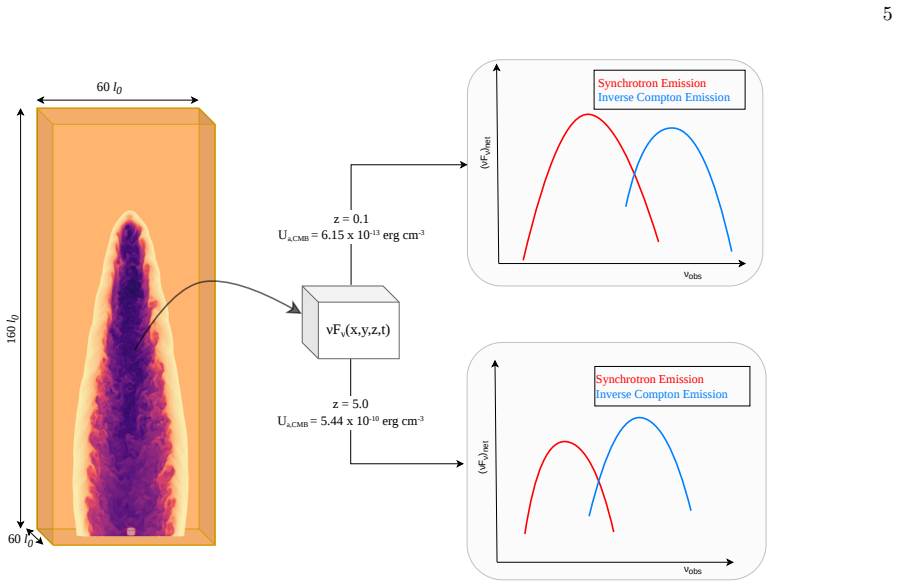
High-redshift AGN jets produce X-ray emission scaling as (1+z)^4 from inverse Compton scattering of CMB photons when jet dynamics are held fixed.
A machine-rendered reading of the paper's core claim, the machinery that carries it, and where it could break.
Core claim
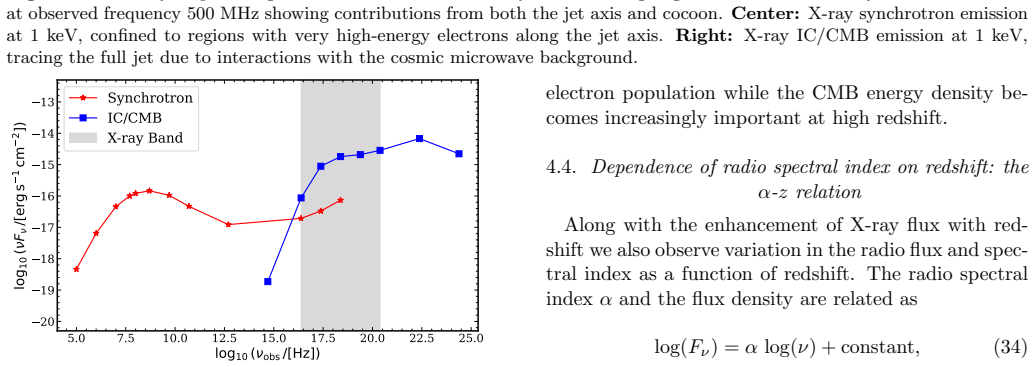
Three-dimensional relativistic magnetohydrodynamic simulations coupled to a hybrid Eulerian-Lagrangian particle framework, run with identical jet dynamics and ambient conditions at different redshifts, show that X-ray luminosity follows the (1+z)^4 scaling expected from IC scattering of CMB photons while radio luminosity remains weakly dependent; the same runs recover the alpha-z steepening of the radio spectrum through differential energy losses.
What carries the argument
Inverse Compton scattering of CMB photons, isolated by holding jet propagation length scales, speed, and particle energy evolution fixed while varying only cosmological CMB density.
If this is right
- X-ray luminosity follows (1+z)^4 while radio stays nearly constant.
- X-ray-to-radio flux ratio increases systematically with redshift.
- Slower jets show stronger X-ray enhancement than faster jets.
- Radio spectral index steepens with redshift, reproducing the alpha-z relation.
Where Pith is reading between the lines
- If jet speeds or densities actually change with redshift, the predicted X-ray scaling would be altered and could be tested against larger samples.
- The strength of the X-ray boost could serve as an indirect indicator of typical jet propagation lengths at high redshift.
- The same particle framework would predict detectable gamma-ray emission from the same IC process at still higher energies.
Load-bearing premise
Jet dynamics, speed, magnetic field, and ambient medium properties remain unchanged across redshifts so that only the CMB energy density changes.
What would settle it
A sample of high-redshift radio-loud quasars with matched radio luminosities whose X-ray luminosities deviate from (1+z)^4 scaling would falsify the claim that IC/CMB dominates under fixed jet conditions.
Figures
read the original abstract
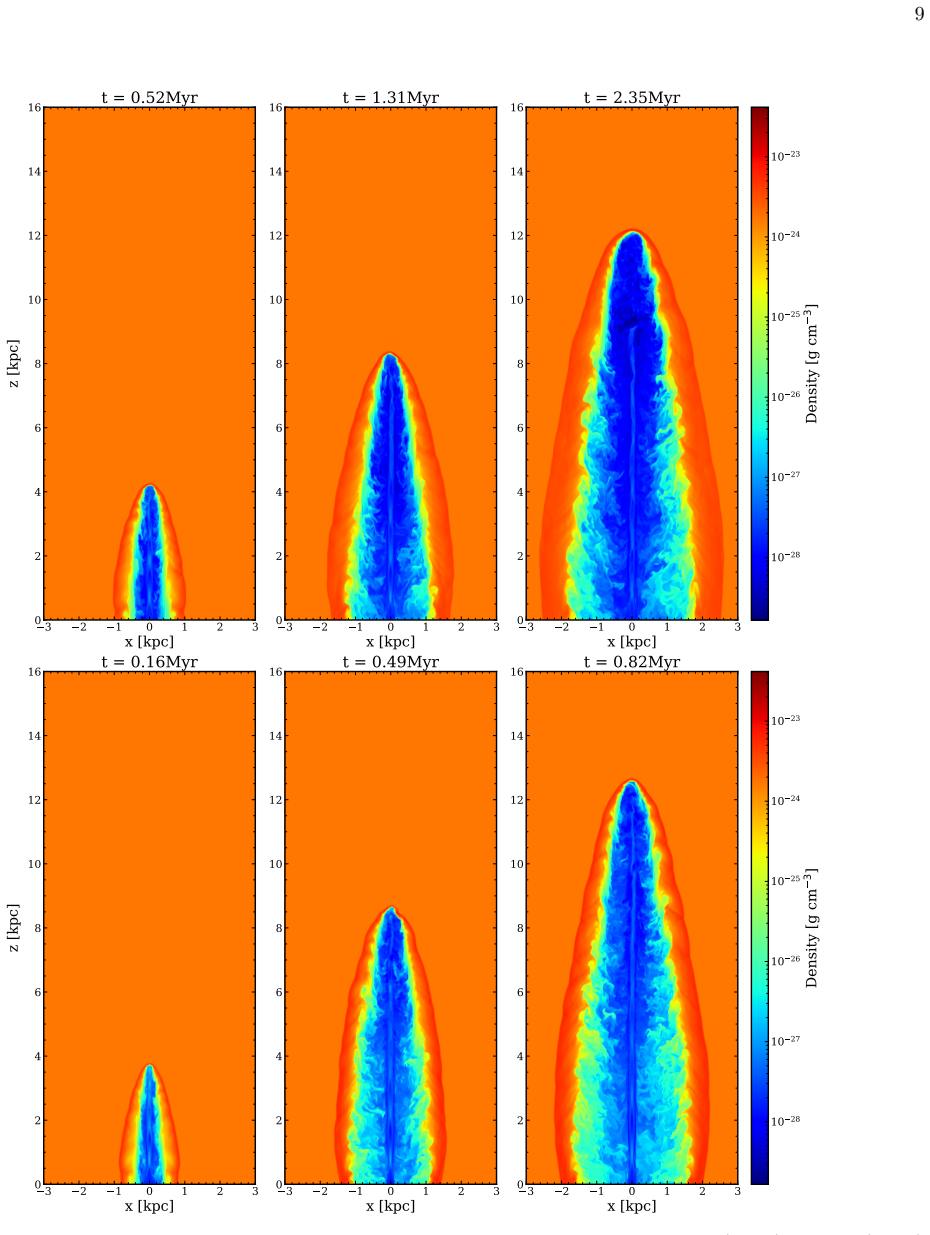
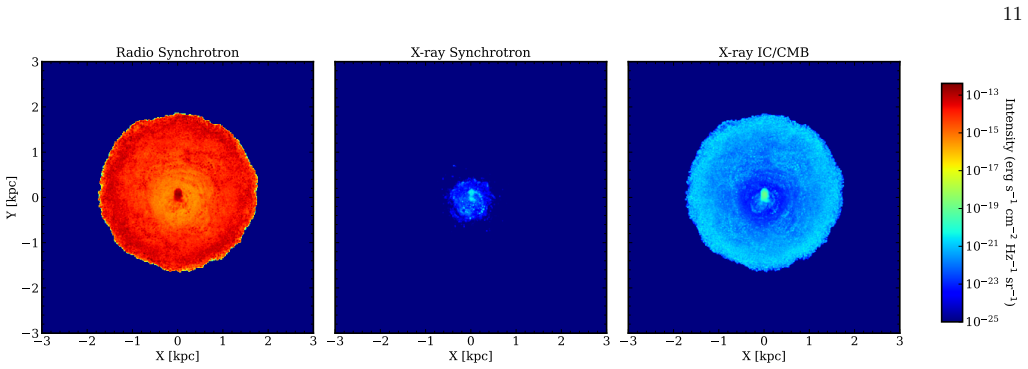
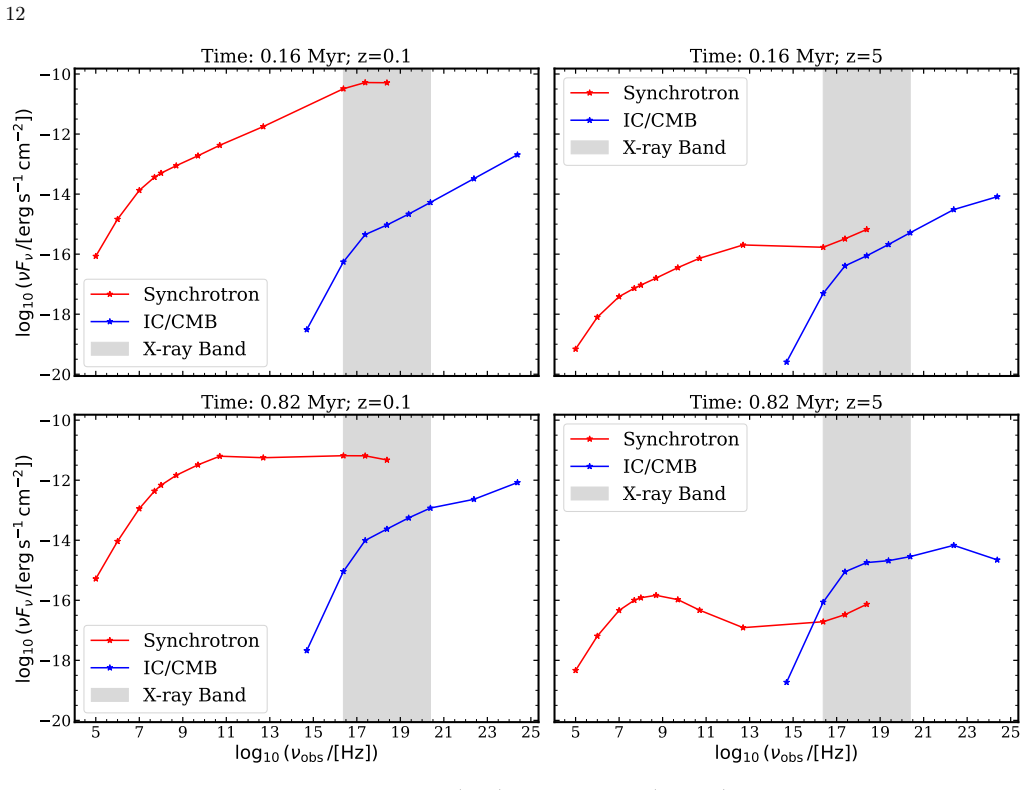
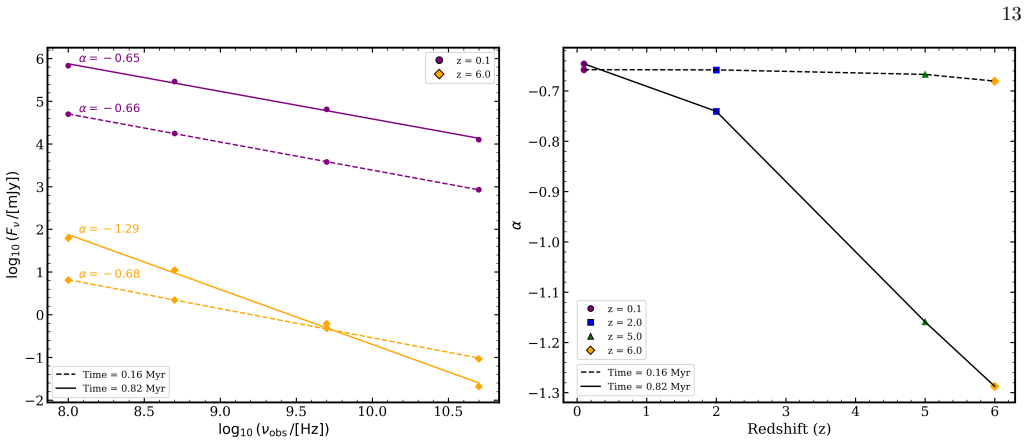
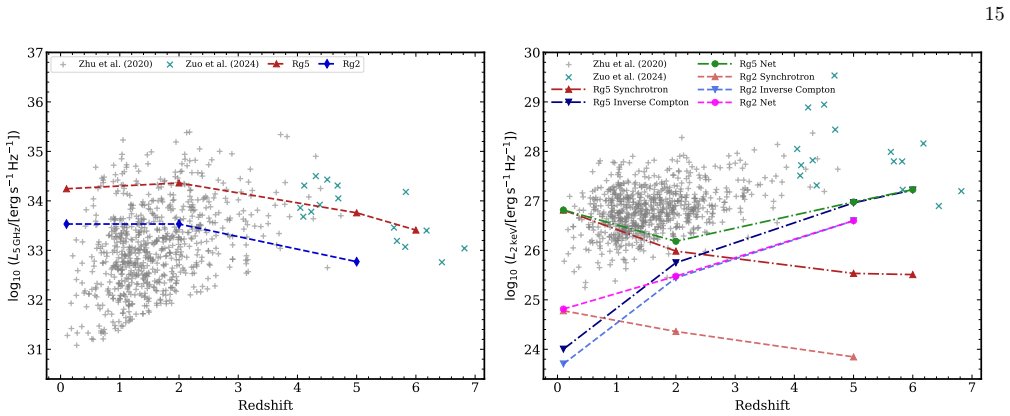
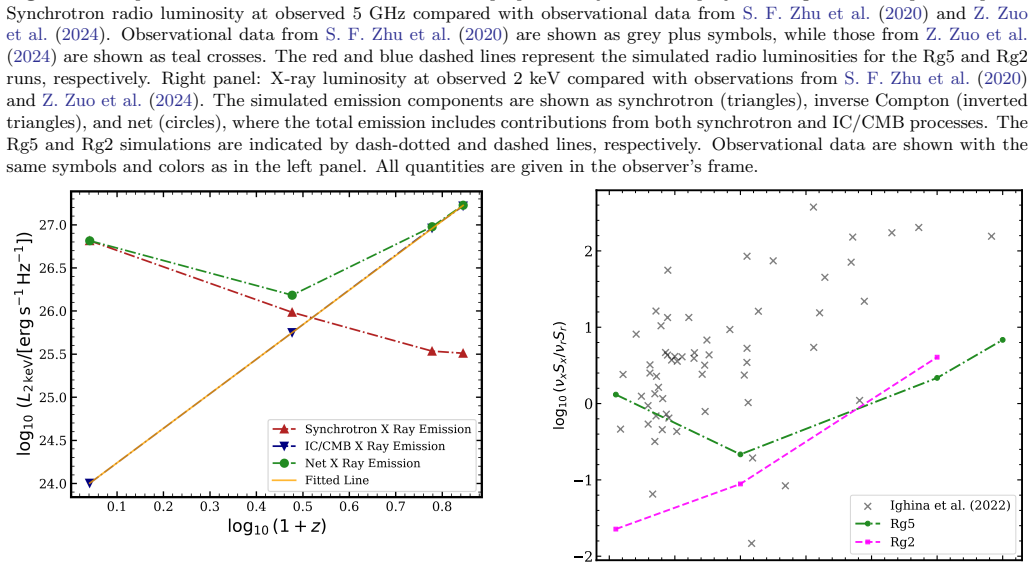
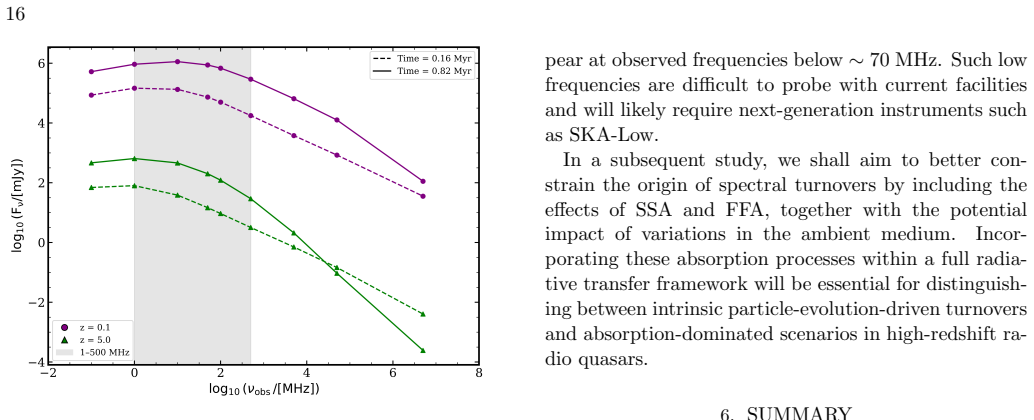
Relativistic jets from active galactic nuclei are expected to exhibit strong redshift evolution in their radiative output due to the increasing energy density of the cosmic microwave background (CMB). We investigate the role of inverse Compton (IC) scattering of CMB photons in regulating the radio and X-ray emission from large-scale jets using three-dimensional relativistic magnetohydrodynamic simulations coupled with a hybrid Eulerian-Lagrangian particle framework. By keeping the jet dynamics and ambient medium properties fixed across redshifts, we are able to isolate the impact of the cosmological evolution of the CMB on the jet radiation. From our simulations, we construct synthetic spectral energy distributions and intensity maps considering synchrotron and IC/CMB losses along with particle acceleration from shocks. We are able to reproduce the weak redshift dependence of radio luminosity and the strong enhancement of X-ray emission toward high redshift that is observed in radio-loud quasars. At high redshift, the X-ray luminosity follows the expected $(1+z)^4$ scaling, confirming IC/CMB as the dominant mechanism driving the X-ray enhancement. The resulting X-ray-to-radio flux ratio increases systematically with redshift and is consistent with observational constraints. Finally, we show that slower jets exhibit a stronger redshift evolution of the X-ray enhancement than faster jets, highlighting the critical role of jet propagation length scales and particle energy evolution. The simulations also naturally reproduce the steepening of the radio spectral index with redshift - the $\alpha$-$z$ relation - thus providing a unified framework that allows to interpret the multiwavelength properties of high-redshift radio sources.
Editorial analysis
A structured set of objections, weighed in public.
Referee Report
Summary. The manuscript reports 3D relativistic MHD simulations coupled to a hybrid Eulerian-Lagrangian particle scheme that model synchrotron radio and IC X-ray emission from large-scale AGN jets. Jet Lorentz factor, magnetic field, density, and ambient medium are held fixed while only the CMB energy density is varied with redshift; the resulting synthetic SEDs and maps recover a weak redshift dependence of radio luminosity, a strong (1+z)^4 rise in X-ray luminosity, an increasing X-ray-to-radio flux ratio, stronger evolution for slower jets, and the observed steepening of the radio spectral index with redshift.
Significance. If the fixed-parameter results hold, the work supplies a controlled numerical demonstration that IC/CMB scattering can produce the observed X-ray enhancement and multi-wavelength trends in high-redshift radio-loud quasars, offering a unified interpretive framework. The explicit isolation of the CMB effect and the reproduction of the alpha-z relation are strengths that would be useful for future modeling of high-z jet sources.
major comments (2)
- [Abstract] Abstract: the central claim that the simulations confirm IC/CMB as the dominant mechanism rests on the explicit premise that jet dynamics and ambient medium properties are held fixed across redshifts. If any of these quantities (Lorentz factor, B-field, density) evolve with z in nature, the same X-ray enhancement could arise from changes in the electron distribution or magnetic field rather than CMB photons; the manuscript should therefore include at least one sensitivity run in which a key parameter is allowed to vary with redshift to test the robustness of the isolation.
- [Abstract] Abstract: the statements that X-ray luminosity follows the expected (1+z)^4 scaling and that the X-ray-to-radio ratio is consistent with observational constraints are presented without quantitative tables, fitted exponents, or direct side-by-side comparison metrics in the provided text. Inclusion of such tables (e.g., best-fit power-law indices and residuals versus observed samples) is required to substantiate the claimed agreement.
Simulated Author's Rebuttal
We thank the referee for the constructive comments. We address each point below.
read point-by-point responses
-
Referee: [Abstract] Abstract: the central claim that the simulations confirm IC/CMB as the dominant mechanism rests on the explicit premise that jet dynamics and ambient medium properties are held fixed across redshifts. If any of these quantities (Lorentz factor, B-field, density) evolve with z in nature, the same X-ray enhancement could arise from changes in the electron distribution or magnetic field rather than CMB photons; the manuscript should therefore include at least one sensitivity run in which a key parameter is allowed to vary with redshift to test the robustness of the isolation.
Authors: The study is a controlled experiment whose explicit purpose is to isolate the CMB effect by holding all other parameters fixed; this is stated in the abstract and methods. Adding redshift-dependent variations in jet properties would confound the isolation and change the scope of the work. We have revised the abstract to emphasize the fixed-parameter assumption and its implications as a limitation. revision: partial
-
Referee: [Abstract] Abstract: the statements that X-ray luminosity follows the expected (1+z)^4 scaling and that the X-ray-to-radio ratio is consistent with observational constraints are presented without quantitative tables, fitted exponents, or direct side-by-side comparison metrics in the provided text. Inclusion of such tables (e.g., best-fit power-law indices and residuals versus observed samples) is required to substantiate the claimed agreement.
Authors: We agree that quantitative support is needed. A new table has been added to the results section (with a reference in the abstract) reporting best-fit power-law indices for the X-ray luminosity, X-ray-to-radio ratios, and direct comparisons to observed samples including residuals. revision: yes
Circularity Check
No significant circularity; forward simulation under explicit isolation assumption
full rationale
The paper conducts 3D RMHD simulations with jet Lorentz factor, magnetic field, density, and ambient properties held identical at all redshifts while only varying u_CMB. The resulting X-ray luminosity scaling with (1+z)^4 is the direct numerical consequence of the known IC power dependence on photon energy density under this controlled setup, but the paper presents it as an explicit methodological choice to isolate the CMB effect rather than a derived result that reduces to its own inputs. No parameters are fitted to the target observables inside the runs, no self-citations supply load-bearing uniqueness theorems, and the outputs are compared to external observational constraints. The derivation chain is therefore self-contained as a forward numerical experiment.
Axiom & Free-Parameter Ledger
free parameters (2)
- jet Lorentz factor
- magnetic field strength
axioms (2)
- standard math Standard relativistic MHD equations govern the jet dynamics
- domain assumption Diffusive shock acceleration operates at internal shocks
Reference graph
Works this paper leans on
-
[1]
Aharonian, F. A., Kelner, S. R., & Prosekin, A. Y. 2010, Physical Review D, 82, 043002, doi: 10.1103/physrevd.82.043002
-
[2]
Andalman, Z. L., Teyssier, R., & Dekel, A. 2025, MNRAS, 540, 3350, doi: 10.1093/mnras/staf930
-
[3]
Athreya, R. M., & Kapahi, V. K. 1998, Journal of Astrophysics and Astronomy, 19, 63, doi: 10.1007/bf02714911 Ba˜ nados, E., Carilli, C., Walter, F., et al. 2018a, ApJL, 861, L14, doi: 10.3847/2041-8213/aac511 Ba˜ nados, E., Venemans, B. P., Mazzucchelli, C., et al. 2018b, Nature, 553, 473, doi: 10.1038/nature25180 Ba˜ nados, E., Momjian, E., Connor, T., e...
-
[4]
2003, The Astrophysical Journal, 600, L27, doi: 10.1086/381497
Baejowski, M., Siemiginowska, A., Sikora, M., Moderski, R., & Bechtold, J. 2003, The Astrophysical Journal, 600, L27, doi: 10.1086/381497
-
[5]
2020, A&A, 635, L7, doi: 10.1051/0004-6361/201937395
Belladitta, S., Moretti, A., Caccianiga, A., et al. 2020, A&A, 635, L7, doi: 10.1051/0004-6361/201937395
-
[6]
J., et al
Belladitta, S., Ba˜ nados, E., Gloudemans, A. J., et al. 2026, submitted to ApJ
2026
-
[7]
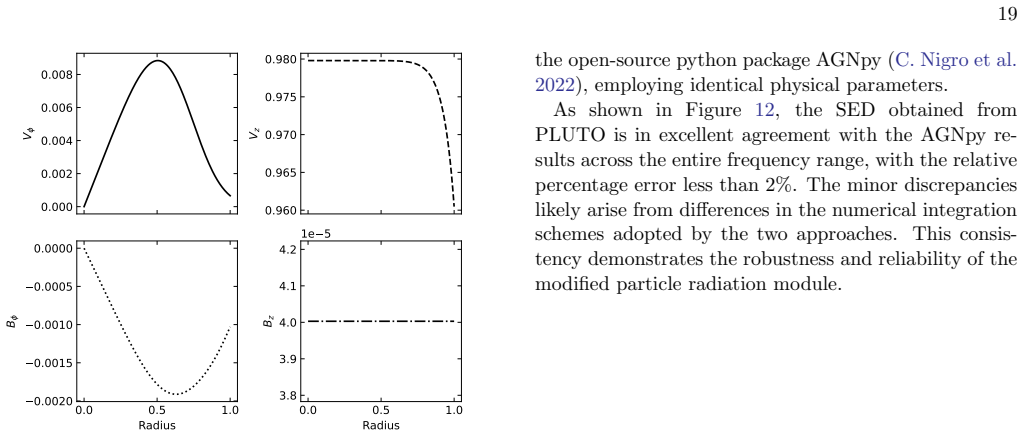
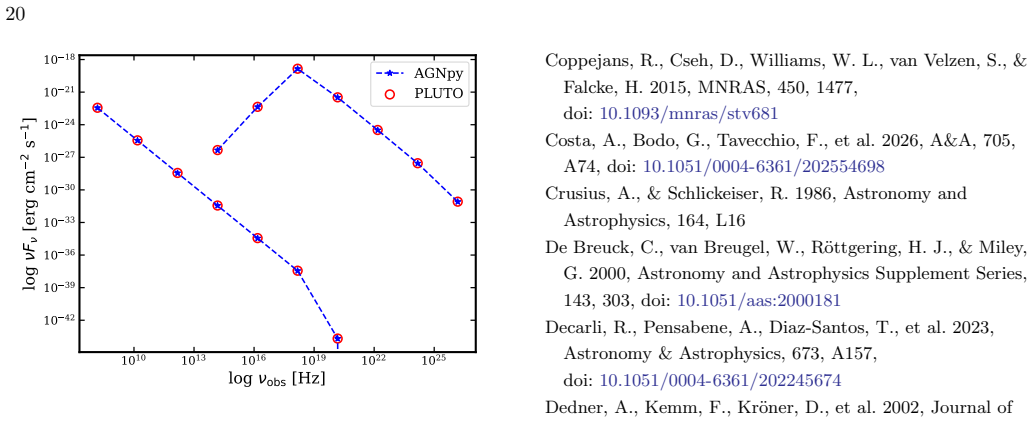
Blandford, R., Meier, D., & Readhead, A. 2019, ARA&A, 57, 467, doi: 10.1146/annurev-astro-081817-051948 20 1010 1013 1016 1019 1022 1025 log obs [Hz] 10 42 10 39 10 36 10 33 10 30 10 27 10 24 10 21 10 18 log F [erg cm 2 s 1] AGNpy PLUTO Figure 12.Comparison of the spectral energy distributions (SEDs) computed using AGNpy (lines) and PLUTO (open circles) f...
-
[8]
Hydromagnetic flows from accretion disks and the production of radio jets
Blandford, R. D., & Payne, D. G. 1982, Monthly Notices of the Royal Astronomical Society, 199, 883, doi: 10.1093/mnras/199.4.883
-
[9]
Bloom, S. D., & Marscher, A. P. 1996, The Astrophysical Journal, 461, 657, doi: 10.1086/177092
-
[10]
Blumenthal, G. R., & Gould, R. J. 1970, Reviews of Modern Physics, 42, 237, doi: 10.1103/RevModPhys.42.237
-
[11]
2019, Monthly Notices of the Royal Astronomical Society, 485, 2909, doi: 10.1093/mnras/stz591
Bodo, G., Mamatsashvili, G., Rossi, P., & Mignone, A. 2019, Monthly Notices of the Royal Astronomical Society, 485, 2909, doi: 10.1093/mnras/stz591
-
[12]
2018, A&A, 609, A122, doi: 10.1051/0004-6361/201732000
Bodo, G., & Tavecchio, F. 2018, A&A, 609, A122, doi: 10.1051/0004-6361/201732000
-
[13]
2021, A&A, 649, A150, doi: 10.1051/0004-6361/202140440 Calistro Rivera, G., Alexander, D
Borse, N., Acharya, S., Vaidya, B., et al. 2021, A&A, 649, A150, doi: 10.1051/0004-6361/202140440 Calistro Rivera, G., Alexander, D. M., Harrison, C. M., et al. 2024, A&A, 691, A191, doi: 10.1051/0004-6361/202348982
-
[14]
Callingham, J. R., Ekers, R. D., Gaensler, B. M., et al. 2017, ApJ, 836, 174, doi: 10.3847/1538-4357/836/2/174
-
[15]
Celotti, A., Ghisellini, G., & Chiaberge, M. 2001, Monthly Notices of the Royal Astronomical Society, 321, L1, doi: 10.1046/j.1365-8711.2001.04160.x
-
[16]
Colella, P., & Woodward, P. R. 1984, Journal of Computational Physics, 54, 174, doi: 10.1016/0021-9991(84)90143-8
-
[17]
2024, Universe, 10, 227, doi: 10.3390/universe10050227
Connor, T., Ba˜ nados, E., Cappelluti, N., & Foord, A. 2024, Universe, 10, 227, doi: 10.3390/universe10050227
-
[18]
2021, ApJ, 911, 120, doi: 10.3847/1538-4357/abe710
Connor, T., Ba˜ nados, E., Stern, D., et al. 2021, ApJ, 911, 120, doi: 10.3847/1538-4357/abe710
-
[19]
2015, MNRAS, 450, 1477, doi: 10.1093/mnras/stv681
Falcke, H. 2015, MNRAS, 450, 1477, doi: 10.1093/mnras/stv681
-
[20]
2026, A&A, 705, A74, doi: 10.1051/0004-6361/202554698
Costa, A., Bodo, G., Tavecchio, F., et al. 2026, A&A, 705, A74, doi: 10.1051/0004-6361/202554698
-
[21]
1986, Astronomy and Astrophysics, 164, L16 De Breuck, C., van Breugel, W., R¨ ottgering, H
Crusius, A., & Schlickeiser, R. 1986, Astronomy and Astrophysics, 164, L16 De Breuck, C., van Breugel, W., R¨ ottgering, H. J., & Miley, G. 2000, Astronomy and Astrophysics Supplement Series, 143, 303, doi: 10.1051/aas:2000181
-
[22]
2023, Astronomy & Astrophysics, 673, A157, doi: 10.1051/0004-6361/202245674
Decarli, R., Pensabene, A., Diaz-Santos, T., et al. 2023, Astronomy & Astrophysics, 673, A157, doi: 10.1051/0004-6361/202245674
-
[23]
2002, Journal of Computational Physics, 175, 645, doi: 10.1006/jcph.2001.6961
Dedner, A., Kemm, F., Kr¨ oner, D., et al. 2002, Journal of Computational Physics, 175, 645, doi: 10.1006/jcph.2001.6961
-
[24]
D., & Menon, G
Dermer, C. D., & Menon, G. 2009, High Energy Radiation from Black Holes: Gamma Rays, Cosmic Rays, and Neutrinos (Princeton, NJ: Princeton University Press)
2009
-
[25]
Model for the High-Energy Emission from Blazars.Astrophys
Dermer, C. D., & Schlickeiser, R. 1993, The Astrophysical Journal, 416, 458, doi: 10.1086/173251
-
[26]
Dietrich, M., Hamann, F., Shields, J. C., et al. 2003, The Astrophysical Journal, 589, 722, doi: 10.1086/374662
-
[27]
Dihingia, I. K., Vaidya, B., & Fendt, C. 2021, MNRAS, 505, 3596, doi: 10.1093/mnras/stab1512
-
[28]
Dubey, R. P., Fendt, C., & Vaidya, B. 2023, The Astrophysical Journal, 952, 1, doi: 10.3847/1538-4357/ace0bf
-
[29]
Dubey, R. P., Fendt, C., & Vaidya, B. 2024, ApJ, 976, 144, doi: 10.3847/1538-4357/ad8135
-
[30]
Elley, E. L., Matthews, J. H., Mukherjee, D., & Vaidya, B. 2026, MNRAS, 546, stag131, doi: 10.1093/mnras/stag131
-
[31]
English, W., Hardcastle, M. J., & Krause, M. G. H. 2016, Monthly Notices of the Royal Astronomical Society, 461, 2025, doi: 10.1093/mnras/stw1407
-
[32]
Fabian, A. C. 2012, ARA&A, 50, 455, doi: 10.1146/annurev-astro-081811-125521
work page internal anchor Pith review doi:10.1146/annurev-astro-081811-125521 2012
-
[33]
Fan, X., Ba˜ nados, E., & Simcoe, R. A. 2023, ARA&A, 61, 373, doi: 10.1146/annurev-astro-052920-102455
-
[34]
Synchrotron Self-Compton Analysis of TeV X-Ray-Selected BL Lacertae Objects.Astrophys
Finke, J. D., Dermer, C. D., & B¨ ottcher, M. 2008, The Astrophysical Journal, 686, 181, doi: 10.1086/590900
-
[35]
Georganopoulos, M., Kirk, J. G., & Mastichiadis, A. 2001, The Astrophysical Journal, 561, 111, doi: 10.1086/323225
-
[36]
2016, Galaxies, 4, 65, doi: 10.3390/galaxies4040065
Georganopoulos, M., Meyer, E., & Perlman, E. 2016, Galaxies, 4, 65, doi: 10.3390/galaxies4040065
-
[37]
2014, Monthly Notices of the Royal Astronomical Society, 438, 2694, doi: 10.1093/mnras/stt2394 21
Sbarrato, T. 2014, Monthly Notices of the Royal Astronomical Society, 438, 2694, doi: 10.1093/mnras/stt2394 21
-
[38]
2025, A&A, 703, A214, doi: 10.1051/0004-6361/202554872
Giri, G., Fendt, C., Bagchi, J., et al. 2025, A&A, 703, A214, doi: 10.1051/0004-6361/202554872
-
[39]
Harris, D., & Krawczynski, H. 2006, Annual Review of Astronomy and Astrophysics, 44, 463, doi: 10.1146/annurev.astro.44.051905.092446
-
[40]
Heckman, T. M., & Best, P. N. 2014, ARA&A, 52, 589, doi: 10.1146/annurev-astro-081913-035722
work page internal anchor Pith review doi:10.1146/annurev-astro-081913-035722 2014
-
[41]
2021, Monthly Notices of the Royal Astronomical Society, 505, 1543, doi: 10.1093/mnras/stab1314
Hodges-Kluck, E., Gallo, E., Ghisellini, G., et al. 2021, Monthly Notices of the Royal Astronomical Society, 505, 1543, doi: 10.1093/mnras/stab1314
-
[42]
Cooper, N. J. 2011, ApJ, 730, 92, doi: 10.1088/0004-637X/730/2/92
-
[43]
2022, Astronomy and Astrophysics, 659, A93, doi: 10.1051/0004-6361/202142676
Ighina, L., Moretti, A., Tavecchio, F., et al. 2022, Astronomy and Astrophysics, 659, A93, doi: 10.1051/0004-6361/202142676
-
[44]
2020, Annual Review of Astronomy and Astrophysics, 58, 27, doi: 10.1146/annurev-astro-120419-014455
Inayoshi, K., Visbal, E., & Haiman, Z. 2020, Annual Review of Astronomy and Astrophysics, 58, 27, doi: 10.1146/annurev-astro-120419-014455
-
[45]
J., Rawlings, S., Lacy, M., et al
Jarvis, M. J., Rawlings, S., Lacy, M., et al. 2001, MNRAS, 326, 1563, doi: 10.1111/j.1365-2966.2001.04726.x
-
[46]
2025, PASA, 42, e136, doi: 10.1017/pasa.2025.10101
Jerrim, L., Shabala, S., Yates-Jones, P., et al. 2025, PASA, 42, e136, doi: 10.1017/pasa.2025.10101
-
[47]
Jlassi, L., Weinberger, R., Pfrommer, C., et al. 2026, arXiv e-prints, arXiv:2601.10787, doi: 10.48550/arXiv.2601.10787
work page internal anchor Pith review Pith/arXiv arXiv doi:10.48550/arxiv.2601.10787 2026
-
[48]
Johnson, J. L., & Haardt, F. 2016, Publications of the Astronomical Society of Australia, 33, doi: 10.1017/pasa.2016.4
-
[49]
Jones, F. C. 1968, Physical Review, 167, 1159, doi: 10.1103/physrev.167.1159
-
[50]
Kellermann, K. I. 2013, Bulletin of the Astronomical Society of India, 41, 1, doi: 10.48550/arXiv.1304.3627
work page internal anchor Pith review Pith/arXiv arXiv doi:10.48550/arxiv.1304.3627 2013
-
[51]
2008, A&A, 486, 663, doi: 10.1051/0004-6361:20079174
Keppens, R., Meliani, Z., van der Holst, B., & Casse, F. 2008, A&A, 486, 663, doi: 10.1051/0004-6361:20079174
-
[52]
Klamer, I. J., Ekers, R. D., Bryant, J. J., et al. 2006, Monthly Notices of the Royal Astronomical Society, 371, 852, doi: 10.1111/j.1365-2966.2006.10714.x
-
[53]
2024, A&A, 691, A14, doi: 10.1051/0004-6361/202450978
Ricci, L. 2024, A&A, 691, A14, doi: 10.1051/0004-6361/202450978
-
[54]
Kundu, S., Vaidya, B., Mignone, A., & Hardcastle, M. J. 2022, A&A, 667, A138, doi: 10.1051/0004-6361/202244251
-
[55]
T., Georganopoulos, M., Sparks, W
Meyer, E. T., Georganopoulos, M., Sparks, W. B., et al. 2015, ApJ, 805, 154, doi: 10.1088/0004-637X/805/2/154
-
[56]
2007, The Astrophysical Journal Supplement Series, 170, 228, doi: 10.1086/513316
Mignone, A., Bodo, G., Massaglia, S., et al. 2007, The Astrophysical Journal Supplement Series, 170, 228, doi: 10.1086/513316
-
[57]
Mignone, A., & McKinney, J. C. 2007, Monthly Notices of the Royal Astronomical Society, 378, 1118, doi: 10.1111/j.1365-2966.2007.11849.x
-
[58]
2005, The Astrophysical Journal Supplement Series, 160, 199, doi: 10.1086/430905
Mignone, A., Plewa, T., & Bodo, G. 2005, The Astrophysical Journal Supplement Series, 160, 199, doi: 10.1086/430905
-
[59]
Mignone, A., Ugliano, M., & Bodo, G. 2009, Monthly Notices of the Royal Astronomical Society, 393, 1141, doi: 10.1111/j.1365-2966.2008.14221.x
-
[60]
2025, Galaxies, 13, 102, doi: 10.3390/galaxies13050102
Mukherjee, D. 2025, Galaxies, 13, 102, doi: 10.3390/galaxies13050102
-
[61]
2020, Monthly Notices of the Royal Astronomical Society, 499, 681, doi: 10.1093/mnras/staa2934
Mukherjee, D., Bodo, G., Mignone, A., Rossi, P., & Vaidya, B. 2020, Monthly Notices of the Royal Astronomical Society, 499, 681, doi: 10.1093/mnras/staa2934
-
[62]
2021, Monthly Notices of the Royal Astronomical Society, 505, 2267, doi: 10.1093/mnras/stab1327
Mukherjee, D., Bodo, G., Rossi, P., Mignone, A., & Vaidya, B. 2021, Monthly Notices of the Royal Astronomical Society, 505, 2267, doi: 10.1093/mnras/stab1327
-
[63]
Nath, B. B. 2010, Monthly Notices of the Royal Astronomical Society, 407, 1998, doi: 10.1111/j.1365-2966.2010.17058.x
-
[64]
2022, Astronomy and Astrophysics, 660, A18, doi: 10.1051/0004-6361/202142000
Nigro, C., Sitarek, J., Gliwny, P., et al. 2022, Astronomy and Astrophysics, 660, A18, doi: 10.1051/0004-6361/202142000
-
[65]
Padovani, P., Alexander, D. M., Assef, R. J., et al. 2017, A&A Rv, 25, 2, doi: 10.1007/s00159-017-0102-9
-
[66]
Perucho, M., & L´ opez-Miralles, J. 2023, Journal of Plasma Physics, 89, 915890501, doi: 10.1017/S0022377823000892 Planck Collaboration, Ade, P. A. R., Aghanim, N., et al. 2016, A&A, 594, A13, doi: 10.1051/0004-6361/201525830
-
[67]
A., Sahayanathan, S., Malik, Z., & Subha, P
Rahman, A. A., Sahayanathan, S., Malik, Z., & Subha, P. A. 2023, Monthly Notices of the Royal Astronomical Society, 524, 3335, doi: 10.1093/mnras/stad2016
-
[68]
Rojas-Ruiz, S., Momjian, E., Davies, F. B., et al. 2025, ApJ, 985, 34, doi: 10.3847/1538-4357/adc4df
-
[69]
2010, New Journal of Physics, 12, 033044, doi: 10.1088/1367-2630/12/3/033044
Schlickeiser, R., & Ruppel, J. 2010, New Journal of Physics, 12, 033044, doi: 10.1088/1367-2630/12/3/033044
-
[70]
2019, Astronomische Nachrichten, 340, 30, doi: 10.1002/asna.201913554
Schwartz, D., Siemiginowska, A., Worrall, D., et al. 2019, Astronomische Nachrichten, 340, 30, doi: 10.1002/asna.201913554
-
[71]
2025, A&A, 699, A296, doi: 10.1051/0004-6361/202554490
Sciaccaluga, A., Costa, A., Tavecchio, F., et al. 2025, A&A, 699, A296, doi: 10.1051/0004-6361/202554490
-
[72]
Shakura, N. I., & Sunyaev, R. A. 1973, Black Holes in Binary Systems: Observational Appearances (Springer Netherlands), 155–164, doi: 10.1007/978-94-010-2585-0 13
-
[73]
2022, A&A, 659, A159, doi: 10.1051/0004-6361/202142489
Shao, Y., Wagg, J., Wang, R., et al. 2022, A&A, 659, A159, doi: 10.1051/0004-6361/202142489
-
[74]
Sikora, M., Begelman, M. C., & Rees, M. J. 1994, The Astrophysical Journal, 421, 153, doi: 10.1086/173633 22
-
[75]
Singh, K. P. 2013, Bulletin of the Astronomical Society of India, 41, 137, doi: 10.48550/arXiv.1310.0270
work page internal anchor Pith review Pith/arXiv arXiv doi:10.48550/arxiv.1310.0270 2013
-
[76]
Singh, V., Beelen, A., Wadadekar, Y., et al. 2014, A&A, 569, A52, doi: 10.1051/0004-6361/201423644 Smolˇ ci´ c, V., Ciliegi, P., Jeli´ c, V., et al. 2014, MNRAS, 443, 2590, doi: 10.1093/mnras/stu1331
-
[77]
2021, MNRAS, 508, 2798, doi: 10.1093/mnras/stab2114
Sotnikova, Y., Mikhailov, A., Mufakharov, T., et al. 2021, MNRAS, 508, 2798, doi: 10.1093/mnras/stab2114
-
[78]
2020, A&A, 643, L12, doi: 10.1051/0004-6361/202039458
Spingola, C., Dallacasa, D., Belladitta, S., et al. 2020, A&A, 643, L12, doi: 10.1051/0004-6361/202039458
-
[79]
2026, MNRAS, 546, stag322, doi: 10.1093/mnras/stag322
Suriano, A., Nurisso, M., Celotti, A., Mignone, A., & Bodo, G. 2026, MNRAS, 546, stag322, doi: 10.1093/mnras/stag322
-
[80]
Tavecchio, F., Maraschi, L., Sambruna, R. M., & Urry, C. M. 2000, The Astrophysical Journal, 544, L23, doi: 10.1086/317292
discussion (0)
Sign in with ORCID, Apple, or X to comment. Anyone can read and Pith papers without signing in.