The Information Content of Quasar Variability Light Curves: How Well Can we Infer Stochastic Model Parameters?
Pith reviewed 2026-06-28 16:27 UTC · model grok-4.3
The pith
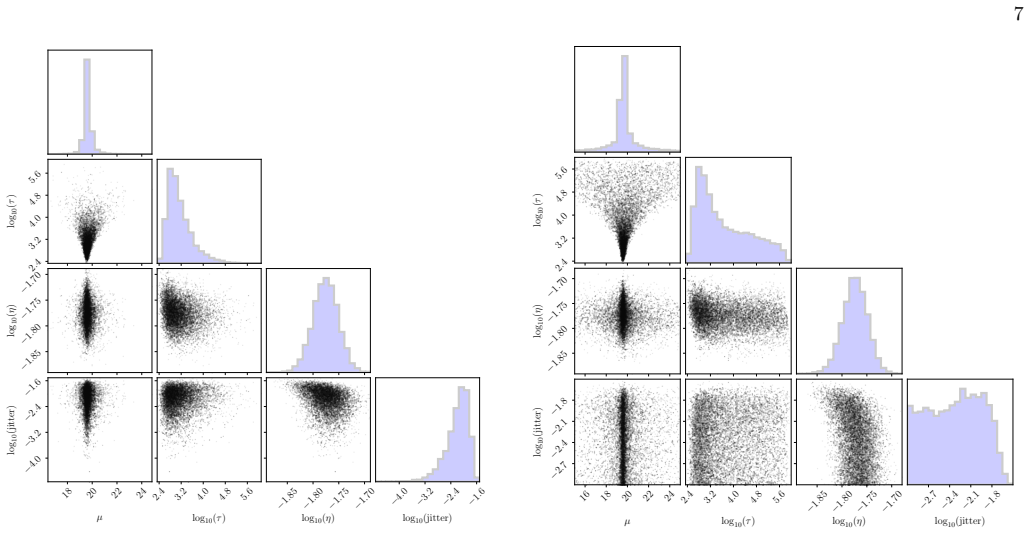
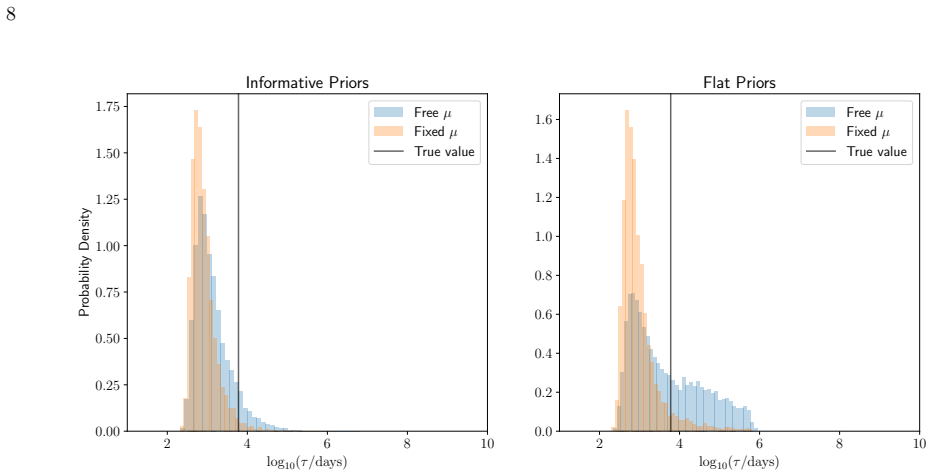
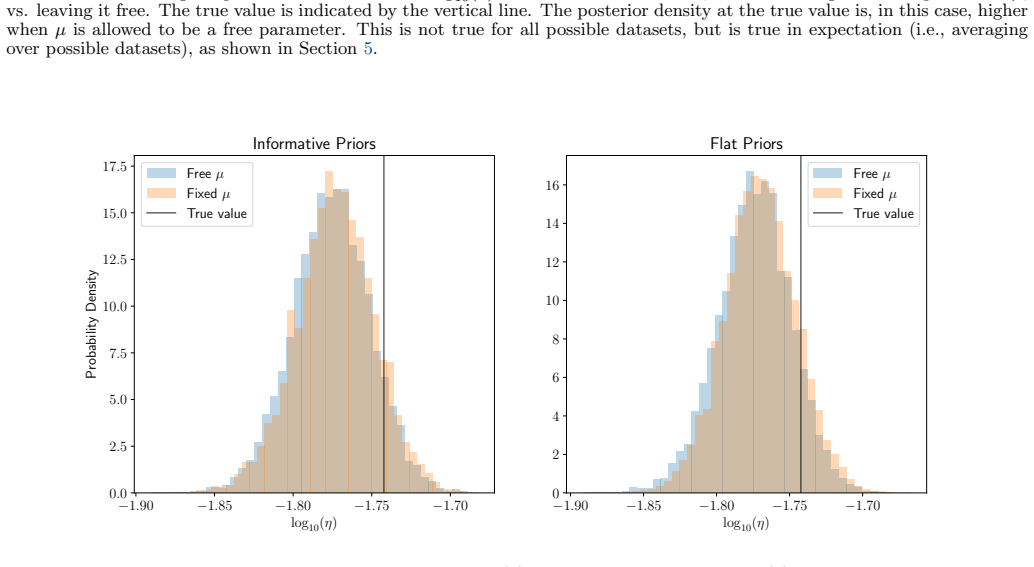
Fixing the mean when fitting DRW models to quasar light curves produces overconfident estimates of the damping timescale au.
A machine-rendered reading of the paper's core claim, the machinery that carries it, and where it could break.
Core claim
When fitting DRW models to quasar variability light curves, fixing the mean μ leads to overconfident inferences about the variability timescale au with substantially underestimated uncertainties. Light curves provide much more information about the short-term volatility parameter η than about au, as quantified by conditional entropy and mutual information on simulated data. A hierarchical Bayesian model fitted directly to 570 light curves shows that volatility decreases with bolometric luminosity and rest wavelength and evolves more steeply with redshift than time dilation alone predicts.
What carries the argument
The damped random walk (Ornstein-Uhlenbeck) stochastic process with parameters μ, au and η, together with mutual information and conditional entropy computed on simulated light curves to measure parameter information content.
If this is right
- Studies of quasar variability should prioritize the volatility parameter η over the damping timescale τ.
- Volatility decreases as a function of bolometric luminosity.
- Volatility decreases as a function of rest wavelength.
- Volatility decreases more steeply with redshift than expected from time dilation alone.
Where Pith is reading between the lines
- The hierarchical model that ingests light curves directly avoids propagating errors from separate per-object fits into the population-level trends.
- The stronger constraint on η implies that short-term variability physics is more directly accessible from typical survey cadences than the longer damping process.
- The extra redshift evolution of volatility beyond time dilation suggests intrinsic changes in accretion-disk behavior across cosmic time.
Load-bearing premise
The damped random walk process is an adequate description of the quasar light curves and the simulated curves used for the information calculations are statistically representative of the real data.
What would settle it
Repeating the information calculations on real light curves longer than those simulated, or refitting the same data while allowing μ to vary freely, and finding that the uncertainty on au remains as underestimated as when μ is fixed.
Figures
read the original abstract
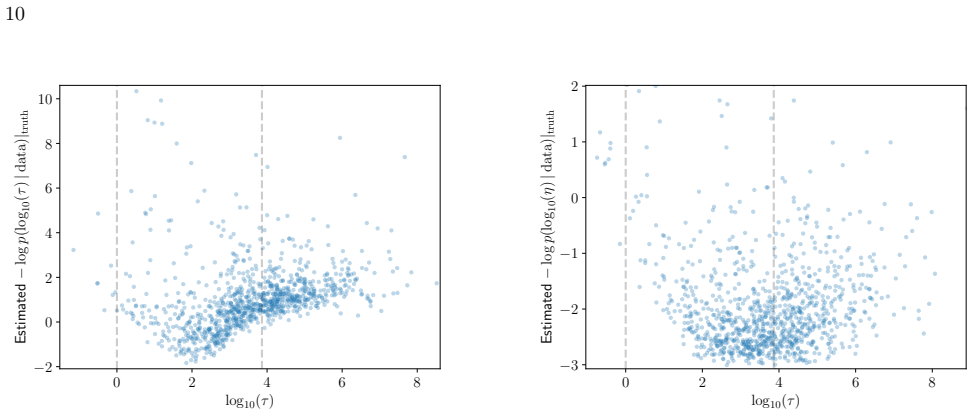
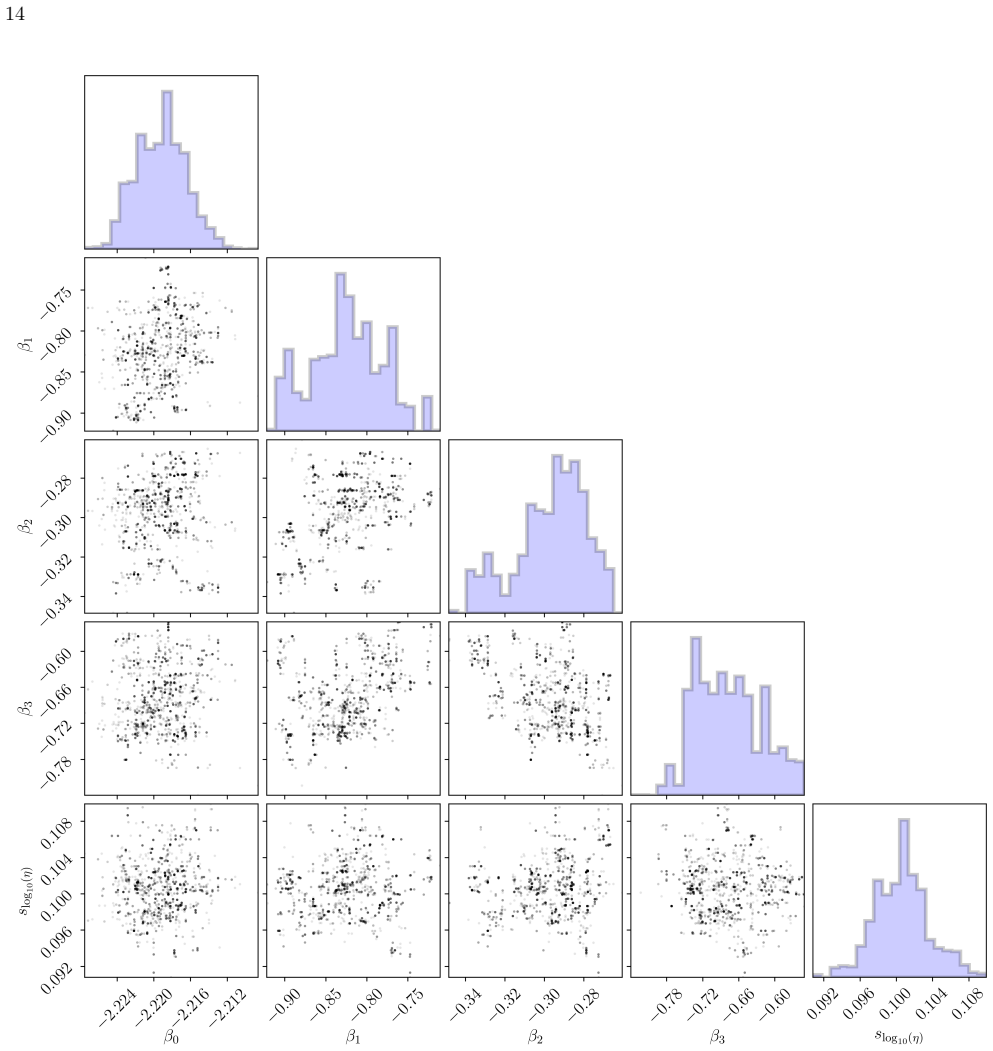
Quasar variability, driven by multi-scale physical processing within a relativistic accretion disk, is commonly modelled with stochastic time series models. The simplest of these is the Damped Random Walk (DRW), also known as the Ornstein-Uhlenbeck (OU) process. Here, we demonstrate that, when fitting such a model to quasar light curve data, the mean of the light curve, $\mu$, should not be fixed (which is the typical approach), as this leads to overconfident inferences about the variability timescale $\tau$, with substantially underestimated uncertainties. However, the short term volatility parameter $\eta$ is typically very well constrained from short light curves. Through simulations, we compute information theoretic quantities such as the conditional entropy and the mutual information, confirming that light curves provide much more information about $\eta$ than about $\tau$. As a result, we recommend that future quasar variability studies focus on $\eta$ rather than $\tau$. To demonstrate this approach, we fit a hierarchical Bayesian regression model for $\eta$ as a function of bolometric luminosity and rest wavelength to a dataset of 570 light curves measured over decades. We perform the fit using a likelihood function that uses the light curves directly, rather than using intermediate $\eta$ values from individual light curve fits. We find that volatility decreases as a function of both bolometric luminosity and rest wavelength. The volatility also decreases more steeply with redshift than time dilation alone would suggest, pointing to an increase in intrinsic volatility as quasars evolve over cosmic time.
Editorial analysis
A structured set of objections, weighed in public.
Referee Report
Summary. The manuscript argues that fixing the mean μ when fitting Damped Random Walk (DRW/Ornstein-Uhlenbeck) models to quasar light curves produces overconfident inferences on the timescale τ with substantially underestimated uncertainties, while the short-term volatility η remains well constrained even from short light curves. Simulations are used to compute conditional entropy and mutual information, establishing that light curves carry substantially more information about η than about τ. A hierarchical Bayesian regression is then fit to 570 real light curves, modeling η directly as a function of bolometric luminosity and rest wavelength via a likelihood that operates on the light curves themselves rather than pre-fitted η values; the fit yields a decrease in volatility with both luminosity and wavelength, plus a steeper redshift dependence than time dilation alone would predict.
Significance. If the central claims hold, the work would usefully redirect quasar variability studies toward η rather than τ and demonstrate the value of hierarchical modeling that bypasses intermediate per-object fits. The direct-likelihood approach and the reported evolutionary trend in intrinsic volatility would be notable strengths if the simulation-based information calculations are shown to be representative of the real data.
major comments (2)
- [Simulations section (information calculations)] The information-theoretic results (conditional entropy and mutual information) are derived exclusively from light curves simulated under the pure DRW process. The manuscript does not verify that the simulated cadences, noise properties, lengths, and sampling patterns are statistically representative of the 570 real light curves used in the hierarchical regression; any mismatch in non-DRW components or non-stationarity would invalidate the quantitative claim that real light curves provide far more information about η than about τ.
- [Hierarchical model section] The hierarchical regression claims to use the light curves directly in the likelihood rather than intermediate η values. However, the precise form of the joint likelihood, the treatment of the mean μ, and the marginalization over τ are not specified in sufficient detail to confirm that the reported trends in η(luminosity, wavelength) are robust to these modeling choices.
minor comments (1)
- The abstract states that volatility decreases more steeply with redshift than time dilation alone would suggest; a quantitative comparison (e.g., a model with and without an explicit redshift term) should be shown in the text to support this interpretation.
Simulated Author's Rebuttal
We thank the referee for their constructive comments. We address each major comment below and indicate where revisions will be made to strengthen the manuscript.
read point-by-point responses
-
Referee: [Simulations section (information calculations)] The information-theoretic results (conditional entropy and mutual information) are derived exclusively from light curves simulated under the pure DRW process. The manuscript does not verify that the simulated cadences, noise properties, lengths, and sampling patterns are statistically representative of the 570 real light curves used in the hierarchical regression; any mismatch in non-DRW components or non-stationarity would invalidate the quantitative claim that real light curves provide far more information about η than about τ.
Authors: We agree that explicit verification of representativeness strengthens the applicability of the information-theoretic results to the real data. The simulations drew cadences, lengths, and noise levels from the empirical distributions of the 570 light curves, but we did not include a direct statistical comparison. In revision we will add this comparison (e.g., side-by-side histograms and Kolmogorov-Smirnov tests) to the Simulations section, confirming that the simulated ensemble matches the real sampling properties under the DRW assumption used throughout the paper. We note that the information quantities are computed under the DRW model itself; any non-DRW behavior in the real data would affect both the simulations and the hierarchical fit equally, preserving the relative information comparison. revision: yes
-
Referee: [Hierarchical model section] The hierarchical regression claims to use the light curves directly in the likelihood rather than intermediate η values. However, the precise form of the joint likelihood, the treatment of the mean μ, and the marginalization over τ are not specified in sufficient detail to confirm that the reported trends in η(luminosity, wavelength) are robust to these modeling choices.
Authors: We appreciate the request for greater mathematical detail. The joint likelihood is the product over objects of the marginal DRW likelihood for each light curve, with μ integrated analytically (or marginalized numerically when the analytic form is unavailable) and τ integrated via nested sampling or quadrature within the hierarchical model. The population-level parameters for η(L_bol, λ_rest) enter through the prior on η for each object. To address the comment we will expand the Hierarchical model section with the explicit likelihood expression, the chosen priors, the numerical marginalization scheme, and a brief robustness check showing that the reported trends in η are insensitive to whether μ is fixed or marginalized (consistent with the earlier finding that μ primarily affects τ). revision: yes
Circularity Check
No significant circularity: information quantities derived from independent simulations; hierarchical fit uses direct likelihood on light curves
full rationale
The paper computes conditional entropy and mutual information via Monte Carlo simulations drawn from the DRW generative model with specified cadences and noise; these quantities are not fitted to or derived from the 570 real light curves. The hierarchical regression employs a likelihood that directly evaluates the light-curve data rather than any pre-computed η point estimates. No equations reduce a claimed prediction to a fitted parameter by construction, no uniqueness theorem is imported via self-citation, and no ansatz is smuggled through prior work. The derivation chain therefore remains self-contained against external simulation benchmarks.
Axiom & Free-Parameter Ledger
free parameters (1)
- hierarchical regression coefficients for η(luminosity, wavelength)
axioms (1)
- domain assumption The Damped Random Walk process adequately describes quasar variability light curves
Reference graph
Works this paper leans on
-
[1]
Private Communications
Me, Moi. Private Communications. OJA. doi:000
-
[2]
Fagin, Joshua and Chan, James Hung-Hsu and Best, Henry and O’Dowd, Matthew and Ford, K. E. Saavik and Graham, Matthew J. and Park, Ji Won and Villar, V. Ashley , year=. Joint Modeling of Quasar Variability and Accretion Disk Reprocessing Using Latent Stochastic Differential Equations , volume=. The Astrophysical Journal , publisher=. doi:10.3847/1538-4357...
-
[3]
Padovani, P. and Alexander, D. M. and Assef, R. J. and De Marco, B. and Giommi, P. and Hickox, R. C. and Richards, G. T. and Smolčić, V. and Hatziminaoglou, E. and Mainieri, V. and Salvato, M. , year=. Active galactic nuclei: what’s in a name? , volume=. The Astronomy and Astrophysics Review , publisher=. doi:10.1007/s00159-017-0102-9 , number=
-
[4]
Accretion disks, quasars and cosmology: meandering towards understanding , volume=
Czerny, Bożena and Cao, Shulei and Jaiswal, Vikram Kumar and Karas, Vladimír and Khadka, Narayan and Martínez-Aldama, Mary Loli and Naddaf, Mohammad Hassan and Panda, Swayamtrupta and Pozo Nuñez, Francisco and Prince, Raj and Ratra, Bharat and Sniegowska, Marzena and Yu, Zhefu and Zajaček, Michal , year=. Accretion disks, quasars and cosmology: meandering...
-
[5]
Journal of the American statistical Association , volume=
Strictly proper scoring rules, prediction, and estimation , author=. Journal of the American statistical Association , volume=. 2007 , publisher=
2007
-
[6]
The Astrophysical Journal , volume=
Flexible and scalable methods for quantifying stochastic variability in the era of massive time-domain astronomical data sets , author=. The Astrophysical Journal , volume=. 2014 , publisher=
2014
-
[7]
An Alternative Approach To Measuring Reverberation Lags in Active Galactic Nuclei
An Alternative Approach to Measuring Reverberation Lags in Active Galactic Nuclei. , keywords =. doi:10.1088/0004-637X/735/2/80 , archivePrefix =. 1008.0641 , primaryClass =
work page internal anchor Pith review Pith/arXiv arXiv doi:10.1088/0004-637x/735/2/80
-
[8]
The Astrophysical Journal , volume=
Geometric and dynamical models of reverberation mapping data , author=. The Astrophysical Journal , volume=. 2011 , publisher=
2011
-
[9]
A likelihood function for the Gaia Data
A likelihood function for the Gaia Data. arXiv e-prints , keywords =. doi:10.48550/arXiv.1804.07766 , archivePrefix =. 1804.07766 , primaryClass =
work page internal anchor Pith review Pith/arXiv arXiv doi:10.48550/arxiv.1804.07766
-
[10]
International Workshop on Artificial Intelligence and Statistics , pages=
Toward question-asking machines: The logic of questions and the inquiry calculus , author=. International Workshop on Artificial Intelligence and Statistics , pages=. 2005 , organization=
2005
-
[11]
Monthly Notices of the Royal Astronomical Society , volume =
Huda, I Nurul and Souchay, J and Barache, C and Liu, J -C and Liu, N , title =. Monthly Notices of the Royal Astronomical Society , volume =. 2025 , month =. doi:10.1093/mnras/staf1398 , url =
-
[12]
The Bell system technical journal , volume=
A mathematical theory of communication , author=. The Bell system technical journal , volume=. 1948 , publisher=
1948
-
[13]
Entropy , volume=
Computing entropies with nested sampling , author=. Entropy , volume=. 2017 , publisher=
2017
-
[14]
Publications of the Astronomical Society of Australia , archivePrefix = "arXiv", eprint =
The Murchison Widefield Array: The Square Kilometre Array Precursor at Low Radio Frequencies. Publications of the Astronomical Society of Australia , archivePrefix = "arXiv", eprint =. doi:10.1017/pasa.2012.007 , adsurl =
-
[15]
Dynamical modelling of the Lick AGN Monitoring Project 2008 data set , author=
Modelling reverberation mapping data--II. Dynamical modelling of the Lick AGN Monitoring Project 2008 data set , author=. Monthly Notices of the Royal Astronomical Society , volume=. 2014 , publisher=
2008
-
[16]
Annual Review of Astronomy and Astrophysics , volume=
Gaussian process regression for astronomical time series , author=. Annual Review of Astronomy and Astrophysics , volume=. 2023 , publisher=
2023
-
[17]
Maximum-Entropy and Bayesian Methods in Science and Engineering: Foundations , pages=
Excerpts from Bayesian spectrum analysis and parameter estimation , author=. Maximum-Entropy and Bayesian Methods in Science and Engineering: Foundations , pages=. 1988 , publisher=
1988
-
[18]
The Astrophysical Journal , volume=
Improving damped random walk parameters for SDSS Stripe 82 quasars with Pan-STARRS1 , author=. The Astrophysical Journal , volume=. 2021 , publisher=
2021
-
[19]
Science , volume=
A characteristic optical variability time scale in astrophysical accretion disks , author=. Science , volume=. 2021 , publisher=
2021
-
[20]
Optical variability of quasars with 20-yr photometric light curves. MNRAS , keywords =. doi:10.1093/mnras/stac1259 , archivePrefix =. 2201.02762 , primaryClass =
-
[21]
The Engineering Development Array: A Low Frequency Radio Telescope Utilising SKA Precursor Technology. , keywords =. doi:10.1017/pasa.2017.27 , archivePrefix =. 1707.03499 , primaryClass =
work page internal anchor Pith review Pith/arXiv arXiv doi:10.1017/pasa.2017.27 2017
-
[22]
The Astrophysical Journal , volume=
Inferring the eccentricity distribution , author=. The Astrophysical Journal , volume=. 2010 , publisher=
2010
-
[23]
Monthly Notices of the Royal Astronomical Society: Letters , volume=
Hierarchical reverberation mapping , author=. Monthly Notices of the Royal Astronomical Society: Letters , volume=. 2014 , publisher=
2014
-
[24]
Kevin H. Knuth , keywords =. Lattice duality: The origin of probability and entropy , journal =. 2005 , note =. doi:https://doi.org/10.1016/j.neucom.2004.11.039 , url =
-
[25]
The Astrophysical Journal , volume=
Is quasar optical variability a damped random walk? , author=. The Astrophysical Journal , volume=. 2013 , publisher=
2013
-
[26]
Journal of Statistical Software, Articles , volume =
Brendon Brewer and Daniel Foreman-Mackey , title =. Journal of Statistical Software, Articles , volume =. 2018 , keywords =. doi:10.18637/jss.v086.i07 , url =
-
[27]
2006 , publisher=
Gaussian processes for machine learning , author=. 2006 , publisher=
2006
-
[28]
Annual Review of Astronomy and Astrophysics , volume=
Markov chain Monte Carlo methods for Bayesian data analysis in astronomy , author=. Annual Review of Astronomy and Astrophysics , volume=. 2017 , publisher=
2017
-
[29]
arXiv preprint physics/0608185 , year=
Updating probabilities , author=. arXiv preprint physics/0608185 , year=
-
[30]
Bayesian analysis , volume=
Nested sampling for general Bayesian computation , author=. Bayesian analysis , volume=. 2006 , publisher=
2006
-
[31]
Statistics and Computing , volume=
Diffusive nested sampling , author=. Statistics and Computing , volume=. 2011 , publisher=
2011
-
[32]
2015 23rd European signal processing conference (EUSIPCO) , pages=
The class of generalized hampel filters , author=. 2015 23rd European signal processing conference (EUSIPCO) , pages=. 2015 , organization=
2015
-
[33]
Daniel Foreman-Mackey , title =. 2016 , month =. doi:10.21105/joss.00024 , url =
-
[34]
Entropy , volume=
Entropy, information, and the updating of probabilities , author=. Entropy , volume=. 2021 , publisher=
2021
-
[35]
Physical Review D , volume=
Next generation strong lensing time delay estimation with Gaussian processes , author=. Physical Review D , volume=. 2014 , publisher=
2014
-
[36]
Monthly Notices of the Royal Astronomical Society , volume=
Revisiting the cosmological time dilation of distant quasars: influence of source properties and evolution , author=. Monthly Notices of the Royal Astronomical Society , volume=. 2025 , publisher=
2025
-
[37]
Nature Astronomy , volume=
Detection of the cosmological time dilation of high-redshift quasars , author=. Nature Astronomy , volume=. 2023 , publisher=
2023
-
[38]
The Astrophysical Journal , volume=
Are the variations in quasar optical flux driven by thermal fluctuations? , author=. The Astrophysical Journal , volume=. 2009 , publisher=
2009
-
[39]
Astronomy & Astrophysics , volume=
Limitations on the recovery of the true AGN variability parameters using damped random walk modeling , author=. Astronomy & Astrophysics , volume=. 2017 , publisher=
2017
-
[40]
Radio Frequency Interference (RFI , year = 2017, month = jan, eid =
The statistics of radio frequency interference propagating from long distances to the Murchison radio-astronomy observatory. Radio Frequency Interference (RFI , year = 2017, month = jan, eid =. doi:10.1109/RFINT.2016.7833541 , adsurl =
-
[41]
Scalable Backpropagation for Gaussian Processes using Celerite. Research Notes of the American Astronomical Society , year = 2018, month = feb, volume = 2, number = 1, pages =. doi:10.3847/2515-5172/aaaf6c , adsurl =
-
[42]
arXiv e-prints , keywords =
The statistics of low frequency radio interference at the Murchison Radio-astronomy Observatory. arXiv e-prints , keywords =
-
[43]
BIGHORNS - Broadband Instrument for Global HydrOgen ReioNisation Signal
BIGHORNS - Broadband Instrument for Global HydrOgen ReioNisation Signal. , keywords =. doi:10.1017/pasa.2015.3 , archivePrefix =. 1501.02922 , primaryClass =
work page internal anchor Pith review Pith/arXiv arXiv doi:10.1017/pasa.2015.3 2015
-
[44]
The Low-Frequency Environment of the Murchison Widefield Array: Radio-Frequency Interference Analysis and Mitigation. , keywords =. doi:10.1017/pasa.2015.7 , archivePrefix =. 1501.03946 , primaryClass =
work page internal anchor Pith review Pith/arXiv arXiv doi:10.1017/pasa.2015.7 2015
-
[45]
Absolving the SSINS of Precision Interferometric Radio Data: A New Technique for Mitigating Faint Radio Frequency Interference. , keywords =. doi:10.1088/1538-3873/ab3cad , archivePrefix =. 1906.01093 , primaryClass =
-
[46]
DAOPHOT: A Computer Program for Crowded-Field Stellar Photometry. , keywords =. doi:10.1086/131977 , adsurl =
-
[47]
arXiv e-prints , keywords =
The Development of Non-coherent Passive Radar Techniques for Space Situational Awareness with the Murchison Widefield Array. arXiv e-prints , keywords =
-
[48]
2019 IEEE Radar Conference (RadarConf) , title=
B. 2019 IEEE Radar Conference (RadarConf) , title=. 2019 , volume=. doi:10.1109/RADAR.2019.8835821 , ISSN=
-
[49]
J. E. 2017 IEEE Radar Conference (RadarConf) , title=. 2017 , volume=. doi:10.1109/RADAR.2017.7944483 , ISSN=
-
[50]
Tingay, S. J. and Kaplan, D. L. and McKinley, B. and Briggs, F. and Wayth, R. B. and Hurley-Walker, N. and Kennewell, J. and Smith, C. and Zhang, K. and Arcus, W. and Bhat, N. D R and Emrich, D. and Herne, D. and Kudryavtseva, N. and Lynch, M. and Ord, S. M. and Waterson, M. and Barnes, D. G. and Bell, M. and Gaensler, B. M. and Lenc, E. and Bernardi, G. ...
-
[51]
Holdsworth and Masaki Tsutsumi and Iain M
David A. Holdsworth and Masaki Tsutsumi and Iain M. Reid and Takuji Nakamura and Toshitaka Tsuda , title =. 2004 , month = oct, publisher =. doi:10.1029/2003rs003026 , url =
-
[52]
M. A. Cervera , title =. 2004 , publisher =. doi:10.1029/2004ja010450 , url =
-
[53]
arXiv e-prints , keywords =
Accelerating Radio Astronomy Cross-Correlation with Graphics Processing Units. arXiv e-prints , keywords =. 2011
2011
-
[54]
Benz, Arnold O. 4.1.1.6 Radio emission of the quiet Sun: Datasheet from Landolt-B \"o rnstein - Group VI Astronomy and Astrophysics Volume 4B: ``Solar System'' in SpringerMaterials (https://doi.org/10.1007/978-3-540-88055-4_5). 2009. doi:10.1007/978-3-540-88055-4_5
-
[55]
2019 , type =
AIPS FITS File Format , institution =. 2019 , type =
2019
-
[56]
arXiv e-prints , keywords =
Quantifying Excess Power from Radio Frequency Interference in Epoch of Reionization Measurements. arXiv e-prints , keywords =
-
[57]
Science with ASKAP - the Australian Square Kilometre Array Pathfinder
Science with ASKAP. The Australian square-kilometre-array pathfinder. Experimental Astronomy , keywords =. doi:10.1007/s10686-008-9124-7 , archivePrefix =. 0810.5187 , primaryClass =
work page internal anchor Pith review Pith/arXiv arXiv doi:10.1007/s10686-008-9124-7
-
[58]
The Phase II Murchison Widefield Array: Design Overview
The Phase II Murchison Widefield Array: Design overview. , keywords =. doi:10.1017/pasa.2018.37 , archivePrefix =. 1809.06466 , primaryClass =
work page internal anchor Pith review Pith/arXiv arXiv doi:10.1017/pasa.2018.37 2018
-
[59]
arXiv e-prints , keywords =
Orbit Determination Before Detect: Orbital Parameter Matched Filtering for Uncued Detection. arXiv e-prints , keywords =
-
[60]
Limits on radio emission from meteors using the MWA
Limits on radio emission from meteors using the MWA. MNRAS , keywords =. doi:10.1093/mnras/sty930 , archivePrefix =. 1804.07060 , primaryClass =
work page internal anchor Pith review Pith/arXiv arXiv doi:10.1093/mnras/sty930
-
[61]
Journal of Astronomical Instrumentation , keywords =
The Signal Processing Firmware for the Low Frequency Aperture Array. Journal of Astronomical Instrumentation , keywords =. doi:10.1142/S2251171716410154 , archivePrefix =. 2002.10307 , primaryClass =
-
[62]
Journal of Astronomical Instrumentation , keywords =
The Digital Signal Processing Platform for the Low Frequency Aperture Array: Preliminary Results on the Data Acquisition Unit. Journal of Astronomical Instrumentation , keywords =. doi:10.1142/S2251171716410142 , adsurl =
-
[63]
2020 , eprint=
The Low Earth Orbit Satellite Population and Impacts of the SpaceX Starlink Constellation , author=. 2020 , eprint=
2020
-
[64]
2020 , eprint=
Concerns about ground based astronomical observations: a step to safeguard the astronomical sky , author=. 2020 , eprint=
2020
-
[65]
Astronomy & Astrophysics , volume=
Impact of satellite constellations on astronomical observations with ESO telescopes in the visible and infrared domains , author=. Astronomy & Astrophysics , volume=. 2020 , publisher=
2020
-
[66]
arXiv preprint arXiv:2003.07805 , year=
A Flat-Panel Brightness Model for the Starlink Satellites and Measurement of their Absolute Visual Magnitude , author=. arXiv preprint arXiv:2003.07805 , year=
arXiv 2003
-
[67]
Reliability of CubeSats – Statistical Data, Developers' Beliefs and the Way Forward , journal =
Langer, Martin and Bouwmeester, Jasper , year =. Reliability of CubeSats – Statistical Data, Developers' Beliefs and the Way Forward , journal =
-
[68]
Monroe, Ryan McKay , keywords =. Gigahertz Bandwidth and Nanosecond Timescales: New Frontiers in Radio Astronomy Through Peak Performance Signal Processing , publisher =. doi:10.7907/25DP-J474 , url =
-
[69]
arXiv e-prints , keywords =
Extended reionization in models beyond CDM with Planck 2018 data. arXiv e-prints , keywords =
2018
-
[70]
The LOFAR radio environment. , keywords =. doi:10.1051/0004-6361/201220293 , archivePrefix =. 1210.0393 , primaryClass =
work page internal anchor Pith review Pith/arXiv arXiv doi:10.1051/0004-6361/201220293
-
[71]
Cosmology at Low Frequencies: The 21 cm Transition and the High-Redshift Universe
Cosmology at low frequencies: The 21 cm transition and the high-redshift Universe. , keywords =. doi:10.1016/j.physrep.2006.08.002 , archivePrefix =. astro-ph/0608032 , primaryClass =
work page internal anchor Pith review Pith/arXiv arXiv doi:10.1016/j.physrep.2006.08.002 2006
-
[72]
Advancing Astrophysics with the Square Kilometre Array (AASKA14) , year = 2015, month = apr, eid =
The Cosmic Dawn and Epoch of Reionisation with SKA. Advancing Astrophysics with the Square Kilometre Array (AASKA14) , year = 2015, month = apr, eid =
2015
-
[73]
The development of non-coherent passive radar techniques for space situational awareness with the Murchison Widefield Array. , keywords =. doi:10.1017/pasa.2020.1 , archivePrefix =. 2002.01674 , primaryClass =
-
[74]
Astronomical Data Analysis Software and Systems IV , year = 1995, editor =
A Retrospective View of MIRIAD. Astronomical Data Analysis Software and Systems IV , year = 1995, editor =
1995
-
[75]
astropy/photutils: v0.6 , month = jan, year = 2019, doi =
Larry Bradley and Brigitta Sip. astropy/photutils: v0.6 , month = jan, year = 2019, doi =
2019
-
[76]
Ultrastructural localization of
Adade, Camila M and de Castro, Solange L and Soares, Maurilio J , journal=. Ultrastructural localization of. 2007 , publisher=
2007
-
[77]
Journal of Proteome Research , volume=
Proteomic analysis of Trypanosoma cruzi secretome: characterization of two populations of extracellular vesicles and soluble proteins , author=. Journal of Proteome Research , volume=. 2013 , publisher=
2013
discussion (0)
Sign in with ORCID, Apple, or X to comment. Anyone can read and Pith papers without signing in.