RadioMaster: Multi-Agent System for Autonomous Radio Signal Generation
Pith reviewed 2026-06-28 12:00 UTC · model grok-4.3
The pith
A multi-agent framework overcomes LLM limitations to turn user intents into viable physical radio signals.
A machine-rendered reading of the paper's core claim, the machinery that carries it, and where it could break.
Core claim
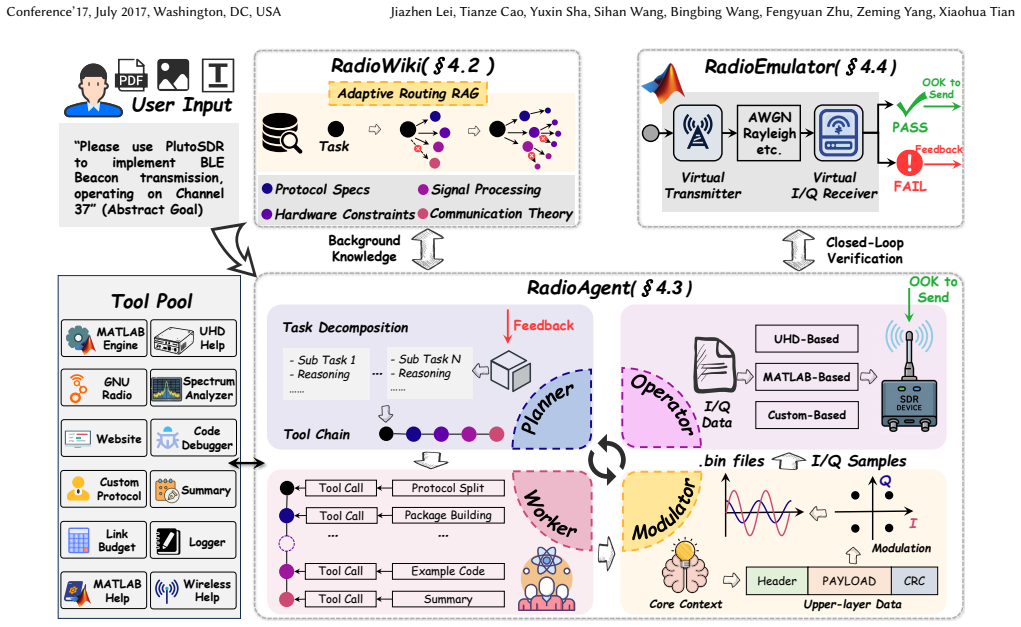
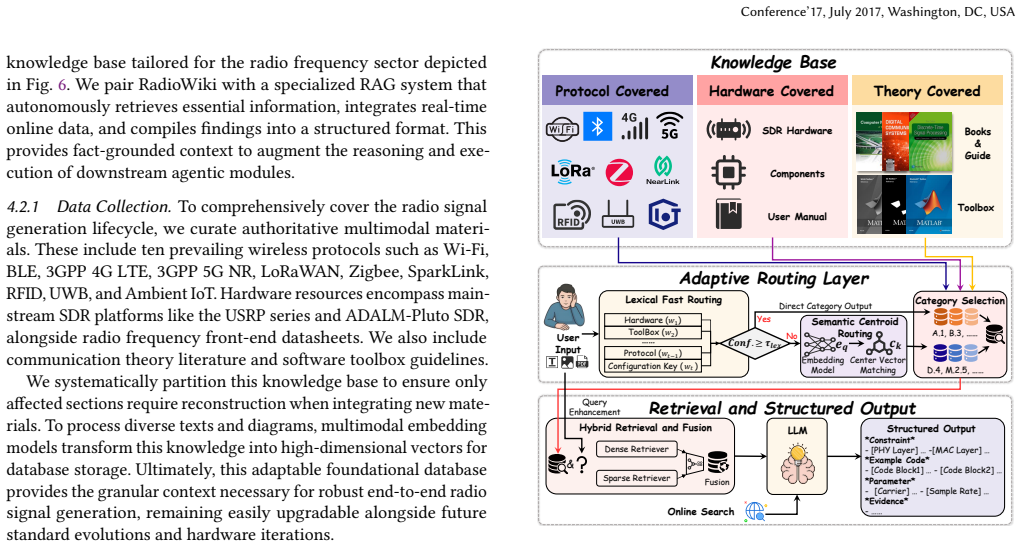
RadioMaster is a fully autonomous multi-agent framework that translates user input into real-world wireless emissions through three synergistic pillars: RadioWiki for domain-specific knowledge retrieval, RadioAgent for collaborative I/Q sample generation alongside hardware configuration, and RadioEmulator for closed-loop physical layer verification, achieving higher configuration viability and signal fidelity than state-of-the-art baselines on the introduced RadioBench.
What carries the argument
The three synergistic pillars of RadioWiki for knowledge retrieval, RadioAgent for joint I/Q and hardware generation, and RadioEmulator for physical verification that together close the gap between text intent and emitted signal.
If this is right
- Wireless prototyping can proceed from natural-language descriptions without manual coding of physical-layer details.
- A dedicated benchmark enables repeatable measurement of signal-generation systems on both viability and fidelity.
- Multi-agent division of labor plus verification can produce usable I/Q samples and hardware settings where single models fail.
- Real-world emissions become reachable for users who lack radio engineering expertise.
Where Pith is reading between the lines
- The same retrieval-collaboration-verification pattern could be tested on other constrained physical tasks such as sensor configuration or motor control scripts.
- If the emulator step is replaced by direct hardware feedback, the loop could become fully online and adapt to live channel conditions.
- Scaling the knowledge base beyond the current RadioWiki might extend the range of supported modulation schemes and device types.
Load-bearing premise
That retrieving domain facts, letting agents collaborate on samples and settings, and running an emulator check is enough to fix the domain ignorance and hardware insensitivity that block current models.
What would settle it
A controlled test on user intents requiring specific hardware parameters absent from the retrieval source where RadioMaster produces no viable configurations or signals whose measured spectrum matches the intended waveform.
Figures



read the original abstract
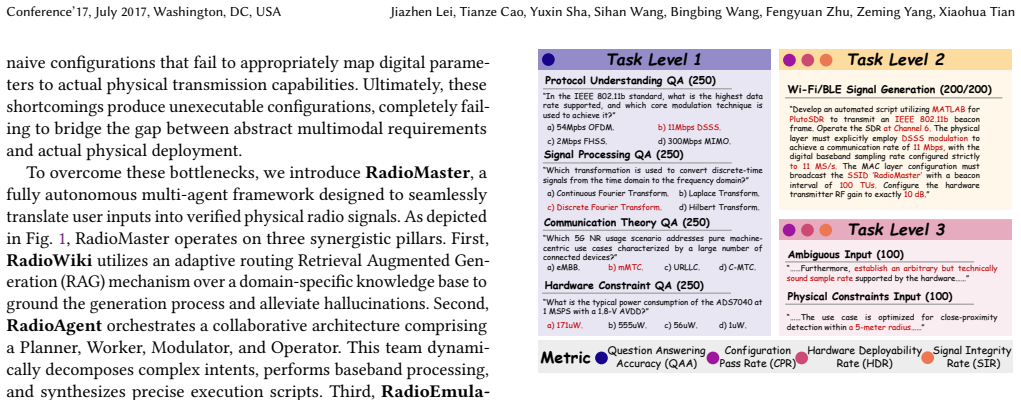
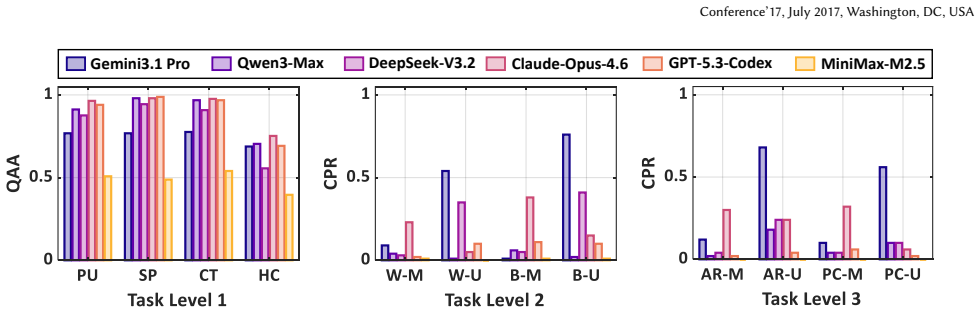
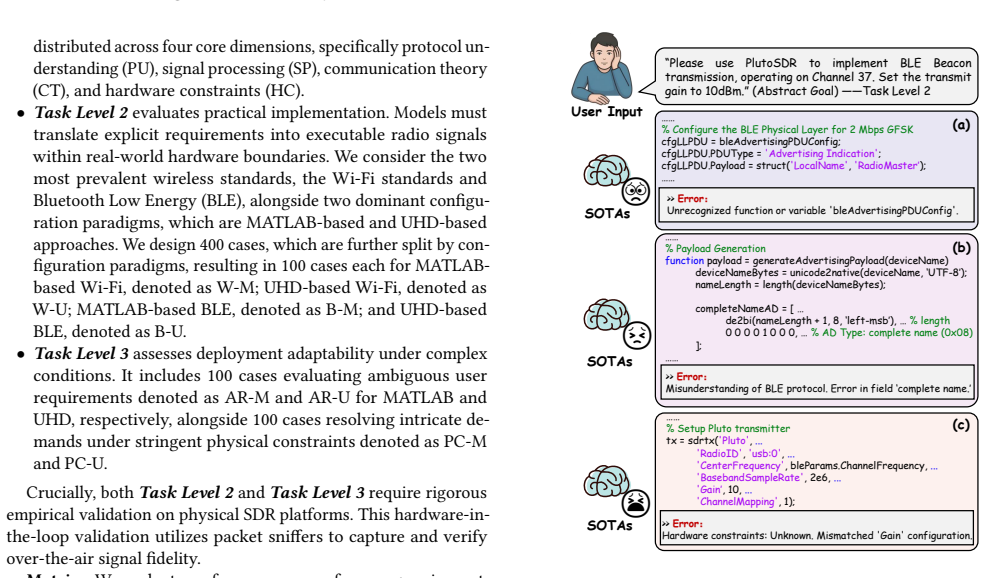
Translating user intents into physical radio signals represents the critical yet notoriously tedious final step in wireless prototyping, as it requires intricate knowledge of physical layer details and presents immense implementation challenges. Large Language Models (LLMs) and multi-agent systems have revolutionized conventional software engineering, raising the compelling question of whether they can resolve these formidable difficulties. However, our investigations reveal that current models experience significant limitations and fail to accomplish this task when applied to radio signal generation. This performance degradation primarily stems from severe domain ignorance and a fundamental insensitivity to physical hardware constraints. To bridge this gap, we introduce RadioMaster, a fully autonomous multi-agent framework designed to seamlessly translate user input into real-world wireless emissions. RadioMaster operates on three synergistic pillars: RadioWiki for domain-specific knowledge retrieval, RadioAgent for collaborative I/Q sample generation alongside hardware configuration, and RadioEmulator for closed-loop physical layer verification. Furthermore, we construct RadioBench, the first comprehensive benchmark tailored specifically for the radio signal generation domain. Extensive real-world evaluations demonstrate that RadioMaster significantly outperforms state-of-the-art (SOTA) baselines regarding configuration viability and signal fidelity.
Editorial analysis
A structured set of objections, weighed in public.
Referee Report
Summary. The manuscript introduces RadioMaster, a multi-agent framework that uses RadioWiki for domain-specific knowledge retrieval, RadioAgent for collaborative I/Q sample generation and hardware configuration, and RadioEmulator for closed-loop physical layer verification to translate user intents into real-world radio signals. It also presents RadioBench as the first benchmark for this domain and claims, based on real-world evaluations, that RadioMaster significantly outperforms state-of-the-art baselines in configuration viability and signal fidelity.
Significance. If the central results hold, the work could meaningfully advance automation of wireless prototyping by addressing documented LLM shortcomings in domain knowledge and hardware constraint sensitivity. The construction of RadioBench is a clear positive contribution as the first dedicated benchmark. However, the assessed significance is limited by the absence of evidence that RadioEmulator's predictions match physical hardware behavior.
major comments (1)
- [Abstract and §4 (Evaluation)] The outperformance claim on viability and fidelity (abstract and evaluation sections) is load-bearing on RadioEmulator delivering accurate closed-loop verification. No information is supplied on whether the emulator incorporates measured hardware impairments, nonlinearities, or channel effects, nor on any quantitative agreement metrics or validation against physical testbeds; without this, reported gains risk being artifacts of simulation-reality mismatch rather than genuine progress.
minor comments (1)
- [Abstract] The abstract states outperformance but supplies no numerical metrics, baseline names, error bars, or evaluation protocol details; these should be added for immediate readability.
Simulated Author's Rebuttal
We thank the referee for the thoughtful and constructive review. The major comment raises a valid point about the need for greater transparency on RadioEmulator. We address it directly below and are prepared to revise the manuscript accordingly.
read point-by-point responses
-
Referee: [Abstract and §4 (Evaluation)] The outperformance claim on viability and fidelity (abstract and evaluation sections) is load-bearing on RadioEmulator delivering accurate closed-loop verification. No information is supplied on whether the emulator incorporates measured hardware impairments, nonlinearities, or channel effects, nor on any quantitative agreement metrics or validation against physical testbeds; without this, reported gains risk being artifacts of simulation-reality mismatch rather than genuine progress.
Authors: We agree that additional detail on RadioEmulator is required. The final claims of outperformance in the abstract and §4 are grounded in real-world hardware experiments (actual over-the-air transmissions and measurements on physical testbeds), not solely on emulator outputs. RadioEmulator provides intermediate closed-loop feedback during the multi-agent generation process. In the revision we will add to §3.3 a description of the emulator's modeled effects (standard hardware impairments, nonlinearities, and channel models), quantitative agreement metrics (e.g., waveform correlation and error vector magnitude) between emulator predictions and hardware measurements, and explicit validation results against the same physical testbed used for the reported evaluations. This will confirm that the observed gains reflect genuine progress rather than simulation-reality mismatch. revision: yes
Circularity Check
No circularity; claims rest on external real-world evaluations
full rationale
The paper describes an engineering system (RadioMaster) with three components and a new benchmark (RadioBench), then reports outperformance on real-world hardware tests. No equations, fitted parameters, or derivation chain appear in the abstract or described structure. The central performance claim is tied to external evaluations rather than internal definitions, self-citations, or renamings. The reader's provided circularity score of 2.0 aligns with this assessment of a self-contained empirical result.
Axiom & Free-Parameter Ledger
Reference graph
Works this paper leans on
-
[1]
https://www.analog.com/en/resources/evaluation-hardware- and-software/evaluation-boards-kits/adalm-pluto.html
ADALM-PLUTO. https://www.analog.com/en/resources/evaluation-hardware- and-software/evaluation-boards-kits/adalm-pluto.html
-
[2]
https://code.claude.com/docs/en/overview
Claude Code. https://code.claude.com/docs/en/overview
-
[3]
https://platform.claude.com/docs/en/about-claude/models/ whats-new-claude-4-6
Claude-Opus-4.6. https://platform.claude.com/docs/en/about-claude/models/ whats-new-claude-4-6
-
[4]
https://www.ettus.com/sdr-software/uhd-usrp- hardware-driver/
Ettus USRP Hardware Driver. https://www.ettus.com/sdr-software/uhd-usrp- hardware-driver/
-
[5]
https://ai.google.dev/gemini-api/docs/models/gemini-3.1-pro- preview?hl=zh-cn
Gemini3.1 Pro. https://ai.google.dev/gemini-api/docs/models/gemini-3.1-pro- preview?hl=zh-cn
-
[6]
https://docs.z.ai/guides/llm/glm-5-turbo
GLM-5-Turbo. https://docs.z.ai/guides/llm/glm-5-turbo
-
[7]
https://openai.com/zh-Hans-CN/index/introducing-gpt-5-3- codex/
GPT-5.3-Codex. https://openai.com/zh-Hans-CN/index/introducing-gpt-5-3- codex/
-
[8]
https://punchthrough.com/lightblue/
LightBlue. https://punchthrough.com/lightblue/
-
[9]
https://www.mediatek.com/products/broadband-wifi/ mt7612u
MediaTek MT7612U. https://www.mediatek.com/products/broadband-wifi/ mt7612u
-
[10]
https://www.minimax.io/news/minimax-m25
MiniMax-2.5. https://www.minimax.io/news/minimax-m25
-
[11]
https://qwen.ai/blog?id=241398b9cd6353de490b0f82806c7848c5d2777d& from=research.latest-advancements-list
Qwen3-Max. https://qwen.ai/blog?id=241398b9cd6353de490b0f82806c7848c5d2777d& from=research.latest-advancements-list
-
[12]
https://www.ettus.com/all-products/ub210-kit/
USRP B210. https://www.ettus.com/all-products/ub210-kit/
-
[13]
Gnu radio: tools for exploring the radio frequency spectrum.Linux journal, 2004(122):4, 2004
Eric Blossom. Gnu radio: tools for exploring the radio frequency spectrum.Linux journal, 2004(122):4, 2004
2004
-
[14]
Combining software-defined radio learning modules and neural networks for teaching communication systems courses.Information, 14(11):599, 2023
Luis A Camunas-Mesa and Jos’e M de la Rosa. Combining software-defined radio learning modules and neural networks for teaching communication systems courses.Information, 14(11):599, 2023
2023
-
[15]
Shuai Chen, Yong Zu, Zhixi Feng, Shuyuan Yang, and Mengchang Li. Radiollm: Introducing large language model into cognitive radio via hybrid prompt and token reprogrammings.arXiv preprint arXiv:2501.17888, 2025
-
[16]
Xiang Cheng, Weibo Wen, Haotian Zhang, Boxun Liu, Zonghui Yang, Jianan Zhang, and Xuesong Cai. Embodied intelligent wireless (eiw): Synesthesia of machines empowered wireless communications.arXiv preprint arXiv:2511.22845, 2025
-
[17]
Videoagent: A memory-augmented multimodal agent for video understanding
Yue Fan, Xiaojian Ma, Rujie Wu, Yuntao Du, Jiaqi Li, Zhi Gao, and Qing Li. Videoagent: A memory-augmented multimodal agent for video understanding. InEuropean Conference on Computer Vision, pages 75–92. Springer, 2024
2024
-
[18]
Ai hospital: Benchmarking large language models in a multi-agent medical interaction simulator
Zhihao Fan, Lai Wei, Jialong Tang, Wei Chen, Wang Siyuan, Zhongyu Wei, and Fei Huang. Ai hospital: Benchmarking large language models in a multi-agent medical interaction simulator. InProceedings of the 31st International Conference on Computational Linguistics, pages 10183–10213, 2025
2025
-
[19]
Sciagents: automating scientific discovery through bioinspired multi-agent intelligent graph reasoning.Advanced Materials, 37(22):2413523, 2025
Alireza Ghafarollahi and Markus J Buehler. Sciagents: automating scientific discovery through bioinspired multi-agent intelligent graph reasoning.Advanced Materials, 37(22):2413523, 2025
2025
-
[20]
Programming embedded iot applications in natural language with iotpilot
Kaijie Gong, Wei Dong, Hao Wang, Yingqi Peng, and Yi Gao. Programming embedded iot applications in natural language with iotpilot. InProceedings of the 23rd Annual International Conference on Mobile Systems, Applications and Services, pages 70–82, 2025
2025
-
[21]
Large language model based multi-agents: A survey of progress and challenges
T Guo, X Chen, Y Wang, R Chang, S Pei, NV Chawla, O Wiest, and X Zhang. Large language model based multi-agents: A survey of progress and challenges. In33rd International Joint Conference on Artificial Intelligence (IJCAI 2024). IJCAI; Cornell arxiv, 2024
2024
-
[22]
Embodied llm agents learn to cooperate in organized teams.IEEE Transactions on Computational Social Systems, 2026
Xudong Guo, Kaixuan Huang, Jiale Liu, Wenhui Fan, Natalia Vélez, Qingyun Wu, Huazheng Wang, Thomas L Griffiths, and Mengdi Wang. Embodied llm agents learn to cooperate in organized teams.IEEE Transactions on Computational Social Systems, 2026
2026
-
[23]
Llm-based multi-agent systems for software engineering: Literature review, vision, and the road ahead.ACM Transactions on Software Engineering and Methodology, 34(5):1–30, 2025
Junda He, Christoph Treude, and David Lo. Llm-based multi-agent systems for software engineering: Literature review, vision, and the road ahead.ACM Transactions on Software Engineering and Methodology, 34(5):1–30, 2025
2025
-
[24]
Tinysdr: Low-power sdr platform for over-the-air programmable iot testbeds
Mehrdad Hessar, Ali Najafi, Vikram Iyer, and Shyamnath Gollakota. Tinysdr: Low-power sdr platform for over-the-air programmable iot testbeds. In17th USENIX Symposium on Networked Systems Design and Implementation (NSDI 20), pages 1031–1046, Santa Clara, CA, February 2020. USENIX Association
2020
-
[25]
Metagpt: Meta programming for a multi-agent collaborative framework
Sirui Hong, Mingchen Zhuge, Jonathan Chen, Xiawu Zheng, Yuheng Cheng, Jinlin Wang, Ceyao Zhang, Zili Wang, Steven Ka Shing Yau, Zijuan Lin, et al. Metagpt: Meta programming for a multi-agent collaborative framework. InThe twelfth international conference on learning representations, 2023
2023
-
[26]
Cued- agent: A collaborative multi-agent system for automatic cued speech recognition
Guanjie Huang, Danny HK Tsang, Shan Yang, Guangzhi Lei, and Li Liu. Cued- agent: A collaborative multi-agent system for automatic cued speech recognition. InProceedings of the 33rd ACM International Conference on Multimedia, pages 8313–8321, 2025
2025
-
[27]
Chat3gpp: An open-source retrieval-augmented generation framework for 3gpp documents
Long Huang, Ming Zhao, Limin Xiao, Xiujun Zhang, and Jungang Hu. Chat3gpp: An open-source retrieval-augmented generation framework for 3gpp documents. In2025 IEEE International Conference on Communications Workshops (ICC Work- shops), pages 492–497. IEEE, 2025
2025
-
[28]
Audiogpt: Under- standing and generating speech, music, sound, and talking head
Rongjie Huang, Mingze Li, Dongchao Yang, Jiatong Shi, Xuankai Chang, Zhenhui Ye, Yuning Wu, Zhiqing Hong, Jiawei Huang, Jinglin Liu, et al. Audiogpt: Under- standing and generating speech, music, sound, and talking head. InProceedings of the AAAI Conference on Artificial Intelligence, volume 38, pages 23802–23804, 2024
2024
-
[29]
Mapcoder: Multi-agent code generation for competitive problem solving
Md Ashraful Islam, Mohammed Eunus Ali, and Md Rizwan Parvez. Mapcoder: Multi-agent code generation for competitive problem solving. InProceedings of the 62nd Annual Meeting of the Association for Computational Linguistics (Volume 1: Long Papers), pages 4912–4944, 2024
2024
-
[30]
Mccd: Multi-agent collaboration-based compositional diffusion for complex text-to-image genera- tion
Mingcheng Li, Xiaolu Hou, Ziyang Liu, Dingkang Yang, Ziyun Qian, Jiawei Chen, Jinjie Wei, Yue Jiang, Qingyao Xu, and Lihua Zhang. Mccd: Multi-agent collaboration-based compositional diffusion for complex text-to-image genera- tion. InProceedings of the Computer Vision and Pattern Recognition Conference, pages 13263–13272, 2025
2025
-
[31]
The importance of expert knowledge for automatic modulation open set recognition.IEEE Transactions on Pattern Analysis and Machine Intelligence, 45(11):13730–13748, 2023
Taotao Li, Zhenyu Wen, Yang Long, Zhen Hong, Shilian Zheng, Li Yu, Bo Chen, Xiaoniu Yang, and Ling Shao. The importance of expert knowledge for automatic modulation open set recognition.IEEE Transactions on Pattern Analysis and Machine Intelligence, 45(11):13730–13748, 2023
2023
-
[32]
A survey on llm-based multi-agent systems: workflow, infrastructure, and challenges.Vicinagearth, 1(1):9, 2024
Xinyi Li, Sai Wang, Siqi Zeng, Yu Wu, and Yi Yang. A survey on llm-based multi-agent systems: workflow, infrastructure, and challenges.Vicinagearth, 1(1):9, 2024
2024
-
[33]
DeepSeek-V3.2: Pushing the Frontier of Open Large Language Models
Aixin Liu, Aoxue Mei, Bangcai Lin, Bing Xue, Bingxuan Wang, Bingzheng Xu, Bochao Wu, Bowei Zhang, Chaofan Lin, Chen Dong, et al. Deepseek-v3. 2: Push- ing the frontier of open large language models.arXiv preprint arXiv:2512.02556, 2025
work page internal anchor Pith review Pith/arXiv arXiv 2025
-
[34]
Junhua Liu, Fanfan Lin, Xinze Li, Kwan Hui Lim, and Shuai Zhao. Physics- informed llm-agent for automated modulation design in power electronics sys- tems.arXiv preprint arXiv:2411.14214, 2024
-
[35]
Tasksense: A translation-like approach for tasking heterogeneous sensor systems with llms
Kaiwei Liu, Bufang Yang, Lilin Xu, Yunqi Guo, Guoliang Xing, Xian Shuai, Xiaozhe Ren, Xin Jiang, and Zhenyu Yan. Tasksense: A translation-like approach for tasking heterogeneous sensor systems with llms. InProceedings of the 23rd ACM Conference on Embedded Networked Sensor Systems, pages 213–225, 2025
2025
-
[36]
Ali Maatouk, Kenny Chirino Ampudia, Rex Ying, and Leandros Tassiulas. Tele- llms: A series of specialized large language models for telecommunications.arXiv preprint arXiv:2409.05314, 2024
-
[37]
A history of matlab.Proceedings of the ACM on Programming Languages, 4(HOPL):1–67, 2020
Cleve Moler and Jack Little. A history of matlab.Proceedings of the ACM on Programming Languages, 4(HOPL):1–67, 2020
2020
-
[38]
Tree-of-reasoning: Towards complex medical diagnosis via multi-agent reasoning with evidence tree
Qi Peng, Jialin Cui, Jiayuan Xie, Yi Cai, and Qing Li. Tree-of-reasoning: Towards complex medical diagnosis via multi-agent reasoning with evidence tree. In Proceedings of the 33rd ACM International Conference on Multimedia, pages 1744– 1753, 2025
2025
-
[39]
Multi-agent system for comprehensive soccer understanding
Jiayuan Rao, Zifeng Li, Haoning Wu, Ya Zhang, Yanfeng Wang, and Weidi Xie. Multi-agent system for comprehensive soccer understanding. InProceedings of the 33rd ACM International Conference on Multimedia, pages 3654–3663, 2025
2025
-
[40]
Audiogenie: A training-free multi-agent framework for diverse multimodality-to-multiaudio generation
Yan Rong, Jinting Wang, Guangzhi Lei, Shan Yang, and Li Liu. Audiogenie: A training-free multi-agent framework for diverse multimodality-to-multiaudio generation. InProceedings of the 33rd ACM International Conference on Multimedia, pages 8872–8881, 2025
2025
-
[41]
Autoiot: Llm-driven automated natural language programming for aiot applications
Leming Shen, Qiang Yang, Yuanqing Zheng, and Mo Li. Autoiot: Llm-driven automated natural language programming for aiot applications. InProceedings of the 31st Annual International Conference on Mobile Computing and Networking, pages 468–482, 2025
2025
-
[42]
Batalama, and Dimitris A
George Sklivanitis, Adam Gannon, Stella N. Batalama, and Dimitris A. Pados. Ad- dressing next-generation wireless challenges with commercial software-defined radio platforms.IEEE Communications Magazine, 54(1):59–67, 2016
2016
-
[43]
Simviews: An interactive multi-agent system simulating visitor-to-visitor conver- sational patterns to present diverse perspectives of artifacts in virtual museums
Mingyang Su, Chao Liu, Jingling Zhang, WU Shuang, and Mingming Fan. Simviews: An interactive multi-agent system simulating visitor-to-visitor conver- sational patterns to present diverse perspectives of artifacts in virtual museums. InProceedings of the 33rd ACM International Conference on Multimedia, pages 6740–6750, 2025
2025
-
[44]
Multi-agent em- bodied question answering in interactive environments
Sinan Tan, Weilai Xiang, Huaping Liu, Di Guo, and Fuchun Sun. Multi-agent em- bodied question answering in interactive environments. InEuropean Conference on Computer Vision, pages 663–678. Springer, 2020
2020
-
[45]
Verigen: A large language model for verilog code generation.ACM Transactions on Design Automation of Electronic Systems, 29(3):1–31, 2024
Shailja Thakur, Baleegh Ahmad, Hammond Pearce, Benjamin Tan, Brendan Dolan-Gavitt, Ramesh Karri, and Siddharth Garg. Verigen: A large language model for verilog code generation.ACM Transactions on Design Automation of Electronic Systems, 29(3):1–31, 2024
2024
-
[46]
Wirelessagent++: Automated agentic workflow design and benchmarking for wireless networks, 2026
Jingwen Tong, Zijian Li, Fang Liu, Wei Guo, and Jun Zhang. Wirelessagent++: Automated agentic workflow design and benchmarking for wireless networks, 2026
2026
-
[47]
Nn-defined modulator: Reconfigurable and portable software modulator on iot gateways
Jiazhao Wang, Wenchao Jiang, Ruofeng Liu, Bin Hu, Demin Gao, and Shuai Wang. Nn-defined modulator: Reconfigurable and portable software modulator on iot gateways. In21st USENIX Symposium on Networked Systems Design and Implementation (NSDI 24), pages 775–789, 2024
2024
-
[48]
Xinquan Wang, Fenghao Zhu, Zhaohui Yang, Chongwen Huang, Xiaoming Chen, Zhaoyang Zhang, Sami Muhaidat, and Mérouane Debbah. Bridging physical and digital worlds: embodied large ai for future wireless systems.arXiv preprint arXiv:2506.24009, 2025
-
[49]
Genartist: Multimodal llm as an agent for unified image generation and editing.Advances in Neural Information Processing Systems, 37:128374–128395, 2024
Zhenyu Wang, Aoxue Li, Zhenguo Li, and Xihui Liu. Genartist: Multimodal llm as an agent for unified image generation and editing.Advances in Neural Information Processing Systems, 37:128374–128395, 2024
2024
-
[50]
Generative multi-agent collaboration in embodied ai: A systematic review
Di Wu, Xian Wei, Guang Chen, Hao Shen, Xiangfeng Wang, Wenhao Li, and Bo Jin. Generative multi-agent collaboration in embodied ai: A systematic review. Conference’17, July 2017, Washington, DC, USA Jiazhen Lei, Tianze Cao, Yuxin Sha, Sihan Wang, Bingbing Wang, Fengyuan Zhu, Zeming Yang, Xiaohua Tian arXiv preprint arXiv:2502.11518, 2025
-
[51]
ReWOO: Decoupling Reasoning from Observations for Efficient Augmented Language Models
Binfeng Xu, Zhiyuan Peng, Bowen Lei, Subhabrata Mukherjee, Yuchen Liu, and Dongkuan Xu. Rewoo: Decoupling reasoning from observations for efficient augmented language models.arXiv preprint arXiv:2305.18323, 2023
work page internal anchor Pith review Pith/arXiv arXiv 2023
-
[52]
Penetrative ai: Making llms comprehend the physical world
Huatao Xu, Liying Han, Qirui Yang, Mo Li, and Mani Srivastava. Penetrative ai: Making llms comprehend the physical world. InFindings of the Association for Computational Linguistics: ACL 2024, pages 7324–7341, 2024
2024
-
[53]
React: Synergizing reasoning and acting in language models
Shunyu Yao, Jeffrey Zhao, Dian Yu, Nan Du, Izhak Shafran, Karthik R Narasimhan, and Yuan Cao. React: Synergizing reasoning and acting in language models. In The eleventh international conference on learning representations, 2022
2022
-
[54]
Flexifly: interfacing the physical world with foundation models empowered by reconfigurable drone systems
Minghui Zhao, Junxi Xia, Kaiyuan Hou, Yanchen Liu, Stephen Xia, and Xiaofan Jiang. Flexifly: interfacing the physical world with foundation models empowered by reconfigurable drone systems. InProceedings of the 23rd ACM Conference on Embedded Networked Sensor Systems, pages 463–476, 2025
2025
-
[55]
An agentic system for rare disease diagnosis with traceable reasoning.Nature, pages 1–10, 2026
Weike Zhao, Chaoyi Wu, Yanjie Fan, Pengcheng Qiu, Xiaoman Zhang, Yuze Sun, Xiao Zhou, Shuju Zhang, Yu Peng, Yanfeng Wang, et al. An agentic system for rare disease diagnosis with traceable reasoning.Nature, pages 1–10, 2026
2026
-
[56]
Agentstory: A multi-agent system for story visualization with multi-subject consistent text-to-image generation
Tianchen Zhou, Zhongjie Duan, Cen Chen, Wenmeng Zhou, Yanhao Wang, and Yaliang Li. Agentstory: A multi-agent system for story visualization with multi-subject consistent text-to-image generation. InProceedings of the 2025 International Conference on Multimedia Retrieval, pages 1894–1902, 2025
2025
-
[57]
Enabling software-defined phy for backscatter networks
Fengyuan Zhu, Mingwei Ouyang, Luwei Feng, Yaoyu Liu, Xiaohua Tian, Meng Jin, Dongyao Chen, and Xinbing Wang. Enabling software-defined phy for backscatter networks. InProceedings of the 20th Annual International Conference on Mobile Systems, Applications and Services, pages 330–342, 2022
2022
-
[58]
Rf-gpt: Teaching ai to see the wireless world
Hang Zou, Yu Tian, Bohao Wang, Lina Bariah, Samson Lasaulce, Chongwen Huang, and Mérouane Debbah. Rf-gpt: Teaching ai to see the wireless world. arXiv preprint arXiv:2602.14833, 2026. Conference’17, July 2017, Washington, DC, USA TX 8.2m TX RX (a) (b) 4m RX Figure 8: Real-world hardware testbed deployed in an indoor conference room. TX (a) RX Range Tx Rx ...
discussion (0)
Sign in with ORCID, Apple, or X to comment. Anyone can read and Pith papers without signing in.