A Simple Hierarchical Causality Primer
Pith reviewed 2026-06-28 11:51 UTC · model grok-4.3
The pith
In complex systems, actor-level roles constrain agent-level behaviour and require causation classes, aggregation operators, and discrete event-time maps.
A machine-rendered reading of the paper's core claim, the machinery that carries it, and where it could break.
Core claim
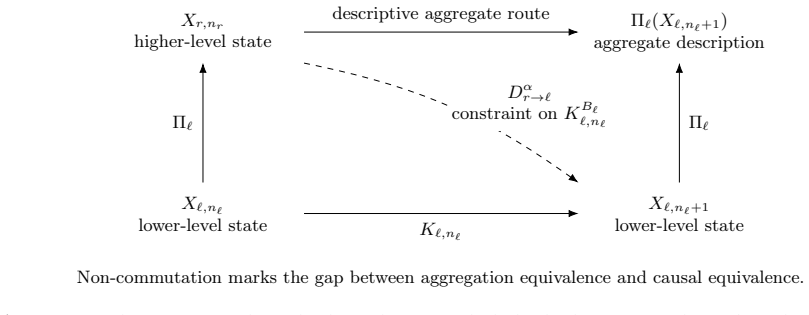
Hierarchical causality describes how actor-level roles constrain, select, and organise agent-level behaviour across levels. The system then necessarily requires three additional structures: causation classes to abstract a given form of causal influence that an actor instantiates, aggregation operators to move across the levels, and discrete event-time maps because the system comprises events and the relation between local event counts and any global clock must be specified. The formulation here is purposefully simple and discrete.
What carries the argument
The distinction between actors that instantiate causation classes and agents that implement local dynamics, together with the required causation classes, aggregation operators, and discrete event-time maps.
If this is right
- Actor roles at one level can select and organise the possible behaviours of agents at lower levels.
- Causation classes provide an abstraction layer for different types of causal influence.
- Aggregation operators enable consistent description when shifting between organisational levels.
- Discrete event-time maps make explicit how local timings relate to global time in event-driven systems.
Where Pith is reading between the lines
- This framing could help in designing multi-agent simulations where roles are assigned separately from individual rules.
- Testing the framework on a concrete example like traffic flow or supply chains could reveal whether the three structures are indeed necessary.
- The requirement for discrete event-time maps suggests that timing relations between scales must be modeled explicitly rather than assumed continuous.
Load-bearing premise
The distinction between actors instantiating causation classes and agents implementing local dynamics is a useful and non-redundant way to decompose causal influence in complex systems, and that any such system must be treated as composed of discrete events requiring explicit event-time maps.
What would settle it
A counterexample would be a complex system in which causal influences across levels can be fully captured using only agent dynamics without needing separate causation classes, aggregation operators, or event-time maps.
Figures
read the original abstract
We provide a brief primer for the idea behind formalising hierarchical causality in the context of complex systems. Here actors are not simply agents. Actors instantiate causation classes. Agents implement local dynamics in given levels or organisation in a given system. Hierarchical causality then describes how actor-level roles constrain, select, and organise agent-level behaviour across levels. The system then necessarily requires three additional structures. First, causation classes to abstract a given form of causal influence that an actor instantiates. Second, aggregation operators to move across the levels. Third, discrete event-time maps are required because the system comprises events, and the relation between local event counts and any global clock must be specified. Our formulation here is purposefully simple and discrete.
Editorial analysis
A structured set of objections, weighed in public.
Referee Report
Summary. The manuscript is a short primer on hierarchical causality in complex systems. It distinguishes actors (which instantiate causation classes) from agents (which implement local dynamics at given levels). Hierarchical causality is defined as the way actor-level roles constrain, select, and organise agent-level behaviour across levels. The text asserts that any such system necessarily requires three additional structures: causation classes (to abstract forms of causal influence), aggregation operators (to move across levels), and discrete event-time maps (because the system comprises events whose local counts must be related to a global clock). The formulation is stated to be purposefully simple and discrete.
Significance. If the necessity claim can be substantiated, the primer would supply a compact conceptual scaffold for decomposing multi-level causal influence, separating role-based constraints from local dynamics. This could be useful in fields such as multi-agent systems and complex-systems modelling where explicit handling of cross-level aggregation and event timing is required. The absence of derivations, examples, or consistency checks in the current text, however, leaves the framework at the level of definitional scaffolding rather than a deployable formalism.
major comments (1)
- [Abstract] Abstract (and the single-paragraph body): the central claim that 'the system then necessarily requires' causation classes, aggregation operators, and discrete event-time maps is presented as a direct consequence of distinguishing actors from agents, yet no derivation, reduction, or counter-model argument is supplied to show why a hierarchical model omitting any one of these structures cannot capture the described constraining/selecting/organising relations. A formal argument or explicit demonstration that alternatives are inadequate is needed for the necessity statement to be load-bearing.
Simulated Author's Rebuttal
We thank the referee for their review and for identifying the need to better substantiate the necessity claim in our short primer. We agree that the current text asserts the requirement for the three structures without an explicit argument or counterexample. We address this below and will revise the manuscript accordingly.
read point-by-point responses
-
Referee: [Abstract] Abstract (and the single-paragraph body): the central claim that 'the system then necessarily requires' causation classes, aggregation operators, and discrete event-time maps is presented as a direct consequence of distinguishing actors from agents, yet no derivation, reduction, or counter-model argument is supplied to show why a hierarchical model omitting any one of these structures cannot capture the described constraining/selecting/organising relations. A formal argument or explicit demonstration that alternatives are inadequate is needed for the necessity statement to be load-bearing.
Authors: We agree that the manuscript presents the necessity of causation classes, aggregation operators, and discrete event-time maps as following from the actor/agent distinction and the definition of hierarchical causality, without supplying a formal derivation or counter-model. The primer is intentionally concise and conceptual; the three structures are motivated by the need to (i) abstract distinct forms of causal influence, (ii) relate quantities across organisational levels, and (iii) align local event counts with a global clock in an event-driven system. To address the referee's concern, we will revise the text to include a short illustrative paragraph showing, at a conceptual level, why a model lacking any one of these elements cannot fully express the constraining, selecting, and organising relations across levels. revision: yes
Circularity Check
No significant circularity; framework is purely definitional with no equations or self-referential reductions
full rationale
The paper is a short conceptual primer that defines hierarchical causality via the distinction between actors (instantiating causation classes) and agents (implementing local dynamics), then states that the system 'necessarily requires' three structures. No equations, parameters, or fitted quantities appear anywhere. No self-citations are used to justify load-bearing claims, no uniqueness theorems are invoked, and no derivation chain reduces any output to its inputs by construction. The text explicitly labels the formulation as 'purposefully simple and discrete,' confirming it is a modeling choice rather than a derived result. The central necessity claim is an assertion, but this does not constitute circularity under the specified patterns because nothing loops back to prior fitted values or self-citations. The derivation chain is therefore self-contained.
Axiom & Free-Parameter Ledger
axioms (2)
- domain assumption Actors instantiate causation classes that abstract forms of causal influence.
- domain assumption The system comprises events whose local counts must be related to a global clock via discrete event-time maps.
invented entities (3)
-
causation classes
no independent evidence
-
aggregation operators
no independent evidence
-
discrete event-time maps
no independent evidence
Reference graph
Works this paper leans on
-
[1]
Constrained Markov Decision Processes
Altman, E., 1999. Constrained Markov Decision Processes. Chapman and Hall/CRC. doi:10.1201/ 9781315140223
1999
-
[2]
Viability Theory: New Direc- tions
Aubin, J.P., Bayen, A.M., Saint-Pierre, P., 2011. Viability Theory: New Direc- tions. Springer, Berlin, Heidelberg. URL: https://doi.org/10.1007/978-3-642-16684-6, doi:10.1007/978-3-642-16684-6
-
[3]
Auletta, G., Ellis, G.F.R., Jaeger, L., 2008. Top- down causation by information control: from a philo- sophical problem to a scientific research programme. Journal of The Royal Society Interface 5, 1159–1172. URL:https://doi.org/10.1098/rsif.2008.0018, doi:10.1098/rsif.2008.0018
-
[4]
Abstracting causal models, in: Proceedings of the AAAI Conference on Artificial Intelligence, pp
Beckers, S., Halpern, J.Y., 2019. Abstracting causal models, in: Proceedings of the AAAI Conference on Artificial Intelligence, pp. 2678–2685. URL:https:// doi.org/10.1609/aaai.v33i01.33012678, doi:10. 1609/aaai.v33i01.33012678
-
[5]
Many learning agents interacting with an agent- based market model
Dicks, M., Paskaramoorthy, A., Gebbie, T., 2024. Many learning agents interacting with an agent- based market model. URL:https://arxiv.org/ abs/2303.07393,arXiv:2303.07393
arXiv 2024
-
[6]
Top-down causation and emer- gence: some comments on mechanisms
Ellis, G.F.R., 2012. Top-down causation and emer- gence: some comments on mechanisms. Interface Fo- cus 2, 126–140. URL:https://doi.org/10.1098/ rsfs.2011.0062, doi:10.1098/rsfs.2011.0062
-
[7]
Lectures on Phase Transitions and the Renormalization Group
Goldenfeld, N., 1992. Lectures on Phase Transitions and the Renormalization Group. CRC Press
1992
-
[8]
Viewing control structures as pat- terns of passing messages
Hewitt, C., 1977. Viewing control structures as pat- terns of passing messages. Artificial Intelligence 8, 323–364. doi:10.1016/0004-3702(77)90033-9
-
[9]
A universal modular actor formalism for artificial intelligence, in: Proceedings of the 3rd International Joint Conference on Artificial Intelligence (IJCAI), pp
Hewitt, C., Bishop, P., Steiger, R., 1973. A universal modular actor formalism for artificial intelligence, in: Proceedings of the 3rd International Joint Conference on Artificial Intelligence (IJCAI), pp. 235–245
1973
-
[10]
Quanti- fying causal emergence shows that macro can beat micro
Hoel, E.P., Albantakis, L., Tononi, G., 2013. Quanti- fying causal emergence shows that macro can beat micro. Proceedings of the National Academy of 8 Sciences 110, 19790–19795. URL:https://doi. org/10.1073/pnas.1314922110, doi:10.1073/pnas. 1314922110
-
[11]
Foundations of Modern Proba- bility
Kallenberg, O., 2002. Foundations of Modern Proba- bility. 2 ed., Springer
2002
-
[12]
Causality: Models, Rea- soning, and Inference
Pearl, J., 2009. Causality: Models, Rea- soning, and Inference. 2 ed., Cam- bridge University Press, Cambridge. URL: https://doi.org/10.1017/CBO9780511803161, doi:10.1017/CBO9780511803161
-
[13]
Markov Decision Processes: Discrete Stochastic Dynamic Programming
Puterman, M.L., 1994. Markov Decision Processes: Discrete Stochastic Dynamic Programming. Wiley. doi:10.1002/9780470316887
-
[14]
Rubenstein, P.K., Weichwald, S., Bongers, S., Mooij, J.M., Janzing, D., Grosse-Wentrup, M., Schölkopf, B., 2017. Causal consistency of structural equa- tion models, in: Proceedings of the 33rd Conference on Uncertainty in Artificial Intelligence, p. ID 11. URL:https://arxiv.org/abs/1707.00819, doi:10. 48550/arXiv.1707.00819
arXiv 2017
-
[15]
Approximation of the via- bility kernel
Saint-Pierre, P., 1994. Approximation of the via- bility kernel. Applied Mathematics and Optimiza- tion 29, 187–209. URL:https://doi.org/10.1007/ BF01204182, doi:10.1007/BF01204182
-
[16]
Category Theory for the Sciences
Spivak, D.I., 2014. Category Theory for the Sciences. MIT Press
2014
-
[17]
Wilcox, D., Gebbie, T., 2014. Hierarchical causality in financial economics. URL:https: //arxiv.org/abs/1408.5585, doi:10.48550/arXiv. 1408.5585,arXiv:1408.5585. 9
work page internal anchor Pith review doi:10.48550/arxiv 2014
discussion (0)
Sign in with ORCID, Apple, or X to comment. Anyone can read and Pith papers without signing in.