FigSIM: A Dataset for Fine-grained Suicide Severity and Figurative Language in Suicide Memes
Pith reviewed 2026-06-28 15:01 UTC · model grok-4.3
The pith
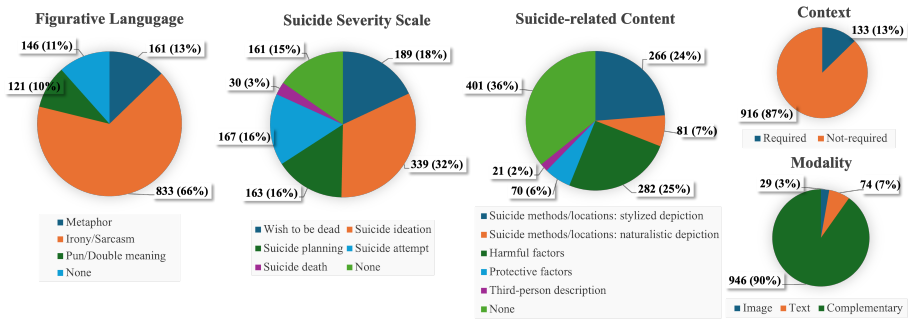
FigSIM is the first dataset of 1049 suicide memes annotated for fine-grained severity levels, figurative phenomena, and related content.
A machine-rendered reading of the paper's core claim, the machinery that carries it, and where it could break.
Core claim
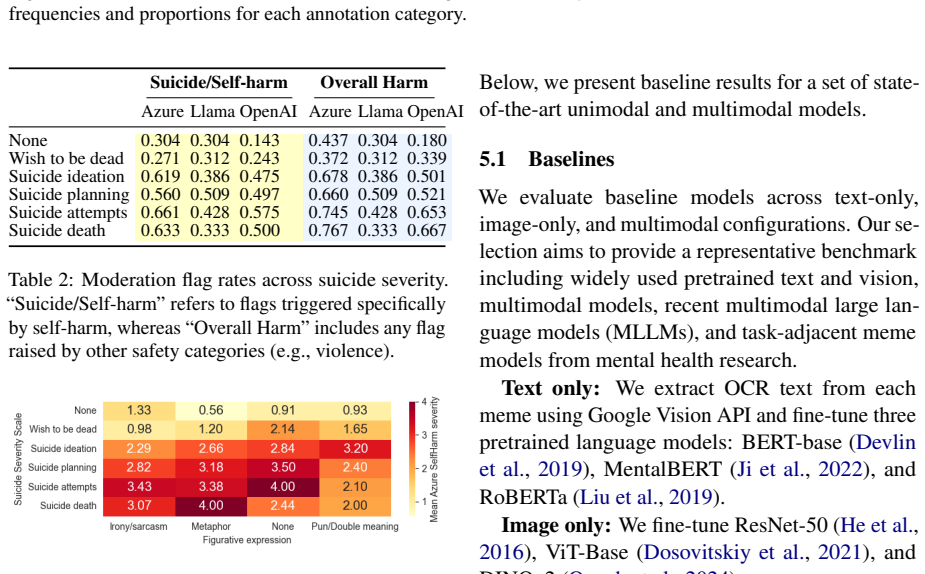
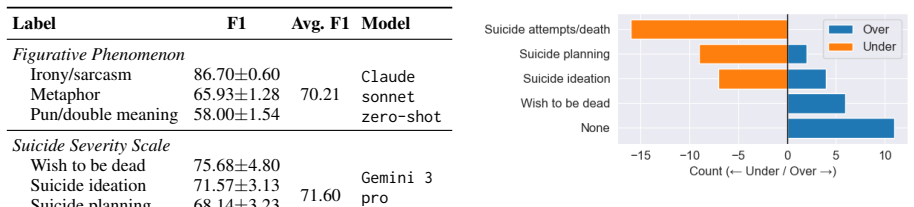
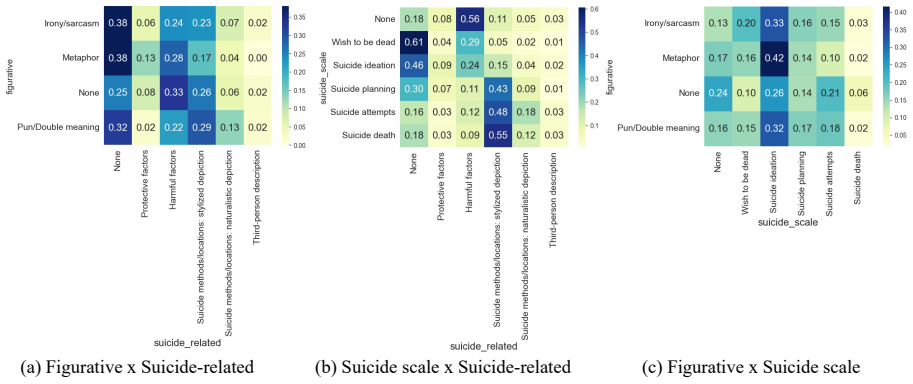
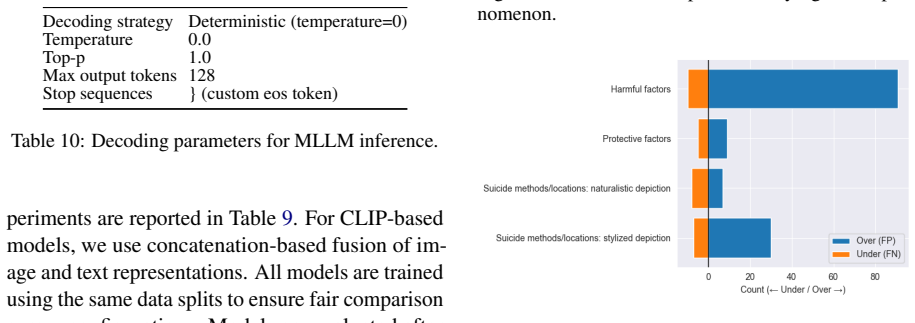
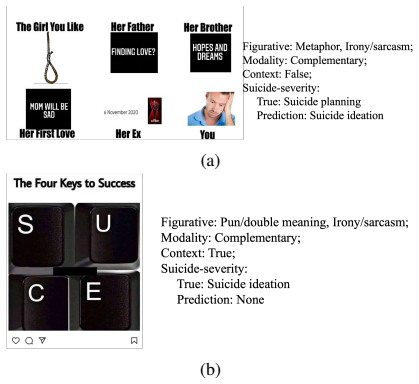
The authors introduce FigSIM, consisting of 1049 memes annotated for fine-grained suicide severity levels, figurative phenomena, and suicide-related content. They benchmark unimodal and multimodal models on three tasks and find that suicide memes pose unique challenges, with analysis revealing biases such as underprediction of higher suicide severity levels, especially for figurative memes.
What carries the argument
The FigSIM dataset with its triple annotations for severity levels, figurative language, and content type, serving as the basis for model benchmarking.
If this is right
- Automated content moderation systems can now be trained and tested on a dedicated resource for suicide memes.
- Model performance gaps are larger on figurative memes at higher severity, indicating a need for better handling of non-literal language.
- The public release of the dataset and its splits supports standardized evaluation of future detection methods.
- Suicide memes exhibit distinct patterns that require specialized strategies beyond general harmful-content classifiers.
Where Pith is reading between the lines
- Platforms could use severity-stratified thresholds to prioritize review of high-risk figurative examples.
- Annotation schemes like those in FigSIM might extend to other ambiguous online expressions tied to mental health.
- Longer-term collection efforts could track whether model biases persist as meme styles evolve.
Load-bearing premise
Human annotations for suicide severity levels and figurative phenomena are reliable and consistent, and the 1049 memes adequately represent the diversity and distribution of suicide memes on social media.
What would settle it
A larger independently collected and annotated collection of suicide memes that produces model predictions without systematic underprediction of high-severity figurative cases would falsify the reported biases.
Figures

read the original abstract
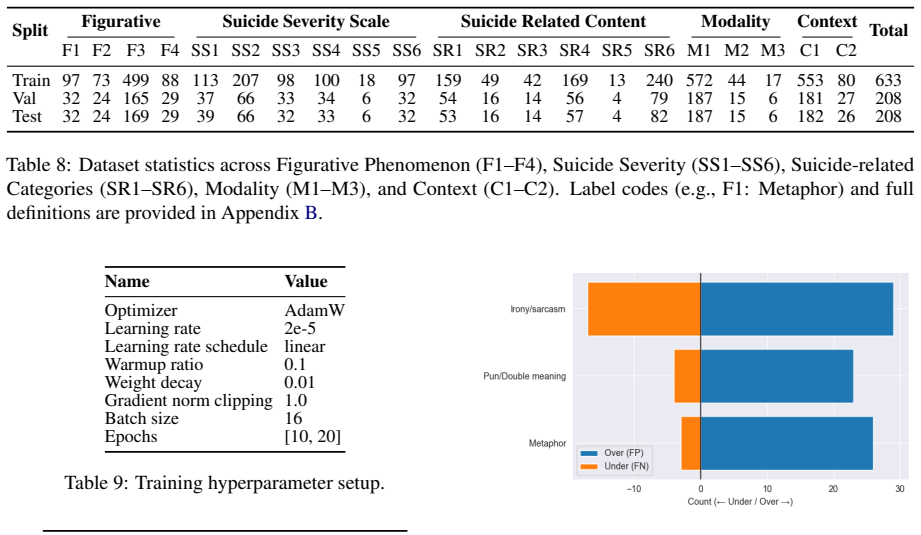
Suicide memes are memes used to express suicide-related thoughts or comment on suicide-related issues. Suicide memes are increasingly common on social media, yet remain poorly understood and potentially harmful. There is an urgent need to better understand their characteristics and to develop appropriate content moderation strategies that limits users' exposure to potentially harmful content. Currently, the absence of annotated datasets of suicide memes remains a key barrier to developing and evaluating automated moderation approaches. In this paper, we introduce FigSIM, the first dataset designed for fine-grained analysis of suicide memes. The dataset consists of 1049 memes, each annotated for (1) fine-grained suicide severity levels, (2) figurative phenomena (e.g., metaphors), and (3) suicide-related content (e.g., suicide method depiction). We benchmark 16 unimodal and multimodal models across three tasks: figurative language, suicide severity, and suicide-related content detection. Overall, FigSIM demonstrates that suicide memes pose unique challenges for both modeling and content moderation. Analysis revealed biases, such as underprediction of higher suicide severity levels, especially for figurative memes. The dataset (including splits used for analyses) is publicly available. Content Warning: This paper contains suicide-related content that may be triggering.
Editorial analysis
A structured set of objections, weighed in public.
Referee Report
Summary. The manuscript introduces FigSIM, the first dataset of 1049 suicide memes annotated for fine-grained suicide severity levels, figurative phenomena (e.g., metaphors), and suicide-related content (e.g., method depiction). It benchmarks 16 unimodal and multimodal models on three detection tasks and reports biases including underprediction of higher severity levels, especially for figurative memes. The dataset and splits are released publicly with a content warning.
Significance. If the human annotations are shown to be reliable, FigSIM would fill a documented gap by enabling fine-grained modeling and moderation research on suicide memes. The benchmarking results and bias analysis would then provide concrete evidence of modeling challenges with figurative language. Public release of the data and splits is a clear strength that supports reproducibility.
major comments (2)
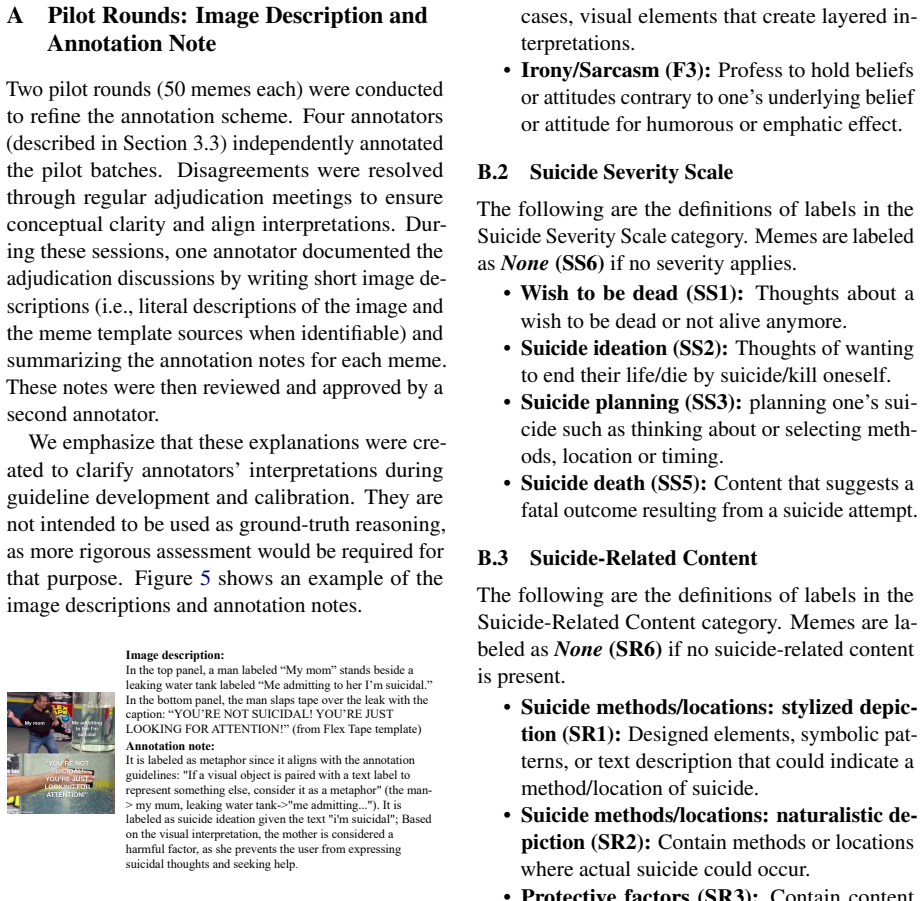
- [Section 3] Section 3 (Dataset Creation and Annotation): The operationalization of the fine-grained suicide severity scale, annotation guidelines, and inter-annotator agreement statistics are not reported. This directly undermines the load-bearing assumption for the bias claims in Section 5, where model underprediction of higher severity levels (especially on figurative memes) is attributed to model behavior rather than label noise or subjectivity.
- [Section 4] Section 4 (Data Collection Pipeline): No details are given on how the 1049-meme sample was sampled from social media or any steps taken to ensure representativeness across platforms, time periods, or meme styles. Without this, the generalization of the observed prediction biases cannot be assessed.
minor comments (2)
- [Results tables] Table 2 or equivalent results table: Clarify whether the reported metrics are macro- or micro-averaged and whether statistical significance tests were performed across the 16 models.
- [Abstract] Abstract: The phrase 'analysis revealed biases' should briefly indicate the number of models and the specific tasks involved for immediate clarity.
Simulated Author's Rebuttal
We thank the referee for their constructive feedback. We address each major comment point-by-point below and will revise the manuscript to provide the requested details.
read point-by-point responses
-
Referee: [Section 3] Section 3 (Dataset Creation and Annotation): The operationalization of the fine-grained suicide severity scale, annotation guidelines, and inter-annotator agreement statistics are not reported. This directly undermines the load-bearing assumption for the bias claims in Section 5, where model underprediction of higher severity levels (especially on figurative memes) is attributed to model behavior rather than label noise or subjectivity.
Authors: We acknowledge that Section 3 lacks explicit operationalization of the severity scale, full annotation guidelines, and IAA statistics. These details are necessary to substantiate the reliability of labels and the interpretation of model biases in Section 5. In the revised manuscript we will expand Section 3 to include: (1) precise definitions and examples for each severity level, (2) key excerpts from the annotation guidelines, and (3) IAA metrics (e.g., Fleiss’ kappa). This addition will directly support the distinction between label noise and model behavior. revision: yes
-
Referee: [Section 4] Section 4 (Data Collection Pipeline): No details are given on how the 1049-meme sample was sampled from social media or any steps taken to ensure representativeness across platforms, time periods, or meme styles. Without this, the generalization of the observed prediction biases cannot be assessed.
Authors: We agree that the absence of sampling details in Section 4 prevents assessment of representativeness and generalizability. The manuscript currently omits the specific collection procedures, platform sources, temporal range, and any stratification steps. We will revise Section 4 to document the full data collection pipeline, including selection criteria and diversity considerations, enabling readers to evaluate the scope of the reported biases. revision: yes
Circularity Check
No circularity: dataset release and empirical benchmarking with no derivations or self-referential predictions
full rationale
The paper introduces a new annotated dataset (FigSIM) of 1049 memes and reports benchmark results from 16 models on three detection tasks. No mathematical derivations, fitted parameters, or predictions are present; the work consists of data collection, human annotation, and standard model evaluation. No self-citation chains, ansatzes, or uniqueness theorems are invoked to support any claim. The central results (dataset statistics and observed model biases) are direct empirical outputs rather than reductions to prior inputs by construction. This is a standard data-release paper with no internal circularity.
Axiom & Free-Parameter Ledger
axioms (1)
- domain assumption Human annotators can reliably assign fine-grained suicide severity and figurative language labels to memes
Reference graph
Works this paper leans on
-
[1]
Anthropic . 2025. https://www.anthropic.com/claude/sonnet Claude sonnet 4.5 . Accessed: 2025-12-07
2025
-
[2]
Yael Badian, Yaakov Ophir, Refael Tikochinski, Nitay Calderon, Anat Brunstein Klomek, Eyal Fruchter, and Roi Reichart. 2023. https://doi.org/10.4088/JCP.23m14962 Social media images can predict suicide risk using interpretable large language-vision models . The Journal of Clinical Psychiatry, 85(1):50516
-
[3]
Shuai Bai, Yuxuan Cai, Ruizhe Chen, Keqin Chen, Xionghui Chen, Zesen Cheng, Lianghao Deng, Wei Ding, Chang Gao, Chunjiang Ge, Wenbin Ge, Zhifang Guo, Qidong Huang, Jie Huang, Fei Huang, Binyuan Hui, Shutong Jiang, Zhaohai Li, Mingsheng Li, and 45 others. 2025. https://arxiv.org/abs/2511.21631 Qwen3-VL technical report . arXiv preprint arXiv:2511.21631
Pith/arXiv arXiv 2025
-
[4]
Jason Baumgartner, Savvas Zannettou, Brian Keegan, Megan Squire, and Jeremy Blackburn. 2020. https://ojs.aaai.org/index.php/ICWSM/article/view/7347 The P ushshift R eddit dataset . In Proc. Int. AAAI Conf. Web Soc. Media (ICWSM '20), volume 14, pages 830--839
2020
-
[5]
Adrian Benton, Glen Coppersmith, and Mark Dredze. 2017. https://doi.org/10.18653/v1/W17-1612 Ethical research protocols for social media health research . In Proc. 1st ACL Workshop on Ethics in Nat. Lang. Process. (EthicsNLP '17), pages 94--102, Valencia, Spain. ACL
-
[6]
Moumita Chatterjee, Piyush Kumar, Poulomi Samanta, and Dhrubasish Sarkar. 2022. https://doi.org/10.1016/j.jjimei.2022.100103 Suicide ideation detection from online social media: A multi-modal feature-based technique . International Journal of Information Management Data Insights, 2(2):100103
-
[7]
Liuliu Chen, Jo Robinson, and Mike Conway. 2025. https://doi.org/10.1609/icwsm.v19i1.35822 What do you meme? -- identifying characteristics and user perceptions of suicide memes in social media . Proceedings of the International AAAI Conference on Web and Social Media, 19(1):385--402
-
[8]
Jacob Cohen. 1960. https://api.semanticscholar.org/CorpusID:15926286 A coefficient of agreement for nominal scales . Educational and Psychological Measurement, 20:37--46
1960
-
[9]
Mithun Das and Animesh Mukherjee. 2023. https://doi.org/10.18653/v1/2023.emnlp-main.959 B angla A buse M eme: A dataset for B engali abusive meme classification . In Proceedings of the 2023 Conference on Empirical Methods in Natural Language Processing, pages 15498--15512, Singapore. Association for Computational Linguistics
-
[10]
Munmun De Choudhury, Michael Gamon, Scott Counts, and Eric Horvitz. 2021. https://doi.org/10.1609/icwsm.v7i1.14432 Predicting depression via social media . Proceedings of the International AAAI Conference on Web and Social Media, 7(1):128--137
-
[11]
Jacob Devlin, Ming-Wei Chang, Kenton Lee, and Kristina Toutanova. 2019. https://doi.org/10.18653/v1/N19-1423 BERT : Pre-training of deep bidirectional transformers for language understanding . In Proceedings of the 2019 Conference of the North A merican Chapter of the Association for Computational Linguistics: Human Language Technologies, Volume 1 (Long a...
-
[12]
Alexey Dosovitskiy, Lucas Beyer, Alexander Kolesnikov, Dirk Weissenborn, Xiaohua Zhai, Thomas Unterthiner, Mostafa Dehghani, Matthias Minderer, Georg Heigold, Sylvain Gelly, Jakob Uszkoreit, and Neil Houlsby. 2021. https://openreview.net/forum?id=YicbFdNTTy An image is worth 16x16 words: Transformers for image recognition at scale . In International Confe...
2021
-
[13]
Abhimanyu Dubey, Abhinav Jauhri, Abhinav Pandey, Abhishek Kadian, Ahmad Al-Dahle, Aiesha Letman, Akhil Mathur, Amy Yang, Angela Fan, and 1 others. 2024. https://arxiv.org/abs/2407.21783 The Llama 3 herd of models . arXiv preprint arXiv:2407.21783
Pith/arXiv arXiv 2024
-
[14]
Manas Gaur, Amanuel Alambo, Joy Prakash Sain, Ugur Kursuncu, Krishnaprasad Thirunarayan, Ramakanth Kavuluru, Amit Sheth, Randy Welton, and Jyotishman Pathak. 2019. https://doi.org/10.1145/3308558.3313698 Knowledge-aware assessment of severity of suicide risk for early intervention . In The World Wide Web Conference, WWW '19, page 514–525, New York, NY, US...
-
[15]
Google DeepMind . 2025. Gemini: A family of highly capable multimodal models. https://deepmind.google/technologies/gemini/. Accessed: 2025-12-02
2025
-
[16]
Kaiming He, Xiangyu Zhang, Shaoqing Ren, and Jian Sun. 2016. https://doi.org/10.1109/CVPR.2016.90 Deep residual learning for image recognition . In 2016 IEEE Conference on Computer Vision and Pattern Recognition (CVPR), pages 770--778
-
[17]
Jianzhao Huang, Hongzhan Lin, Liu Ziyan, Ziyang Luo, Guang Chen, and Jing Ma. 2024. https://doi.org/10.18653/v1/2024.emnlp-main.136 Towards low-resource harmful meme detection with LMM agents . In Proceedings of the 2024 Conference on Empirical Methods in Natural Language Processing, pages 2269--2293, Miami, Florida, USA. Association for Computational Linguistics
-
[18]
Prince Jha, Krishanu Maity, Raghav Jain, Apoorv Verma, Sriparna Saha, and Pushpak Bhattacharyya. 2024. https://doi.org/10.18653/v1/2024.eacl-long.56 Meme-ingful analysis: Enhanced understanding of cyberbullying in memes through multimodal explanations . In Proceedings of the 18th Conference of the European Chapter of the Association for Computational Ling...
-
[19]
Shaoxiong Ji, Shirui Pan, Xue Li, Erik Cambria, Guodong Long, and Zi Huang. 2021. https://doi.org/10.1109/TCSS.2020.3021467 Suicidal ideation detection: A review of machine learning methods and applications . IEEE Transactions on Computational Social Systems, 8(1):214--226
-
[20]
Shaoxiong Ji, Tianlin Zhang, Luna Ansari, Jie Fu, Prayag Tiwari, and Erik Cambria. 2022. https://aclanthology.org/2022.lrec-1.778/ M ental BERT : Publicly available pretrained language models for mental healthcare . In Proceedings of the Thirteenth Language Resources and Evaluation Conference, pages 7184--7190, Marseille, France. European Language Resourc...
2022
-
[21]
Douwe Kiela, Hamed Firooz, Aravind Mohan, Vedanuj Goswami, Amanpreet Singh, Pratik Ringshia, and Davide Testuggine. 2020. https://proceedings.neurips.cc/paper_files/paper/2020/file/1b84c4cee2b8b3d823b30e2d604b1878-Paper.pdf The hateful memes challenge: Detecting hate speech in multimodal memes . In Advances in Neural Information Processing Systems, volume...
2020
-
[22]
Louise La Sala, Amanda Sabo, Maria Michail, Pinar Thorn, Michelle Lamblin, Vivienne Browne, and Jo Robinson. 2025. https://doi.org/10.2196/66321 Online safety when considering self-harm and suicide-related content: Qualitative focus group study with young people, policy makers, and social media industry professionals . J Med Internet Res, 27:e66321
-
[23]
Richard Landis and Gary G
J. Richard Landis and Gary G. Koch. 1977. https://api.semanticscholar.org/CorpusID:11077516 The measurement of observer agreement for categorical data . Biometrics, 33 1:159--74
1977
-
[24]
Junnan Li, Dongxu Li, Silvio Savarese, and Steven Hoi. 2023. https://proceedings.mlr.press/v202/li23q.html BLIP -2: Bootstrapping language-image pre-training with frozen image encoders and large language models . In Proceedings of the 40th International Conference on Machine Learning, volume 202 of Proceedings of Machine Learning Research, pages 19730--19...
2023
-
[25]
Ioana Literat and Neta Kligler-Vilenchik. 2019. https://doi.org/10.1177/1461444819837571 Youth collective political expression on Social Media : The role of affordances and memetic dimensions for voicing political views . New Media & Society, 21(9):1988--2009
-
[26]
Chen Liu, Gregor Geigle, Robin Krebs, and Iryna Gurevych. 2022. https://doi.org/10.18653/v1/2022.emnlp-main.476 F ig M emes: A dataset for figurative language identification in politically-opinionated memes . In Proceedings of the 2022 Conference on Empirical Methods in Natural Language Processing, pages 7069--7086, Abu Dhabi, United Arab Emirates. Associ...
-
[27]
Yinhan Liu, Myle Ott, Naman Goyal, Jingfei Du, Mandar Joshi, Danqi Chen, Omer Levy, Mike Lewis, Luke Zettlemoyer, and Veselin Stoyanov. 2019. https://arxiv.org/abs/1907.11692 RoBERTa : A robustly optimized BERT pretraining approach . arXiv preprint arXiv:1907.11692
Pith/arXiv arXiv 2019
-
[28]
Lydia Manikonda and Munmun De Choudhury. 2017. https://doi.org/10.1145/3025453.3025932 Modeling and understanding visual attributes of mental health disclosures in social media . In Proceedings of the 2017 CHI Conference on Human Factors in Computing Systems, CHI '17, page 170–181, New York, NY, USA. Association for Computing Machinery
-
[29]
Matthew Matero, Akash Idnani, Youngseo Son, Salvatore Giorgi, Huy Vu, Mohammad Zamani, Parth Limbachiya, Sharath Chandra Guntuku, and H. Andrew Schwartz. 2019. https://doi.org/10.18653/v1/W19-3005 Suicide risk assessment with multi-level dual-context language and BERT . In Proceedings of the Sixth Workshop on Computational Linguistics and Clinical Psychol...
-
[30]
Lambert Mathias, Shaoliang Nie, Aida Mostafazadeh Davani, Douwe Kiela, Vinodkumar Prabhakaran, Bertie Vidgen, and Zeerak Waseem. 2021. https://doi.org/10.18653/v1/2021.woah-1.21 Findings of the WOAH 5 shared task on fine grained hateful memes detection . In Proceedings of the 5th Workshop on Online Abuse and Harms (WOAH 2021), pages 201--206, Online. Asso...
-
[31]
Abdullah Mazhar, Zuhair Hasan Shaik, Aseem Srivastava, Polly Ruhnke, Lavanya Vaddavalli, Sri Keshav Katragadda, Shweta Yadav, and Md Shad Akhtar. 2025. https://doi.org/10.1145/3696410.3714778 Figurative-cum-commonsense knowledge infusion for multimodal mental health meme classification . In Proceedings of the ACM on Web Conference 2025, WWW '25, page 637–...
-
[32]
Niall McTernan, Ailbhe Spillane, Grace Cully, Eimear Cusack, Theresa O’Reilly, and Ella Arensman. 2018. https://doi.org/10.1177/0020764018784624 Media reporting of suicide and adherence to media guidelines . International Journal of Social Psychiatry, 64(6):536--544. PMID: 29972096
-
[33]
Computational Intelligence30(1), 48–70 (2014) https://doi.org/10.1111/ j.1467-8640.2012.00463.x
Saif M. Mohammad and Peter D. Turney. 2013. https://doi.org/10.1111/j.1467-8640.2012.00460.x Crowdsourcing a word-emotion association lexicon . Computational Intelligence, 29(3):436--465
-
[34]
Anna S. Mueller and Seth Abrutyn. 2015. https://doi.org/10.1177/0022146514568793 Suicidal disclosures among friends: Using social network data to understand suicide contagion . Journal of Health and Social Behavior, 56(1):131--148. Publisher: SAGE Publications Inc
-
[35]
Khoi P. N. Nguyen and Vincent Ng. 2024. https://doi.org/10.18653/v1/2024.emnlp-main.1184 Computational meme understanding: A survey . In Proceedings of the 2024 Conference on Empirical Methods in Natural Language Processing, pages 21251--21267, Miami, Florida, USA. Association for Computational Linguistics
-
[36]
Christian Jasper C. Nicomedes, Christoper F. Sasot, Geraldine F. Santos, John Mark S. Distor, Pricila B. Marzan, and Aimee Rose Manda. 2024. https://doi.org/10.2174/0118743501281193231219064504 A convergent-mixed method study on the attitudes and perception towards suicide memes and suicidality . The Open Psychology Journal, 17
-
[37]
OpenAI . 2025. https://platform.openai.com/docs/models/gpt-5 Gpt-5 model documentation . Accessed: 2025-12-07
2025
-
[38]
Maxime Oquab, Timoth \'e e Darcet, Th \'e o Moutakanni, Huy V. Vo, Marc Szafraniec, Vasil Khalidov, Pierre Fernandez, Daniel HAZIZA, Francisco Massa, Alaaeldin El-Nouby, Mido Assran, Nicolas Ballas, Wojciech Galuba, Russell Howes, Po-Yao Huang, Shang-Wen Li, Ishan Misra, Michael Rabbat, Vasu Sharma, and 7 others. 2024. https://openreview.net/forum?id=a68S...
2024
-
[39]
James W Pennebaker, Ryan L Boyd, Kayla Jordan, and Kate Blackburn. 2015. https://doi.org/10.15781/T29G6Z The development and psychometric properties of LIWC2015
-
[40]
Jessamine Perez. 2019. https://repository.digital.georgetown.edu/handle/10822/1055298 Suicide memes: Internet users’ anti-future expressions . Ph.D. thesis, Georgetown University in Qatar
2019
-
[41]
Jane Pirkis, Rakhi Dandona, Morton Silverman, Murad Khan, and Keith Hawton. 2024. https://doi.org/10.1016/S2468-2667(24)00149-X Preventing suicide: a public health approach to a global problem . The Lancet Public Health, 9(10):e787--e795
-
[42]
Brown, Barbara Stanley, David A
Kelly Posner, Gregory K. Brown, Barbara Stanley, David A. Brent, Kseniya V. Yershova, Maria A. Oquendo, Glenn W. Currier, Glenn A. Melvin, Laurence Greenhill, Sa Shen, and J. John Mann. 2011. https://doi.org/10.1176/appi.ajp.2011.10111704 The Columbia – Suicide Severity Rating Scale : Initial validity and internal consistency findings from three multisite...
-
[43]
Alec Radford, Jong Wook Kim, Chris Hallacy, Aditya Ramesh, Gabriel Goh, Sandhini Agarwal, Girish Sastry, Amanda Askell, Pamela Mishkin, Jack Clark, Gretchen Krueger, and Ilya Sutskever. 2021. https://api.semanticscholar.org/CorpusID:231591445 Learning transferable visual models from natural language supervision . In International Conference on Machine Lea...
2021
-
[44]
Reddit. 2024 a . https://www.reddit.com/policies/privacy-policy Reddit privacy policy . https://www.reddit.com/policies/privacy-policy. [Accessed 07-09-2024]
2024
-
[45]
Reddit. 2024 b . https://www.reddit.com/r/SuicideMeme/ Suicidememe. best meme. https://www.reddit.com/r/SuicideMeme/. [Accessed 07-09-2024]
2024
-
[46]
Andrew G Reece and Christopher M Danforth. 2017. https://doi.org/10.1140/epjds/s13688-017-0110-z Instagram photos reveal predictive markers of depression . EPJ Data Science, 6(1):15
-
[47]
Simon Rice, Jo Robinson, Sarah Bendall, Sarah Hetrick, Georgina Cox, Eleanor Bailey, John Gleeson, and Mario Alvarez-Jimenez. 2016. https://www.ncbi.nlm.nih.gov/pmc/articles/PMC4879947/ Online and social media suicide prevention interventions for young people: A focus on implementation and moderation . Journal of the Canadian Academy of Child and Adolesce...
2016
-
[48]
Jo Robinson, Nicole T. M. Hill, Pinar Thorn, Rikki Battersby, Zoe Teh, Nicola J. Reavley, Jane Pirkis, Michelle Lamblin, Simon Rice, and Jaelea Skehan. 2018. https://doi.org/10.1371/journal.pone.0206584 The \#chatsafe project. Developing guidelines to help young people communicate safely about suicide on social media: A Delphi study . PLOS ONE, 13(11):e0206584
-
[49]
Jo Robinson, Louise La Sala, Bridget Kenny, Charlie Cooper, Michelle Lamblin, Matthew Spittal, Caroline Gao, Marina Kunin, Angela Nicholas, Atria Rezwan, Maddox Gifford, Jane Pirkis, and Ann John. 2025. https://doi.org/10.1186/s12889-025-25646-0 How do Australian social media users experience self-harm and suicide-related content? A National cross-section...
-
[50]
Jo Robinson, Pinar Thorn, Samuel McKay, Laura Hemming, Rikki Battersby-Coulter, Charlie Cooper, Maria Veresova, Angela Li, Nicola Reavley, Simon Rice, and 1 others. 2023. https://doi.org/10.1371/journal.pone.0289494 \# chatsafe 2.0. updated guidelines to support young people to communicate safely online about self-harm and suicide: A delphi expert consens...
-
[51]
Ramit Sawhney, Harshit Joshi, Saumya Gandhi, and Rajiv Ratn Shah. 2020. https://doi.org/10.18653/v1/2020.emnlp-main.619 A time-aware transformer based model for suicide ideation detection on social media . In Proc. Conf. Empir. Methods Nat. Lang. Process. (EMNLP '20), pages 7685--7697, Online. Association for Computational Linguistics
-
[52]
Judy Hanwen Shen and Frank Rudzicz. 2017. https://doi.org/10.18653/v1/W17-3107 Detecting anxiety through R eddit . In Proceedings of the Fourth Workshop on Computational Linguistics and Clinical Psychology --- From Linguistic Signal to Clinical Reality , pages 58--65, Vancouver, BC. Association for Computational Linguistics
-
[53]
Nicholas Smith and Shannah Linker. 2021. https://doi.org/10.1080/13576275.2021.1987668 Suicide-memes as exemplars of the everyday inauthentic relationship with death . Mortality, 26:1--16
-
[54]
Shardul Suryawanshi, Bharathi Raja Chakravarthi, Mihael Arcan, and Paul Buitelaar. 2020. https://aclanthology.org/2020.trac-1.6/ Multimodal meme dataset ( M ulti OFF ) for identifying offensive content in image and text . In Proceedings of the Second Workshop on Trolling, Aggression and Cyberbullying, pages 32--41, Marseille, France. European Language Res...
2020
-
[55]
Karima Susi, Francesca Glover-Ford, Anne Stewart, Rebecca Knowles Bevis, and Keith Hawton. 2023. https://doi.org/10.1111/jcpp.13754 Research Review : Viewing self-harm images on the internet and social media platforms: systematic review of the impact and associated psychological mechanisms . Journal of Child Psychology and Psychiatry, 64(8):1115--1139
-
[56]
Kohtaro Tanaka, Hiroaki Yamane, Yusuke Mori, Yusuke Mukuta, and Tatsuya Harada. 2022. https://aclanthology.org/2022.cai-1.9/ Learning to evaluate humor in memes based on the incongruity theory . In Proceedings of the Second Workshop on When Creative AI Meets Conversational AI, pages 81--93, Gyeongju, Republic of Korea. Association for Computational Linguistics
2022
-
[57]
Pinar Thorn, Louise La Sala, Sarah Hetrick, Simon Rice, Michelle Lamblin, and Jo Robinson. 2023. https://doi.org/10.1177/20552076231176689 Motivations and perceived harms and benefits of online communication about self-harm: An interview study with young people . DIGITAL HEALTH, 9:20552076231176689
-
[58]
Cats be outside, how about meow
Camilla Vásquez and Erhan Aslan. 2021. https://doi.org/10.1016/j.pragma.2020.10.006 “ Cats be outside, how about meow”: Multimodal humor and creativity in an internet meme . Journal of Pragmatics, 171:101--117
-
[59]
Weiyun Wang, Zhangwei Gao, Lixin Gu, Hengjun Pu, Long Cui, Xingguang Wei, Zhaoyang Liu, Linglin Jing, Shenglong Ye, Jie Shao, and 1 others. 2025. https://arxiv.org/abs/2508.18265 InternVL 3.5: Advancing open-source multimodal models in versatility, reasoning, and efficiency . arXiv preprint arXiv:2508.18265
Pith/arXiv arXiv 2025
-
[60]
WHO. 2024. S uicide --- who.int. https://www.who.int/news-room/fact-sheets/detail/suicide. [Accessed 13-01-2025]
2024
-
[61]
Shweta Yadav, Cornelia Caragea, Chenye Zhao, Naincy Kumari, Marvin Solberg, and Tanmay Sharma. 2023. https://doi.org/10.18653/v1/2023.acl-long.495 Towards identifying fine-grained depression symptoms from memes . In Proceedings of the 61st Annual Meeting of the Association for Computational Linguistics (Volume 1: Long Papers), pages 8890--8905, Toronto, C...
-
[62]
Shweta Yadav, Jainish Chauhan, Joy Prakash Sain, Krishnaprasad Thirunarayan, Amit Sheth, and Jeremiah Schumm. 2020. https://doi.org/10.18653/v1/2020.coling-main.61 Identifying depressive symptoms from tweets: Figurative language enabled multitask learning framework . In Proceedings of the 28th International Conference on Computational Linguistics, pages 6...
-
[63]
YPulse. 2019. https://www.ypulse.com/report/2019/02/20/topline-social-media-behavior2/ Topline: Social media behavior . https://www.ypulse.com/report/2019/02/20/topline-social-media-behavior2/. [Accessed 07-09-2025]
2019
discussion (0)
Sign in with ORCID, Apple, or X to comment. Anyone can read and Pith papers without signing in.