Simulation based parameter space for shock in transonic, sub-Keplerian accretion flow onto non-rotating black holes
Pith reviewed 2026-06-28 09:19 UTC · model grok-4.3
The pith
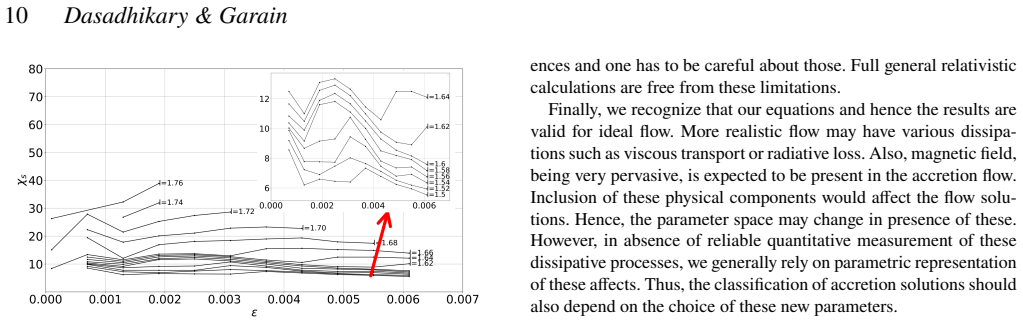
Numerical simulations show shocks form in sub-Keplerian accretion flows around non-rotating black holes over a much wider range of energy and angular momentum than analytic models predict.
A machine-rendered reading of the paper's core claim, the machinery that carries it, and where it could break.
Core claim
In non-dissipative transonic sub-Keplerian accretion flows onto non-rotating black holes, the parameter space allowing shock formation is identified through multi-dimensional numerical simulations and shown to be much larger than the one obtained from analytic calculations. The post-shock boundary layer is dynamic over a significant fraction of this space and leads to self-consistent production of outflows from the accretion disk.
What carries the argument
The two-dimensional grid in specific energy and specific angular momentum explored by hydrodynamical simulations to locate where shocks form and persist.
If this is right
- Shocks and their associated boundary layers exist across a broader set of accretion flows than previously calculated.
- The dynamic boundary layer shapes the radiative output of the disk over an expanded portion of parameter space.
- Outflows emerge naturally from the disk in a large fraction of the simulated flows.
- The accretion flow exhibits time-dependent behavior that is absent from steady analytic solutions.
Where Pith is reading between the lines
- Multi-dimensional effects appear to allow shocks in regimes where one-dimensional theory forbids them.
- Time variability in the boundary layer may produce observable fluctuations in emission from black hole systems.
- Adding dissipation or magnetic fields in later simulations could shift the boundaries of the shock region still further.
Load-bearing premise
The analytic calculation supplies the correct baseline parameter space, so any enlargement found in the simulations must reflect previously missed physical effects rather than differences in assumptions or numerics.
What would settle it
A set of one-dimensional simulations performed with identical energy and angular momentum values and the same boundary conditions that recover exactly the same narrow shock region reported by analytic theory.
Figures

read the original abstract
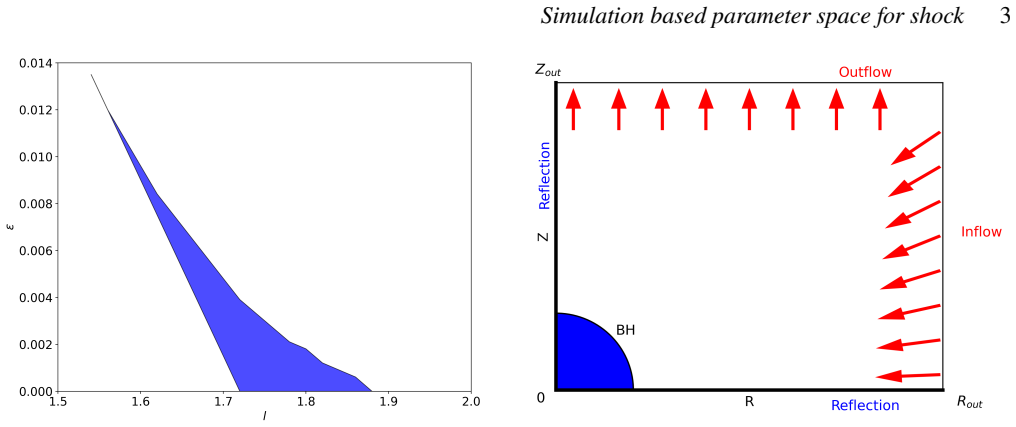
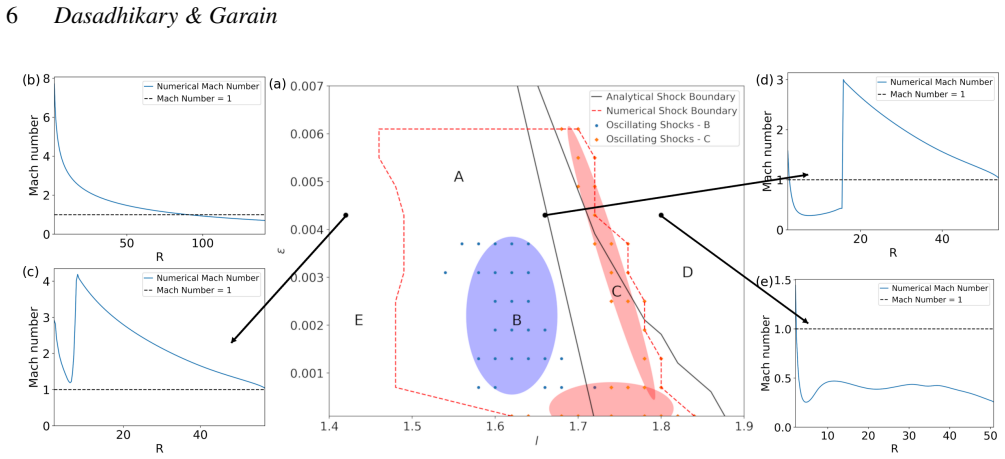
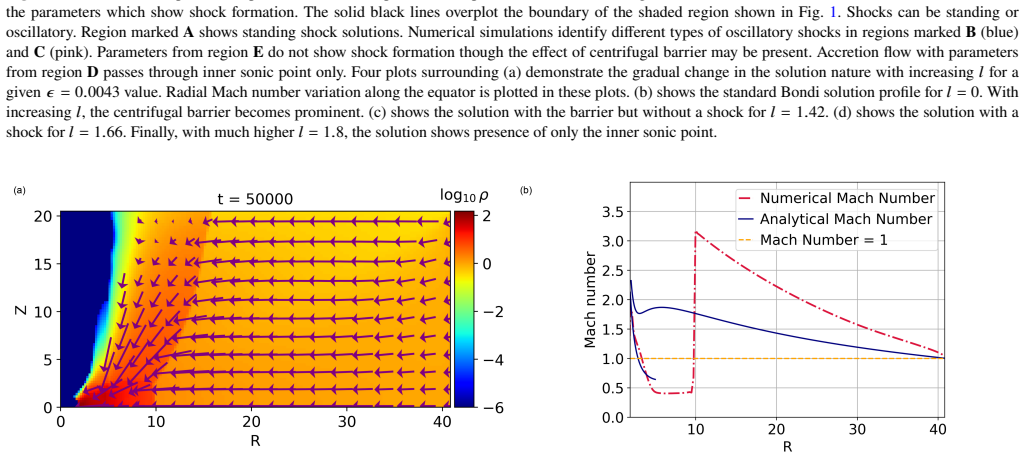
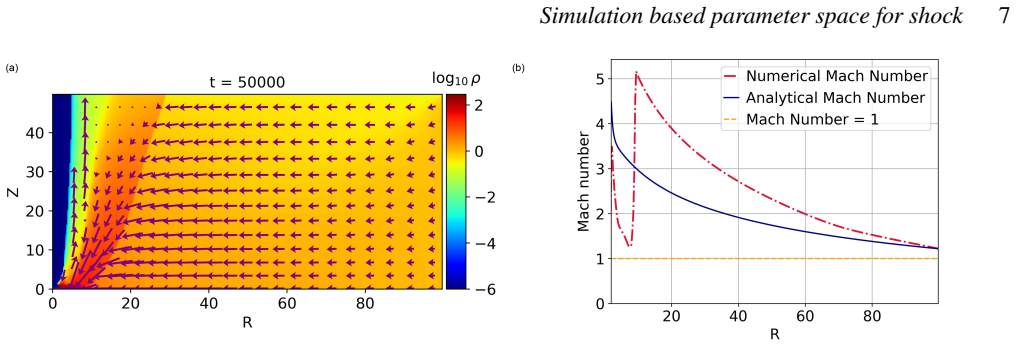
Non-dissipative, transonic, sub-Keplerian accretion flow onto black holes is characterized by two conserved parameters: specific energy and specific angular momentum of the flow. For certain range of these parameters, the accretion flow shows shock formation and the post-shock matter forms a boundary layer which is believed to shape the radiative properties of the accretion disk. In this work, we identify the parameter space for shock in such accretion flows using multi-dimensional numerical simulations around non-rotating black holes and demonstrate that the shock formation parameter space is much larger than the analytically calculated one. We also find the boundary layer to be dynamic for a significant part of this parameter space and self-consistently produce outflow from the accretion disk.
Editorial analysis
A structured set of objections, weighed in public.
Referee Report
Summary. The manuscript uses multi-dimensional numerical simulations to map the parameter space of specific energy and specific angular momentum for which shocks form in non-dissipative, transonic, sub-Keplerian accretion onto non-rotating black holes. It reports that this shock-forming region is substantially larger than the domain obtained from 1D steady analytic solutions, that the post-shock boundary layer is dynamic over much of the enlarged domain, and that outflows are generated self-consistently.
Significance. If the numerical results survive validation against the analytic baseline, the work would indicate that time-dependent and multi-dimensional effects permit shocks under a wider range of conserved parameters than steady 1D theory allows, with implications for the radiative properties of the post-shock layer and the origin of disk outflows.
major comments (2)
- [Methods / Simulation Setup] The central claim—that simulations reveal a larger shock parameter space than the analytic calculation—requires an explicit demonstration that the numerical scheme recovers the known analytic shock solutions (locations, compression ratios, and existence boundaries) in the overlapping regime before attributing any mismatch to new physics. No such benchmark, grid-resolution study, or convergence test is described.
- [Results / Parameter-space comparison] Because the analytic model assumes strict conservation of specific energy and angular momentum with no dissipation, any effective numerical viscosity, differing outer-boundary treatment, or dimensionality-induced transport in the simulations must be quantified and shown not to shift the shock boundary; otherwise the reported expansion cannot be interpreted as a physical result.
Simulated Author's Rebuttal
We thank the referee for their constructive comments on our manuscript. We agree that explicit validation against analytic solutions and quantification of numerical effects are necessary to support the central claims. We address each point below and will revise the manuscript accordingly.
read point-by-point responses
-
Referee: [Methods / Simulation Setup] The central claim—that simulations reveal a larger shock parameter space than the analytic calculation—requires an explicit demonstration that the numerical scheme recovers the known analytic shock solutions (locations, compression ratios, and existence boundaries) in the overlapping regime before attributing any mismatch to new physics. No such benchmark, grid-resolution study, or convergence test is described.
Authors: We acknowledge that the manuscript does not present these benchmarks. In the revised version we will add a dedicated subsection demonstrating that the numerical scheme recovers analytic shock locations, compression ratios, and existence boundaries in the overlapping regime. Grid-resolution studies and convergence tests will also be included to establish numerical reliability before discussing the enlarged parameter space. revision: yes
-
Referee: [Results / Parameter-space comparison] Because the analytic model assumes strict conservation of specific energy and angular momentum with no dissipation, any effective numerical viscosity, differing outer-boundary treatment, or dimensionality-induced transport in the simulations must be quantified and shown not to shift the shock boundary; otherwise the reported expansion cannot be interpreted as a physical result.
Authors: We agree this quantification is required. The revised manuscript will report conservation errors for specific energy and angular momentum, describe the outer-boundary implementation, and include tests varying boundary conditions. We will also analyze multi-dimensional transport and demonstrate that it does not artificially enlarge the shock domain in the reported runs; any residual numerical influence will be stated explicitly as a limitation. revision: yes
Circularity Check
No circularity: simulations benchmarked against independent analytic baseline
full rationale
The paper performs multi-dimensional time-dependent simulations of transonic sub-Keplerian accretion and compares the resulting shock parameter space to an analytic calculation based on 1D steady conserved-energy/angular-momentum solutions. The analytic result is treated as an external reference rather than derived from or fitted to the simulations; the claim is simply that the simulated domain is larger. No self-definitional steps, fitted inputs renamed as predictions, or load-bearing self-citations appear in the derivation chain. The comparison is therefore self-contained against an external benchmark and receives the default non-circularity finding.
Axiom & Free-Parameter Ledger
axioms (2)
- domain assumption The accretion flow is non-dissipative, transonic, and sub-Keplerian.
- domain assumption Specific energy and specific angular momentum are the only two conserved parameters that determine shock formation.
Reference graph
Works this paper leans on
-
[1]
Black Holes (Les Astres Occlus) , Date-Added =
-
[2]
doi:10.1051/0004-6361:20010797 , Eprint =
, Keywords =. doi:10.1051/0004-6361:20010797 , Eprint =
-
[3]
Astronomical Data Analysis Software and Systems V , Date-Modified =
-
[4]
doi:10.1086/170270 , Journal =
-
[5]
doi:10.1086/303604 , Journal =
-
[6]
The 2004 outburst of BHC H1743-322: analysis of spectral and timing properties using the TCAF solution. , keywords =. doi:10.1093/mnras/stw3117 , adsurl =
-
[7]
doi:10.1086/175831 , Journal =
-
[8]
doi:10.1016/0370-1573(95)00057-7 , Eprint =
, Keywords =. doi:10.1016/0370-1573(95)00057-7 , Eprint =
-
[9]
doi:10.1051/0004-6361:20034523 , Eprint =
, Keywords =. doi:10.1051/0004-6361:20034523 , Eprint =
-
[10]
, Keywords =. doi:10.1086/176610 , Eprint =
-
[11]
, Keywords =. doi:10.1086/304325 , Eprint =
-
[12]
, Keywords =. doi:10.1086/177965 , Eprint =
-
[13]
doi:10.1093/mnras/283.1.325 , Eprint =
, Month = nov, Pages =. doi:10.1093/mnras/283.1.325 , Eprint =
-
[14]
, Keywords =. doi:10.1086/177354 , Eprint =
-
[15]
Edited by CHAKRABARTI SANDIP K
Theory of Transonic Astrophysical Flows. Edited by CHAKRABARTI SANDIP K. Published by World Scientific Publishing Co. Pte. Ltd., ISBN \#9789814439220 , Date-Modified =. doi:10.1142/1091 , Keywords =
-
[16]
doi:10.1086/168125 , Journal =
-
[17]
2001, MNRAS, 322, 231, doi: 10.1046/j.1365-8711.2001.04022.x
, Keywords =. doi:10.1046/j.1365-8711.2001.04758.x , Eprint =
-
[18]
doi:10.1093/mnras/272.1.80 , Journal =
-
[20]
doi:10.1093/mnras/stv1566 , Eprint =
, Keywords =. doi:10.1093/mnras/stv1566 , Eprint =
-
[21]
Accretion Flow Properties of MAXI J1543-564 During 2011 Outburst from TCAF Solution
doi:10.3847/0004-637X/827/1/88 , Eid =. arXiv , Author =:1605.06960 , Journal =
work page internal anchor Pith review Pith/arXiv arXiv doi:10.3847/0004-637x/827/1/88
-
[22]
doi:10.1093/mnras/stu864 , Eprint =
, Keywords =. doi:10.1093/mnras/stu864 , Eprint =
-
[23]
doi:10.1093/mnrasl/slu024 , Eprint =
, Keywords =. doi:10.1093/mnrasl/slu024 , Eprint =
-
[24]
doi:10.1088/0004-637X/803/2/59 , Eid =. arXiv , Author =:1504.05312 , Journal =
work page internal anchor Pith review Pith/arXiv arXiv doi:10.1088/0004-637x/803/2/59
-
[25]
doi:10.1093/mnras/stu2588 , Eprint =
, Keywords =. doi:10.1093/mnras/stu2588 , Eprint =
-
[26]
, archivePrefix = "arXiv", eprint =
Accretion Flow Properties of Swift J1753.5-0127 during Its 2005 Outburst. , archivePrefix = "arXiv", eprint =. doi:10.3847/1538-4357/aa9077 , adsurl =
-
[28]
doi:10.1088/0004-637X/758/2/114 , Eid =. arXiv , Author =:1210.3515 , Journal =
work page internal anchor Pith review Pith/arXiv arXiv doi:10.1088/0004-637x/758/2/114
-
[29]
doi:10.1093/mnras/stt087 , Eprint =
, Keywords =. doi:10.1093/mnras/stt087 , Eprint =
-
[30]
, Keywords =. doi:10.1111/j.1365-2966.2011.20343.x , Eprint =
-
[31]
, Keywords =. doi:10.1111/j.1365-2966.2009.16147.x , Eprint =
-
[32]
doi:10.1093/mnras/stv223 , Eprint =
, Keywords =. doi:10.1093/mnras/stv223 , Eprint =
-
[33]
doi:10.1051/0004-6361:20031080 , Eprint =
, Keywords =. doi:10.1051/0004-6361:20031080 , Eprint =
-
[34]
, Keywords =. doi:10.1111/j.1365-2966.2005.09750.x , Eprint =
-
[35]
doi:10.1086/172021 , Journal =
-
[36]
doi:10.1086/177356 , Journal =
-
[37]
doi:10.1086/175311 , Journal =
-
[38]
Accretion flow dynamics of MAXI J1836-194 during its 2011 outburst from TCAF solution
doi:10.3847/0004-637X/819/2/107 , Eid =. arXiv , Author =:1601.02080 , Journal =
work page internal anchor Pith review Pith/arXiv arXiv doi:10.3847/0004-637x/819/2/107
-
[39]
, Keywords =. doi:10.1111/j.1365-2966.2012.21203.x , Eprint =
-
[40]
, Keywords =. doi:10.1111/j.1365-2966.2007.11556.x , Eprint =
-
[41]
doi:10.1051/0004-6361:20077958 , Journal =
-
[42]
, Keywords =. doi:10.1046/j.1365-8711.1998.01816.x , Eprint =
-
[43]
Simulations of Viscous Accretion Flow around Black Holes in Two-Dimensional Cylindrical Geometry
doi:10.3847/0004-637X/831/1/33 , Eid =. arXiv , Author =:1608.03997 , Journal =
work page internal anchor Pith review Pith/arXiv arXiv doi:10.3847/0004-637x/831/1/33
-
[44]
Quasi-Spherical, Time-Dependent Viscous Accretion Flow: One-Dimensional Results
doi:10.1088/0004-637X/728/2/142 , Eid =. arXiv , Author =:1012.4548 , Journal =
work page internal anchor Pith review Pith/arXiv arXiv doi:10.1088/0004-637x/728/2/142
-
[45]
, Keywords =. doi:10.1086/173972 , Eprint =
-
[46]
, Keywords =. doi:10.1086/177877 , Eprint =
-
[47]
, Keywords =. doi:10.1086/176775 , Eprint =
-
[48]
, Keywords =. doi:10.1086/307079 , Eprint =
-
[49]
doi:10.1088/0004-637X/786/1/4 , Eid =. arXiv , Author =:1401.4239 , Journal =
work page internal anchor Pith review Pith/arXiv arXiv doi:10.1088/0004-637x/786/1/4
-
[50]
doi:10.1093/mnras/270.4.871 , Journal =
-
[51]
doi:10.1093/mnras/259.2.259 , Journal =
-
[52]
New York, Wiley-Interscience, 1979
Radiative processes in astrophysics. New York, Wiley-Interscience, 1979. 393 p. , year = 1979, adsurl =
1979
-
[53]
doi:10.1103/PhysRevD.67.024033 , Eid =. gr-qc/0301103 , Journal =
work page internal anchor Pith review Pith/arXiv arXiv doi:10.1103/physrevd.67.024033
-
[54]
doi:10.1016/0021-9991(88)90177-5 , Journal =
-
[55]
doi:10.1016/0021-9991(77)90095-X , Journal =
-
[56]
Lax and Bram van Leer , title =
Amiram Harten and Peter D. Lax and Bram van Leer , title =. SIAM Review , year =. doi:10.1137/1025002 , eprint =
-
[58]
General Relativity and Gravitation , eprint =
Republication of: The dynamics of general relativity. General Relativity and Gravitation , eprint =. doi:10.1007/s10714-008-0661-1 , adsurl =
-
[59]
Journal of Mathematical Physics , year = 1967, month = feb, volume = 8, pages =
Maximal Analytic Extension of the Kerr Metric. Journal of Mathematical Physics , year = 1967, month = feb, volume = 8, pages =. doi:10.1063/1.1705193 , adsurl =
-
[60]
Accretion Power in Astrophysics, by Juhan Frank and Andrew King and Derek Raine, pp
Accretion Power in Astrophysics: Third Edition. Accretion Power in Astrophysics, by Juhan Frank and Andrew King and Derek Raine, pp. 398. ISBN 0521620538. Cambridge, UK: Cambridge University Press, February 2002. , year = 2002, month = jan, pages =
2002
-
[61]
The natural angular momentum distribution in the study of thick disks around black holes. , keywords =. doi:10.1086/162755 , adsurl =
-
[62]
X-Ray Properties of Black-Hole Binaries. , eprint =. doi:10.1146/annurev.astro.44.051905.092532 , adsurl =
work page internal anchor Pith review Pith/arXiv arXiv doi:10.1146/annurev.astro.44.051905.092532
-
[63]
, archivePrefix = "arXiv", eprint =
Black Hole Spin via Continuum Fitting and the Role of Spin in Powering Transient Jets. , archivePrefix = "arXiv", eprint =. doi:10.1007/s11214-013-0003-9 , adsurl =
-
[64]
Accretion of Matter by Condensed Objects. , year = 1972, month = jan, volume = 15, pages =. doi:10.1007/BF00649949 , adsurl =
-
[65]
1982", month =
Jets from a geometrically thick disk. , year = "1982", month = "Jan", volume =
1982
-
[66]
, keywords =
Transonic disk accretion revisited. , keywords =
-
[67]
Studying Shocks in Model Astrophysical Flows. , keywords =. 1989. doi:10.1086/185385 , adsurl =
-
[68]
High-order conservative reconstruction schemes for finite volume methods in cylindrical and spherical coordinates. Journal of Computational Physics , keywords =. doi:10.1016/j.jcp.2014.04.001 , archivePrefix =. 1404.0537 , primaryClass =
work page internal anchor Pith review Pith/arXiv arXiv doi:10.1016/j.jcp.2014.04.001 2014
-
[69]
Living Reviews in Relativity , keywords =
Numerical Hydrodynamics and Magnetohydrodynamics in General Relativity. Living Reviews in Relativity , keywords =. doi:10.12942/lrr-2008-7 , adsurl =
-
[70]
A subluminal relativistic magnetohydrodynamics scheme with ADER-WENO predictor and multidimensional Riemann solver-based corrector. Journal of Computational Physics , keywords =. doi:10.1016/j.jcp.2016.02.001 , archivePrefix =. 1602.00633 , primaryClass =
work page internal anchor Pith review Pith/arXiv arXiv doi:10.1016/j.jcp.2016.02.001 2016
-
[71]
An HLLC Riemann solver for relativistic flows - I. Hydrodynamics. , keywords =. doi:10.1111/j.1365-2966.2005.09546.x , archivePrefix =. astro-ph/0506414 , primaryClass =
-
[72]
An efficient shock-capturing central-type scheme for multidimensional relativistic flows. I. Hydrodynamics. , keywords =. doi:10.1051/0004-6361:20020776 , archivePrefix =. astro-ph/0205290 , primaryClass =
work page internal anchor Pith review Pith/arXiv arXiv doi:10.1051/0004-6361:20020776
-
[73]
The runaway instability of thick discs around black holes - I. The constant angular momentum case. , keywords =. doi:10.1046/j.1365-8711.2002.05515.x , archivePrefix =. astro-ph/0203403 , primaryClass =
-
[74]
, year = 1952, month = jan, volume =
On spherically symmetrical accretion. , year = 1952, month = jan, volume =. doi:10.1093/mnras/112.2.195 , adsurl =
-
[75]
The Event Horizon General Relativistic Magnetohydrodynamic Code Comparison Project. , keywords =. doi:10.3847/1538-4365/ab29fd , archivePrefix =. 1904.04923 , primaryClass =
-
[76]
Zero Energy Rotating Accretion Flows near a Black Hole
Zero-Energy Rotating Accretion Flows near a Black Hole. , keywords =. 1997. doi:10.1086/303461 , archivePrefix =. astro-ph/9607051 , primaryClass =
work page internal anchor Pith review Pith/arXiv arXiv doi:10.1086/303461 1997
-
[77]
Three-dimensional simulations of advective, sub-Keplerian accretion flow on to non-rotating black holes. , keywords =. doi:10.1093/mnras/stac3736 , archivePrefix =. 2212.08310 , primaryClass =
-
[78]
Shocks in the relativistic transonic accretion with low angular momentum
Shocks in the relativistic transonic accretion with low angular momentum. , keywords =. doi:10.1093/mnras/stx2254 , archivePrefix =. 1709.01824 , primaryClass =
work page internal anchor Pith review Pith/arXiv arXiv doi:10.1093/mnras/stx2254
-
[79]
General relativistic numerical simulation of sub-Keplerian transonic accretion flows on to black holes: Schwarzschild space-time. , keywords =. doi:10.1093/mnras/stx1986 , archivePrefix =. 1707.09856 , primaryClass =
work page internal anchor Pith review Pith/arXiv arXiv doi:10.1093/mnras/stx1986
-
[80]
General relativistic numerical simulation of sub-Keplerian transonic accretion flows on to rotating black holes: Kerr space-time. , keywords =. doi:10.1093/mnras/sty2953 , archivePrefix =. 1810.12469 , primaryClass =
work page internal anchor Pith review Pith/arXiv arXiv doi:10.1093/mnras/sty2953
-
[81]
Temporal Properties of Cygnus X-1 During the Spectral Transitions
Temporal Properties of Cygnus X-1 during the Spectral Transitions. , keywords =. doi:10.1086/304341 , archivePrefix =. astro-ph/9702073 , primaryClass =
work page internal anchor Pith review Pith/arXiv arXiv doi:10.1086/304341
-
[82]
Correlation among QPO frequencies and Quiescence-state Duration in Black Hole Candidate GRS 1915+105
Correlation among Quasi-Periodic Oscillation Frequencies and Quiescent-State Duration in Black Hole Candidate GRS 1915+105. , keywords =. doi:10.1086/312512 , archivePrefix =. astro-ph/9910012 , primaryClass =
work page internal anchor Pith review Pith/arXiv arXiv doi:10.1086/312512 1915
-
[83]
SWIFT view of the 2015 outburst of GS 2023+338 (V404 Cyg): complex evolution of spectral and temporal characteristics. , keywords =. doi:10.1093/mnras/stw1755 , archivePrefix =. 1601.03234 , primaryClass =
work page internal anchor Pith review Pith/arXiv arXiv doi:10.1093/mnras/stw1755 2015
discussion (0)
Sign in with ORCID, Apple, or X to comment. Anyone can read and Pith papers without signing in.