Constraining AGN accretion physics with black hole mass-luminosity scaling relations
Pith reviewed 2026-06-28 09:05 UTC · model grok-4.3
The pith
Black hole mass-luminosity scaling relations favor chaotic cold accretion over Bondi accretion across a wide mass range.
A machine-rendered reading of the paper's core claim, the machinery that carries it, and where it could break.
Core claim
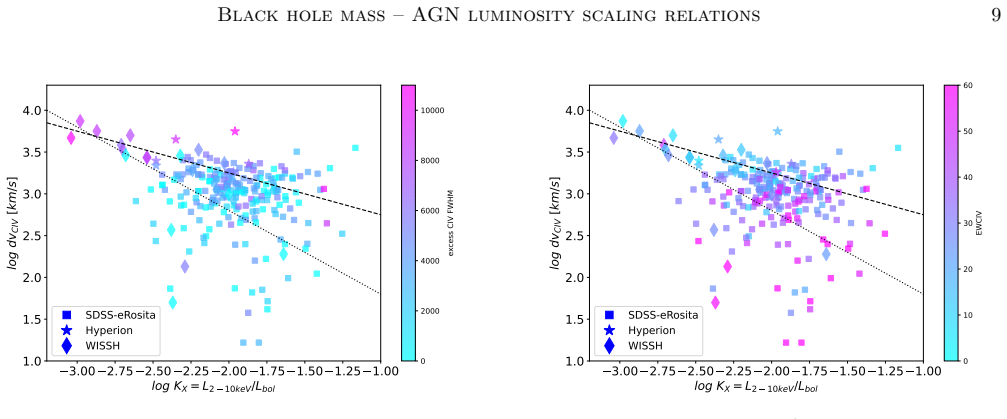
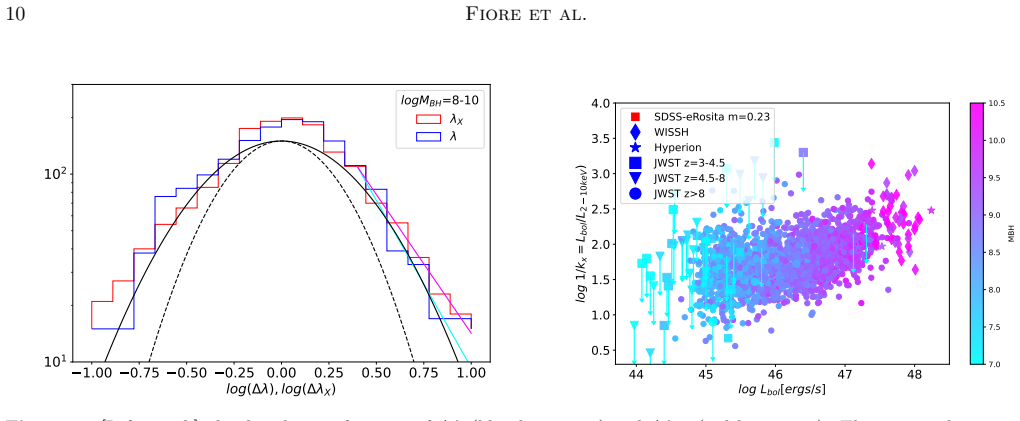
By comparing the observed black hole mass-bolometric luminosity relation (slope of 0.91) and the hard X-ray relation (slope of 0.73) from a sample of 1729 quasars to model predictions, the paper shows that chaotic cold accretion reproduces the data while Bondi accretion underpredicts the luminosities by two dex at high masses. This leads to the conclusion that CCA-driven, self-regulated feeding is the dominant mechanism across black hole masses from 10^7 to 10^10 solar masses.
What carries the argument
The black hole mass-luminosity scaling relations derived from virial estimates and band corrections in the quasar sample, used to discriminate between Bondi spherical capture and Chaotic Cold Accretion feeding models.
If this is right
- The X-ray slope being shallower than the bolometric one implies a decreasing coronal power fraction with black hole mass.
- X-ray weakness in some high-redshift AGN is consistent with shielding or anisotropy at high accretion rates.
- Star formation contributions can cause overestimates in Halpha-based luminosity and mass estimates for JWST AGN.
- The preference for CCA motivates similar tests at lower masses and higher redshifts.
Where Pith is reading between the lines
- This suggests that the thermodynamics of the host halo gas directly influences black hole growth rates through condensation processes.
- It provides a link between AGN feeding and the observed multiphase interstellar and circumgalactic medium in galaxies.
- Extending the relations to lower luminosity AGN could test if the same mechanism operates in less massive systems.
Load-bearing premise
The virial black hole mass estimates and bolometric luminosity corrections from observed bands accurately trace the true instantaneous accretion rates without significant contamination from star formation or selection biases.
What would settle it
A measurement of the mass-luminosity slope in a large AGN sample that closely matches the Bondi prediction of a much steeper or different relation, or direct evidence of accretion rates two orders of magnitude lower than observed at high black hole masses.
Figures


read the original abstract
We test how supermassive black holes are fed by combining new black hole mass-luminosity relations with physically motivated feeding models. We build a uniform sample of 1729 unobscured blue quasars at z>2 by cross-matching SDSS DRE16 with eROSITA, and augment it with hyperluminous quasars (WISSH, HYPERION) plus 49 JWST broad-line AGN at z>3.5. We find for the SDSS-eROSITA sample of blue quasars a near-linear scaling of bolometric luminosity with mass (slope 0.91+/-0.01) and a shallower hard-X-ray trend (slope 0.73+/-0.01). Classical hot-mode (Bondi) accretion underpredicts the observed luminosities by about 2 dex at the high-mass end and is inconsistent with the measured slopes. In contrast, Chaotic Cold Accretion (CCA) - in which multiphase gas condenses, collides, and rains onto the nucleus - consistently reproduces both the normalization and the near-linear slope expected from halo thermodynamics. The shallower X-ray relation points to a decreasing coronal power fraction with black hole mass. JWST broad-line AGN frequently appear X-ray weak or Halpha enhanced. The latter case can be due to contributions from collisional ionization and photoionization from star-formation to the broad Halpha emission, leading to overestimate AGN luminosities and black hole masses. In the former case, the X-ray weakness is consistent with coronal shielding or anisotropy at high accretion rates. Overall, the data favor CCA-driven, self-regulated feeding over local spherical capture across the BH mass range 1E7-1E10 solar masses, and motivate extending these tests to lower masses and higher redshifts.
Editorial analysis
A structured set of objections, weighed in public.
Referee Report
Summary. The paper constructs a sample of 1729 unobscured blue quasars at z>2 from SDSS DRE16 cross-matched with eROSITA, augmented by WISSH/HYPERION hyperluminous quasars and 49 JWST broad-line AGN at z>3.5. It reports a near-linear bolometric luminosity-black hole mass relation (slope 0.91±0.01) for the SDSS-eROSITA subsample and a shallower hard X-ray trend (slope 0.73±0.01). Classical Bondi accretion is shown to underpredict observed luminosities by ~2 dex at the high-mass end and to be inconsistent with the measured slopes, while Chaotic Cold Accretion (CCA) reproduces both the normalization and near-linear slope from halo thermodynamics. The shallower X-ray slope is interpreted as a decreasing coronal power fraction with mass. Potential biases from Hα enhancement or X-ray weakness in JWST objects are noted, but the data are concluded to favor CCA-driven self-regulated feeding over local spherical capture for BH masses 10^7-10^10 M_⊙.
Significance. If the measured relation accurately encodes instantaneous accretion physics, the result supplies an empirical discriminator between feeding models across a wide mass range, with direct implications for models of black hole growth and galaxy co-evolution. The large sample size and uniform selection provide statistical leverage, and the explicit comparison to halo-thermodynamic predictions from CCA offers a falsifiable link between observed scalings and theoretical expectations.
major comments (2)
- [Abstract] Abstract: The central claim that the data favor CCA over Bondi rests on the observed slope (0.91) and 2-dex normalization offset. The text flags that Hα enhancement in JWST objects can lead to overestimates of AGN luminosities and black hole masses; a quantitative assessment of how a ~0.2 shift in slope or >0.5 dex shift in normalization would affect the model discrimination is required, as this directly impacts whether the mismatch with Bondi remains decisive.
- [Abstract] Abstract (sample construction): Virial BH mass estimates from broad lines and bolometric corrections (including hard X-ray) are assumed to trace instantaneous accretion rates without major contamination from star formation or selection effects. Given the noted X-ray weakness and Hα enhancement at z>3.5, the manuscript should demonstrate that these systematics do not flatten or steepen the relation enough to erase the distinction from Bondi predictions.
minor comments (1)
- [Abstract] Abstract: Clarify whether the 49 JWST AGN are folded into the reported slope fits or treated only as a separate discussion; the current wording leaves ambiguous how they influence the overall SDSS-eROSITA relation.
Simulated Author's Rebuttal
We thank the referee for the constructive report and the recommendation of major revision. We address the two major comments below, agreeing that additional quantitative robustness checks are warranted to strengthen the model discrimination claims.
read point-by-point responses
-
Referee: [Abstract] Abstract: The central claim that the data favor CCA over Bondi rests on the observed slope (0.91) and 2-dex normalization offset. The text flags that Hα enhancement in JWST objects can lead to overestimates of AGN luminosities and black hole masses; a quantitative assessment of how a ~0.2 shift in slope or >0.5 dex shift in normalization would affect the model discrimination is required, as this directly impacts whether the mismatch with Bondi remains decisive.
Authors: We agree that a quantitative sensitivity analysis is needed to confirm the robustness of the CCA vs. Bondi distinction. In the revised manuscript we will add a dedicated subsection (and associated figure) performing Monte Carlo perturbations: we will shift the JWST subsample luminosities and masses by up to 0.5 dex and the overall slope by ±0.2, then re-fit the relations and re-compare to the Bondi and CCA model tracks. Preliminary internal checks indicate the ~2 dex normalization offset and near-linear slope remain inconsistent with Bondi even after these shifts, but the explicit test will be included. revision: yes
-
Referee: [Abstract] Abstract (sample construction): Virial BH mass estimates from broad lines and bolometric corrections (including hard X-ray) are assumed to trace instantaneous accretion rates without major contamination from star formation or selection effects. Given the noted X-ray weakness and Hα enhancement at z>3.5, the manuscript should demonstrate that these systematics do not flatten or steepen the relation enough to erase the distinction from Bondi predictions.
Authors: We acknowledge that the current text notes the potential biases but does not quantify their effect on the slope and offset relative to the accretion models. In revision we will add an appendix with two tests: (1) a jackknife analysis excluding the 49 JWST objects entirely, and (2) a perturbed-sample analysis in which we apply plausible Hα contamination fractions (10-30%) and X-ray weakness corrections drawn from the literature. These will show whether the observed slope remains inconsistent with Bondi predictions. We note that the primary SDSS-eROSITA sample (1729 objects) already drives the reported slope and offset; the JWST objects mainly extend the high-mass end. revision: yes
Circularity Check
Minor self-citation for CCA framework but central derivation uses independent new data and standard Bondi comparison
full rationale
The paper measures a new L_bol-M_BH relation (slope 0.91) from a fresh SDSS-eROSITA + JWST sample of 1729+ quasars and compares it to two external feeding models. Bondi is the classical spherical capture formula; CCA is a multiphase condensation model whose near-linear slope is stated to follow from halo thermodynamics. While CCA is associated with co-author Gaspari, the load-bearing step is the direct mismatch (2 dex underprediction by Bondi) and match to the thermodynamic expectation, which does not reduce to a fitted parameter or self-defined input from the present dataset. No equation or prediction is shown to equal its own inputs by construction, and the observational relation itself is independently derived from virial masses and bolometric corrections. This yields only minor self-citation without circular reduction of the central claim.
Axiom & Free-Parameter Ledger
free parameters (1)
- L_bol-M_BH slope
axioms (2)
- domain assumption Virial black hole mass estimates from broad emission lines are unbiased
- domain assumption Standard bolometric corrections convert observed fluxes to total accretion luminosity
Reference graph
Works this paper leans on
-
[1]
A catalog of rich clusters of galaxies. , keywords =. doi:10.1086/191333 , adsurl =
-
[2]
Fundamental differences between SPH and grid methods. , eprint =. doi:10.1111/j.1365-2966.2007.12183.x , adsurl =
-
[3]
The distribution of AGN accretion rates as a function of stellar mass and redshift
X-rays across the galaxy population - II. The distribution of AGN accretion rates as a function of stellar mass and redshift. , archivePrefix = "arXiv", eprint =. doi:10.1093/mnras/stx2700 , adsurl =
-
[4]
Linear Regression for Astronomical Data with Measurement Errors and Intrinsic Scatter. , eprint =. doi:10.1086/177901 , adsurl =
-
[5]
CARMA CO imaging survey of early-type galaxies
The ATLAS ^ 3D project - XVIII. CARMA CO imaging survey of early-type galaxies. , archivePrefix = "arXiv", eprint =. doi:10.1093/mnras/sts299 , adsurl =
-
[6]
Galactic Cluster Cooling Flows , year = 1997, series =
X-Ray Observations of cooling Flow Clusters. Galactic Cluster Cooling Flows , year = 1997, series =
1997
-
[7]
The X-ray virial relations for relaxed lensing clusters observed with Chandra. , eprint =. doi:10.1046/j.1365-8711.2001.05079.x , adsurl =
-
[8]
doi:10.1111/j.1365-2966.2006.11277.x , eprint =
The relation between accretion rate and jet power in X-ray luminous elliptical galaxies. , eprint =. doi:10.1111/j.1365-2966.2006.10778.x , adsurl =
-
[9]
, archivePrefix = "arXiv", eprint =
Discovery of H I gas in a young radio galaxy at z = 0.44 using the Australian Square Kilometre Array Pathfinder. , archivePrefix = "arXiv", eprint =. doi:10.1093/mnras/stv1532 , adsurl =
-
[10]
, archivePrefix = "arXiv", eprint =
Detection of a Hot Gaseous Halo around the Giant Spiral Galaxy NGC 1961. , archivePrefix = "arXiv", eprint =. doi:10.1088/0004-637X/737/1/22 , adsurl =
-
[11]
, archivePrefix = "arXiv", eprint =
Extended Hot Halos around Isolated Galaxies Observed in the ROSAT All-Sky Survey. , archivePrefix = "arXiv", eprint =. doi:10.1088/0004-637X/762/2/106 , adsurl =
-
[12]
, archivePrefix = "arXiv", eprint =
Unifying X-ray scaling relations from galaxies to clusters. , archivePrefix = "arXiv", eprint =. doi:10.1093/mnras/stv437 , adsurl =
-
[13]
, archivePrefix = "arXiv", eprint =
A deep XMM-Newton study of the hot gaseous halo around NGC 1961. , archivePrefix = "arXiv", eprint =. doi:10.1093/mnras/stv2314 , adsurl =
-
[14]
Monthly Notices of the Royal Astronomical Society , author =
A Mexican hat with holes: calculating low-resolution power spectra from data with gaps. , archivePrefix = "arXiv", eprint =. doi:10.1111/j.1365-2966.2012.21789.x , adsurl =
-
[15]
Density power spectrum in the local interstellar medium. , keywords =. doi:10.1038/291561a0 , adsurl =
-
[16]
Electron density power spectrum in the local interstellar medium. , keywords =. doi:10.1086/175515 , adsurl =
-
[17]
, archivePrefix = "arXiv", eprint =
The universal galaxy cluster pressure profile from a representative sample of nearby systems (REXCESS) and the Y _ SZ - M _ 500 relation. , archivePrefix = "arXiv", eprint =. doi:10.1051/0004-6361/200913416 , adsurl =
-
[18]
ArXiv e-prints , archivePrefix = "arXiv", eprint =
Chandra Observations of Early-type Galaxies. ArXiv e-prints , archivePrefix = "arXiv", eprint =
-
[19]
Plasma Physics and Controlled Fusion , year = 2004, month = nov, volume = 46, pages =
Book Review:. Plasma Physics and Controlled Fusion , year = 2004, month = nov, volume = 46, pages =. doi:10.1088/0741-3335/46/11/183910 , adsurl =
-
[20]
, archivePrefix = "arXiv", eprint =
X-Ray Scaling Relations of Early-type Galaxies. , archivePrefix = "arXiv", eprint =. doi:10.3847/1538-4357/aab3c9 , adsurl =
-
[21]
Chandra X-Ray Spectroscopic Imaging of Sagittarius A* and the Central Parsec of the Galaxy. , eprint =. doi:10.1086/375145 , adsurl =
-
[22]
Five properties where groups differ from clusters
Intracluster medium cooling, AGN feedback, and brightest cluster galaxy properties of galaxy groups. Five properties where groups differ from clusters. , archivePrefix = "arXiv", eprint =. doi:10.1051/0004-6361/201322684 , adsurl =
-
[23]
The photoelectric heating mechanism for very small graphitic grains and polycyclic aromatic hydrocarbons. , keywords =. doi:10.1086/174188 , adsurl =
-
[24]
III - Suprathermal evaporation
The evaporation of spherical clouds in a hot gas. III - Suprathermal evaporation. , keywords =. doi:10.1086/159581 , adsurl =
-
[25]
Magnetized thermal conduction fronts. , keywords =. doi:10.1086/164216 , adsurl =
-
[26]
On thermal instability and hydrostatic equilibrium in cooling flows. , keywords =. doi:10.1086/166301 , adsurl =
-
[27]
Theory of local thermal instability in spherical systems. , keywords =. doi:10.1086/167521 , adsurl =
-
[28]
Resonant excitation of internal gravity waves in cluster cooling flows. , keywords =. doi:10.1086/168926 , adsurl =
-
[29]
Instability, turbulence, and enhanced transport in accretion disks. Rev. of Modern Physics , keywords =. doi:10.1103/RevModPhys.70.1 , adsurl =
-
[30]
On the Dynamical Foundations of Disks. , eprint =. doi:10.1086/307594 , adsurl =
-
[31]
Stability, Instability, and ``Backward'' Transport in Stratified Fluids. , eprint =. doi:10.1086/308732 , adsurl =
-
[32]
Enhanced Angular Momentum Transport in Accretion Disks. , eprint =. doi:10.1146/annurev.astro.41.081401.155207 , adsurl =
-
[33]
, archivePrefix = "arXiv", eprint =
The Unusual X-Ray Morphology of NGC 4636 Revealed by Deep Chandra Observations: Cavities and Shocks Created by Past Active Galactic Nucleus Outbursts. , archivePrefix = "arXiv", eprint =. doi:10.1088/0004-637X/707/2/1034 , adsurl =
-
[34]
An analytic investigation of the scatter in the integrated X-ray properties of galaxy groups and clusters. , eprint =. doi:10.1111/j.1365-2966.2005.09917.x , adsurl =
-
[35]
, archivePrefix = "arXiv", eprint =
Turbulence and cooling in galaxy cluster cores. , archivePrefix = "arXiv", eprint =. doi:10.1093/mnras/stu1179 , adsurl =
-
[36]
, archivePrefix = "arXiv", eprint =
Kinetic or thermal AGN feedback in simulations of isolated and merging disc galaxies calibrated by the M- relation. , archivePrefix = "arXiv", eprint =. doi:10.1093/mnras/stt1977 , adsurl =
-
[37]
Monthly Notices of the Royal Astronomical Society , author =
Multiphase, non-spherical gas accretion on to a black hole. , archivePrefix = "arXiv", eprint =. doi:10.1111/j.1365-2966.2012.21260.x , adsurl =
-
[38]
Smoothed particle hydrodynamics simulations of black hole accretion: a step to model black hole feedback in galaxies. , archivePrefix = "arXiv", eprint =. doi:10.1111/j.1365-2966.2011.19508.x , adsurl =
-
[39]
, archivePrefix = "arXiv", eprint =
Kinetic AGN feedback effects on cluster cool cores simulated using SPH. , archivePrefix = "arXiv", eprint =. doi:10.1093/mnras/stw1389 , adsurl =
-
[40]
, archivePrefix = "arXiv", eprint =
Toward Precision Black Hole Masses with ALMA: NGC 1332 as a Case Study in Molecular Disk Dynamics. , archivePrefix = "arXiv", eprint =. doi:10.3847/0004-637X/823/1/51 , adsurl =
-
[41]
ArXiv e-prints , archivePrefix = "arXiv", eprint =
Black hole mass and cluster mass correlation in cosmological hydro-dynamical simulations. ArXiv e-prints , archivePrefix = "arXiv", eprint =
-
[42]
The long-term effect of radio sources on the intracluster medium. , eprint =. doi:10.1046/j.1365-8711.2003.06069.x , adsurl =
-
[43]
The Chandra Deep Field North Survey. IX. Extended X-Ray Sources. , eprint =. doi:10.1086/338903 , adsurl =
-
[44]
Monthly Notices of the Royal Astronomical Society , author =
Subsonic turbulence in smoothed particle hydrodynamics and moving-mesh simulations. , archivePrefix = "arXiv", eprint =. doi:10.1111/j.1365-2966.2012.21058.x , adsurl =
-
[45]
, year = 2015, month = sep, volume = 525, pages =
The quiet revolution of numerical weather prediction. , year = 2015, month = sep, volume = 525, pages =. doi:10.1038/nature14956 , adsurl =
-
[46]
Filaments and striations: anisotropies in observed, supersonic, highly-magnetised turbulent clouds. , keywords =. 2019. doi:10.1093/mnras/stz3377 , adsurl =
-
[47]
Massive black hole binaries in active galactic nuclei. , keywords =. doi:10.1038/287307a0 , adsurl =
-
[48]
, archivePrefix = "arXiv", eprint =
The Average Star Formation Histories of Galaxies in Dark Matter Halos from z = 0-8. , archivePrefix = "arXiv", eprint =. doi:10.1088/0004-637X/770/1/57 , adsurl =
work page internal anchor Pith review doi:10.1088/0004-637x/770/1/57
-
[49]
Dynamics induced by the central supermassive black holes in galaxies
-
[50]
On the correlations between galaxy properties and supermassive black hole mass. , archivePrefix = "arXiv", eprint =. doi:10.1111/j.1365-2966.2011.19903.x , adsurl =
-
[51]
The galaxy population in the Coma cluster
-
[52]
New Light on Galaxy Evolution , year = 1996, series =
Mergers and the Formation of Massive Ellipticals. New Light on Galaxy Evolution , year = 1996, series =
1996
-
[53]
Diffuse X-ray emission from late-type galaxy haloes. , eprint =. doi:10.1046/j.1365-8711.2000.03362.x , adsurl =
-
[54]
What Shapes the Luminosity Function of Galaxies?. , eprint =. doi:10.1086/379160 , adsurl =
-
[55]
, archivePrefix = "arXiv", eprint =
Turbulent Amplification and Structure of the Intracluster Magnetic Field. , archivePrefix = "arXiv", eprint =. doi:10.3847/0004-637X/817/2/127 , adsurl =
-
[56]
Living Reviews in Computational Astrophysics , keywords =
MHD turbulence. Living Reviews in Computational Astrophysics , keywords =. 2019. doi:10.1007/s41115-019-0005-8 , archivePrefix =. 1910.03585 , primaryClass =
-
[57]
Journal of Computational Physics , keywords =
Local adaptive mesh refinement for shock hydrodynamics. Journal of Computational Physics , keywords =. doi:10.1016/0021-9991(89)90035-1 , adsurl =
-
[58]
The host galaxies of radio-loud active galactic nuclei: mass dependences, gas cooling and active galactic nuclei feedback. , eprint =. doi:10.1111/j.1365-2966.2005.09192.x , adsurl =
-
[59]
On the prevalence of radio-loud active galactic nuclei in brightest cluster galaxies: implications for AGN heating of cooling flows. , eprint =. doi:10.1111/j.1365-2966.2007.11937.x , adsurl =
-
[60]
Optical spectra of the central cluster galaxies
X-ray luminosities for a magnitude-limited sample of early-type galaxies from the ROSAT All-Sky Survey. , keywords =. doi:10.1046/j.1365-8711.1999.02108.x , adsurl =
-
[61]
ADA&A , archivePrefix = "arXiv", eprint =
AGN Obscuration and the Unified Model. ADA&A , archivePrefix = "arXiv", eprint =. doi:10.1155/2012/782030 , adsurl =
-
[62]
, archivePrefix = "arXiv", eprint =
On the Nature of Hydrostatic Equilibrium in Galaxy Clusters. , archivePrefix = "arXiv", eprint =. doi:10.3847/0004-637X/827/2/112 , adsurl =
-
[63]
, archivePrefix = "arXiv", eprint =
The origin of ICM enrichment in the outskirts of present-day galaxy clusters from cosmological hydrodynamical simulations. , archivePrefix = "arXiv", eprint =. doi:10.1093/mnras/sty363 , adsurl =
-
[64]
Hot Gas Structure in the Elliptical Galaxy NGC 4472. , eprint =. doi:10.1086/423020 , adsurl =
-
[65]
Galactic Dynamics , year = 1988, publisher =
1988
-
[66]
Velocity mapping and models of the elliptical galaxies NGC 720, NGC 1052, and NGC 4697. , keywords =. doi:10.1086/169169 , adsurl =
-
[67]
, year = 1995, month = sep, volume = 276, pages =
Evolving Cooling Flows. , year = 1995, month = sep, volume = 276, pages =
1995
-
[68]
The Riddle of Cooling Flows in Galaxies and Clusters of galaxies , year = 2004, eprint =
Cooling Flows Or Heating Flows?. The Riddle of Cooling Flows in Galaxies and Clusters of galaxies , year = 2004, eprint =
2004
-
[69]
Do high-velocity clouds form by thermal instability?. , archivePrefix = "arXiv", eprint =. doi:10.1111/j.1365-2966.2009.15113.x , adsurl =
-
[70]
A Systematic Study of Radio-induced X-Ray Cavities in Clusters, Groups, and Galaxies. , eprint =. doi:10.1086/383519 , adsurl =
-
[71]
Monthly Notices of the Royal Astronomical Society , author =
The duty cycle of radio-mode feedback in complete samples of clusters. , archivePrefix = "arXiv", eprint =. doi:10.1111/j.1365-2966.2012.22083.x , adsurl =
-
[72]
, keywords =
Hydromagnetic flows from accretion discs and the production of radio jets. , keywords =
-
[73]
Optical spectra of the central cluster galaxies
On the fate of gas accreting at a low rate on to a black hole. , eprint =. doi:10.1046/j.1365-8711.1999.02358.x , adsurl =
-
[74]
Chandra Observation of the Radio Source/X-Ray Gas Interaction in the Cooling Flow Cluster Abell 2052. , eprint =. doi:10.1086/323269 , adsurl =
-
[75]
Chandra Observation of the Cooling Flow Cluster Abell 2052. , eprint =. doi:10.1086/345984 , adsurl =
-
[76]
, archivePrefix = "arXiv", eprint =
Shocks and Bubbles in a Deep Chandra Observation of the Cooling Flow Cluster Abell 2052. , archivePrefix = "arXiv", eprint =. doi:10.1088/0004-637X/697/2/L95 , adsurl =
-
[77]
Advances in Science and Research , year = 2011, month = may, volume = 6, pages =
Observations and modelling of 1/f-noise in weather and climate. Advances in Science and Research , year = 2011, month = may, volume = 6, pages =. doi:10.5194/asr-6-137-2011 , adsurl =
-
[78]
, archivePrefix = "arXiv", eprint =
Simulations of Magnetohydrodynamics Instabilities in Intracluster Medium Including Anisotropic Thermal Conduction. , archivePrefix = "arXiv", eprint =. doi:10.1088/0004-637X/704/1/211 , adsurl =
-
[79]
, archivePrefix = "arXiv", eprint =
Chandra and ROSAT Observations of A194: Detection of an X-Ray Cavity and Mapping the Dynamics of the Cluster. , archivePrefix = "arXiv", eprint =. doi:10.1088/0004-637X/743/1/59 , adsurl =
-
[80]
ArXiv e-prints , archivePrefix = "arXiv", eprint =
Correlation between the Total Gravitating Mass of Groups and Clusters and the Supermassive Black Hole Mass of Brightest Galaxies. ArXiv e-prints , archivePrefix = "arXiv", eprint =
discussion (0)
Sign in with ORCID, Apple, or X to comment. Anyone can read and Pith papers without signing in.