Taiji: Pareto Optimal Policy Optimization with Semantics-IDs Trade-off for Industrial LLM-Enhanced Recommendation
Pith reviewed 2026-06-28 07:57 UTC · model grok-4.3
The pith
Taiji uses Pareto Optimal Policy Optimization to balance LLM semantic knowledge with collaborative ID features in industrial recommendation.
A machine-rendered reading of the paper's core claim, the machinery that carries it, and where it could break.
Core claim
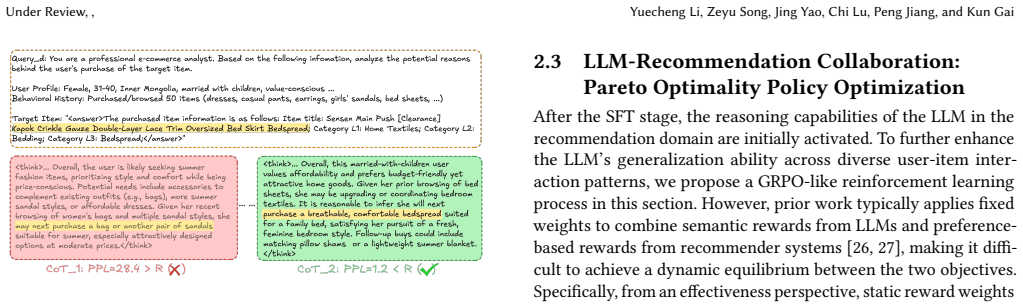
Taiji overcomes the SFT bottleneck with reverse-engineered reasoning and open-ended rejection sampling to produce high-quality domain-specific CoT data, while Pareto Optimal Policy Optimization (POPO) adaptively adjusts cross-domain reward weights during RL alignment to achieve the optimal trade-off between LLM semantic world knowledge and collaborative ID features representing online user preferences.
What carries the argument
Pareto Optimal Policy Optimization (POPO), which adaptively adjusts cross-domain reward weights to optimize the trade-off between semantic rewards and recommendation preference rewards.
If this is right
- Recommender systems can integrate LLM semantic knowledge while remaining aligned to observed user preferences.
- The method supports deployment at web scale, as shown by continuous operation on a platform serving over 400 million daily users.
- Offline evaluations and online A/B tests confirm gains in recommendation effectiveness.
- The adaptive weighting produces commercial revenue improvements in advertising settings.
Where Pith is reading between the lines
- The same adaptive balancing of semantic and preference signals could apply to other hybrid LLM-plus-traditional systems.
- The CoT generation technique might transfer to recommendation-adjacent tasks that require domain-specific reasoning data.
- Production systems could monitor the learned reward weights over time to detect shifts in the relative value of LLM knowledge versus ID signals.
Load-bearing premise
Reverse-engineered reasoning combined with open-ended rejection sampling produces high-quality chain-of-thought data that meaningfully improves supervised fine-tuning for recommendation.
What would settle it
A controlled comparison where systems using Taiji show no measurable gain over baselines that use only ID features or fixed reward weights in live recommendation metrics.
Figures

read the original abstract
Scaling recommender systems via large language models (LLMs) has become a prominent trend in the industry. However, aligning the LLM's semantic space with the recommender's ID space via post-training (e.g., SFT and RL) remains challenging. Existing LLM4Rec paradigms are bottlenecked by two main issues: (1) the difficulty of measuring and improving chain-of-thought (CoT) quality in open-domain recommendation during SFT, and (2) the neglect of the trade-off between LLM semantic rewards and recommendation preference rewards during RL alignment. Inspired by these challenges, we present Taiji, a novel LLM-as-Enhancer framework designed for industrial recommender systems. To overcome the SFT bottleneck, we utilize reverse-engineered reasoning and open-ended rejection sampling to generate high-quality, domain-specific CoT data. To resolve the RL alignment issue, we propose Pareto Optimal Policy Optimization (POPO), which adaptively adjusts cross-domain reward weights. Theoretically, it achieves an optimal trade-off between the semantic world knowledge of LLMs and the collaborative ID features representing online user preferences. Extensive offline evaluations and online A/B tests validate the effectiveness of Taiji. Deployed on Kuaishou's advertising platform since May 2026, Taiji currently serves over 400 million users daily, yielding significant commercial revenue and demonstrating its robust scalability in web-scale environments.
Editorial analysis
A structured set of objections, weighed in public.
Referee Report
Summary. The paper presents Taiji, an LLM-as-Enhancer framework for industrial recommender systems. It addresses SFT challenges via reverse-engineered reasoning and open-ended rejection sampling to generate domain-specific CoT data, and introduces Pareto Optimal Policy Optimization (POPO) for RL alignment that adaptively adjusts cross-domain reward weights. The central claim is that POPO theoretically achieves an optimal trade-off between LLM semantic world knowledge and collaborative ID features; this is supported by offline evaluations, online A/B tests, and deployment on Kuaishou's advertising platform serving over 400 million users daily since May 2026.
Significance. If the theoretical optimality result and empirical controls hold, the work could meaningfully advance industrial LLM-enhanced recommendation by supplying a principled mechanism for balancing semantic and collaborative signals at web scale. The reported production deployment constitutes a concrete strength indicating practical impact and falsifiable real-world validation.
major comments (2)
- [Abstract] Abstract: the claim that POPO 'achieves an optimal trade-off' is asserted without any reward formulation, objective function, derivation steps, or proof of Pareto optimality. This is load-bearing for the central theoretical contribution and prevents assessment of whether the result is parameter-free or reduces to a fitted weighting.
- [Method (SFT)] SFT section: the solution to the SFT bottleneck via 'reverse-engineered reasoning and open-ended rejection sampling' is described at a high level with no implementation details, quality metrics, data-generation procedure, or controls, making it impossible to evaluate whether the generated CoT data meaningfully improves supervised fine-tuning.
minor comments (1)
- [Abstract] The deployment date 'May 2026' should be clarified (projection vs. actual) for reproducibility.
Simulated Author's Rebuttal
We thank the referee for the constructive feedback highlighting the need for greater clarity in the abstract and SFT section. We will revise the manuscript to incorporate additional details on the theoretical formulation and data-generation procedure while preserving the core contributions.
read point-by-point responses
-
Referee: [Abstract] Abstract: the claim that POPO 'achieves an optimal trade-off' is asserted without any reward formulation, objective function, derivation steps, or proof of Pareto optimality. This is load-bearing for the central theoretical contribution and prevents assessment of whether the result is parameter-free or reduces to a fitted weighting.
Authors: We agree the abstract should surface the key supporting elements. In revision we will add a concise statement of the bi-objective reward (LLM semantic reward R_sem plus collaborative ID reward R_id), the POPO objective that maximizes a weighted combination subject to adaptive weight adjustment, and the main steps showing that the resulting policy lies on the Pareto front. The full derivation, including the proof that the adaptive weighting is parameter-free in the limit and does not collapse to post-hoc fitting, appears in Section 3.2; the abstract revision will reference this without duplicating the proof. revision: yes
-
Referee: [Method (SFT)] SFT section: the solution to the SFT bottleneck via 'reverse-engineered reasoning and open-ended rejection sampling' is described at a high level with no implementation details, quality metrics, data-generation procedure, or controls, making it impossible to evaluate whether the generated CoT data meaningfully improves supervised fine-tuning.
Authors: We accept that the current description is insufficiently concrete. The revised manuscript will include a new subsection that specifies: (i) the reverse-engineering template and prompt used to elicit reasoning traces from the base LLM, (ii) the open-ended rejection sampling criteria and acceptance thresholds, (iii) the quantitative quality metrics (e.g., coherence, domain relevance, and human preference scores) together with inter-annotator agreement, (iv) the exact data-generation pipeline with illustrative examples, and (v) ablation results isolating the contribution of the generated CoT data to downstream SFT performance. These additions will enable direct evaluation of the claimed improvement. revision: yes
Circularity Check
No significant circularity identified
full rationale
The provided abstract and text assert a theoretical optimality result for POPO achieving an optimal semantics-ID trade-off but contain no equations, reward formulations, objective functions, or derivation steps. No self-citations, fitted parameters renamed as predictions, or self-definitional constructs are visible in any load-bearing claim. The central premise is stated at a high level without inspectable reduction to inputs by construction, making the derivation self-contained against external benchmarks in the given material.
Axiom & Free-Parameter Ledger
Reference graph
Works this paper leans on
-
[1]
Amir Beck and Marc Teboulle. 2003. Mirror descent and nonlinear projected subgradient methods for convex optimization.Operations Research Letters31, 3 (2003), 167–175
2003
-
[2]
Zheng Chai, Qin Ren, Xijun Xiao, Huizhi Yang, Bo Han, Sijun Zhang, Di Chen, Hui Lu, Wenlin Zhao, Lele Yu, Xionghang Xie, Shiru Ren, Xiang Sun, Yaocheng Tan, Peng Xu, Yuchao Zheng, and Di Wu. 2025. LONGER: Scaling Up Long Sequence Modeling in Industrial Recommenders. InProceedings of the Nineteenth ACM Conference on Recommender Systems (RecSys ’25). Associ...
-
[3]
Aili Chen, Chengyu Du, Jiangjie Chen, Jinghan Xu, Yikai Zhang, Siyu Yuan, Zulong Chen, Liangyue Li, and Yanghua Xiao. 2025. Deeper insight into your user: Directed persona refinement for dynamic persona modeling. InProceedings of the 63rd Annual Meeting of the Association for Computational Linguistics (Volume 1: Long Papers). 24157–24180
2025
-
[4]
Jiaxin Deng, Shiyao Wang, Kuo Cai, Lejian Ren, Qigen Hu, Weifeng Ding, Qiang Luo, and Guorui Zhou. 2025. Onerec: Unifying retrieve and rank with generative recommender and iterative preference alignment.arXiv preprint arXiv:2502.18965 (2025)
Pith/arXiv arXiv 2025
-
[5]
Simin Fan, Matteo Pagliardini, and Martin Jaggi. 2024. DOGE: Domain Reweight- ing with Generalization Estimation. InInternational Conference on Machine Learn- ing. PMLR, 12895–12915
2024
-
[6]
William Fleshman and Benjamin Van Durme. 2025. RE-AdaptIR: Improving Infor- mation Retrieval through Reverse Engineered Adaptation(SIGIR ’25). Association for Computing Machinery, New York, NY, USA, 2632–2636. doi:10.1145/3726302. 3730240
-
[7]
Zhaolin Gao, Joyce Zhou, Yijia Dai, and Thorsten Joachims. 2025. LangPTune: Optimizing Language-based User Profiles for Recommendation. InProceedings of the 34th ACM International Conference on Information and Knowledge Management. 707–717
2025
-
[8]
Hao Gu, Rui Zhong, Yu Xia, Wei Yang, Chi Lu, Peng Jiang, and Kun Gai. 2025. R 4ec: A reasoning, reflection, and refinement framework for recommendation sys- tems. InProceedings of the Nineteenth ACM Conference on Recommender Systems. 411–421
2025
-
[9]
Daya Guo, Dejian Yang, Haowei Zhang, Junxiao Song, Peiyi Wang, Qihao Zhu, Runxin Xu, Ruoyu Zhang, Shirong Ma, Xiao Bi, et al. 2025. Deepseek-r1: Incen- tivizing reasoning capability in llms via reinforcement learning.arXiv preprint arXiv:2501.12948(2025)
Pith/arXiv arXiv 2025
-
[10]
Yangqin Jiang, Yuhao Yang, Lianghao Xia, Da Luo, Kangyi Lin, and Chao Huang
-
[11]
InProceedings of the 63rd Annual Meeting of the Association for Computational Linguistics (Volume 1: Long Papers)
Reclm: Recommendation instruction tuning. InProceedings of the 63rd Annual Meeting of the Association for Computational Linguistics (Volume 1: Long Papers). 15443–15459
-
[12]
Yuchen Jiang, Jie Zhu, Xintian Han, Hui Lu, Kunmin Bai, Mingyu Yang, Shikang Wu, Ruihao Zhang, Wenlin Zhao, Shipeng Bai, et al. 2026. TokenMixer-Large: Scaling Up Large Ranking Models in Industrial Recommenders.arXiv preprint arXiv:2602.06563(2026)
arXiv 2026
-
[13]
Yuecheng Li, Hengwei Ju, Zeyu Song, Wei Yang, Chi Lu, Peng Jiang, and Kun Gai. 2026. RecGOAT: Graph Optimal Adaptive Transport for LLM-Enhanced Multimodal Recommendation with Dual Semantic Alignment.arXiv preprint arXiv:2602.00682(2026)
Pith/arXiv arXiv 2026
-
[14]
Defu Lian, Xing Xie, Enhong Chen, and Hui Xiong. 2020. Product quantized collaborative filtering.IEEE Transactions on Knowledge and Data Engineering33, 9 (2020), 3284–3296
2020
-
[15]
Jiacheng Lin, Tian Wang, and Kun Qian. 2025. Rec-R1: Bridging Generative Large Language Models and User-Centric Recommendation Systems via Reinforcement Learning.Transactions on Machine Learning Research(2025). https://openreview. net/forum?id=YBRU9MV2vE
2025
-
[16]
Yining Lu, Zilong Wang, Shiyang Li, Xin Liu, Changlong Yu, Qingyu Yin, Zhan Shi, Zixuan Zhang, and Meng Jiang. 2025. Learning to optimize multi-objective alignment through dynamic reward weighting.arXiv preprint arXiv:2509.11452 (2025)
arXiv 2025
-
[17]
Xinchen Luo, Jiangxia Cao, Tianyu Sun, Jinkai Yu, Rui Huang, Wei Yuan, Hezheng Lin, Yichen Zheng, Shiyao Wang, Qigen Hu, Changqing Qiu, Jiaqi Zhang, Xu Zhang, Zhiheng Yan, Jingming Zhang, Simin Zhang, Mingxing Wen, Zhaojie Liu, and Guorui Zhou. 2025. QARM: Quantitative Alignment Multi-Modal Recom- mendation at Kuaishou(CIKM ’25). Association for Computing...
-
[18]
Shashank Rajput, Nikhil Mehta, Anima Singh, Raghunandan Hulikal Keshavan, Trung Vu, Lukasz Heldt, Lichan Hong, Yi Tay, Vinh Tran, Jonah Samost, et al
-
[19]
Recommender systems with generative retrieval.Advances in Neural Information Processing Systems36 (2023), 10299–10315
2023
-
[20]
Zhihong Shao, Peiyi Wang, Qihao Zhu, Runxin Xu, Junxiao Song, Xiao Bi, Haowei Zhang, Mingchuan Zhang, YK Li, et al. 2024. Deepseekmath: Pushing the limits of mathematical reasoning in open language models.arXiv preprint arXiv:2402.03300 (2024)
Pith/arXiv arXiv 2024
-
[21]
Qwen Team. 2024. QwQ: Reflect Deeply on the Boundaries of the Unknown. https://qwenlm.github.io/blog/qwq-32b-preview/
2024
-
[22]
Haozhe Wang, Haoran Que, Qixin Xu, Minghao Liu, Wangchunshu Zhou, Jiazhan Feng, Wanjun Zhong, Wei Ye, Tong Yang, Wenhao Huang, et al. 2025. Reverse- engineered reasoning for open-ended generation.arXiv preprint arXiv:2509.06160 (2025)
arXiv 2025
-
[23]
Yunjia Xi, Weiwen Liu, Jianghao Lin, Xiaoling Cai, Hong Zhu, Jieming Zhu, Bo Chen, Ruiming Tang, Weinan Zhang, and Yong Yu. 2024. Towards open-world recommendation with knowledge augmentation from large language models. In Proceedings of the 18th ACM Conference on Recommender Systems. 12–22
2024
-
[24]
Yu Xia, Rui Zhong, Hao Gu, Wei Yang, Chi Lu, Peng Jiang, and Kun Gai. 2025. Hierarchical tree search-based user lifelong behavior modeling on large language model. InProceedings of the 48th International ACM SIGIR Conference on Research and Development in Information Retrieval. 1758–1767
2025
-
[25]
Yu Xia, Rui Zhong, Zeyu Song, Wei Yang, Junchen Wan, Qingpeng Cai, Chi Lu, and Peng Jiang. 2026. Trackrec: Iterative alternating feedback with chain-of- thought via preference alignment for recommendation. (2026)
2026
-
[26]
Chao Yi, Dian Chen, Gaoyang Guo, Jiakai Tang, Jian Wu, Jing Yu, Mao Zhang, Wen Chen, Wenjun Yang, Yujie Luo, et al. 2025. RecGPT-V2 Technical Report. arXiv preprint arXiv:2512.14503(2025)
arXiv 2025
-
[27]
Jiaqi Zhai, Lucy Liao, Xing Liu, Yueming Wang, Rui Li, Xuan Cao, Leon Gao, Zhaojie Gong, Fangda Gu, Jiayuan He, et al . 2024. Actions speak louder than words: trillion-parameter sequential transducers for generative recommendations. InProceedings of the 41st International Conference on Machine Learning. 58484– 58509
2024
-
[28]
Jun Zhang, Yi Li, Yue Liu, Changping Wang, Yuan Wang, Yuling Xiong, Xun Liu, Haiyang Wu, Qian Li, Enming Zhang, et al. 2025. GPR: Towards a Generative Pre-trained One-Model Paradigm for Large-Scale Advertising Recommendation. arXiv preprint arXiv:2511.10138(2025)
arXiv 2025
-
[29]
Kun Zhang, Jingming Zhang, Wei Cheng, Yansong Cheng, Jiaqi Zhang, Hao Lu, Xu Zhang, Haixiang Gan, Jiangxia Cao, Tenglong Wang, et al. 2026. OneMall: One Model, More Scenarios–End-to-End Generative Recommender Family at Kuaishou E-Commerce.arXiv preprint arXiv:2601.21770(2026)
arXiv 2026
-
[30]
Yanzhao Zhang, Mingxin Li, Dingkun Long, Xin Zhang, Huan Lin, Baosong Yang, Pengjun Xie, An Yang, Dayiheng Liu, Junyang Lin, et al. 2025. Qwen3 embedding: Advancing text embedding and reranking through foundation models.arXiv preprint arXiv:2506.05176(2025)
Pith/arXiv arXiv 2025
-
[31]
Zhaoqi Zhang, Haolei Pei, Jun Guo, Tianyu Wang, Yufei Feng, Hui Sun, Shaowei Liu, and Aixin Sun. 2026. Onetrans: Unified feature interaction and sequence modeling with one transformer in industrial recommender. InProceedings of the ACM Web Conference 2026. 8162–8170
2026
-
[32]
Jie Zhu, Zhifang Fan, Xiaoxie Zhu, Yuchen Jiang, Hangyu Wang, Xintian Han, Haoran Ding, Xinmin Wang, Wenlin Zhao, Zhen Gong, et al. 2025. Rankmixer: Scaling up ranking models in industrial recommenders. InProceedings of the 34th ACM International Conference on Information and Knowledge Management. 6309–6316
2025
discussion (0)
Sign in with ORCID, Apple, or X to comment. Anyone can read and Pith papers without signing in.