From 'What' to 'How' and 'Why': Sharing LLM-Generated Retrospective Summaries of Older Adults' Passive Tracking Data with Remote Family Members
Pith reviewed 2026-06-28 08:12 UTC · model grok-4.3
The pith
A multi-layer, multi-agent LLM system produces retrospective summaries of older adults' tracking data that remote family members rate significantly higher in satisfaction, helpfulness, trust, and willingness to receive.
A machine-rendered reading of the paper's core claim, the machinery that carries it, and where it could break.
Core claim
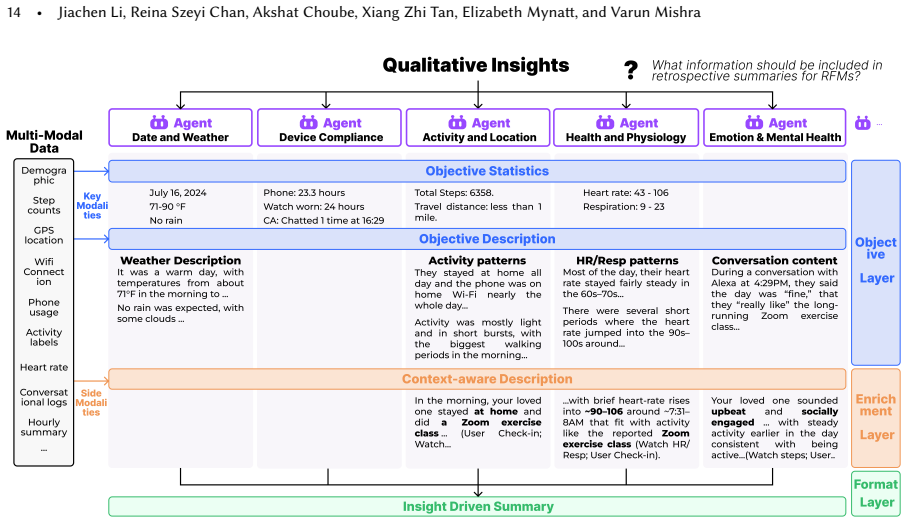
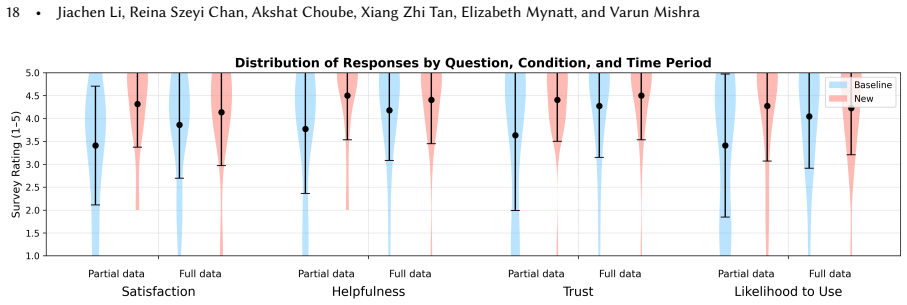
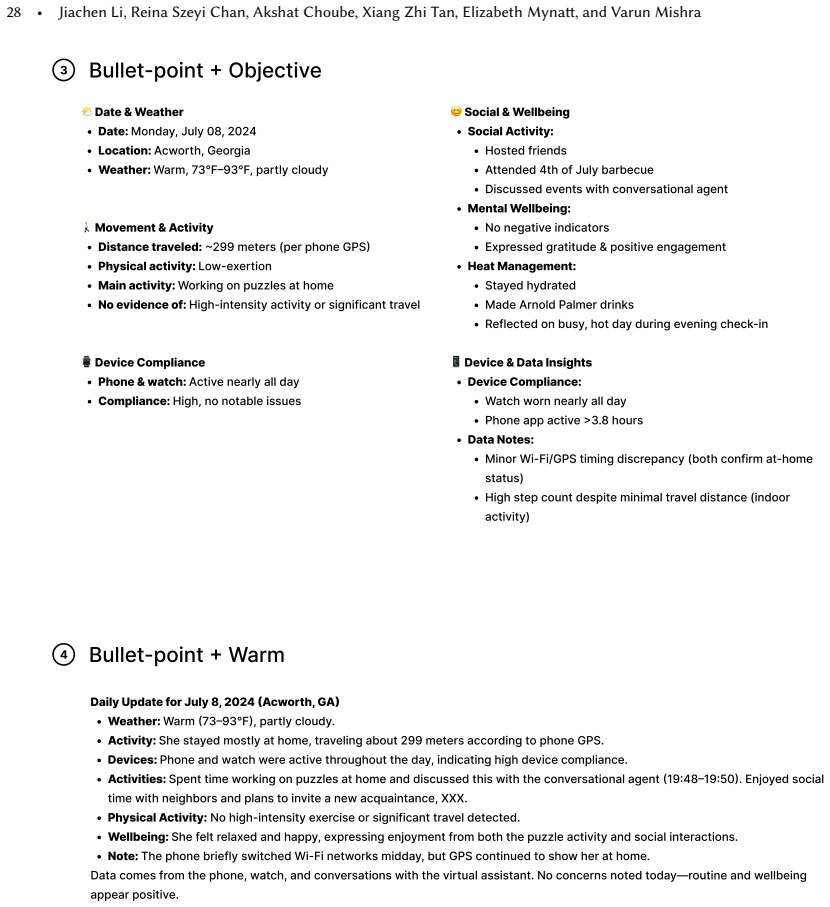
Redesigning the summary generator into a multi-layer, multi-agent, insight-driven pipeline that progresses from objective statistics and descriptions to enriched, context-aware narratives produces summaries that the same 11 remote family members judge significantly better on satisfaction, perceived helpfulness, trust, and willingness to receive than the initial probe versions.
What carries the argument
The multi-layer, multi-agent, insight-driven summary approach, which constructs narratives by layering objective data, behavioral descriptions, and context-aware interpretations.
If this is right
- Remote family members gain a clearer picture of daily patterns and can coordinate care with less uncertainty.
- Designers should prioritize narrative layers that address 'how' and 'why' rather than stopping at raw data presentation.
- The same staged generation method can be reused for other stakeholders who need both facts and interpretation.
- Willingness to keep receiving AI summaries rises when the output supplies actionable context instead of lists of events.
Where Pith is reading between the lines
- The approach may transfer to other family-care scenarios such as monitoring chronic illness or post-operative recovery.
- Adding mechanisms for family members to inject their own background knowledge could further increase perceived relevance.
- Longitudinal deployment would reveal whether repeated use sustains the reported gains in trust and helpfulness.
Load-bearing premise
The improvements observed with 11 remote family members are caused by the specific redesign rather than by repeated exposure to any summaries or by the small sample's particular preferences.
What would settle it
A new study with fresh remote family members that finds no statistically significant difference in satisfaction, trust, or willingness between the two summary styles would falsify the central claim.
Figures


read the original abstract
With the growing prevalence of modern ubiquitous computing technologies, multi-modal tracking systems hold promise for providing timely awareness and reassurance to stakeholders such as remote family members (RFMs) of older adults, who play a central role in care coordination. However, combining heterogeneous data streams into high-level, meaningful content - such as retrospective summaries - remains challenging. While recent work has demonstrated the promise of large language models (LLMs) for interpreting multi-modal tracking data, less attention has been given to generating narrative accounts for stakeholders like RFMs, who possess rich personal knowledge of older adults and strong emotional responsibility, yet have limited visibility into their daily lives and limited capacity for caregiving. In this work, we explore how LLMs can be used to generate retrospective summaries from multi-modal tracking data for RFMs of older adults. We leveraged and customized an existing system, Vital Insight, to generate initial summaries on different dates and data availability scenarios as technology probes, and conducted interviews with 11 RFMs to gather feedback. Based on these insights, we redesigned the system into a multi-layer, multi-agent, insight-driven summary approach that builds from objective statistics and descriptions to enriched, context-aware narratives. We then compared the redesigned summaries with the initial versions through a survey with the same 11 RFMs and found significant improvements in satisfaction, perceived helpfulness, trust, and willingness to receive the summaries. We conclude by presenting design implications for AI-generated summaries for RFMs and broader contexts, emphasizing the need to support RFMs' sensemaking shift from simply presenting ''What'' data were collected, to explaining ''How'' is my loved one doing and ''Why''.
Editorial analysis
A structured set of objections, weighed in public.
Referee Report
Summary. The paper explores using LLMs to generate retrospective summaries from multi-modal passive tracking data for remote family members (RFMs) of older adults. It customizes the Vital Insight system to produce initial summaries as technology probes, conducts interviews with 11 RFMs to collect feedback, redesigns the system into a multi-layer multi-agent insight-driven approach that progresses from objective statistics to context-aware narratives, and then surveys the same 11 RFMs to report significant improvements in satisfaction, perceived helpfulness, trust, and willingness to receive the summaries. The work ends with design implications for shifting AI summaries from 'What' data to 'How' and 'Why' explanations.
Significance. If the reported improvements prove robust, the work offers timely design guidance for LLM-generated narratives in ubiquitous computing and caregiving contexts, where RFMs have emotional stakes but limited visibility into daily data. It usefully distinguishes objective description from enriched sensemaking support.
major comments (1)
- [Abstract / Evaluation] Abstract and evaluation description: the headline claim of 'significant improvements' in satisfaction, helpfulness, trust, and willingness rests on a within-subjects survey using the identical 11 RFMs for both initial and redesigned summaries. No information is supplied on counterbalancing of order, blinding, statistical correction for sequence effects, or power analysis for N=11; the observed gains could therefore arise from repeated exposure or task familiarity rather than the shift to multi-layer, multi-agent narratives. This directly weakens the central empirical result.
minor comments (1)
- [Abstract] Abstract: the phrase 'significant improvements' is stated without accompanying details on the statistical tests, effect sizes, or confidence intervals used.
Simulated Author's Rebuttal
We thank the referee for the constructive feedback. The methodological concern raised is valid and we address it directly below, with planned revisions to better contextualize our evaluation.
read point-by-point responses
-
Referee: [Abstract / Evaluation] Abstract and evaluation description: the headline claim of 'significant improvements' in satisfaction, helpfulness, trust, and willingness rests on a within-subjects survey using the identical 11 RFMs for both initial and redesigned summaries. No information is supplied on counterbalancing of order, blinding, statistical correction for sequence effects, or power analysis for N=11; the observed gains could therefore arise from repeated exposure or task familiarity rather than the shift to multi-layer, multi-agent narratives. This directly weakens the central empirical result.
Authors: We acknowledge this limitation in the current manuscript. The study was conducted sequentially: initial summaries were generated as technology probes, interviews were held with the 11 RFMs to collect feedback, the system was then redesigned based on that input, and a follow-up survey compared both versions with the same participants. Consequently, presentation order was not counterbalanced, participants were not blinded (having previously seen the initial summaries), no power analysis was performed, and sequence-effect corrections were not applied. We agree these factors could contribute to the observed differences. In the revised manuscript we will add an explicit limitations subsection to the Evaluation section discussing these issues and their implications, qualify the claims of 'significant improvements' in the abstract and conclusion to note the within-subjects design and potential confounds, and report additional details on the statistical tests used. revision: yes
Circularity Check
Empirical HCI study with interviews and surveys; no derivations, equations, or fitted predictions present
full rationale
The paper describes an empirical process: customizing an existing system as probes, conducting interviews with 11 RFMs for feedback, redesigning into a multi-layer multi-agent approach, and running a follow-up survey with the same participants to compare versions. No mathematical models, parameter fitting, predictions derived from inputs, or self-citation chains appear in the provided abstract or described structure. The central claims rest on participant ratings rather than any self-referential reduction. This matches the default expectation of no circularity for non-theoretical empirical work.
Axiom & Free-Parameter Ledger
axioms (1)
- domain assumption Qualitative feedback from a small number of stakeholders can reliably inform system redesign and predict user satisfaction improvements.
Reference graph
Works this paper leans on
-
[1]
From information to reflection-design strategies for personal informatics
Naseem Ahmadpour and Karen Anne Cochrane. From information to reflection-design strategies for personal informatics. In2017 IEEE Life Sciences Conference (LSC), pages 103–106, 2017
2017
-
[2]
Data management and wearables in older adults: A systematic review.Maturitas, 124:100–110, 2019
Muaddi Alharbi, Nicola Straiton, Sidney Smith, Lis Neubeck, and Robyn Gallagher. Data management and wearables in older adults: A systematic review.Maturitas, 124:100–110, 2019
2019
-
[3]
who wants to know all this stuff?!
Sami Alkhatib, Ryan Kelly, Jenny Waycott, George Buchanan, Marthie Grobler, and Shuo Wang. “who wants to know all this stuff?!”: Understanding older adults’ privacy concerns in aged care monitoring devices.Interacting with Computers, 2021
2021
-
[4]
you get reminded you’re a sick person
Jessica S Ancker, Holly O Witteman, Baria Hafeez, Thierry Provencher, Mary Van de Graaf, and Esther Wei. “you get reminded you’re a sick person”: personal data tracking and patients with multiple chronic conditions.Journal of medical Internet research, 17(8):e202, 2015
2015
-
[5]
Older people are more likely to live alone in the u.s
Jacob Ausubel. Older people are more likely to live alone in the u.s. than elsewhere in the world, 2020
2020
-
[6]
i could wear it all of the time, just like my wedding ring:
Laura-Bianca Bilius and Radu-Daniel Vatavu. “i could wear it all of the time, just like my wedding ring:” insights into older people’s perceptions of smart rings. InExtended Abstracts of the 2023 CHI Conference on Human Factors in Computing Systems, CHI EA ’23, page 1–8, New York, NY, USA, April 2023. Association for Computing Machinery
2023
-
[7]
Heet Bodara, Md Masum Mushfiq, and Isma Farah Siddiqui. Bias beneath the tone: Empirical characterisation of tone bias in llm-driven ux systems.arXiv preprint arXiv:2512.19950, 2025
-
[8]
The impact of informal caregiving for older adults on the health of various types of caregivers: a systematic review.The Gerontologist, 59(5):e629–e642, 2019
Judith Bom, Pieter Bakx, Frederik Schut, and Eddy Van Doorslaer. The impact of informal caregiving for older adults on the health of various types of caregivers: a systematic review.The Gerontologist, 59(5):e629–e642, 2019
2019
-
[9]
Co-designing customizable clinical dashboards with multidisciplinary teams: Bridging the gap in chronic disease care
Diogo Branco, Margarida Móteiro, Raquel Bouça-Machado, Rita Miranda, Tiago Reis, Élia Decoroso, Rita Cardoso, Joana Ramalho, Filipa Rato, Joana Malheiro, Diana Miranda, Verónica Caniça, Filipa Pona-Ferreira, Daniela Guerreiro, Mariana Leitão, Alexandra Saúde Braz, Joaquim J Ferreira, and Tiago Guerreiro. Co-designing customizable clinical dashboards with ...
2024
-
[10]
Association for Computing Machinery. , Vol. 1, No. 1, Article . Publication date: June 2026. From ‘What’ to ‘How’ and ‘Why’: Sharing LLM-Generated Retrospective Summaries of Older Adults’ Passive Tracking Data with Remote Family Members•23
2026
-
[11]
Using thematic analysis in psychology.Qualitative research in psychology, 3(2):77, 2006
Virginia Braun and Victoria Clarke. Using thematic analysis in psychology.Qualitative research in psychology, 3(2):77, 2006
2006
-
[12]
Senior care for aging in place: balancing assistance and independence
Clara Caldeira, Matthew Bietz, Marisol Vidauri, and Yunan Chen. Senior care for aging in place: balancing assistance and independence. InProceedings of the 2017 ACM Conference on Computer Supported Cooperative Work and Social Computing, pages 1605–1617, 2017
2017
-
[13]
Understanding socio-technical opportunities for enhancing communication between older adults and their remote family
Baihui Chen and Xueliang Li. Understanding socio-technical opportunities for enhancing communication between older adults and their remote family. InProceedings of the 2024 CHI Conference on Human Factors in Computing Systems, pages 1–16, 2024
2024
-
[14]
Summary report: evidence for the effectiveness of rehabilitation for persons with traumatic brain injury.The Journal of head trauma rehabilitation, 14(2):176–188, 1999
Randall M Chesnut, Nancy Carney, Hugo Maynard, N Clay Mann, Patricia Patterson, and Mark Helfand. Summary report: evidence for the effectiveness of rehabilitation for persons with traumatic brain injury.The Journal of head trauma rehabilitation, 14(2):176–188, 1999
1999
-
[15]
Akshat Choube, Ha Le, Jiachen Li, Kaixin Ji, Vedant Das Swain, and Varun Mishra. Gloss: Group of llms for open-ended sensemaking of passive sensing data for health and wellbeing.Proceedings of the ACM on Interactive, Mobile, Wearable and Ubiquitous Technologies, 9(3):1–32, 2025
2025
-
[16]
The carenet display: lessons learned from an in home evaluation of an ambient display
Sunny Consolvo, Peter Roessler, and Brett E Shelton. The carenet display: lessons learned from an in home evaluation of an ambient display. InInternational conference on ubiquitous computing, pages 1–17. Springer, 2004
2004
-
[17]
Grounded theory research: Procedures, canons, and evaluative criteria.Qualitative sociology, 13(1):3–21, 1990
Juliet M Corbin and Anselm Strauss. Grounded theory research: Procedures, canons, and evaluative criteria.Qualitative sociology, 13(1):3–21, 1990
1990
-
[18]
Towards a personal health large language model.arXiv preprint arXiv:2406.06474, 2024
Justin Cosentino, Anastasiya Belyaeva, Xin Liu, Nicholas A Furlotte, Zhun Yang, Chace Lee, Erik Schenck, Yojan Patel, Jian Cui, Logan Douglas Schneider, et al. Towards a personal health large language model.arXiv preprint arXiv:2406.06474, 2024
-
[19]
Comparative study between formal and informal caregivers of older adults.Ciencia & saude coletiva, 23:3789–3798, 2018
Maria Angélica Andreotti Diniz, Beatriz Rodrigues de Souza Melo, Karolina Helena Neri, Francine Golghetto Casemiro, Leandro Correa Figueiredo, Cheila Cristina Leonardo de Oliveira Gaioli, and Aline Cristina Martins Gratão. Comparative study between formal and informal caregivers of older adults.Ciencia & saude coletiva, 23:3789–3798, 2018
2018
-
[20]
The importance of social connectedness in building age-friendly communities.Journal of aging research, 2012, 2012
Charles A Emlet and Joane T Moceri. The importance of social connectedness in building age-friendly communities.Journal of aging research, 2012, 2012
2012
-
[21]
Zachary Englhardt, Chengqian Ma, Margaret E Morris, Chun-Cheng Chang, Xuhai" Orson" Xu, Lianhui Qin, Daniel McDuff, Xin Liu, Shwetak Patel, and Vikram Iyer. From classification to clinical insights: Towards analyzing and reasoning about mobile and behavioral health data with large language models.Proceedings of the ACM on Interactive, Mobile, Wearable and...
2024
-
[22]
Benefits and challenges of conversational agents in older adults: a scoping review.Zeitschrift für Gerontologie und Geriatrie, 55(5):381–387, 2022
Christiane Even, Torsten Hammann, Vera Heyl, Christian Rietz, Hans-Werner Wahl, Peter Zentel, and Anna Schlomann. Benefits and challenges of conversational agents in older adults: a scoping review.Zeitschrift für Gerontologie und Geriatrie, 55(5):381–387, 2022
2022
-
[23]
Cathy Mengying Fang, Valdemar Danry, Nathan Whitmore, Andria Bao, Andrew Hutchison, Cayden Pierce, and Pattie Maes. Physiollm: Supporting personalized health insights with wearables and large language models.arXiv preprint arXiv:2406.19283, 2024
-
[24]
Aging in place: A state survey of livability policies and practices
Nicholas Farber, Douglas Shinkle, Jana Lynott, Wendy Fox-Grage, and Rodney Harrell. Aging in place: A state survey of livability policies and practices. 2011
2011
-
[25]
A discriminatively trained, multiscale, deformable part model
Pedro Felzenszwalb, David McAllester, and Deva Ramanan. A discriminatively trained, multiscale, deformable part model. In2008 IEEE conference on computer vision and pattern recognition, pages 1–8. Ieee, 2008
2008
-
[26]
Public health terms for planners and planning terms for public health professionals, 2013
Centers for Disease Control, Prevention, et al. Public health terms for planners and planning terms for public health professionals, 2013
2013
-
[27]
The discovery of grounded theory; strategies for qualitative research.Nursing research, 17(4):364, 1968
Barney G Glaser, Anselm L Strauss, and Elizabeth Strutzel. The discovery of grounded theory; strategies for qualitative research.Nursing research, 17(4):364, 1968
1968
-
[28]
Effect of selection format on llm performance.arXiv preprint arXiv:2503.06926, 2025
Yuchen Han, Yucheng Wu, and Jeffrey Willard. Effect of selection format on llm performance.arXiv preprint arXiv:2503.06926, 2025
-
[29]
What’s happening at home: a claims-based approach to better understand home clinical care received by older adults.Medical care, 58(4):360–367, 2020
Krista L Harrison, Bruce Leff, Aylin Altan, Stephan Dunning, Casey R Patterson, and Christine S Ritchie. What’s happening at home: a claims-based approach to better understand home clinical care received by older adults.Medical care, 58(4):360–367, 2020
2020
-
[30]
Dancing with the roles: Towards designing technology that supports the multifaceted roles of caregivers for older adults
Long-Jing Hsu and Chia-Fang Chung. Dancing with the roles: Towards designing technology that supports the multifaceted roles of caregivers for older adults. InProceedings of the 2024 CHI Conference on Human Factors in Computing Systems, pages 1–12, 2024
2024
-
[31]
Technology probes: inspiring design for and with families
Hilary Hutchinson, Wendy Mackay, Bo Westerlund, Benjamin B Bederson, Allison Druin, Catherine Plaisant, Michel Beaudouin-Lafon, Stéphane Conversy, Helen Evans, Heiko Hansen, et al. Technology probes: inspiring design for and with families. InProceedings of the SIGCHI conference on Human factors in computing systems, pages 17–24, 2003
2003
-
[32]
Hargpt: Are llms zero-shot human activity recognizers?arXiv preprint arXiv:2403.02727, 2024
Sijie Ji, Xinzhe Zheng, and Chenshu Wu. Hargpt: Are llms zero-shot human activity recognizers?arXiv preprint arXiv:2403.02727, 2024
-
[33]
Older adults and mobile phones for health: a review.Journal of biomedical informatics, 46(5):947–954, 2013
Jonathan Joe and George Demiris. Older adults and mobile phones for health: a review.Journal of biomedical informatics, 46(5):947–954, 2013
2013
-
[34]
Jeffrey A Kaye, Shoshana A Maxwell, Nora Mattek, Tamara L Hayes, Hiroko Dodge, Misha Pavel, Holly B Jimison, Katherine Wild, Linda Boise, and Tracy A Zitzelberger. Intelligent systems for assessing aging changes: home-based, unobtrusive, and continuous assessment of aging.Journals of Gerontology Series B: Psychological Sciences and Social Sciences, 66(sup...
2011
-
[35]
Yubin Kim, Xuhai Xu, Daniel McDuff, Cynthia Breazeal, and Hae Won Park. Health-llm: Large language models for health prediction via wearable sensor data.arXiv preprint arXiv:2401.06866, 2024
-
[36]
The use of wearable activity trackers among older adults: focus group study of tracker perceptions, motivators, and barriers in the maintenance stage of behavior change
Anastasia Kononova, Lin Li, Kendra Kamp, Marie Bowen, RV Rikard, Shelia Cotten, Wei Peng, et al. The use of wearable activity trackers among older adults: focus group study of tracker perceptions, motivators, and barriers in the maintenance stage of behavior change. JMIR mHealth and uHealth, 7(4):e9832, 2019. , Vol. 1, No. 1, Article . Publication date: J...
2019
-
[37]
A multi-agent llm network for suggesting and correcting human activity and posture annotations
Ha Le, Akshat Choube, Vedant Das Swain, Varun Mishra, and Stephen Intille. A multi-agent llm network for suggesting and correcting human activity and posture annotations. InCompanion of the 2025 ACM International Joint Conference on Pervasive and Ubiquitous Computing, pages 877–884, 2025
2025
-
[38]
Jiachen Li, Xiwen Li, Justin Steinberg, Akshat Choube, Bingsheng Yao, Xuhai Xu, Dakuo Wang, Elizabeth Mynatt, and Varun Mishra. Vital insight: Assisting experts’ context-driven sensemaking of multi-modal personal tracking data using visualization and human-in-the-loop llm.Proceedings of the ACM on Interactive, Mobile, Wearable and Ubiquitous Technologies,...
2025
-
[39]
Privacy vs
Jiachen Li, Bingrui Zong, Tingyu Cheng, Yunzhi Li, Elizabeth D Mynatt, and Ashutosh Dhekne. Privacy vs. awareness: Relieving the tension between older adults and adult children when sharing in-home activity data.Proceedings of the ACM on Human-Computer Interaction, 7(CSCW2):1–30, 2023
2023
-
[40]
Burden, satisfaction caregiving, and family relations in informal caregivers of older adults.Frontiers in Medicine, 9:1059467, 2022
Jéssica da Silva Marinho, Ilaise Brilhante Batista, Rute Alessandra da Silva Nobre, Maria Sortênia Alves Guimarães, Ariene Angelini dos Santos-Orlandi, Tábatta Renata Pereira Brito, Valéria Pagotto, Maria Giovana Borges Saidel, Suzimar de Fátima Benato Fusco, Flavia de Oliveira Motta Maia, et al. Burden, satisfaction caregiving, and family relations in in...
2022
-
[41]
Niharika Mathur, Tamara Zubatiy, and Elizabeth Mynatt. Categorizing sources of information for explanations in conversational ai systems for older adults aging in place.arXiv preprint arXiv:2406.05111, 2024
-
[42]
Older adults’ experiences using a commercially available monitor to self-track their physical activity.JMIR mHealth and uHealth, 4(2):e5120, 2016
Siobhan K McMahon, Beth Lewis, Michael Oakes, Weihua Guan, Jean F Wyman, and Alexander J Rothman. Older adults’ experiences using a commercially available monitor to self-track their physical activity.JMIR mHealth and uHealth, 4(2):e5120, 2016
2016
-
[43]
Functional privacy concerns of older adults about pervasive health- monitoring systems
Andrew McNeill, Pam Briggs, Jake Pywell, and Lynne Coventry. Functional privacy concerns of older adults about pervasive health- monitoring systems. InProceedings of the 10th international conference on pervasive technologies related to assistive environments, pages 96–102, 2017
2017
-
[44]
Interventions aimed at reducing problems in adult patients discharged from hospital to home: a systematic meta-review.BMC health services research, 7(1):47, 2007
Patriek Mistiaen, Anneke L Francke, and Else Poot. Interventions aimed at reducing problems in adult patients discharged from hospital to home: a systematic meta-review.BMC health services research, 7(1):47, 2007
2007
-
[45]
Aware technologies for aging in place: understanding user needs and attitudes.IEEE Pervasive Computing, 3(2):36–41, 2004
Elizabeth D Mynatt, A-S Melenhorst, A-D Fisk, and Wendy A Rogers. Aware technologies for aging in place: understanding user needs and attitudes.IEEE Pervasive Computing, 3(2):36–41, 2004
2004
-
[46]
Digital family portraits: supporting peace of mind for extended family members
Elizabeth D Mynatt, Jim Rowan, Sarah Craighill, and Annie Jacobs. Digital family portraits: supporting peace of mind for extended family members. InProceedings of the SIGCHI conference on Human factors in computing systems, pages 333–340, 2001
2001
-
[47]
Activity summarisation and fall detection in a supportive home environment
Hammadi Nait-Charif and Stephen J McKenna. Activity summarisation and fall detection in a supportive home environment. In Proceedings of the 17th International Conference on Pattern Recognition, 2004. ICPR 2004., volume 4, pages 323–326. IEEE, 2004
2004
-
[48]
Contextual ai journaling: Integrating llm and time series behavioral sensing technology to promote self- reflection and well-being using the mindscape app
Subigya Nepal, Arvind Pillai, William Campbell, Talie Massachi, Eunsol Soul Choi, Xuhai Xu, Joanna Kuc, Jeremy F Huckins, Jason Holden, Colin Depp, et al. Contextual ai journaling: Integrating llm and time series behavioral sensing technology to promote self- reflection and well-being using the mindscape app. InExtended Abstracts of the CHI Conference on ...
2024
-
[49]
Mindscape study: integrating llm and behavioral sensing for personalized ai-driven journaling experiences
Subigya Nepal, Arvind Pillai, William Campbell, Talie Massachi, Michael V Heinz, Ashmita Kunwar, Eunsol Soul Choi, Xuhai Xu, Joanna Kuc, Jeremy F Huckins, et al. Mindscape study: integrating llm and behavioral sensing for personalized ai-driven journaling experiences. Proceedings of the ACM on interactive, mobile, wearable and ubiquitous technologies, 8(4...
2024
-
[50]
i left my legacy, told my story
Novia Nurain and Chia-Fang Chung. “i left my legacy, told my story”: Understanding older adults’ tracking practices to promote active aging. InProceedings of the 2023 ACM Designing Interactive Systems Conference, pages 459–475, 2023
2023
-
[51]
Size and Demographics of Aging Populations
Institute of Medicine (US) Food Forum.Providing Healthy and Safe Foods As We Age: Workshop Summary. Size and Demographics of Aging Populations. National Academies Press (US), 2010
2010
-
[52]
Older americans 2020: Key indicators of well-being
Federal Interagency Forum on Aging-Related Statistics (US). Older americans 2020: Key indicators of well-being. Federal Interagency Forum on Aging Related Statistics, 2020
2020
-
[53]
Xiaomin Ouyang and Mani Srivastava. Llmsense: Harnessing llms for high-level reasoning over spatiotemporal sensor traces.arXiv preprint arXiv:2403.19857, 2024
-
[54]
Technology adoption and learning preferences for older adults: evolving perceptions, ongoing challenges, and emerging design opportunities
Carolyn Pang, Zhiqin Collin Wang, Joanna McGrenere, Rock Leung, Jiamin Dai, and Karyn Moffatt. Technology adoption and learning preferences for older adults: evolving perceptions, ongoing challenges, and emerging design opportunities. InProceedings of the 2021 CHI conference on human factors in computing systems, pages 1–13, 2021
2021
-
[55]
Emotionally aware or tone-deaf? evaluating emotional alignment in LLM-based conversational recommendation systems
Darshna Parmar and Pramit Mazumdar. Emotionally aware or tone-deaf? evaluating emotional alignment in LLM-based conversational recommendation systems. In Chen Zhang, Emily Allaway, Hua Shen, Lesly Miculicich, Yinqiao Li, Meryem M’hamdi, Peerat Limkon- chotiwat, Richard He Bai, Santosh T.y.s.s., Sophia Simeng Han, Surendrabikram Thapa, and Wiem Ben Rim, ed...
2025
-
[56]
Marzieh Pashmdarfard and Akram Azad. Assessment tools to evaluate activities of daily living (adl) and instrumental activities of daily living (iadl) in older adults: A systematic review.Medical journal of the Islamic Republic of Iran, 34:33, 2020
2020
-
[57]
The communication of information about older people between health and social care practitioners.Age and ageing, 31(2):107–117, 2002
Sheila Payne, Chris Kerr, Sheila Hawker, Michael Hardey, and Jackie Powell. The communication of information about older people between health and social care practitioners.Age and ageing, 31(2):107–117, 2002. , Vol. 1, No. 1, Article . Publication date: June 2026. From ‘What’ to ‘How’ and ‘Why’: Sharing LLM-Generated Retrospective Summaries of Older Adul...
2002
-
[58]
Habit formation in wearable activity tracker use among older adults: qualitative study.JMIR mHealth and uHealth, 9(1):e22488, 2021
Wei Peng, Lin Li, Anastasia Kononova, Shelia Cotten, Kendra Kamp, Marie Bowen, et al. Habit formation in wearable activity tracker use among older adults: qualitative study.JMIR mHealth and uHealth, 9(1):e22488, 2021
2021
-
[59]
Weld, Joseph Chee Chang, Pao Siangliulue, and Jonathan Bragg
Marissa Radensky, Daniel S. Weld, Joseph Chee Chang, Pao Siangliulue, and Jonathan Bragg. Papers-to-posts: Supporting detailed long-document summarization with an interactive llm-powered source outline, 2025
2025
-
[60]
Ai-enabled conversational journaling for advancing parkinson’s disease symptom tracking
Mashrur Rashik, Shilpa Sweth, Nishtha Agrawal, Saiyyam Kochar, Kara M Smith, Fateme Rajabiyazdi, Vidya Setlur, Narges Mahyar, and Ali Sarvghad. Ai-enabled conversational journaling for advancing parkinson’s disease symptom tracking. InProceedings of the 2025 CHI Conference on Human Factors in Computing Systems, CHI ’25, New York, NY, USA, 2025. Associatio...
2025
-
[61]
Digital family portrait field trial: Support for aging in place
Jim Rowan and Elizabeth D Mynatt. Digital family portrait field trial: Support for aging in place. InProceedings of the SIGCHI conference on Human factors in computing systems, pages 521–530, 2005
2005
-
[62]
A case study on older adults’ long-term use of an activity tracker.Gerontechnology, 16(2), 2017
Anna Schlomann. A case study on older adults’ long-term use of an activity tracker.Gerontechnology, 16(2), 2017
2017
-
[63]
Clinician roles and responsibilities during care transitions of older adults.Journal of the American Geriatrics Society, 61(2):231–236, 2013
Nancy L Schoenborn, Alicia I Arbaje, Kathryn J Eubank, Kenric Maynor, and Joseph A Carrese. Clinician roles and responsibilities during care transitions of older adults.Journal of the American Geriatrics Society, 61(2):231–236, 2013
2013
-
[64]
Jessica Schroeder, Ravi Karkar, Natalia Murinova, James Fogarty, and Sean A Munson. Examining opportunities for goal-directed self- tracking to support chronic condition management.Proceedings of the ACM on interactive, mobile, wearable and ubiquitous technologies, 3(4):1–26, 2019
2019
-
[65]
Family caregiving for older adults.Annual review of psychology, 71(1):635–659, 2020
Richard Schulz, Scott R Beach, Sara J Czaja, Lynn M Martire, and Joan K Monin. Family caregiving for older adults.Annual review of psychology, 71(1):635–659, 2020
2020
-
[66]
The use of mobile devices for physical activity tracking in older adults’ everyday life.Digital health, 3:2055207617740088, 2017
Alexander Seifert, Anna Schlomann, Christian Rietz, and Hans Rudolf Schelling. The use of mobile devices for physical activity tracking in older adults’ everyday life.Digital health, 3:2055207617740088, 2017
2017
-
[67]
Overview of post-discharge predictors for psychiatric re-hospitalisations: a systematic review of the literature.BMC psychiatry, 17(1):227, 2017
R Sfetcu, S Musat, P Haaramo, M Ciutan, G Scintee, C Vladescu, K Wahlbeck, and H Katschnig. Overview of post-discharge predictors for psychiatric re-hospitalisations: a systematic review of the literature.BMC psychiatry, 17(1):227, 2017
2017
-
[68]
Exploring the needs and requirements of informal caregivers of older adults with cognitive impairment from sensor-based care solutions: multimethod study.JMIR aging, 6:e49319, 2023
Nikita Sharma, Louise MA Braakman-Jansen, Harri Oinas-Kukkonen, Jan Hendrik Croockewit, and JEWC van Gemert-Pijnen. Exploring the needs and requirements of informal caregivers of older adults with cognitive impairment from sensor-based care solutions: multimethod study.JMIR aging, 6:e49319, 2023
2023
-
[69]
Tracking and its potential for older adults with memory concerns
Amelia Short, Norman Makoto Su, Ruipu Hu, Eun Kyoung Choe, Hernisa Kacorri, Margaret Danilovich, David E Conroy, Shannon Jette, Beth Barnett, and Amanda Lazar. Tracking and its potential for older adults with memory concerns. InProceedings of the 2025 CHI Conference on Human Factors in Computing Systems, pages 1–15, 2025
2025
-
[70]
they make us old before we’re old
Jianna So, Samantha Estrada, Matthew Jörke, Eva Bianchi, Maria Wang, Nava Haghighi, Kristen L Fessele, James A Landay, and Andrea Cuadra. " they make us old before we’re old": Designing ethical health technology with and for older adults.Proceedings of the ACM on Human-Computer Interaction, 8(CSCW2):1–30, 2024
2024
-
[71]
Activity-tracking devices for older adults: comparison and preferences.Universal Access in the Information Society, 17(2):411–419, 2018
Anika Steinert, Marten Haesner, and Elisabeth Steinhagen-Thiessen. Activity-tracking devices for older adults: comparison and preferences.Universal Access in the Information Society, 17(2):411–419, 2018
2018
-
[72]
Narrating fitness: Leveraging large language models for reflective fitness tracker data interpretation
Konstantin R Strömel, Stanislas Henry, Tim Johansson, Jasmin Niess, and Paweł W Woźniak. Narrating fitness: Leveraging large language models for reflective fitness tracker data interpretation. InProceedings of the 2024 CHI Conference on Human Factors in Computing Systems, pages 1–16, 2024
2024
-
[73]
Dailyllm: Context-aware activity log generation using multi-modal sensors and llms
Ye Tian, Xiaoyuan Ren, Zihao Wang, Onat Gungor, Xiaofan Yu, and Tajana Rosing. Dailyllm: Context-aware activity log generation using multi-modal sensors and llms. In2025 IEEE 22nd International Conference on Mobile Ad-Hoc and Smart Systems (MASS), pages 372–380, 2025
2025
-
[74]
Wearable physical activity tracking systems for older adults—a systematic review.ACM Transactions on Computing for Healthcare, 1(4):1–37, 2020
Dimitri Vargemidis, Kathrin Gerling, Katta Spiel, Vero Vanden Abeele, and Luc Geurts. Wearable physical activity tracking systems for older adults—a systematic review.ACM Transactions on Computing for Healthcare, 1(4):1–37, 2020
2020
-
[75]
Aging in place: Evolution of a research topic whose time has come.Journal of Aging Research, 2012, 2012
Sarinnapha Vasunilashorn, Bernard A Steinman, Phoebe S Liebig, and Jon Pynoos. Aging in place: Evolution of a research topic whose time has come.Journal of Aging Research, 2012, 2012
2012
-
[76]
Ellen Verbakel, Silke F Metzelthin, and Gertrudis IJM Kempen. Caregiving to older adults: Determinants of informal caregivers’ subjective well-being and formal and informal support as alleviating conditions.The Journals of Gerontology: Series B, 73(6):1099–1111, 2018
2018
-
[77]
Making family care work: dependence, privacy and remote home monitoring telecare systems
John Vines, Stephen Lindsay, Gary W Pritchard, Mabel Lie, David Greathead, Patrick Olivier, and Katie Brittain. Making family care work: dependence, privacy and remote home monitoring telecare systems. InProceedings of the 2013 ACM international joint conference on Pervasive and ubiquitous computing, pages 607–616, 2013
2013
-
[78]
A review of monitoring technology for use with older adults.Journal of geriatric physical therapy, 35(1):28–34, 2012
Flo Wagner, Jenny Basran, and Vanina Dal Bello-Haas. A review of monitoring technology for use with older adults.Journal of geriatric physical therapy, 35(1):28–34, 2012
2012
-
[79]
Ai-driven privacy in elderly care: Developing a comprehensive solution for camera-based monitoring of older adults.Applied Sciences, 14(10):4150, 2024
Chang-Yueh Wang and Fang-Suey Lin. Ai-driven privacy in elderly care: Developing a comprehensive solution for camera-based monitoring of older adults.Applied Sciences, 14(10):4150, 2024
2024
-
[80]
Social workers’ attitudes toward older adults: A review of the literature.Journal of Social Work Education, 49(1):150–172, 2013
Donna Wang and Jill Chonody. Social workers’ attitudes toward older adults: A review of the literature.Journal of Social Work Education, 49(1):150–172, 2013
2013
discussion (0)
Sign in with ORCID, Apple, or X to comment. Anyone can read and Pith papers without signing in.