Dynamics and detectability of long-lived non-accretion phases for massive black hole binaries in cold, thermally regulating disks
Pith reviewed 2026-06-28 08:43 UTC · model grok-4.3
The pith
Massive black hole binaries in self-consistently cooled disks enter long-lived non-accreting phases because stream-launching regions stay cold.
A machine-rendered reading of the paper's core claim, the machinery that carries it, and where it could break.
Core claim
In grid-based hydrodynamics simulations that include an energy equation with viscous and hydrodynamic heating coupled to radiative blackbody cooling in the high-Mach-number regime, the regions launching accretion streams remain comparatively cold even as gas accumulates and heats at the far edge of the circumbinary cavity, producing potentially long-lived suppression of the binary accretion rate.
What carries the argument
The energy equation that couples viscous and hydrodynamic heating to blackbody radiative cooling, which keeps stream temperatures low despite outer-disk heating.
Load-bearing premise
Blackbody radiative cooling together with viscous and hydrodynamic heating in the high-Mach-number regime is enough to set the temperatures that decide whether accretion streams form and reach the binary.
What would settle it
Finding a massive black hole binary candidate that shows strong periodic optical variability yet also bright X-ray emission would contradict the predicted X-ray weakness from disk truncation.
Figures
read the original abstract
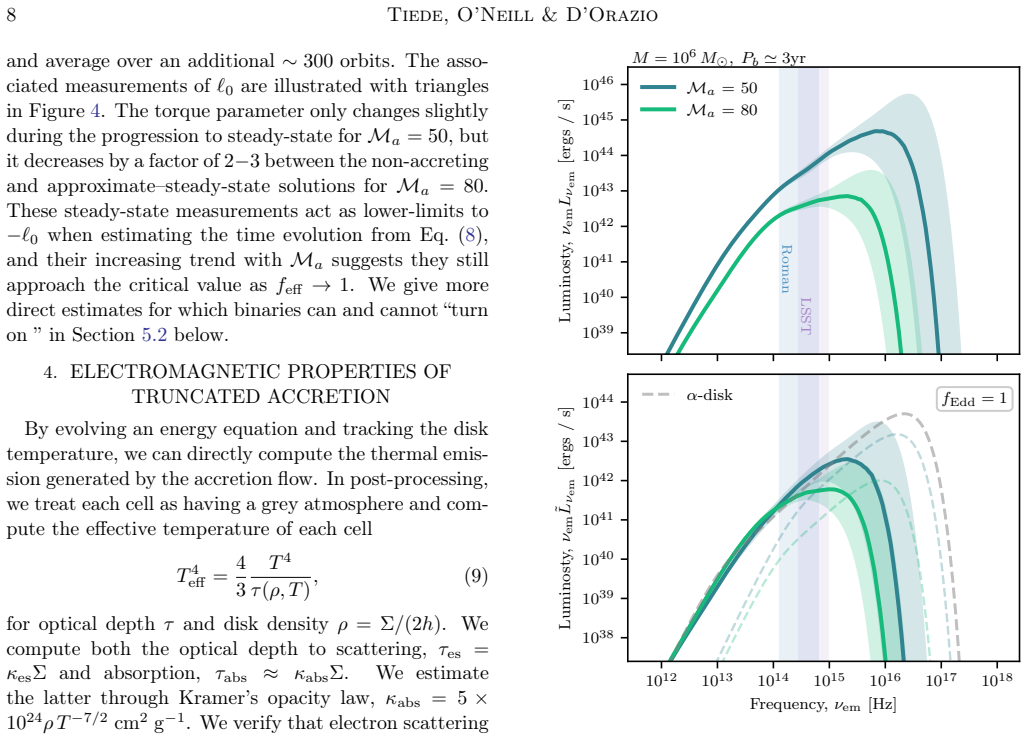
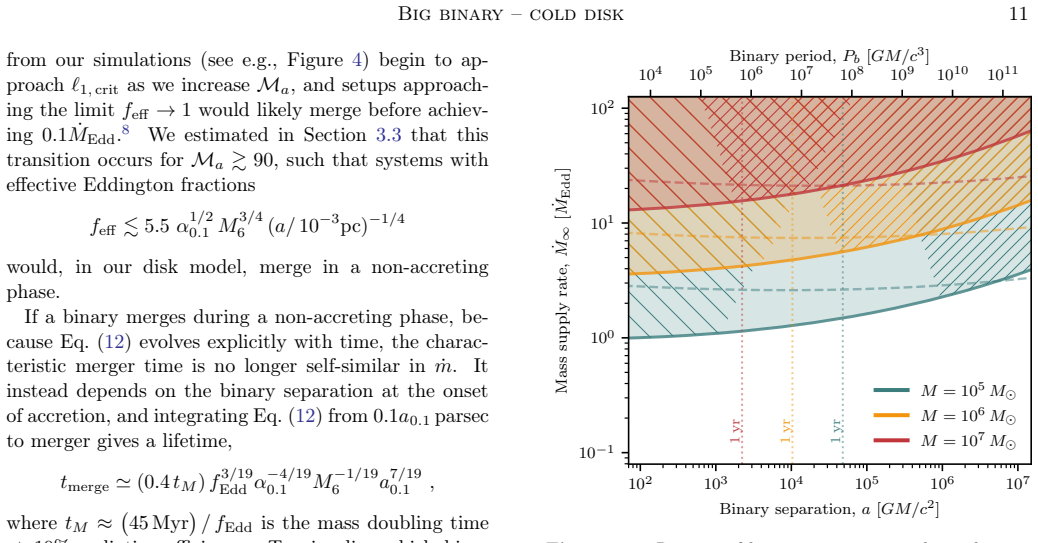
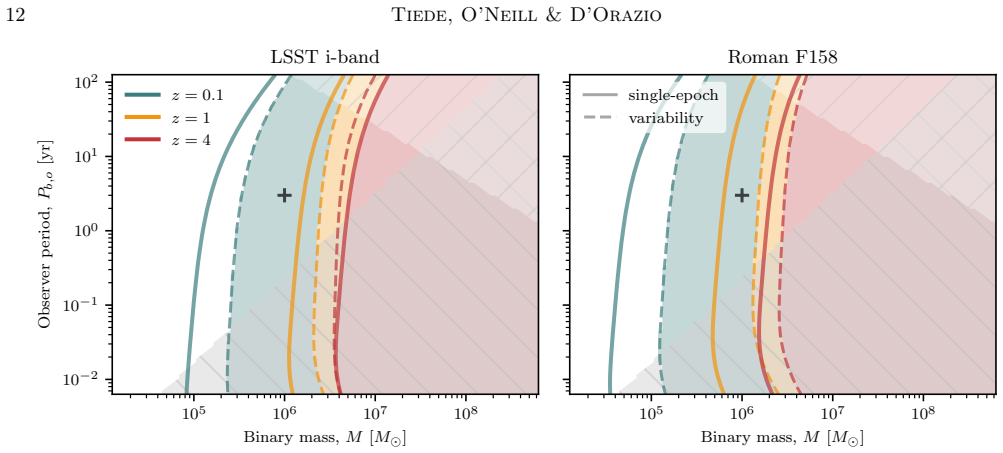
We investigate whether the non-accreting phases found in thin, locally isothermal circumbinary disks survive when the disk thermodynamics are evolved self-consistently. We present grid-based hydrodynamics simulations of circumbinary accretion with an energy equation that includes viscous and hydrodynamic heating coupled to radiative blackbody cooling in the high-Mach number regime. We find that, although gas accumulates and heats at the far edge of the circumbinary cavity, the regions that launch accretion streams remain comparatively cold, leading to potentially long-lived suppression of the binary accretion rate as the large-scale feeding rate is reduced towards the Eddington limit. This runaway non-accretion problem, however, is weakened relative to locally isothermal solutions. Despite their low accretion rates, binaries interacting with disks in a non-accreting phase can remain sufficiently luminous and variable at optical and near-infrared frequencies to be detectable in upcoming wide-field surveys like LSST and the Roman Space Telescope. Because of the effective truncation of the surrounding disk, though, such systems are comparatively faint in high energy, photo-ionizing emission, and may therefore appear as intrinsically X-ray-weak AGN with weak or absent emission line features. We additionally suggest an update to grid-based sink prescriptions for approximating mass loss across an unresolved horizon when including an energy conservation equation.
Editorial analysis
A structured set of objections, weighed in public.
Referee Report
Summary. The manuscript presents grid-based hydrodynamics simulations of massive black hole binary accretion in circumbinary disks, evolving an energy equation with viscous and hydrodynamic heating balanced by blackbody radiative cooling in the high-Mach regime. It claims that gas heats at the cavity edge but accretion-stream launching regions remain cold, producing long-lived suppression of the binary accretion rate (weakened relative to locally isothermal runs) as the large-scale feeding rate approaches the Eddington limit. The work also discusses optical/NIR detectability for surveys such as LSST and Roman, X-ray weakness, and an update to grid-based sink prescriptions that conserve energy.
Significance. If the central thermodynamic result holds, the paper would strengthen understanding of how self-consistent cooling can sustain non-accretion phases in MBHBs, with direct implications for binary evolution timescales and multi-wavelength selection in wide-field surveys. The explicit comparison to isothermal solutions and the proposed sink update are constructive contributions that address known limitations of prior work.
major comments (2)
- [Methods] Methods (simulation setup and diagnostics): quantitative accretion-rate time series, resolution convergence tests, and direct numerical comparison metrics to the isothermal reference runs are not reported, preventing assessment of whether the claimed weakening of runaway non-accretion is robust or sensitive to numerical choices.
- [Results] Results (thermodynamic balance): the central claim that stream-launching regions remain cold enough for persistent suppression rests on blackbody cooling plus viscous/hydrodynamic heating alone; the manuscript does not test or bound the effects of omitted magnetic reconnection heating or frequency-dependent radiative transfer, which could alter the temperature contrast between cavity edge and streams.
minor comments (2)
- [Abstract] The abstract states that binaries 'can remain sufficiently luminous' but the manuscript should provide explicit luminosity or flux estimates at optical/NIR wavelengths for the non-accreting phase.
- [Discussion] Notation for the sink prescription update should be defined with an equation number and compared quantitatively to the standard prescription.
Simulated Author's Rebuttal
We thank the referee for their constructive review and the opportunity to address these points. We respond to each major comment below.
read point-by-point responses
-
Referee: [Methods] Methods (simulation setup and diagnostics): quantitative accretion-rate time series, resolution convergence tests, and direct numerical comparison metrics to the isothermal reference runs are not reported, preventing assessment of whether the claimed weakening of runaway non-accretion is robust or sensitive to numerical choices.
Authors: We agree that explicit quantitative diagnostics will strengthen the manuscript. The revised version will add: (i) full time series of binary accretion rates for both the self-consistent thermodynamic runs and the locally isothermal reference cases; (ii) resolution convergence tests at multiple grid resolutions confirming that cavity-edge heating and cold stream-launching regions persist; and (iii) direct comparison metrics including time-averaged accretion-rate ratios and durations of non-accretion phases. These additions will enable quantitative assessment of the claimed weakening relative to isothermal solutions. revision: yes
-
Referee: [Results] Results (thermodynamic balance): the central claim that stream-launching regions remain cold enough for persistent suppression rests on blackbody cooling plus viscous/hydrodynamic heating alone; the manuscript does not test or bound the effects of omitted magnetic reconnection heating or frequency-dependent radiative transfer, which could alter the temperature contrast between cavity edge and streams.
Authors: We acknowledge that the thermodynamic model is simplified and omits magnetic reconnection heating and frequency-dependent radiative transfer. Our result demonstrates that, even with this minimal treatment, the stream-launching regions remain cold enough for suppression (weakened relative to isothermal runs). We will expand the discussion to explicitly note these limitations, describe why the high-Mach blackbody approximation is adopted, and state that quantitative bounds on the omitted physics require future MHD simulations with radiative transfer. This addresses the concern within the paper's scope. revision: partial
Circularity Check
No circularity: simulation results derive directly from evolved energy equation without self-referential reduction
full rationale
The paper reports outcomes from grid-based hydrodynamics simulations that evolve an energy equation with viscous/hydrodynamic heating balanced by blackbody cooling. The key result—that accretion-stream regions remain cold while the cavity edge heats—is obtained by direct integration of the simulation equations and compared to separate prior isothermal runs. No load-bearing step reduces a reported prediction or suppression factor to a fitted parameter or self-citation chain by construction; the thermodynamics are solved forward from initial conditions and boundary feeding rates. The derivation is therefore self-contained against external simulation benchmarks.
Axiom & Free-Parameter Ledger
Reference graph
Works this paper leans on
-
[1]
Supermassive Black Hole Binary Candidates from the Pan-STARRS1 Medium Deep Survey. , keywords =. doi:10.3847/1538-4357/ab40cb , archivePrefix =. 1906.08315 , primaryClass =
-
[2]
Living Reviews in Relativity , keywords =
Electromagnetic counterparts to massive black-hole mergers. Living Reviews in Relativity , keywords =. doi:10.1007/s41114-022-00037-8 , archivePrefix =. 2109.03262 , primaryClass =
-
[3]
Relativistic gas accretion onto supermassive black hole binaries from inspiral through merger. , keywords =. doi:10.1103/yc25-v1q4 , archivePrefix =. 2502.06389 , primaryClass =
-
[4]
, year = 2026, month = mar, doi =
Unequal Mass Binary Evolution Driven by High Mach Circumbinary Disks. , year = 2026, month = mar, doi =
2026
-
[5]
Active galactic nuclei : from the central black hole to the galactic environment /Julian H
Active galactic nuclei: from the central black hole to the galactic environment. Active galactic nuclei : from the central black hole to the galactic environment /Julian H. Krolik. Princeton, N. J. : Princeton University Press, c1999. , year = 1999, publisher =
1999
-
[6]
Hydrodynamic and hydromagnetic stability
-
[7]
, archivePrefix = "arXiv", eprint =
A systematic search for close supermassive black hole binaries in the Catalina Real-time Transient Survey. , archivePrefix = "arXiv", eprint =. doi:10.1093/mnras/stv1726 , adsurl =
-
[8]
The final-parsec problem in the collisionless limit
The Final-parsec Problem in the Collisionless Limit. , keywords =. doi:10.1088/0004-637X/810/1/49 , archivePrefix =. 1505.05480 , primaryClass =
work page internal anchor Pith review Pith/arXiv arXiv doi:10.1088/0004-637x/810/1/49
-
[9]
, archivePrefix = "arXiv", eprint =
The Pairing of Accreting Massive Black Holes in Multiphase Circumnuclear Disks: the Interplay Between Radiative Cooling, Star Formation, and Feedback Processes. , archivePrefix = "arXiv", eprint =. doi:10.3847/1538-4357/aa5d19 , adsurl =
-
[10]
, archivePrefix = "arXiv", eprint =
Orbital decay of supermassive black hole binaries in clumpy multiphase merger remnants. , archivePrefix = "arXiv", eprint =. doi:10.1093/mnras/stv312 , adsurl =
-
[11]
Science , archivePrefix = "arXiv", eprint =
Rapid Formation of Supermassive Black Hole Binaries in Galaxy Mergers with Gas. Science , archivePrefix = "arXiv", eprint =. doi:10.1126/science.1141858 , adsurl =
-
[12]
, archivePrefix = "arXiv", eprint =
Massive Black Hole Pairs in Clumpy, Self-gravitating Circumnuclear Disks: Stochastic Orbital Decay. , archivePrefix = "arXiv", eprint =. doi:10.1088/2041-8205/777/1/L14 , adsurl =
-
[13]
Transformations of Galaxies. II. Gasdynamics in Merging Disk Galaxies. , keywords =. doi:10.1086/177957 , adsurl =
-
[14]
Titans of the early Universe: The Prato statement on the origin of the first supermassive black holes. , keywords =. doi:10.1017/pasa.2019.14 , archivePrefix =. 1810.12310 , primaryClass =
-
[15]
, archivePrefix = "arXiv", eprint =
Global Calculations of Density Waves and Gap Formation in Protoplanetary Disks Using a Moving Mesh. , archivePrefix = "arXiv", eprint =. doi:10.1088/0004-637X/755/1/7 , adsurl =
-
[16]
, archivePrefix = "arXiv", eprint =
Observational Signatures of Binary Supermassive Black Holes. , archivePrefix = "arXiv", eprint =. doi:10.1088/0004-637X/785/2/115 , adsurl =
-
[17]
, archivePrefix = "arXiv", eprint =
Estimating the Prompt Electromagnetic Luminosity of a Black Hole Merger. , archivePrefix = "arXiv", eprint =. doi:10.1088/0004-637X/709/2/774 , adsurl =
-
[18]
, archivePrefix = "arXiv", eprint =
Gravitational Waves and Gamma-Rays from a Binary Neutron Star Merger: GW170817 and GRB 170817A. , archivePrefix = "arXiv", eprint =. doi:10.3847/2041-8213/aa920c , adsurl =
-
[21]
Periodic self-lensing from accreting massive black hole binaries
Periodic self-lensing from accreting massive black hole binaries. , keywords =. doi:10.1093/mnras/stx2936 , archivePrefix =. 1707.02335 , primaryClass =
work page internal anchor Pith review Pith/arXiv arXiv doi:10.1093/mnras/stx2936
-
[22]
ApJ, submitted; e-print ArXiv:1704.07886 , archivePrefix = "arXiv", eprint =
Electromagnetic Chirps from Neutron Star-Black Hole Mergers. ApJ, submitted; e-print ArXiv:1704.07886 , archivePrefix = "arXiv", eprint =
-
[23]
, year = 1995, month = jan, volume =
Inward Bound---The Search For Supermassive Black Holes In Galactic Nuclei. , year = 1995, volume = 33, pages =. doi:10.1146/annurev.aa.33.090195.003053 , adsurl =
-
[24]
Coevolution (Or Not) of Supermassive Black Holes and Host Galaxies
Coevolution (Or Not) of Supermassive Black Holes and Host Galaxies. , archivePrefix = "arXiv", eprint =. doi:10.1146/annurev-astro-082708-101811 , adsurl =
work page internal anchor Pith review doi:10.1146/annurev-astro-082708-101811
-
[25]
Alignment of the Spins of Supermassive Black Holes Prior to Coalescence. , eprint =. doi:10.1086/518769 , adsurl =
-
[26]
Modeling of Emission Signatures of Massive Black Hole Binaries. I. Methods. , keywords =. doi:10.1086/521828 , archivePrefix =. 0708.0414 , primaryClass =
work page internal anchor Pith review Pith/arXiv arXiv doi:10.1086/521828
-
[27]
Supermassive Black Hole Binaries: The Search Continues
Supermassive Black Hole Binaries: The Search Continues. Gravitational Wave Astrophysics , year = 2015, series =. doi:10.1007/978-3-319-10488-1\_9 , archivePrefix =. 1406.5193 , primaryClass =
work page internal anchor Pith review Pith/arXiv arXiv doi:10.1007/978-3-319-10488-1 2015
-
[28]
, archivePrefix = "arXiv", eprint =
Relativistic Mergers of Supermassive Black Holes and Their Electromagnetic Signatures. , archivePrefix = "arXiv", eprint =. doi:10.1088/0004-637X/715/2/1117 , adsurl =
-
[29]
Living Reviews in Relativity , eprint =
The Confrontation between General Relativity and Experiment. Living Reviews in Relativity , eprint =. doi:10.12942/lrr-2006-3 , adsurl =
-
[30]
Massive black hole binary mergers within subparsec scale gas discs. , archivePrefix = "arXiv", eprint =. doi:10.1111/j.1365-2966.2008.14147.x , adsurl =
-
[31]
Accretion during the Merger of Supermassive Black Holes. , eprint =. doi:10.1086/339770 , adsurl =
-
[32]
Eccentricity of supermassive black hole binaries coalescing from gas rich mergers
Eccentricity of Supermassive Black Hole Binaries Coalescing from Gas-rich Mergers. , keywords =. 2005. doi:10.1086/497108 , archivePrefix =. astro-ph/0508493 , primaryClass =
work page internal anchor Pith review Pith/arXiv arXiv doi:10.1086/497108 2005
-
[33]
ArXiv e-prints , archivePrefix = "arXiv", eprint =
The accretion of migrating giant planets. ArXiv e-prints , archivePrefix = "arXiv", eprint =
-
[34]
Planet-disk interaction and orbital evolution
Planet-Disk Interaction and Orbital Evolution. , keywords =. doi:10.1146/annurev-astro-081811-125523 , archivePrefix =. 1203.1184 , primaryClass =
work page internal anchor Pith review Pith/arXiv arXiv doi:10.1146/annurev-astro-081811-125523
-
[35]
, archivePrefix = "arXiv", eprint =
Accretion into the central cavity of a circumbinary disc. , archivePrefix = "arXiv", eprint =. doi:10.1093/mnras/stt1787 , adsurl =
-
[36]
, archivePrefix = "arXiv", eprint =
TESS: A Relativistic Hydrodynamics Code on a Moving Voronoi Mesh. , archivePrefix = "arXiv", eprint =. doi:10.1088/0067-0049/197/2/15 , adsurl =
-
[37]
, archivePrefix = "arXiv", eprint =
Gap Opening by Extremely Low-mass Planets in a Viscous Disk. , archivePrefix = "arXiv", eprint =. doi:10.1088/0004-637X/769/1/41 , adsurl =
-
[38]
, archivePrefix = "arXiv", eprint =
Binary Black Hole Accretion from a Circumbinary Disk: Gas Dynamics inside the Central Cavity. , archivePrefix = "arXiv", eprint =. doi:10.1088/0004-637X/783/2/134 , adsurl =
-
[39]
, archivePrefix = "arXiv", eprint =
Characteristic signatures in the thermal emission from accreting binary black holes. , archivePrefix = "arXiv", eprint =. doi:10.1093/mnrasl/slu160 , adsurl =
-
[40]
An Eccentric Circumbinary Accretion Disk and the Detection of Binary Massive Black Holes. , eprint =. doi:10.1086/523869 , adsurl =
-
[41]
Lighthouse in the Dust: Infrared Echoes of Periodic Emission from Massive Black Hole Binaries
Lighthouse in the dust: infrared echoes of periodic emission from massive black hole binaries★. , keywords =. doi:10.1093/mnras/stx1269 , archivePrefix =. 1702.01219 , primaryClass =
work page internal anchor Pith review Pith/arXiv arXiv doi:10.1093/mnras/stx1269
-
[42]
, archivePrefix = "arXiv", eprint =
Viscous hydrodynamics simulations of circumbinary accretion discs: variability, quasi-steady state and angular momentum transfer. , archivePrefix = "arXiv", eprint =. doi:10.1093/mnras/stw3189 , adsurl =
-
[43]
and Miranda, Ryan and Lai, Dong , year=
Hydrodynamics of Circumbinary Accretion: Angular Momentum Transfer and Binary Orbital Evolution. , archivePrefix = "arXiv", eprint =. doi:10.3847/1538-4357/aaf867 , adsurl =
-
[44]
Circumbinary Accretion: From Binary Stars to Massive Binary Black Holes. , keywords =. doi:10.1146/annurev-astro-052622-022933 , archivePrefix =. 2211.00028 , primaryClass =
-
[45]
Moody, Mackenzie S. L. and Shi, Ji-Ming and Stone, James M. , year=. Hydrodynamic Torques in Circumbinary Accretion Disks , volume=. The Astrophysical Journal , publisher=. doi:10.3847/1538-4357/ab09ee , number=
-
[46]
Circumbinary Accretion from Finite and Infinite Disks. , keywords =. doi:10.3847/1538-4357/ab5d33 , archivePrefix =. 1910.04763 , primaryClass =
-
[47]
arXiv e-prints , keywords =
Circumbinary Accretion: From Binary Stars to Massive Binary Black Holes. arXiv e-prints , keywords =
-
[48]
, archivePrefix = "arXiv", eprint =
Circumbinary Magnetohydrodynamic Accretion into Inspiraling Binary Black Holes. , archivePrefix = "arXiv", eprint =. doi:10.1088/0004-637X/755/1/51 , adsurl =
-
[49]
Structure and evolution of circumbinary disks around supermassive black hole (SMBH) binaries
Structure and Evolution of Circumbinary Disks around Supermassive Black Hole Binaries. , keywords =. doi:10.1088/0004-637X/774/2/144 , archivePrefix =. 1205.5017 , primaryClass =
work page internal anchor Pith review Pith/arXiv arXiv doi:10.1088/0004-637x/774/2/144
-
[50]
, archivePrefix = "arXiv", eprint =
Accretion and Orbital Inspiral in Gas-assisted Supermassive Black Hole Binary Mergers. , archivePrefix = "arXiv", eprint =. doi:10.3847/0004-637X/827/2/111 , adsurl =
-
[51]
Evolution of binary black holes in self gravitating discs. Dissecting the torques. , archivePrefix = "arXiv", eprint =. doi:10.1051/0004-6361/201219986 , adsurl =
-
[52]
Observational appearance
Black holes in binary systems. Observational appearance. , year = 1973, volume = 24, pages =
1973
-
[53]
Satellites in discs: regulating the accretion luminosity. , eprint =. doi:10.1093/mnras/277.3.758 , adsurl =
-
[55]
Krolik and Stephen H
Ji-Ming Shi and Julian H. Krolik and Stephen H. Lubow and John F. Hawley , title=. , volume=
-
[56]
Three-dimensional MHD Simulation of Circumbinary Accretion Disks. II. Net Accretion Rate. , keywords =. doi:10.1088/0004-637X/807/2/131 , archivePrefix =. 1503.05561 , primaryClass =
work page internal anchor Pith review Pith/arXiv arXiv doi:10.1088/0004-637x/807/2/131
-
[57]
, keywords =
Thick accretion disks and supercritical luminosities. , keywords =
-
[58]
, year = 1997, month = apr, volume =
Protoplanet Migration by Nebula Tides. , year = 1997, month = apr, volume = 126, pages =. doi:10.1006/icar.1996.5647 , adsurl =
-
[59]
, archivePrefix = "arXiv", eprint =
The Migration of Gap-opening Planets is Not Locked to Viscous Disk Evolution. , archivePrefix = "arXiv", eprint =. doi:10.1088/2041-8205/792/1/L10 , adsurl =
-
[60]
III - Orbital migration of protoplanets
On the tidal interaction between protoplanets and the protoplanetary disk. III - Orbital migration of protoplanets. , keywords =. doi:10.1086/164653 , adsurl =
-
[61]
, archivePrefix = "arXiv", eprint =
The Population of Viscosity- and Gravitational Wave-driven Supermassive Black Hole Binaries Among Luminous Active Galactic Nuclei. , archivePrefix = "arXiv", eprint =. doi:10.1088/0004-637X/700/2/1952 , adsurl =
-
[62]
, year = 2022, month = oct, volume =
Erratum: ``The Population of Viscosity- and Gravitational Wave-driven Supermassive Black Hole Binaries among Luminous Active Galactic Nuclei'' (2009, ApJ, 700, 1952). , year = 2022, month = oct, volume =. doi:10.3847/1538-4357/ac93f7 , adsurl =
-
[63]
Science , archivePrefix = "arXiv", eprint =
Kepler-47: A Transiting Circumbinary Multiplanet System. Science , archivePrefix = "arXiv", eprint =. doi:10.1126/science.1228380 , adsurl =
-
[64]
Classical and Quantum Gravity , archivePrefix = "arXiv", eprint =
Massive black hole binaries in gas-rich galaxy mergers; multiple regimes of orbital decay and interplay with gas inflows. Classical and Quantum Gravity , archivePrefix = "arXiv", eprint =. doi:10.1088/0264-9381/30/24/244008 , adsurl =
-
[65]
Advances in Astronomy , archivePrefix = "arXiv", eprint =
Massive Black Hole Binaries: Dynamical Evolution and Observational Signatures. Advances in Astronomy , archivePrefix = "arXiv", eprint =. doi:10.1155/2012/940568 , adsurl =
-
[66]
, keywords =
Massive black hole binaries in active galactic nuclei. , keywords =
-
[67]
Supermassive Black Holes in Galactic Nuclei: Past, Present and Future Research. , eprint =. doi:10.1007/s11214-005-3947-6 , adsurl =
-
[68]
Disk-satellite interactions. , keywords =. doi:10.1086/158356 , adsurl =
-
[69]
Stellar dynamics in the nuclei of M31 and M32 - Evidence for massive black holes?. , keywords =. doi:10.1086/165930 , adsurl =
-
[70]
The Classical T Tauri Spectroscopic Binary DQ Tau.I.Orbital Elements and Light Curves. , keywords =. doi:10.1086/118395 , adsurl =
-
[71]
NICMOS Images of the GG Tau Circumbinary Disk
NICMOS Images of the GG Tauri Circumbinary Disk. , keywords =. doi:10.1086/341479 , archivePrefix =. astro-ph/0204465 , primaryClass =
work page internal anchor Pith review Pith/arXiv arXiv doi:10.1086/341479
-
[72]
HST/ACS Images of the GG Tauri Circumbinary Disk
Hubble Space Telescope ACS Images of the GG Tauri Circumbinary Disk. , keywords =. doi:10.1086/497069 , archivePrefix =. astro-ph/0508222 , primaryClass =
work page internal anchor Pith review Pith/arXiv arXiv doi:10.1086/497069
-
[73]
The sedentary multifrequency survey—I
P. B Ivanov and J. C. B Papaloizou and A. G Polnarev , journal =. The evolution of a supermassive binary caused by an accretion disc , abstract =. 1999 , month =. doi:10.1046/j.1365-8711.1999.02623.x , pmid =
-
[74]
Orbital eccentricity growth through disc-companion tidal interaction. , keywords =. doi:10.1051/0004-6361:20000011 , adsurl =
-
[75]
Halting type I planet migration in non-isothermal disks. , eprint =. doi:10.1051/0004-6361:20066304 , adsurl =
-
[76]
The Astrophysical Journal , title =
Andr. The Astrophysical Journal , title =. 2005 , month =. doi:10.1086/431747 , pmid =
-
[77]
arXiv", primaryClass =
Electromagnetic counterparts of supermassive black hole binaries resolved by pulsar timing arrays. , archivePrefix = "arXiv", primaryClass = "astro-ph.CO", keywords =
-
[78]
The Assembly and Merging History of Supermassive Black Holes in Hierarchical Models of Galaxy Formation. , eprint =. doi:10.1086/344675 , adsurl =
-
[79]
Multimessenger astronomy with pulsar timing and X-ray observations of massive black hole binaries. , archivePrefix = "arXiv", eprint =. doi:10.1111/j.1365-2966.2011.20097.x , adsurl =
-
[80]
The Gravitational Wave Signal from Massive Black Hole Binaries and Its Contribution to the LISA Data Stream. , eprint =. doi:10.1086/428492 , adsurl =
-
[81]
On the Occupation Fraction of Seed Black Holes in High-redshift Dark Matter Halos. , keywords =. doi:10.1088/0004-637X/701/1/360 , adsurl =
-
[82]
ascl:1605.011 , adsurl =
DISCO: 3-D moving-mesh magnetohydrodynamics package. ascl:1605.011 , adsurl =
-
[83]
, archivePrefix = "arXiv", eprint =
DISCO: A 3D Moving-mesh Magnetohydrodynamics Code Designed for the Study of Astrophysical Disks. , archivePrefix = "arXiv", eprint =. doi:10.3847/0067-0049/226/1/2 , adsurl =
discussion (0)
Sign in with ORCID, Apple, or X to comment. Anyone can read and Pith papers without signing in.