Simulating realistic radio morphologies of Fanaroff-Riley I jets in a self-regulating cool-core cluster
Pith reviewed 2026-06-28 08:53 UTC · model grok-4.3
The pith
Self-regulated AGN jets in cool-core clusters produce realistic Fanaroff-Riley I radio morphologies and prevent cooling flows.
A machine-rendered reading of the paper's core claim, the machinery that carries it, and where it could break.
Core claim
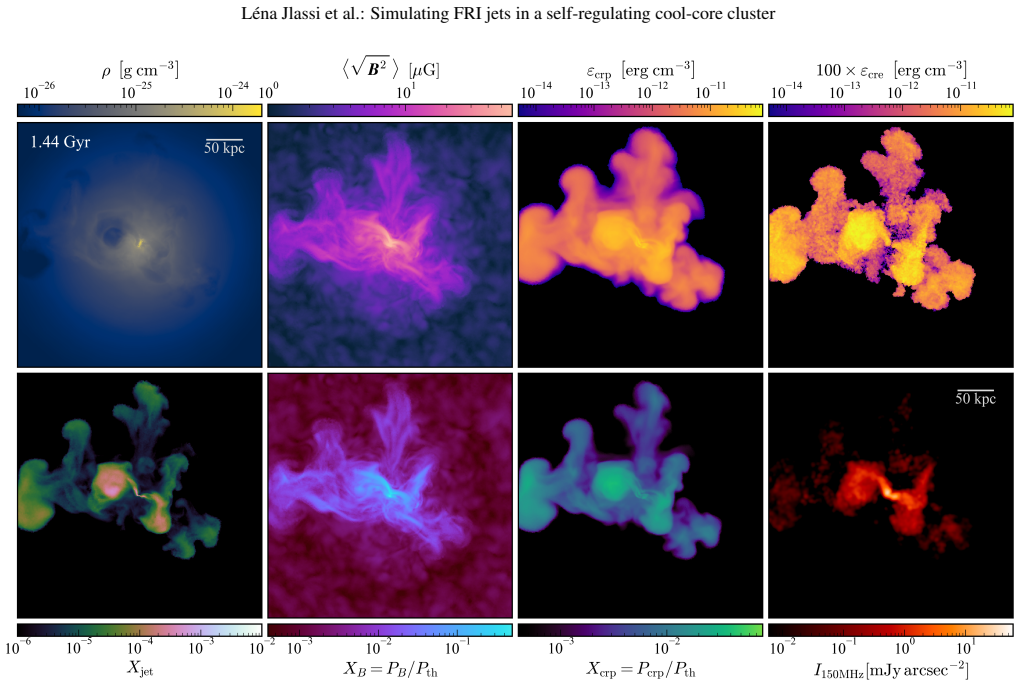
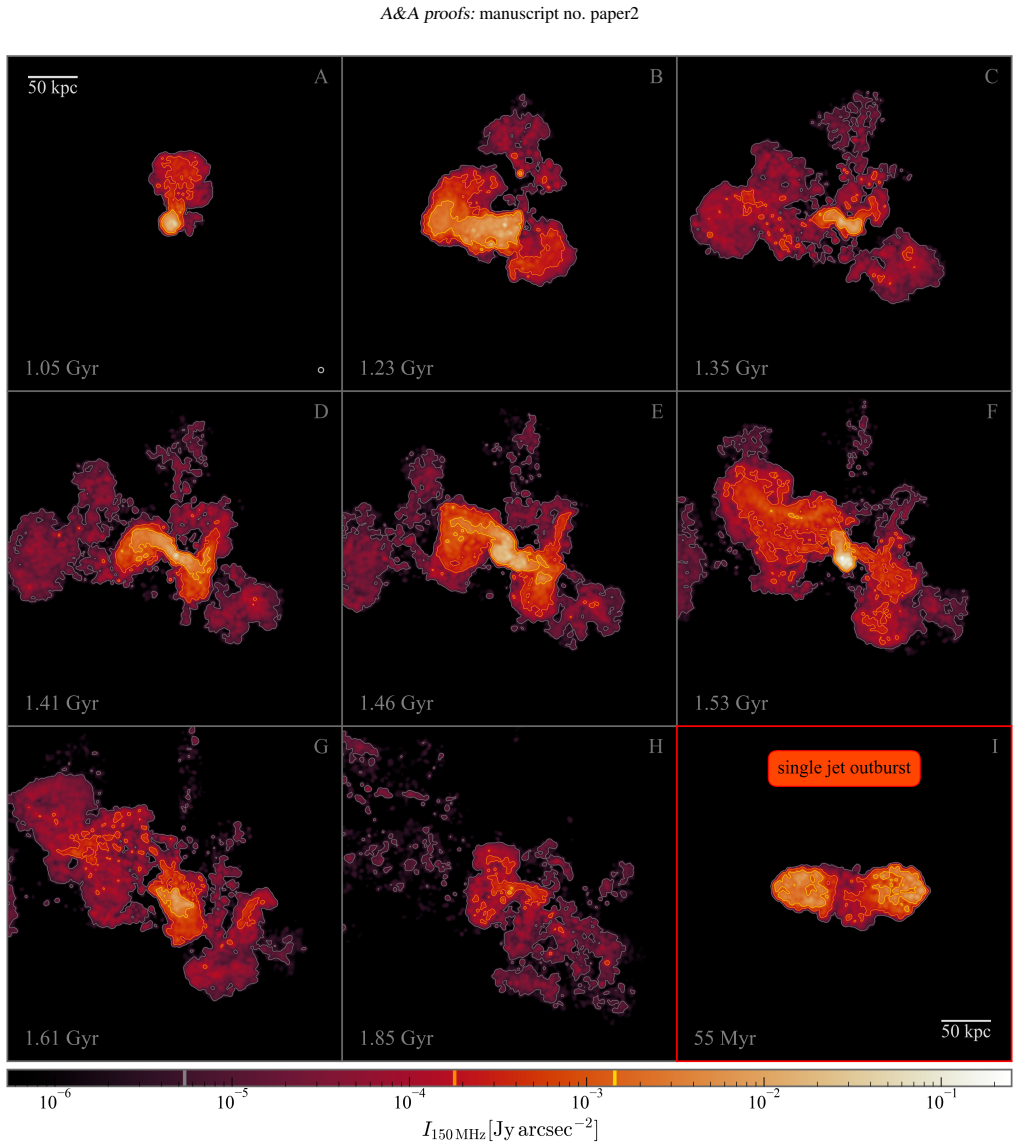
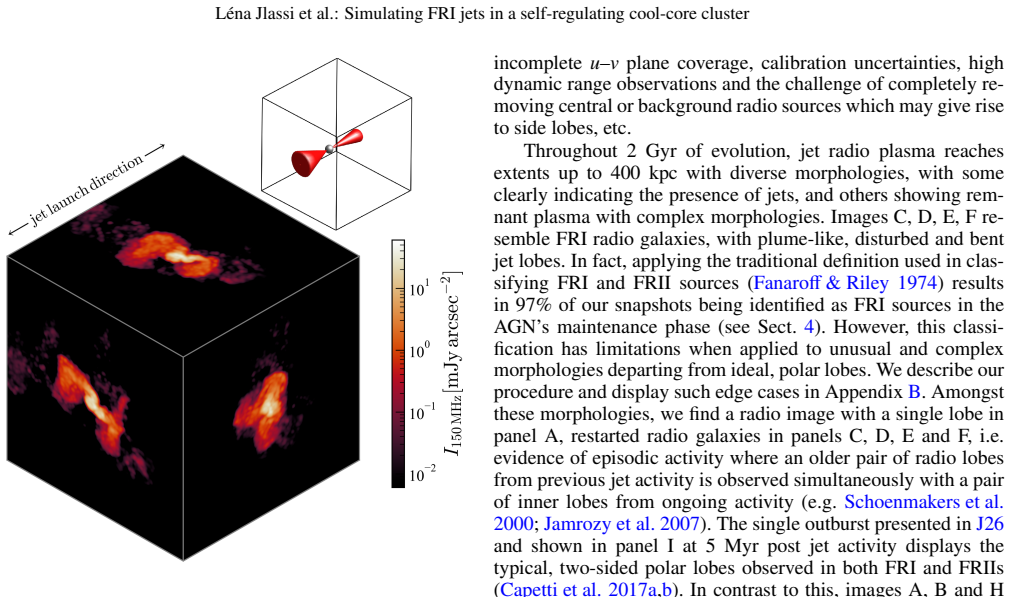
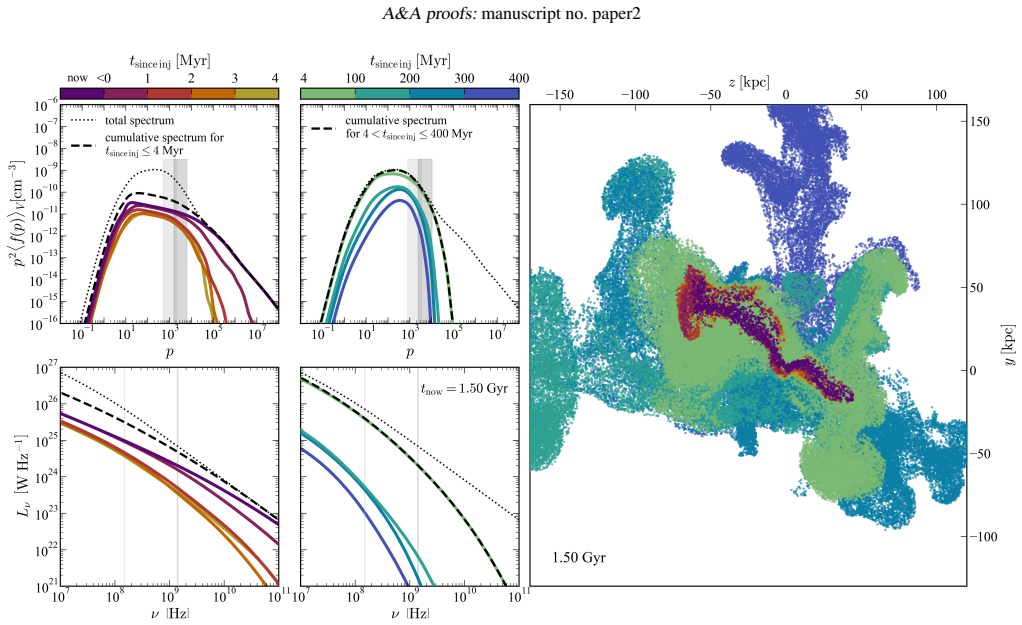
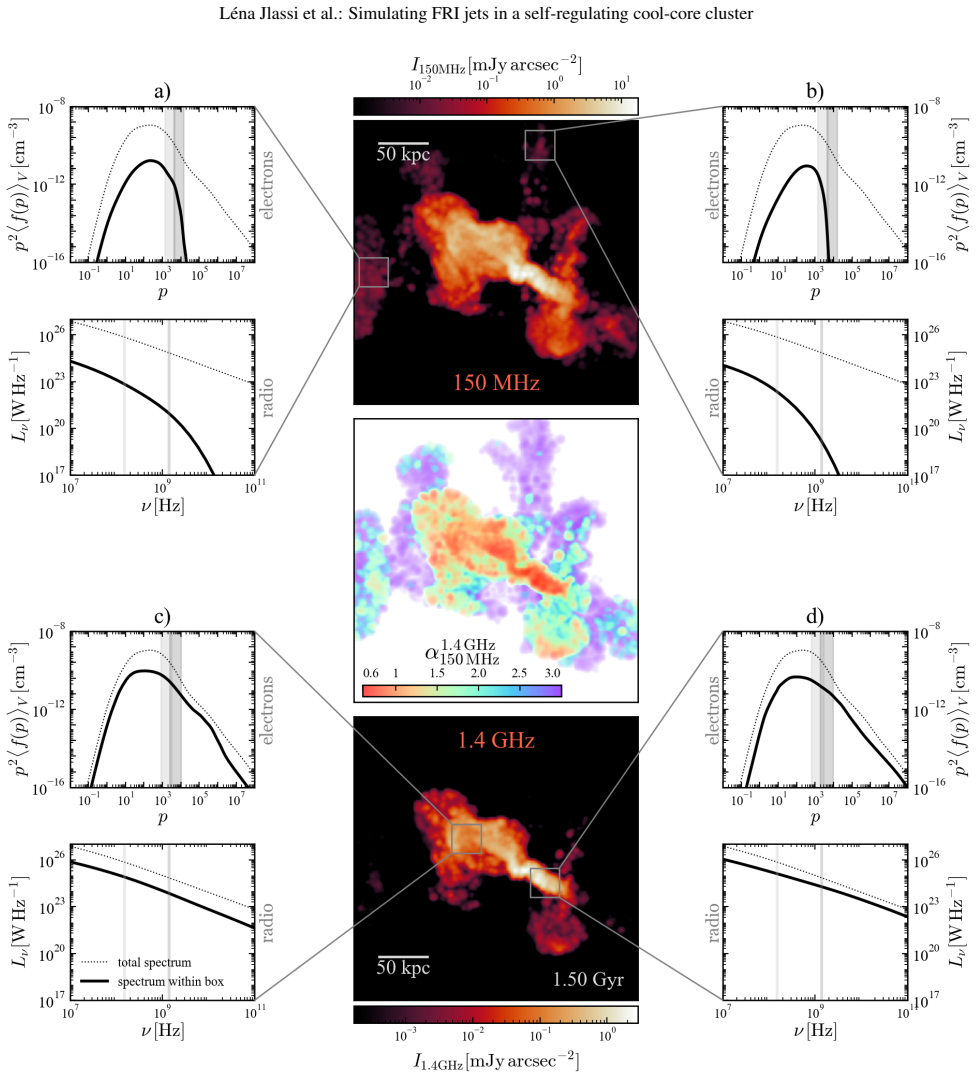
Self-regulated AGN jets stabilize the cool-core cluster against cooling flows and produce realistic Fanaroff-Riley I (FRI) and disturbed lobe morphologies, in contrast to symmetrical lobe structures obtained with a single jet outburst of fixed power. Our mock radio observations are viewed in a blazar configuration - along the jet axis - and exhibit complex radio-emitting lobe structures despite this. This highlights the strong deflection of light jets by cold gas structures and suggests that small-scale black hole and jet properties cannot be inferred from kpc-scale FRI radio lobe morphologies. Combining self-consistently evolved magnetic fields and electron spectra enables us to explain a k
What carries the argument
Self-regulating accretion-powered low-density AGN jets with a sub-grid cosmic ray acceleration model, using the Crest Fokker-Planck solver to evolve electron spectra along Lagrangian tracers and compute radio synchrotron emission.
If this is right
- Self-regulated jets maintain thermal balance in the cluster core by responding to accretion rates.
- Disturbed FRI morphologies arise primarily from jet deflection by cold gas rather than variations in jet power.
- Small-scale properties of the central black hole and jets cannot be directly read from observed kpc-scale lobe shapes.
- Both young and old cosmic ray electrons contribute to radio emission across 150 MHz to 1.4 GHz in typical cool-core magnetic fields.
Where Pith is reading between the lines
- Jet deflection by cold gas structures may be a general process limiting what can be inferred about jet launching from large-scale radio maps.
- The same simulation framework could be used to predict how radio morphologies evolve in clusters with different masses or dynamical states.
- If the sub-grid cosmic ray model is accurate, these simulations provide a way to interpret upcoming wide-field radio surveys of galaxy clusters.
Load-bearing premise
The sub-grid model used to accelerate cosmic ray protons and electrons by the jets, when combined with the Fokker-Planck evolution in Crest along Lagrangian tracers, produces radio synchrotron emission that accurately represents real observations.
What would settle it
If multi-frequency radio maps of cool-core clusters like Perseus show symmetric lobes despite ongoing AGN activity, or if lobe spatial extents differ markedly between 150 MHz and 1.4 GHz in regions with 1-50 microGauss fields, the central claims would be challenged.
Figures
read the original abstract
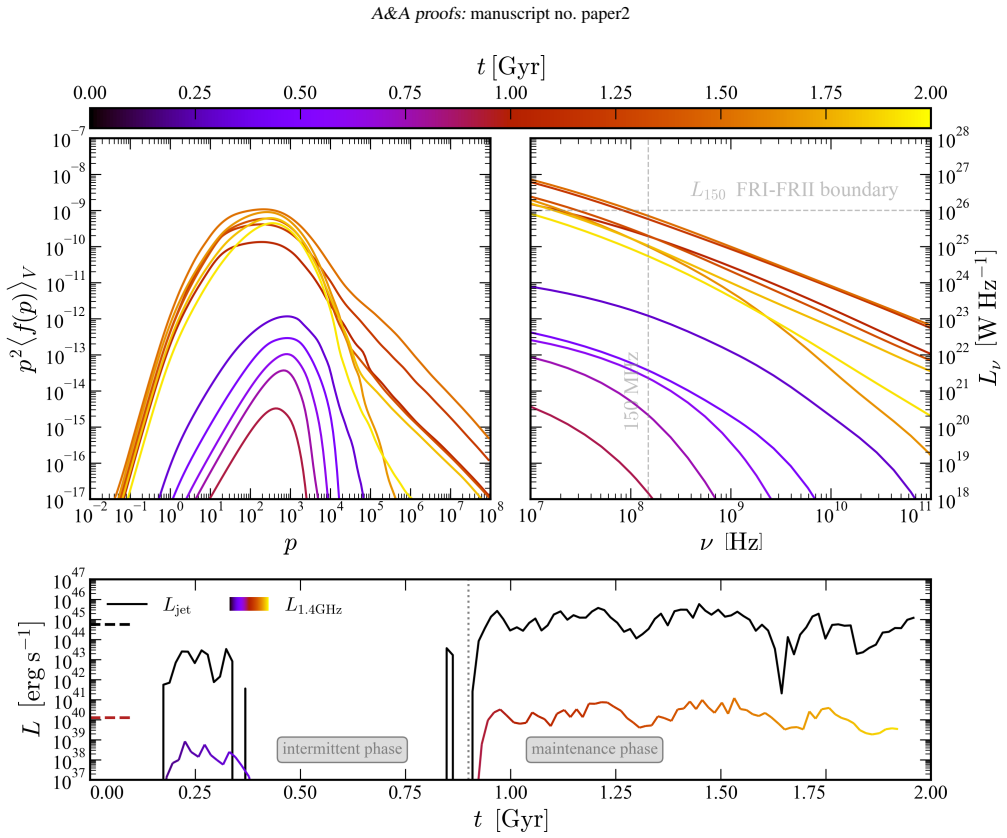
Active galactic nucleus (AGN) jets radiate radio synchrotron emission displaying a wide range of morphologies. At the same time, they provide heat to prevent cooling flows in cool-core galaxy clusters. We produce mock radio observations of AGN jets in a self-regulating cool-core galaxy cluster. To this end, we employ magneto-hydrodynamical simulations of an idealised Perseus-like galaxy cluster, in which accretion-powered low-density jets accelerate cosmic ray protons and electrons by means of a sub-grid model. Cosmic ray electron spectra are spatially and temporally evolved along Lagrangian tracer trajectories using the Fokker-Planck solver Crest to produce radio synchrotron emission. Self-regulated AGN jets stabilize the cool-core cluster against cooling flows and produce realistic Fanaroff-Riley I (FRI) and disturbed lobe morphologies, in contrast to symmetrical lobe structures obtained with a single jet outburst of fixed power. Our mock radio observations are viewed in a blazar configuration - along the jet axis - and exhibit complex radio-emitting lobe structures despite this. This highlights the strong deflection of light jets by cold gas structures and suggests that small-scale black hole and jet properties cannot be inferred from kpc-scale FRI radio lobe morphologies. Combining self-consistently evolved magnetic fields and electron spectra enables us to explain a known observational phenomenon, whereby radio observations of AGN lobes on galaxy cluster scales occasionally display similar spatial extents at different frequencies: in 1-50 $\mu$G magnetic fields obtained in our cool-core environment, both freshly accelerated and hundreds-of-Myr-old electrons are able to contribute to the 150 MHz - 1.4 GHz frequency range.
Editorial analysis
A structured set of objections, weighed in public.
Referee Report
Summary. The manuscript presents MHD simulations of an idealized Perseus-like cool-core cluster in which accretion-powered jets self-regulate via a sub-grid cosmic-ray acceleration model. Electron spectra are evolved along Lagrangian tracers with the Crest Fokker-Planck solver to generate mock synchrotron maps viewed along the jet axis; the central claims are that these self-regulated jets stabilize the core against cooling flows, produce realistic FRI and disturbed lobe morphologies (unlike symmetric lobes from fixed-power outbursts), and explain the observational fact of similar lobe extents at 150 MHz–1.4 GHz in the simulated 1–50 μG fields.
Significance. If the mock radio images are shown to be quantitatively consistent with observations, the work would strengthen the case that self-regulated AGN feedback can simultaneously quench cooling flows and reproduce complex FRI structures. A clear strength is the self-consistent coupling of evolved magnetic fields with the Crest-evolved electron spectra, which directly addresses the frequency-extent puzzle without ad-hoc assumptions about electron populations.
major comments (2)
- [Abstract] Abstract: the headline claim that the simulations 'produce realistic Fanaroff-Riley I (FRI) and disturbed lobe morphologies' is load-bearing for the paper's main result, yet the abstract (and the provided summary) supplies no quantitative metrics such as lobe asymmetry indices, surface-brightness profiles, or direct spectral-index comparisons to observed Perseus FRI sources; without these, it is impossible to assess whether the sub-grid CR model plus Crest evolution actually reproduces the target morphologies.
- [Abstract] Abstract: the explanation that 'both freshly accelerated and hundreds-of-Myr-old electrons are able to contribute to the 150 MHz–1.4 GHz frequency range' in 1–50 μG fields rests on the accuracy of the unspecified sub-grid CR acceleration efficiency and the subsequent Fokker-Planck losses; no calibration, sensitivity tests, or comparison of predicted luminosities/spectral indices against real Perseus data are described, directly affecting the robustness of both the morphological and frequency-extent claims.
minor comments (1)
- [Abstract] The term 'blazar configuration' for the line-of-sight viewing angle should be defined or replaced with a clearer description of the projection geometry.
Simulated Author's Rebuttal
We thank the referee for their constructive comments on our manuscript. We respond to each major comment below.
read point-by-point responses
-
Referee: [Abstract] Abstract: the headline claim that the simulations 'produce realistic Fanaroff-Riley I (FRI) and disturbed lobe morphologies' is load-bearing for the paper's main result, yet the abstract (and the provided summary) supplies no quantitative metrics such as lobe asymmetry indices, surface-brightness profiles, or direct spectral-index comparisons to observed Perseus FRI sources; without these, it is impossible to assess whether the sub-grid CR model plus Crest evolution actually reproduces the target morphologies.
Authors: We agree that the abstract's use of 'realistic' would be strengthened by quantitative metrics. The manuscript demonstrates the key physical result through direct comparison: self-regulated jets produce complex, disturbed lobe structures via deflection by cold gas, in contrast to the symmetric lobes from fixed-power outbursts. This qualitative distinction is shown in the figures and arises self-consistently from the simulation physics. We will revise the abstract to state that the simulations 'produce complex FRI-like and disturbed lobe morphologies' to more accurately reflect the nature of the comparison presented. revision: partial
-
Referee: [Abstract] Abstract: the explanation that 'both freshly accelerated and hundreds-of-Myr-old electrons are able to contribute to the 150 MHz–1.4 GHz frequency range' in 1–50 μG fields rests on the accuracy of the unspecified sub-grid CR acceleration efficiency and the subsequent Fokker-Planck losses; no calibration, sensitivity tests, or comparison of predicted luminosities/spectral indices against real Perseus data are described, directly affecting the robustness of both the morphological and frequency-extent claims.
Authors: The sub-grid cosmic-ray acceleration model, including the efficiency parameter, is fully specified in the methods section, with values drawn from standard AGN jet models. Magnetic fields are evolved self-consistently in the MHD simulation and reach 1–50 μG in the lobe regions. The Crest Fokker-Planck solver then evolves the electron spectra including all relevant losses. This setup directly shows that, for these B-field strengths, synchrotron frequencies in the 150 MHz–1.4 GHz range receive contributions from both young and old electrons. The simulation is idealized and not tuned to match specific Perseus luminosities or spectral indices; the goal is to illustrate the mechanism for frequency-independent extents. We will add a short paragraph in the revised manuscript discussing the model assumptions and parameter choices. revision: partial
Circularity Check
No circularity: forward simulation chain is self-contained
full rationale
The derivation proceeds via explicit MHD simulations of a Perseus-like cluster, sub-grid jet-powered CR acceleration, Lagrangian tracer evolution with the external Crest Fokker-Planck solver, and post-processed synchrotron maps. No parameter is fitted to the target FRI morphologies, no self-citation supplies a uniqueness theorem or ansatz that forces the outcome, and the contrast to fixed-power outbursts follows directly from the self-regulated accretion model rather than from re-labeling inputs. The central claims therefore remain independent of the reported results.
Axiom & Free-Parameter Ledger
free parameters (2)
- jet power response function
- cosmic-ray acceleration efficiency
axioms (2)
- domain assumption Idealised Perseus-like initial conditions accurately represent a real cool-core cluster
- domain assumption Crest Fokker-Planck solver correctly evolves electron spectra under the simulated conditions
Forward citations
Cited by 2 Pith papers
-
The PICO-Cluster Project: presenting the galaxy cluster sample and studying magnetic field growth, Faraday rotation and Braginskii heating
Presents 24 AREPO+IllustrisTNG zoom-in simulations of clusters above 10^15 solar masses showing converged magnetic fields with volume-averaged plasma beta approximately 100 inside R200 after z~1.2, declining Faraday r...
-
Active galactic nucleus driven jet feedback in cosmologically forming cool-core galaxy clusters I: The effect of hierarchical assembly on intra-cluster medium properties
Cosmological simulations with AGN jet feedback reproduce observed cool-core cluster ICM properties more accurately than isolated simulations or IllustrisTNG due to merger-driven effects on gas velocity and warm gas abundance.
Reference graph
Works this paper leans on
-
[1]
The link between accretion mode and environment in radio-loud active galaxies
The link between accretion mode and environment in radio-loud active galaxies. , keywords =. doi:10.1093/mnras/stv1807 , archivePrefix =. 1508.01033 , primaryClass =
work page internal anchor Pith review Pith/arXiv arXiv doi:10.1093/mnras/stv1807
-
[2]
AGN jet feedback on a moving mesh: cocoon inflation, gas flows and turbulence
AGN jet feedback on a moving mesh: cocoon inflation, gas flows and turbulence. , keywords =. doi:10.1093/mnras/stx2269 , archivePrefix =. 1705.07900 , primaryClass =
work page internal anchor Pith review Pith/arXiv arXiv doi:10.1093/mnras/stx2269
-
[3]
Influence of AGN jets on the magnetized ICM. , keywords =. doi:10.1111/j.1745-3933.2009.00721.x , archivePrefix =. 0905.3345 , primaryClass =
-
[4]
On the fundamental dichotomy in the local radio-AGN population: accretion, evolution and host galaxy properties. , keywords =. doi:10.1111/j.1365-2966.2012.20414.x , archivePrefix =. 1201.2397 , primaryClass =
-
[5]
Radio AGN in the local universe: unification, triggering and evolution
Radio AGN in the local universe: unification, triggering and evolution. , keywords =. doi:10.1007/s00159-016-0094-x , archivePrefix =. 1605.08773 , primaryClass =
work page internal anchor Pith review Pith/arXiv arXiv doi:10.1007/s00159-016-0094-x
-
[6]
Cosmic Ray Heating of the Warm Ionized Medium
Cosmic Ray Heating of the Warm Ionized Medium. , keywords =. doi:10.1088/0004-637X/767/1/87 , archivePrefix =. 1301.4445 , primaryClass =
work page internal anchor Pith review Pith/arXiv arXiv doi:10.1088/0004-637x/767/1/87
-
[7]
Annual Review of Nuclear and Particle Science , keywords =
Cosmic-Ray Propagation and Interactions in the Galaxy. Annual Review of Nuclear and Particle Science , keywords =. doi:10.1146/annurev.nucl.57.090506.123011 , archivePrefix =. astro-ph/0701517 , primaryClass =
-
[8]
X-ray study of a sample of FR0 radio galaxies: unveiling the nature of the central engine
X-ray study of a sample of FR0 radio galaxies: unveiling the nature of the central engine. , keywords =. doi:10.1093/mnras/sty520 , archivePrefix =. 1802.08581 , primaryClass =
work page internal anchor Pith review Pith/arXiv arXiv doi:10.1093/mnras/sty520
-
[9]
Additional planets and stellar models
Jet-regulated cooling catastrophe. , keywords =. doi:10.1111/j.1365-2966.2010.17338.x , archivePrefix =. 1004.1851 , primaryClass =
-
[10]
FR-type radio sources at 3 GHz VLA-COSMOS: Relation to physical properties and large-scale environment. , keywords =. doi:10.1051/0004-6361/202039488 , archivePrefix =. 2009.10721 , primaryClass =
-
[11]
The Dynamic Evolution of Young Extragalactic Radio Sources
The Dynamic Evolution of Young Extragalactic Radio Sources. , keywords =. doi:10.1088/0004-637X/760/1/77 , archivePrefix =. 1211.1760 , primaryClass =
work page internal anchor Pith review Pith/arXiv arXiv doi:10.1088/0004-637x/760/1/77
-
[12]
The Theory of Resonant Cosmic Ray─driven Instabilities Growth and Saturation of Single Modes. , keywords =. doi:10.3847/1538-4357/ad8eb3 , archivePrefix =. 2406.04400 , primaryClass =
-
[13]
Journal of Plasma Physics , keywords =
Deciphering the physical basis of the intermediate-scale instability. Journal of Plasma Physics , keywords =. doi:10.1017/S0022377823001289 , archivePrefix =. 2305.18050 , primaryClass =
-
[14]
How supermassive black holes shape central entropies in galaxy clusters. , keywords =. doi:10.1051/0004-6361/202558710 , archivePrefix =. 2601.20932 , primaryClass =
-
[15]
What is a cool-core cluster? a detailed analysis of the cores of the X-ray flux-limited HIFLUGCS cluster sample. , keywords =. doi:10.1051/0004-6361/200912377 , archivePrefix =. 0911.0409 , primaryClass =
work page internal anchor Pith review Pith/arXiv arXiv doi:10.1051/0004-6361/200912377
-
[16]
arXiv e-prints , keywords =
Revisiting radio synchrotron diagnostics in star-forming galaxies. arXiv e-prints , keywords =
-
[17]
Ackermann, M. and Ajello, M. and Allafort, A. and Baldini, L. and Ballet, J. and Barbiellini, G. and Bastieri, D. and Bechtol, K. and Bellazzini, R. and Blandford, R. D. and Blasi, P. and Bloom, E. D. and Bonamente, E. and Borgland, A. W. and Bouvier, A. and Brandt, T. J. and Bregeon, J. and Brigida, M. and Bruel, P. and Buehler, R. and Buson, S. and Cali...
-
[18]
Ackermann, M. and Ajello, M. and Albert, A. and Allafort, A. and Atwood, W. B. and Baldini, L. and Ballet, J. and Barbiellini, G. and Bastieri, D. and Bechtol, K. and Bellazzini, R. and Bloom, E. D. and Bonamente, E. and Bottacini, E. and Brandt, T. J. and Bregeon, J. and Brigida, M. and Bruel, P. and Buehler, R. and Buson, S. and Caliandro, G. A. and Cam...
-
[19]
Angular, Spectral, and Time Distributions of Highest Energy Protons and Associated Secondary Gamma-Rays and Neutrinos Propagating through Extragalactic Magnetic and Radiation Fields , author =. Physical Review D , volume =. doi:10.1103/PhysRevD.82.043002 , urldate =. arXiv , langid =:1006.1045 , primaryclass =
work page internal anchor Pith review Pith/arXiv arXiv doi:10.1103/physrevd.82.043002
-
[20]
, archivePrefix = "arXiv", eprint =
The Quiescent Intracluster Medium in the Core of the Perseus Cluster , author =. Nature , volume =. doi:10.1038/nature18627 , urldate =
-
[21]
Ahnen, M. L. and Ansoldi, S. and Antonelli, L. A. and Antoranz, P. and Babic, A. and Banerjee, B. and Bangale, P. and Barres De Almeida, U. and Barrio, J. A. and Becerra Gonz. Deep Observation of the. , volume =. doi:10.1051/0004-6361/201527846 , urldate =
-
[22]
Aleksi. , volume =. doi:10.1088/0004-637X/710/1/634 , urldate =
-
[23]
Aleksi. Letters , volume =. doi:10.1088/2041-8205/723/2/L207 , urldate =
-
[24]
Aleksi. Detection of Very-High Energy. , volume =. doi:10.1051/0004-6361/201118668 , urldate =
-
[25]
Constraining Cosmic Rays and Magnetic Fields in the
Aleksi. Constraining Cosmic Rays and Magnetic Fields in the. , volume =. doi:10.1051/0004-6361/201118502 , urldate =
-
[26]
doi:10.48550/arXiv.2505.05675 , urldate =
Entropy Plateaus Can Emerge from Gas Replacement at a Characteristic Halo Mass in Simulated Groups and Clusters of Galaxies , author =. doi:10.48550/arXiv.2505.05675 , urldate =. arXiv , langid =:2505.05675 , primaryclass =
-
[27]
The Effect of Extended Radio Emission on
Amarantidis, Stergios and Farrah, Duncan and Seymour, Nick and Lacy, Mark and Breda, Iris and Ziegler, Bodo and Piana, Olmo and. The Effect of Extended Radio Emission on. doi:10.48550/arXiv.2510.05845 , urldate =. arXiv , langid =:2510.05845 , primaryclass =
-
[28]
Anderson, C. S. and Gaensler, B. M. and Heald, G. H. and O'Sullivan, S. P. and Kaczmarek, J. F. and Feain, I. J. , year = 2018, month = mar, journal =. Broadband Radio Polarimetry of Fornax a. doi:10.3847/1538-4357/aaaec0 , urldate =
-
[29]
Axford, W. I. and Leer, E. and Skadron, G. , year = 1977, month = jan, volume =. The Acceleration of Cosmic Rays by Shock Waves , booktitle =
1977
-
[30]
and Capetti, Alessandro and Giovannini, Gabriele , year = 2015, month = apr, journal =
Baldi, Ranieri D. and Capetti, Alessandro and Giovannini, Gabriele , year = 2015, month = apr, journal =. Pilot Study of the Radio-Emitting. doi:10.1051/0004-6361/201425426 , urldate =
-
[31]
Baldi, Ranieri D and Capetti, Alessandro and Giovannini, Gabriele , year = 2019, month = jan, journal =. High-Resolution. doi:10.1093/mnras/sty2703 , urldate =
-
[32]
Beckmann, R S and Devriendt, J and Slyz, A , year = 2019, month = mar, journal =. Zooming in on Supermassive Black Holes: How Resolving Their Gas Cloud Host Renders Their Accretion Episodic , shorttitle =. doi:10.1093/mnras/sty2890 , urldate =
-
[33]
Beckmann, R. S. and Dubois, Y. and Guillard, P. and Salome, P. and Olivares, V. and Polles, F. and Cadiou, C. and Combes, F. and Hamer, S. and Lehnert, M. D. and. Dense Gas Formation and Destruction in a Simulated. , volume =. doi:10.1051/0004-6361/201936188 , urldate =
-
[34]
Cosmic Rays and Thermal Instability in Self-Regulating Cooling Flows of Massive Galaxy Clusters , author =. , volume =. doi:10.1051/0004-6361/202142527 , urldate =
-
[35]
Bell, A. R. , year = 1978, month = jan, journal =. The Acceleration of Cosmic Rays in Shock Fronts -. doi:10.1093/mnras/182.2.147 , urldate =
-
[36]
Bell, A. R. , year = 1978, month = mar, journal =. The Acceleration of Cosmic Rays in Shock Fronts --. doi:10.1093/mnras/182.3.443 , urldate =
-
[37]
On the Origin of the Ancient, Large-scale Cold Front in the Perseus Cluster of Galaxies. , keywords =. doi:10.3847/1538-4357/ad6e83 , archivePrefix =. 2310.09422 , primaryClass =
-
[38]
Disentangling AGN Feedback and Sloshing in the Perseus Cluster with XRISM: Insights from Simulations. arXiv e-prints , keywords =. doi:10.48550/arXiv.2512.12754 , archivePrefix =. 2512.12754 , primaryClass =
-
[39]
Berlok, Thomas and Jlassi, L. Paicos: A Python Package for Analysis of (Cosmological)Simulations Performed with Arepo , shorttitle =. Journal of Open Source Software , volume =. doi:10.21105/joss.06296 , urldate =
-
[40]
Best, P. N. and Von Der Linden, A. and Kauffmann, G. and Heckman, T. M. and Kaiser, C. R. , year = 2007, month = aug, journal =. On the Prevalence of Radio-Loud Active Galactic Nuclei in Brightest Cluster Galaxies: Implications for. doi:10.1111/j.1365-2966.2007.11937.x , urldate =
-
[41]
A Simulation Study of Low-power Relativistic Jets: Flow Dynamics and Radio Morphology of FR-I Jets. , keywords =. doi:10.3847/1538-4357/ad83cc , archivePrefix =. 2409.18416 , primaryClass =
-
[42]
Relativistic Jets and the Fanaroff-Riley Classification of Radio Galaxies , author =. , volume =. doi:10.1086/192232 , urldate =
-
[43]
A Systematic Study of Radio-Induced X-ray Cavities in Clusters, Groups, and Galaxies
A Systematic Study of Radio-Induced x-Ray Cavities in Clusters, Groups, and Galaxies , author =. , volume =. doi:10.1086/383519 , urldate =. arXiv , langid =:astro-ph/0402348 , pages =
work page internal anchor Pith review Pith/arXiv arXiv doi:10.1086/383519
-
[44]
Radiative Efficiency and Content of Extragalactic Radio Sources:
B. Radiative Efficiency and Content of Extragalactic Radio Sources:. , volume =. doi:10.1086/591416 , urldate =
-
[45]
B. , volume =. doi:10.1093/mnras/staa1594 , urldate =. arXiv , langid =:2006.09708 , primaryclass =
-
[46]
The Astrophysical Journal Letters , keywords =
Particle Acceleration by Astrophysical Shocks. , author =. , volume =. doi:10.1086/182658 , urldate =
-
[47]
Relativistic Jets in Active Galactic Nuclei , author =. Annual Review of , volume =. doi:10.1146/annurev-astro-081817-051948 , urldate =. arXiv , langid =:1812.06025 , primaryclass =
-
[48]
On the Dynamical Role of Cosmic Rays in Cooling Flows in Clusters of Galaxies , author =. , volume =. doi:10.1086/166497 , urldate =
-
[49]
Boehringer, H. and Voges, W. and Fabian, A. C. and Edge, A. C. and Neumann, D. M. , year = 1993, month = oct, journal =. A. doi:10.1093/mnras/264.1.L25 , urldate =
-
[50]
Crescendo: An on-the-Fly Fokker--Planck Solver for Spectral Cosmic Rays in Cosmological Simulations , author =. , volume =. doi:10.1093/mnras/stac3584 , urldate =
-
[51]
B. A Formation Mechanism for ``. Letters , volume =. doi:10.3847/2041-8213/ad03f7 , urldate =
-
[52]
Galaxy Cluster Simulations with a Spectral Cosmic Ray Model -- "
B. Galaxy Cluster Simulations with a Spectral Cosmic Ray Model -- ". arXiv , keywords =:2308.00448 , primaryclass =
-
[53]
B. Simulating the. doi:10.48550/arXiv.2510.15634 , urldate =. arXiv , langid =:2510.15634 , primaryclass =
-
[54]
Botteon, A. and Shimwell, T. W. and Cassano, R. and Cuciti, V. and Zhang, X. and Bruno, L. and Camillini, L. and Natale, R. and Jones, A. and Gastaldello, F. and Simionescu, A. and Rossetti, M. and Akamatsu, H. and Van Weeren, R. J. and Brunetti, G. and Br. The. , volume =. doi:10.1051/0004-6361/202143020 , urldate =
-
[55]
doi:10.1093/mnras/stab1662 , urldate =
Bourne, Martin A and Sijacki, Debora , year = 2021, month = jul, journal =. doi:10.1093/mnras/stab1662 , urldate =
-
[56]
Recent Progress in Modeling the Macro- and Micro-Physics of Radio Jet Feedback in Galaxy Clusters , author =. Galaxies , volume =. doi:10.3390/galaxies11030073 , urldate =. arXiv , keywords =:2305.00019 , primaryclass =
-
[57]
Brienza, M. and Morganti, R. and Shulevski, A. and Godfrey, L. and Vilchez, N. , year = 2016, journal =. A. doi:10.1002/asna.201512260 , urldate =
-
[58]
Brienza, M. and Godfrey, L. and Morganti, R. and Prandoni, I. and Harwood, J. and Mahony, E. K. and Hardcastle, M. J. and Murgia, M. and R. Search and Modelling of Remnant Radio Galaxies in the. , volume =. doi:10.1051/0004-6361/201730932 , urldate =
-
[59]
Brienza, M. and Morganti, R. and Harwood, J. and Duchet, T. and Rajpurohit, K. and Shulevski, A. and Hardcastle, M. J. and Mahatma, V. and Godfrey, L. E. H. and Prandoni, I. and Shimwell, T. W. and Intema, H. , year = 2020, month = jun, journal =. Radio Spectral Properties and Jet Duty Cycle in the Restarted Radio Galaxy. doi:10.1051/0004-6361/202037457 ,...
-
[60]
Brienza, M. and Shimwell, T. W. and. A Snapshot of the Oldest. Nature Astronomy , volume =. doi:10.1038/s41550-021-01491-0 , urldate =. arXiv , keywords =:2110.09189 , primaryclass =
-
[61]
Brienza, M. and Lovisari, L. and Rajpurohit, K. and Bonafede, A. and Gastaldello, F. and Murgia, M. and Vazza, F. and Bonnassieux, E. and Botteon, A. and Brunetti, G. and Drabent, A. and Hardcastle, M. J. and Pasini, T. and Riseley, C. J. and R. The Galaxy Group. , volume =. doi:10.1051/0004-6361/202142579 , urldate =
-
[62]
Brienza, M. and Gilli, R. and Prandoni, I. and D'Amato, Q. and Rajpurohit, K. and Calura, F. and Chiaberge, M. and Comastri, A. and Iwasawa, K. and Lanzuisi, G. and Liuzzo, E. and Marchesi, S. and Mignoli, M. and Miley, G. and Norman, C. and Peca, A. and Raciti, M. and Shimwell, T. and Tozzi, P. and Vignali, C. and Vitello, F. and Vito, F. , year = 2023, ...
-
[63]
Brienza, M. and Rajpurohit, K. and Churazov, E. and Heywood, I. and Br. Non-Thermal Filaments and. , volume =. doi:10.1051/0004-6361/202553676 , urldate =
-
[64]
Brienza, M. and Rajpurohit, K. and Churazov, E. and Heywood, I. and Br. Non-Thermal Filaments and. doi:10.48550/arXiv.2502.18244 , urldate =. arXiv , langid =:2502.18244 , primaryclass =
-
[65]
The propagation of relativistic jets in external media
The Propagation of Relativistic Jets in External Media , author =. , volume =. doi:10.1088/0004-637X/740/2/100 , urldate =. arXiv , langid =:1107.1326 , primaryclass =
work page internal anchor Pith review Pith/arXiv arXiv doi:10.1088/0004-637x/740/2/100
-
[66]
Cosmic rays in galaxy clusters and their non-thermal emission
Cosmic Rays in Galaxy Clusters and Their Non-Thermal Emission , author =. International Journal of Modern Physics D , volume =. doi:10.1142/S0218271814300079 , urldate =. arXiv , langid =:1401.7519 , primaryclass =
work page internal anchor Pith review Pith/arXiv arXiv doi:10.1142/s0218271814300079
-
[67]
Bruno, L. and Botteon, A. and Dallacasa, D. and Venturi, T. and Balboni, M. and Biava, N. and Brienza, M. and Br. Resurging from the Ashes:. doi:10.48550/arXiv.2510.05673 , urldate =. arXiv , langid =:2510.05673 , primaryclass =
-
[68]
Candini, S. and Brienza, M. and Bonafede, A. and Rajpurohit, K. and Biava, N. and Murgia, M. and Loi, F. and Van Weeren, R. J. and Vazza, F. , year = 2023, month = sep, journal =. New Filamentary Remnant Radio Emission and Duty Cycle Constraints in the Radio Galaxy. doi:10.1051/0004-6361/202347036 , urldate =
-
[69]
Capetti, A. and Massaro, F. and Baldi, R. D. , year = 2017, month = feb, journal =. doi:10.1051/0004-6361/201629287 , urldate =
-
[70]
Capetti, A. and Massaro, F. and Baldi, R. D. , year = 2017, month = may, journal =. doi:10.1051/0004-6361/201630247 , urldate =
-
[71]
and Blasi, Pasquale , year = 2020, month = dec, journal =
Caprioli, Damiano and Haggerty, Colby C. and Blasi, Pasquale , year = 2020, month = dec, journal =. Kinetic Simulations of Cosmic-Ray-Modified Shocks. doi:10.3847/1538-4357/abbe05 , urldate =. arXiv , langid =:2009.00007 , primaryclass =
-
[72]
Particle Acceleration at Shocks:
Caprioli, Damiano , year = 2023, month = jul, number =. Particle Acceleration at Shocks:. arXiv , keywords =:2307.00284 , primaryclass =
arXiv 2023
-
[73]
Carilli, C. L. and Taylor, G. B. , year = 2002, month = sep, journal =. Cluster. doi:10.1146/annurev.astro.40.060401.093852 , urldate =
-
[74]
A Relationship between Agn Jet Power and Radio Power , author =. , volume =. doi:10.1088/0004-637X/720/2/1066 , urldate =
-
[75]
An Entropy Threshold for Strong H-alpha and Radio Emission in the Cores of Galaxy Clusters
An Entropy Threshold for Strong H and Radio Emission in the Cores of Galaxy Clusters. , keywords =. doi:10.1086/591665 , archivePrefix =. 0806.0382 , primaryClass =
work page internal anchor Pith review Pith/arXiv arXiv doi:10.1086/591665
-
[76]
Extreme Ion Acceleration at Extragalactic Jet Termination Shocks , author =. , volume =. doi:10.1051/0004-6361/202346481 , urldate =
-
[77]
Jets, Bubbles, and Heat Pumps in Galaxy Clusters , author =. , volume =. doi:10.1093/mnras/stz2256 , urldate =
-
[78]
A Numerical Study of the Impact of Jet Magnetic Topology on Radio Galaxy Evolution , author =. , volume =. doi:10.1093/mnras/stad1074 , urldate =
-
[79]
S., Ruszkowski, M., Werhahn, M., Pfrommer, C., & Thomas, T
Robust Magnetic Field Estimates in Star-Forming Galaxies with the Equipartition Formula in the Absence of Equipartition , author =. doi:10.48550/arXiv.2510.03229 , urldate =. arXiv , langid =:2510.03229 , primaryclass =
-
[80]
Chiu 邱, H.-H. Sandy 懷萱 and Ruszkowski, Mateusz and Thomas, Timon and Werhahn, Maria and Pfrommer, Christoph , year = 2024, month = nov, journal =. Simulating. doi:10.3847/1538-4357/ad84e9 , urldate =
discussion (0)
Sign in with ORCID, Apple, or X to comment. Anyone can read and Pith papers without signing in.