INTACT: Ego-Guided Typed Sparse Evidence Retrieval for Heterogeneous Collaborative Perception
Reviewed by Pith T0 review T1 audit T2 compute T3 formal T4 kernel 2026-06-28 07:15 UTCgrok-4.3pith:XPRJDEGKrecord.jsonopen to challenge →

The pith
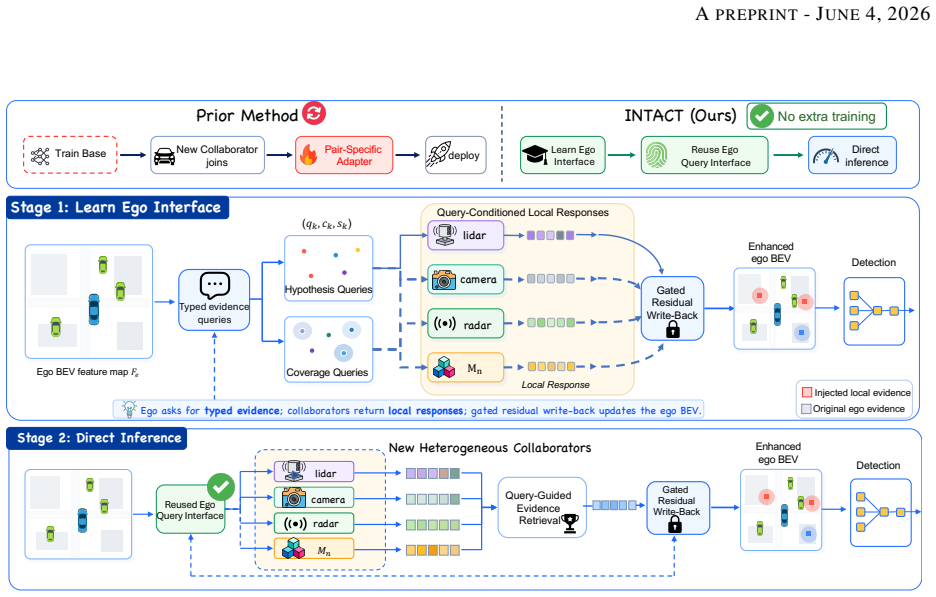
INTACT lets an ego vehicle issue typed queries for local evidence from heterogeneous collaborators, enabling zero-training insertion via checkpoint merging.
A machine-rendered reading of the paper's core claim, the machinery that carries it, and where it could break.
Core claim
INTACT is an ego-guided typed sparse evidence retrieval framework. Instead of translating an entire collaborator feature map, the ego issues typed evidence queries that express suspected objects and evidence-deficient regions. Collaborators respond only with local evidence at the queried locations; the ego selects useful responses through sparse per-query routing and injects them through gated residual write-back. This changes the compatibility requirement from global feature-map interpretability to local, typed response comparability under ego-issued queries, enabling a zero-training heterogeneous insertion protocol in which the ego interface is trained once and new collaborators join throu
What carries the argument
Ego-issued typed evidence queries that elicit local comparable responses, combined with sparse per-query routing and gated residual write-back for injection.
If this is right
- On OPV2V-H the method reaches 80.1 AP70 using 0.52M extra parameters and 18.0 log2 communication volume, roughly 16 times less than dense feature transmission.
- On DAIR-V2X the method reaches 43.8 AP50 under real-world heterogeneous conditions.
- The ego interface trains once; any new collaborator joins by checkpoint merge without further adaptation.
- Communication volume drops because only sparse local evidence travels instead of full feature maps.
Where Pith is reading between the lines
- The same query-response pattern could let a fleet mix models trained on entirely separate datasets without pairwise translators.
- Sparse routing may integrate with existing low-bandwidth V2V channels already deployed in vehicles.
- If local comparability generalizes, the protocol could extend to tasks beyond 3D detection such as segmentation or tracking across mixed sensor suites.
Load-bearing premise
Heterogeneous collaborator models can produce locally comparable evidence at ego-issued query locations that is selectable via sparse per-query routing without global alignment or adaptation.
What would settle it
Insert a new collaborator model via checkpoint merge only and measure whether its local evidence responses produce any measurable gain in ego detection accuracy over the ego-only baseline.
Figures


read the original abstract
Collaborative perception extends the perceptual range of autonomous vehicles by sharing information across agents, but heterogeneous sensors and perception models make intermediate feature fusion difficult to deploy at scale. Existing heterogeneous collaboration methods typically follow a translation-first paradigm: collaborator features must be aligned, adapted, or projected into an ego-compatible space before fusion. Such feature-compatibility contracts improve fixed-system performance, but they couple deployment to collaborator-specific adaptation and make newly joined heterogeneous agents costly to integrate. To address this gap, we propose INTACT, an ego-guided typed sparse evidence retrieval framework for heterogeneous collaborative perception. Instead of translating an entire collaborator feature map, INTACT lets the ego vehicle issue typed evidence queries that express suspected objects and evidence-deficient regions. Collaborators respond only with local evidence at queried locations, and the ego selects useful responses through sparse per-query routing and injects them through gated residual write-back. This changes the compatibility requirement from global feature-map interpretability to local, typed response comparability under ego-issued queries, enabling a zero-training heterogeneous insertion protocol in which the ego interface is trained once and new collaborators join through checkpoint merging. Extensive experiments on simulated and real-world heterogeneous collaborative perception benchmarks validate the effectiveness and deployability of INTACT. On OPV2V-H, INTACT achieves 80.1 AP70 with only 0.52M additional parameters and 18.0 $\log_2$ communication volume, corresponding to about 16$\times$ compression over dense feature transmission. On DAIR-V2X, INTACT achieves 43.8 AP50 under challenging real-world conditions.
Editorial analysis
A structured set of objections, weighed in public.
Referee Report
Summary. The paper proposes INTACT, an ego-guided typed sparse evidence retrieval framework for heterogeneous collaborative perception. Rather than requiring global feature-map translation or adaptation, the ego issues typed queries for objects and evidence-deficient regions; collaborators return only local responses at those locations, which the ego routes sparsely and injects via gated residual write-back. This shifts the compatibility contract to local typed-response comparability and enables a zero-training insertion protocol in which the ego interface is trained once and new collaborators are added by checkpoint merging. Experiments on OPV2V-H report 80.1 AP70 with 0.52 M extra parameters and 18.0 log₂ communication volume (≈16× compression); on DAIR-V2X the method reaches 43.8 AP50.
Significance. If the central claims are supported by the full experimental protocol, the work addresses a practical deployment bottleneck in heterogeneous V2X perception by removing per-collaborator adaptation costs. The combination of query-driven sparsity, checkpoint merging, and reported compression ratios could enable more scalable multi-agent systems. The manuscript supplies concrete benchmark numbers and parameter counts that allow direct comparison with prior translation-first approaches.
minor comments (2)
- [Abstract] The abstract states an 18.0 log₂ communication volume and 16× compression but does not define the exact baseline (dense feature map size, bit-width, or entropy coding) used for the ratio; this definition should appear in §3 or §4 with an explicit equation.
- [§3] The description of typed query formulation and the sparse per-query routing mechanism would benefit from a compact pseudocode listing or a small diagram in §3 to make the zero-training insertion protocol reproducible from the text alone.
Simulated Author's Rebuttal
We thank the referee for the positive evaluation and recommendation of minor revision. The provided summary accurately captures the motivation, method, and reported results of INTACT.
Circularity Check
No significant circularity detected
full rationale
The paper introduces INTACT as an architectural shift from global feature-map translation to ego-issued typed queries with local sparse responses and gated injection, enabling zero-training collaborator insertion via checkpoint merging. This claim is grounded in the described protocol and validated through experiments on the external benchmarks OPV2V-H and DAIR-V2X with reported metrics; no equations, self-citations, or fitted parameters are shown to reduce the central result to its own inputs by construction. The derivation chain remains independent of the flagged assumptions.
Axiom & Free-Parameter Ledger
axioms (1)
- domain assumption Heterogeneous models produce locally comparable evidence under typed ego queries without global alignment
Reference graph
Works this paper leans on
-
[1]
Cooperative perception for 3d object detection in driving scenarios using infrastructure sensors.IEEE Transactions on Intelligent Transportation Systems, 23(3):1852–1864, 2020
Eduardo Arnold, Mehrdad Dianati, Robert De Temple, and Saber Fallah. Cooperative perception for 3d object detection in driving scenarios using infrastructure sensors.IEEE Transactions on Intelligent Transportation Systems, 23(3):1852–1864, 2020
2020
-
[2]
Stamp: Scalable task- and model-agnostic collaborative perception
Xiangbo Gao, Runsheng Xu, Jiachen Li, Ziran Wang, Zhiwen Fan, and Zhengzhong Tu. Stamp: Scalable task- and model-agnostic collaborative perception. InThe Thirteenth International Conference on Learning Representations, 2025
2025
-
[3]
Deep residual learning for image recognition
Kaiming He, Xiangyu Zhang, Shaoqing Ren, and Jian Sun. Deep residual learning for image recognition. In Proceedings of the IEEE conference on computer vision and pattern recognition, pages 770–778, 2016. 12 APREPRINT- JUNE4, 2026
2016
-
[4]
Where2comm: Communication-efficient collaborative perception via spatial confidence maps.Advances in neural information processing systems, 35: 4874–4886, 2022
Yue Hu, Shaoheng Fang, Zixing Lei, Yiqi Zhong, and Siheng Chen. Where2comm: Communication-efficient collaborative perception via spatial confidence maps.Advances in neural information processing systems, 35: 4874–4886, 2022
2022
-
[5]
Communication-efficient collaborative perception via information filling with codebook
Yue Hu, Juntong Peng, Sifei Liu, Junhao Ge, Si Liu, and Siheng Chen. Communication-efficient collaborative perception via information filling with codebook. InProceedings of the IEEE/CVF Conference on Computer Vision and Pattern Recognition, pages 15481–15490, 2024
2024
-
[6]
Pointpillars: Fast encoders for object detection from point clouds
Alex H Lang, Sourabh V ora, Holger Caesar, Lubing Zhou, Jiong Yang, and Oscar Beijbom. Pointpillars: Fast encoders for object detection from point clouds. InProceedings of the IEEE/CVF conference on computer vision and pattern recognition, pages 12697–12705, 2019
2019
-
[7]
Who2com: Collabo- rative perception via learnable handshake communication
Yen-Cheng Liu, Junjiao Tian, Chih-Yao Ma, Nathan Glaser, Chia-Wen Kuo, and Zsolt Kira. Who2com: Collabo- rative perception via learnable handshake communication. In2020 IEEE International Conference on Robotics and Automation (ICRA), pages 6876–6883. IEEE, 2020
2020
-
[8]
An extensible framework for open heterogeneous collaborative perception
Yifan Lu, Yue Hu, Yiqi Zhong, Dequan Wang, Yanfeng Wang, and Siheng Chen. An extensible framework for open heterogeneous collaborative perception. InThe Twelfth International Conference on Learning Representations, 2024
2024
-
[9]
Collaborative perception in multi-robot systems: Case studies in household cleaning and warehouse operations
Bharath Rajiv Nair. Collaborative perception in multi-robot systems: Case studies in household cleaning and warehouse operations. InInternational Conference on Robotics and Computer Vision (ICRCV), pages 195–200. IEEE, 2024
2024
-
[10]
Efficientnet: Rethinking model scaling for convolutional neural networks
Mingxing Tan and Quoc Le. Efficientnet: Rethinking model scaling for convolutional neural networks. In International conference on machine learning, pages 6105–6114. PMLR, 2019
2019
-
[11]
V2vnet: Vehicle-to-vehicle communication for joint perception and prediction
Tsun-Hsuan Wang, Sivabalan Manivasagam, Ming Liang, Bin Yang, Wenyuan Zeng, and Raquel Urtasun. V2vnet: Vehicle-to-vehicle communication for joint perception and prediction. InEuropean conference on computer vision, pages 605–621. Springer, 2020
2020
-
[12]
Gt-space: Enhancing heterogeneous collaborative perception with ground truth feature space
Wentao Wang, Haoran Xu, and Guang Tan. Gt-space: Enhancing heterogeneous collaborative perception with ground truth feature space. InThe Fourteenth International Conference on Learning Representations, 2026
2026
-
[13]
Hao Xiang, Zhaoliang Zheng, Xin Xia, Runsheng Xu, Letian Gao, Zewei Zhou, Xu Han, Xinkai Ji, Mingxi Li, Zonglin Meng, et al. V2x-real: a largs-scale dataset for vehicle-to-everything cooperative perception.arXiv preprint arXiv:2403.16034, 2024
-
[14]
V2x-vit: Vehicle-to- everything cooperative perception with vision transformer
Runsheng Xu, Hao Xiang, Zhengzhong Tu, Xin Xia, Ming-Hsuan Yang, and Jiaqi Ma. V2x-vit: Vehicle-to- everything cooperative perception with vision transformer. InEuropean conference on computer vision, pages 107–124. Springer, 2022
2022
-
[15]
Bridging the domain gap for multi-agent perception
Runsheng Xu, Jinlong Li, Xiaoyu Dong, Hongkai Yu, and Jiaqi Ma. Bridging the domain gap for multi-agent perception. In2023 IEEE International Conference on Robotics and Automation (ICRA), pages 6035–6042. IEEE, 2023
2023
-
[16]
Instinct: Instance-level interaction architecture for query-based collaborative perception
Yunjiang Xu, Lingzhi Li, Jin Wang, Yupeng Ouyang, and Benyuan Yang. Instinct: Instance-level interaction architecture for query-based collaborative perception. InProceedings of the IEEE/CVF International Conference on Computer Vision, pages 25464–25473, 2025
2025
-
[17]
Second: Sparsely embedded convolutional detection.Sensors, 18(10):3337, 2018
Yan Yan, Yuxing Mao, and Bo Li. Second: Sparsely embedded convolutional detection.Sensors, 18(10):3337, 2018
2018
-
[18]
Kang Yang, Peng Wang, Lantao Li, Tianci Bu, Chen Sun, Deying Li, and Yongcai Wang. Eimc: Efficient instance-aware multi-modal collaborative perception.arXiv preprint arXiv:2603.02532, 2026
-
[19]
Dair-v2x: A large-scale dataset for vehicle-infrastructure cooperative 3d object detection
Haibao Yu, Yizhen Luo, Mao Shu, Yiyi Huo, Zebang Yang, Yifeng Shi, Zhenglong Guo, Hanyu Li, Xing Hu, Jirui Yuan, et al. Dair-v2x: A large-scale dataset for vehicle-infrastructure cooperative 3d object detection. In Proceedings of the IEEE/CVF conference on computer vision and pattern recognition, pages 21361–21370, 2022
2022
-
[20]
Junfei Zhou, Penglin Dai, Quanmin Wei, Bingyi Liu, Xiao Wu, and Jianping Wang. Pragmatic heterogeneous collaborative perception via generative communication mechanism.arXiv preprint arXiv:2510.19618, 2025
-
[21]
Deformable detr: Deformable transformers for end-to-end object detection
Xizhou Zhu, Weijie Su, Lewei Lu, Bin Li, Xiaogang Wang, and Jifeng Dai. Deformable detr: Deformable transformers for end-to-end object detection. InInternational Conference on Learning Representations, 2021. 13 APREPRINT- JUNE4, 2026 A Technical appendices and supplementary material A.1 Additional Implementation Details Unless otherwise stated, all traini...
discussion (0)
Sign in with ORCID, Apple, or X to comment. Anyone can read and Pith papers without signing in.