The GALAH Survey: Neutron-Capture Elemental Abundances for 350,000 Gaia-RVS Spectra and the Chemodynamics of Accreted Structures
Pith reviewed 2026-06-28 05:46 UTC · model grok-4.3
The pith
A logistic regression classifier on chemical abundances from 357k Gaia RVS spectra identifies Gaia-Sausage-Enceladus members with persistent distinctive patterns.
A machine-rendered reading of the paper's core claim, the machinery that carries it, and where it could break.
Core claim
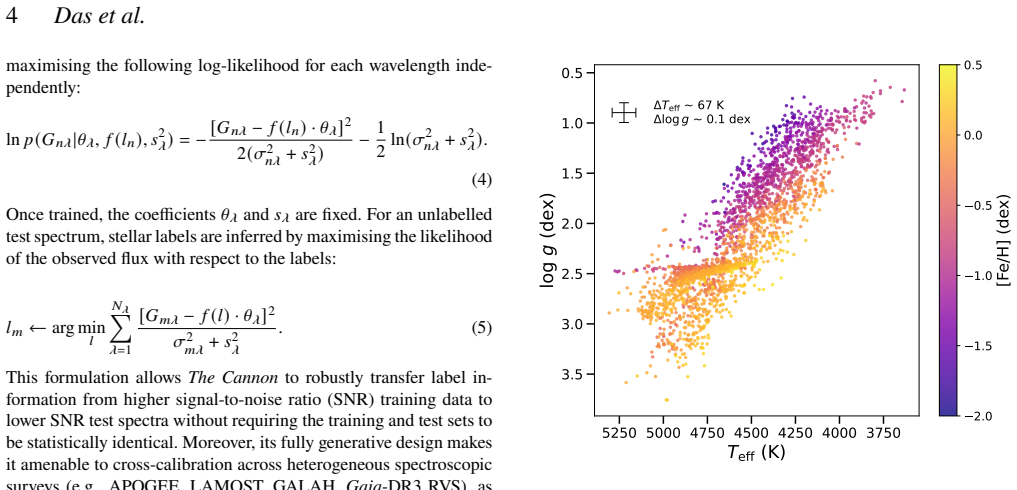
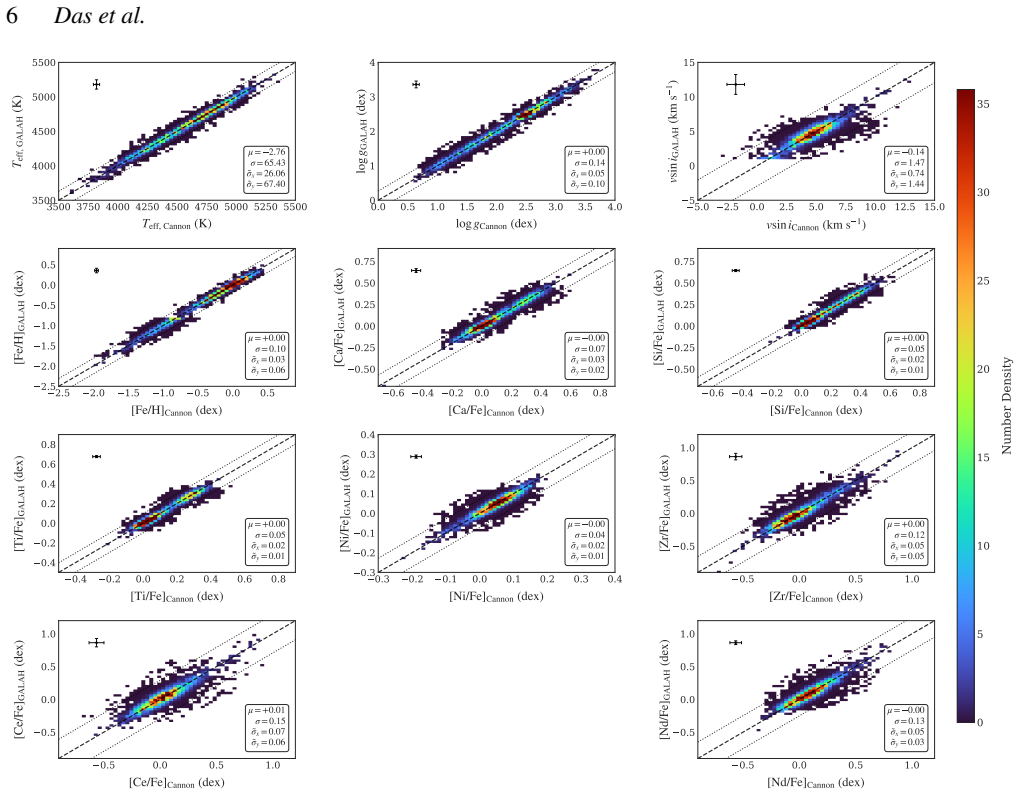
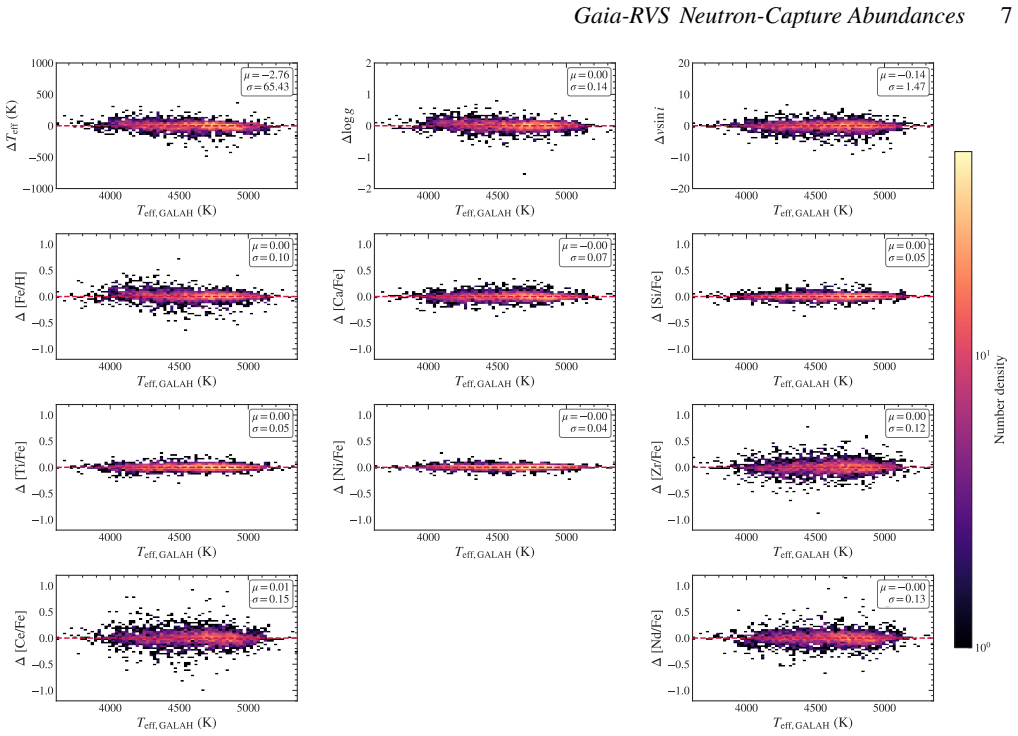
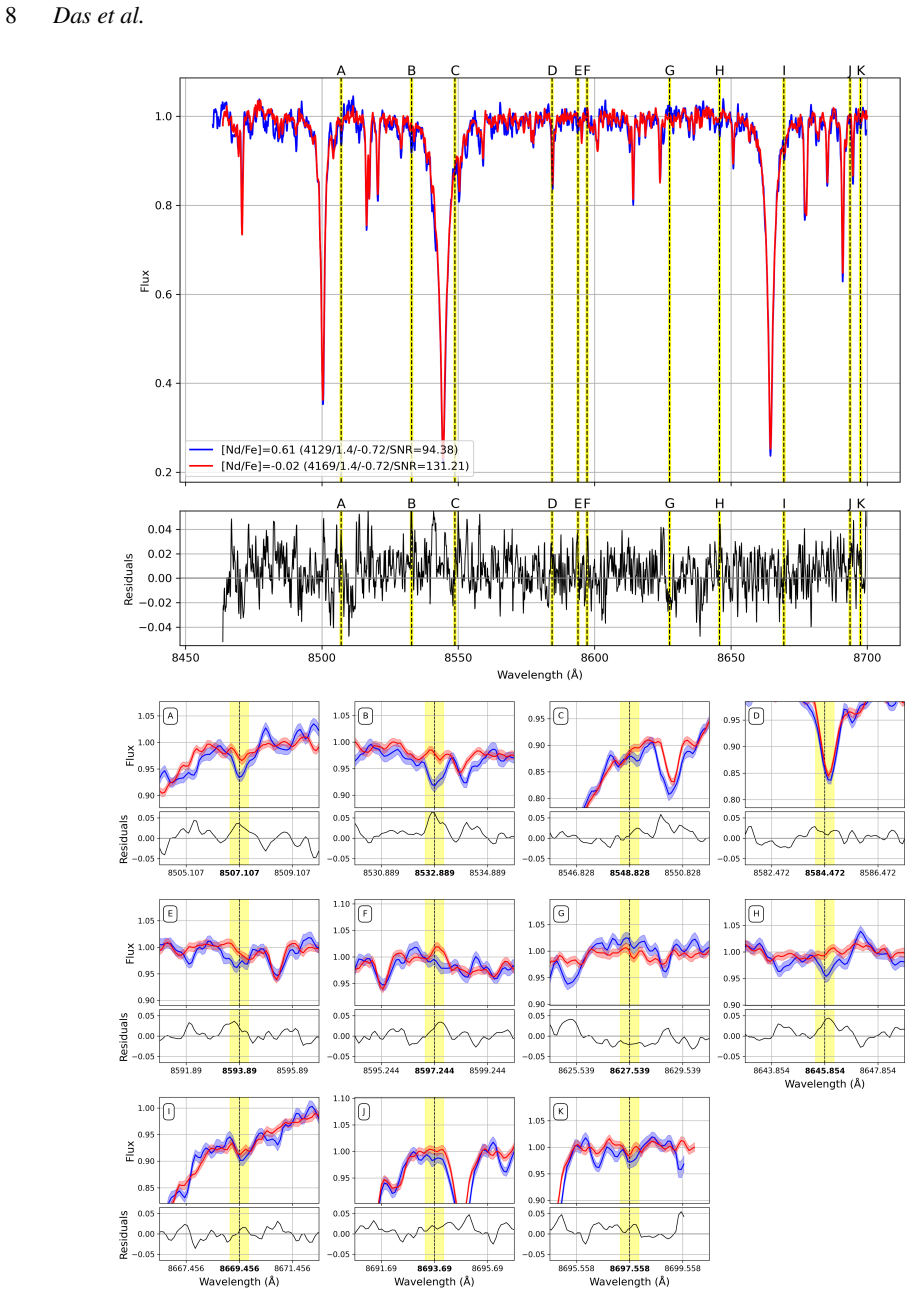
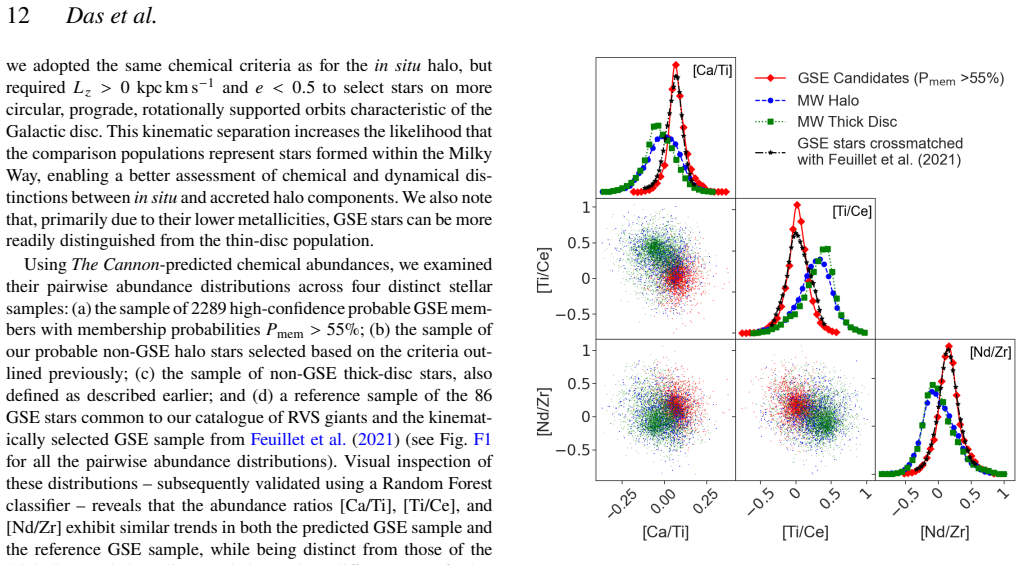
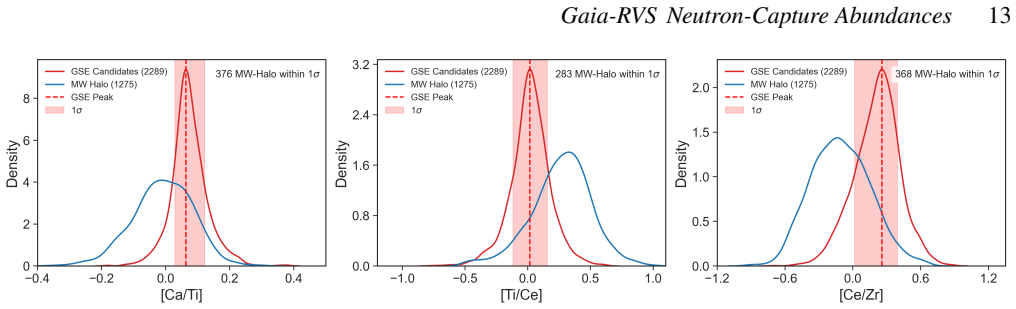
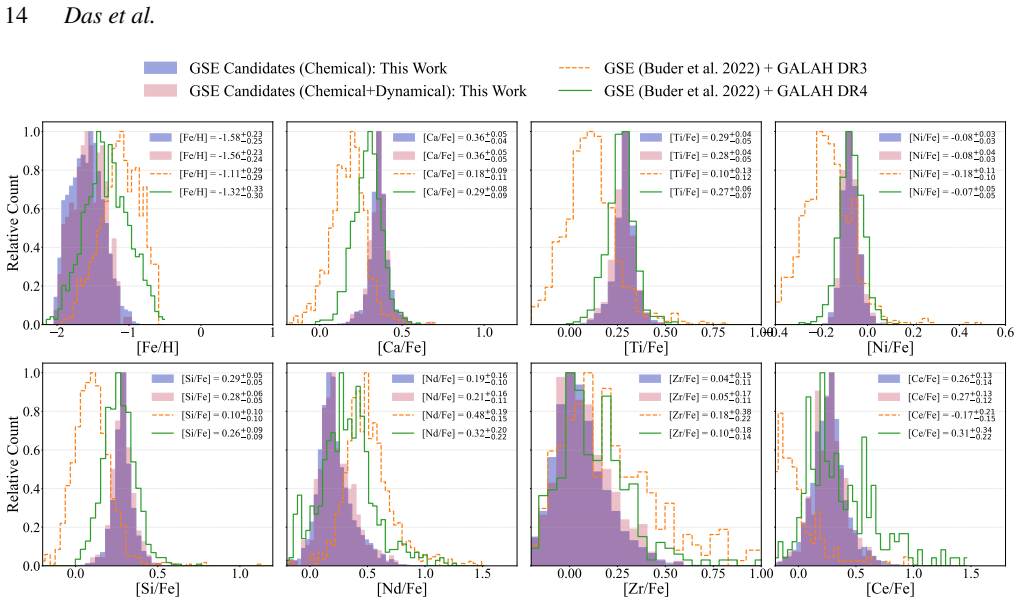
Using The Cannon trained on 2747 common giants, we predict stellar parameters and abundances including [Zr/Fe], [Ce/Fe], [Nd/Fe] for 357,415 RVS stars. A logistic regression classifier optimised via MCMC and trained on a reference GSE sample identifies stars with high membership probabilities based on chemical abundances alone, with candidates exhibiting distinctive patterns in [Ca/Ti], [Ti/Ce], and [Nd/Zr] that hold after kinematic constraints are applied.
What carries the argument
Logistic regression classifier optimised via Markov Chain Monte Carlo sampling and trained on chemical abundances to identify accreted stars.
If this is right
- The derived abundances enable large-scale chemodynamic studies of the Milky Way using neutron-capture elements.
- Chemical signatures alone can identify accreted structures with patterns that survive kinematic filtering.
- The data-driven framework extracts detailed abundances from medium-resolution spectra at the scale of hundreds of thousands of stars.
- Neutron-capture ratios such as [Ti/Ce] and [Nd/Zr] provide additional leverage for distinguishing accreted populations.
Where Pith is reading between the lines
- Similar classifiers could be trained on reference samples for other known accretion events such as the Helmi streams.
- The method could be tested against simulated merger remnants to check how well abundance patterns separate from in-situ stars.
- Extending the training to include more elements or photometric data might tighten membership probabilities further.
Load-bearing premise
The small reference sample of GSE members and comparison stars is sufficiently pure, representative, and chemically distinct from other Milky Way populations.
What would settle it
Higher-resolution follow-up spectroscopy of the high-probability candidates that measures the same abundance ratios and checks consistency with the training sample would confirm or refute the chemical classification.
Figures
read the original abstract
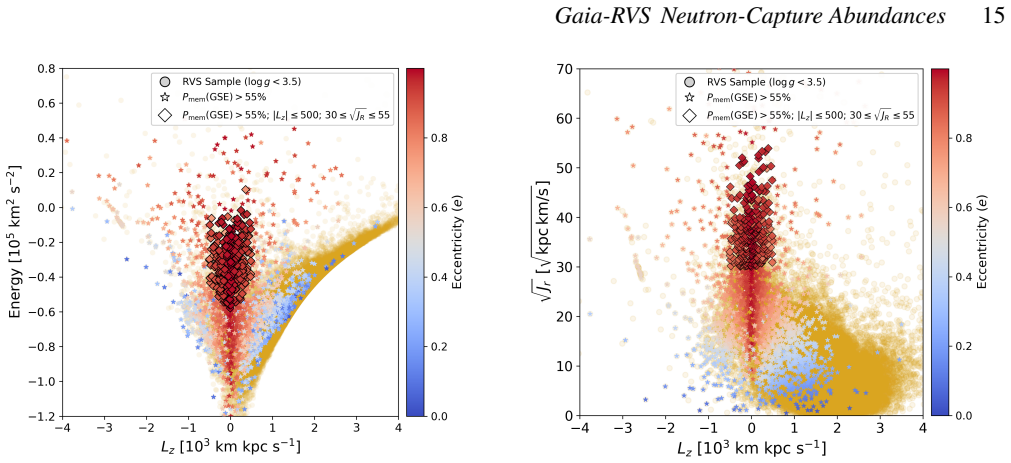
We present a comprehensive data-driven spectroscopic analysis of 357,415 red giant stars using Gaia DR3 Radial Velocity Spectrometer (RVS) spectra (8460-8700 A; $R\approx11,500$), aimed at deriving precise stellar parameters and elemental abundances (collectively referred to as stellar labels). We employ The Cannon, a generative model based on 2747 giants in common with GALAH DR4, adopting GALAH labels ($R\approx28,000$) for training. The resulting model predicts eleven stellar labels for RVS giants: effective temperature ($T_{\rm eff}$), surface gravity ($\log g$), projected rotational velocity ($v\sin i$), and abundances of [Fe/H], [Ca/Fe], [Si/Fe], [Ni/Fe], [Ti/Fe], as well as the neutron-capture elements [Zr/Fe], [Ce/Fe], and [Nd/Fe]. Building on these results, we develop a probabilistic framework to chemically identify debris from the Gaia-Sausage-Enceladus (GSE) accretion event. A logistic regression classifier, optimised via Markov Chain Monte Carlo sampling and trained on a small reference sample of GSE members and comparison stars, identifies stars with high GSE membership probabilities based solely on their chemical abundances, with the resulting candidates exhibiting distinctive abundance-ratio patterns, including [Ca/Ti], [Ti/Ce], and [Nd/Zr]. Applying independent kinematic constraints yields a robust sample of GSE candidates, demonstrating that the characteristic chemical signatures remain consistent after applying these constraints. This work demonstrates the power of data-driven analysis techniques to extract detailed chemical information from medium-resolution spectra and establishes a framework for tracing Galactic accretion events using chemical abundances.
Editorial analysis
A structured set of objections, weighed in public.
Referee Report
Summary. The paper applies The Cannon, trained on 2747 GALAH DR4 giants, to derive 11 stellar labels (including [Zr/Fe], [Ce/Fe], [Nd/Fe]) from 357,415 Gaia RVS spectra. It then trains a logistic regression classifier via MCMC on chemical abundances from a small reference set of GSE members and comparison stars to assign GSE membership probabilities, reporting that high-probability candidates show distinctive ratios ([Ca/Ti], [Ti/Ce], [Nd/Zr]) that persist after independent kinematic filtering.
Significance. If the classifier generalizes, the work would deliver one of the largest chemically tagged GSE samples to date and demonstrate that medium-resolution RVS spectra can yield usable neutron-capture abundances for chemodynamic studies of accretion events. The data-driven pipeline itself is a useful technical contribution for large spectroscopic surveys.
major comments (3)
- [GSE classifier description (near end of abstract and corresponding methods/results)] The section describing the logistic regression classifier provides no quantitative details on the size of the GSE reference sample, its selection criteria (kinematic, abundance, or otherwise), purity estimates, or chemical distinctness metrics relative to other Milky Way populations. This information is required to assess whether the learned decision boundary generalizes or reproduces the input selection.
- [Results on abundance-ratio patterns and kinematic filtering] No cross-validation performance, confusion matrix, or comparison against an independent GSE catalog is reported for the classifier. Without these, the claim that the [Ca/Ti], [Ti/Ce], and [Nd/Zr] patterns are robust GSE signatures (rather than artifacts of the training set) cannot be evaluated.
- [GSE identification framework] The abstract states that the classifier is trained 'based solely on their chemical abundances,' yet the reference sample selection method is not shown; if that sample was itself defined with kinematic cuts, the subsequent 'independent kinematic constraints' test is not fully independent and the circularity risk noted in the stress-test applies directly.
minor comments (2)
- [Data and model description] The training-set size (2747 stars) and label list are stated, but the wavelength range and resolution of the RVS spectra are given only in the abstract; a dedicated table or paragraph in the methods would improve clarity.
- [Abundance results] Notation for the neutron-capture ratios (e.g., [Nd/Zr]) should be defined explicitly the first time they appear, including whether they are [X/Fe] or [X/Y] quantities.
Simulated Author's Rebuttal
We thank the referee for their constructive and detailed comments, which highlight important areas for clarification and validation in our GSE identification framework. We address each major comment below and will revise the manuscript to incorporate the requested information and analyses.
read point-by-point responses
-
Referee: [GSE classifier description (near end of abstract and corresponding methods/results)] The section describing the logistic regression classifier provides no quantitative details on the size of the GSE reference sample, its selection criteria (kinematic, abundance, or otherwise), purity estimates, or chemical distinctness metrics relative to other Milky Way populations. This information is required to assess whether the learned decision boundary generalizes or reproduces the input selection.
Authors: We agree that quantitative details on the reference sample are necessary. The current manuscript describes it only as 'small' without specifics. In the revised version, we will expand the methods section to report the exact sample size, full selection criteria (including any kinematic or abundance cuts from the literature), purity estimates, and metrics of chemical distinctness relative to other populations. This will enable readers to evaluate generalization. revision: yes
-
Referee: [Results on abundance-ratio patterns and kinematic filtering] No cross-validation performance, confusion matrix, or comparison against an independent GSE catalog is reported for the classifier. Without these, the claim that the [Ca/Ti], [Ti/Ce], and [Nd/Zr] patterns are robust GSE signatures (rather than artifacts of the training set) cannot be evaluated.
Authors: We acknowledge the absence of these validation metrics. We will add cross-validation results for the logistic regression, include a confusion matrix, and compare our high-probability candidates against an independent GSE catalog (where overlaps exist) in the revised manuscript. These additions will support the robustness of the reported abundance patterns. revision: yes
-
Referee: [GSE identification framework] The abstract states that the classifier is trained 'based solely on their chemical abundances,' yet the reference sample selection method is not shown; if that sample was itself defined with kinematic cuts, the subsequent 'independent kinematic constraints' test is not fully independent and the circularity risk noted in the stress-test applies directly.
Authors: The reference sample draws from literature GSE members that were originally identified with both kinematic and chemical information, though the classifier uses only abundances. We will revise the text to explicitly detail the reference sample construction and discuss the independence of the subsequent kinematic test, including limitations and additional stress-tests to mitigate circularity concerns. revision: partial
Circularity Check
No significant circularity
full rationale
The abstract describes training a logistic regression classifier on a reference sample of GSE members and comparison stars, then applying it to predict membership probabilities in the 357k-star catalog based on chemical abundances, followed by independent kinematic validation. No equations, self-citations, or descriptions are provided that reduce the output probabilities or abundance patterns to the training inputs by construction. The workflow is a standard supervised learning pipeline with an external check, making the derivation self-contained against the given text.
Axiom & Free-Parameter Ledger
Reference graph
Works this paper leans on
-
[12]
2018 , howpublished =
James Bradbury and Roy Frostig and Peter Hawkins and Matthew James Johnson and Chris Leary and Dougal Maclaurin and Skye Wanderman-Milne , title =. 2018 , howpublished =
2018
-
[25]
VizieR Online Data Catalog: Gaia RVS stellar labels using The Cannon (Das+, 2025)
2025
-
[36]
The Messenger , year = 2012, month = mar, volume =
The Gaia-ESO Public Spectroscopic Survey. The Messenger , year = 2012, month = mar, volume =
2012
-
[55]
SciPy , year=
Data Structures for Statistical Computing in Python , author=. SciPy , year=
-
[64]
The Messenger , year = 2013, month = dec, volume =
The Gaia-ESO Large Public Spectroscopic Survey. The Messenger , year = 2013, month = dec, volume =
2013
-
[74]
Astronomical Data Analysis Software and Systems XIV , year = 2005, editor =
TOPCAT & STIL: Starlink Table/VOTable Processing Software. Astronomical Data Analysis Software and Systems XIV , year = 2005, editor =
2005
-
[75]
TOPCAT: Tool for OPerations on Catalogues And Tables
-
[77]
Astropy Collaboration et al., 2013, @doi [ ] 10.1051/0004-6361/201322068 , https://ui.adsabs.harvard.edu/abs/2013A&A...558A..33A 558, A33
-
[78]
Astropy Collaboration et al., 2018, @doi [ ] 10.3847/1538-3881/aabc4f , https://ui.adsabs.harvard.edu/abs/2018AJ....156..123A 156, 123
-
[79]
Astropy Collaboration et al., 2022, @doi [ ] 10.3847/1538-4357/ac7c74 , https://ui.adsabs.harvard.edu/abs/2022ApJ...935..167A 935, 167
work page internal anchor Pith review doi:10.3847/1538-4357/ac7c74 2022
-
[80]
Belokurov V., Erkal D., Evans N. W., Koposov S. E., Deason A. J., 2018, @doi [ ] 10.1093/mnras/sty982 , https://ui.adsabs.harvard.edu/abs/2018MNRAS.478..611B 478, 611
-
[81]
Bennett M., Bovy J., 2019, @doi [ ] 10.1093/mnras/sty2813 , https://ui.adsabs.harvard.edu/abs/2019MNRAS.482.1417B 482, 1417
work page internal anchor Pith review doi:10.1093/mnras/sty2813 2019
-
[82]
Berni L., Palla M., Magrini L., Spina L., 2026, @doi [ ] 10.1051/0004-6361/202558043 , https://ui.adsabs.harvard.edu/abs/2026A&A...707A.242B 707, A242
-
[83]
Betancourt M., 2017, @doi [arXiv e-prints] 10.48550/arXiv.1706.01520 , https://ui.adsabs.harvard.edu/abs/2017arXiv170601520B p. arXiv:1706.01520
work page internal anchor Pith review Pith/arXiv arXiv doi:10.48550/arxiv.1706.01520 2017
-
[84]
Pyro: Deep Universal Probabilistic Programming
Bingham E., et al., 2018, @doi [arXiv e-prints] 10.48550/arXiv.1810.09538 , https://ui.adsabs.harvard.edu/abs/2018arXiv181009538B p. arXiv:1810.09538
work page internal anchor Pith review Pith/arXiv arXiv doi:10.48550/arxiv.1810.09538 2018
-
[85]
Borsato N. W., Hoeijmakers H. J., Prinoth B., Thorsbro B., Forsberg R., Kitzmann D., Jones K., Heng K., 2023, @doi [ ] 10.1051/0004-6361/202245121 , https://ui.adsabs.harvard.edu/abs/2023A&A...673A.158B 673, A158
-
[86]
Bovy J., 2015, @doi [ ] 10.1088/0067-0049/216/2/29 , https://ui.adsabs.harvard.edu/abs/2015ApJS..216...29B 216, 29
work page internal anchor Pith review doi:10.1088/0067-0049/216/2/29 2015
-
[87]
Bovy J., Rix H.-W., 2013, @doi [ ] 10.1088/0004-637X/779/2/115 , https://ui.adsabs.harvard.edu/abs/2013ApJ...779..115B 779, 115
-
[88]
J., Leary C., Maclaurin D., Wanderman-Milne S., 2018, JAX: Composable transformations of Python+NumPy programs, https://github.com/google/jax
Bradbury J., Frostig R., Hawkins P., Johnson M. J., Leary C., Maclaurin D., Wanderman-Milne S., 2018, JAX: Composable transformations of Python+NumPy programs, https://github.com/google/jax
2018
-
[89]
E., ed., Society of Photo-Optical Instrumentation Engineers (SPIE) Conference Series Vol
Brzeski J., Case S., Gers L., 2011, in Hatheway A. E., ed., Society of Photo-Optical Instrumentation Engineers (SPIE) Conference Series Vol. 8125, Optomechanics 2011: Innovations and Solutions. p. 812504, @doi 10.1117/12.896389
-
[90]
Buder S., et al., 2018, @doi [ ] 10.1093/mnras/sty1281 , https://ui.adsabs.harvard.edu/abs/2018MNRAS.478.4513B 478, 4513
-
[91]
Buder S., et al., 2021, @doi [ ] 10.1093/mnras/stab1242 , https://ui.adsabs.harvard.edu/abs/2021MNRAS.506..150B 506, 150
-
[92]
Buder S., et al., 2022, @doi [ ] 10.1093/mnras/stab3504 , https://ui.adsabs.harvard.edu/abs/2022MNRAS.510.2407B 510, 2407
-
[93]
Buder S., et al., 2025, @doi [ ] 10.1017/pasa.2025.26 , https://ui.adsabs.harvard.edu/abs/2025PASA...42...51B 42, e051
-
[94]
Carrillo A., Hawkins K., Jofr \'e P., de Brito Silva D., Das P., Lucey M., 2022, @doi [ ] 10.1093/mnras/stac518 , https://ui.adsabs.harvard.edu/abs/2022MNRAS.513.1557C 513, 1557
-
[95]
The Cannon 2: A data-driven model of stellar spectra for detailed chemical abundance analyses
Casey A. R., Hogg D. W., Ness M., Rix H.-W., Ho A. Q. Y., Gilmore G., 2016, @doi [arXiv e-prints] 10.48550/arXiv.1603.03040 , https://ui.adsabs.harvard.edu/abs/2016arXiv160303040C p. arXiv:1603.03040
work page internal anchor Pith review Pith/arXiv arXiv doi:10.48550/arxiv.1603.03040 2016
-
[96]
New Grids of ATLAS9 Model Atmospheres
Castelli F., Kurucz R. L., 2003, in Piskunov N., Weiss W. W., Gray D. F., eds, IAU Symposium Vol. 210, Modelling of Stellar Atmospheres. p. A20 ( @eprint arXiv astro-ph/0405087 ), @doi 10.48550/arXiv.astro-ph/0405087
work page internal anchor Pith review Pith/arXiv arXiv doi:10.48550/arxiv.astro-ph/0405087 2003
-
[97]
Cox D. R., 1958, @doi [Journal of the Royal Statistical Society: Series B (Methodological)] 10.1111/j.2517-6161.1958.tb00292.x , 20, 215
-
[98]
Cropper M., et al., 2018, @doi [ ] 10.1051/0004-6361/201832763 , https://ui.adsabs.harvard.edu/abs/2018A&A...616A...5C 616, A5
-
[99]
Das P., Hawkins K., Jofr \'e P., 2020, @doi [ ] 10.1093/mnras/stz3537 , https://ui.adsabs.harvard.edu/abs/2020MNRAS.493.5195D 493, 5195
-
[100]
B., et al., 2025a, VizieR Online Data Catalog: Gaia RVS stellar labels using The Cannon (Das+, 2025) , VizieR On-line Data Catalog: J/MNRAS/538/605
Das P. B., et al., 2025a, VizieR Online Data Catalog: Gaia RVS stellar labels using The Cannon (Das+, 2025) , VizieR On-line Data Catalog: J/MNRAS/538/605. Originally published in: 2025MNRAS.538..605D
2025
-
[101]
Das P. B., et al., 2025b, @doi [ ] 10.1093/mnras/staf169 , https://ui.adsabs.harvard.edu/abs/2025MNRAS.538..605D 538, 605
-
[102]
De Silva G. M., et al., 2015, @doi [ ] 10.1093/mnras/stv327 , https://ui.adsabs.harvard.edu/abs/2015MNRAS.449.2604D 449, 2604
-
[103]
Ernandes H., Feuillet D., Feltzing S., Sk \'u lad \'o ttir \'A ., 2024, @doi [ ] 10.1051/0004-6361/202450827 , https://ui.adsabs.harvard.edu/abs/2024A&A...691A.333E 691, A333
-
[104]
Ernandes H., Sk \'u lad \'o ttir \'A ., Feltzing S., Feuillet D., 2025, @doi [ ] 10.1051/0004-6361/202557149 , https://ui.adsabs.harvard.edu/abs/2025A&A...703A.256E 703, A256
-
[105]
Feuillet D. K., Feltzing S., Sahlholdt C. L., Casagrande L., 2020, @doi [ ] 10.1093/mnras/staa1888 , https://ui.adsabs.harvard.edu/abs/2020MNRAS.497..109F 497, 109
-
[106]
Feuillet D. K., Sahlholdt C. L., Feltzing S., Casagrande L., 2021, @doi [ ] 10.1093/mnras/stab2614 , https://ui.adsabs.harvard.edu/abs/2021MNRAS.508.1489F 508, 1489
-
[107]
Fishlock C. K., Yong D., Karakas A. I., Alves-Brito A., Mel \'e ndez J., Nissen P. E., Kobayashi C., Casey A. R., 2017, @doi [ ] 10.1093/mnras/stx047 , https://ui.adsabs.harvard.edu/abs/2017MNRAS.466.4672F 466, 4672
-
[108]
Gaia Collaboration et al., 2016, @doi [ ] 10.1051/0004-6361/201629272 , https://ui.adsabs.harvard.edu/abs/2016A&A...595A...1G 595, A1
-
[109]
Gaia Collaboration et al., 2018, @doi [ ] 10.1051/0004-6361/201833051 , https://ui.adsabs.harvard.edu/abs/2018A&A...616A...1G 616, A1
work page internal anchor Pith review doi:10.1051/0004-6361/201833051 2018
-
[110]
Gaia Collaboration et al., 2023a, @doi [ ] 10.1051/0004-6361/202243940 , https://ui.adsabs.harvard.edu/abs/2023A&A...674A...1G 674, A1
-
[111]
Gaia Collaboration et al., 2023b, @doi [ ] 10.1051/0004-6361/202243511 , https://ui.adsabs.harvard.edu/abs/2023A&A...674A..38G 674, A38
-
[112]
Gilmore G., et al., 2012, The Messenger, https://ui.adsabs.harvard.edu/abs/2012Msngr.147...25G 147, 25
2012
-
[113]
Guiglion G., et al., 2024, @doi [ ] 10.1051/0004-6361/202347122 , https://ui.adsabs.harvard.edu/abs/2024A&A...682A...9G 682, A9
-
[114]
Harris C. R., et al., 2020, @doi [ ] 10.1038/s41586-020-2649-2 , https://ui.adsabs.harvard.edu/abs/2020Natur.585..357H 585, 357
-
[115]
Hawkins K., Jofr \'e P., Masseron T., Gilmore G., 2015, @doi [ ] 10.1093/mnras/stv1586 , https://ui.adsabs.harvard.edu/abs/2015MNRAS.453..758H 453, 758
-
[116]
Heijmans J., et al., 2012, in McLean I. S., Ramsay S. K., Takami H., eds, Society of Photo-Optical Instrumentation Engineers (SPIE) Conference Series Vol. 8446, Ground-based and Airborne Instrumentation for Astronomy IV. p. 84460W, @doi 10.1117/12.925806
-
[117]
H., Massari D., Veljanoski J., Brown A
Helmi A., Babusiaux C., Koppelman H. H., Massari D., Veljanoski J., Brown A. G. A., 2018, @doi [ ] 10.1038/s41586-018-0625-x , https://ui.adsabs.harvard.edu/abs/2018Natur.563...85H 563, 85
-
[118]
Ho A. Y. Q., et al., 2017a, @doi [ ] 10.3847/1538-4357/836/1/5 , https://ui.adsabs.harvard.edu/abs/2017ApJ...836....5H 836, 5
-
[119]
Ho A. Y. Q., Rix H.-W., Ness M. K., Hogg D. W., Liu C., Ting Y.-S., 2017b, @doi [ ] 10.3847/1538-4357/aa6db3 , https://ui.adsabs.harvard.edu/abs/2017ApJ...841...40H 841, 40
-
[120]
Horta D., Ness M. K., 2025, @doi [ ] 10.1093/mnrasl/slaf093 , https://ui.adsabs.harvard.edu/abs/2025MNRAS.544L..64H 544, L64
-
[121]
2013, Applied Logistic Regression: Third Edition (wiley), doi: 10.1002/9781118548387
Hosmer D., Lemeshow S., Sturdivant R., 2013, Applied Logistic Regression: Third Edition. wiley, @doi 10.1002/9781118548387
-
[122]
Matplotlib: A 2D graphics environment.Comput
Hunter J. D., 2007, @doi [Computing in Science and Engineering] 10.1109/MCSE.2007.55 , https://ui.adsabs.harvard.edu/abs/2007CSE.....9...90H 9, 90
-
[123]
Koppelman H., Helmi A., Veljanoski J., 2018, @doi [ ] 10.3847/2041-8213/aac882 , https://ui.adsabs.harvard.edu/abs/2018ApJ...860L..11K 860, L11
-
[124]
H., Helmi A., Massari D., Price-Whelan A
Koppelman H. H., Helmi A., Massari D., Price-Whelan A. M., Starkenburg T. K., 2019, @doi [ ] 10.1051/0004-6361/201936738 , https://ui.adsabs.harvard.edu/abs/2019A&A...631L...9K 631, L9
-
[125]
Lewis I. J., et al., 2002, @doi [ ] 10.1046/j.1365-8711.2002.05333.x , https://ui.adsabs.harvard.edu/abs/2002MNRAS.333..279L 333, 279
-
[126]
Luo A.-L., et al., 2015, @doi [Research in Astronomy and Astrophysics] 10.1088/1674-4527/15/8/002 , https://ui.adsabs.harvard.edu/abs/2015RAA....15.1095L 15, 1095
-
[127]
Majewski S. R., et al., 2017, @doi [ ] 10.3847/1538-3881/aa784d , https://ui.adsabs.harvard.edu/abs/2017AJ....154...94M 154, 94
-
[128]
Manea C., Hawkins K., Ness M. K., Buder S., Martell S. L., Zucker D. B., 2024, @doi [ ] 10.3847/1538-4357/ad58d9 , https://ui.adsabs.harvard.edu/abs/2024ApJ...972...69M 972, 69
-
[129]
Martell S. L., et al., 2017, @doi [ ] 10.1093/mnras/stw2835 , https://ui.adsabs.harvard.edu/abs/2017MNRAS.465.3203M 465, 3203
-
[130]
McKenzie M., et al., 2022, @doi [ ] 10.1093/mnras/stac2254 , https://ui.adsabs.harvard.edu/abs/2022MNRAS.516.3515M 516, 3515
-
[131]
https://api.semanticscholar.org/CorpusID:13156234
McKinney W., 2010, in SciPy. https://api.semanticscholar.org/CorpusID:13156234
2010
-
[132]
Monty S., Yong D., Marino A. F., Karakas A. I., McKenzie M., Grundahl F., Mura-Guzm \'a n A., 2023, @doi [ ] 10.1093/mnras/stac3040 , https://ui.adsabs.harvard.edu/abs/2023MNRAS.518..965M 518, 965
-
[133]
P., Conroy C., Bonaca A., Johnson B
Naidu R. P., Conroy C., Bonaca A., Johnson B. D., Ting Y.-S., Caldwell N., Zaritsky D., Cargile P. A., 2020, @doi [ ] 10.3847/1538-4357/abaef4 , https://ui.adsabs.harvard.edu/abs/2020ApJ...901...48N 901, 48
-
[134]
Naidu R. P., et al., 2021, @doi [ ] 10.3847/1538-4357/ac2d2d , https://ui.adsabs.harvard.edu/abs/2021ApJ...923...92N 923, 92
-
[135]
Nandakumar G., et al., 2022, @doi [ ] 10.1093/mnras/stac873 , https://ui.adsabs.harvard.edu/abs/2022MNRAS.513..232N 513, 232
-
[136]
Ness M., Hogg D. W., Rix H.-W., Ho A. Y. Q., Zasowski G., 2015, @doi [ ] 10.1088/0004-637X/808/1/16 , https://ui.adsabs.harvard.edu/abs/2015ApJ...808...16N 808, 16
-
[137]
Nissen P. E., Schuster W. J., 2010, @doi [ ] 10.1051/0004-6361/200913877 , https://ui.adsabs.harvard.edu/abs/2010A&A...511L..10N 511, L10
-
[138]
Composable Effects for Flexible and Accelerated Probabilistic Programming in NumPyro
Phan D., Pradhan N., Jankowiak M., 2019, @doi [arXiv e-prints] 10.48550/arXiv.1912.11554 , https://ui.adsabs.harvard.edu/abs/2019arXiv191211554P p. arXiv:1912.11554
work page internal anchor Pith review Pith/arXiv arXiv doi:10.48550/arxiv.1912.11554 2019
-
[139]
Placco V. M., Sneden C., Roederer I. U., Lawler J. E., Den Hartog E. A., Hejazi N., Maas Z., Bernath P., 2021, @doi [Research Notes of the American Astronomical Society] 10.3847/2515-5172/abf651 , https://ui.adsabs.harvard.edu/abs/2021RNAAS...5...92P 5, 92
-
[140]
Randich S., Gilmore G., Gaia-ESO Consortium 2013, The Messenger, https://ui.adsabs.harvard.edu/abs/2013Msngr.154...47R 154, 47
2013
-
[141]
Recio-Blanco A., et al., 2016, @doi [ ] 10.1051/0004-6361/201425030 , https://ui.adsabs.harvard.edu/abs/2016A&A...585A..93R 585, A93
-
[142]
Recio-Blanco A., et al., 2023, @doi [ ] 10.1051/0004-6361/202243750 , https://ui.adsabs.harvard.edu/abs/2023A&A...674A..29R 674, A29
-
[143]
Sharma S., et al., 2018, @doi [ ] 10.1093/mnras/stx2582 , https://ui.adsabs.harvard.edu/abs/2018MNRAS.473.2004S 473, 2004
-
[144]
Sharma S., et al., 2019, @doi [ ] 10.1093/mnras/stz2861 , https://ui.adsabs.harvard.edu/abs/2019MNRAS.490.5335S 490, 5335
-
[145]
Sheinis A., et al., 2015, @doi [Journal of Astronomical Telescopes, Instruments, and Systems] 10.1117/1.JATIS.1.3.035002 , https://ui.adsabs.harvard.edu/abs/2015JATIS...1c5002S 1, 035002
-
[146]
K., Mori A., Feltzing S., Lucchesi R
Sk \'u lad \'o ttir \'A ., Ernandes H., Feuillet D. K., Mori A., Feltzing S., Lucchesi R. E. R., Di Matteo P., 2025, @doi [ ] 10.3847/2041-8213/addc66 , https://ui.adsabs.harvard.edu/abs/2025ApJ...986L..21S 986, L21
-
[147]
Sneden C., 1973, @doi [ ] 10.1086/152374 , https://ui.adsabs.harvard.edu/abs/1973ApJ...184..839S 184, 839
-
[148]
Sneden C., Cowan J. J., Gallino R., 2008, @doi [ ] 10.1146/annurev.astro.46.060407.145207 , https://ui.adsabs.harvard.edu/abs/2008ARA&A..46..241S 46, 241
-
[149]
Snellen I. A. G., de Kok R. J., de Mooij E. J. W., Albrecht S., 2010, @doi [ ] 10.1038/nature09111 , https://ui.adsabs.harvard.edu/abs/2010Natur.465.1049S 465, 1049
discussion (0)
Sign in with ORCID, Apple, or X to comment. Anyone can read and Pith papers without signing in.