Real-World Deployment of a 5G-Connected Edge-Controlled Aerial Robot in Industrial Subterranean Mines
Pith reviewed 2026-06-28 06:13 UTC · model grok-4.3
The pith
An edge-based MPC controller enables the first autonomous 5G-connected flight of an aerial robot in an active mine.
A machine-rendered reading of the paper's core claim, the machinery that carries it, and where it could break.
Core claim
The paper establishes that a 5G-connected edge-offloaded Model Predictive Controller can support the first real-world autonomous flight of an aerial robot in an industrial subterranean mine, where the robot receives control actions generated remotely to navigate through human-selected waypoints in a collision-free manner.
What carries the argument
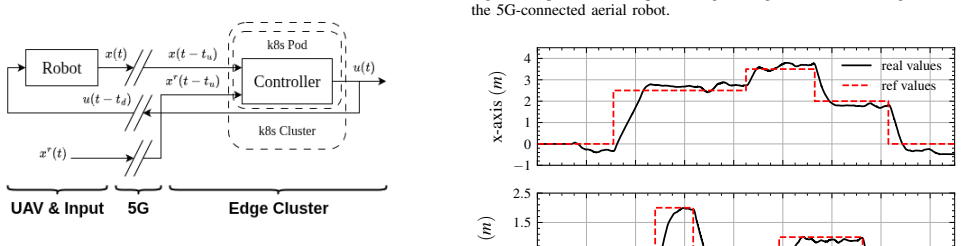
The Model Predictive Controller (MPC) offloaded to the Kubernetes-based edge cluster, which computes control actions transmitted over the 5G NR SA link to enable closed-loop autonomous navigation.
If this is right
- The edge-controlled system supports seamless navigation in mining environments.
- Human waypoint selection combined with MPC path generation allows safe autonomous execution.
- Real-world evaluation confirms viability for time-critical and efficient robotic deployments.
- 5G connectivity bridges the robot and edge cluster without onboard heavy computation.
Where Pith is reading between the lines
- If the 5G link proves stable, similar setups could apply to other GPS-denied industrial sites.
- Future work might test multi-robot coordination sharing the same edge controller.
- Potential reduction in robot hardware costs by offloading computation.
Load-bearing premise
The 5G network must deliver sufficiently low latency and reliable bidirectional communication to keep the MPC control loop stable in the mine's environment.
What would settle it
Observation of control failure or path deviation during a flight test when 5G latency exceeds the time required for the MPC to update control actions.
Figures


read the original abstract
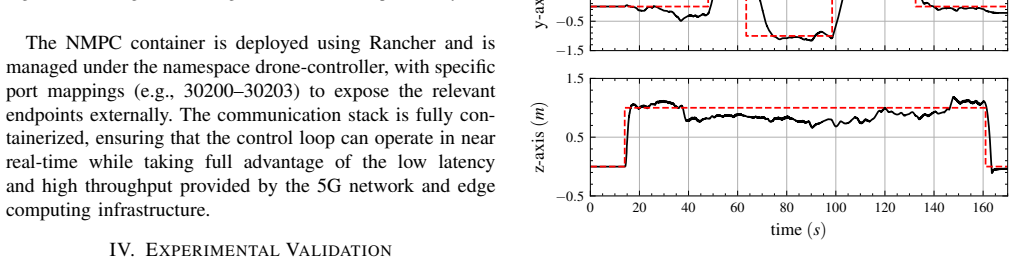
This article presents the first real-world autonomous flight of a 5G-connected aerial robot controlled by an edge-offloaded controller, and aims to bridge the gap between controlled and factual setups. The robot operates within an active industrial subterranean mine, while the high-level controller is deployed in a nearby Kubernetes-based edge cluster. Communication between the robot and the edge is enabled via a 5G New Radio (NR) Standalone (SA) network. The chosen controller is a Model Predictive Controller (MPC), which generates control actions to allow the robot to navigate seamlessly through the mining environment. A human operator selects waypoints for the aerial robot, and the MPC generates smooth, collision-free paths for autonomous executions. The proposed 5G edge-based closed-loop system is evaluated in a real industrial setting and demonstrates the potential of edge-controlled robotic systems toward time-critical, safe and efficient future deployments.
Editorial analysis
A structured set of objections, weighed in public.
Referee Report
Summary. The manuscript claims to present the first real-world autonomous flight of a 5G-connected aerial robot whose high-level Model Predictive Controller (MPC) is offloaded to a Kubernetes-based edge cluster. Communication occurs over a 5G NR Standalone network inside an active industrial subterranean mine; a human operator supplies waypoints and the MPC produces collision-free trajectories. The work positions itself as bridging controlled laboratory setups and factual industrial deployments, with an evaluation performed in the real mine environment.
Significance. A rigorously documented deployment of edge-offloaded closed-loop control over 5G in a subterranean industrial setting would be a useful existence proof for time-critical robotic applications in GPS-denied, communication-challenged environments. The manuscript supplies no quantitative latency, reliability, or control-performance data, so this potential significance is not yet realized.
major comments (2)
- [Abstract] Abstract: the central claim that the 5G NR SA link 'supports' closed-loop MPC control rests on the unstated assumption that the measured round-trip latency, jitter, and packet-loss statistics remain within the timing envelope required by the MPC. No such statistics, histograms, or worst-case values are reported, rendering the claim unverifiable from the supplied text.
- [Abstract] Abstract (evaluation paragraph): the statement that the system 'is evaluated in a real industrial setting and demonstrates the potential' is not accompanied by any table, figure, or numerical result quantifying flight success rate, trajectory tracking error, communication reliability, or control-loop timing under mine conditions. This absence directly undermines the deployment claim.
minor comments (1)
- [Abstract] The abstract repeatedly uses the phrase 'demonstrates the potential' without defining what concrete metric would constitute a successful demonstration; a short clarification of success criteria would improve readability.
Simulated Author's Rebuttal
We thank the referee for the constructive feedback. We respond point-by-point to the major comments and will revise the abstract to align its claims more closely with the content and data actually presented in the manuscript.
read point-by-point responses
-
Referee: [Abstract] Abstract: the central claim that the 5G NR SA link 'supports' closed-loop MPC control rests on the unstated assumption that the measured round-trip latency, jitter, and packet-loss statistics remain within the timing envelope required by the MPC. No such statistics, histograms, or worst-case values are reported, rendering the claim unverifiable from the supplied text.
Authors: We accept the point. The manuscript does not report round-trip latency, jitter, or packet-loss statistics, so the abstract claim that the link 'supports' closed-loop MPC control cannot be verified quantitatively. We will revise the abstract to state only that the system was deployed and operated successfully over the 5G NR SA link, removing the unsupported assertion about timing support. revision: yes
-
Referee: [Abstract] Abstract (evaluation paragraph): the statement that the system 'is evaluated in a real industrial setting and demonstrates the potential' is not accompanied by any table, figure, or numerical result quantifying flight success rate, trajectory tracking error, communication reliability, or control-loop timing under mine conditions. This absence directly undermines the deployment claim.
Authors: We agree that the abstract implies a quantitative evaluation that is not present. The manuscript reports a successful autonomous flight but contains no tables, figures, or numerical results on success rate, tracking error, reliability, or timing. We will revise the abstract to describe the work as a proof-of-concept deployment demonstration rather than an evaluation that demonstrates quantified potential. revision: yes
- The manuscript contains no quantitative latency, jitter, packet-loss, or control-performance data, so we cannot add such results without conducting new experiments.
Circularity Check
No circularity: experimental deployment report with no derivations
full rationale
This is an experimental deployment paper describing a real-world 5G edge-controlled aerial robot flight in a mine. It contains no equations, derivations, parameter fitting, or mathematical claims that could reduce to self-definition or self-citation. The central narrative rests on hardware setup, network use, and observed operation rather than any load-bearing derivation chain, so the paper is self-contained against external benchmarks with no circular steps.
Axiom & Free-Parameter Ledger
Reference graph
Works this paper leans on
-
[1]
Edge robotics: are we ready? an experimental evaluation of current vision and future directions,
M. Groshev, G. Baldoni, L. Cominardi, A. de la Oliva, and R. Gazda, “Edge robotics: are we ready? an experimental evaluation of current vision and future directions,”Digital Communications and Networks, 2022
2022
-
[2]
Robotics 4.0–are we there yet?
T. Haidegger, P. Galambos, and I. J. Rudas, “Robotics 4.0–are we there yet?” in2019 IEEE 23rd International Conference on Intelligent Engineering Systems (INES). IEEE, 2019, pp. 000 117–000 124
2019
-
[3]
A survey on the convergence of edge computing and ai for uavs: Opportunities and challenges,
P. McEnroe, S. Wang, and M. Liyanage, “A survey on the convergence of edge computing and ai for uavs: Opportunities and challenges,” IEEE Internet of Things Journal, vol. 9, no. 17, pp. 15 435–15 459, 2022
2022
-
[4]
Explicit mpc recovery for cloud control systems,
P. Skarin and K.-E. ˚Arz´en, “Explicit mpc recovery for cloud control systems,” in2021 60th IEEE Conference on Decision and Control (CDC). IEEE, 2021, pp. 5394–5401
2021
-
[5]
An edge-based architecture for offloading model predictive control for uavs,
A. S. Seisa, S. G. Satpute, B. Lindqvist, and G. Nikolakopoulos, “An edge-based architecture for offloading model predictive control for uavs,”Robotics, vol. 11, no. 4, p. 80, 2022
2022
-
[6]
A Comprehensive Survey of Recent Trends in Cloud Robotics Architectures and Applications,
O. Saha and P. Dasgupta, “A Comprehensive Survey of Recent Trends in Cloud Robotics Architectures and Applications,”Robotics, vol. 7, no. 3, 2018
2018
-
[7]
Cloud robotics: architecture, challenges and applications,
G. Hu, W. P. Tay, and Y . Wen, “Cloud robotics: architecture, challenges and applications,”IEEE network, vol. 26, no. 3, pp. 21–28, 2012
2012
-
[8]
Enabling remote whole-body control with 5g edge computing,
H. Zhu, M. Sharma, K. Pfeiffer, M. Mezzavilla, J. Shen, S. Rangan, and L. Righetti, “Enabling remote whole-body control with 5g edge computing,” in2020 IEEE/RSJ international conference on intelligent robots and systems (IROS). IEEE, 2020, pp. 3553–3560
2020
-
[9]
Toward 5g edge computing for enabling autonomous aerial vehicles,
G. Damigos, T. Lindgren, and G. Nikolakopoulos, “Toward 5g edge computing for enabling autonomous aerial vehicles,”IEEE Access, vol. 11, pp. 3926–3941, 2023
2023
-
[10]
Offloading autonomous driving services via edge computing,
M. Cui, S. Zhong, B. Li, X. Chen, and K. Huang, “Offloading autonomous driving services via edge computing,”IEEE Internet of Things Journal, vol. 7, no. 10, pp. 10 535–10 547, 2020
2020
-
[11]
Swarm robotics in a sustainable warehouse automation: Opportunities, challenges and solutions,
O. M. Ikumapayi, O. T. Laseinde, R. R. Elewa, T. S. Ogedengbe, and E. T. Akinlabi, “Swarm robotics in a sustainable warehouse automation: Opportunities, challenges and solutions,” inE3S Web of Conferences, vol. 552. EDP Sciences, 2024, p. 01080
2024
-
[12]
Digital twin- based industrial cloud robotics: Framework, control approach and implementation,
W. Xu, J. Cui, L. Li, B. Yao, S. Tian, and Z. Zhou, “Digital twin- based industrial cloud robotics: Framework, control approach and implementation,”Journal of Manufacturing Systems, vol. 58, pp. 196– 209, 2021
2021
-
[13]
Edge computing for industry 5.0: Fundamental, applications, and research challenges,
M. Sharma, A. Tomar, and A. Hazra, “Edge computing for industry 5.0: Fundamental, applications, and research challenges,”IEEE Inter- net of Things Journal, vol. 11, no. 11, pp. 19 070–19 093, 2024
2024
-
[14]
A. Dalgkitsis and C. Verikoukis, “Netros-5g: Enhancing personaliza- tion through 5g network slicing and edge computing in human-robot interactions,”arXiv preprint arXiv:2312.06475, 2023
-
[15]
Advances in automation and robotics: The state of the emerging future mining industry,
M. Obosu and S. Frimpong, “Advances in automation and robotics: The state of the emerging future mining industry,”Journal of Safety and Sustainability, 2025
2025
-
[16]
A mobile robot-based system for automatic inspection of belt conveyors in mining industry,
J. Szrek, J. Jakubiak, and R. Zimroz, “A mobile robot-based system for automatic inspection of belt conveyors in mining industry,”Energies, vol. 15, no. 1, p. 327, 2022
2022
-
[17]
Industrial progress of robotic automation in mining applications: A survey,
H. Du, L. Chan, J. Tong, R. Raad, F. Naghdy, Q. Guo, Y . Yu, M. R. Islam, F. Tubbal, M. Ros,et al., “Industrial progress of robotic automation in mining applications: A survey,”Mining, Metallurgy & Exploration, pp. 1–20, 2025
2025
-
[18]
A. Agha, K. Otsu, B. Morrell, D. D. Fan, R. Thakker, A. Santamaria- Navarro, S.-K. Kim, A. Bouman, X. Lei, J. Edlund,et al., “Nebula: Quest for robotic autonomy in challenging environments; team costar at the darpa subterranean challenge,”arXiv preprint arXiv:2103.11470, 2021
-
[19]
Paced-5g: Predictive autonomous control using edge for drones over 5g,
V . N. Sankaranarayanan, G. Damigos, A. S. Seisa, S. G. Sat- pute, T. Lindgren, and G. Nikolakopoulos, “Paced-5g: Predictive autonomous control using edge for drones over 5g,”arXiv preprint arXiv:2301.13097, 2023
-
[20]
A resilient framework for 5g-edge-connected uavs based on switching edge-mpc and onboard-pid control,
G. Damigos, A. S. Seisa, S. G. Satpute, T. Lindgren, and G. Niko- lakopoulos, “A resilient framework for 5g-edge-connected uavs based on switching edge-mpc and onboard-pid control,” in2023 IEEE 32nd International Symposium on Industrial Electronics (ISIE). IEEE, 2023, pp. 1–8
2023
-
[21]
Envi- ronmental awareness dynamic 5g qos for retaining real time constraints in robotic applications,
G. Damigos, A. Saradagi, S. Sandberg, and G. Nikolakopoulos, “Envi- ronmental awareness dynamic 5g qos for retaining real time constraints in robotic applications,” in2024 IEEE International Conference on Robotics and Automation (ICRA), 2024, pp. 12 069–12 075
2024
-
[22]
Oros: Online operation and orchestration of collaborative robots using 5g,
A. Romero, C. Delgado, L. Zanzi, X. Li, and X. Costa-P ´erez, “Oros: Online operation and orchestration of collaborative robots using 5g,” IEEE Transactions on Network and Service Management, vol. 20, no. 4, pp. 4216–4230, 2023
2023
-
[23]
Optimising robotic operation speed with edge computing via 5g network: Insights from selective harvesting robots,
U. A. Zahidi, A. Khan, T. Zhivkov, J. Dichtl, D. Li, S. Parsa, M. Hanheide, G. Cielniak, E. I. Sklar, S. Pearson,et al., “Optimising robotic operation speed with edge computing via 5g network: Insights from selective harvesting robots,”Journal of Field Robotics, vol. 41, no. 8, pp. 2771–2789, 2024
2024
-
[24]
Compra: A compact reactive autonomy framework for subterranean mav based search-and-rescue operations,
B. Lindqvist, C. Kanellakis, S. S. Mansouri, A.-a. Agha-mohammadi, and G. Nikolakopoulos, “Compra: A compact reactive autonomy framework for subterranean mav based search-and-rescue operations,” Journal of Intelligent & Robotic Systems, vol. 105, no. 3, p. 49, 2022
2022
-
[25]
Design and experimental comparison of pid, lqr and mpc stabilizing controllers for parrot mambo mini-drone,
M. Okasha, J. Kralev, and M. Islam, “Design and experimental comparison of pid, lqr and mpc stabilizing controllers for parrot mambo mini-drone,”Aerospace, vol. 9, no. 6, p. 298, 2022
2022
-
[26]
An edge architecture for enabling autonomous aerial navigation with embedded collision avoidance through remote nonlinear model predictive control,
A. S. Seisa, B. Lindqvist, S. G. Satpute, and G. Nikolakopoulos, “An edge architecture for enabling autonomous aerial navigation with embedded collision avoidance through remote nonlinear model predictive control,”Journal of Parallel and Distributed Computing, vol. 188, p. 104849, 2024
2024
-
[27]
Vehicle routing problems for drone delivery,
K. Dorling, J. Heinrichs, G. G. Messier, and S. Magierowski, “Vehicle routing problems for drone delivery,”IEEE Transactions on Systems, Man, and Cybernetics: Systems, vol. 47, no. 1, pp. 70–85, 2016
2016
-
[28]
Towards field deploy- ment of mavs in adaptive exploration of gps-denied subterranean en- vironments,
A. Patel, S. Karlsson, B. Lindqvist, J. Haluska, C. Kanellakis, A. Agha-mohammadi, and G. Nikolakopoulos, “Towards field deploy- ment of mavs in adaptive exploration of gps-denied subterranean en- vironments,”Robotics and Autonomous Systems, vol. 176, p. 104663, 2024
2024
-
[29]
Cloud-Based Scheduling Mechanism for Scalable and Resource-Efficient Central- ized Controllers,
A. S. Seisa, S. G. Satpute, and G. Nikolakopoulos, “Cloud-Based Scheduling Mechanism for Scalable and Resource-Efficient Central- ized Controllers,” inIECON 2024-50th Annual Conference of the IEEE Industrial Electronics Society. IEEE, 2024, pp. 1–6
2024
discussion (0)
Sign in with ORCID, Apple, or X to comment. Anyone can read and Pith papers without signing in.