Abduction Prover in Isabelle/HOL
Pith reviewed 2026-06-28 03:46 UTC · model grok-4.3
The pith
Abductive reasoning generates conjectures that enable construction of proof scripts for challenging goals.
A machine-rendered reading of the paper's core claim, the machinery that carries it, and where it could break.
Core claim
Given a challenging proof goal, the prover constructs a proof script for the goal by identifying useful conjectures using abductive reasoning.
What carries the argument
Abductive reasoning applied to a proof goal to identify useful conjectures that support proof script construction.
If this is right
- Increased automation for proof search in systems that use expressive logics.
- Reduced manual effort required for formal verification of complex statements.
- Successful handling of proof goals that exceed the reach of current automation techniques.
Where Pith is reading between the lines
- Abductive conjecture generation could be tested in combination with existing proof tactics to measure gains in coverage.
- The same mechanism might extend to proof goals in other logical frameworks that share similar expressiveness.
- Systematic evaluation across a benchmark set of hard goals would clarify the range of cases where the conjectures suffice.
Load-bearing premise
Abductive reasoning applied to a proof goal will produce conjectures that are both relevant and sufficient to enable construction of a successful proof script.
What would settle it
A challenging proof goal for which the conjectures generated by abductive reasoning do not lead to a valid proof script despite being checked for relevance.
Figures
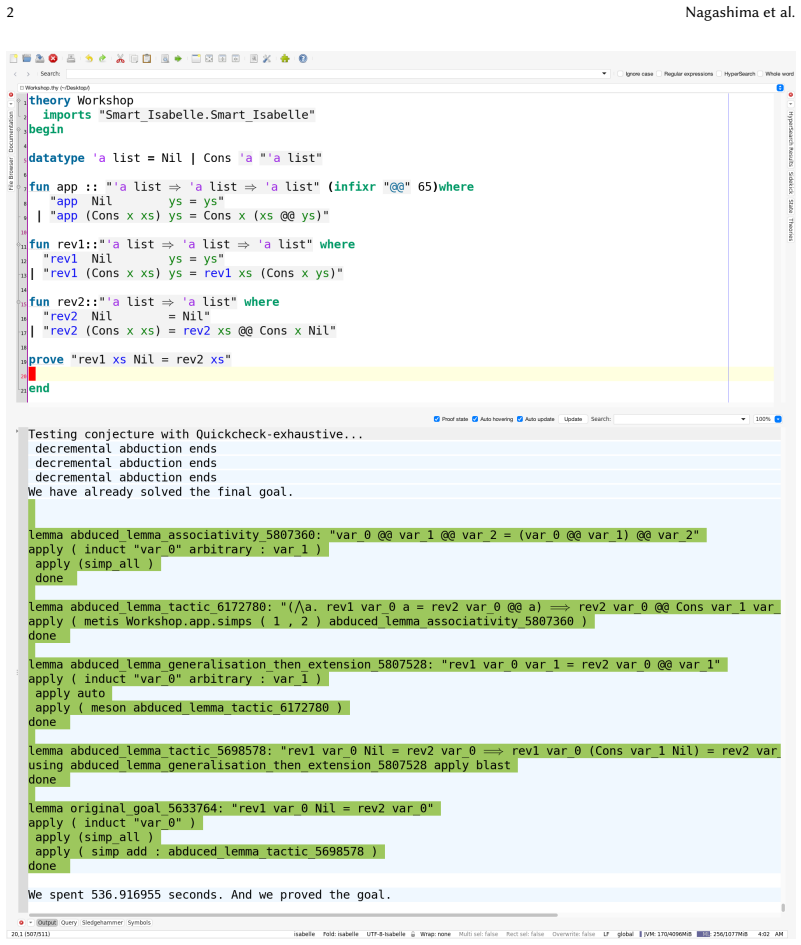
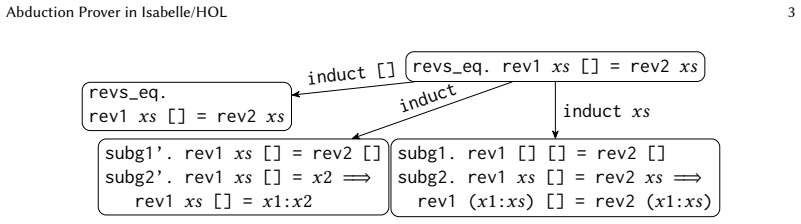
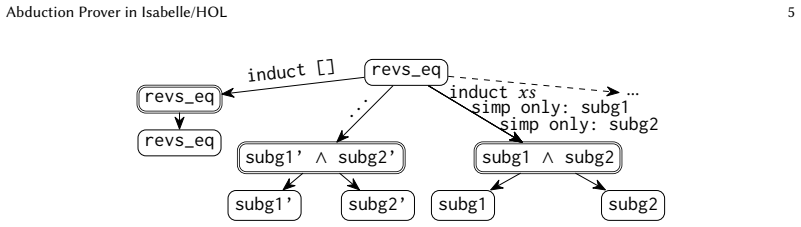
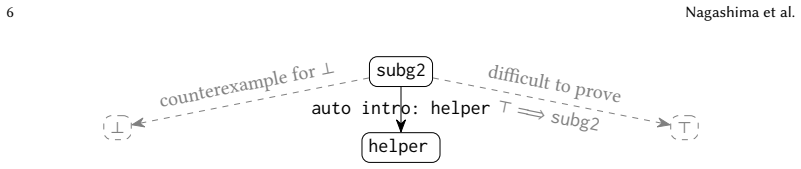

read the original abstract
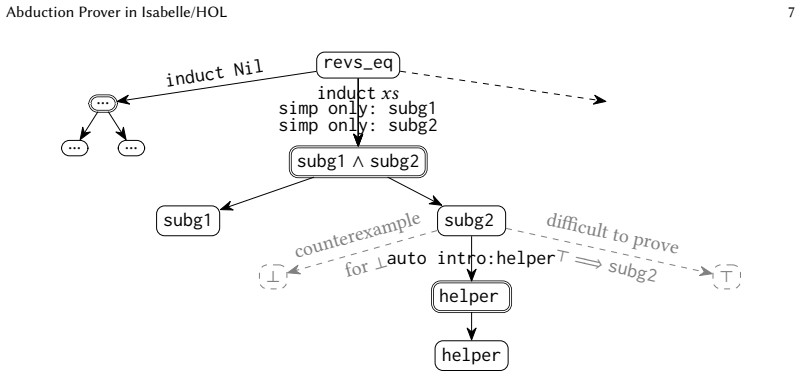
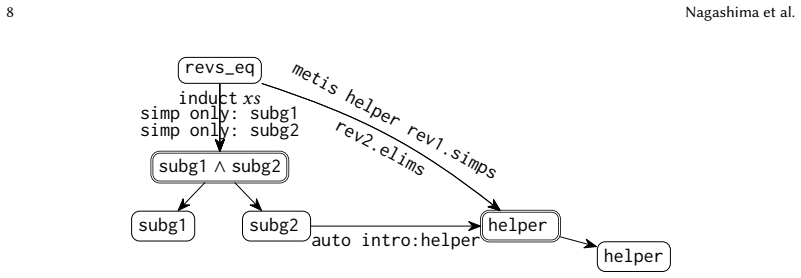
Proof assistants based on expressive logics suffer limited automation for proof search, raising the cost of formal verification based on proof assistants. We address this problem by introducing the Abduction Prover for Isabelle/HOL. Given a challenging proof goal, the Abduction Prover constructs a proof script for the goal by identifying useful conjectures using abductive reasoning.
Editorial analysis
A structured set of objections, weighed in public.
Referee Report
Summary. The manuscript introduces the Abduction Prover for Isabelle/HOL. Given a challenging proof goal, the system is claimed to construct a proof script by identifying useful conjectures via abductive reasoning.
Significance. An effective implementation of abductive reasoning to generate conjectures for proof-script construction in Isabelle/HOL would address a recognized bottleneck in automation for expressive logics and could lower the effort required for formal verification. The approach is conceptually distinct from existing tactic-based or machine-learning methods. However, the manuscript contains no implementation description, algorithm, evaluation, or correctness argument, so the practical significance cannot be determined from the provided text.
major comments (1)
- [Abstract] Abstract: the central claim that the Abduction Prover 'constructs a proof script for the goal by identifying useful conjectures using abductive reasoning' is asserted without any accompanying description of the abduction procedure, the form of the generated conjectures, the interface to Isabelle/HOL, or any supporting evidence.
Simulated Author's Rebuttal
We thank the referee for their review of our manuscript on the Abduction Prover. We address the major comment below.
read point-by-point responses
-
Referee: [Abstract] Abstract: the central claim that the Abduction Prover 'constructs a proof script for the goal by identifying useful conjectures using abductive reasoning' is asserted without any accompanying description of the abduction procedure, the form of the generated conjectures, the interface to Isabelle/HOL, or any supporting evidence.
Authors: We agree that the manuscript asserts the central claim without providing descriptions of the abduction procedure, the form of the generated conjectures, the interface to Isabelle/HOL, or supporting evidence. The current manuscript is a brief conceptual introduction. We will revise the manuscript to incorporate these details, including a description of the procedure, conjecture forms, interface, and evidence. revision: yes
Circularity Check
No significant circularity detected
full rationale
The paper presents a descriptive introduction of the Abduction Prover system in Isabelle/HOL, which applies abductive reasoning to generate conjectures for constructing proof scripts. No equations, fitted parameters, predictions of derived quantities, or load-bearing self-citations appear in the provided abstract or description. The central claim is a functional system description without any derivation chain that reduces results to inputs by construction, self-definition, or imported uniqueness theorems. This is a standard non-circular presentation of a proof tool implementation.
Axiom & Free-Parameter Ledger
Reference graph
Works this paper leans on
-
[1]
A Proof Strategy Language and Proof Script Generation for
Yutaka Nagashima and Ramana Kumar , editor =. A Proof Strategy Language and Proof Script Generation for. Automated Deduction -. 2017 , url =. doi:10.1007/978-3-319-63046-5\_32 , timestamp =
-
[2]
2020 Formal Methods in Computer Aided Design,
Yutaka Nagashima , title =. 2020 Formal Methods in Computer Aided Design,. 2020 , url =. doi:10.34727/2020/isbn.978-3-85448-042-6\_32 , timestamp =
-
[3]
Faster Smarter Proof by Induction in
Yutaka Nagashima , editor =. Faster Smarter Proof by Induction in. Proceedings of the Thirtieth International Joint Conference on Artificial Intelligence,. 2021 , url =. doi:10.24963/ijcai.2021/273 , timestamp =
-
[4]
Lukas Bulwahn , editor =. The New Quickcheck for. Certified Programs and Proofs - Second International Conference,. 2012 , url =. doi:10.1007/978-3-642-35308-6\_10 , timestamp =
-
[5]
Jasmin Christian Blanchette and Tobias Nipkow , editor =. Nitpick:. Interactive Theorem Proving, First International Conference,. 2010 , url =. doi:10.1007/978-3-642-14052-5\_11 , timestamp =
-
[6]
Intelligent Computer Mathematics - International Conference,
Koen Claessen and Moa Johansson and Dan Ros. Intelligent Computer Mathematics - International Conference,. 2015 , url =. doi:10.1007/978-3-319-20615-8\_23 , timestamp =
-
[7]
S. Template-based Theory Exploration: Discovering Properties of Functional Programs by Testing , booktitle =. 2020 , url =. doi:10.1145/3462172.3462192 , timestamp =
-
[8]
Nicholas Smallbone and Moa Johansson and Koen Claessen and Maximilian Algehed , title =. J. Funct. Program. , volume =. 2017 , url =. doi:10.1017/S0956796817000090 , timestamp =
-
[9]
Lemma Discovery for Induction -
Moa Johansson , editor =. Lemma Discovery for Induction -. Intelligent Computer Mathematics - 12th International Conference,. 2019 , url =. doi:10.1007/978-3-030-23250-4\_9 , timestamp =
-
[10]
Basin and Dieter Hutter and Andrew Ireland , title =
Alan Bundy and David A. Basin and Dieter Hutter and Andrew Ireland , title =. 2005 , isbn =
2005
-
[11]
Alan Bundy and Frank van Harmelen and Christian Horn and Alan Smaill , editor =. The. 10th International Conference on Automated Deduction, Kaiserslautern, FRG, July 24-27, 1990, Proceedings , series =. 1990 , url =. doi:10.1007/3-540-52885-7\_123 , timestamp =
-
[12]
Koen Claessen and Moa Johansson and Dan Ros. Hip. ATx'12/WInG'12: Joint Proceedings of the Workshops on Automated Theory eXploration and on Invariant Generation, Manchester, UK, June 2012 , series =. 2012 , url =. doi:10.29007/3qwr , timestamp =
-
[13]
Moa Johansson , editor =. Automated Theory Exploration for Interactive Theorem Proving: - An Introduction to the Hipster System , booktitle =. 2017 , url =. doi:10.1007/978-3-319-66107-0\_1 , timestamp =
-
[14]
Goal-Oriented Conjecturing for Isabelle/HOL , booktitle =
Yutaka Nagashima and Julian Parsert , editor =. Goal-Oriented Conjecturing for Isabelle/HOL , booktitle =. 2018 , url =. doi:10.1007/978-3-319-96812-4\_19 , timestamp =
-
[15]
Tobias Nipkow and Lawrence C. Paulson and Markus Wenzel , title =. 2002 , url =. doi:10.1007/3-540-45949-9 , isbn =
-
[16]
Paulson and Jasmin Christian Blanchette , editor =
Lawrence C. Paulson and Jasmin Christian Blanchette , editor =. Three years of experience with Sledgehammer, a Practical Link Between Automatic and Interactive Theorem Provers , booktitle =. 2010 , url =. doi:10.29007/36dt , timestamp =
-
[17]
2000 , doi =
Computer-Aided Reasoning ACL2 Case Studies , series =. 2000 , doi =
2000
-
[18]
Induction in Saturation-Based Proof Search , booktitle =
Giles Reger and Andrei Voronkov , editor =. Induction in Saturation-Based Proof Search , booktitle =. 2019 , url =. doi:10.1007/978-3-030-29436-6\_28 , timestamp =
-
[19]
Induction with Recursive Definitions in Superposition , booktitle =
M. Induction with Recursive Definitions in Superposition , booktitle =. 2021 , url =. doi:10.34727/2021/isbn.978-3-85448-046-4\_34 , timestamp =
-
[20]
Andrew Reynolds and Viktor Kuncak , editor =. Induction for. Verification, Model Checking, and Abstract Interpretation - 16th International Conference,. 2015 , url =. doi:10.1007/978-3-662-46081-8\_5 , timestamp =
-
[21]
Grant O. Passmore and Simon Cruanes and Denis Ignatovich and Dave Aitken and Matt Bray and Elijah Kagan and Kostya Kanishev and Ewen Maclean and Nicola Mometto , editor =. The Imandra Automated Reasoning System (System Description) , booktitle =. 2020 , url =. doi:10.1007/978-3-030-51054-1\_30 , timestamp =
-
[22]
Definitional Quantifiers Realise Semantic Reasoning for Proof by Induction , booktitle =
Yutaka Nagashima , editor =. Definitional Quantifiers Realise Semantic Reasoning for Proof by Induction , booktitle =. 2022 , url =. doi:10.1007/978-3-031-09827-7\_4 , timestamp =
-
[23]
Programming Languages and Systems - 17th Asian Symposium,
Yutaka Nagashima , editor =. Programming Languages and Systems - 17th Asian Symposium,. 2019 , url =. doi:10.1007/978-3-030-34175-6\_14 , timestamp =
-
[24]
Work-in-progress papers presented at the 15th Conference on Intelligent Computer Mathematics (CICM 2022) Informal Proceedings , year =
Sólrún Halla Einarsdóttir and Moa Johansson and Nicholas Smallbone , editor =. Work-in-progress papers presented at the 15th Conference on Intelligent Computer Mathematics (CICM 2022) Informal Proceedings , year =
2022
-
[25]
The Lean Theorem Prover (System Description) , booktitle =
Leonardo Mendon. The Lean Theorem Prover (System Description) , booktitle =. 2015 , url =
2015
-
[26]
Theorem Proving in Higher Order Logics, 21st International Conference, TPHOLs 2008, Montreal, Canada, August 18-21, 2008
Konrad Slind and Michael Norrish , title =. Theorem Proving in Higher Order Logics, 21st International Conference, TPHOLs 2008, Montreal, Canada, August 18-21, 2008. Proceedings , pages =. 2008 , url =
2008
-
[27]
Template-Based Conjecturing for Automated Induction in Isabelle/HOL , booktitle =
Yutaka Nagashima and Zijin Xu and Ningli Wang and Daniel Sebastian Goc and James Bang , editor =. Template-Based Conjecturing for Automated Induction in Isabelle/HOL , booktitle =. 2023 , url =. doi:10.1007/978-3-031-42441-0\_9 , timestamp =
discussion (0)
Sign in with ORCID, Apple, or X to comment. Anyone can read and Pith papers without signing in.