Observational signatures of thermonuclear electron-capture supernovae -- Ne II line strengthening and color evolution as traces of the explosion mechanism
Pith reviewed 2026-06-28 04:04 UTC · model grok-4.3
The pith
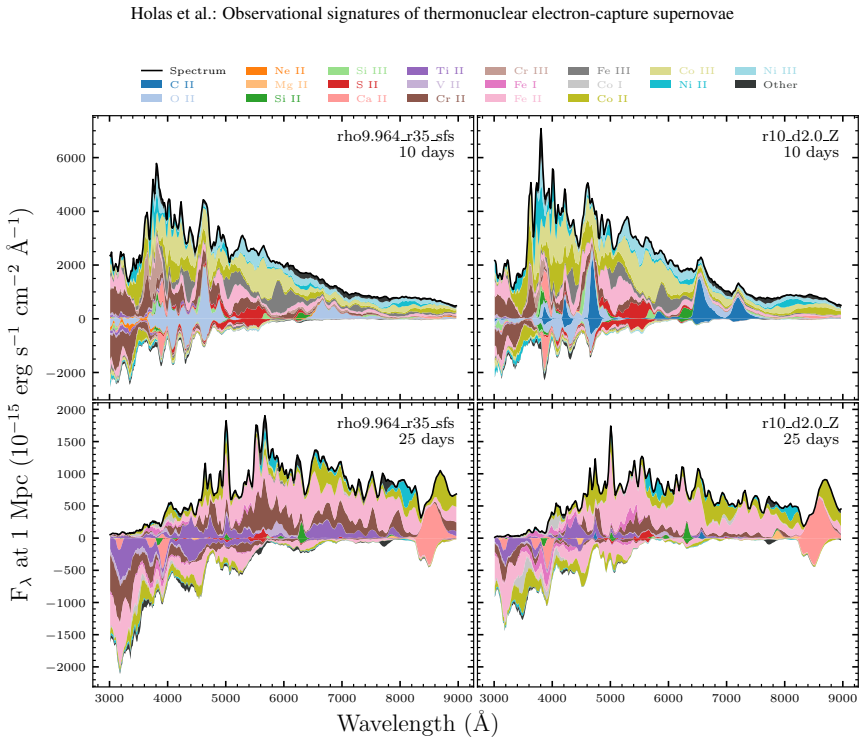
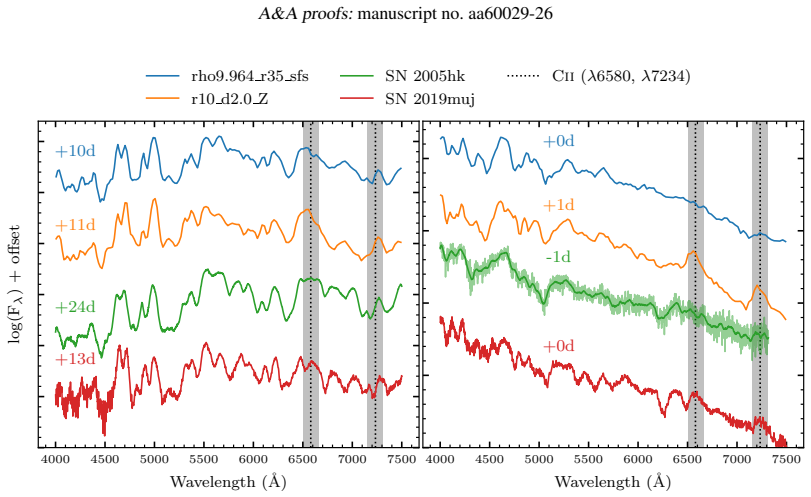
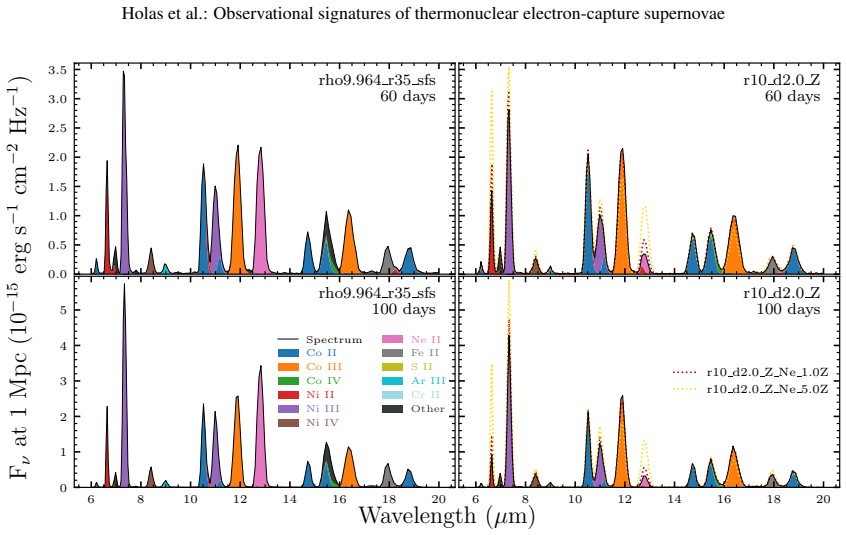
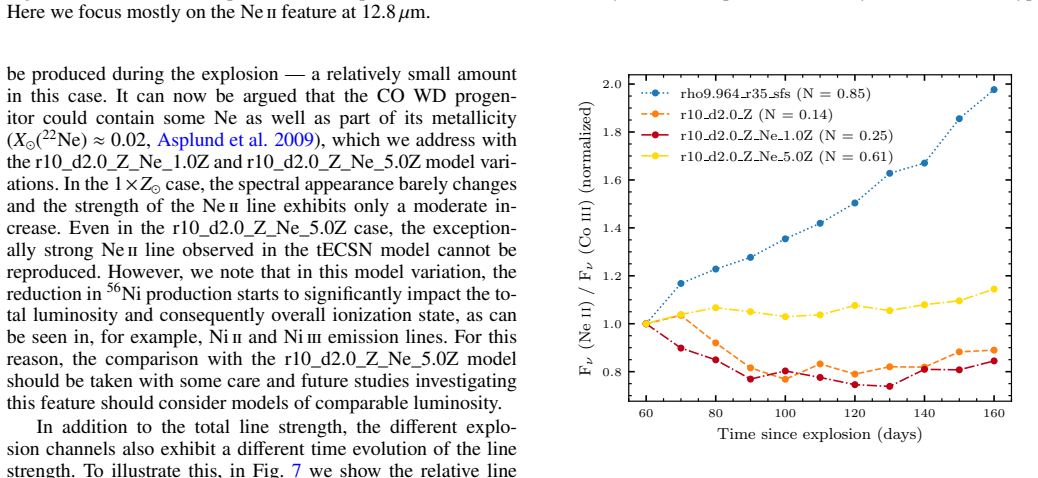
tECSN models show a strengthening 12.8 μm Ne II line over time unlike CO deflagrations of similar nickel yield.
A machine-rendered reading of the paper's core claim, the machinery that carries it, and where it could break.
Core claim
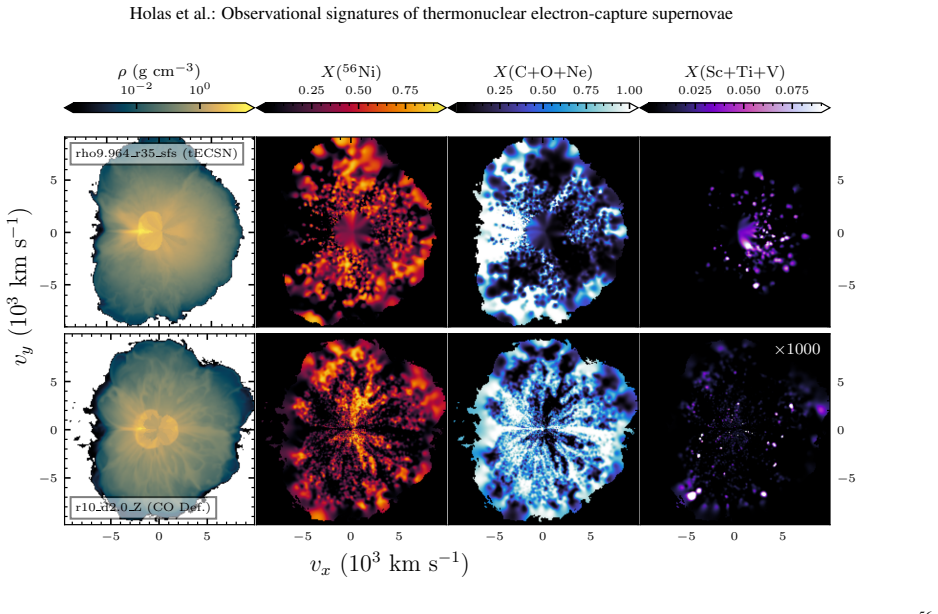
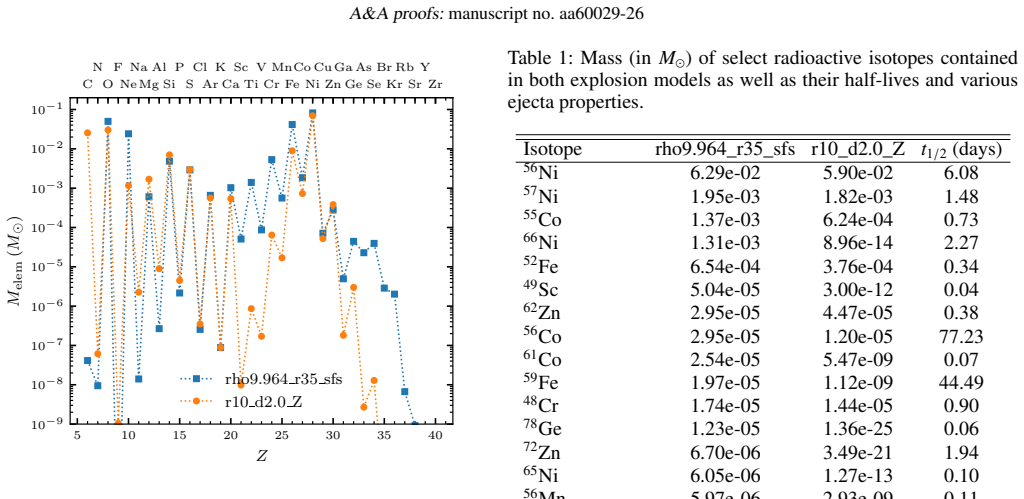
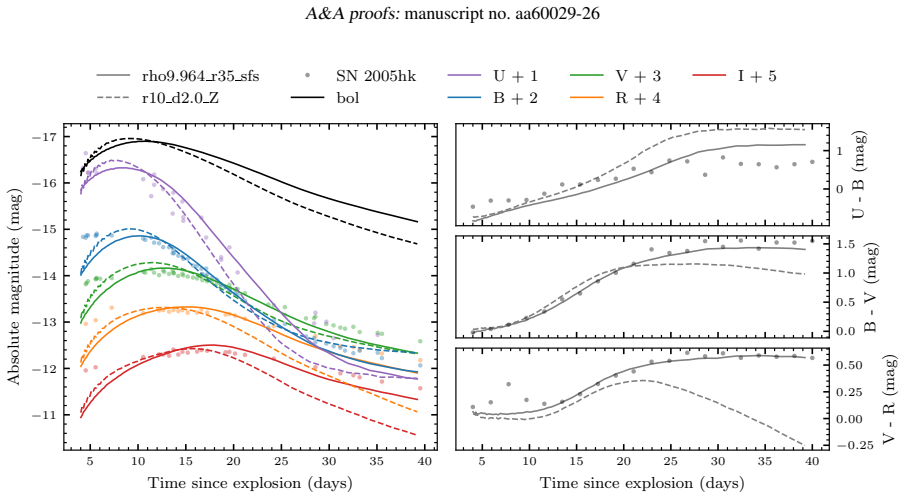
Thermonuclear electron-capture supernovae produce ejecta with a 25 percent lower nickel-to-total-mass ratio than comparable CO deflagrations and synthesize more titanium and chromium. When these yields are fed into radiative transfer calculations the resulting observables match SN Iax-like events at photospheric phases but diverge at late times through the exceptional strengthening of the 12.8 μm Ne II line, which remains nearly constant in the deflagration case.
What carries the argument
Late-time 1D radiative transfer spectra computed with the Artis code on 3D Leafs explosion models, isolating the time evolution of the 12.8 μm Ne II emission line as the distinguishing diagnostic.
If this is right
- tECSNe remain viable candidates for some observed SN Iax events.
- Early-time photometry alone cannot separate tECSNe from CO deflagrations.
- Mid-infrared monitoring at late times offers the clearest route to mechanism discrimination.
- The lower nickel fraction and higher titanium-chromium content alter the color evolution in a measurable way.
- No current observables rule out tECSNe occurring in nature.
Where Pith is reading between the lines
- Targeted mid-IR observations of known SN Iax events could test whether any match the predicted Ne II strengthening.
- If the line signature is confirmed, it would tighten constraints on the fraction of intermediate-mass stars that end as ONe-core explosions rather than white-dwarf deflagrations.
- The same modeling approach could be applied to other candidate channels such as hybrid CONe white dwarfs to map out additional spectral diagnostics.
Load-bearing premise
The nucleosynthetic yields and density structure taken from the 3D explosion simulations remain accurate when mapped into the radiative transfer calculation without major additional mixing at late times.
What would settle it
Mid-infrared spectra of a real SN Iax-like transient taken at multiple epochs after maximum light that either show or fail to show a steadily strengthening 12.8 μm Ne II line.
Figures


read the original abstract
Thermonuclear electron-capture supernovae (tECSNe) are a potential fate of certain intermediate mass stars forming ONe cores at the end of their evolution. Simulations suggest that these explosions are a viable alternative to collapse, yet no synthetic observables exist that allow for their identification among observed transients. We present first of their kind synthetic observables of a tECSN simulation, aiming to establish whether these explosions can occur in nature, and investigate potential observational signatures to separate them from similar transients such as pure deflagrations in CO white dwarfs. We carry out 3D photospheric phase and 1D late phase simulations using the radiative transfer code Artis. As input, we use a tECSN explosion simulation and a CO deflagration simulation with comparable $^{56}$Ni production, both computed with the Leafs code. Both models have similar observational characteristics, akin to SNe~Iax-like events. The tECSN ejecta model are characterized by a $M(^{56}\mathrm{Ni})/M_\mathrm{ej}$ ratio $25\%$ lower than that of comparable CO deflagration models. At early times, the tECSN model shows a slower decline in the red colors compared to the CO deflagration due the greater amount of Ti and Cr synthesized in the tECSN explosion. At late times, the tECSN model exhibits an exceptionally strong $12.8\,\mu$m Ne II emission line, that strengthens substantially over time, whereas its strength remains largely unchanged in the CO deflagration. Our results suggest tECSNe could potentially result in SN~Iax-like transients. Importantly, we find no features that are in tension with existing observables. So far, there are no indicators that unambiguously and robustly separate tECSNe from deflagrations in CO white dwarfs. Nonetheless, our work highlights the potential importance of the mid-infrared wavelength range for distinguishing possible explosion mechanisms.
Editorial analysis
A structured set of objections, weighed in public.
Referee Report
Summary. The paper presents the first synthetic observables for a thermonuclear electron-capture supernova (tECSN) model computed with the Leafs code, compared against a CO white-dwarf deflagration model with comparable 56Ni yield. Using 3D photospheric-phase and 1D late-phase Artis radiative-transfer calculations, the authors report that both models produce SN Iax-like transients; the tECSN model exhibits slower early-time red-color decline due to higher Ti/Cr production and, at late times, an exceptionally strong 12.8 μm Ne II line whose strength increases substantially, while the line remains roughly constant in the deflagration model. They conclude that tECSNe remain viable but lack unambiguous observational discriminants from CO deflagrations.
Significance. If the reported Ne II line evolution and color differences prove robust, the work supplies the first quantitative, forward-model predictions that could guide mid-infrared searches for tECSNe and tests of explosion mechanisms in the Iax-like population. The direct comparison of two models with matched 56Ni mass run through an identical Artis pipeline is a clear methodological strength.
major comments (2)
- [late-phase simulations] Abstract and late-phase results section: the central claim that the 12.8 μm Ne II line strengthens substantially over time in the tECSN model (while remaining constant in the CO deflagration) rests on 1D late-phase Artis calculations applied to 3D Leafs ejecta. No test is presented of whether 3D asymmetries, clumping, or non-spherical ionization balance in the Ne-rich zones at t ≳ 100 d would alter the reported line evolution.
- [model selection and yields] Methods and results on nucleosynthesis: the paper states that the two models were chosen with comparable 56Ni production, yet provides no quantitative uncertainty estimates, convergence tests, or sensitivity analysis on how variations in the Ne, Ti, or Cr mass fractions (or their spatial distributions) propagate into the Ne II line strength or color curves.
minor comments (2)
- [abstract] Notation: the ratio M(56Ni)/M_ej is given as 25% lower for the tECSN model; the exact numerical values and the total ejecta masses should be stated explicitly for reproducibility.
- [figures] Figure clarity: the late-time spectral plots should indicate the wavelength range and resolution used for the Ne II line measurement and whether any continuum subtraction was applied.
Simulated Author's Rebuttal
We thank the referee for the constructive report and for recognizing the methodological strength of the direct model comparison. We address the two major comments below and will incorporate revisions to clarify limitations and strengthen the discussion of uncertainties.
read point-by-point responses
-
Referee: [late-phase simulations] Abstract and late-phase results section: the central claim that the 12.8 μm Ne II line strengthens substantially over time in the tECSN model (while remaining constant in the CO deflagration) rests on 1D late-phase Artis calculations applied to 3D Leafs ejecta. No test is presented of whether 3D asymmetries, clumping, or non-spherical ionization balance in the Ne-rich zones at t ≳ 100 d would alter the reported line evolution.
Authors: We agree that the late-time calculations use a 1D approximation applied to the 3D ejecta structure and that no explicit tests of 3D effects (asymmetries, clumping, or non-spherical ionization) on the Ne II line evolution have been performed. Full 3D radiative-transfer calculations at t ≳ 100 d remain computationally prohibitive for this initial study. We will revise the manuscript to expand the discussion of this approximation, including references to prior work that has examined the validity of 1D late-time modeling for similar events, and to qualify the reported line evolution accordingly. revision: partial
-
Referee: [model selection and yields] Methods and results on nucleosynthesis: the paper states that the two models were chosen with comparable 56Ni production, yet provides no quantitative uncertainty estimates, convergence tests, or sensitivity analysis on how variations in the Ne, Ti, or Cr mass fractions (or their spatial distributions) propagate into the Ne II line strength or color curves.
Authors: The two models were deliberately selected for comparable 56Ni yields to enable a controlled comparison. We acknowledge that the manuscript does not include quantitative uncertainty estimates, convergence tests, or sensitivity analyses on variations in Ne, Ti, or Cr abundances. As this is the first presentation of synthetic observables for a tECSN model, such explorations were outside the present scope. We will add a dedicated paragraph in the discussion section that qualitatively assesses how plausible variations in these species could affect the reported color evolution and Ne II line, and we will flag this as an important avenue for future work. revision: yes
Circularity Check
No circularity: forward radiative-transfer predictions from independent explosion simulations
full rationale
The paper computes synthetic observables by feeding nucleosynthetic yields and ejecta structures from pre-existing Leafs 3D explosion simulations into the Artis radiative-transfer code. No parameters are fitted to observed spectra or light curves, no self-referential definitions appear in the derivation of the Ne II line evolution or color differences, and no load-bearing step reduces to a prior result by the same authors that itself depends on the target claim. The reported differences between tECSN and CO-deflagration models are therefore direct consequences of the input yields rather than constructions internal to the present work.
Axiom & Free-Parameter Ledger
axioms (2)
- domain assumption Leafs-code explosion models accurately capture the nucleosynthesis and density structure of tECSN and CO deflagration events.
- domain assumption Artis radiative transfer calculations in 3D photospheric and 1D nebular phases are sufficient to predict the reported line and color differences.
Reference graph
Works this paper leans on
-
[1]
Abbott, B. P. and Abbott, R. and Abbott, T. D. and Abernathy, M. R. and Acernese, F. and Ackley, K. and Adams, C. and Adams, T. and Addesso, P. and Adhikari, R. X. and Adya, V. B. and Affeldt, C. and Agathos, M. and Agatsuma, K. and Aggarwal, N. and Aguiar, O. D. and Ain, A. and Ajith, P. and Allen, B. and Allocca, A. and Altin, P. A. and Amariutei, D. V....
-
[2]
Adalsteinsson, D. and Sethian, J. A. , year = 1999, month = jan, journal =. The. doi:10.1006/jcph.1998.6090 , urldate =
-
[3]
Stripped-Envelope Stars in Different Metallicity Environments -. A&A , volume =. doi:10.1051/0004-6361/202142895 , urldate =
-
[4]
Alam, Shadab and Ata, Metin and Bailey, Stephen and Beutler, Florian and Bizyaev, Dmitry and Blazek, Jonathan A. and Bolton, Adam S. and Brownstein, Joel R. and Burden, Angela and Chuang, Chia-Hsun and Comparat, Johan and Cuesta, Antonio J. and Dawson, Kyle S. and Eisenstein, Daniel J. and Escoffier, Stephanie and. The Clustering of Galaxies in the Comple...
-
[5]
Aldering, G. and Antilogus, P. and Bailey, S. and Baltay, C. and Bauer, A. and Blanc, N. and Bongard, S. and Copin, Y. and Gangler, E. and Gilles, S. and Kessler, R. and Kocevski, D. and Lee, B. C. and Loken, S. and Nugent, P. and Pain, R. and P. Nearby. ApJ , volume =. doi:10.1086/507020 , urldate =
-
[6]
Almgren, Ann S. and Bell, John B. and Colella, Phillip and Howell, Louis H. and Welcome, Michael L. , year = 1998, month = may, journal =. A. doi:10.1006/jcph.1998.5890 , urldate =
-
[7]
doi:10.1007/978-3-319-21846-5 , urldate =
Handbook of. doi:10.1007/978-3-319-21846-5 , urldate =
-
[8]
Evidence for a Maximum Mass Cut-off in the Neutron Star Mass Distribution and Constraints on the Equation of State , author =. MNRAS , volume =. doi:10.1093/mnras/sty1065 , urldate =
-
[9]
Astronomy and Astrophysics , volume =
Structure and Evolution of Ultra-Massive White Dwarfs in General Relativity , author =. Astronomy and Astrophysics , volume =. doi:10.1051/0004-6361/202244604 , urldate =
-
[10]
An, Zhen-Dong and Chen, Zhen-Peng and Ma, Yu-Gang and Yu, Jian-Kai and Sun, Ye-Ying and Fan, Gong-Tao and Li, Yong-Jiang and Xu, Hang-Hua and Huang, Bo-Song and Wang, Kan , year = 2015, month = oct, journal =. Astrophysical. doi:10.1103/PhysRevC.92.045802 , urldate =
-
[11]
Anand, Gagandeep S. and Rizzi, Luca and Tully, R. Brent and Shaya, Edward J. and Karachentsev, Igor D. and Makarov, Dmitry I. and Makarova, Lidia and Wu, Po-Feng and Dolphin, Andrew E. and Kourkchi, Ehsan , year = 2021, month = aug, journal =. The. doi:10.3847/1538-3881/ac0440 , urldate =
-
[12]
Anderson, Richard I. and Koblischke, Nolan W. and Eyer, Laurent , year = 2024, month = mar, journal =. Small-Amplitude. doi:10.3847/2041-8213/ad284d , urldate =
-
[13]
Antoniadis, J. and Chanlaridis, S. and Gr. Type. A&A , volume =. doi:10.1051/0004-6361/201936991 , urldate =
-
[14]
Electron Fraction Constraints Based on Nuclear Statistical Equilibrium with Beta Equilibrium , author =. A&A , volume =. doi:10.1051/0004-6361/201014276 , urldate =
-
[15]
David , year = 1969, month = oct, journal =
Arnett, W. David , year = 1969, month = oct, journal =. A Possible Model of Supernovae:. doi:10.1007/BF00650291 , urldate =
-
[16]
Arnett, W. David and Bahcall, John N. and Kirshner, Robert P. and Woosley, Stanford E. , year = 1989, month = jan, journal =. Supernova. doi:10.1146/annurev.aa.27.090189.003213 , urldate =
-
[17]
Supernovae and
Arnett, David , year = 1996, month = jan, urldate =. Supernovae and
1996
-
[18]
Artis (V2025.11.11) , author =
-
[19]
Asplund, Martin and Grevesse, Nicolas and Sauval, A. Jacques and Scott, Pat , year = 2009, month = sep, journal =. The. doi:10.1146/annurev.astro.46.060407.145222 , urldate =
-
[20]
Asplund, M. and Amarsi, A. M. and Grevesse, N. , year = 2021, month = sep, journal =. The Chemical Make-up of the. doi:10.1051/0004-6361/202140445 , urldate =
work page internal anchor Pith review doi:10.1051/0004-6361/202140445 2021
-
[21]
and Gustafsson, B
Asplund, M. and Gustafsson, B. and Lambert, D. L. and Rao, N. K. , year = 2000, month = jan, journal =. The
2000
-
[22]
Baade, W. and Zwicky, F. , year = 1934, month = may, journal =. Cosmic. doi:10.1073/pnas.20.5.259 , urldate =
-
[23]
and Zwicky, F
Baade, W. and Zwicky, F. , year = 1934, month = jan, journal =. On
1934
-
[24]
Baade, W. and Zwicky, F. , year = 1934, month = may, journal =. On. doi:10.1073/pnas.20.5.254 , urldate =
-
[25]
Baade, W. and Zwicky, F. , year = 1934, month = jul, journal =. Remarks on. doi:10.1103/PhysRev.46.76.2 , urldate =
-
[26]
Baade, W. and Zwicky, F. , year = 1938, month = nov, journal =. Photographic. doi:10.1086/143996 , urldate =
-
[27]
, year = 1945, month = nov, journal =
Baade, W. , year = 1945, month = nov, journal =. B. doi:10.1086/144761 , urldate =
-
[28]
A Semi-Implicit Mid-Point Rule for Stiff Systems of Ordinary Differential Equations , author =. Numer. Math. , volume =. doi:10.1007/BF01418331 , urldate =
-
[29]
Badwaik, Jayesh and Chandrashekar, Praveen and Klingenberg, Christian , year = 2020, month = dec, journal =. Single-. doi:10.1007/s42967-019-00054-5 , urldate =
-
[30]
Baltay, Charles and Rabinowitz, David and Hadjiyska, Elena and Walker, Emma S. and Nugent, Peter and Coppi, Paolo and Ellman, Nancy and Feindt, Ulrich and McKinnon, Ryan and Horowitz, Benjamin and Effron, Aaron , year = 2013, month = may, journal =. The. doi:10.1086/671198 , urldate =
-
[31]
and Ciatti, F
Barbon, R. and Ciatti, F. and Rosino, L. , year = 1979, month = feb, journal =. Photometric Properties of Type
1979
-
[32]
Barna, Barnab. MNRAS , volume =. doi:10.1093/mnras/staa3543 , urldate =
-
[33]
Batziou, Eirini and Glas, Robert and Janka, H.-Thomas and Ehring, Jakob and Abdikamalov, Ernazar and Just, Oliver , year = 2024, month = dec, number =. Nucleosynthesis. doi:10.48550/arXiv.2412.02756 , urldate =. arXiv , langid =:2412.02756 , primaryclass =
-
[34]
Bellm, Eric C. and Kulkarni, Shrinivas R. and Graham, Matthew J. and Dekany, Richard and Smith, Roger M. and Riddle, Reed and Masci, Frank J. and Helou, George and Prince, Thomas A. and Adams, Scott M. and Barbarino, C. and Barlow, Tom and Bauer, James and Beck, Ron and Belicki, Justin and Biswas, Rahul and Blagorodnova, Nadejda and Bodewits, Dennis and B...
-
[35]
Benetti, S. and Cappellaro, E. and Mazzali, P. A. and Turatto, M. and Altavilla, G. and Bufano, F. and. The. The Astrophysical Journal , volume =. doi:10.1086/428608 , urldate =
-
[36]
Journal of Computational Physics , keywords =
Local Adaptive Mesh Refinement for Shock Hydrodynamics , author =. Journal of Computational Physics , volume =. doi:10.1016/0021-9991(89)90035-1 , urldate =
-
[37]
Bessell, Michael and Murphy, Simon , year = 2012, month = feb, journal =. Spectrophotometric. doi:10.1086/664083 , urldate =
-
[38]
The Astrophysical Journal , volume =
Revival of a Stalled Supernova Shock by Neutrino Heating , author =. The Astrophysical Journal , volume =. doi:10.1086/163343 , urldate =
-
[39]
Beutler, Florian and Blake, Chris and Colless, Matthew and Jones, D. Heath and. The. Monthly Notices of the Royal Astronomical Society , volume =. doi:10.1111/j.1365-2966.2011.19250.x , urldate =
-
[40]
Discovery of a runaway star likely ejected by a Type Iax Supernova
Bhat, A. and Hollands, M. and Dorsch, M. and Geier, S. and Heber, U. and Koester, D. and Pakmor, R. and Shen, Ken J. , year = 2026, month = feb, number =. Discovery of a Runaway Star Likely Ejected by a. doi:10.48550/arXiv.2602.23900 , urldate =. arXiv , langid =:2602.23900 , primaryclass =
work page internal anchor Pith review Pith/arXiv arXiv doi:10.48550/arxiv.2602.23900 2026
-
[41]
Blinnikov, S. I. and Bartunov, O. S. , year = 1993, month = jun, journal =. Non-Equilibrium Radiative Transfer in Supernova Theory : Models of Linear Type
1993
-
[42]
Blinnikov, S. I. and R. Theoretical Light Curves for Deflagration Models of Type. A&A , volume =. doi:10.1051/0004-6361:20054594 , urldate =
-
[43]
, year = 1995, month = may, journal =
Bloecker, T. , year = 1995, month = may, journal =. Stellar Evolution of Low and Intermediate-Mass Stars
1995
-
[44]
Blondin, S. and Matheson, T. and Kirshner, R. P. and Mandel, K. S. and Berlind, P. and Calkins, M. and Challis, P. and Garnavich, P. M. and Jha, S. W. and Modjaz, M. and Riess, A. G. and Schmidt, B. P. , year = 2012, month = may, journal =. The. doi:10.1088/0004-6256/143/5/126 , urldate =
-
[45]
Blondin, St. Evidence for Sub-. MNRAS , volume =. doi:10.1093/mnras/stw2492 , urldate =
-
[46]
Blondin, S. and Dessart, L. and Hillier, D. J. and Ramsbottom, C. A. and Storey, P. J. , year = 2023, month = oct, journal =. Nebular Spectra from. doi:10.1051/0004-6361/202347147 , urldate =
-
[47]
Blondin, St. A&A , volume =. doi:10.1051/0004-6361/202244134 , urldate =
-
[48]
Boccioli, Luca and Roberti, Lorenzo , year = 2024, month = mar, journal =. The. doi:10.3390/universe10030148 , urldate =
-
[49]
Bodansky, David and Clayton, Donald D. and Fowler, William A. , year = 1968, month = nov, journal =. Nuclear. doi:10.1086/190176 , urldate =
-
[50]
Boos, Samuel J. and Townsley, Dean M. and Shen, Ken J. and Caldwell, Spencer and Miles, Broxton J. , year = 2021, month = oct, journal =. Multidimensional. doi:10.3847/1538-4357/ac07a2 , urldate =
-
[51]
Boos, Samuel J. and Townsley, Dean M. and Shen, Ken J. , year = 2024, month = sep, journal =. Type. doi:10.3847/1538-4357/ad5da2 , urldate =
-
[52]
and Dessart, Luc and Shen, Ken J
Boos, Samuel J. and Dessart, Luc and Shen, Ken J. and Townsley, Dean M. , year = 2024, month = oct, doi =. Non-
2024
-
[53]
Azalee and Pearson, Jeniveve and Shrestha, Manisha and Sand, David J
Bostroem, K. Azalee and Pearson, Jeniveve and Shrestha, Manisha and Sand, David J. and Valenti, Stefano and Jha, Saurabh W. and Andrews, Jennifer E. and Smith, Nathan and Terreran, Giacomo and Green, Elizabeth and Dong, Yize and Lundquist, Michael and Haislip, Joshua and Hoang, Emily T. and Hosseinzadeh, Griffin and Janzen, Daryl and Jencson, Jacob E. and...
-
[54]
Bouchet, Laurent and Strong, Andrew W. and Porter, Troy A. and Moskalenko, Igor V. and Jourdain, Elisabeth and Roques, Jean-Pierre , year = 2011, month = sep, journal =. doi:10.1088/0004-637X/739/1/29 , urldate =
-
[55]
Brady, Ryan and Zingale, Michael , year = 2025, journal =. Numerical. doi:10.3847/2515-5172/add686 , urldate =. arXiv , langid =:2505.07918 , primaryclass =
-
[56]
Brahe, Tycho , year = 1573, publisher =
-
[57]
Branch, David and Baron, E. and Thomas, R. C. and Kasen, D. and Li, Weidong and Filippenko, Alexei V. , year = 2004, month = oct, journal =. Reading the. doi:10.1086/425081 , urldate =
-
[58]
Branch, David and Wheeler, J. Craig , year = 2017, series =. Supernova. doi:10.1007/978-3-662-55054-0 , isbn =
-
[59]
Bravo, E. and. Coulomb Corrections to the Equation of State of Nuclear Statistical Equilibrium Matter: Implications for. Monthly Notices of the Royal Astronomical Society , volume =. doi:10.1046/j.1365-8711.1999.02694.x , urldate =
-
[60]
Bravo, E. and. Explosion of White Dwarfs Harboring Hybrid. Astronomy and Astrophysics , volume =. doi:10.1051/0004-6361/201527861 , urldate =
-
[61]
Brinkman, Hannah E. and Doherty, Carolyn and Pignatari, Marco and Pols, Onno and Lugaro, Maria , year = 2023, month = jul, journal =. Aluminium-26 from. doi:10.3847/1538-4357/acd7ea , urldate =
-
[62]
Brooker, Ezra and Zhiglo, Andrey and Plewa, Tomasz , year = 2025, month = may, number =. Mesoscale. doi:10.48550/arXiv.2505.18482 , urldate =. arXiv , keywords =:2505.18482 , primaryclass =
-
[63]
Brooks, Jared and Schwab, Josiah and Bildsten, Lars and Quataert, Eliot and Paxton, Bill , year = 2017, month = jan, journal =. Convection. doi:10.3847/2041-8213/834/2/L9 , urldate =
-
[64]
Bryan, Greg L. and Norman, Michael L. and O'Shea, Brian W. and Abel, Tom and Wise, John H. and Turk, Matthew J. and Reynolds, Daniel R. and Collins, David C. and Wang, Peng and Skillman, Samuel W. and Smith, Britton and Harkness, Robert P. and Bordner, James and Kim, Ji-hoon and Kuhlen, Michael and Xu, Hao and Goldbaum, Nathan and Hummels, Cameron and Kri...
-
[65]
Computer Physics Communications , series =
A Piecewise Parabolic Method for Cosmological Hydrodynamics , author =. Computer Physics Communications , series =. doi:10.1016/0010-4655(94)00191-4 , urldate =
-
[66]
Bugli, Matteo and Guilet, J. Magnetorotational Core-Collapse Supernovae: The Impact of the Magnetic Field's Structure , shorttitle =. IAU Symp. , volume =. doi:10.1017/S1743921322001193 , keywords =
-
[67]
Bulla, M. and Sim, S. A. and Kromer, M. , year = 2015, month = jun, journal =. Polarization Spectral Synthesis for. doi:10.1093/mnras/stv657 , urldate =
-
[68]
Burkert, Andreas and Bodenheimer, Peter , year = 2000, month = nov, journal =. Turbulent. doi:10.1086/317122 , urldate =
-
[69]
Burrows, Adam and Dolence, Joshua C. and Murphy, Jeremiah W. , year = 2012, month = oct, journal =. doi:10.1088/0004-637X/759/1/5 , urldate =
-
[70]
Burrows, Adam and Wang, Tianshu and Vartanyan, David and Coleman, Matthew S. B. , year = 2023, month = nov, number =. A. doi:10.48550/arXiv.2311.12109 , urldate =. arXiv , keywords =:2311.12109 , primaryclass =
-
[71]
Butterworth, Stephen , year = 1930, month = oct, journal =. On the
1930
-
[72]
Cai, Y.-Z. and Pastorello, A. and Fraser, M. and Botticella, M. T. and. Intermediate-Luminosity Red Transients:. A&A , volume =. doi:10.1051/0004-6361/202141078 , urldate =
-
[73]
Investigating the Origins of Thermonuclear Supernovae through Multi-Dimensional Radiative Transfer Modelling , author =
-
[74]
Callan, F. P. and Sim, S. A. and Collins, C. E. and Shingles, L. J. and Lach, F. and R. Including a Luminous Central Remnant in Radiative Transfer Simulations for. MNRAS , volume =. doi:10.1093/mnras/stae847 , urldate =
-
[75]
Callan, F. P. and Holas, A. and. A&A , volume =. doi:10.1051/0004-6361/202554548 , urldate =
-
[76]
Canal, Ramon and Isern, Jordi and Labay, Javier , year = 1992, month = oct, journal =. The. doi:10.1086/186574 , urldate =
-
[77]
Monthly Notices of the Royal Astronomical Society , volume =
Black Dwarf Supernova in the Far Future , author =. Monthly Notices of the Royal Astronomical Society , volume =. doi:10.1093/mnras/staa2262 , urldate =
-
[78]
and Scolnic, Dan and Said, Khaled and Brout, Dillon and Peterson, Erik R
Carr, Anthony and Davis, Tamara M. and Scolnic, Dan and Said, Khaled and Brout, Dillon and Peterson, Erik R. and Kessler, Richard , year = 2022, month = oct, journal =. The. doi:10.1017/pasa.2022.41 , urldate =
-
[79]
Casanova, Jordi and Jos. Kelvin--. Nature , volume =. doi:10.1038/nature10520 , urldate =
-
[80]
Cassisi, S. and Potekhin, A. Y. and Pietrinferni, A. and Catelan, M. and Salaris, M. , year = 2007, month = jun, journal =. Updated. doi:10.1086/516819 , urldate =
discussion (0)
Sign in with ORCID, Apple, or X to comment. Anyone can read and Pith papers without signing in.