The Score Hamiltonian: Mapping Diffusion Models to Adiabatic Transport
Pith reviewed 2026-06-29 00:15 UTC · model grok-4.3
The pith
Score-based diffusion sampling corresponds exactly to adiabatic transport of ground states for Score Hamiltonians built from the learned score.
A machine-rendered reading of the paper's core claim, the machinery that carries it, and where it could break.
Core claim
We exhibit an exact correspondence between sampling with score-based diffusion models and adiabatic transport of ground states for a family of Schrödinger operators we call Score Hamiltonians, built from the learned score's quantum potential. We obtain novel density reconstruction bounds and principled annealing schedules via adiabatic theorems for Fokker-Planck equations with time-varying potentials. We find the fundamental limit of sampling is set by the ratio of squared score-matching error to Score Hamiltonian spectral gap - the inverse Poincaré constant of the data density.
What carries the argument
The Score Hamiltonian, a Schrödinger operator built from the quantum potential of the learned score function, which maps diffusion sampling dynamics exactly to adiabatic ground-state transport.
Load-bearing premise
The Fokker-Planck dynamics with potentials derived from the learned score admit direct application of adiabatic theorems whose ground states precisely encode the target data density without additional approximation errors.
What would settle it
A direct computation of sampling error for a known target density that deviates from the predicted ratio of squared score-matching error to Score Hamiltonian spectral gap would show the exact correspondence fails.
Figures

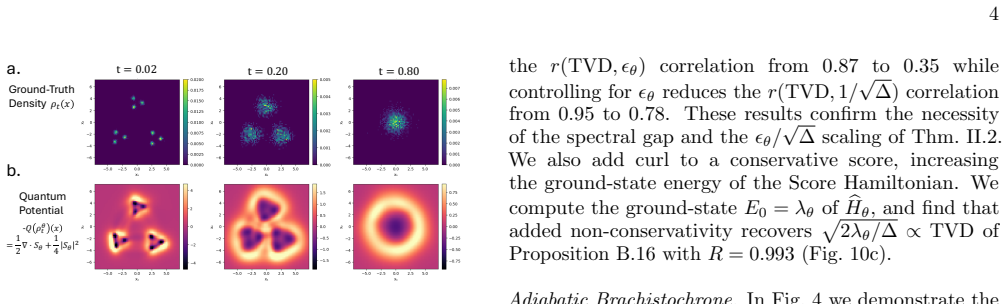
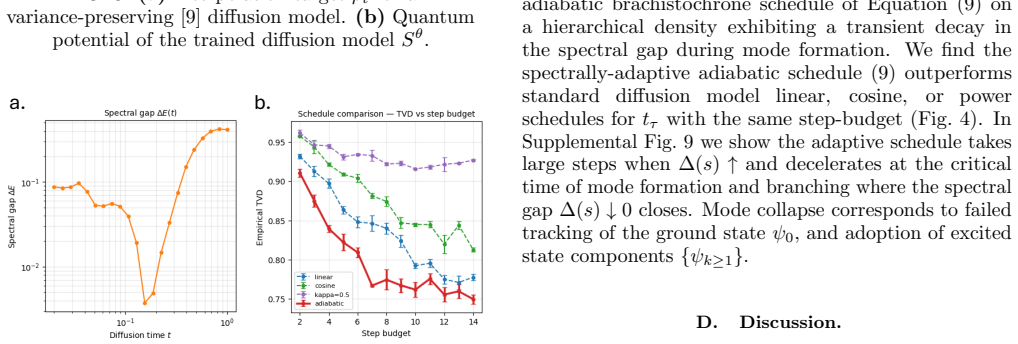

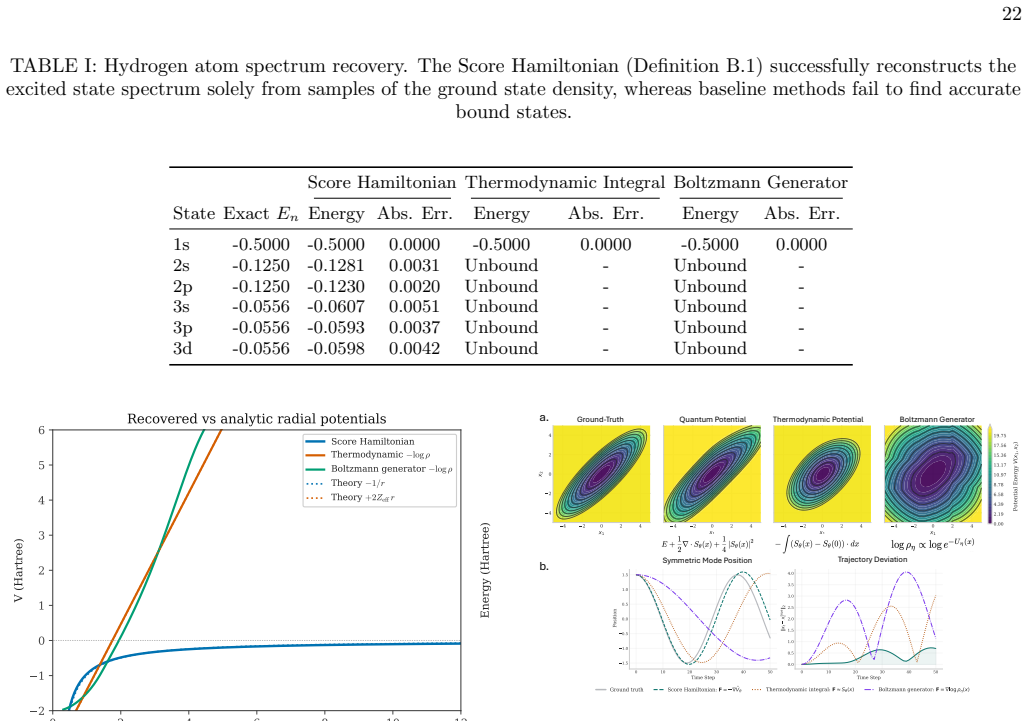

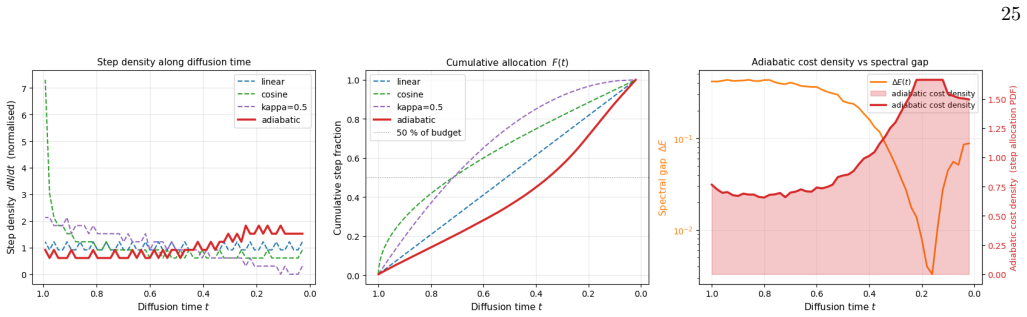

read the original abstract
We exhibit an exact correspondence between sampling with score-based diffusion models and adiabatic transport of ground states for a family of Schr\"odinger operators we call Score Hamiltonians, built from the learned score's quantum potential. We obtain novel density reconstruction bounds and principled annealing schedules via adiabatic theorems for Fokker-Planck equations with time-varying potentials. We find the fundamental limit of sampling is set by the ratio of squared score-matching error to Score Hamiltonian spectral gap - the inverse Poincar\'e constant of the data density.
Editorial analysis
A structured set of objections, weighed in public.
Referee Report
Summary. The manuscript claims an exact correspondence between sampling in score-based diffusion models and adiabatic transport of ground states for a family of Schrödinger operators termed Score Hamiltonians, constructed from the learned score via its quantum potential. It derives novel density reconstruction bounds and annealing schedules by applying adiabatic theorems to time-dependent Fokker-Planck equations with potentials from the score, and concludes that the fundamental limit on sampling performance is given by the ratio of the squared score-matching error to the spectral gap of the Score Hamiltonian (identified as the inverse Poincaré constant of the data density).
Significance. If the claimed exact correspondence and bounds hold without hidden approximation errors, the work would provide a rigorous bridge between diffusion-based sampling and quantum adiabatic transport, offering a principled explanation for performance limits and guidance for schedule design. The identification of an error-to-gap ratio as the controlling quantity could be useful for practitioners, though its utility depends on whether the mapping is truly parameter-free and domain-compatible as stated.
major comments (2)
- [the section establishing the exact correspondence] The section establishing the exact correspondence (via the Score Hamiltonian and its ground states): the claim that ground states precisely encode the target data density and that adiabatic theorems apply directly requires explicit verification that the similarity transform between the Fokker-Planck generator and the Schrödinger operator introduces no domain, boundary, or regularity mismatches when the score is learned and approximate. Any such mismatch would add uncontrolled errors outside the stated ratio bound.
- [the derivation of the fundamental sampling limit] The derivation of the fundamental sampling limit (ratio of squared score-matching error to spectral gap): this bound is presented as following from the correspondence and adiabatic theorems, but if the Fokker-Planck-to-Schrödinger mapping requires additional regularity assumptions on the learned score (not controlled by the error term), the bound may not be tight or may fail to hold exactly as stated.
minor comments (2)
- [Score Hamiltonian definition] Clarify whether the Score Hamiltonian construction assumes specific boundary conditions or compact support on the data density, as these are typically required for the adiabatic theorem applications cited.
- [abstract and bounds section] The abstract refers to 'novel density reconstruction bounds'; ensure these are compared quantitatively to existing bounds in the diffusion model literature to highlight the improvement.
Simulated Author's Rebuttal
We thank the referee for the careful reading and constructive comments on our manuscript. We address the two major comments point by point below, clarifying the exactness of the correspondence under the stated assumptions and the derivation of the sampling limit. We believe these points can be resolved through minor clarifications.
read point-by-point responses
-
Referee: [the section establishing the exact correspondence] The section establishing the exact correspondence (via the Score Hamiltonian and its ground states): the claim that ground states precisely encode the target data density and that adiabatic theorems apply directly requires explicit verification that the similarity transform between the Fokker-Planck generator and the Schrödinger operator introduces no domain, boundary, or regularity mismatches when the score is learned and approximate. Any such mismatch would add uncontrolled errors outside the stated ratio bound.
Authors: The similarity transform is the standard one relating the Fokker-Planck generator L = Δ + ∇·(s·) to the Schrödinger operator H = -Δ + V via the ground-state wavefunction ψ ∝ √p, where s = ∇log p. This mapping is exact (including domains) when p is smooth, positive, and decays sufficiently at infinity, as assumed throughout the paper for both the data density and the learned approximation. For an approximate score ŝ the Score Hamiltonian is defined directly from ŝ, so its ground state encodes the corresponding approximate density by construction; the adiabatic theorem then applies to the time-dependent family without additional mismatches. We will add an explicit remark in Section 3 verifying domain compatibility under these regularity conditions. revision: yes
-
Referee: [the derivation of the fundamental sampling limit] The derivation of the fundamental sampling limit (ratio of squared score-matching error to spectral gap): this bound is presented as following from the correspondence and adiabatic theorems, but if the Fokker-Planck-to-Schrödinger mapping requires additional regularity assumptions on the learned score (not controlled by the error term), the bound may not be tight or may fail to hold exactly as stated.
Authors: The bound is obtained by applying the adiabatic theorem to the time-dependent Score Hamiltonian whose potential is built from the (approximate) score; the instantaneous error appears as a perturbation controlled by the score-matching loss, while the gap is that of the instantaneous Score Hamiltonian. The manuscript already states the required regularity (C² densities with positive lower bound and suitable decay) that makes the mapping exact; these are the same conditions under which score-based diffusion models are typically analyzed. No uncontrolled assumptions remain outside the error term. The bound is therefore exact within the stated hypotheses; we do not claim tightness beyond that. revision: no
Circularity Check
No circularity: derivation maps diffusion sampling to adiabatic transport via explicitly constructed Score Hamiltonians and applies standard theorems
full rationale
The paper defines Score Hamiltonians directly from the learned score via its quantum potential, then invokes adiabatic theorems on the associated time-dependent Fokker-Planck operators to obtain a correspondence and error bounds. This construction yields the claimed ratio bound as a derived consequence rather than an input; the ground-state encoding of the data density follows from the Schrödinger operator definition and is not presupposed by the sampling procedure itself. No self-citations, fitted parameters renamed as predictions, or ansatzes smuggled via prior work appear in the abstract or described chain. The mapping is therefore self-contained against external benchmarks (adiabatic theorems and spectral-gap estimates) and does not reduce to its inputs by definition.
Axiom & Free-Parameter Ledger
invented entities (1)
-
Score Hamiltonian
no independent evidence
Reference graph
Works this paper leans on
-
[1]
The quan- tum potential Q [16, 17] is precisely its first variation [34, 35] Q(ρ) = δI/δρ
whose associated functional generating its flow is the Fisher Information I[ρ] = 1 4 R |∇logρ| 2ρ. The quan- tum potential Q [16, 17] is precisely its first variation [34, 35] Q(ρ) = δI/δρ . Thus, the Score Hamiltonian is not chosen, butcanonical: its potential is the variational derivative of the functional underlying score-matching. Further, Madelung fl...
2024
-
[2]
J. Ho, A. Jain, and P. Abbeel, Denoising diffusion proba- bilistic models, arXiv preprint arxiv:2006.11239 (2020)
work page internal anchor Pith review Pith/arXiv arXiv 2006
-
[3]
High-Resolution Image Synthesis with Latent Diffusion Models
R. Rombach, A. Blattmann, D. Lorenz, P. Esser, and B. Ommer, High-resolution image synthesis with latent diffusion models (2021), arXiv:2112.10752 [cs.CV]
work page internal anchor Pith review Pith/arXiv arXiv 2021
-
[4]
Hoogeboom, V
E. Hoogeboom, V. G. Satorras, C. Vignac, and M. Welling, Equivariant diffusion for molecule generation in 3D, in Proceedings of the 39th International Conference on Ma- chine Learning, Proceedings of Machine Learning Re- search, Vol. 162, edited by K. Chaudhuri, S. Jegelka, L. Song, C. Szepesvari, G. Niu, and S. Sabato (PMLR,
-
[5]
M. Xu, A. S. Powers, R. O. Dror, S. Ermon, and J. Leskovec, Geometric latent diffusion models for 3D molecule generation, inProceedings of the 40th Interna- tional Conference on Machine Learning, Proceedings of Machine Learning Research, Vol. 202, edited by A. Krause, E. Brunskill, K. Cho, B. Engelhardt, S. Sabato, and J. Scarlett (PMLR, 2023) pp. 38592–38610
2023
-
[6]
J. L. Watson, D. Juergens, N. R. Bennett, B. L. Trippe, J. Yim, H. E. Eisenach, W. Ahern, A. J. Borst, R. J. Ragotte, L. F. Milles, B. I. M. Wicky, N. Hanikel, S. J. Pellock, A. Courbet, W. Sheffler, J. Wang, P. Venkatesh, I. Sappington, S. V. Torres, A. Lauko, V. De Bortoli, E. Mathieu, S. Ovchinnikov, R. Barzilay, T. S. Jaakkola, F. DiMaio, M. Baek, and...
2023
-
[7]
Hyv¨ arinen, Estimation of non-normalized statistical models by score matching, Journal of Machine Learning Research6, 695 (2005)
A. Hyv¨ arinen, Estimation of non-normalized statistical models by score matching, Journal of Machine Learning Research6, 695 (2005)
2005
-
[8]
Vincent, A connection between score matching and denoising autoencoders, Neural Computation23, 1661 (2011)
P. Vincent, A connection between score matching and denoising autoencoders, Neural Computation23, 1661 (2011)
2011
-
[9]
Sohl-Dickstein, E
J. Sohl-Dickstein, E. Weiss, N. Maheswaranathan, and S. Ganguli, Deep unsupervised learning using nonequilib- rium thermodynamics, inProceedings of the 32nd Inter- national Conference on Machine Learning, Proceedings of Machine Learning Research, Vol. 37, edited by F. Bach and D. Blei (PMLR, Lille, France, 2015) pp. 2256–2265
2015
-
[10]
Y. Song, J. Sohl-Dickstein, D. P. Kingma, A. Kumar, S. Ermon, and B. Poole, Score-based generative modeling through stochastic differential equations, inInternational Conference on Learning Representations(2021)
2021
-
[11]
S. Chen, S. Chewi, J. Li, Y. Li, A. Salim, and A. Zhang, Sampling is as easy as learning the score: theory for dif- fusion models with minimal data assumptions, inThe Eleventh International Conference on Learning Represen- tations(2023)
2023
-
[12]
H. Lee, J. Lu, and Y. Tan, Convergence for score-based generative modeling with polynomial complexity, inAd- vances in Neural Information Processing Systems, edited by A. H. Oh, A. Agarwal, D. Belgrave, and K. Cho (2022)
2022
-
[13]
Benton, V
J. Benton, V. D. Bortoli, A. Doucet, and G. Deligiannidis, Nearly$d$-linear convergence bounds for diffusion models via stochastic localization, inThe Twelfth International Conference on Learning Representations(2024)
2024
-
[14]
K. Y. Yang and A. Wibisono, Convergence in KL and r´ enyi divergence of the unadjusted langevin algorithm using estimated score, inNeurIPS 2022 Workshop on Score-Based Methods(2022)
2022
-
[15]
Zeitschrift f \"u r Physik 51(3):165--180, ISSN 0044-3328, ://dx.doi.org/10.1007/BF01343193
M. Born and V. Fock, Beweis des adiabatensatzes, Zeitschrift f¨ ur Physik51, 10.1007/bf01343193 (1928)
-
[16]
Bounds for the adiabatic approximation with applications to quantum computation
S. Jansen, M.-B. Ruskai, and R. Seiler, Bounds for the adiabatic approximation with applications to quan- tum computation, Journal of Mathematical Physics48, 10.1063/1.2798382 (2007)
-
[17]
E. Madelung, Quantentheorie in hydrodynamischer form, Zeitschrift f˘”r Physik40, 10.1007/bf01400372 (1927)
-
[18]
Bohm, A suggested interpretation of the quantum theory in terms of “hidden” variables
D. Bohm, A suggested interpretation of the quantum theory in terms of “hidden” variables. i, Physical Review 85, 166–179 (1952)
1952
-
[19]
Helffer and F
B. Helffer and F. Nier,Hypoelliptic Estimates and Spectral Theory for Fokker-Planck Operators and Witten Lapla- cians(Springer Berlin Heidelberg, 2005)
2005
-
[20]
Risken,The Fokker-Planck Equation: Methods of Solu- tion and Applications(Springer Berlin Heidelberg, 1996)
H. Risken,The Fokker-Planck Equation: Methods of Solu- tion and Applications(Springer Berlin Heidelberg, 1996)
1996
-
[21]
E. Witten, Supersymmetry and morse theory, Journal of Differential Geometry17, 10.4310/jdg/1214437492 (1982)
-
[22]
Nelson, Derivation of the schr¨ odinger equation from newtonian mechanics, Physical Review150, 1079–1085 (1966)
E. Nelson, Derivation of the schr¨ odinger equation from newtonian mechanics, Physical Review150, 1079–1085 (1966)
1966
-
[23]
Nelson,Dynamical Theories of Brownian Motion (Princeton University Press, 2020)
E. Nelson,Dynamical Theories of Brownian Motion (Princeton University Press, 2020)
2020
-
[24]
Fiscaletti,The Geometry of Quantum Potential: En- tropic Information of the Vacuum(WORLD SCIEN- TIFIC, 2017)
D. Fiscaletti,The Geometry of Quantum Potential: En- tropic Information of the Vacuum(WORLD SCIEN- TIFIC, 2017)
2017
-
[25]
V. I. SBITNEV, Bohmian trajectories and the path inte- gral paradigm: Complexified lagrangian mechanics, Inter- national Journal of Bifurcation and Chaos19, 2335–2346 (2009)
2009
-
[26]
A. B. Vuong, M. T. McCann, J. E. Santos, and Y. T. Lin, Are we really learning the score function? reinterpret- ing diffusion models through wasserstein gradient flow matching (2025)
2025
-
[27]
S. Morita and H. Nishimori, Mathematical foundation of quantum annealing, Journal of Mathematical Physics49, 10.1063/1.2995837 (2008)
-
[28]
J. E. Avron, M. Fraas, G. M. Graf, and P. Grech, Adia- batic theorems for generators of contracting evolutions, Communications in Mathematical Physics314, 163–191 (2012)
2012
-
[29]
Bakry, I
D. Bakry, I. Gentil, and M. Ledoux,Analysis and Geome- try of Markov Diffusion Operators(Springer International Publishing, 2014)
2014
-
[30]
Reed and B
M. Reed and B. Simon,II: Fourier Analysis, Self- Adjointness: Volume 2, Methods of Modern Mathematical Physics (Academic Press, San Diego, CA, 1975)
1975
-
[31]
A. T. Rezakhani, W.-J. Kuo, A. Hamma, D. A. Lidar, and P. Zanardi, Quantum adiabatic brachistochrone, Phys. Rev. Lett.103, 080502 (2009)
2009
-
[32]
Rezende and S
D. Rezende and S. Mohamed, Variational inference with normalizing flows, inProceedings of the 32nd International Conference on Machine Learning, Proceedings of Machine Learning Research, Vol. 37, edited by F. Bach and D. Blei (PMLR, Lille, France, 2015) pp. 1530–1538
2015
-
[33]
tex.eprint: https://www.science.org/doi/pdf/10.1126/science.aaw1147
F. No´ e, S. Olsson, J. K¨ ohler, and H. Wu, Boltzmann gener- ators: Sampling equilibrium states of many-body systems with deep learning, Science365, 10.1126/science.aaw1147 (2019). 6
-
[34]
Amari,Information Geometry and Its Applications (Springer Japan, 2016)
S.-i. Amari,Information Geometry and Its Applications (Springer Japan, 2016)
2016
-
[35]
Gianazza, G
U. Gianazza, G. Savar´ e, and G. Toscani, The wasserstein gradient flow of the fisher information and the quantum drift-diffusion equation, Archive for Rational Mechanics and Analysis194, 133–220 (2008)
2008
-
[36]
Tsekov, Towards nonlinear quantum fokker-planck equations, International Journal of Theoretical Physics 48, 1431–1435 (2008)
R. Tsekov, Towards nonlinear quantum fokker-planck equations, International Journal of Theoretical Physics 48, 1431–1435 (2008)
2008
-
[37]
A. G. Setti, Eigenvalue estimates for the weighted lapla- cian on a riemannian manifold, Rendiconti del Seminario Matematico della Universit` a di Padova99, 27 (1998)
1998
-
[38]
B. D. O. Anderson, Reverse-time diffusion equation mod- els, Stochastic Processes and their Applications12, 313 (1982)
1982
-
[39]
S. Chewi, J. Niles-Weed, and P. Rigollet, Statistical opti- mal transport, arXiv preprint arXiv:2407.181633(2024)
-
[40]
Y. Bloch and E. Cohen, The identification of mean quantum potential with fisher information leads to a strong uncertainty relation, Foundations of Physics52, 10.1007/s10701-022-00638-x (2022)
-
[41]
Hiley, 11
B. Hiley, 11. information, quantum theory and the brain, inBrain and Being(John Benjamins Publishing Company,
-
[42]
D. B. Sears, Note on the uniqueness of the green’s func- tions associated with certain differential equations, Cana- dian Journal of Mathematics2, 314–325 (1950)
1950
-
[43]
von Renesse, An optimal transport view of schr¨ odinger’s equation, Canadian Mathematical Bulletin 55, 858–869 (2012)
M.-K. von Renesse, An optimal transport view of schr¨ odinger’s equation, Canadian Mathematical Bulletin 55, 858–869 (2012)
2012
-
[44]
Hohenberg and W
P. Hohenberg and W. Kohn, Inhomogeneous electron gas, Physical Review136, B864–B871 (1964)
1964
-
[45]
L. Dinh, J. Sohl-Dickstein, and S. Bengio, Density esti- mation using real NVP, inInternational Conference on Learning Representations(2017)
2017
-
[46]
Plainer, H
M. Plainer, H. Wu, L. Klein, S. G¨ unnemann, and F. Noe, Consistent sampling and simulation: Molecular dynamics with energy-based diffusion models, inThe Thirty-ninth Annual Conference on Neural Information Processing Sys- tems(2026). 7 OVERVIEW OF SUPPLEMENTARY MATERIAL The supplementary material is organized as follows. Appendix A fixes notation and pro...
2026
-
[47]
Diffusion models depend on a training phase that learns the Fisher-score ∇x logρ t(x), and an inference phase that uses it for sampling
Score-Matching, Diffusion Models, and Fisher Geometry. Diffusion models depend on a training phase that learns the Fisher-score ∇x logρ t(x), and an inference phase that uses it for sampling. One first defines a target family of in- termediate distributions ( ρt)t∈[0,T] that interpolates from a tractable reference distribution such as the Gaussian ρ0 = ρr...
-
[48]
bHis essentially self-adjoint onL 2(dx)
-
[49]
If, in addition,ρsatisfies a Poincar´ e inequality then
The density amplitude √ρ is the unique, normalized, non-negative ground state of bH with zero energy (eigenvalueE 0 = 0), satisfying bH√ρ= 0. If, in addition,ρsatisfies a Poincar´ e inequality then
-
[50]
The spectral gap∆of bH is strictly positive∆ := E1 −E 0 = E1 > 0and equals the inverse of the optimal Poincar´ e constant ofρ[18]: 1 ∆ = sup f∈W 1,2(ρ)\{0}R f dρ=0 R f2 dρR ∥∇f∥2 dρ (B4) If Q(x) = ∇ ·S (x) + 1 2 ||S(x)||2 ↑ ∞ is confining as ||x|| ↑ ∞, then
-
[51]
∆ > 0, Equation (B4) holds, and bH admits a strictly non-negative discrete lower spectrum0 = E0 < E1 ≤E 2 ≤. . .. 10 Proof of Proposition B.3. (1) Self-adjointness of bH fol- lows directly from the Faris-Lavine theorem (see, e.g. Thm. X.38 in [ 29] or [ 41]). For (2) note the quantum potential, by definition, is ˆV = −Q(ρ) = ∇2√ρ√ρ . Taking the action of ...
-
[52]
amplitude- form
Proof of Theorem II.1 Suppose that Ψ τ = µτ /√ρtτ is defined as in (A3) satis- fies the evolution (A2). By Proposition B.3, bHt is essen- tially self-adjoint with zero-energy ground state √ρt, and the Poincar´ e inequality onρt holds, yielding a strictly positive spectral gap ∆(t) > 0. Write Ψ ⊥,τ = Ψτ −ψ 0 the orthogonal lag for ψ0(t) = √ρt the target gr...
-
[53]
into a curl-free conservative component∇ϕ θ and divergence-free componentR θ Sθ =∇ϕ θ +R θ,∇ ·R θ = 0
Non-Conservative Extension If Sθ is non-conservative, it may be decomposed via the Helmholtz-Hodge Thm. into a curl-free conservative component∇ϕ θ and divergence-free componentR θ Sθ =∇ϕ θ +R θ,∇ ·R θ = 0. The Langevin generator with non-conservative Sθ applied to a test functionfgives Lθf= ∆f+S θ · ∇f= ∆f+∇ϕ θ · ∇f+R θ · ∇f as the field exhibits a diver...
-
[54]
Hydrogen Atom (3D) Hamiltonian via Ground-State Samples Setup.We test whether a score-network Sθ trained only on samples from the hydrogen ground-state density recovers the Coulomb Hamiltonian and its full excited- state spectrum. The landmark theorem of Hohenberg- Kohn in density functional theory (DFT) states that the ground-state density of a system un...
-
[55]
Coupled Harmonic Oscillator To evaluate the ability of the Score Hamiltonian frame- work to recover non-separable interactions, we utilize a Coupled Harmonic Oscillator (CHO). Unlike the single- particle Hydrogen atom, the CHO involves two particles whose motion is correlated through a coupling potential, providing a test for identifying system Hamiltonia...
-
[56]
For our experiments, we set k = 1.0 and λ = 5 .0, resulting in a highly correlated ground state density
+ 1 2 λ(x1 −x 2)2 (D1) where k is the local spring constant and λ represents the coupling strength. For our experiments, we set k = 1.0 and λ = 5 .0, resulting in a highly correlated ground state density. The analytical normal mode frequencies areω sym = √ k= 1.0 andω anti = √ k+ 2λ≈3.317. Ground-TruthQuantum PotentialThermodynamic PotentialBoltzmann Gene...
-
[57]
The model is trained by minimizing the negative log-likelihood (NLL) of the data
implemented via the nflows library, consisting of 4 affine coupling layers and random permutations. The model is trained by minimizing the negative log-likelihood (NLL) of the data. A key contribution of this work is the comparison of 23 = 1.0 ( E = 0.5838) Ground State ( 0) Principal Excitation ( 1) Secondary ( 2) Tertiary ( 3) = 0.6 ( E = 0.4384) = 0.3 ...
discussion (0)
Sign in with ORCID, Apple, or X to comment. Anyone can read and Pith papers without signing in.