How Common Are Common Envelopes? Quantifying Their Role in Forming Gravitational-Wave Sources
Pith reviewed 2026-06-28 04:42 UTC · model grok-4.3
The pith
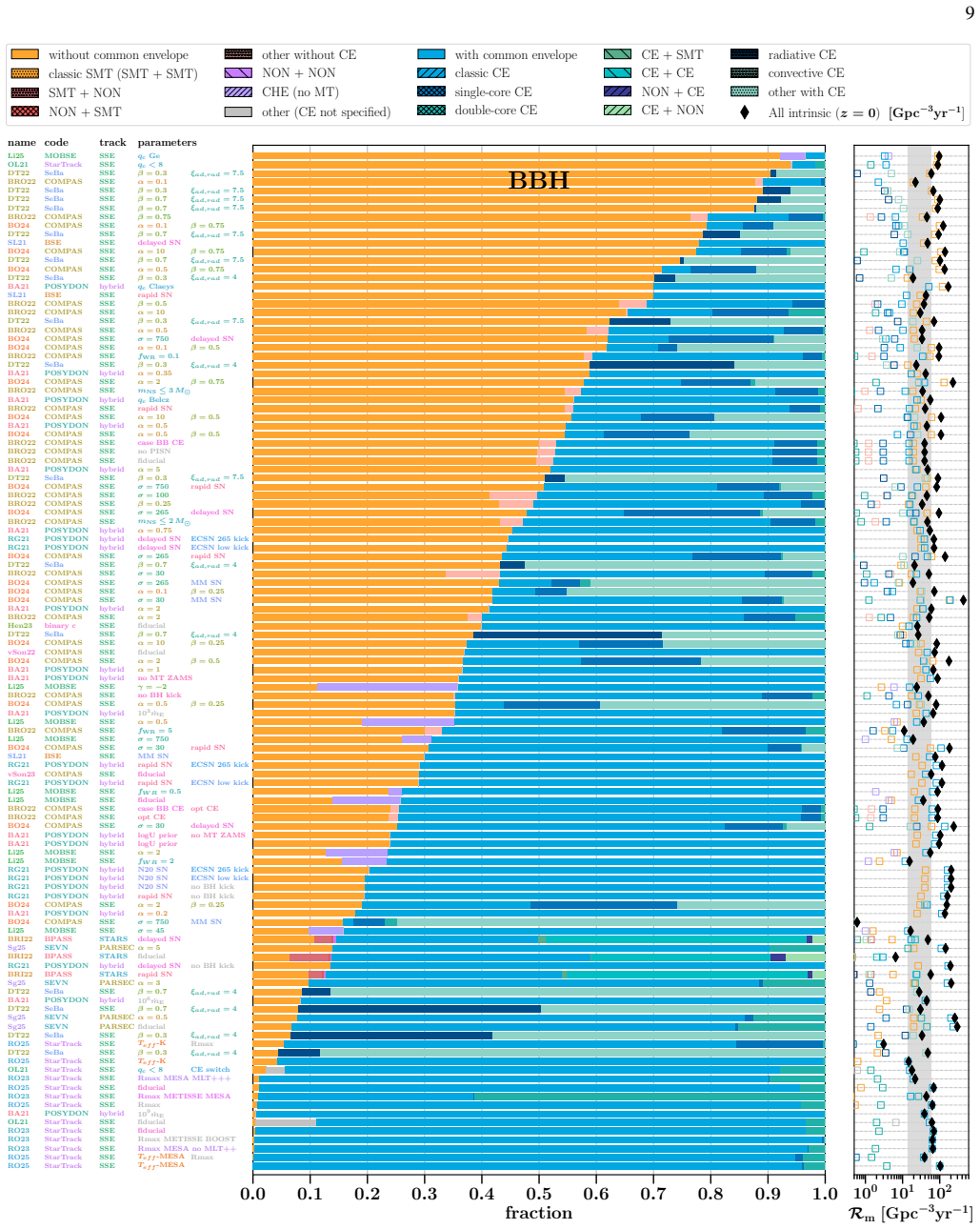
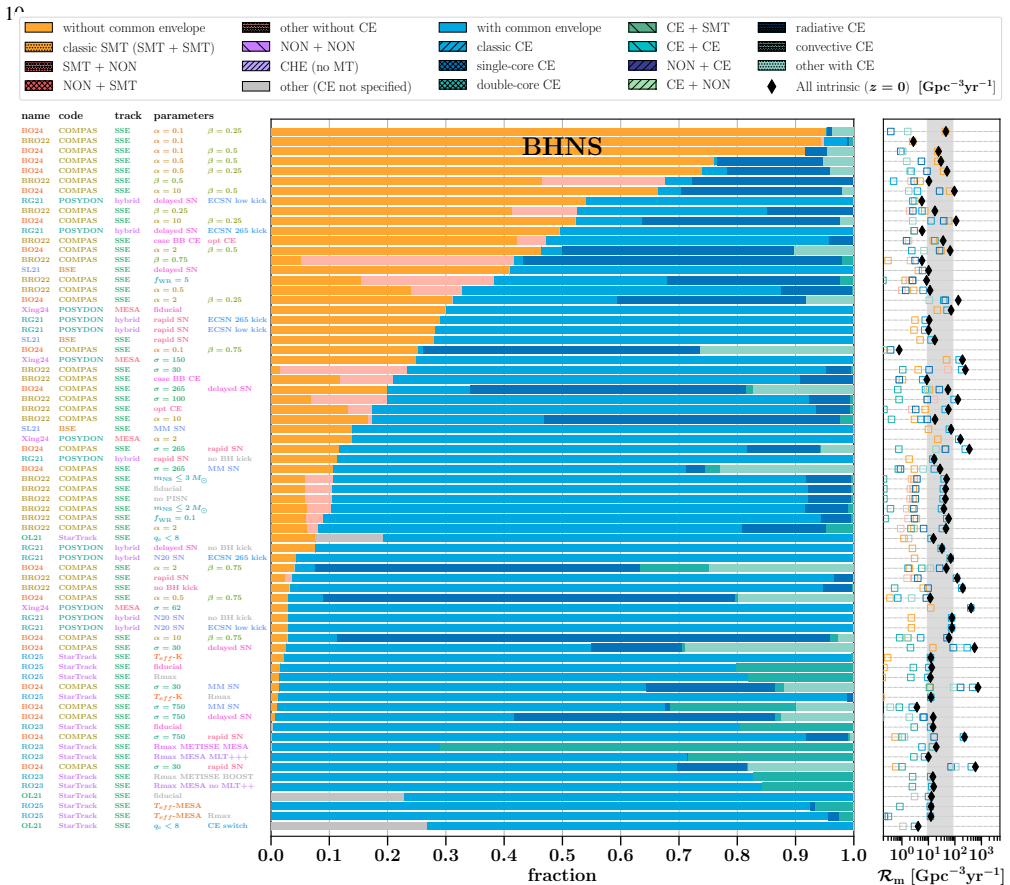
Binary black hole and black hole-neutron star mergers can form with or without common-envelope evolution while producing similar rates.
A machine-rendered reading of the paper's core claim, the machinery that carries it, and where it could break.
Core claim
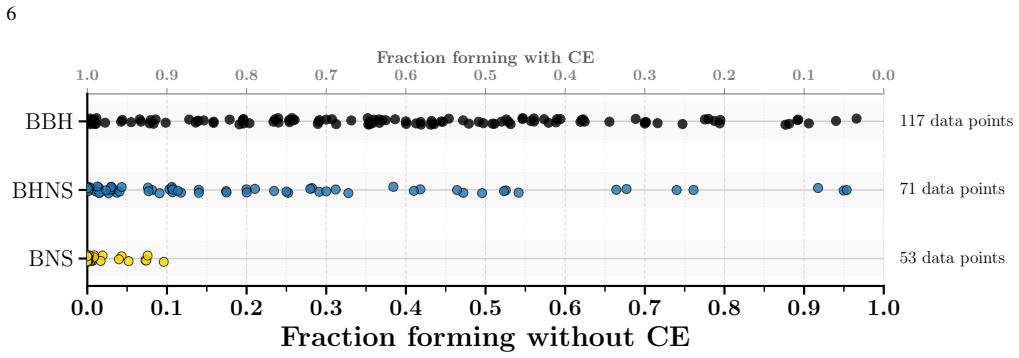
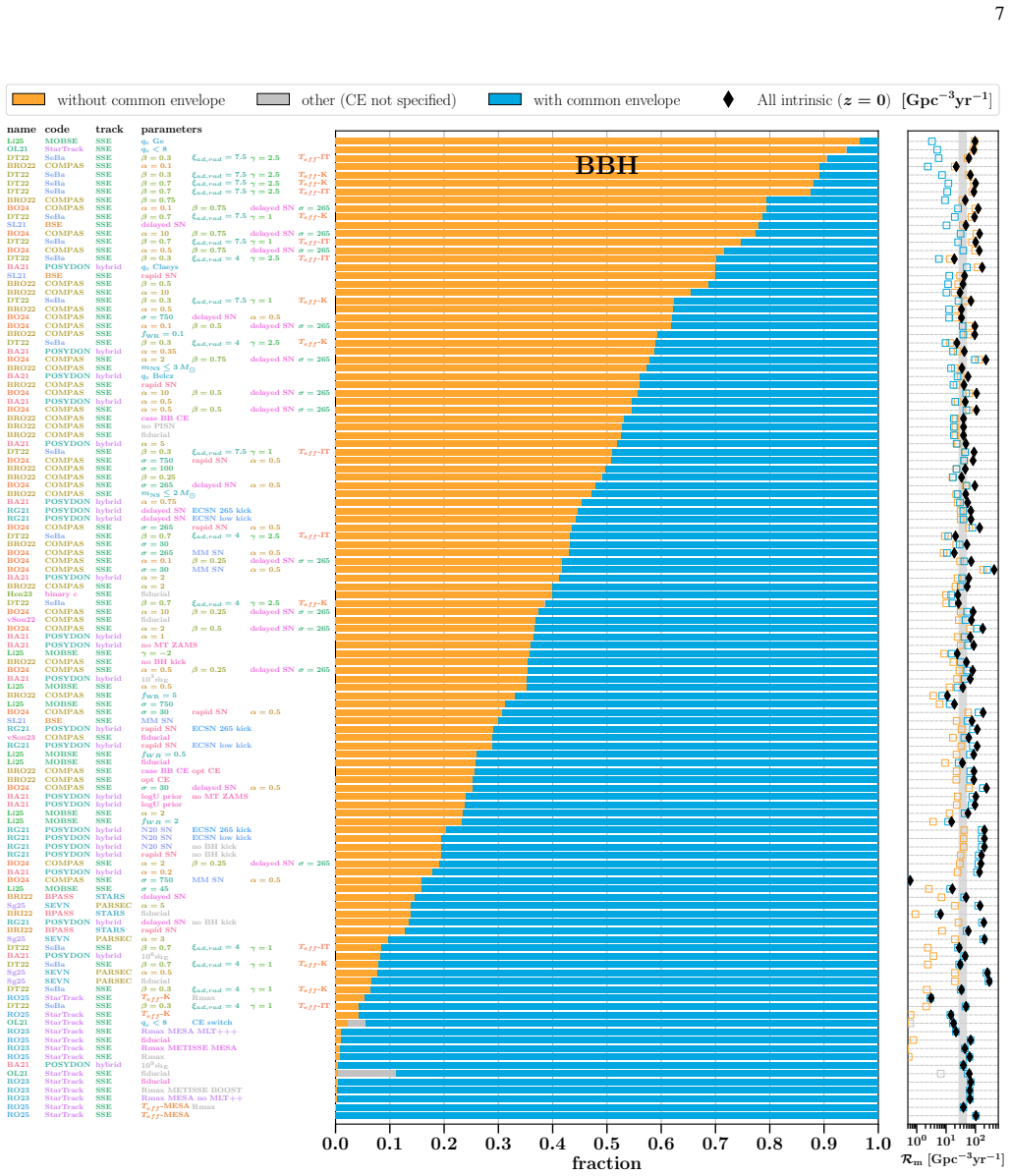
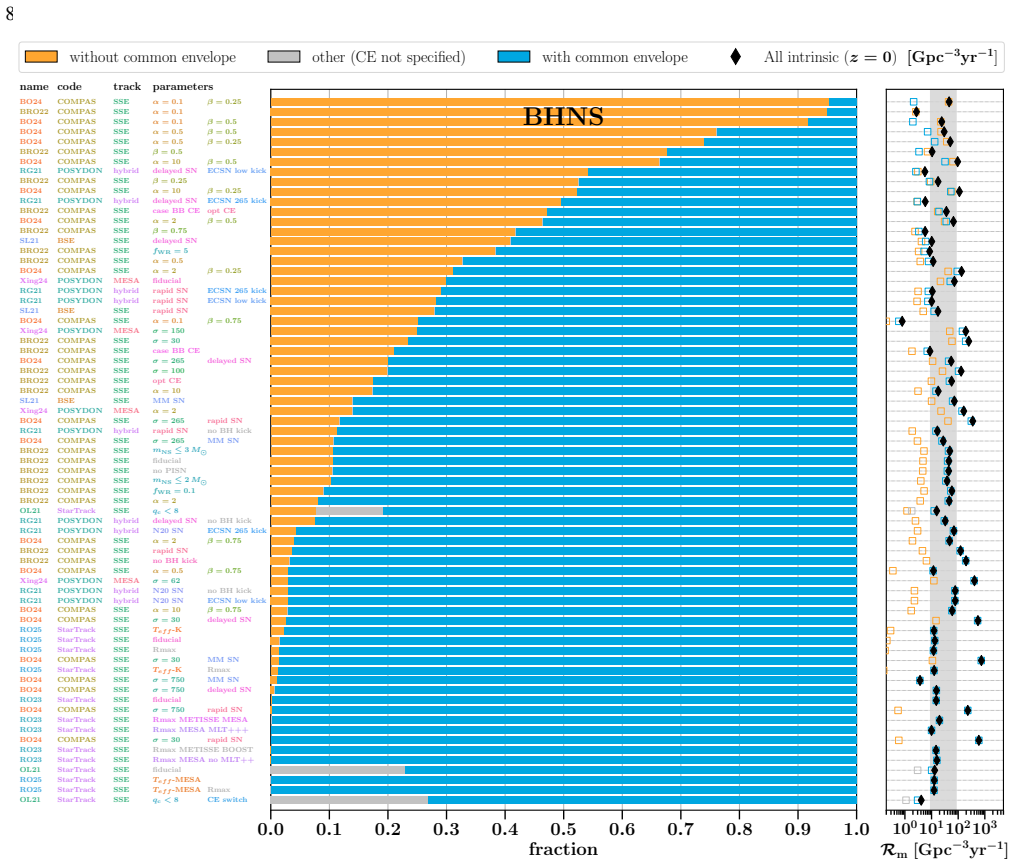
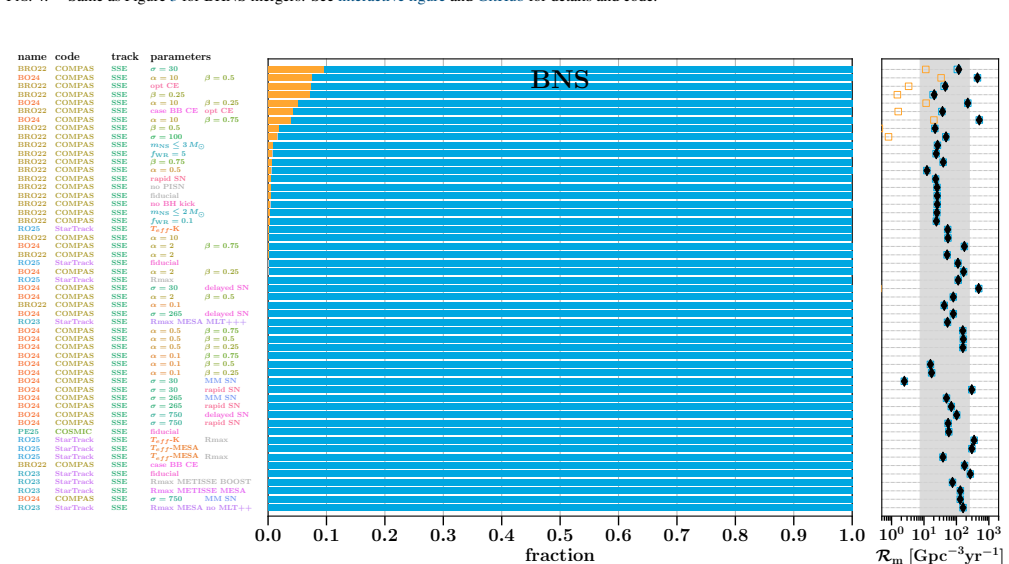
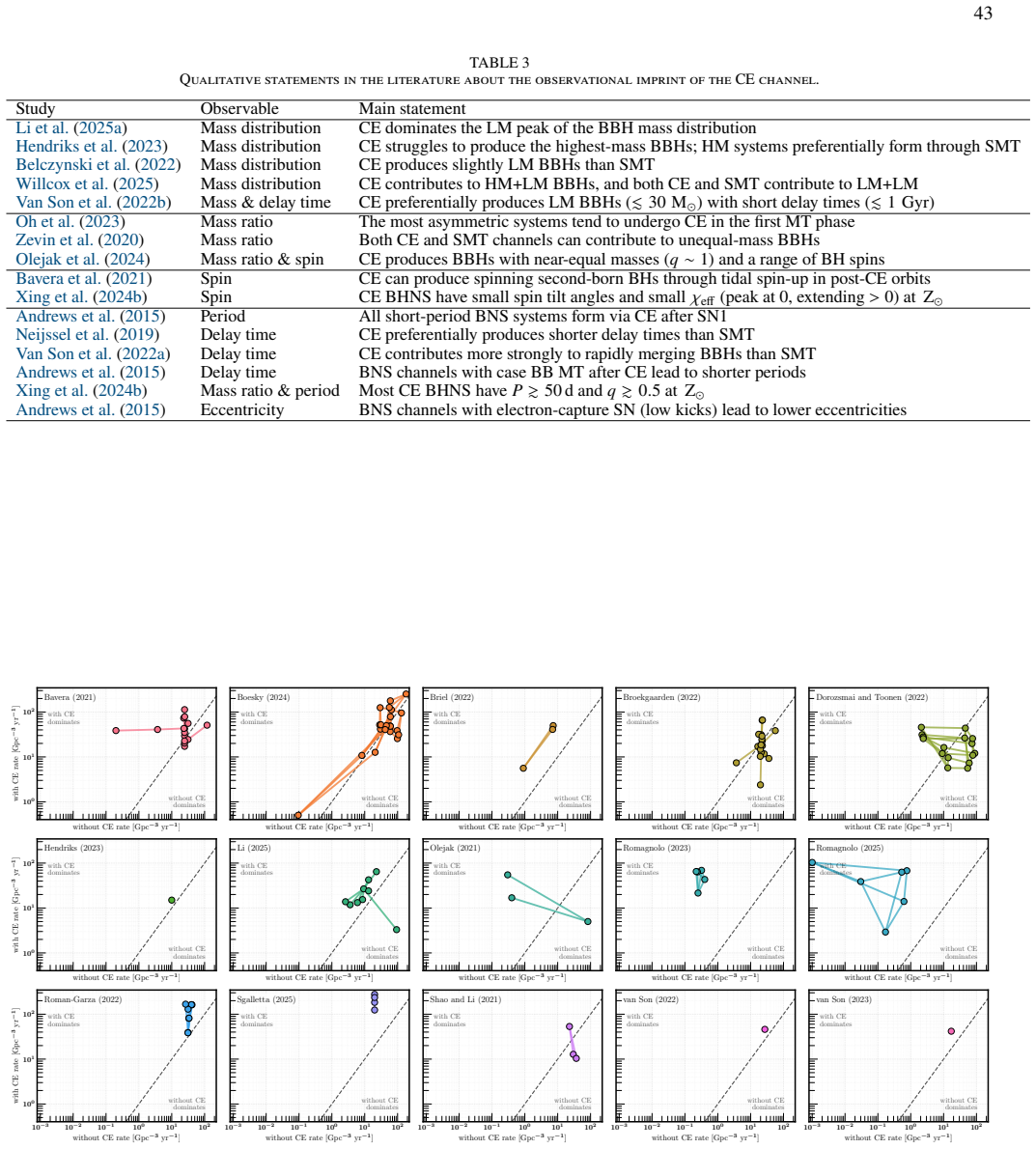
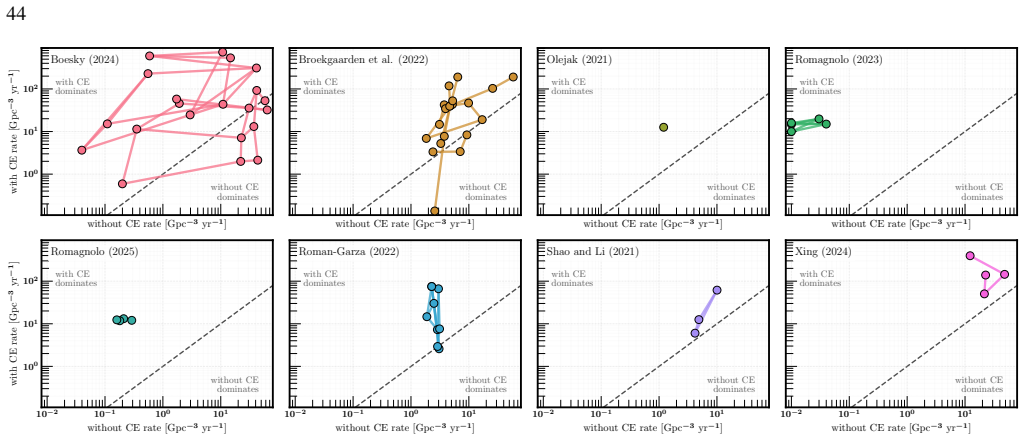
By organizing more than 200 population-synthesis simulations in a unified hierarchical taxonomy of formation channels, the analysis shows that BBH and BHNS formation spans the full allowed range of common-envelope involvement from 0 to 100 percent while often yielding comparable merger rates, which establishes a fundamental degeneracy that prevents merger-rate measurements from uniquely constraining the underlying evolutionary pathways. In contrast, BNS formation proceeds almost exclusively through channels involving at least one common-envelope phase with fractions above 90 to 100 percent.
What carries the argument
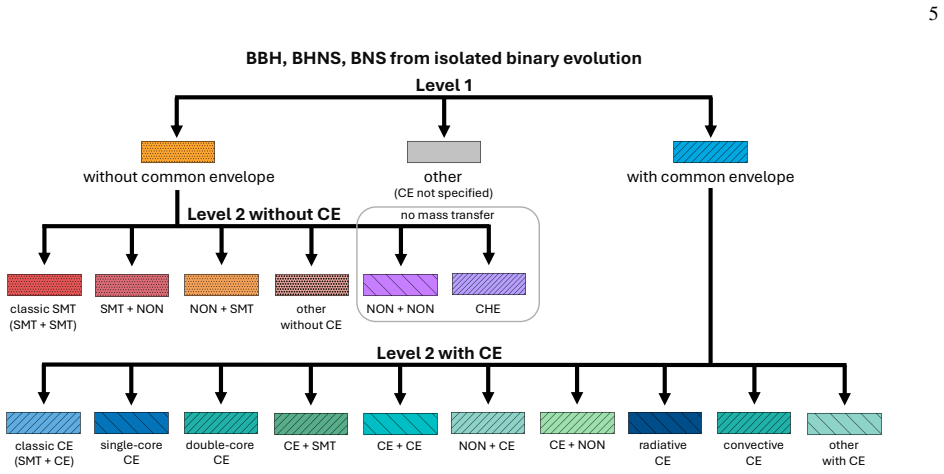
A unified hierarchical taxonomy that classifies formation channels according to whether they involve common-envelope evolution or not, allowing systematic comparison across different simulation codes.
Load-bearing premise
The compiled set of more than 200 simulations provides an unbiased and sufficiently complete sampling of the range of possible formation-channel predictions under current modeling frameworks.
What would settle it
An observational measurement showing that fewer than 90 percent of binary neutron star mergers involve a common-envelope phase would contradict the central finding for BNS systems.
Figures


read the original abstract
A central goal of gravitational-wave astronomy is to use merging binary black hole (BBH), black hole-neutron star (BHNS), and binary neutron star (BNS) systems as fossils to reconstruct the formation and evolution of massive stars across cosmic time. In practice, this inference relies on population-synthesis models that map massive stellar binaries to merging compact objects. However, these models disagree on the dominant orbital-hardening mechanisms within isolated binary evolution, particularly on whether common-envelope (CE) evolution is required. To address this, we compile and systematically compare formation-channel predictions from more than 200 isolated-binary population-synthesis simulations, organized within a unified hierarchical taxonomy. We find that BBH and BHNS formation pathways span nearly the full allowed range from CE-dominated to without-CE-dominated evolution (0-100%), while often predicting similar merger rates, revealing a fundamental degeneracy: merger-rate measurements alone do not uniquely constrain the underlying evolutionary pathways. In contrast, BNS formation proceeds almost exclusively through channels involving at least one CE phase (>90-100%), suggesting CE evolution plays a qualitatively different role in BNS than in BBH and BHNS formation. The relative contributions of with-CE and without-CE pathways are governed primarily by assumptions controlling mass-transfer stability, angular-momentum loss, CE efficiency, and supernova physics, which often act non-linearly and in correlated fashion, such that trends from one-at-a-time parameter variations do not generalize across simulation frameworks. Robust interpretation of gravitational-wave populations will therefore require transparent formation-channel definitions, reproducible analysis pipelines, systematic cross-code comparisons, and observational constraints that extend beyond merger rates alone.
Editorial analysis
A structured set of objections, weighed in public.
Referee Report
Summary. The manuscript compiles and compares formation-channel predictions from more than 200 isolated-binary population-synthesis simulations, organized in a unified hierarchical taxonomy. It reports that BBH and BHNS pathways span nearly the full 0–100% range of CE versus without-CE contributions while often yielding similar merger rates, implying a degeneracy in which merger-rate measurements alone cannot uniquely constrain evolutionary pathways; by contrast, BNS formation is almost exclusively (>90–100%) CE-involved. The relative contributions are attributed to non-linear, correlated assumptions on mass-transfer stability, angular-momentum loss, CE efficiency, and supernova physics.
Significance. If the compiled sample is representative, the result demonstrates that current population-synthesis frameworks permit a wide range of CE contributions for BBH/BHNS systems at comparable rates, underscoring the need for observables beyond merger rates and for transparent, reproducible channel definitions. The systematic taxonomy and cross-simulation aggregation constitute a useful organizational contribution.
major comments (2)
- [Abstract and compilation description] Abstract and compilation description: the central claim that BBH/BHNS channels span the full 0–100% CE range (with similar rates) is load-bearing on the assertion that the >200 simulations constitute an unbiased and sufficiently complete sampling of existing modeling frameworks; however, no explicit inclusion criteria, code-coverage statistics, or test for publication/availability bias are stated, leaving open the possibility that the observed degeneracy is an artifact of incomplete sampling rather than a robust feature of the model space.
- [Results on BNS versus BBH/BHNS contrast] Results on BNS versus BBH/BHNS contrast: the claim that BNS formation proceeds almost exclusively through CE channels (>90–100%) while BBH/BHNS do not is presented as qualitatively different, yet the manuscript provides no quantitative breakdown (e.g., by code family or by specific parameter assumptions) showing that this contrast survives when the same selection and taxonomy are applied uniformly across all three source types.
minor comments (2)
- [Abstract] Abstract: the phrase 'more than 200' could be replaced by the exact count once the final compilation is fixed, and a one-sentence statement of the taxonomy structure would improve immediate clarity.
- [Notation] Notation: the distinction between 'with-CE' and 'without-CE' pathways is used throughout but is not given an explicit operational definition (e.g., whether a single CE phase suffices or whether both components must experience CE) until later in the text; an early boxed definition would aid readability.
Simulated Author's Rebuttal
We thank the referee for their constructive report and recommendation for major revision. We address each major comment below and agree that clarifications on compilation methodology and additional quantitative breakdowns will strengthen the manuscript. We plan to incorporate these changes in the revised version.
read point-by-point responses
-
Referee: [Abstract and compilation description] Abstract and compilation description: the central claim that BBH/BHNS channels span the full 0–100% CE range (with similar rates) is load-bearing on the assertion that the >200 simulations constitute an unbiased and sufficiently complete sampling of existing modeling frameworks; however, no explicit inclusion criteria, code-coverage statistics, or test for publication/availability bias are stated, leaving open the possibility that the observed degeneracy is an artifact of incomplete sampling rather than a robust feature of the model space.
Authors: We acknowledge that the original manuscript did not include an explicit description of inclusion criteria or bias assessment for the compilation of >200 simulations. The sample was assembled from all published isolated-binary population-synthesis studies (post-2010) that report quantitative CE versus non-CE channel fractions for at least one compact-object merger type using standard codes. In the revision we will add a dedicated methods subsection specifying the literature search protocol, inclusion criteria, code coverage, and a discussion of potential publication/availability bias. We note that the 0–100% span for BBH/BHNS appears consistently across independent codes and parameter explorations, which argues against it being solely a sampling artifact, but we will make this explicit. revision: yes
-
Referee: [Results on BNS versus BBH/BHNS contrast] Results on BNS versus BBH/BHNS contrast: the claim that BNS formation proceeds almost exclusively through CE channels (>90–100%) while BBH/BHNS do not is presented as qualitatively different, yet the manuscript provides no quantitative breakdown (e.g., by code family or by specific parameter assumptions) showing that this contrast survives when the same selection and taxonomy are applied uniformly across all three source types.
Authors: We agree that the manuscript would benefit from explicit quantitative breakdowns to demonstrate the robustness of the BNS (>90–100% CE) versus BBH/BHNS (0–100%) contrast under uniform taxonomy. Although the aggregate results apply the same hierarchical channel definitions to all simulations, we did not stratify by code family or key assumptions in the submitted version. In the revision we will add supplementary tables and figures providing these breakdowns (e.g., CE-fraction distributions per source type, stratified by code and by assumptions on mass-transfer stability and CE efficiency) to confirm the contrast holds uniformly. revision: yes
Circularity Check
No circularity: result follows from external simulation compilation
full rationale
The paper's core claim (BBH/BHNS pathways span 0-100% CE contribution with rate degeneracy, while BNS are >90% CE) is obtained by systematically comparing >200 independent published population-synthesis runs. No internal equations, fitted parameters, or self-referential definitions are used to generate the spread or degeneracy; the result is a direct empirical observation of the existing literature ensemble. Self-citations, if present, are not load-bearing for the central degeneracy statement. The derivation is therefore self-contained against external benchmarks.
Axiom & Free-Parameter Ledger
axioms (1)
- domain assumption The population-synthesis simulations used in the compilation accurately capture the dominant binary-evolution physics under the assumptions of each code.
Forward citations
Cited by 2 Pith papers
-
Lower Your Rates: On Claims of a Binary Black Hole Merger-Rate Crisis
A meta-analysis of 1490 BBH merger rate predictions from 57 studies shows substantial subsets reproduce or underestimate the observed rate, indicating that apparent crises are model-dependent rather than universal.
-
Twin Peaks: Resolving Features in the Binary Black Hole Mass Function with COSMIC-METISSE
New MESA stellar tracks with varied winds and convective mixing produce a primary black hole mass function with twin peaks near 8 and 13 solar masses in most variations, the higher peak dominated by mass-ratio-reversa...
Reference graph
Works this paper leans on
-
[1]
Compact object mergers: exploring uncertainties from stellar and binary evolution with SEVN
Abrams N. S., et al., 2025, ApJS, 276, 10 Agrawal P., Hurley J., Stevenson S., Rodriguez C. L., Szécsi D., Kemp A., 2023, MNRAS, 525, 933 Alvarez-Lopez S., Heinzel J., Mould M., Vitale S., 2025, arXiv e-prints, p. arXiv:2506.20731 Andreoni I., et al., 2020, ApJ, 904, 155 Andrews J. J., Farr W. M., Kalogera V., Willems B., 2015, ApJ, 801, 32 Andrews J. J.,...
-
[2]
other” do undergo a CE episode (but, for example, do not undergo SMT prior to the first SN hence the ‘other’ classification). Accordingly, we as- sign these systems to the “with CE
Intotal, thisyields15distinctBBHmerger-rateestimatesand their corresponding CE and SMT contributions. Boesky et al. (2024b,a) [Bo24]—Boesky et al. (2024a,a) use theCOMPASpopulationsynthesiscodetocompute21model variations: 12 exploring different values of the CE efficiency parameter (𝛼) and binding energy parameter (𝛽), and 9 vary- ing the remnant mass pre...
2023
-
[3]
with CE” category, and classify the remaining systems as “without CE
to the “with CE” category, and classify the remaining systems as “without CE”. For the Level 2 classification, we adopt the authors’moredetailedtaxonomy,whichdistinguishessystems according to whether CE, SMT, or no mass transfer occurs in the primary and/or secondary component. We obtain the to- tal BBH merger rate for the fiducial model from Table 1 of B...
2023
-
[4]
with CE” group and classify all remaining systems as “with- out CE
We adopt these definitions for our Level 2 classification. For the Level1categorization,wecombinethethreeCE-relatedchan- nels (classic, single-core, and double-core CE) into a single “with CE” group and classify all remaining systems as “with- out CE”. 6 https://github.com/FloorBroekgaarden/DCO_FormationChannels Dorozsmai & Toonen (2024) [DT22]—Dorozsmai ...
2024
-
[5]
MT switch
Li et al. (2025a) [Li25]—Li et al. (2025a) study the formation channels,massdistributions,andmergerratesofBBHsystems using the binary population-synthesis codeMOBSE, explic- itly incorporating chemically homogeneous evolution (CHE) alongside the more traditional CE and SMT isolated-binary evolutionpathways. Theauthorsexploreagridofpopulation- synthesis mo...
2021
-
[6]
Weretrievetheirformationchannel rates from digitizing Figure 6, which shows the contributions of the formation channels to the BBH merger rate
based on only stable mass transfer, the classic CE channel, and the single-core CE and double-coreCEchannels. Weretrievetheirformationchannel rates from digitizing Figure 6, which shows the contributions of the formation channels to the BBH merger rate. We take therateatredshift𝑧∼0usingaplotdigitizer. Notethatinthe FigureitisclearthattheclassicCEchanneldo...
2015
-
[7]
conventional
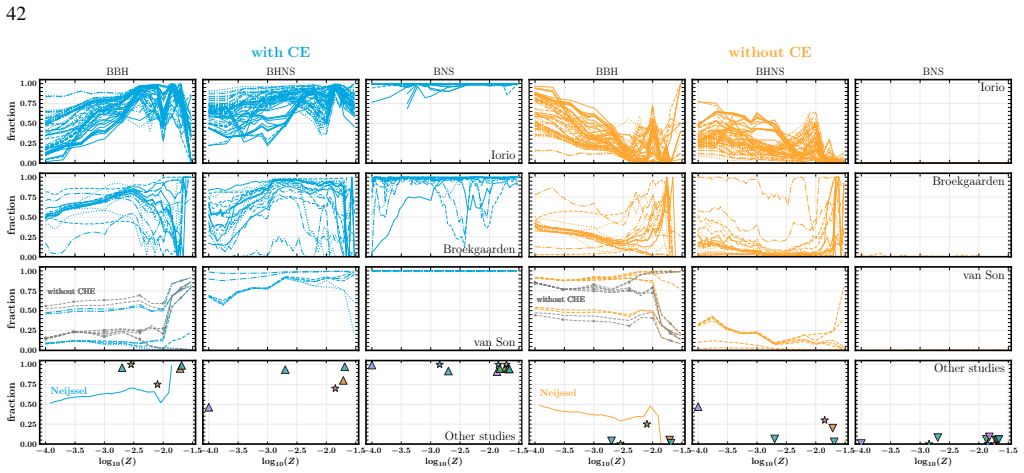
Across their broad model variations—including changes in𝛼 CE, chemically homogeneous evolution, supernova natal kicks, remnant-mass prescriptions, and envelope binding en- ergies—theyfindarobustandconsistentresult: BNSmergers form exclusively through channels involving at least one CE phase. In contrast, BHNS and BBH systems exhibit a strong dependence on...
2018
-
[8]
andincludeinFigures14and15. TheirresultsshowthatBNS systems form almost exclusively through channels involving a CE phase across all metallicities, BHNS systems are pre- dominantly formed via CE channels, and BBH systems can receive a substantial contribution from channels without CE, including CHE. We do not include this study in our main ta- blesandfigu...
2018
-
[9]
This limits a consistent comparison with studies that explore metallicity-dependent trends and report quantitative channel contributions
We do not include this study in our formation-channel comparison, as it is restricted to a single (solar) metallicity and does not provide channel frac- tions for intrinsic merger rates across a broader model grid. This limits a consistent comparison with studies that explore metallicity-dependent trends and report quantitative channel contributions. We i...
2020
-
[10]
In the𝑞c formalism, mass transfer becomes dynamically unstable when the donor- to-accretor mass ratio exceeds a threshold value, leading to a CE phase
with response coefficients such as the adiabatic mass– radiusexponent𝜉≡d ln𝑅/d ln𝑀(e.g.𝜉 ad,rad inDorozsmai& Toonen (2024) for radiative envelopes). In the𝑞c formalism, mass transfer becomes dynamically unstable when the donor- to-accretor mass ratio exceeds a threshold value, leading to a CE phase. In contrast,𝜉-based prescriptions compare the donor’s ra...
2024
-
[11]
Used in Olejak et al
This highly permissive criterion substantially expands the parameter space in which binaries avoid CE evolution. Used in Olejak et al. (2021) (OL21; their model M480.B), which addi- tionally uses the Pavlovskii et al. (2017a) donor-radius gridtodeterminestabilityacrossarangeofmassesand compact-object accretors. The related label𝑞c <8CE switchrefers to mod...
2021
-
[12]
2021, for both exceptions)
and BPASS(BRI22;Eldridgeetal.2017),whichbothavoidafixed threshold:POSYDONinterpolates pre-computedMESAbi- nary grids that self-consistently capture the donor response as a function of mass, mass ratio, separation, and metallicity, whileBPASSruns detailedSTARSmodels for each individ- ual system (see footnote 2 of Bavera et al. 2021, for both exceptions). T...
2017
-
[13]
log𝑈prior
noMTZAMS(suppressedmasstransferatzero-agemainsequence) —ThelabelnoMTZAMS(appearinginBA21rows)refersto amodelvariantinwhichmasstransferatorverynearthezero- age main sequence — typically arising from contact or over- contact systems — is suppressed. In the default Bavera et al. (2021) framework, such systems are allowed to undergo mass transfer and potentia...
2021
-
[14]
For BBH and BHNS mergers, the formation-channel frac- tions show substantially more variation across models and metallicity. For BBH systems in particular, the relative con- tribution of without-CE channels generally increases toward the lowest metallicities (log10 (𝑍)≲−2.5), likely reflecting the reduced stellar wind mass loss and the resulting larger st...
2019
discussion (0)
Sign in with ORCID, Apple, or X to comment. Anyone can read and Pith papers without signing in.