Tricriticality and chaos in a generalized Allee-logistic map
Pith reviewed 2026-06-28 02:19 UTC · model grok-4.3
The pith
A generalized Allee-logistic map exhibits tricriticality separating continuous and discontinuous extinction transitions with a closed-form expression for the tricritical point.
A machine-rendered reading of the paper's core claim, the machinery that carries it, and where it could break.
Core claim
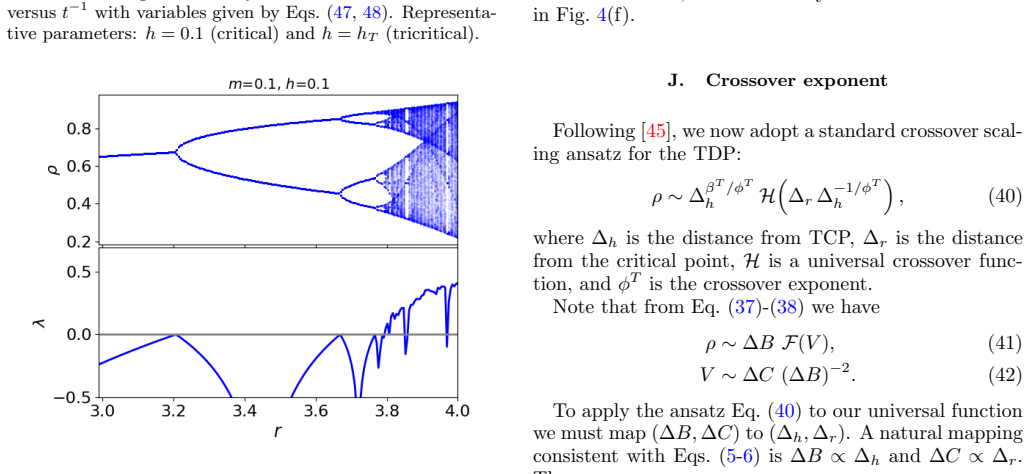
The GAL map displays nontrivial behavior between the m=0 and m=1 limits, including a tricritical point at which the extinction transition changes character, together with an exact closed-form expression for that point and a universal crossover function; the Allee effect additionally disfavors chaos.
What carries the argument
The linear Allee factor G(x_t) = m (x_t - h) + 1 - m that continuously interpolates between the logistic map and the strong-Allee case.
If this is right
- The extinction transition is continuous below the tricritical value of m and discontinuous above it.
- A universal crossover function describes the scaling of observables near the tricritical point.
- Widom-like relations hold when a small external input is added to the map.
- Increasing the Allee magnitude m reduces the parameter region in which chaos appears.
Where Pith is reading between the lines
- The exact tricritical expression may permit analytic calculations of scaling exponents in related threshold maps.
- Similar linear interpolations could be applied to other population models to locate tricritical points without numerical search.
- The suppression of chaos by the Allee term suggests testable predictions for extinction risk in fluctuating environments.
Load-bearing premise
The chosen linear form for the Allee factor G(x_t) is sufficient to capture the essential features of the Allee effect.
What would settle it
Iterating the map at the predicted tricritical values of m and h should produce the change from continuous to discontinuous extinction together with data collapse onto the claimed universal crossover function.
Figures



read the original abstract
We present a novel nonlinear dynamical model, the generalized Allee-logistic (GAL) map given by $x_{t+1} = r x_t (1 - x_t) G(x_t)$ where $G(x_t) = m (x_t - h) + 1 - m$ incorporates the Allee effect with magnitude $m$ and threshold $h$. The case $m = 0$ yields the logistic map with a continuous transition to extinction. Conversely, $m = 1$ recovers a previously studied model that undergoes only a discontinuous extinction-to-active transition. Between these extremes, the GAL map exhibits nontrivial phenomena, including tricriticality with a closed-form expression for the tricritical point and a universal crossover function. Under a small external input, we verify Widom-like relations. We also note that the Allee effect disfavors the onset of chaos. Our work establishes additional bridges between analytically tractable chaotic maps, nonequilibrium tricriticality, and Allee effects.
Editorial analysis
A structured set of objections, weighed in public.
Referee Report
Summary. The manuscript introduces the generalized Allee-logistic (GAL) map x_{t+1} = r x_t (1 - x_t) G(x_t) with linear G(x_t) = m(x_t - h) + 1 - m. It claims that this family exhibits tricriticality with a closed-form tricritical point and universal crossover function, verifies Widom-like relations under small external drive, and shows that the Allee effect suppresses the onset of chaos.
Significance. If the closed-form tricritical point and universal crossover are rigorously derived, the work supplies an analytically tractable one-dimensional map that connects Allee-effect population models to nonequilibrium tricriticality and chaotic dynamics; the explicit location of the codimension-2 point would be a concrete strength.
major comments (2)
- [Model definition] Model definition (paragraph introducing G(x_t)): the linear choice G(x_t) = m(x_t - h) + 1 - m is asserted to capture the essential Allee features, yet the closed-form tricritical point and universal crossover may rely on cancellations special to this linearity; without an explicit check against a quadratic or higher-order G, the robustness of the central claim remains unverified.
- [Abstract / tricriticality analysis] Abstract and tricriticality section: the existence of a closed-form tricritical point is stated, but the provided text supplies neither the expansion coefficients near x=0 nor the algebraic steps that locate the codimension-2 point; this derivation is load-bearing for the claim that the transition order changes while higher-order terms remain controlled.
minor comments (1)
- The abstract would be clearer if it stated the numerical values of the tricritical (r, h) or (m, h) coordinates once they are derived.
Simulated Author's Rebuttal
We thank the referee for the careful reading and constructive suggestions. We address the two major comments below and will revise the manuscript accordingly.
read point-by-point responses
-
Referee: [Model definition] Model definition (paragraph introducing G(x_t)): the linear choice G(x_t) = m(x_t - h) + 1 - m is asserted to capture the essential Allee features, yet the closed-form tricritical point and universal crossover may rely on cancellations special to this linearity; without an explicit check against a quadratic or higher-order G, the robustness of the central claim remains unverified.
Authors: The linear form of G(x_t) was selected because it permits an exact interpolation between the continuous (m=0) and discontinuous (m=1) extinction transitions while still allowing closed-form location of the tricritical point. This choice is motivated by the standard linear Allee-effect term used in the population-dynamics literature. We agree that the robustness to higher-order nonlinearities in G has not been verified numerically. In the revised manuscript we will add a short paragraph and a supplementary figure showing that tricriticality persists for a representative quadratic G, thereby confirming that the phenomenon is not an artifact of linearity. revision: yes
-
Referee: [Abstract / tricriticality analysis] Abstract and tricriticality section: the existence of a closed-form tricritical point is stated, but the provided text supplies neither the expansion coefficients near x=0 nor the algebraic steps that locate the codimension-2 point; this derivation is load-bearing for the claim that the transition order changes while higher-order terms remain controlled.
Authors: We apologize for the omission of the explicit derivation. The tricritical point is obtained by expanding the map to cubic order about x=0, setting the coefficients of the linear and quadratic terms simultaneously to zero, and solving the resulting algebraic system for r and h at fixed m. The resulting closed-form expressions are r_tc = 1 + 1/m and h_tc = (m-2)/(2m). In the revised version we will insert these expansion coefficients together with the algebraic steps (either in the main text or as an appendix) so that the location of the codimension-2 point can be reproduced directly. revision: yes
Circularity Check
No circularity; derivation self-contained from novel map definition
full rationale
The paper introduces the GAL map x_{t+1} = r x_t (1 - x_t) G(x_t) with the explicit linear form G(x_t) = m (x_t - h) + 1 - m as a modeling choice, then analyzes its bifurcations, tricritical point, and crossover function directly from iteration and local expansion of this equation. No load-bearing step reduces a claimed prediction to a fitted input, self-citation chain, or ansatz imported from prior work by the same authors. The closed-form tricritical point is obtained by solving the model's own coefficient conditions for codimension-2 behavior, which is independent of external benchmarks. This is the normal case of a self-contained analysis of a newly defined dynamical system.
Axiom & Free-Parameter Ledger
free parameters (2)
- m
- h
axioms (1)
- domain assumption The iteration x_{t+1} = r x_t (1 - x_t) G(x_t) is a valid discrete-time population model
Reference graph
Works this paper leans on
-
[1]
Thus, from Eq
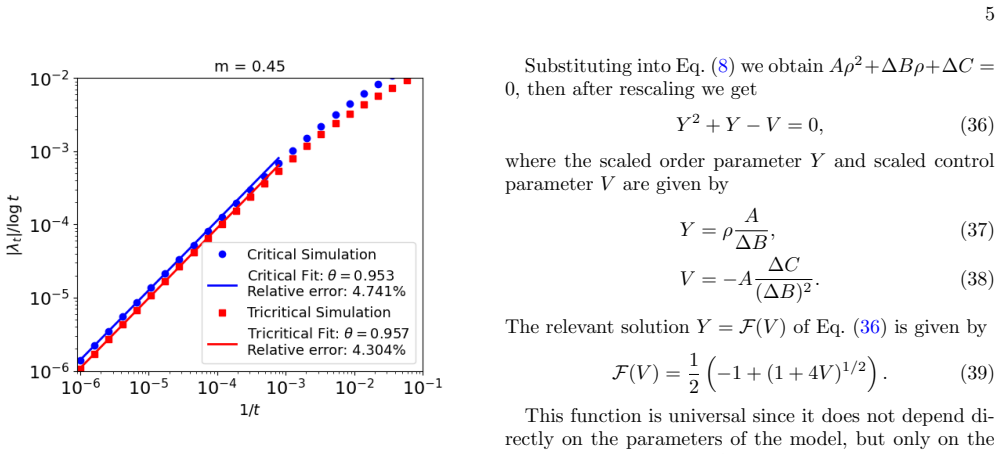
Above the extinction point WhenC >1, the linear term dominates in both the critical and tricritical cases. Thus, from Eq. (19) we ob- tain an exponential behaviorx t ∼e t/τ which leads to: τ∼ |r−r c|−zD , z D = 1,(20) τ∼ |r−r T |−zT , z T = 1.(21) These Eqs. (20, 21) indicate that the characteristic time has a divergence-like behavior, as confirmed in Fig. 3
-
[2]
Critical caseWhenB̸= 0 andC→1, the dom- inant term in Eq
At the extinction point a. Critical caseWhenB̸= 0 andC→1, the dom- inant term in Eq. (19) isx 2, which gives us ˙x≈Bx 2. Integrating this expression yields x(t)∼t −αD ,withα D = 1.(22) b. Tricritical caseWhenB→0 andC→1, the dominant term in Eq. (19) becomesx 3, resulting in ˙x≈ Ax3. Integration leads to the scaling relation: x(t)∼t −αT ,withα T = 1 2 .(23...
-
[3]
M. J. Feigenbaum, Quantitative universality for a class of nonlinear transformations, Journal of statistical physics 19, 25 (1978)
1978
-
[4]
Chang, M
S.-J. Chang, M. Wortis, and J. A. Wright, Iterative prop- erties of a one-dimensional quartic map: Critical lines and tricritical behavior, Physical Review A24, 2669 (1981)
1981
-
[5]
J. V. Kapustina, A. P. Kuznetsov, S. P. Kuznetsov, and E. Mosekilde, Scaling properties of bicritical dynamics in unidirectionally coupled period-doubling systems in the presence of noise, Physical Review E64, 066207 (2001)
2001
-
[6]
A. P. Kuznetsov, S. P. Kuznetsov, E. Mosekilde, and L. V. Turukina, Two-parameter analysis of the scaling behavior at the onset of chaos: Tricritical and pseudo- tricritical points, Physica A300, 367 (2001)
2001
-
[7]
Ambika and N
G. Ambika and N. Sujatha, Critical exponents in the transition to chaos in one-dimensional discrete systems, Pramana59, 9 (2002)
2002
-
[8]
Xu, Y.-C
B. Xu, Y.-C. Lai, L. Zhu, and Y. Do, Experimental char- acterization of transition to chaos in the presence of noise, Physical review letters90, 164101 (2003)
2003
-
[9]
A. P. Kuznetsov, S. P. Kuznetsov, and J. V. Sedova, Ef- fect of noise on the critical golden-mean quasiperiodic dynamics in the circle map, Physica A359, 48 (2006)
2006
-
[10]
Stynes, W
D. Stynes, W. Hanan, S. Pouryahya, and D. Heffernan, Scaling relations and critical exponents for two dimen- sional two parameter maps, The European Physical Jour- nal B77, 469 (2010)
2010
-
[11]
R. M. Teixeira, D. S. Rando, F. C. Geraldo, R. Costa Filho, J. A. de Oliveira, and E. D. Leonel, Con- vergence towards asymptotic state in 1-d mappings: A scaling investigation, Physics Letters A379, 1246 (2015)
2015
-
[12]
convergence towards asymptotic state in 1-d mappings: A scaling investigation
M. Girardi-Schappo and M. Tragtenberg, Comment on “convergence towards asymptotic state in 1-d mappings: A scaling investigation”[phys. lett. a 379 (18–19)(2015) 1246–1250], Physics Letters A383, 126031 (2019)
2015
-
[13]
Corral, J
´A. Corral, J. Sardany´ es, and L. Alsed` a, Finite-time scaling in local bifurcations, Scientific reports8, 11783 (2018)
2018
-
[14]
´A. Corral, Universal finite-time scaling in the transcrit- ical, saddle-node, and pitchfork discrete and continuous bifurcations, Chaos: An Interdisciplinary Journal of Non- linear Science35(2025)
2025
-
[15]
D. A. Martin, Q.-Y. Tang, and D. R. Chialvo, Finite- time scaling on low-dimensional map bifurcations, Phys- ical Review Research7, 043241 (2025)
2025
-
[16]
Polli, A
J. Polli, A. Fid´ elis, and M. da Luz, Power-law behavior around bifurcation points of 1d maps: A supertracks ap- proach, Chaos: An Interdisciplinary Journal of Nonlinear Science35(2025)
2025
-
[17]
R. M. May, Simple mathematical models with very com- plicated dynamics, Nature261, 459 (1976)
1976
-
[18]
Ausloos,The logistic map and the route to chaos: From the beginnings to modern applications(Springer Science & Business Media, 2006)
M. Ausloos,The logistic map and the route to chaos: From the beginnings to modern applications(Springer Science & Business Media, 2006)
2006
-
[19]
K. S. Korolev, J. B. Xavier, and J. Gore, Turning ecology and evolution against cancer, Nature Reviews Cancer14, 371 (2014)
2014
-
[20]
Sewalt, K
L. Sewalt, K. Harley, P. van Heijster, and S. Balasuriya, Influences of allee effects in the spreading of malignant tumours, Journal of theoretical biology394, 77 (2016)
2016
-
[21]
Sun, Mathematical modeling of population dynam- ics with allee effect, Nonlinear Dynamics85, 1 (2016)
G.-Q. Sun, Mathematical modeling of population dynam- ics with allee effect, Nonlinear Dynamics85, 1 (2016)
2016
-
[22]
Amarasekare, Allee effects in metapopulation dynam- ics, The American Naturalist152, 298 (1998)
P. Amarasekare, Allee effects in metapopulation dynam- ics, The American Naturalist152, 298 (1998)
1998
-
[23]
Fowler and G
M. Fowler and G. Ruxton, Population dynamic conse- quences of allee effects, Journal of Theoretical Biology 215, 39 (2002)
2002
-
[24]
B. Nath, N. Kumari, V. Kumar, and K. P. Das, Refu- gia and allee effect in prey species stabilize chaos in a tri-trophic food chain model, Differential Equations and Dynamical Systems30, 631 (2022)
2022
-
[25]
Berec, Models of allee effects and their implications for population and community dynamics, Biophysical Re- views and Letters3, 157 (2008)
L. Berec, Models of allee effects and their implications for population and community dynamics, Biophysical Re- views and Letters3, 157 (2008)
2008
-
[26]
R. V. dos Santos, F. L. Ribeiro, and A. S. Martinez, Mod- els for allee effect based on physical principles, Journal of theoretical biology385, 143 (2015)
2015
-
[27]
M. A. Pires and S. M. Duarte Queir´ os, Optimal dispersal in ecological dynamics with allee effect in metapopula- tions, PloS one14, e0218087 (2019)
2019
-
[28]
M. A. Pires, N. Crokidakis, and S. M. D. Queir´ os, Ran- domness in ecology: The role of complexity on the allee effect, Physica A589, 126548 (2022)
2022
-
[29]
S. M. Aleixo, J. L. Rocha, and D. D. Pestana, Popula- tional growth models proportional to beta densities with allee effect, inAIP Conference Proceedings, Vol. 1124 (American Institute of Physics, 2009) pp. 3–12
2009
-
[30]
Leonel Rocha and A.-K
J. Leonel Rocha and A.-K. Taha, Allee’s effect bifurca- tion in generalized logistic maps, International Journal of Bifurcation and Chaos29, 1950039 (2019)
2019
-
[31]
El-Metwally, A
H. El-Metwally, A. Khan, and M. Hamada, Allee effect in a ricker type discrete-time predator–prey model with holling type-ii functional response, Journal of Biological Systems31, 591 (2023)
2023
-
[32]
Courchamp, L
F. Courchamp, L. Berec, and J. Gascoigne,Allee effects in ecology and conservation(OUP Oxford, 2008)
2008
-
[33]
P. C. Tobin, L. Berec, and A. M. Liebhold, Exploiting allee effects for managing biological invasions, Ecology letters14, 615 (2011)
2011
-
[34]
A. M. Kramer, B. Dennis, A. M. Liebhold, and J. M. Drake, The evidence for allee effects, Population Ecology 51, 341 (2009)
2009
-
[35]
Fauvergue, A review of mate-finding a llee effects in insects: from individual behavior to population manage- ment, Entomologia Experimentalis et Applicata146, 79 (2013)
X. Fauvergue, A review of mate-finding a llee effects in insects: from individual behavior to population manage- ment, Entomologia Experimentalis et Applicata146, 79 (2013)
2013
-
[36]
Angulo, G
E. Angulo, G. M. Luque, S. D. Gregory, J. W. Wenzel, C. Bessa-Gomes, L. Berec, and F. Courchamp, Allee ef- fects in social species, Journal of Animal Ecology87, 47 (2018)
2018
-
[37]
Branco, T
M. Branco, T. Dokhelar, E. G. Brockerhoff, A. M. Lieb- hold, and H. Jactel, Widespread experimental evidence of allee effects in insects: a meta-analysis, Entomologia Generalis44, 765 (2024)
2024
-
[38]
Smith, C
R. Smith, C. Tan, J. K. Srimani, A. Pai, K. A. Riccione, H. Song, and L. You, Programmed allee effect in bacteria causes a tradeoff between population spread and survival, Proceedings of the National Academy of Sciences111, 1969 (2014). 8
1969
-
[39]
N. Jung, J. H. Choi, K.-E. Lee, D.-H. Lee, A. Kim, T.- S. Chon, and J. W. Lee, Chaotic dynamics of a simple population model under the allee effect, Journal of the Korean Physical Society76, 533 (2020)
2020
-
[40]
Janssen, M
H.-K. Janssen, M. M¨ uller, and O. Stenull, Generalized epidemic process and tricritical dynamic percolation, Physical Review E70, 026114 (2004)
2004
-
[41]
M. A. Pires, C. I. Sampaio Filho, H. J. Herrmann, and J. S. Andrade Jr, Tricritical behavior in epidemic dy- namics with vaccination, Chaos, Solitons & Fractals174, 113761 (2023)
2023
-
[42]
Bhattacharyya, Emergence of first-order and second- order phase transitions in a cyclic ecosystem exposed to environmental impact, Physica Scripta99, 045207 (2024)
S. Bhattacharyya, Emergence of first-order and second- order phase transitions in a cyclic ecosystem exposed to environmental impact, Physica Scripta99, 045207 (2024)
2024
-
[43]
Windus and H
A. Windus and H. J. Jensen, Cluster geometry and sur- vival probability in systems driven by reaction–diffusion dynamics, New Journal of Physics10, 113023 (2008)
2008
-
[44]
G. K. Jayasingh and N. Goldenfeld, Tricritical directed percolation controls the laminar-turbulent transition in pipes with body forces, Physical review letters135, 104001 (2025)
2025
-
[45]
N. A. M. Ara´ ujo, J. S. Andrade Jr, R. M. Ziff, and H. J. Herrmann, Tricritical point in explosive percola- tion, Physical Review Letters106, 095703 (2011)
2011
-
[46]
Cellai, A
D. Cellai, A. Lawlor, K. A. Dawson, and J. P. Glee- son, Tricritical point in heterogeneousk-core percolation, Physical Review Letters107, 175703 (2011)
2011
-
[47]
L¨ ubeck, Tricritical directed percolation, Journal of Statistical Physics123, 193 (2006)
S. L¨ ubeck, Tricritical directed percolation, Journal of Statistical Physics123, 193 (2006)
2006
-
[48]
Grassberger, Tricritical directed percolation in 2+ 1 dimensions, Journal of Statistical Mechanics: Theory and Experiment2006, P01004 (2006)
P. Grassberger, Tricritical directed percolation in 2+ 1 dimensions, Journal of Statistical Mechanics: Theory and Experiment2006, P01004 (2006)
2006
-
[49]
J. A. De Oliveira, E. R. Papesso, and E. D. Leonel, Re- laxation to fixed points in the logistic and cubic maps: Analytical and numerical investigation, Entropy15, 4310 (2013)
2013
-
[50]
A. G. Radwan, On some generalized discrete logistic maps, Journal of advanced research4, 163 (2013)
2013
-
[51]
S. E. Borujeni and M. S. Ehsani, Modified logistic maps for cryptographic application, Applied Mathematics6, 773 (2015)
2015
-
[52]
Lawnik, Generalized logistic map and its application in chaos based cryptography, inJournal of Physics: Con- ference Series, Vol
M. Lawnik, Generalized logistic map and its application in chaos based cryptography, inJournal of Physics: Con- ference Series, Vol. 936 (IOP Publishing, 2017) p. 012017
2017
-
[53]
D. R. da Costa, R. O. Medrano-T, and E. D. Leonel, Route to chaos and some properties in the boundary cri- sis of a generalized logistic mapping, Physica A486, 674 (2017)
2017
-
[54]
W. S. Sayed, H. A. Fahmy, A. A. Rezk, and A. G. Rad- wan, Generalized smooth transition map between tent and logistic maps, International Journal of Bifurcation and Chaos27, 1730004 (2017)
2017
-
[55]
Hamada, Investigating the dynamics of generalized discrete logistic map, Mathematical Methods in the Ap- plied Sciences48, 5325 (2025)
M. Hamada, Investigating the dynamics of generalized discrete logistic map, Mathematical Methods in the Ap- plied Sciences48, 5325 (2025)
2025
-
[56]
Zhang, W
L. Zhang, W. Yu, and S. Gao, Chaos of exponential logis- tic map, Discrete Dynamics in Nature and Society2025, 6620626 (2025)
2025
-
[57]
Abdellah, Generalized logistic map and its applica- tions, AIP Advances15(2025)
M. Abdellah, Generalized logistic map and its applica- tions, AIP Advances15(2025)
2025
-
[58]
M. A. Pires, C. Tsallis, and E. M. F. Curado, Composing α-gauss and logistic maps: Gradual and sudden transi- tions to chaos, Phys. Rev. E112, 034209 (2025)
2025
-
[59]
Chatterjee, B
D. Chatterjee, B. G. Banik, and A. Banik, Attack resis- tant chaos-based cryptosystem by modified baker map and logistic map, International Journal of Information and Computer Security20, 48 (2023)
2023
-
[60]
Gao and B
S. Gao and B. Kan, Chaos of the new multiplicative lo- gistic map, Scientific Reports15, 43743 (2025)
2025
-
[61]
V. Vijayan, Universality classes of chaos in non marko- vian dynamics, arXiv preprint arXiv:2512.22445 (2025)
-
[62]
M. Edelman, On fractional generalizations of the logistic map and their applications, arXiv preprint arXiv:2503.13256 (2025)
-
[63]
Pawela and K
L. Pawela and K. ˙Zyczkowski, Matrix logistic map: frac- tal spectral distributions and transfer of chaos, Chaos: An Interdisciplinary Journal of Nonlinear Science36 (2026)
2026
-
[64]
C. Dias, N. Ara´ ujo, and M. Telo da Gama, Adsorbed films of three-patch colloids: Continuous and discontin- uous transitions between thick and thin films, Physical Review E90, 032302 (2014)
2014
-
[65]
Ara´ ujo, C
N. Ara´ ujo, C. Dias, and M. T. da Gama, Kinetic inter- faces of patchy particles, Journal of Physics: Condensed Matter27, 194123 (2015)
2015
-
[66]
Hnatiˇ c, T
M. Hnatiˇ c, T. Luˇ civjansk` y, and L. Miˇ ziˇ sin, Tricriti- cal directed percolation with long-range spreading, in Chaotic Modeling and Simulation International Confer- ence(Springer, 2019) pp. 101–110
2019
-
[67]
Jo and B
M. Jo and B. Kahng, Tricritical directed percolation with long-range interaction in one and two dimensions, Phys- ical Review E101, 022121 (2020)
2020
-
[68]
Pizzi, A
A. Pizzi, A. Nunnenkamp, and J. Knolle, Bistability and time crystals in long-ranged directed percolation, Nature communications12, 1061 (2021)
2021
-
[69]
F. Gao, J. Shen, S. Wang, W. Li, and D. Xu, The tri- critical point of tricritical directed percolation based on neural network, Physica A , 131634 (2026)
2026
-
[70]
Janssen, On the nonequilibrium phase transition in reaction-diffusion systems with an absorbing stationary state, Z
H.-K. Janssen, On the nonequilibrium phase transition in reaction-diffusion systems with an absorbing stationary state, Z. Physik B - Condensed Matter42, 151 (1981)
1981
-
[71]
Grassberger, On phase transitions in schl¨ ogl’s second model., Z
P. Grassberger, On phase transitions in schl¨ ogl’s second model., Z. Physik B - Condensed Matter47, 365–374 (1982)
1982
-
[72]
Hinrichsen, Non-equilibrium critical phenomena and phase transitions into absorbing states, Advances in Physics49, 815 (2000)
H. Hinrichsen, Non-equilibrium critical phenomena and phase transitions into absorbing states, Advances in Physics49, 815 (2000)
2000
-
[73]
´Odor, Universality classes in nonequilibrium lattice systems, Reviews of modern physics76, 663 (2004)
G. ´Odor, Universality classes in nonequilibrium lattice systems, Reviews of modern physics76, 663 (2004)
2004
discussion (0)
Sign in with ORCID, Apple, or X to comment. Anyone can read and Pith papers without signing in.