Bulk vs. turbulent motions at the centres of galaxy clusters: AGN-driven turbulence according to TNG-Cluster
Pith reviewed 2026-06-28 04:56 UTC · model grok-4.3
The pith
Simulations show turbulent motions contribute less than half the total velocity dispersion in galaxy cluster centers.
A machine-rendered reading of the paper's core claim, the machinery that carries it, and where it could break.
Core claim
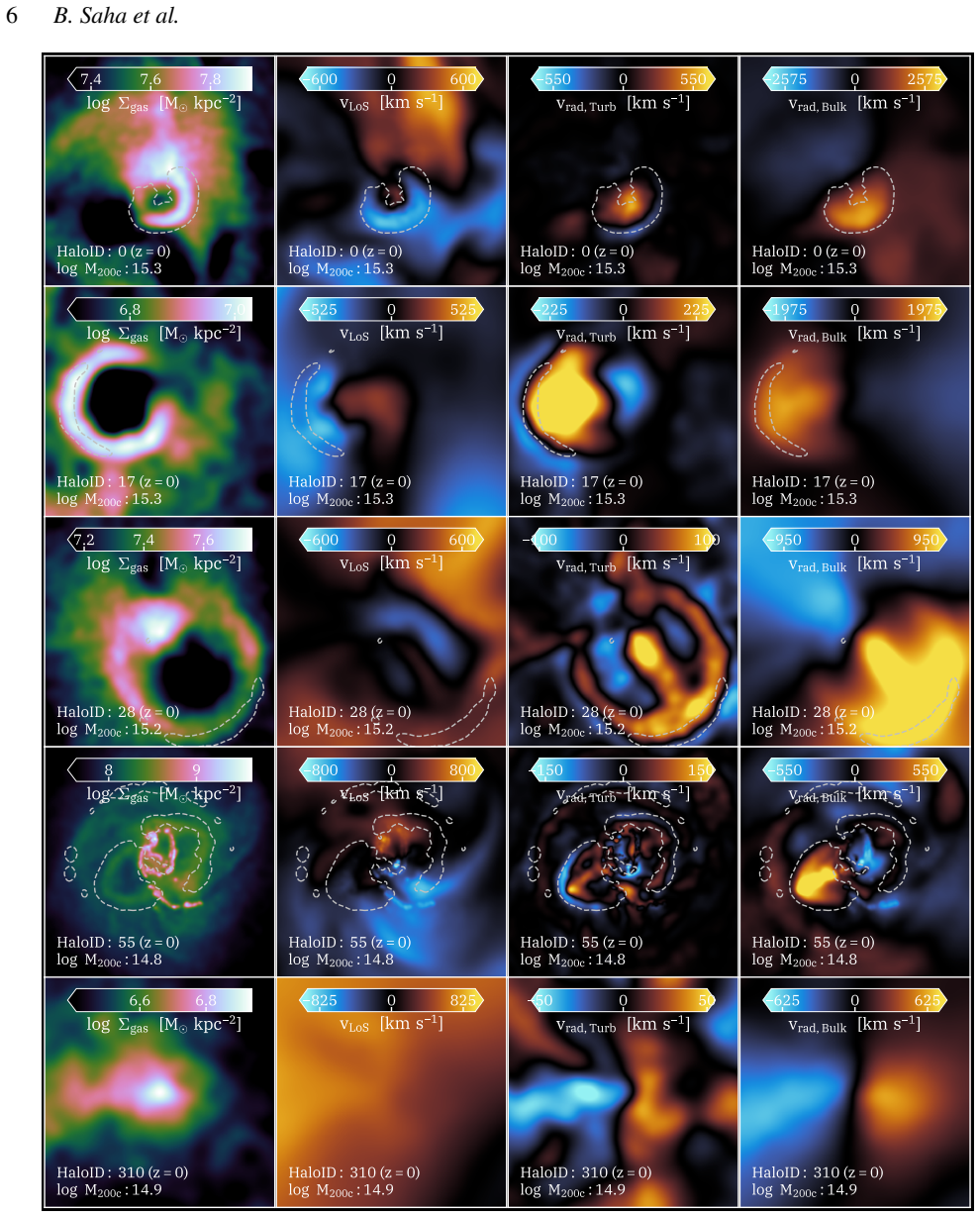
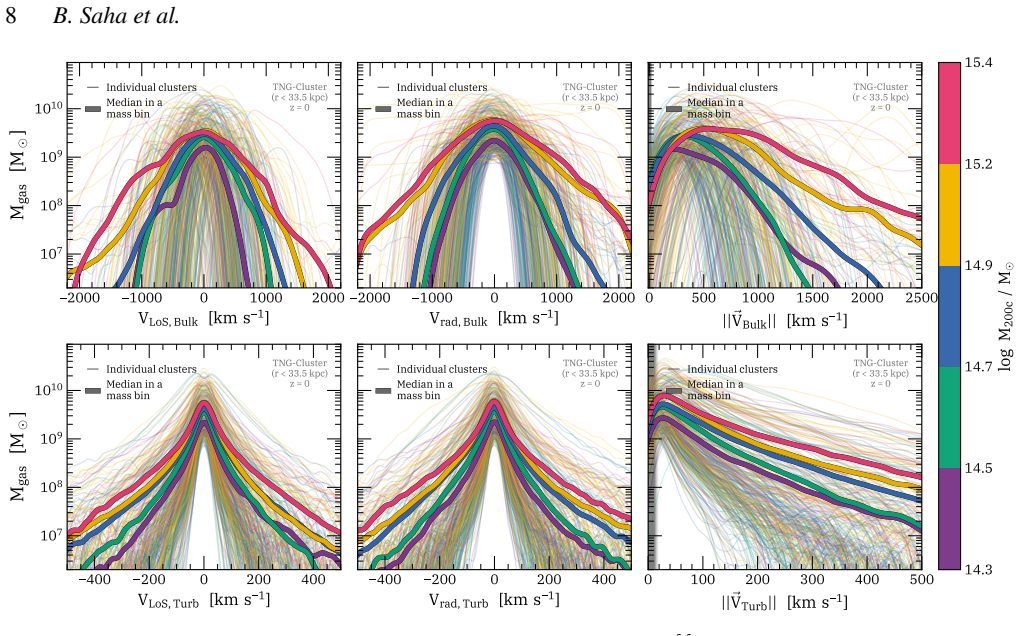
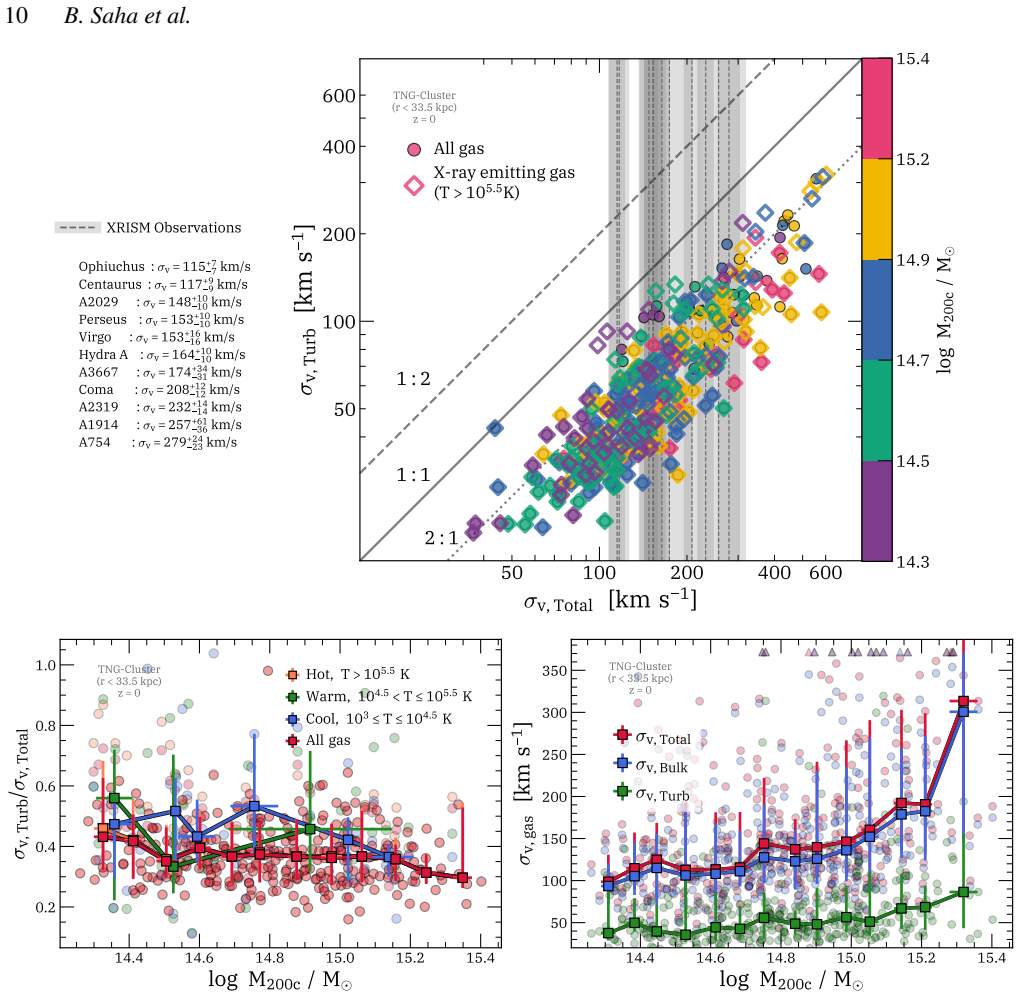
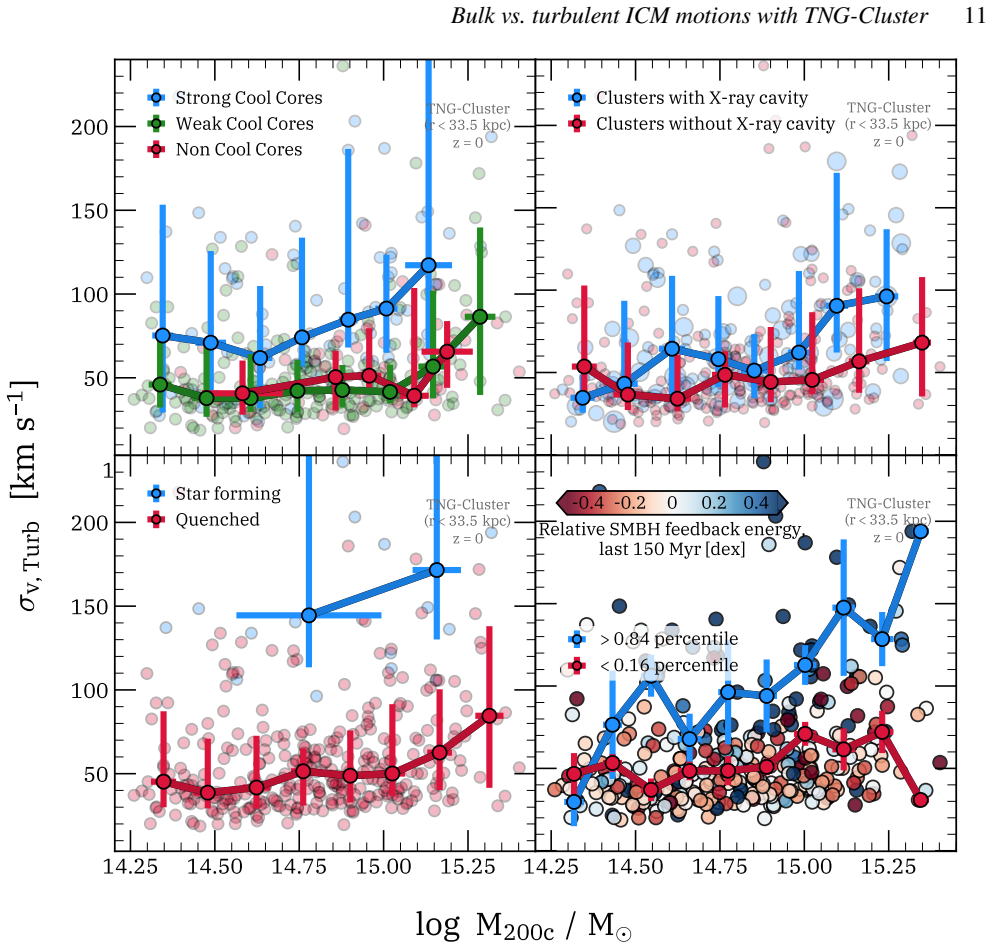
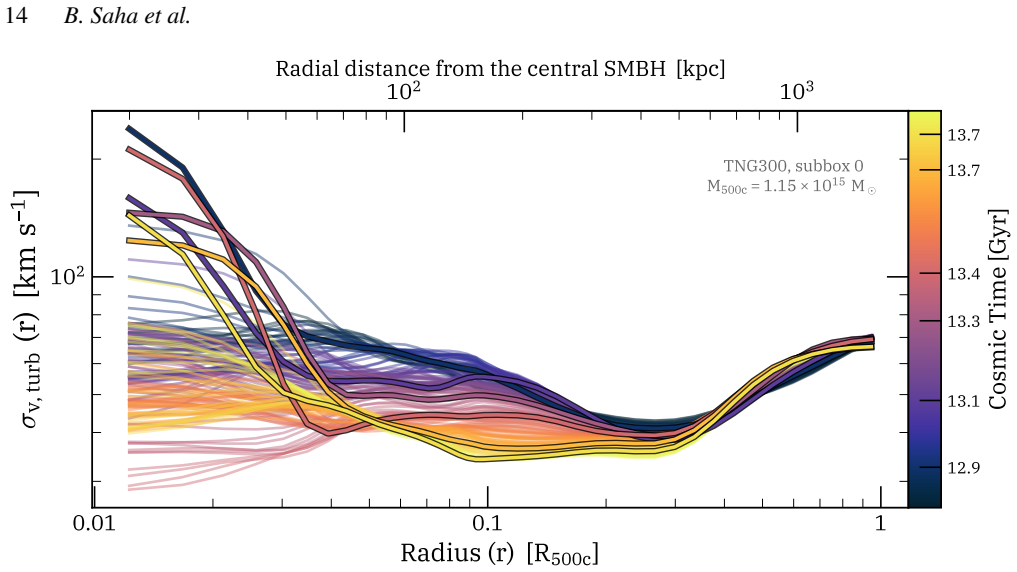
The central claim is that in the hot X-ray emitting gas at cluster centers turbulence contributes less than half of the total velocity dispersion for most systems, with typical turbulent dispersions of 50-75 km s^{-1} and sub-percent levels of turbulent pressure support. The turbulent velocity dispersion peaks at the center, reaches a minimum at 0.1-0.2 R_500c, then rises again. Clusters with strong cool cores, X-ray cavities, or recent black hole feedback injections show systematically larger turbulent velocities and more prominent high-velocity tails. Black hole feedback is presented as the key driver of turbulence in the cores, generating strong but short-lived motions together with high-
What carries the argument
The multi-scale filtering Reynolds decomposition, which isolates small-scale turbulent fluctuations from coherent bulk motions in the gas velocity field.
If this is right
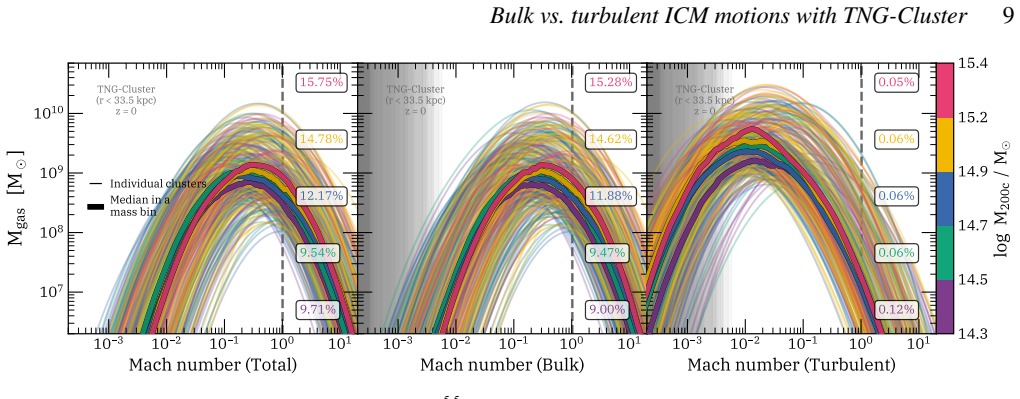
- The intracluster medium shows mostly subsonic turbulence but with broad velocity distributions that can reach high Mach numbers in some regions.
- Turbulent velocity dispersion is enhanced in clusters that are strong cool cores or have experienced recent black hole feedback energy injections.
- The radial profile of turbulent dispersion exhibits a central peak, a dip at intermediate radii, and a subsequent rise.
- Black hole feedback produces strong but transient turbulent motions and outflows in cluster cores.
- Interpreting high spectral resolution X-ray observations requires distinguishing bulk from turbulent components.
Where Pith is reading between the lines
- The dominance of bulk motions suggests that velocity-based mass estimates in cluster cores may need separate accounting for coherent flows rather than assuming isotropic turbulence.
- Correlations between turbulence levels and black hole activity could be tested directly with upcoming X-ray line broadening measurements in individual clusters.
- The short-lived nature of feedback-driven turbulence implies that time-averaged energy injection rates might underpredict instantaneous motion amplitudes.
- Extending the separation to non-central regions or higher redshifts could clarify how turbulence contributes to overall cluster thermodynamic balance.
Load-bearing premise
The multi-scale filtering correctly isolates turbulent small-scale motions from coherent bulk flows in the simulated hot gas.
What would settle it
High-resolution X-ray spectroscopy of real cluster cores that measures a turbulent velocity dispersion exceeding half the total dispersion in a majority of systems would falsify the central claim.
Figures




read the original abstract
The highly dynamic intracluster medium (ICM) influences cluster thermodynamic evolution and probes key physical processes. Quantifying the non-thermal motions is therefore essential for understanding cluster physics and interpreting high spectral-resolution X-ray observations from telescopes like {\it XRISM}. We quantify bulk and turbulent gas motions in 352 galaxy clusters at $z=0$ (${\rm M_{200c}=10^{14.3-15.4}\, M_\odot}$) from the TNG-Cluster suite of magneto-hydrodynamical galaxy simulations. We use a multi-scale filtering Reynolds decomposition to separate total gas velocities into bulk (coherent) and turbulent (small-scale fluctuations) components. We primarily focus on the hot X-ray emitting gas in the central core regions. According to TNG-Cluster, majority of the ICM has subsonic turbulence but with broad velocity distributions reaching $\mathcal{M}_{\rm Turb}\sim 10$ and large cluster-to-cluster variations. In cluster centres, turbulence contributes less than half of the total velocity dispersion $(\sigma_{v\rm,Turb } \sim 0.5 ~\sigma_{v,\rm Total})$ for most clusters, with typical turbulent velocity dispersions of $50-75$ km s$^{-1}$ across the mass range, and with sub per cent levels of turbulent pressure support. Clusters that are strong cool cores, or have X-ray cavities, or experienced recent SMBH feedback energy injections exhibit systematically larger turbulent velocity dispersions and more prominent turbulent velocity tails. On average, the turbulent velocity dispersion peaks in cluster centres, decreases slightly to a minimum at $0.1-0.2 \, R_{\rm500c}$, then rises again. Our analysis shows that SMBH feedback is a key driver of turbulence in cluster cores, generating strong but short-lived motion alongside high-velocity outflows. It also calls for caution for interpreting {\it XRISM} observations.
Editorial analysis
A structured set of objections, weighed in public.
Referee Report
Summary. The paper analyzes bulk and turbulent gas motions in the hot ICM of 352 galaxy clusters (M_200c = 10^14.3-15.4 M_⊙) at z=0 from the TNG-Cluster magneto-hydrodynamical simulations. Using a multi-scale filtering Reynolds decomposition on the central core regions, it reports that turbulence contributes less than half the total velocity dispersion (σ_v,Turb ~ 0.5 σ_v,Total) with typical values 50-75 km s^{-1}, sub-percent turbulent pressure support, mostly subsonic but broad Mach number distributions up to ~10, and identifies SMBH feedback as a key driver, with implications for XRISM observations.
Significance. If the decomposition holds, the large statistical sample provides quantitative benchmarks on non-thermal motions and limited turbulent pressure support in cluster cores, directly relevant to interpreting high-resolution X-ray spectroscopy and AGN feedback effects. The scale of the TNG-Cluster suite (352 objects) is a clear strength for assessing cluster-to-cluster variations.
major comments (2)
- [Methods (Reynolds decomposition)] The multi-scale filtering Reynolds decomposition (described in the methods) is load-bearing for all quantitative claims, including the headline σ_v,Turb ~ 0.5 σ_v,Total ratio and sub-percent pressure support. No validation against analytic test cases, no resolution convergence tests specific to the core region, and no sensitivity analysis to filter scale choices are described; the separation of coherent bulk flows from small-scale fluctuations could shift with different thresholds or effective Reynolds number.
- [Results (SMBH feedback section)] The attribution of turbulence to SMBH feedback (abstract and results) relies on correlations with cool-core status, X-ray cavities, and recent energy injections, but lacks a quantitative decomposition of energy injection rates versus turbulent dissipation or a control comparison to runs without AGN feedback.
minor comments (2)
- [Abstract] Abstract: the notation σ_v,Turb and σ_v,Total should be defined on first use for clarity.
- [Results (radial profiles)] The radial profile of turbulent velocity dispersion (peaking in center, minimum at 0.1-0.2 R_500c) would benefit from explicit error bars or bootstrap uncertainties given the cluster-to-cluster scatter.
Simulated Author's Rebuttal
We thank the referee for their constructive comments. We address each major comment below and indicate where revisions will be made.
read point-by-point responses
-
Referee: The multi-scale filtering Reynolds decomposition (described in the methods) is load-bearing for all quantitative claims, including the headline σ_v,Turb ~ 0.5 σ_v,Total ratio and sub-percent pressure support. No validation against analytic test cases, no resolution convergence tests specific to the core region, and no sensitivity analysis to filter scale choices are described; the separation of coherent bulk flows from small-scale fluctuations could shift with different thresholds or effective Reynolds number.
Authors: We agree that the manuscript would benefit from explicit validation of the Reynolds decomposition. Although the method follows established techniques from prior simulation studies, we will add a new subsection to the Methods section that includes: validation against analytic test cases with prescribed bulk flows plus fluctuations; resolution convergence tests for core regions using the multiple resolution levels in TNG-Cluster for a representative subsample; and sensitivity tests to filter scale choices. These additions will be incorporated in the revised manuscript. revision: yes
-
Referee: The attribution of turbulence to SMBH feedback (abstract and results) relies on correlations with cool-core status, X-ray cavities, and recent energy injections, but lacks a quantitative decomposition of energy injection rates versus turbulent dissipation or a control comparison to runs without AGN feedback.
Authors: The evidence for SMBH feedback as a driver rests on statistically significant correlations between turbulent velocity dispersion and indicators of recent AGN activity (cool-core status, X-ray cavities, recent energy injections) across the 352-cluster sample. We will expand the discussion to include more detail on the timescales of energy injection and turbulent dissipation. However, the TNG-Cluster suite does not contain control runs without AGN feedback, precluding a direct comparison. revision: partial
- Control comparison to runs without AGN feedback, as such simulations are not available in the TNG-Cluster suite.
Circularity Check
No significant circularity: results are direct measurements from simulation data via standard decomposition
full rationale
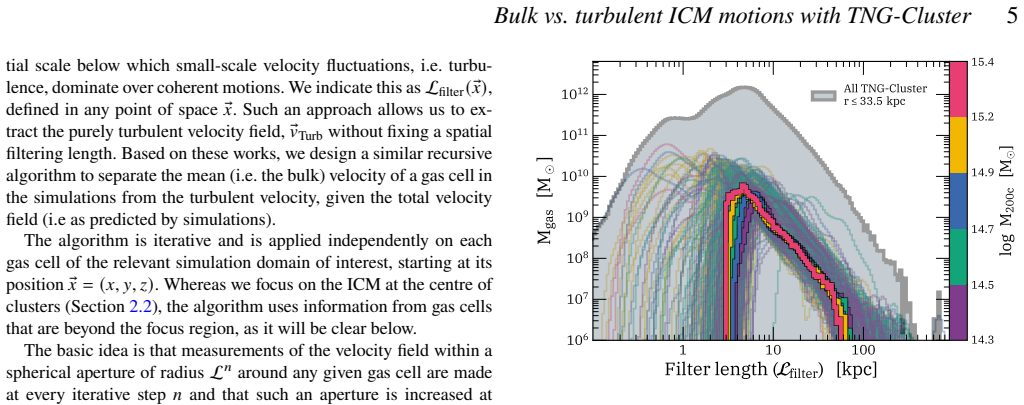
The paper applies a multi-scale filtering Reynolds decomposition to TNG-Cluster simulation outputs to quantify bulk vs. turbulent velocities in cluster cores, reporting empirical statistics such as σ_v,Turb ~ 0.5 σ_v,Total. No load-bearing step reduces by the paper's own equations to a fitted parameter, self-citation chain, or self-definitional ansatz; the decomposition is presented as an input method whose outputs are measured quantities, not redefined or forced by the target results. The derivation chain is therefore self-contained and externally falsifiable via the simulation data.
Axiom & Free-Parameter Ledger
axioms (1)
- domain assumption The TNG-Cluster magneto-hydrodynamical simulations accurately model the relevant physics of the ICM and AGN feedback.
Forward citations
Cited by 1 Pith paper
-
An extreme ram-pressure stripping event in a protocluster at redshift 4.3
ALMA and JWST data reveal an extreme ram-pressure stripping event removing most cold gas from a massive galaxy in a z=4.3 protocluster core.
Reference graph
Works this paper leans on
-
[1]
doi:10.1007/s003489900087 , adsurl =
Experiments in Fluids , keywords =. doi:10.1007/s003489900087 , adsurl =
-
[2]
2005, MNRAS, 361, 850, doi: 10.1111/j.1365-2966.2005.09226.x
, keywords =. doi:10.1111/j.1365-2966.2005.09630.x , archiveprefix =. astro-ph/0507480 , primaryclass =
-
[3]
doi:10.1051/0004-6361/202348609 , archiveprefix =
, keywords =. doi:10.1051/0004-6361/202348609 , archiveprefix =. 2311.06333 , primaryclass =
-
[4]
doi:10.48550/arXiv.2503.01969 , archiveprefix =
arXiv e-prints , keywords =. doi:10.48550/arXiv.2503.01969 , archiveprefix =. 2503.01969 , primaryclass =
-
[5]
doi:10.1093/mnras/stae2743 , adsurl =
, year = 2025, month = feb, volume =. doi:10.1093/mnras/stae2743 , adsurl =
-
[6]
doi:10.1093/mnras/staf525 , archiveprefix =
, keywords =. doi:10.1093/mnras/staf525 , archiveprefix =. 2503.01965 , primaryclass =
-
[7]
, keywords =. doi:10.1051/0004-6361/201118688 , archiveprefix =. 1202.5882 , primaryclass =
work page internal anchor Pith review Pith/arXiv arXiv doi:10.1051/0004-6361/201118688
-
[8]
Turbulent Motions and Shocks Waves in Galaxy Clusters simulated with AMR
, keywords =. doi:10.1051/0004-6361/200912535 , archiveprefix =. 0905.3169 , primaryclass =
work page internal anchor Pith review Pith/arXiv arXiv doi:10.1051/0004-6361/200912535
-
[9]
Turbulence and Vorticity in Galaxy Clusters Generated by Structure Formation
, keywords =. doi:10.1093/mnras/stw2351 , archiveprefix =. 1609.03558 , primaryclass =
work page internal anchor Pith review Pith/arXiv arXiv doi:10.1093/mnras/stw2351
-
[10]
The turbulent pressure support in galaxy clusters revisited
, keywords =. doi:10.1093/mnrasl/sly172 , archiveprefix =. 1809.02690 , primaryclass =
work page internal anchor Pith review Pith/arXiv arXiv doi:10.1093/mnrasl/sly172
-
[11]
, keywords =. doi:10.1088/0004-637X/705/2/1129 , archiveprefix =. 0903.4895 , primaryclass =
work page internal anchor Pith review Pith/arXiv arXiv doi:10.1088/0004-637x/705/2/1129
-
[12]
Weighing Galaxy Clusters with Gas. I. On the Methods of Computing Hydrostatic Mass Bias
, keywords =. doi:10.1088/0004-637X/777/2/151 , archiveprefix =. 1306.3993 , primaryclass =
work page internal anchor Pith review Pith/arXiv arXiv doi:10.1088/0004-637x/777/2/151
-
[13]
Convex Optimization , publisher =
Boyd, Stephen and Vandenberghe, Lieven , year =. Convex Optimization , publisher =
-
[14]
First results from the TNG50 simulation: galactic outflows driven by supernovae and black hole feedback. , keywords =. doi:10.1093/mnras/stz2306 , archivePrefix =. 1902.05554 , primaryClass =
work page internal anchor Pith review Pith/arXiv arXiv doi:10.1093/mnras/stz2306 1902
-
[15]
doi:10.1051/0004-6361/202348608 , archiveprefix =
, keywords =. doi:10.1051/0004-6361/202348608 , archiveprefix =. 2311.06338 , primaryclass =
-
[16]
, keywords =. doi:10.1111/j.1365-2966.2009.15715.x , archiveprefix =. 0901.4107 , primaryclass =
-
[17]
Simulating Galaxy Formation with the IllustrisTNG Model
, keywords =. doi:10.1093/mnras/stx2656 , archiveprefix =. 1703.02970 , primaryclass =
work page internal anchor Pith review Pith/arXiv arXiv doi:10.1093/mnras/stx2656
-
[18]
First results from the IllustrisTNG simulations: the galaxy color bimodality
, keywords =. doi:10.1093/mnras/stx3040 , archiveprefix =. 1707.03395 , primaryclass =
work page internal anchor Pith review Pith/arXiv arXiv doi:10.1093/mnras/stx3040
-
[19]
First results from the IllustrisTNG simulations: matter and galaxy clustering
, keywords =. doi:10.1093/mnras/stx3304 , archiveprefix =. 1707.03397 , primaryclass =
work page internal anchor Pith review Pith/arXiv arXiv doi:10.1093/mnras/stx3304
-
[20]
, keywords =. doi:10.1093/mnras/sty618 , archiveprefix =. 1707.03401 , primaryclass =
work page internal anchor Pith review Pith/arXiv arXiv doi:10.1093/mnras/sty618
-
[21]
, keywords =. doi:10.1093/mnras/stx3112 , archiveprefix =. 1707.03406 , primaryclass =
work page internal anchor Pith review Pith/arXiv arXiv doi:10.1093/mnras/stx3112
-
[22]
2001, MNRAS, 322, 231, doi: 10.1046/j.1365-8711.2001.04022.x
, keywords =. doi:10.1046/j.1365-8711.2001.04912.x , archiveprefix =. astro-ph/0012055 , primaryclass =
-
[23]
2015, MNRAS, 449, 49, doi: 10.1093/mnras/stv264
, keywords =. doi:10.1093/mnras/stv264 , archiveprefix =. 1502.01339 , primaryclass =
work page internal anchor Pith review Pith/arXiv arXiv doi:10.1093/mnras/stv264
-
[24]
, keywords =. doi:10.1046/j.1365-8711.2003.06206.x , archiveprefix =. astro-ph/0206393 , primaryclass =
-
[25]
doi:10.1051/0004-6361/202348562 , archiveprefix =
, keywords =. doi:10.1051/0004-6361/202348562 , archiveprefix =. 2311.06334 , primaryclass =
-
[26]
Constraining Gas Motions in the Intra-Cluster Medium
, keywords =. doi:10.1007/s11214-019-0590-1 , archiveprefix =. 1902.00024 , primaryclass =
work page internal anchor Pith review Pith/arXiv arXiv doi:10.1007/s11214-019-0590-1 1902
-
[27]
doi:10.1051/0004-6361/202348612 , archiveprefix =
, keywords =. doi:10.1051/0004-6361/202348612 , archiveprefix =. 2311.06339 , primaryclass =
-
[28]
doi:10.1093/pasj/psaf023 , adsurl =
, keywords =. doi:10.1093/pasj/psaf023 , adsurl =
-
[29]
2020 , eprint =
Science with the X-ray Imaging and Spectroscopy Mission (XRISM) , author =. 2020 , eprint =
2020
-
[30]
Cruise, Mike and Guainazzi, Matteo and Aird, James and Carrera, Francisco J. and Costantini, Elisa and Corrales, Lia and Dauser, Thomas and Eckert, Dominique and Gastaldello, Fabio and Matsumoto, Hironori and Osten, Rachel and Petrucci, Pierre-Olivier and Porquet, Delphine and Pratt, Gabriel W. and Rea, Nanda and Reiprich, Thomas H. and Simionescu, Aurora...
-
[31]
Hot Gas in Clusters of Galaxies: the Punctuated Equilibria Model , volume =. , author =. 1999 , eprinttype =. doi:10.1046/j.1365-8711.1999.02511.x , shorttitle =. astro-ph/9810498 , keywords =
-
[32]
Hot Gas in Clusters of Galaxies , volume =. , author =. doi:10.1093/mnras/173.3.585 , pages =
-
[33]
doi:10.48550/arXiv.2510.21918 , archiveprefix =
arXiv e-prints , keywords =. doi:10.48550/arXiv.2510.21918 , archiveprefix =. 2510.21918 , primaryclass =
-
[34]
doi:10.48550/arXiv.2510.16553 , archiveprefix =
arXiv e-prints , keywords =. doi:10.48550/arXiv.2510.16553 , archiveprefix =. 2510.16553 , primaryclass =
-
[35]
doi:10.48550/arXiv.2510.12782 , archiveprefix =
arXiv e-prints , keywords =. doi:10.48550/arXiv.2510.12782 , archiveprefix =. 2510.12782 , primaryclass =
-
[36]
doi:10.48550/arXiv.2509.04421 , archiveprefix =
arXiv e-prints , keywords =. doi:10.48550/arXiv.2509.04421 , archiveprefix =. 2509.04421 , primaryclass =
-
[37]
doi:10.1093/pasj/psaf089 , archiveprefix =
, keywords =. doi:10.1093/pasj/psaf089 , archiveprefix =. 2507.00126 , primaryclass =
-
[38]
doi:10.1093/pasj/psaf093 , archiveprefix =
, keywords =. doi:10.1093/pasj/psaf093 , archiveprefix =. 2508.04958 , primaryclass =
-
[39]
doi:10.1093/pasj/psaf055 , archiveprefix =
, keywords =. doi:10.1093/pasj/psaf055 , archiveprefix =. 2505.06533 , primaryclass =
-
[40]
doi:10.1093/pasj/psaf084 , archiveprefix =
, keywords =. doi:10.1093/pasj/psaf084 , archiveprefix =. 2507.02195 , primaryclass =
-
[41]
On the nature of hydrostatic equilibrium in galaxy clusters
, keywords =. doi:10.3847/0004-637X/827/2/112 , archiveprefix =. 1606.02293 , primaryclass =
work page internal anchor Pith review Pith/arXiv arXiv doi:10.3847/0004-637x/827/2/112
-
[42]
, year = 1994, month = jan, volume =. doi:10.1146/annurev.aa.32.090194.001425 , adsurl =
-
[43]
Self-healing high-dimensional quantum key distribution using hybrid spin-orbit Bessel states
, keywords =. doi:10.1146/annurev.astro.45.051806.110625 , archiveprefix =. 0709.2152 , primaryclass =
work page internal anchor Pith review Pith/arXiv arXiv doi:10.1146/annurev.astro.45.051806.110625
-
[44]
Observational Evidence of AGN Feedback
, keywords =. doi:10.1146/annurev-astro-081811-125521 , archiveprefix =. 1204.4114 , primaryclass =
work page internal anchor Pith review Pith/arXiv arXiv doi:10.1146/annurev-astro-081811-125521
-
[45]
Nature Astronomy , keywords =. doi:10.1038/s41550-019-0970-1 , archiveprefix =. 2001.04985 , primaryclass =
-
[46]
X-ray Spectroscopy of Cooling Clusters
, keywords =. doi:10.1016/j.physrep.2005.12.007 , archiveprefix =. astro-ph/0512549 , primaryclass =
work page internal anchor Pith review Pith/arXiv arXiv doi:10.1016/j.physrep.2005.12.007 2005
-
[47]
doi:10.1007/BFb0106425 , adsurl =
The Radio Galaxy Messier 87 , year = 1999, editor =. doi:10.1007/BFb0106425 , adsurl =
-
[48]
, keywords =. doi:10.1051/0004-6361/201016015 , archiveprefix =. 1010.5950 , primaryclass =
work page internal anchor Pith review Pith/arXiv arXiv doi:10.1051/0004-6361/201016015
-
[49]
Testing X-ray Measurements of Galaxy Clusters with Cosmological Simulations
, keywords =. doi:10.1086/509868 , archiveprefix =. astro-ph/0609247 , primaryclass =
work page internal anchor Pith review Pith/arXiv arXiv doi:10.1086/509868
-
[50]
Predicting Merger-Induced Gas Motions in Lambda-CDM Galaxy Clusters
, keywords =. doi:10.1088/0004-637X/777/2/137 , archiveprefix =. 1307.2251 , primaryclass =
work page internal anchor Pith review Pith/arXiv arXiv doi:10.1088/0004-637x/777/2/137
-
[51]
Analytical model for non-thermal pressure in galaxy clusters
, keywords =. doi:10.1093/mnras/stu858 , archiveprefix =. 1401.7657 , primaryclass =
work page internal anchor Pith review Pith/arXiv arXiv doi:10.1093/mnras/stu858
-
[52]
, keywords =. doi:10.1093/mnras/stv036 , archiveprefix =. 1408.3832 , primaryclass =
work page internal anchor Pith review Pith/arXiv arXiv doi:10.1093/mnras/stv036
-
[53]
Cooling flows and quasars: II. Detailed models of feedback modulated accretion flows
, keywords =. doi:10.1086/320053 , archiveprefix =. astro-ph/9912064 , primaryclass =
work page internal anchor Pith review Pith/arXiv arXiv doi:10.1086/320053
-
[54]
Turbulence in Clusters of Galaxies and X-Ray Line Profiles
Astronomy Letters , keywords =. doi:10.1134/1.1631412 , archiveprefix =. astro-ph/0310737 , primaryclass =
work page internal anchor Pith review Pith/arXiv arXiv doi:10.1134/1.1631412
-
[55]
, keywords =. doi:10.1111/j.1365-2966.2012.20844.x , archiveprefix =. 1203.1057 , primaryclass =
-
[56]
, keywords =. doi:10.1111/j.1365-2966.2004.07201.x , archiveprefix =. astro-ph/0309427 , primaryclass =
-
[57]
, keywords =. doi:10.3847/1538-4357/aaa4b3 , archiveprefix =. 1708.07206 , primaryclass =
work page internal anchor Pith review Pith/arXiv arXiv doi:10.3847/1538-4357/aaa4b3
-
[58]
, keywords =. doi:10.1111/j.1365-2966.2011.20372.x , archiveprefix =. 1110.5875 , primaryclass =
-
[59]
Turbulent Heating in Galaxy Clusters Brightest in X-rays
, keywords =. doi:10.1038/nature13830 , archiveprefix =. 1410.6485 , primaryclass =
work page internal anchor Pith review Pith/arXiv arXiv doi:10.1038/nature13830
-
[60]
, keywords =. doi:10.1051/0004-6361/201424043 , archiveprefix =. 1404.5302 , primaryclass =
work page internal anchor Pith review Pith/arXiv arXiv doi:10.1051/0004-6361/201424043
-
[61]
The Quiescent Intracluster Medium in the Core of the Perseus Cluster
, keywords =. doi:10.1038/nature18627 , archiveprefix =. 1607.04487 , primaryclass =
work page internal anchor Pith review Pith/arXiv arXiv doi:10.1038/nature18627
-
[62]
Non-thermal pressure support in X-COP galaxy clusters
, keywords =. doi:10.1051/0004-6361/201833324 , archiveprefix =. 1805.00034 , primaryclass =
work page internal anchor Pith review Pith/arXiv arXiv doi:10.1051/0004-6361/201833324
-
[63]
doi:10.48550/arXiv.2508.05067 , archiveprefix =
arXiv e-prints , keywords =. doi:10.48550/arXiv.2508.05067 , archiveprefix =. 2508.05067 , primaryclass =
-
[64]
doi:10.3847/2041-8213/add2f6 , archiveprefix =
, keywords =. doi:10.3847/2041-8213/add2f6 , archiveprefix =. 2504.20928 , primaryclass =
-
[65]
doi:10.3847/2041-8213/ada7cd , archiveprefix =
, keywords =. doi:10.3847/2041-8213/ada7cd , archiveprefix =. 2501.05514 , primaryclass =
-
[66]
doi:10.1051/0004-6361/202451803 , archiveprefix =
, keywords =. doi:10.1051/0004-6361/202451803 , archiveprefix =. 2408.02719 , primaryclass =
-
[67]
doi:10.48550/arXiv.2507.02041 , archiveprefix =
arXiv e-prints , keywords =. doi:10.48550/arXiv.2507.02041 , archiveprefix =. 2507.02041 , primaryclass =
-
[68]
A Cluster Merger and the Origin of the Extended Radio Emission in Abell 3667
, keywords =. doi:10.1086/307327 , archiveprefix =. astro-ph/9902115 , primaryclass =
work page internal anchor Pith review Pith/arXiv arXiv doi:10.1086/307327
-
[69]
, keywords =. doi:10.1111/j.1365-2966.2006.09918.x , archiveprefix =. astro-ph/0505144 , primaryclass =
-
[70]
doi:10.1093/mnras/staa711 , archiveprefix =
, keywords =. doi:10.1093/mnras/staa711 , archiveprefix =. 2001.06494 , primaryclass =
-
[71]
doi:10.1093/mnras/staa3564 , archiveprefix =
, keywords =. doi:10.1093/mnras/staa3564 , archiveprefix =. 2010.12602 , primaryclass =
-
[72]
doi:10.1093/mnras/stac1610 , archiveprefix =
, keywords =. doi:10.1093/mnras/stac1610 , archiveprefix =. 2206.03602 , primaryclass =
-
[73]
Subgrid Modeling of AGN-Driven Turbulence in Galaxy Clusters
, keywords =. doi:10.1086/591228 , archiveprefix =. 0806.3268 , primaryclass =
work page internal anchor Pith review Pith/arXiv arXiv doi:10.1086/591228
-
[74]
Advanced Science Letters , eprint =
Advanced Science Letters , keywords =. doi:10.1166/asl.2011.1209 , archiveprefix =. 0906.4370 , primaryclass =
-
[75]
, keywords =. doi:10.1093/mnras/stw2027 , archiveprefix =. 1604.03106 , primaryclass =
work page internal anchor Pith review Pith/arXiv arXiv doi:10.1093/mnras/stw2027
-
[76]
doi:10.1007/BF00653471 , adsurl =
, keywords =. doi:10.1007/BF00653471 , adsurl =
-
[77]
doi:10.3847/2041-8213/ab65c7 , archiveprefix =
, keywords =. doi:10.3847/2041-8213/ab65c7 , archiveprefix =. 1911.06329 , primaryclass =
-
[78]
Akademiia Nauk SSSR Doklady , year = 1941, month = jan, volume =
1941
-
[79]
doi:10.1093/mnras/stab1542 , archiveprefix =
, keywords =. doi:10.1093/mnras/stab1542 , archiveprefix =. 2102.06324 , primaryclass =
-
[80]
, keywords =. doi:10.1093/mnras/sty2111 , archiveprefix =. 1809.04622 , primaryclass =
work page internal anchor Pith review Pith/arXiv arXiv doi:10.1093/mnras/sty2111
discussion (0)
Sign in with ORCID, Apple, or X to comment. Anyone can read and Pith papers without signing in.