Modeling Gamma-Ray Burst Spectra with Convolutional Neural Networks: Fast-Cooling Synchrotron Emission in a Decaying Magnetic Field
Pith reviewed 2026-06-28 00:38 UTC · model grok-4.3
The pith
A convolutional neural network emulator makes the decaying magnetic field fast-cooling synchrotron model practical for Bayesian fitting, and this model fits GRB 231020A spectra better than the standard version in most time intervals.
A machine-rendered reading of the paper's core claim, the machinery that carries it, and where it could break.
Core claim
By replacing numerical integration with a trained convolutional neural network, the authors make the fast-cooling synchrotron spectrum in a decaying magnetic field fast enough for routine Bayesian spectral fitting; when this emulator is used on the time-resolved spectra of GRB 231020A, the decaying-field model is statistically preferred over the standard fast-cooling synchrotron model in most intervals.
What carries the argument
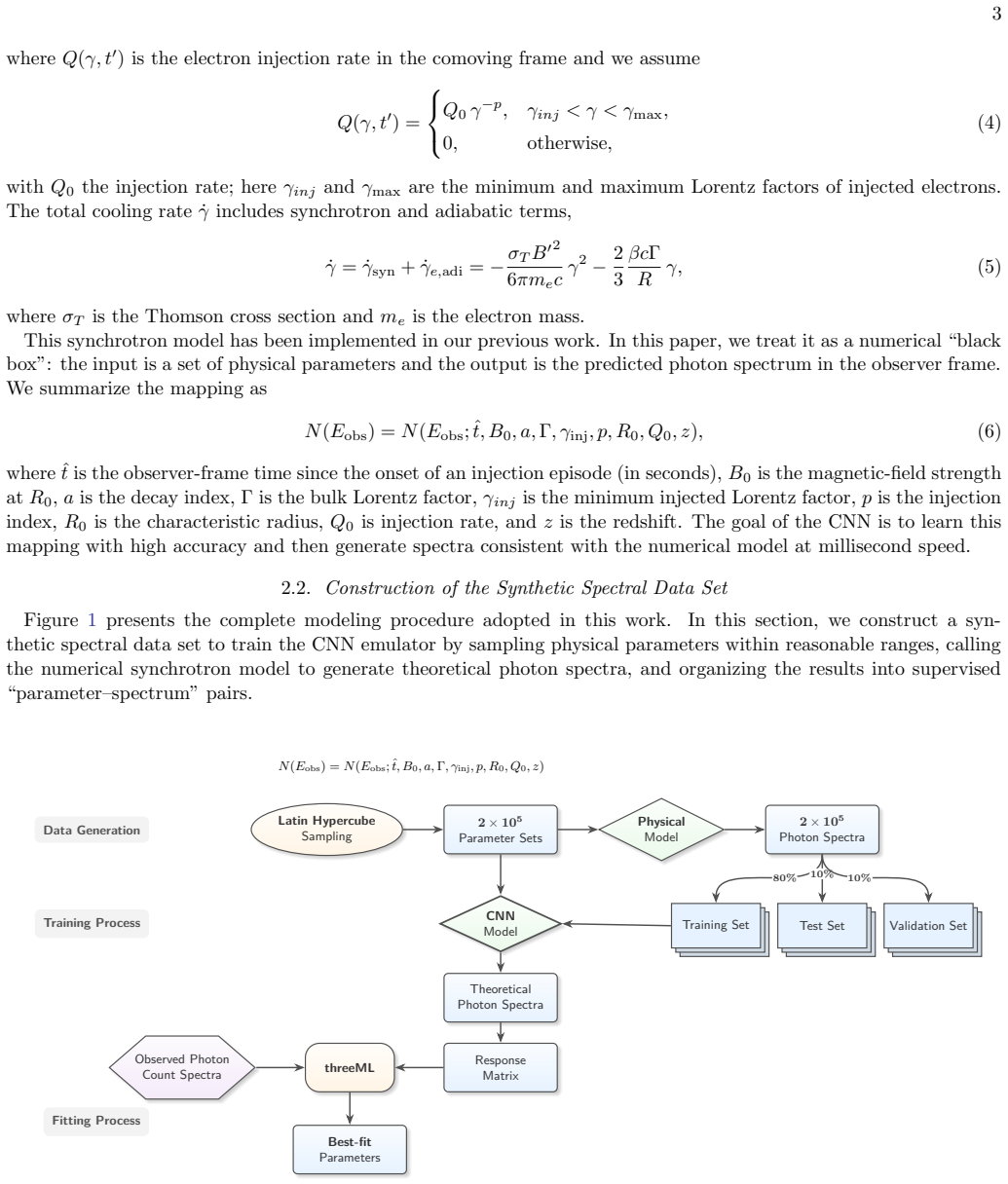
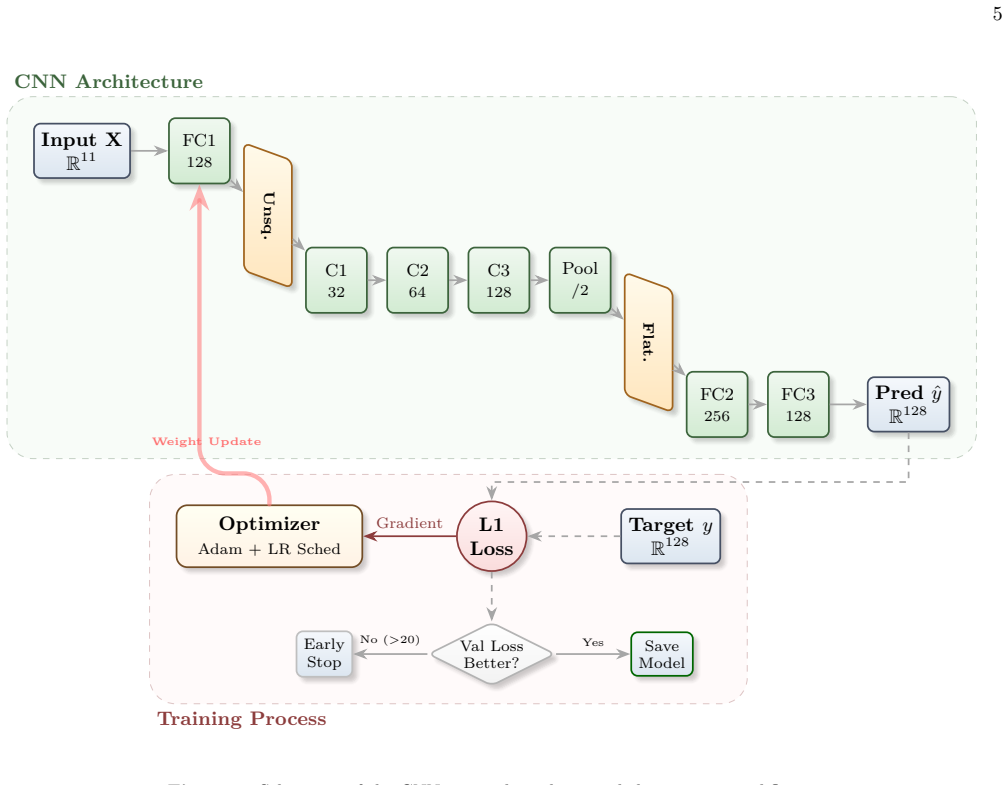
Convolutional neural network spectral emulator trained on numerical realizations of fast-cooling synchrotron emission in a decaying magnetic field, which replaces costly integration with millisecond evaluation inside a Bayesian fitting pipeline.
If this is right
- The decaying-field model becomes feasible for systematic comparison against other prompt-emission mechanisms across large GRB samples.
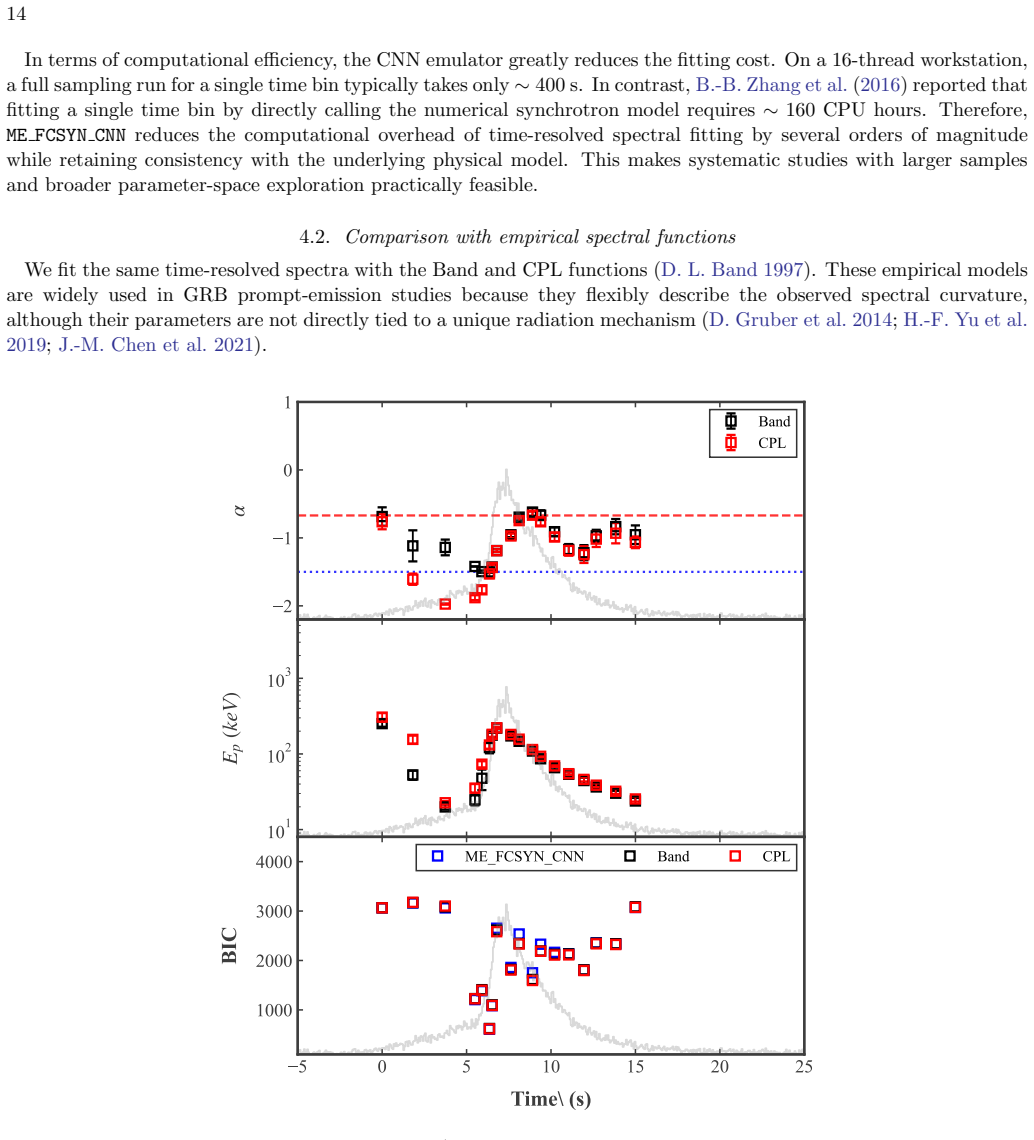
- Bayesian information criterion values favor the decaying-field interpretation for GRB 231020A in the majority of time-resolved intervals.
- The emulator framework can be retrained for other numerically expensive emission models to enable similar statistical tests.
- A radially decaying magnetic field supplies a concrete physical mechanism that naturally produces the observed spectral shape without additional tuning.
Where Pith is reading between the lines
- The same emulator strategy could be applied to other GRBs to test whether decaying fields are common rather than exceptional.
- Extending the network to output time-dependent spectra might allow joint fitting of light curves and spectra within one model.
- If the preference for decaying fields holds in a larger sample, it would tighten constraints on magnetic field evolution in GRB jets.
Load-bearing premise
The convolutional neural network must reproduce the numerical spectra from the decaying magnetic field model with high accuracy across the full range of parameters relevant to real GRB observations.
What would settle it
If re-running the analysis with the actual numerical spectra (without the emulator) reverses the preference and shows the standard model fitting better or equally well in most intervals of GRB 231020A, the central claim is falsified.
Figures
read the original abstract
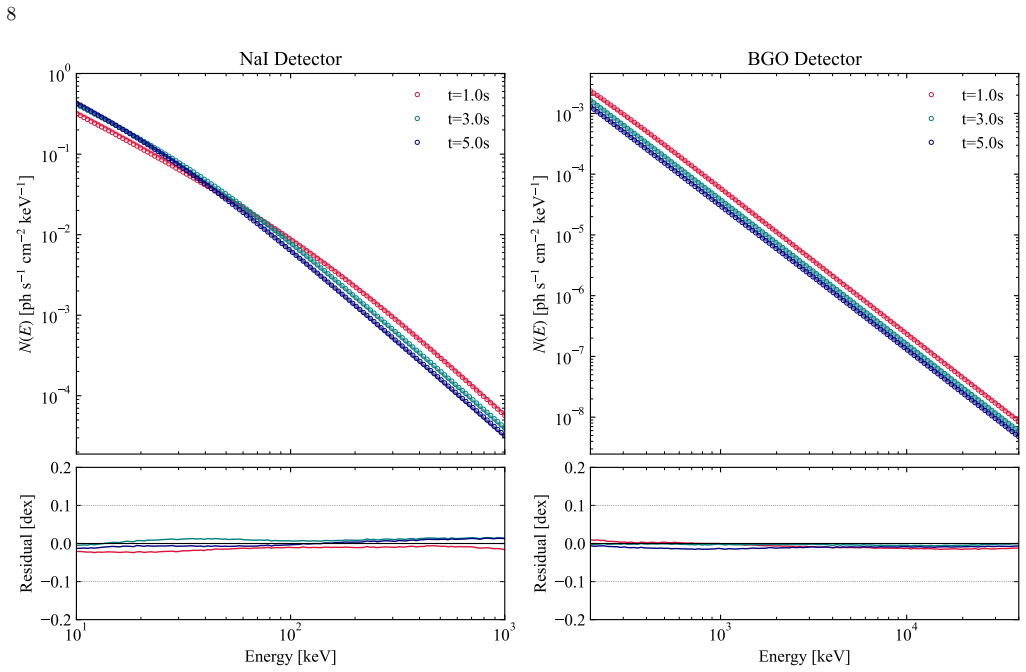
The radiation mechanism of gamma-ray burst (GRB) prompt emission remains uncertain. Although the fast-cooling synchrotron model in a decaying magnetic field can account for the characteristic nonthermal spectral shape, its computational cost has limited its use in systematic observational fitting and statistical model comparison. We develop a convolutional neural network (CNN)-based spectral emulator for this physical model and train it on a large synthetic data set generated over a physically motivated parameter space. The trained network reproduces the numerical spectra with high fidelity while reducing the cost of spectral evaluation to the millisecond level. We then incorporate the emulator into a Bayesian spectral-analysis framework and apply it to the time-resolved spectra of GRB 231020A observed by Fermi/GBM. In most time intervals, the decaying-field fast-cooling synchrotron model provides better fits and smaller Bayesian information criterion values than the standard fast-cooling synchrotron model. These results suggest that a radially decaying magnetic field provides a plausible and more physically motivated interpretation of the prompt-emission spectrum of this burst, while also indicating that the emulator offers a practical route for large-sample Bayesian inference and systematic comparisons of GRB prompt-emission models.
Editorial analysis
A structured set of objections, weighed in public.
Referee Report
Summary. The manuscript develops a CNN-based emulator for fast-cooling synchrotron spectra in a radially decaying magnetic field, trained on a large grid of synthetic spectra. The emulator is then embedded in a Bayesian fitting pipeline and applied to the time-resolved Fermi/GBM spectra of GRB 231020A, where the decaying-field model is reported to yield better fits and lower BIC values than the standard fast-cooling synchrotron model in most time intervals.
Significance. If the emulator fidelity is demonstrated to be sufficient relative to the data uncertainties, the work supplies both a practical computational tool for testing a physically motivated extension of the synchrotron model and concrete evidence favoring magnetic-field decay in at least one bright GRB. The integration of the emulator into a full Bayesian framework with BIC model comparison is a clear methodological advance for systematic GRB prompt-emission studies.
major comments (2)
- [CNN validation section] CNN validation section: The central claim that the decaying-field model produces lower BIC values rests on the assumption that emulator residuals are negligible compared with GBM statistical uncertainties. No quantitative validation metrics (test-set mean fractional error per energy bin, maximum deviation in the 8–1000 keV band, or performance near the best-fit decay index and electron index) are provided, leaving open the possibility that systematic emulation errors contribute to the reported BIC differences.
- [Results section on GRB 231020A fits] Results section on GRB 231020A fits: The statement that the decaying-field model is preferred 'in most time intervals' is load-bearing for the physical interpretation. The manuscript should report the exact fraction of intervals, the distribution of ΔBIC values, and whether the improvement persists after accounting for any emulation uncertainty.
minor comments (2)
- [Training data generation] The parameter ranges used for the synthetic training grid should be stated explicitly and compared with the posterior ranges recovered from the data to confirm coverage.
- [Model description] Notation for the magnetic-field decay index and the electron power-law index should be introduced once and used consistently in both the model description and the emulator output.
Simulated Author's Rebuttal
We thank the referee for the constructive comments on our manuscript. We address each major comment below and have revised the manuscript to incorporate the requested information.
read point-by-point responses
-
Referee: [CNN validation section] CNN validation section: The central claim that the decaying-field model produces lower BIC values rests on the assumption that emulator residuals are negligible compared with GBM statistical uncertainties. No quantitative validation metrics (test-set mean fractional error per energy bin, maximum deviation in the 8–1000 keV band, or performance near the best-fit decay index and electron index) are provided, leaving open the possibility that systematic emulation errors contribute to the reported BIC differences.
Authors: We agree that quantitative validation metrics are required to confirm that emulator residuals do not affect the BIC comparisons. In the revised manuscript we add these metrics to the CNN validation section, reporting the test-set mean fractional error per energy bin, the maximum deviation across the 8–1000 keV band, and the performance evaluated at the best-fit decay and electron indices. These additions demonstrate that the emulation errors remain well below the GBM statistical uncertainties. revision: yes
-
Referee: [Results section on GRB 231020A fits] Results section on GRB 231020A fits: The statement that the decaying-field model is preferred 'in most time intervals' is load-bearing for the physical interpretation. The manuscript should report the exact fraction of intervals, the distribution of ΔBIC values, and whether the improvement persists after accounting for any emulation uncertainty.
Authors: We acknowledge that the current phrasing requires more precise quantification. The revised Results section now states the exact fraction of time intervals in which the decaying-field model is preferred, presents the distribution of ΔBIC values, and includes a check that the model preference remains after emulation uncertainty is propagated into the likelihood and BIC calculation. revision: yes
Circularity Check
No circularity: emulator trained on independent synthetics; BIC comparison uses standard statistics
full rationale
The paper generates a large synthetic dataset from the decaying-field fast-cooling synchrotron model, trains a CNN emulator on it, then applies the emulator to fit real Fermi/GBM time-resolved spectra of GRB 231020A and compares models via BIC. Training data are produced independently of the observational fits; BIC is an external, standard criterion. No equation or step reduces a claimed prediction to a fitted parameter by construction, no self-citation chain bears the central claim, and the derivation remains self-contained against external benchmarks (synthetic spectra and standard model-selection statistics).
Axiom & Free-Parameter Ledger
free parameters (2)
- magnetic field decay index
- electron power-law index
axioms (1)
- domain assumption Fast-cooling synchrotron emission in a radially decaying magnetic field produces the observed nonthermal GRB prompt spectra.
Reference graph
Works this paper leans on
-
[1]
Open questions in GRB physics. Comptes Rendus Physique , keywords =. doi:10.1016/j.crhy.2011.03.004 , archivePrefix =. 1104.0932 , primaryClass =
work page internal anchor Pith review Pith/arXiv arXiv doi:10.1016/j.crhy.2011.03.004 2011
-
[2]
The Physics of Gamma-Ray Bursts and Relativistic Jets
The physics of gamma-ray bursts & relativistic jets. , keywords =. doi:10.1016/j.physrep.2014.09.008 , archivePrefix =. 1410.0679 , primaryClass =
work page internal anchor Pith review Pith/arXiv arXiv doi:10.1016/j.physrep.2014.09.008 2014
-
[3]
doi:10.1017/9781139226530 , adsurl =
The Physics of Gamma-Ray Bursts , year =. doi:10.1017/9781139226530 , publisher =
-
[4]
BATSE Observations of Gamma-Ray Burst Spectra. I. Spectral Diversity. , keywords =. doi:10.1086/172995 , adsurl =
-
[5]
The BATSE Gamma-Ray Burst Spectral Catalog. I. High Time Resolution Spectroscopy of Bright Bursts Using High Energy Resolution Data. , keywords =. doi:10.1086/313289 , archivePrefix =. astro-ph/9908119 , primaryClass =
work page internal anchor Pith review Pith/arXiv arXiv doi:10.1086/313289
-
[6]
The Complete Spectral Catalog of Bright BATSE Gamma-Ray Bursts
The Complete Spectral Catalog of Bright BATSE Gamma-Ray Bursts. , keywords =. doi:10.1086/505911 , archivePrefix =. astro-ph/0601188 , primaryClass =
work page internal anchor Pith review Pith/arXiv arXiv doi:10.1086/505911
-
[7]
The Fermi-GBM Gamma-Ray Burst Spectral Catalog: 10 yr of Data. , keywords =. doi:10.3847/1538-4357/abf24d , archivePrefix =. 2103.13528 , primaryClass =
-
[8]
Fermi Observations of High-Energy Gamma-Ray Emission from GRB 080916C. Science , keywords =. doi:10.1126/science.1169101 , adsurl =
-
[9]
Observations of GRB 990123 by the Compton Gamma-Ray Observatory
Observations of GRB 990123 by the Compton Gamma Ray Observatory. , keywords =. doi:10.1086/307808 , archivePrefix =. astro-ph/9903247 , primaryClass =
work page internal anchor Pith review Pith/arXiv arXiv doi:10.1086/307808
-
[10]
Steep Slopes and Preferred Breaks in GRB Spectra: the Role of Photospheres and Comptonization
Steep Slopes and Preferred Breaks in Gamma-Ray Burst Spectra: The Role of Photospheres and Comptonization. , keywords =. doi:10.1086/308371 , archivePrefix =. astro-ph/9908126 , primaryClass =
work page internal anchor Pith review Pith/arXiv arXiv doi:10.1086/308371
-
[11]
Monthly Notices of the Royal Astronomical Society , author =
Collisional mechanism for gamma-ray burst emission. , keywords =. doi:10.1111/j.1365-2966.2010.16770.x , archivePrefix =. 0907.0732 , primaryClass =
-
[12]
Photospheric Emission in Gamma-Ray Bursts
Photospheric emission in gamma-ray bursts. International Journal of Modern Physics D , keywords =. doi:10.1142/S021827181730018X , archivePrefix =. 1603.05058 , primaryClass =
work page internal anchor Pith review Pith/arXiv arXiv doi:10.1142/s021827181730018x
-
[13]
A Theory of Mulicolor Black Body Emission from Relativistically Expanding Plasmas
A Theory of Multicolor Blackbody Emission from Relativistically Expanding Plasmas. , keywords =. doi:10.1088/0004-637X/732/1/49 , archivePrefix =. 1008.4590 , primaryClass =
work page internal anchor Pith review Pith/arXiv arXiv doi:10.1088/0004-637x/732/1/49
-
[14]
A theory of photospheric emission from relativistic, collimated outflows
A theory of photospheric emission from relativistic, collimated outflows. , keywords =. doi:10.1093/mnras/sts219 , archivePrefix =. 1208.2965 , primaryClass =
work page internal anchor Pith review Pith/arXiv arXiv doi:10.1093/mnras/sts219
-
[15]
Non-thermal Emission from the Photospheres of Gamma-ray Burst Outflows. I. High-Frequency Tails. , keywords =. doi:10.1088/0004-637X/725/1/1137 , archivePrefix =. 1005.4704 , primaryClass =
work page internal anchor Pith review Pith/arXiv arXiv doi:10.1088/0004-637x/725/1/1137
-
[16]
Unsteady Outflow Models for Cosmological Gamma-Ray Bursts
Unsteady Outflow Models for Cosmological Gamma-Ray Bursts. , keywords =. doi:10.1086/187446 , archivePrefix =. astro-ph/9404038 , primaryClass =
work page internal anchor Pith review Pith/arXiv arXiv doi:10.1086/187446
-
[17]
Gamma-ray bursts from internal shocks in a relativistic wind: temporal and spectral properties. , keywords =. doi:10.1046/j.1365-8711.1998.01305.x , archivePrefix =. astro-ph/9801245 , primaryClass =
-
[18]
The Internal-collision-induced Magnetic Reconnection and Turbulence (ICMART) Model of Gamma-ray Bursts. , keywords =. doi:10.1088/0004-637X/726/2/90 , archivePrefix =. 1011.1197 , primaryClass =
work page internal anchor Pith review Pith/arXiv arXiv doi:10.1088/0004-637x/726/2/90
-
[19]
Theory of ``Jitter'' Radiation from Small-Scale Random Magnetic Fields and Prompt Emission from Gamma-Ray Burst Shocks. , keywords =. doi:10.1086/309374 , archivePrefix =. astro-ph/0001314 , primaryClass =
work page internal anchor Pith review Pith/arXiv arXiv doi:10.1086/309374
-
[20]
Gamma-Ray Bursts from Up-Scattered Self-Absorbed Synchrotron Emission
Gamma-Ray Bursts from Upscattered Self-absorbed Synchrotron Emission. , keywords =. doi:10.1086/317301 , archivePrefix =. astro-ph/0009309 , primaryClass =
work page internal anchor Pith review Pith/arXiv arXiv doi:10.1086/317301
-
[21]
MNRAS , archivePrefix = "arXiv", eprint =
A general scheme for modelling -ray burst prompt emission. , keywords =. doi:10.1111/j.1365-2966.2007.12621.x , archivePrefix =. 0802.2704 , primaryClass =
-
[22]
Monthly Notices of the Royal Astronomical Society , author =
Inverse-Compton cooling in Klein-Nishina regime and gamma-ray burst prompt spectrum. , keywords =. doi:10.1111/j.1365-2966.2012.21533.x , archivePrefix =. 1206.4054 , primaryClass =
-
[23]
Inverse Compton Scattering Spectra of Gamma-Ray Burst Prompt Emission
Inverse Compton Scattering Spectra of Gamma-Ray Burst Prompt Emission. , keywords =. doi:10.3847/1538-4357/ab1b10 , archivePrefix =. 1901.05268 , primaryClass =
work page internal anchor Pith review Pith/arXiv arXiv doi:10.3847/1538-4357/ab1b10 1901
-
[24]
Constraints on the emission mechanisms of gamma-ray bursts. , keywords =. doi:10.1046/j.1365-8711.2000.03354.x , archivePrefix =. astro-ph/9912461 , primaryClass =
-
[25]
Time-resolved Analysis of Fermi GRBs with Fast and Slow-Cooled Synchrotron Photon Models
Time-resolved Analysis of Fermi Gamma-Ray Bursts with Fast- and Slow-cooled Synchrotron Photon Models. , keywords =. doi:10.1088/0004-637X/784/1/17 , archivePrefix =. 1304.4628 , primaryClass =
work page internal anchor Pith review Pith/arXiv arXiv doi:10.1088/0004-637x/784/1/17
-
[26]
Gamma-ray bursts as cool synchrotron sources. Nature Astronomy , keywords =. doi:10.1038/s41550-019-0911-z , archivePrefix =. 1810.06965 , primaryClass =
-
[27]
Synchrotron radiation in -ray bursts prompt emission. Nature Astronomy , keywords =. doi:10.1038/s41550-020-1041-3 , archivePrefix =. 2002.09638 , primaryClass =
-
[28]
Spectral properties of 438 GRBs detected by Fermi/GBM
Spectral properties of 438 GRBs detected by Fermi/GBM. , keywords =. doi:10.1051/0004-6361/201016270 , archivePrefix =. 1012.2863 , primaryClass =
work page internal anchor Pith review Pith/arXiv arXiv doi:10.1051/0004-6361/201016270
-
[29]
Fast-cooling synchrotron radiation in a decaying magnetic field and -ray burst emission mechanism. Nature Physics , keywords =. doi:10.1038/nphys2932 , archivePrefix =. 1303.2704 , primaryClass =
work page internal anchor Pith review Pith/arXiv arXiv doi:10.1038/nphys2932
-
[30]
Gamma-Ray Burst Spectrum with Decaying Magnetic Field
Gamma-Ray Burst Spectrum with Decaying Magnetic Field. , keywords =. doi:10.1088/0004-637X/780/1/12 , archivePrefix =. 1310.0551 , primaryClass =
work page internal anchor Pith review Pith/arXiv arXiv doi:10.1088/0004-637x/780/1/12
-
[31]
Gamma Ray Bursts as Electromagnetic Outflows
Gamma Ray Bursts as Electromagnetic Outflows. arXiv e-prints , keywords =. doi:10.48550/arXiv.astro-ph/0312347 , archivePrefix =. astro-ph/0312347 , primaryClass =
work page internal anchor Pith review Pith/arXiv arXiv doi:10.48550/arxiv.astro-ph/0312347
-
[32]
Low-energy Spectra of Gamma-ray Bursts from Cooling Electrons
Low-energy Spectra of Gamma-Ray Bursts from Cooling Electrons. , keywords =. doi:10.3847/1538-4365/aa9e84 , archivePrefix =. 1709.05899 , primaryClass =
work page internal anchor Pith review Pith/arXiv arXiv doi:10.3847/1538-4365/aa9e84
-
[33]
Synchrotron Origin of the Typical GRB Band Function - A Case Study of GRB 130606B
Synchrotron Origin of the Typical GRB Band Function A Case Study of GRB 130606B. , keywords =. doi:10.3847/0004-637X/816/2/72 , archivePrefix =. 1505.05858 , primaryClass =
work page internal anchor Pith review Pith/arXiv arXiv doi:10.3847/0004-637x/816/2/72
-
[34]
Synchrotron Radiation Dominates the Extremely Bright GRB 221009A. , keywords =. doi:10.3847/2041-8213/acc84b , archivePrefix =. 2303.00898 , primaryClass =
-
[35]
One Fits All: A Unified Synchrotron Model Explains GRBs with FRED-shape Pulses. , keywords =. doi:10.3847/1538-4357/ad14fb , archivePrefix =. 2308.00772 , primaryClass =
-
[36]
Classification and Physical Characteristic Analysis of Fermi-GBM Gamma-Ray Bursts Based on Deep Learning. , keywords =. doi:10.3847/1538-4365/ada0b0 , archivePrefix =. 2412.05564 , primaryClass =
-
[37]
Unsupervised machine learning classification of Fermi gamma-ray bursts using spectral parameters. , keywords =. doi:10.1093/mnras/stad3407 , adsurl =
-
[38]
Modeling Blazar Broadband Emission with Convolutional Neural Networks. II. External Compton Model. , keywords =. doi:10.3847/1538-4357/ad5351 , archivePrefix =. 2402.07495 , primaryClass =
-
[39]
Modeling Blazar Broadband Emission with a Convolutional Neural Network. I. Synchrotron Self-Compton Model. , keywords =. doi:10.3847/1538-4357/ad19cf , archivePrefix =. 2311.02979 , primaryClass =
-
[40]
GRB 240619A: Evidence for a Compact Star Merger Origin. , keywords =. doi:10.3847/1538-4357/ae0938 , adsurl =
-
[41]
GRB Coordinates Network , year = 2023, month = oct, volume =
GRB 231020A: Fermi GBM Final Real-time Localization. GRB Coordinates Network , year = 2023, month = oct, volume =
2023
-
[42]
The Multi-Mission Maximum Likelihood framework (3ML)
The Multi-Mission Maximum Likelihood framework (3ML). arXiv e-prints , keywords =. doi:10.48550/arXiv.1507.08343 , archivePrefix =. 1507.08343 , primaryClass =
work page internal anchor Pith review Pith/arXiv arXiv doi:10.48550/arxiv.1507.08343
-
[43]
GRB 231129C: Another Thermal Emission Dominated Gamma-Ray Burst. , keywords =. doi:10.3847/1538-4357/ad5f93 , adsurl =
-
[44]
Spectral Properties and Hybrid Jet Model Constraints of Fermi GRB 210610B. , keywords =. doi:10.3847/1538-4357/ac6c2a , adsurl =
-
[45]
Large scale magnetic fields and their dissipation in GRB fireballs
Large scale magnetic fields and their dissipation in GRB fireballs. , keywords =. doi:10.1051/0004-6361:20010131 , archivePrefix =. astro-ph/0004274 , primaryClass =
work page internal anchor Pith review Pith/arXiv arXiv doi:10.1051/0004-6361:20010131
-
[46]
Bayesian Time-resolved Spectroscopy of GRB Pulses. , keywords =. doi:10.3847/1538-4357/ab488a , archivePrefix =. 1810.07313 , primaryClass =
-
[47]
Studies in Astronomical Time Series Analysis. VI. Bayesian Block Representations. , keywords =. doi:10.1088/0004-637X/764/2/167 , archivePrefix =. 1207.5578 , primaryClass =
work page internal anchor Pith review Pith/arXiv arXiv doi:10.1088/0004-637x/764/2/167
-
[48]
Loss Functions for Image Restoration With Neural Networks , year=
Zhao, Hang and Gallo, Orazio and Frosio, Iuri and Kautz, Jan , journal=. Loss Functions for Image Restoration With Neural Networks , year=
-
[49]
Robust Estimation of a Location Parameter
Huber, Peter J. Robust Estimation of a Location Parameter. Breakthroughs in Statistics: Methodology and Distribution. 1992. doi:10.1007/978-1-4612-4380-9_35
-
[50]
Constructive approximation , volume=
On early stopping in gradient descent learning , author=. Constructive approximation , volume=. 2007 , publisher=
2007
-
[51]
2017 , eprint=
Adam: A Method for Stochastic Optimization , author=. 2017 , eprint=
2017
-
[52]
High Energy Astrophysics
-
[53]
ImageNet Classification with Deep Convolutional Neural Networks , url =
Krizhevsky, Alex and Sutskever, Ilya and Hinton, Geoffrey E , booktitle =. ImageNet Classification with Deep Convolutional Neural Networks , url =
-
[54]
Planck 2018 results. VI. Cosmological parameters. , keywords =. doi:10.1051/0004-6361/201833910 , archivePrefix =. 1807.06209 , primaryClass =
work page internal anchor Pith review Pith/arXiv arXiv doi:10.1051/0004-6361/201833910 2018
-
[55]
Matplotlib: A 2D Graphics Environment. Computing in Science and Engineering , keywords =. doi:10.1109/MCSE.2007.55 , adsurl =
-
[56]
Array programming with NumPy. , keywords =. doi:10.1038/s41586-020-2649-2 , archivePrefix =. 2006.10256 , primaryClass =
work page internal anchor Pith review Pith/arXiv arXiv doi:10.1038/s41586-020-2649-2 2006
-
[57]
SciPy 1.0--Fundamental Algorithms for Scientific Computing in Python
SciPy 1.0: fundamental algorithms for scientific computing in Python. Nature Methods , keywords =. doi:10.1038/s41592-019-0686-2 , archivePrefix =. 1907.10121 , primaryClass =
work page internal anchor Pith review Pith/arXiv arXiv doi:10.1038/s41592-019-0686-2 1907
-
[58]
and Varoquaux, G
Pedregosa, F. and Varoquaux, G. and Gramfort, A. and Michel, V. and Thirion, B. and Grisel, O. and Blondel, M. and Prettenhofer, P. and Weiss, R. and Dubourg, V. and Vanderplas, J. and Passos, A. and Cournapeau, D. and Brucher, M. and Perrot, M. and Duchesnay, E. , journal=. Scikit-learn: Machine Learning in
-
[59]
PyTorch: An Imperative Style, High-Performance Deep Learning Library , url =
Paszke, Adam and Gross, Sam and Massa, Francisco and Lerer, Adam and Bradbury, James and Chanan, Gregory and Killeen, Trevor and Lin, Zeming and Gimelshein, Natalia and Antiga, Luca and Desmaison, Alban and Kopf, Andreas and Yang, Edward and DeVito, Zachary and Raison, Martin and Tejani, Alykhan and Chilamkurthy, Sasank and Steiner, Benoit and Fang, Lu an...
-
[60]
The Low-Energy Spectral Index of Gamma-Ray Burst Prompt Emission from Internal Shocks. Galaxies , keywords =. doi:10.3390/galaxies9030068 , archivePrefix =. 2109.07681 , primaryClass =
-
[61]
Gamma-Ray Burst Spectrum with a Time-dependent Injection Rate of High-energy Electrons. , keywords =. doi:10.3847/2041-8213/ab838e , archivePrefix =. 2003.12231 , primaryClass =
-
[62]
The Soft X-Ray Aspect of Gamma-Ray Bursts in the Einstein Probe Era. , keywords =. doi:10.3847/1538-4357/adceb1 , archivePrefix =. 2410.21687 , primaryClass =
-
[63]
Gamma-Ray Burst Spectral Evolution Through Crosscorrelations of Discriminator Light Curves
Gamma-Ray Burst Spectral Evolution through Cross-Correlations of Discriminator Light Curves. , keywords =. doi:10.1086/304566 , archivePrefix =. astro-ph/9704206 , primaryClass =
work page internal anchor Pith review Pith/arXiv arXiv doi:10.1086/304566
-
[64]
The Fermi GBM Gamma-Ray Burst Spectral Catalog: Four Years Of Data
The Fermi GBM Gamma-Ray Burst Spectral Catalog: Four Years of Data. , keywords =. doi:10.1088/0067-0049/211/1/12 , archivePrefix =. 1401.5069 , primaryClass =
work page internal anchor Pith review Pith/arXiv arXiv doi:10.1088/0067-0049/211/1/12
-
[65]
GRB 180720B: A GRB with Interesting Spectral Characteristics. , keywords =. doi:10.3847/1538-4357/ac14b8 , adsurl =
-
[66]
Constraints on the Synchrotron Emission Mechanism in GRBs
Constraints on the Synchrotron Emission Mechanism in Gamma-Ray Bursts. , keywords =. doi:10.1088/0004-637X/769/1/69 , archivePrefix =. 1301.5575 , primaryClass =
work page internal anchor Pith review Pith/arXiv arXiv doi:10.1088/0004-637x/769/1/69
-
[67]
The emission mechanism in magnetically dominated GRB outflows
The emission mechanism in magnetically dominated gamma-ray burst outflows. , keywords =. doi:10.1093/mnras/stu2032 , archivePrefix =. 1402.4113 , primaryClass =
work page internal anchor Pith review Pith/arXiv arXiv doi:10.1093/mnras/stu2032
-
[68]
Radiation from a Relativistic Poynting Jet: some general considerations
Radiation from a relativistic Poynting jet: some general considerations. , keywords =. doi:10.1093/mnras/stv1696 , archivePrefix =. 1509.00479 , primaryClass =
work page internal anchor Pith review Pith/arXiv arXiv doi:10.1093/mnras/stv1696
-
[69]
Prompt high-energy emission from gamma-ray bursts in the internal shock model
Prompt high-energy emission from gamma-ray bursts in the internal shock model. , keywords =. doi:10.1051/0004-6361/200811375 , archivePrefix =. 0811.2956 , primaryClass =
work page internal anchor Pith review Pith/arXiv arXiv doi:10.1051/0004-6361/200811375
-
[70]
Reconciling observed GRB prompt spectra with synchrotron radiation ?
Reconciling observed gamma-ray burst prompt spectra with synchrotron radiation?. , keywords =. doi:10.1051/0004-6361/201015457 , archivePrefix =. 1009.2636 , primaryClass =
work page internal anchor Pith review Pith/arXiv arXiv doi:10.1051/0004-6361/201015457
-
[71]
Evidence of an initially magnetically dominated outflow in GRB 080916C
Evidence of an Initially Magnetically Dominated Outflow in GRB 080916C. , keywords =. doi:10.1088/0004-637X/700/2/L65 , archivePrefix =. 0904.2943 , primaryClass =
work page internal anchor Pith review Pith/arXiv arXiv doi:10.1088/0004-637x/700/2/l65
-
[72]
Synchrotron Emission in Small-Scale Magnetic Fields as a Possible Explanation for Prompt Emission Spectra of Gamma-Ray Bursts. , keywords =. doi:10.1086/508681 , archivePrefix =. astro-ph/0605641 , primaryClass =
work page internal anchor Pith review Pith/arXiv arXiv doi:10.1086/508681
-
[73]
Statistics and computing , volume=
Uncertainty quantification and propagation in surrogate-based Bayesian inference , author=. Statistics and computing , volume=. 2025 , publisher=
2025
discussion (0)
Sign in with ORCID, Apple, or X to comment. Anyone can read and Pith papers without signing in.